
Thailand Medical and Wellness Tourism Market Size and Share
Market Overview
| Study Period | 2022 - 2031 |
|---|---|
| Forecast Data Period | 2026 - 2031 |
| Base Year Market Size (2025) | USD 9.01 Billion |
| Market Size (2026) | USD 9.46 Billion |
| Market Size (2031) | USD 13.35 Billion |
| Growth Rate (2026 - 2031) | 7.13 % |
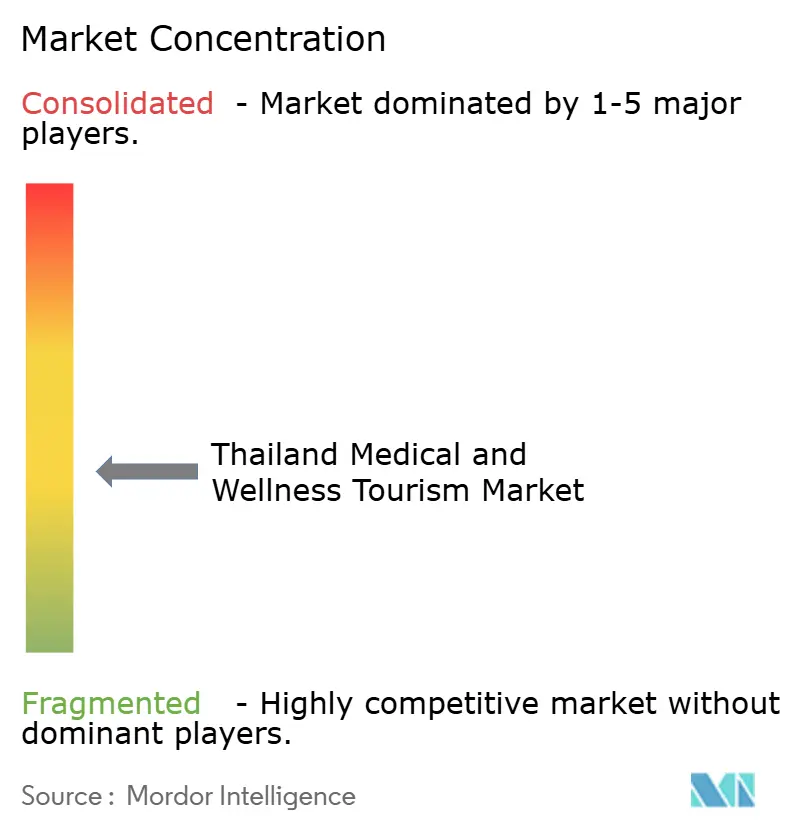
| Market Concentration | Medium |
Major Players *Disclaimer: Major Players sorted in no particular order Image © Mordor Intelligence. Reuse requires attribution under CC BY 4.0. | |
Thailand Medical and Wellness Tourism Market Analysis by Mordor Intelligence
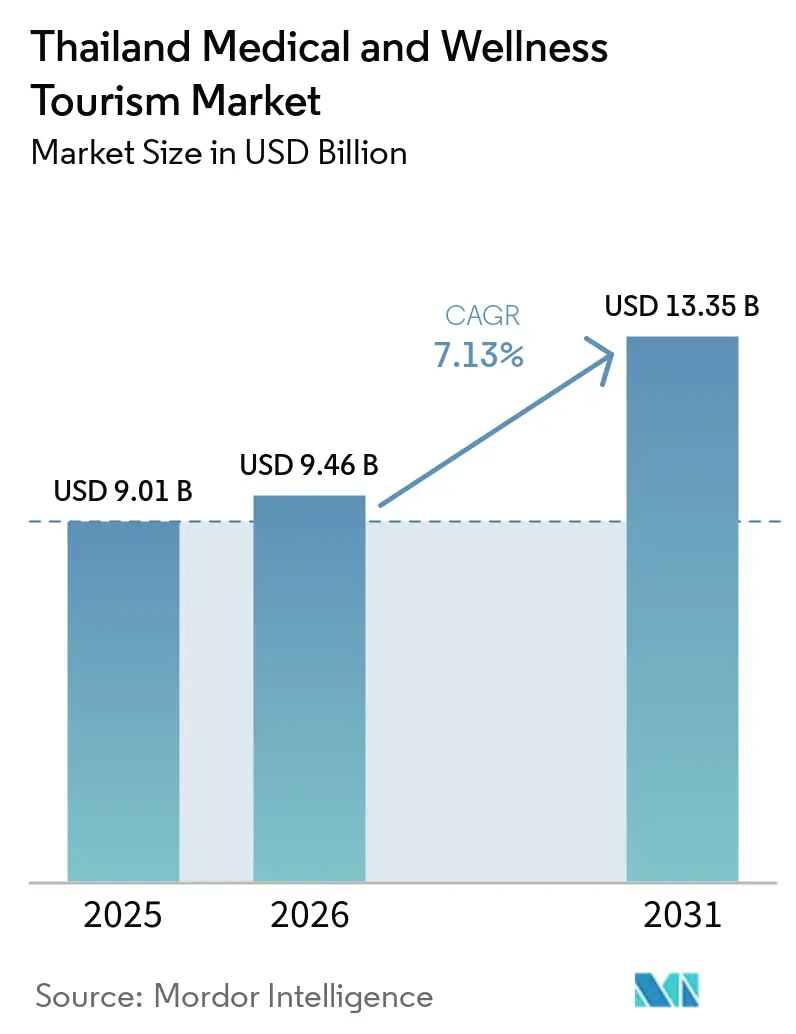
The Thailand Medical And Wellness Tourism Market size is expected to increase from USD 9.01 billion in 2025 to USD 9.46 billion in 2026 and reach USD 13.35 billion by 2031, growing at a CAGR of 7.13% over 2026-2031.
Growth is supported by Thailand’s established base in elective care, a broad wellness services ecosystem, and a service model that increasingly combines treatment, recovery, and leisure in one trip. The Tourism Authority of Thailand targets THB 2.65 trillion (USD 75.7 billion) in tourism revenue in 2026 and places wellness and preventive care among its lead themes, which supports continued policy and promotional focus on higher-value travel categories. The Thailand medical and wellness tourism market is also benefiting from closer links between hospitals, wellness operators, and hospitality brands, which is lifting revenue per visitor and broadening the offer beyond stand-alone procedures or spa stays. Competition remains strongest between large hospital groups and premium wellness brands, while staffing constraints outside Bangkok still limit how quickly new capacity can scale.[1]
Key Report Takeaways
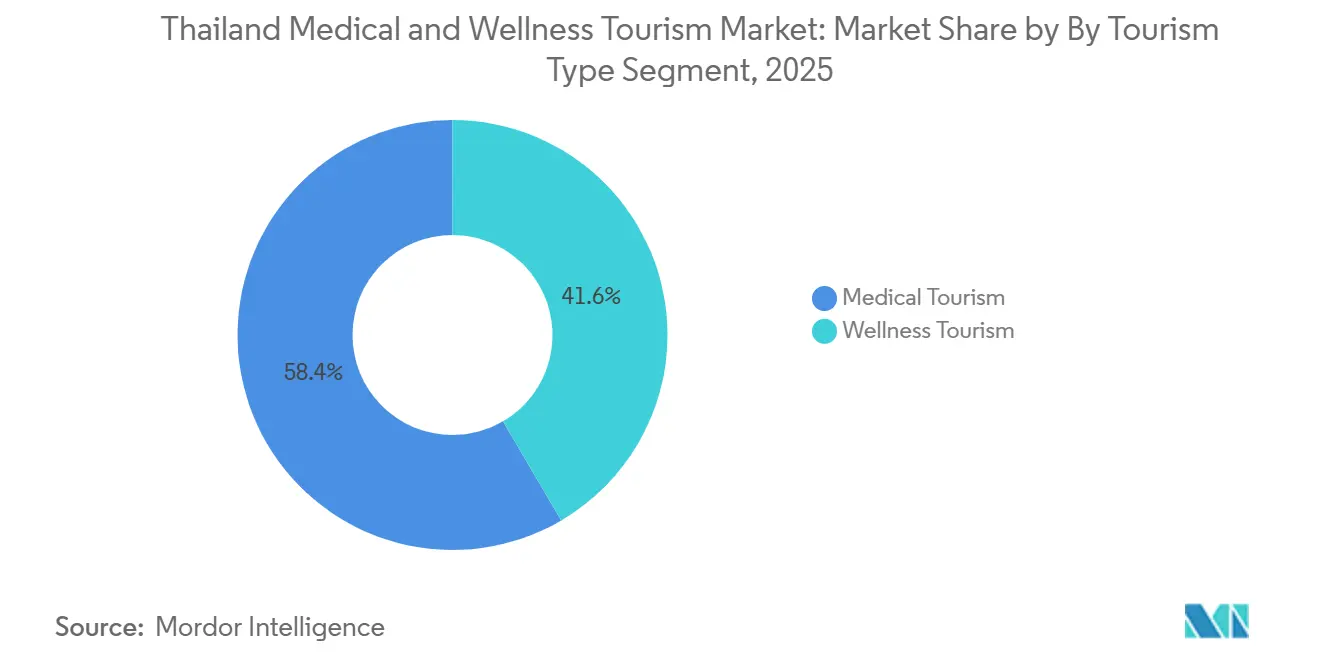
- By tourism type, medical tourism led with 58.43% revenue share in 2025, while wellness tourism is forecast to expand at an 8.97% CAGR through 2031.
- By treatment and service type, Cosmetic & Aesthetic Procedures accounted for 22.61% share in 2025, while Preventive Health & Wellness Check-Ups is projected to grow at a 9.46% CAGR through 2031.
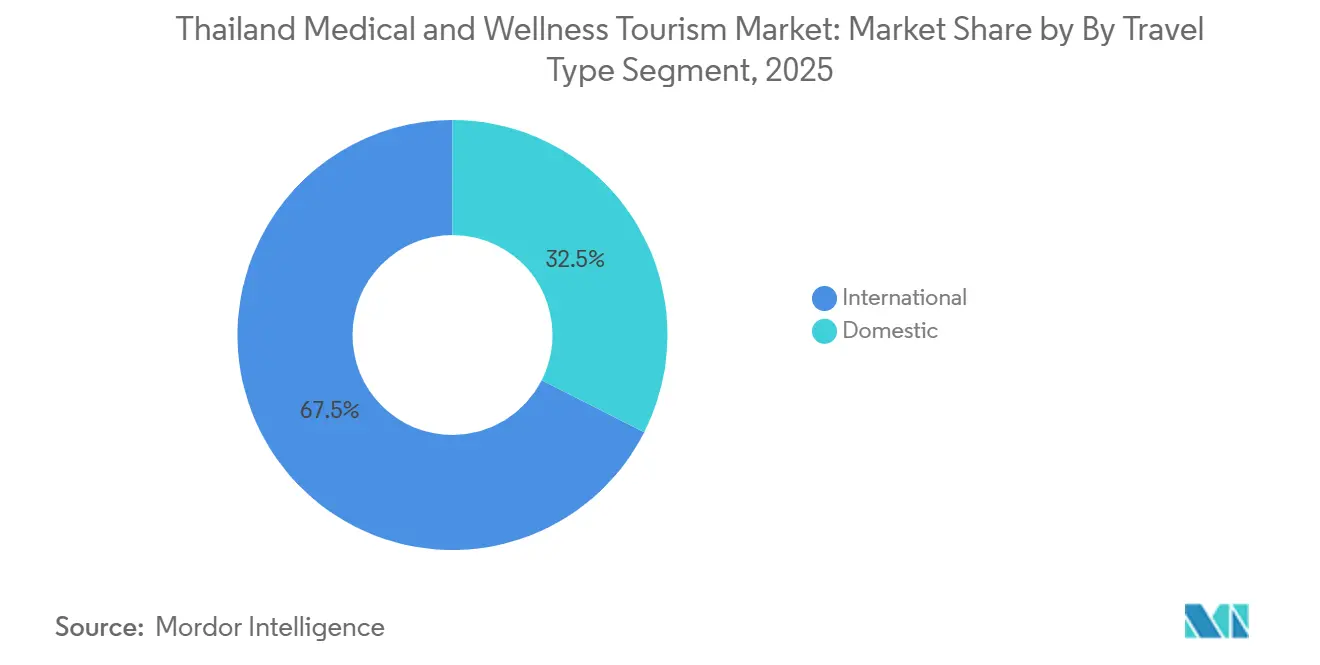
- By travel type, international travelers held 67.54% revenue share in 2025, while domestic travelers are forecast to record the highest CAGR at 9.84% through 2031.
- By geography, Bangkok accounted for 41.55% of revenue in 2025, while Southern Thailand is projected to expand at a 7.96% CAGR through 2031.
Note: Market size and forecast figures in this report are generated using Mordor Intelligence’s proprietary estimation framework, updated with the latest available data and insights as of January 2026.
Thailand Medical and Wellness Tourism Market Trends and Insights
Drivers Impact Analysis*
| Drivers | (~) % Impact on CAGR Forecast | Geographic Relevance | Impact Timeline |
|---|---|---|---|
| Affordable High-Quality Medical Care Versus Western Destinations | +1.8% | Global, with the strongest pull from the Middle East, South Asia, and Europe | Short term (≤ 2 years) |
| Strong Global Reputation for Elective and Specialty Procedures | +1.5% | Global, the strongest demand origination from GCC, India, and Japan | Medium term (2-4 years) |
| JCI-Accredited Hospital Infrastructure and International Care Standards | +1.2% | Bangkok-centric, with secondary nodes in Phuket and Chiang Mai | Medium term (2-4 years) |
| Supportive Visa Policies and Simplified Patient Travel | +0.7% | Global, particularly relevant for Middle East and South Asian patients | Short term (≤ 2 years) |
| Rising Global Demand for Preventive and Wellness-Oriented Travel | +1.4% | Global trend, concentrated impact in Southern and Northern Thailand | Long term (≥ 4 years) |
| Integration of Medical Tourism with Luxury Hospitality and Recovery Services | +0.6% | Phuket, Koh Samui, and Bangkok’s riverside corridor | Long term (≥ 4 years) |
| Source: Mordor Intelligence | |||
Affordable High-Quality Medical Care Versus Western Destinations
The Thailand medical and wellness tourism market continues to attract planned-care travelers because treatment costs remain well below many Western alternatives across surgery, dental work, and recovery care. Major procedures can be 50% to 70% less expensive than in Western markets, while dental scaling typically costs THB 900 to THB 1,200 (USD 25.7 to USD 34.3) in Thailand, compared with around THB 8,000 (USD 228.6) in Australia. This cost advantage supports demand from cost-sensitive travelers while also expanding the addressable market to upper-middle-income patients seeking recognized clinicians at more accessible price points. Thailand’s Board of Investment supports the health and wellness value chain through incentives for specialty medical centers and contract research organizations, helping maintain competitiveness as labor and operating costs increase. Although price competition remains strong across Southeast Asia, Thailand offers greater depth in complex elective procedures than lower-cost regional alternatives.[2]
Strong Global Reputation for Elective and Specialty Procedures
The Thailand medical and wellness market benefits from a long-established reputation in elective and specialty treatments that require both skilled clinicians and destination appeal. Medical tourism accounted for 58.43% of revenue in 2025, with cosmetic surgery, orthopedics, and fertility treatments attracting patients from the Middle East, South Asia, Europe, and China. Cosmetic & Aesthetic Procedures led treatment demand with a 22.61% share in 2025, underscoring the role of a reputation for visible, outcome-based services in shaping international patient choice. Bumrungrad recorded more than 520,000 international patient visits annually, reinforcing Thailand’s cross-border referral strength and brand recognition among foreign patients. This reputation matters because patients booking elective care usually compare surgeons' credentials, hospital brands, and peer referrals before committing to overseas treatment.
JCI-Accredited Hospital Infrastructure and International Care Standards
Clinical credibility remains one of the main supports for Thailand's medical and wellness tourism market, especially for international patients who arrange care in advance. The country has a high concentration of JCI-accredited hospitals, which makes quality signaling more visible to patients, facilitators, and insurers. Bumrungrad has maintained continuous JCI accreditation since 2002, while BPK9 passed its fifth consecutive JCI Edition 8 accreditation in November 2025 with a 99.23% quality score. BDMS is also expanding capacity, reporting multiple hospital openings in 2025, and targeting 9,600 beds by the end of 2027, which shows that accredited scale remains a core competitive lever. As accreditation standards become more demanding, operators with repeat compliance records are likely to maintain an advantage over newer entrants.
Supportive Visa Policies and Simplified Patient Travel
Supportive travel handling and simpler patient movement make the Thailand medical and wellness tourism market easier to access for people booking care across borders. This matters most for elective procedures because patients often travel with companions and need predictable schedules for arrival, treatment, and recovery. The effect is strongest among Middle Eastern and South Asian travelers, who already make up a meaningful part of the inbound patient base. International travelers still accounted for 67.54% of market revenue in 2025, indicating that travel facilitation remains closely linked to actual demand conversion. Easier movement also supports repeat visits for staged treatments, follow-up screening, and extended family-based wellness trips.
Restraints Impact Analysis*
| Restraints | (~) % Impact on CAGR Forecast | Geographic Relevance | Impact Timeline |
|---|---|---|---|
| Specialized Doctor and Nurse Shortages | -0.5% | National, most acute in provinces outside Bangkok, with spillover effects on private capacity | Medium term (2-4 years) |
| Uneven Post-Treatment Follow-Up for International Patients | -0.3% | Global affects repeat-visit conversion and insurance acceptance | Medium term (2-4 years) |
| High Cost of Premium Wellness Programs | -0.4% | Phuket, Koh Samui, and the Bangkok premium corridor | Short term (≤ 2 years) |
| Reimbursement and Coverage Limitations for Cross-Border Care | -0.3% | Global, most acute for GCC and European patient segments | Long term (≥ 4 years) |
| Source: Mordor Intelligence | |||
Specialized Doctor and Nurse Shortages
Thailand’s medical and wellness tourism market faces a shortage of specialized healthcare professionals, which could constrain capacity expansion. By 2026 end, the country is projected to meet only 72% of its physician staffing target, while 661 vacancies remain across 208 community hospitals. Shortages are particularly acute across 36 provinces classified as “red zones,” where staffing gaps exceed 40%. The imbalance is also evident between urban and rural areas, with Bangkok having approximately one doctor per 462 residents compared with one per 5,000 residents in rural provinces. This disparity limits the ability to extend international-grade medical services beyond the capital. For private operators, competition for specialists is intensified by the higher earning potential offered by medical tourism facilities, further concentrating skilled professionals in premium healthcare centers. As demand continues to grow, workforce availability is likely to remain a key constraint on the market’s future expansion.[3]
Uneven Post-Treatment Follow-Up for International Patients
International patients in Thailand's medical and wellness tourism market face inconsistent follow-up care after discharge. This issue is particularly pronounced for treatments requiring staged reviews, medication adjustments, rehabilitation, or direct communication with physicians in the patient's home country. Such inconsistencies can deter repeat visits, as both patients and insurers seek clearer accountability post-discharge from Thailand. While major hospital groups in Bangkok, equipped with robust international patient systems, face this challenge to a lesser extent, smaller provincial settings grapple more significantly. Until there's a consistent approach to discharge planning and cross-border care coordination, higher-value patients may gravitate towards providers with established international case management.
*Our forecasts treat driver/restraint impacts as directional, not additive. The impact forecasts reflect baseline growth, mix effects, and variable interactions.
Segment Analysis
By Tourism Type: Wellness Tourism Is Growing Faster Than the Core Medical Base
Medical tourism accounted for 58.43% of Thailand's medical and wellness tourism market share in 2025. That lead reflects long-standing investment in specialist care, tertiary hospitals, and referral systems that support cosmetic surgery, orthopedics, fertility treatments, and other planned procedures. The segment also benefits from Thailand's ability to combine recognized hospital brands with destination appeal, which makes it easier for patients to justify travel for elective care. Bangkok and Phuket remain central to this segment because they offer the strongest mix of specialist depth, international patient handling, and premium accommodation. Medical tourism, therefore, remains the revenue anchor for Thailand's medical and wellness tourism market, even as growth patterns are broadening.
Wellness tourism is the fastest-growing tourism segment and is projected to grow at a 8.97% CAGR through 2031. This pace shows that the Thailand medical and wellness tourism industry is moving beyond passive recuperation and toward structured prevention, longevity, and recovery-based travel. Operators are increasingly blending diagnostics, nutrition, and traditional healing with resort stays, which raises spend per visitor and supports longer itineraries. The overlap with hospital-led wellness clinics is also increasing, which creates cross-selling opportunities between medical and non-medical services. Over time, that convergence is likely to make the tourism type split less rigid, even if medical tourism remains larger in value terms.
By Treatment / Service Type: Aesthetic Care Leads While Preventive Health Expands Fastest
Cosmetic & Aesthetic Procedures accounted for 22.61% share of the Thailand medical and wellness tourism market size in 2025. This lead is supported by Thailand’s established reputation in gender-affirming surgeries, rhinoplasty, blepharoplasty, and body contouring, which combine strong demand with relatively short recovery windows. These procedures are commercially attractive because they often bring international patients who are highly price-aware but still willing to pay for specialist brands and privacy. They also fit Thailand’s destination model, where treatment can be combined with hotel recovery and companion travel. That combination helps explain why cosmetic and aesthetic care remains the largest treatment category in the Thailand medical and wellness tourism market.
Preventive Health & Wellness Check-Ups is the fastest-growing treatment segment, projected to grow at a 9.46% CAGR through 2031. That growth shows how the Thailand medical and wellness tourism industry is attracting travelers who want health screening and long-term wellness management rather than single-procedure treatment alone. The category fits well with high-income visitors who are already willing to pay for comprehensive check-ups as part of leisure travel. It also benefits from the stronger integration of diagnostics into resort and clinic settings, which makes prevention easier to package and sell. This pattern supports a broader shift in Thailand's medical and wellness tourism market toward higher-value, lower-acuity service bundles.
By Travel Type: International Revenue Leads While Domestic Demand Gains Stability
International travelers accounted for 67.54% of revenue in 2025 and remained the primary demand base for Thailand's medical and wellness tourism market. This position reflects Thailand’s established standing as a medical travel destination within ASEAN and its ability to attract patients from the Middle East, South Asia, Europe, Japan, and China. These source markets do not behave the same way, because GCC travelers lean more toward aesthetics and fertility. At the same time, European and Chinese visitors show stronger interest in preventive screening and wellness programs. International revenue also tends to be higher per trip because medical travel usually includes longer stays, companion travel, and add-on recovery services. That makes foreign patient demand central to Thailand's medical and wellness tourism market's revenue structure, even when overall travel conditions fluctuate.
Domestic travelers are the fastest-growing travel type and are projected to expand at a 9.84% CAGR through 2031. This shows that Thailand's medical and wellness tourism industry is building a more stable local base alongside its international franchises. Urban professionals and middle-income consumers are becoming more health-conscious, driving demand for premium wellness programs, preventive packages, and structured check-ups. Domestic growth also reduces dependence on cross-border travel conditions and provides operators with a steadier demand floor during periods of external disruption. That stabilizing effect is important because it allows the Thailand medical and wellness tourism market to keep building utilization outside peak foreign arrival cycles.
Geography Analysis
Bangkok accounted for 41.55% of revenue in 2025 and remained the central gateway for high-value care in the market. The city combines tertiary-care hospitals, internationally trained specialists, premium hotel stock, and broad air connectivity, which gives it a strong advantage in both medical and wellness travel. Bumrungrad’s latest financial disclosures show continued scale in foreign patient activity, while BDMS remains the country’s largest hospital network and continues to build capacity across multiple facilities. Bangkok is also where medical and wellness integration is most commercially developed, with clinical care, diagnostics, recovery, and hospitality services available at multiple price points. This makes the city especially resilient in complex cases, where patients value broad specialist access and smoother care coordination.
Bangkok’s lead is reinforced by the way patients actually choose destinations. International patients planning surgery or high-value screening tend to prioritize hospital brand, care continuity, and specialist availability before they consider leisure factors. That favors the capital because it can handle both the procedure and the premium recovery within a single urban ecosystem. Wellness demand is also strengthening the city’s role, because urban luxury wellness centers can serve short-stay travelers who want structured programs rather than retreat-based stays alone. Four Seasons Bangkok’s integrated wellness partnership is one example of how hospitality-led assets are deepening this model. Bangkok is therefore likely to remain the national anchor even if its share moderates over time.
Southern Thailand is the fastest-growing regional story inside the Thailand medical and wellness tourism market and is forecast to advance at a 7.96% CAGR through 2031. Phuket is drawing healthcare investment from major private operators, while Koh Samui continues to strengthen its identity as a long-stay wellness destination. The region’s appeal is both commercial and clinical, as resort-led recovery and preventive care packages are easier to sustain in destinations with premium accommodation and strong destination branding. That is why Southern Thailand is emerging as the clearest growth engine outside the capital for the Thailand medical and wellness tourism market.
Competitive Landscape
The Thailand medical and wellness tourism market is moderately consolidated in large hospital-led clinical services and more fragmented in the wellness resort segment. BDMS and Bumrungrad remain the two most visible hospital-centered competitors because they combine scale, international patient reach, and strong accreditation visibility. BDMS operates more than 55 hospitals across Thailand and Cambodia and is targeting 9,600 beds by the end of 2027, giving it a scale advantage that few regional peers can match. Bumrungrad adds premium international brand strength, supported by foreign patient volumes above 520,000 and continued investment in new capacity. This means the competitive center of gravity still lies with a small number of large clinical platforms, even though the broader market includes many smaller operators.
Clinical competition is also becoming more selective. Providers are moving away from pure volume chasing and are putting more focus on procedure complexity, longer stays, and higher-value care pathways. Bumrungrad’s Phuket development is one example, as it is designed to extend the group’s premium medical and wellness reach into a major resort market rather than simply adding standard hospital beds. BDMS’s multiple hospital openings in 2025 show a parallel strategy centered on network expansion, regional coverage, and service differentiation across child care, oncology, preventive care, and provincial access. These moves suggest that future competitive advantage will come from both network depth and the ability to package clinical and wellness services more effectively.
On the wellness side, the field is broader and less concentrated. Chiva-Som, RAKxa, Kamalaya Koh Samui, and other premium brands compete more on program design, setting, and service integration than on hospital scale. Chiva-Som’s service launches and Traditional Thai Medicine positioning show how wellness operators are differentiating through curated programs and stronger thematic identity. Global hospitality groups are also reinforcing this layer, with Four Seasons adding integrated wellness services and IHG expanding premium branded residential and wellness-adjacent assets in Bangkok. That raises the competitive standard, as guests increasingly expect measurable wellness services rather than generic spa offerings.
Thailand Medical and Wellness Tourism Industry Leaders
-
Bangkok Dusit Medical Services Public Company Limited
-
Bumrungrad International Hospital
-
Thonburi Healthcare Group (THG)
-
Praram 9 Hospital
-
Yanhee International Hospital
- *Disclaimer: Major Players sorted in no particular order
Recent Industry Developments
- June 2026: The Tourism Authority of Thailand (TAT) hosted the Thailand Travel Mart Plus (TTM+) 2026 in Pattaya, centering the entire global trade event around wellness-led travel. Generating over 15,000 business appointments, the initiative aims to accelerate Thailand's pivot toward high-value, restorative travel. The strategy actively promotes integrated wellness routes across five regions to international buyers.
- June 2026: BDMS Wellness Clinic officially launched "StiCol," a premium Korean collagen biostimulator. This launch, rolled out during their Global Wellness Day 2026 campaign, targets the highly lucrative cosmetic medical travel segment. The treatment triggers natural collagen production and is administered by certified dermatologists, merging clinical procedures with luxury wellness.
- March 2026: BDMS Wellness Clinic collaborated with Bangkok Hospital Siriroj to launch a targeted international expansion campaign. This strategic partnership is specifically designed to expand their reach into the lucrative Australian market. By joining forces, the operators aim to drive high-value health tourists to Thailand for premium international dental and aesthetic services.
- October 2025: IHG Hotels & Resorts signed the first standalone InterContinental-branded residences in Bangkok, Asoke district, 88 units, completion 2029, with wellness amenities including a pilates and yoga studio and plunge pools, accelerating the brand's high-net-worth wellness-adjacent positioning in Thailand.
Thailand Medical and Wellness Tourism Market Report Scope
| Medical Tourism |
| Wellness Tourism |
| Medical Tourism | Cosmetic & Aesthetic Procedures |
| Dental Treatments | |
| Orthopedic Treatments | |
| Fertility & Reproductive Treatments | |
| Cardiology & Specialized Treatments | |
| Other Medical Treatments | |
| Wellness Tourism | Spa & Wellness Retreats |
| Traditional Thai Healing & Alternative Therapies | |
| Detox & Weight Management Programs | |
| Others (Preventive Health & Wellness Check-Ups,Yoga & Meditation Retreats) |
| Domestic |
| International |
| Bangkok |
| Southern Thailand |
| Northern Thailand |
| Rest of Thailand |
| By Tourism Type | Medical Tourism | |
| Wellness Tourism | ||
| By Treatment / Service Type | Medical Tourism | Cosmetic & Aesthetic Procedures |
| Dental Treatments | ||
| Orthopedic Treatments | ||
| Fertility & Reproductive Treatments | ||
| Cardiology & Specialized Treatments | ||
| Other Medical Treatments | ||
| Wellness Tourism | Spa & Wellness Retreats | |
| Traditional Thai Healing & Alternative Therapies | ||
| Detox & Weight Management Programs | ||
| Others (Preventive Health & Wellness Check-Ups,Yoga & Meditation Retreats) | ||
| By Travel Type | Domestic | |
| International | ||
| By Geography | Bangkok | |
| Southern Thailand | ||
| Northern Thailand | ||
| Rest of Thailand | ||
Key Questions Answered in the Report
What is the 2026 value of Thailand medical and wellness tourism?
The sector is valued at USD 9.46 billion in 2026 and is forecast to reach USD 13.35 billion by 2031 at a 7.13% CAGR.
Which tourism type is growing faster in Thailand?
Wellness tourism is growing faster, with an 8.97% CAGR through 2031, while medical tourism remained the larger segment with 58.43% share in 2025.
Which treatment category leads demand in Thailand?
Cosmetic and Aesthetic Procedures led with a 22.61% share in 2025, reflecting Thailand’s strong position in elective and appearance-led care.
Why does Bangkok remain the leading destination within Thailand?
Bangkok held 41.55% of revenue in 2025 because it combines large hospital networks, specialist depth, international connectivity, and premium recovery infrastructure.
What is driving faster growth in Southern Thailand?
Southern Thailand is forecast to grow at a 7.96% CAGR through 2031, supported by Phuket and Koh Samui’s premium wellness infrastructure and rising private healthcare investment.
What are the main risks to future expansion?
The clearest risks are specialist staffing shortages, uneven post-treatment follow-up, premium pricing in wellness programs, and reimbursement limits for cross-border care.