
Thailand Bonsai Market Size and Share
Market Overview
| Study Period | 2021 - 2031 |
|---|---|
| Forecast Data Period | 2026 - 2031 |
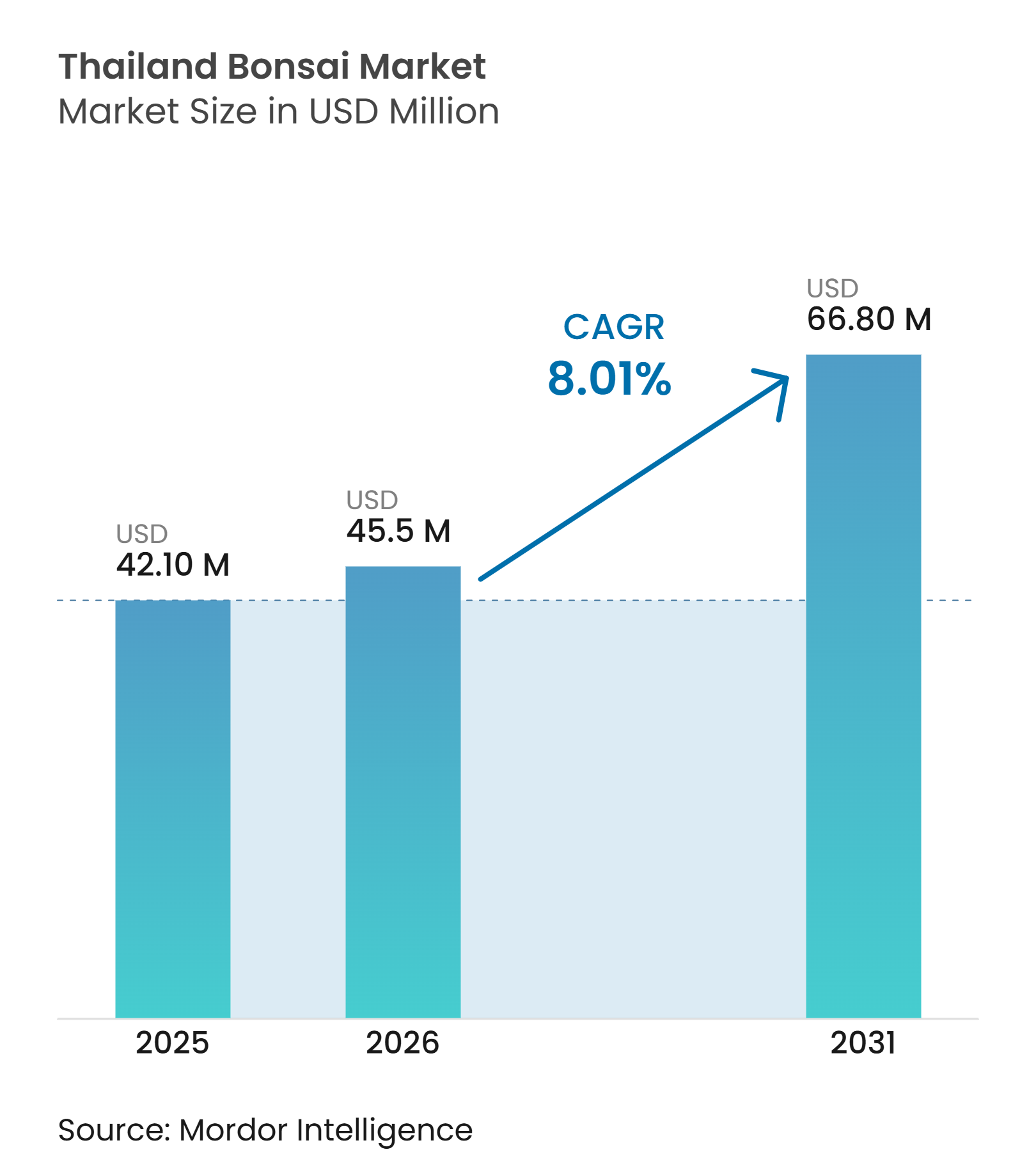
| Base Year Market Size (2025) | USD 42.10 Million |
| Market Size (2026) | USD 45.5 Million |
| Market Size (2031) | USD 66.80 Million |
| Growth Rate (2026 - 2031) | 8.01 % |
| Market Concentration | Low |
Major Players *Disclaimer: Major Players sorted in no particular order Image © Mordor Intelligence. Reuse requires attribution under CC BY 4.0. | |
Thailand Bonsai Market Analysis by Mordor Intelligence
The Thailand bonsai market size was valued at USD 42.10 million in 2025 and is estimated to grow from USD 45.5 million in 2026 to reach USD 66.80 million by 2031, at a CAGR of 8.01% during the forecast period (2026-2031). The market is supported by increasing consumer interest in bonsai as a collectible, a prestigious gift, and a product that requires ongoing care, driving higher spending per purchase. Urban density supports demand for compact plants, while hospitality projects incorporate maintained greenery in guest areas. These conditions favor sellers that combine tree sales with care advice, boarding, and maintenance services. Competition remains fragmented, and reliable grading, provenance records, and after-sales support can help specialty suppliers build customer confidence.
Key Report Takeaways
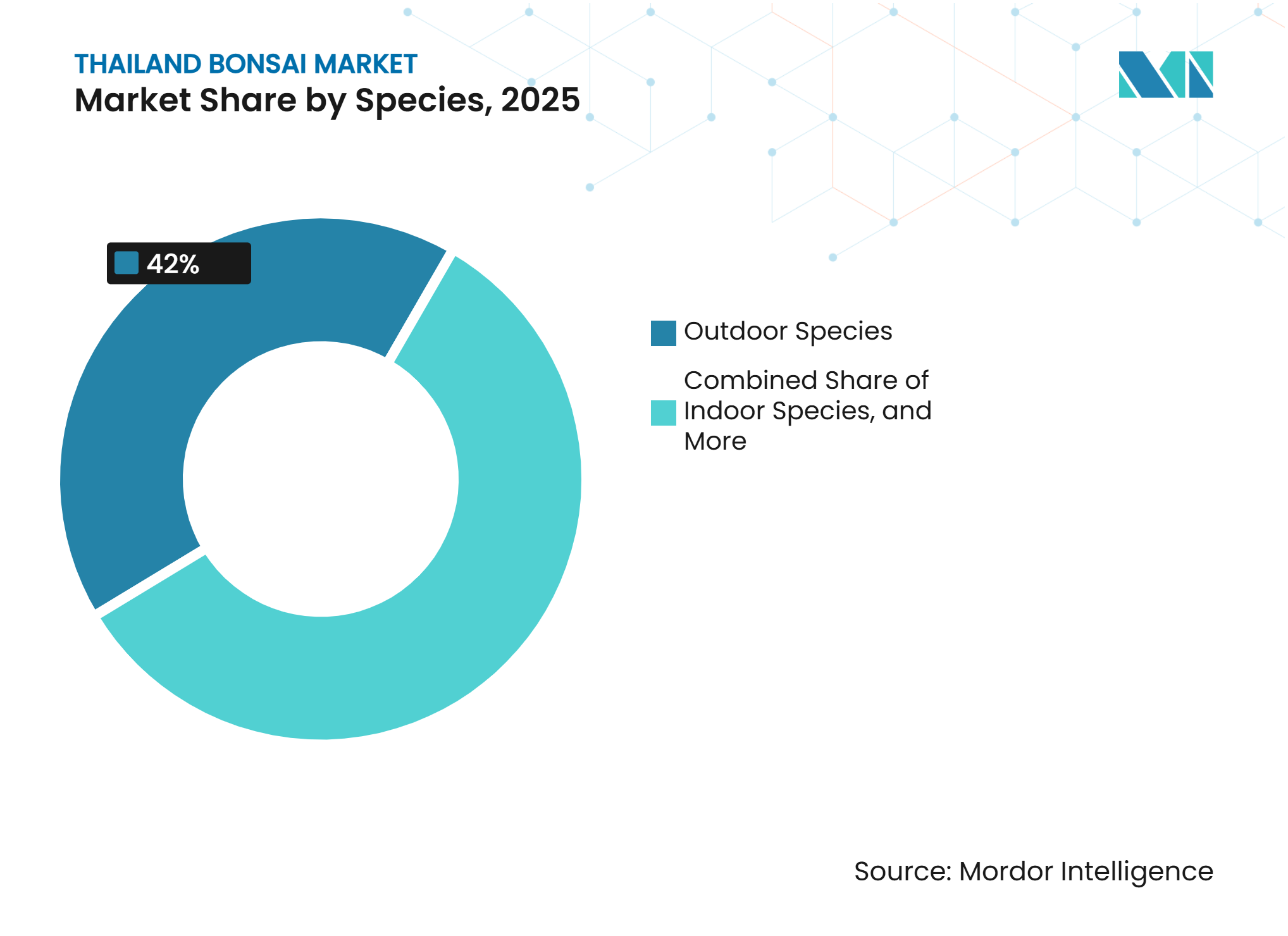
- By species, outdoor species accounted for 42% of the Thailand bonsai market share in 2025, while indoor species is forecast to grow at a CAGR of 10.3% from 2026 to 2031.
- By distribution channel, offline channels accounted for 64% of the Thailand bonsai market size in 2025, while the online channel is forecast to grow at a CAGR of 12.8% from 2026 to 2031.
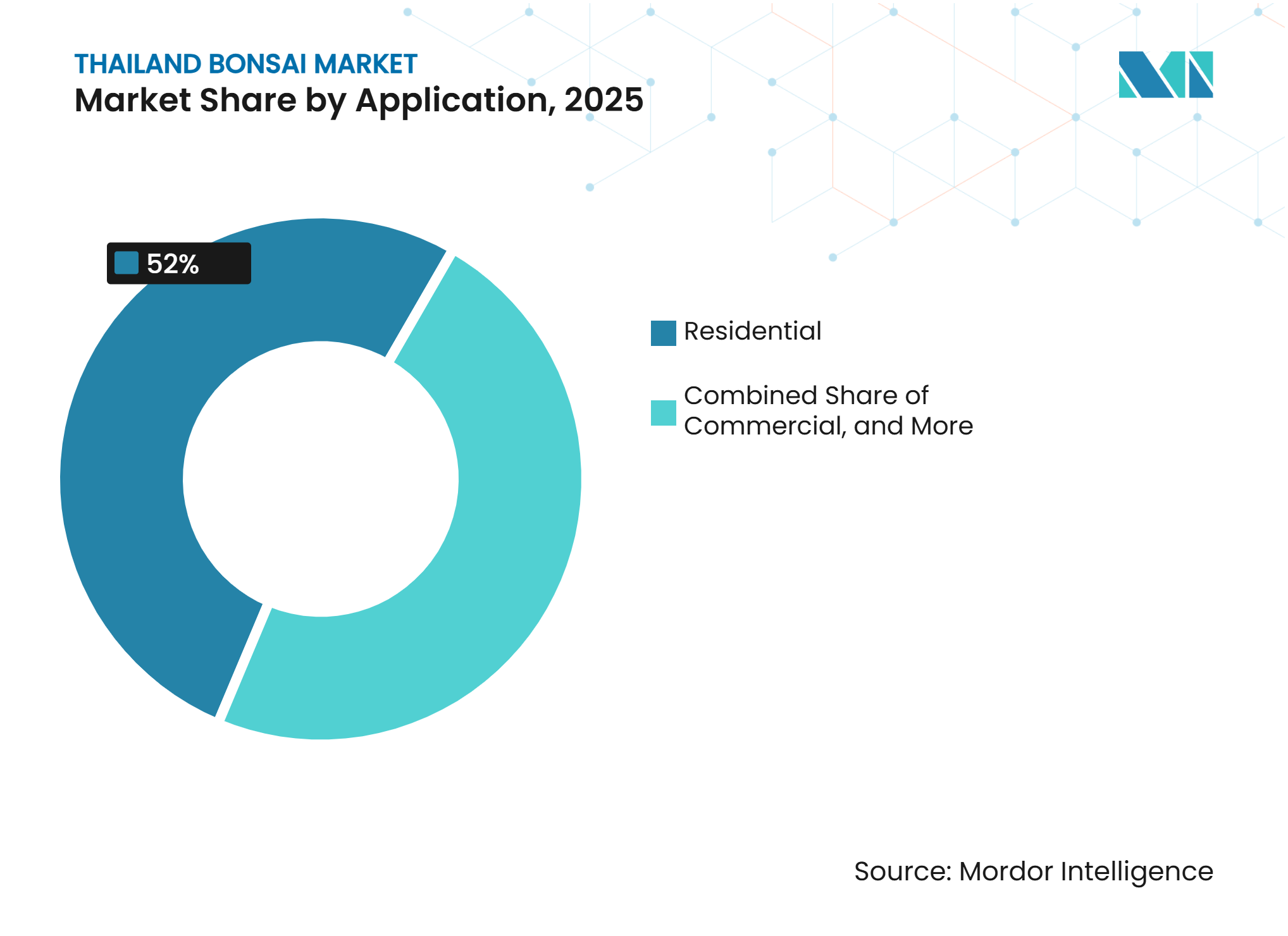
- By application, residential accounted for 52% of the market share in 2025, while commercial is forecast to grow at a CAGR of 9.6% from 2026 to 2031.
Note: Market size and forecast figures in this report are generated using Mordor Intelligence’s proprietary estimation framework, updated with the latest available data and insights as of January 2026.
Market Trends and Insights
Drivers Impact Analysis of Thailand Bonsai Market*
| Driver | (~) % Impact on CAGR Forecast | Geographic Relevance | Impact Timeline |
|---|---|---|---|
| Urban Apartment and Balcony Living | +1.5% | Bangkok Metropolitan Region, Chiang Mai, and Phuket urban cores | Short term (≤ 2 years) |
| Bonsai as a Thai Cultural and Prestige Gift | +1.2% | National, with concentration in Bangkok, Chiang Rai, and major ceremonial hubs | Medium term (2-4 years) |
| Growth of Hospitality and Biophilic Landscaping | +1% | Tourism corridors in Bangkok, Phuket, Samui, Pattaya, and Chiang Mai | Medium term (2-4 years) |
| Social-Commerce Discovery and Live Nursery Sales | +1.3% | Bangkok and urban Thailand, with spillover to provincial buyers through live selling | Short term (≤ 2 years) |
| Tropical-Climate Species and Local Propagation | +1% | National, with early production gains in Nonthaburi, Chiang Rai, and Mae Rim | Long term (≥ 4 years) |
| Digital Plant-Care Education and Remote Support | +0.8% | National, particularly provincial and first-time buyers outside Bangkok | Medium term (2-4 years) |
| Source: Mordor Intelligence | |||
Urban Apartment and Balcony Living
Thailand’s urban population reached 44.98 million in 2025, or 62.8% of the national population[1]. Urban population growth was 1.27% in 2024, reinforcing the concentration of prospective buyers in cities. Bangkok focuses on demand for plants suited to condominium balconies and small indoor spaces. The Thailand bonsai market benefits from this urban living pattern, as trained Ficus or Wrightia bonsai can serve both as a hobby and a visual feature in a compact space. These space constraints can favor smaller bonsai varieties that are easier to accommodate in apartments and condominiums. The growing preference for space-efficient greenery can also support demand for bonsai that require limited floor space and can be maintained on balconies or near windows. This creates an opportunity for nurseries and retailers to offer smaller, beginner-friendly bonsai suited to urban households. As urban living continues to shape residential gardening habits, the availability of compact bonsai options is likely to support market demand among apartment and condominium residents.
Bonsai as a Thai Cultural and Prestige Gift
Bonsai is known in Thai as mai dat and is used in prestige gifting occasions. Corporate merit ceremonies, housewarming occasions, and high-value client gifts can create repeat purchases beyond personal horticultural use. The Thailand bonsai market can therefore attract buyers who value presentation, symbolism, and status alongside plant ownership. Premium trees may command higher prices in this context, as their recipient-facing value can outweigh buyers' concerns about care requirements. Packaging, provenance documentation, and boarding services can also be relevant when purchasers seek a gift that maintains its presentation after delivery. This demand for gifting can encourage sellers to offer curated bonsai selections across different price points, including presentation-ready trees for corporate and personal occasions. It can also support value-added services such as customized packaging and post-purchase care arrangements. As bonsai continues to serve both horticultural and gifting purposes, its role as a culturally relevant prestige product can support demand for premium and presentation-focused offerings in Thailand.
Growth of Hospitality and Biophilic Landscaping
Thailand's hospitality sector continues to support demand for greenery in guest-facing settings. Hotels, resorts, restaurants, and spas can use maintained greenery in guest-facing areas. The Thailand bonsai market benefits from this use, as trained trees require pruning, repotting, pest control, and occasional replacement. These maintenance requirements can turn an initial installation purchase into a recurring maintenance arrangement. Dusit Central Park has incorporated a large urban roof park into its mixed-use development, highlighting the role of living greenery in hospitality-related design. Boarding arrangements can further support suppliers by allowing nurseries to maintain trees and rotate them into commercial settings. As hospitality operators increasingly use greenery to enhance guest-facing spaces, demand can extend beyond one-time bonsai purchases toward maintenance and replacement services. Suppliers that combine bonsai sales with care, boarding, and landscaping services can therefore address the ongoing requirements of commercial customers. This combination of installation and recurring care requirements can strengthen the role of hospitality and biophilic landscaping as a demand driver for the Thailand bonsai market.
Social-Commerce Discovery and Live Nursery Sales
Thailand’s e-commerce sector was valued at USD 21.83 billion in 2024[2]. The expansion of online commerce provides bonsai sellers with additional channels to showcase and sell trees beyond physical nurseries and specialty stores. Live selling can help buyers assess bonsai features that are difficult to judge from static product images, as sellers can show the trunk base, pot, canopy, and overall condition during a real-time session while responding to care-related questions. Trust and direct customer engagement remain important when buyers cannot inspect a tree in person. Live interactions can also help sellers explain differences in tree age, training, pot quality, and maintenance requirements, allowing buyers to make more informed purchasing decisions. For nurseries, social commerce platforms can provide a direct channel to build customer relationships and introduce buyers to additional bonsai varieties and accessories. The Thailand bonsai market may benefit as viewers transition from initial lower-value purchases to repeat purchases of higher-value trees. As digital discovery and live selling become more integrated into bonsai retail, social commerce channels can broaden customer reach and drive repeat purchases, strengthening their role in market development.
Restraints Impact Analysis of Thailand Bonsai Market*
| Restraint | (~) % Impact on CAGR Forecast | Geographic Relevance | Impact Timeline |
|---|---|---|---|
| Skilled Pruning and After-Sales Care Scarcity | -1.2% | Most acute outside Bangkok, including Chiang Mai, Hat Yai, and Khon Kaen | Medium term (2-4 years) |
| Heat, Heavy Rain, and Pest-Control Volatility | -0.8% | National, with stronger exposure in low-altitude coastal and Central Plains production zones | Short term (≤ 2 years) |
| Imported Premium Tree and Pot Cost Exposure | -1% | National, especially Bangkok galleries and premium collectors importing from Japan and Taiwan | Medium term (2-4 years) |
| Fragmented Quality Grading and Provenance | -0.7% | National, most visible in online sales and collector-grade transactions | Long term (≥ 4 years) |
| Source: Mordor Intelligence | |||
Skilled Pruning and After-Sales Care Scarcity
Specialist bonsai care requires botanical knowledge, aesthetic training, and hands-on experience with individual species. Outside established bonsai clusters in Bangkok, including Chatuchak, and in Nonthaburi, and Chatuchak, new owners may have limited access to seasonal pruning, repotting, or urgent care support. The Thailand bonsai market can face weaker repeat demand when first-time buyers do not receive adequate support after a tree develops health or maintenance issues. Remote consultations can address basic care questions but cannot fully replace hands-on diagnosis and treatment during root pruning or repotting. The shortage of specialized care also increases the risk of improper maintenance, particularly among first-time owners who may lack species-specific knowledge. This can make buyers more dependent on sellers that provide ongoing maintenance, boarding, and technical support after the initial purchase. Suppliers that train regional technicians and offer boarding or maintenance services can reduce this limitation. Improving access to skilled after-sales care would help address a key barrier to long-term bonsai ownership and support repeat purchasing in the Thailand bonsai market.
Heat, Heavy Rain, and Pest-Control Volatility
Thailand’s tropical climate can be difficult for temperate species such as Japanese Black Pine and Chinese Juniper. High temperatures, heavy rainfall, humidity, and dry spells can increase the need for shade management, controlled irrigation, and regular pest monitoring. Fungal diseases can become more prevalent following periods of high moisture, while spider mite activity can increase during hot and dry conditions. These factors can raise treatment, maintenance, and substrate replacement costs for nurseries handling premium imported trees. Climate-related stress can also affect tree appearance and survival, increasing the level of care required before and after sale. For buyers, the additional maintenance requirements of less climate-adapted species may make locally suitable bonsai varieties more attractive. Local Ficus, Wrightia, and Bougainvillea are better suited to domestic conditions and can reduce supply-side exposure. Kasetsart University reported that its 2025 climate-smart greenhouse program reduced water use by 30% and improved horticultural yields by 26% through AI-assisted climate control[3]. Such climate-management technologies could help nurseries improve growing conditions and reduce resource use, although their adoption may require additional investment. Overall, heat, rainfall, humidity, and pest pressure can increase the cost and complexity of maintaining climate-sensitive bonsai in Thailand, creating a restraint for suppliers and buyers of temperate species.
*Our forecasts treat driver/restraint impacts as directional, not additive. The impact forecasts reflect baseline growth, mix effects, and variable interactions.
Thailand Bonsai Market Segment Analysis
By Species:
Outdoor Species Lead the Market, While Indoor Species Grow FastestOutdoor Species accounted for 42% of the market share in 2025, making it the largest species category in the Thailand bonsai market. Collector demand supports Serissa, Chinese Elm, and locally propagated Ficus suited to balconies and gardens. Larger, structurally mature trees command a premium in prestige gardens and temple-related displays. Established collectors and formal display settings provide a stable customer base, though outdoor specimens require suitable space and regular care.
Indoor Species is forecast to grow at a 10.3% CAGR from 2026 to 2031, the fastest growth rate among species categories. The category serves condominium residents who need plants suited to filtered light, small rooms, and inconsistent watering routines. JinShari, launched at the 10th World Bonsai Convention in Kuala Lumpur in August 2026, uses smartphone photo recognition to provide species recommendations tailored to home conditions. Needle tree species and deciduous tree species serve collectors seeking Japanese Black Pine and Shimpaku Juniper. Exhibition-grade imported material can cost THB 50,000 to THB 100,000 (USD 1,400 to USD 2,800) based on the 2026 average conversion rate, but tropical conditions limit this category's volume.



By Distribution Channel:
Offline Channels Lead the Market, While Online Channels Grow FastestOffline channels accounted for 64% of Thailand bonsai market share in 2025. Buyers prefer to inspect the trunk base, pot proportions, canopy, and overall form before purchasing a higher-value tree. Physical galleries also provide consultations, care advice, and boarding services that reduce the perceived risk of ownership. Bonsai Hunter Gallery and Dang Bonsai benefit from physical locations that combine retail and service activities. Personal interaction remains important in the Thailand bonsai market when customers are uncertain about tree quality or care requirements.
Online distribution is forecast to grow at a 12.8% CAGR from 2026 to 2031. Live-stream sessions can reduce trust barriers by allowing sellers to show the trunk, canopy, pot, and overall form from multiple angles. Broader e-commerce reach gives nurseries access to consumers outside established nursery districts. Thailand's e-commerce value of USD 21.83 billion in 2024 indicates that digital purchasing infrastructure is well-developed. The strongest model combines online discovery with offline boarding, delivery, or maintenance, maintaining digital reach while preserving buyer confidence.
By Application:
Residential Applications Lead the Market, While Commercial Applications Grow FastestResidential accounted for 52% of the market share in 2025, making it the largest application group in the Thailand bonsai market. Urban apartments, gifting occasions, and social media engagement have broadened the residential buyer base. Some customers build collections over time and purchase specimen-grade trees, while others begin with plants costing THB 500 to THB 3,000 (USD 14 to USD 84), based on the 2026 average conversion rate. Repeat demand depends on whether new owners receive adequate guidance on care.
Commercial applications are forecast to grow at a 9.6% CAGR from 2026 to 2031. Hotels, resorts, spas, and upscale restaurants use permanent bonsai features instead of seasonal displays. Hospitality properties focused on maintaining guest environments support demand for installation and care services, with installation work often leading to recurring contracts for pruning, pest management, and replacement trees. Corporate gifting and international events create periodic demand for gallery sellers, while institutional gifts and art fairs provide a smaller but stable demand base.

Geography Analysis
Bangkok and the surrounding provinces of Nonthaburi, Pathum Thani, and Samut Prakan form the primary geographic center of the Thailand bonsai market, supported by a concentration of specialty nurseries, collector-oriented sellers, and commercial landscaping activity. Retail clusters in Chatuchak and Nonthaburi serve individual collectors as well as hospitality and commercial buyers, while boarding and maintenance services allow businesses to use trained specimens without managing all care requirements in-house. Bangkok benefits from its large urban population, extensive condominium stock, and established retail and logistics infrastructure, supporting demand for compact indoor bonsai as well as premium specimens for residential and commercial applications. Thailand's Ministry of Commerce has identified ornamental plants as emerging star exports, with decorative plant exports totaling THB 9.32 billion (approximately USD 267 million) during 2023–2024. Thai PBS World Bangkok also serves as an important logistics center for imported plant material, with specialist importers managing phytosanitary and import-permit requirements under Thailand's plant quarantine regulations.
Northern Thailand, particularly Chiang Mai, Chiang Rai, and Mae Rim, represents another important bonsai production and retail cluster. The region's cooler highland conditions support the cultivation of temperate species, including Japanese Black Pine, Juniper, and Chinese Elm, which require greater climate management in Thailand's warmer lowland areas. Chiang Mai's hospitality sector, including boutique hotels, wellness properties, and guesthouses, provides opportunities for bonsai installations and maintenance services. Thailand's ornamental horticulture exports were reported at USD 132 million in 2023 by the International Association of Horticultural Producers (AIPH), reflecting the country's established export base.
Southern Thailand, particularly Phuket, Ko Samui, Surat Thani, and Krabi, has a commercially oriented demand profile driven by its hospitality and tourism sectors. Hotels, resorts, pool villas, and spas can use bonsai in entrances, reception areas, outdoor spaces, and other guest-facing settings, creating demand for both installations and ongoing maintenance. Thailand's tourism authorities targeted 36.7 million foreign arrivals in 2026, according to Nation Thailand. This tourism concentration can create opportunities for suppliers offering presentation-ready specimens and recurring care services. Eastern Thailand, particularly Chonburi and Pattaya, shows a similar combination of hospitality, commercial real estate, and residential demand. Northeastern markets such as Khon Kaen, Udon Thani, and Nakhon Ratchasima remain less concentrated, but online retail and social commerce channels improve access to specialist sellers. Overall, Bangkok serves as the main commercial and distribution center, northern Thailand supports production and specialist cultivation, and tourism-oriented regions generate commercial demand from hospitality and landscaping applications.
Competitive Landscape
Market Concentration
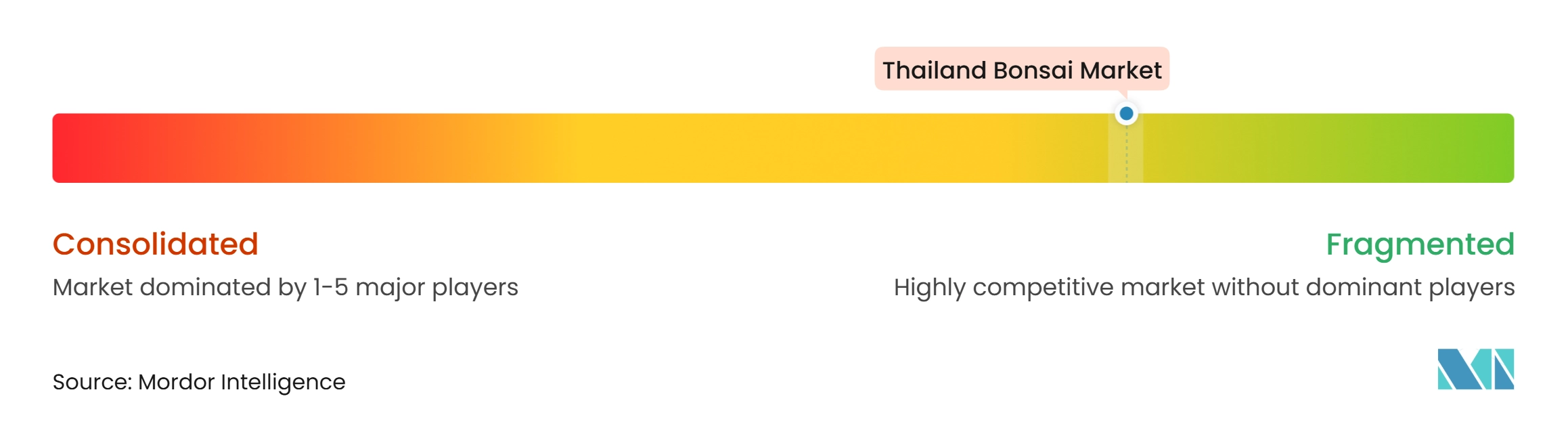
The Thailand bonsai market is fragmented, with competition spread across specialty galleries, domestic nurseries, garden centers, social-commerce sellers, and import dealers. Informal growers and smaller sellers also contribute to the market, particularly through direct sales and online channels. Bonsai Hunter Gallery competes through Japanese species curation, boarding, and international shipping, while Bonsai Koen Thailand focuses on imported Japanese specimens and Japanese rock-garden styling. Thaising Tropical Plants Nursery Co., Ltd., BCK Bonsai, and Dang Bonsai serve mid-market and e-commerce demand through domestic material, imports, and nationwide delivery.
The competitive landscape includes gallery operators, mid-market domestic nurseries, and digital-first education and tool platforms. Gallery operators focus on higher-value imports and care services, while mid-market nurseries build volume through accessible pricing and live-stream selling. Digital platforms extend interest in bonsai through educational content and related tools. Commercial leasing and maintenance packages provide additional opportunities for suppliers serving hotels, resorts, and other commercial customers. Starter kits suited to Thailand’s climate and regional fulfillment needs can help meet entry-level demand and improve access for customers outside Bangkok, including in Chiang Mai, Phuket, and Khon Kaen. Kaizen Bonsai Ltd. introduced biochar-enhanced compost and expanded its Exhibition Quality pot range in 2026. Provenance documentation, import licenses, and established relationships with suppliers in Japan and Taiwan can also support businesses handling imported plant material, as plant-import requirements involve additional operational and compliance considerations. Overall, competition in the Thailand bonsai market spans specialized premium sellers and broader domestic nurseries, with product selection, care services, digital engagement, and distribution capabilities shaping the competitive landscape.
Thailand Bonsai Industry Leaders
-
Bonsai Hunter Gallery
-
Bonsai Koen Thailand
-
Thaising Tropical Plants Nursery Co., Ltd.
-
Dang Bonsai
-
Nong Nooch Tropical Garden, Bonsai Nursery
- *Disclaimer: Major Players sorted in no particular order
Thailand Bonsai Market Companies Covered in this Report
- Bonsai Hunter Gallery
- Bonsai Koen Thailand
- Dang Bonsai
- Thaising Tropical Plants Nursery Co., Ltd.
- Nong Nooch Tropical Garden, Bonsai Nursery
- N V Bonsai Bangsean Shop
- Bonsai Network Japan
- Mistral Bonsai
- Lodder Bonsai BV
- Ewaterplant
- Pround Interplants
- Kimura Bonsai Garden
Recent Industry Developments in Thailand Bonsai Market
- September 2026: Seishin Tougei launched the “Matcha Bowl Moss Bonsai” growing kit in Japan at a suggested retail price of JPY 1,600 before tax. The compact kit combines sunagoke moss with a miniature matcha bowl and is designed for beginners, with availability through variety stores, souvenir shops, and the company’s online store.
- August 2026: JinShari showcased its AI-powered bonsai management and design app at the 10th World Bonsai Convention in Kuala Lumpur, Malaysia. The platform combines cultivation management, care recommendations, and AI-based evaluation and design support, highlighting the growing adoption of digital tools in bonsai care and cultivation.
Thailand Bonsai Market Report Scope
Our study defines the Thailand bonsai market as the annual value of miniature, living woody plants intentionally trained to mimic mature trees, along with the pots, soils, and pruning inputs sold with them. Values represent consumer-level spending through specialty nurseries and general retail channels in Thailand and are expressed in USD.
The Thailand Bonsai Market Report is Segmented by Species (Indoor Species, Outdoor Species, Needle Tree Species, and Deciduous Tree Species), by Distribution Channel (Online and Offline), and by Application (Residential, Commercial, and Others (Institutional Gifts and Art Fairs)). The Market Forecasts are Provided in Terms of Value (USD).
Segmentation Overview
| Indoor Species |
| Outdoor Species |
| Needle Tree Species |
| Deciduous Tree Species |
| Online |
| Offline |
| Residential |
| Commercial |
| Others (Institutional Gifts and Art Fairs) |
| By Species | Indoor Species |
| Outdoor Species | |
| Needle Tree Species | |
| Deciduous Tree Species | |
| By Distribution Channel | Online |
| Offline | |
| By Application | Residential |
| Commercial | |
| Others (Institutional Gifts and Art Fairs) |
Key Questions Answered in the Report
What is the forecast growth rate of the Thailand bonsai Market?
The Thailand bonsai market is forecast to grow at an 8.01% CAGR from 2026 to 2031 to reach USD 66.80 million by 2031.
Which bonsai species category is growing fastest in Thailand?
Indoor Species is forecast to grow at a 10.3% CAGR from 2026 to 2031 as apartment residents seek compact plants for indoor conditions.
Why do offline bonsai stores remain important in Thailand?
Offline channels accounted for 64% of the 2025 share, as buyers often want to assess a tree’s form, pot, and condition before making a purchase.
Which application segment is growing fastest in the Thailand bonsai market?
Commercial applications are forecast to grow at a 9.6% CAGR from 2026 to 2031, supported by demand from the hospitality, spa, restaurant, and resort sectors.
What limits the wider adoption of bonsai among new owners in Thailand?
Limited access to skilled pruning and after-sales care outside Bangkok can reduce repeat purchasing by first-time owners.