
Testosterone Booster Market Size and Share
Market Overview
| Study Period | 2021 - 2032 |
|---|---|
| Market Size (2027) | USD 5.05 Billion |
| Market Size (2032) | USD 8.15 Billion |
| Growth Rate (2027 - 2032) | 10.06 % |
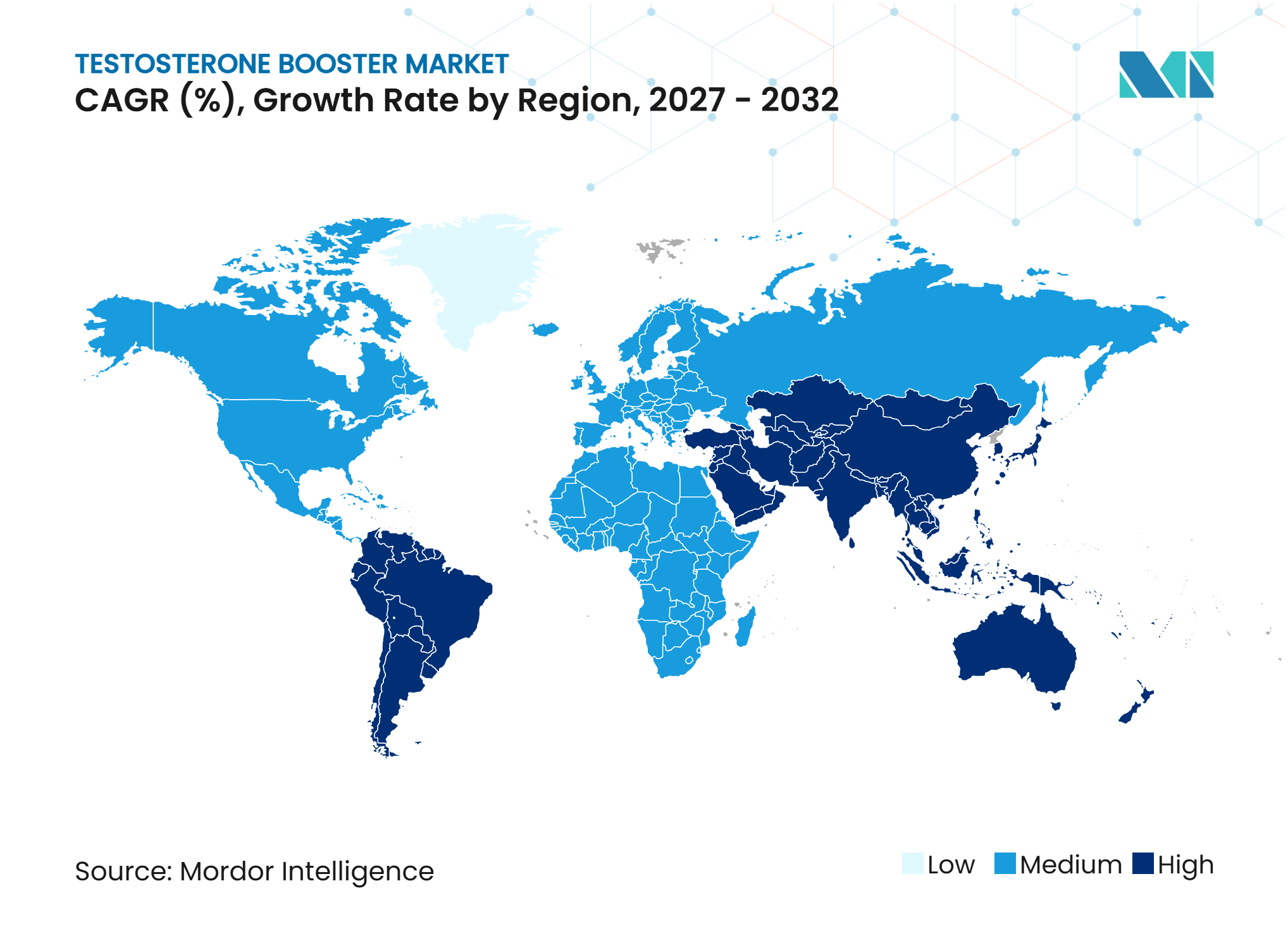
| Fastest Growing Market | Asia-Pacific |
| Largest Market | North America |
| Market Concentration | Medium |
Major Players *Disclaimer: Major Players sorted in no particular order Image © Mordor Intelligence. Reuse requires attribution under CC BY 4.0. | |
Testosterone Booster Market Analysis by Mordor Intelligence
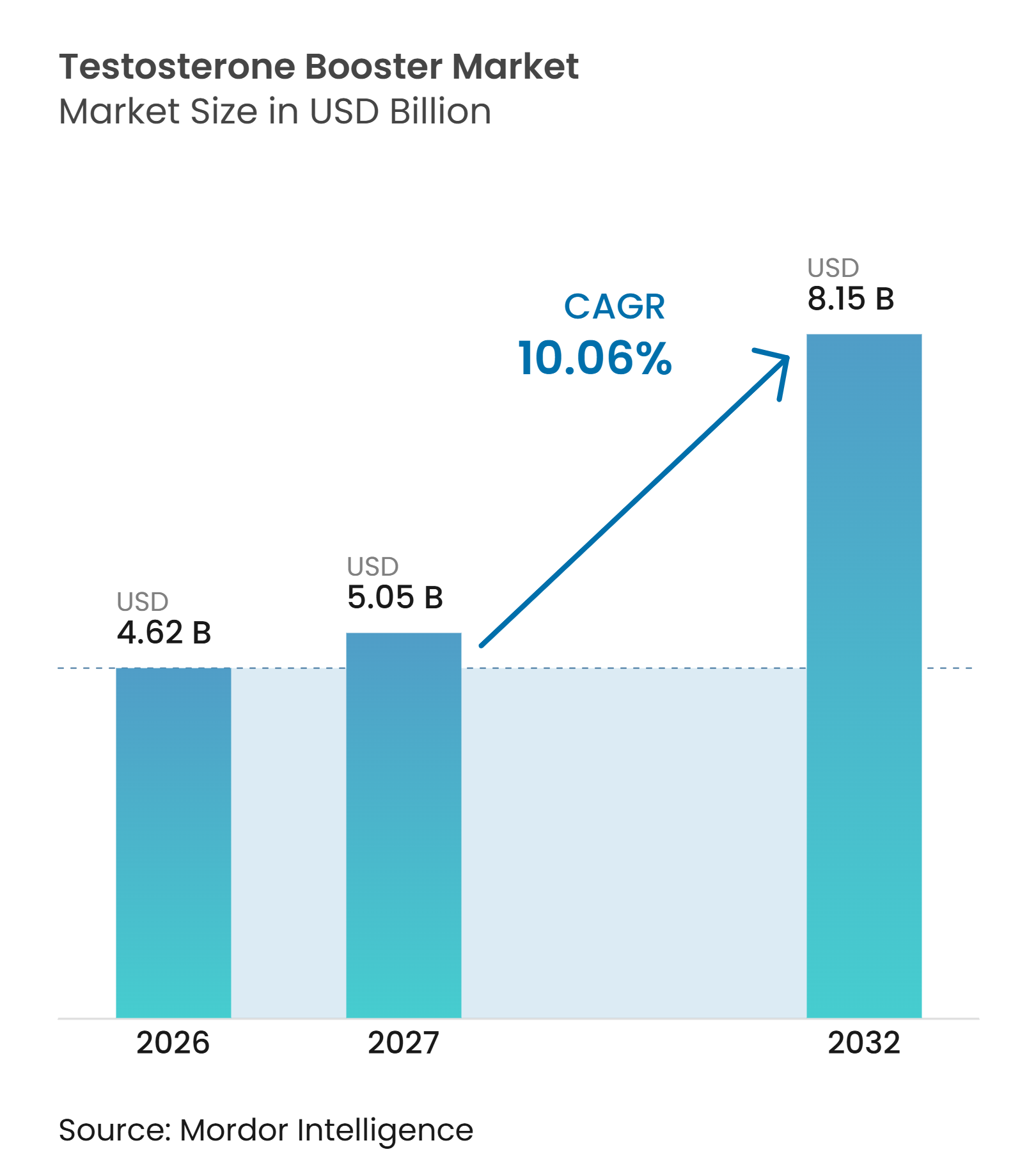
The Testosterone Booster Market size is projected to expand from USD 4.62 billion in 2026 and USD 5.05 billion in 2027 to USD 8.15 billion by 2032, registering a CAGR of 10.06% between 2027 and 2032.
The demand base is broadening as low testosterone, metabolic health concerns, and interest in preventive wellness become more visible to consumers. Fitness participation continues to support purchases, especially among people who associate resistance training with strength, recovery, and energy. Product positioning is moving beyond bodybuilding toward daily wellness, but companies still need to keep product claims within dietary supplement rules. Brands with transparent dosing, third-party testing, and evidence for standardized ingredients can build more durable consumer trust. Online subscriptions and diagnostic-led programs also create a path toward repeat purchasing and more individualized product recommendations.
Key Report Takeaways
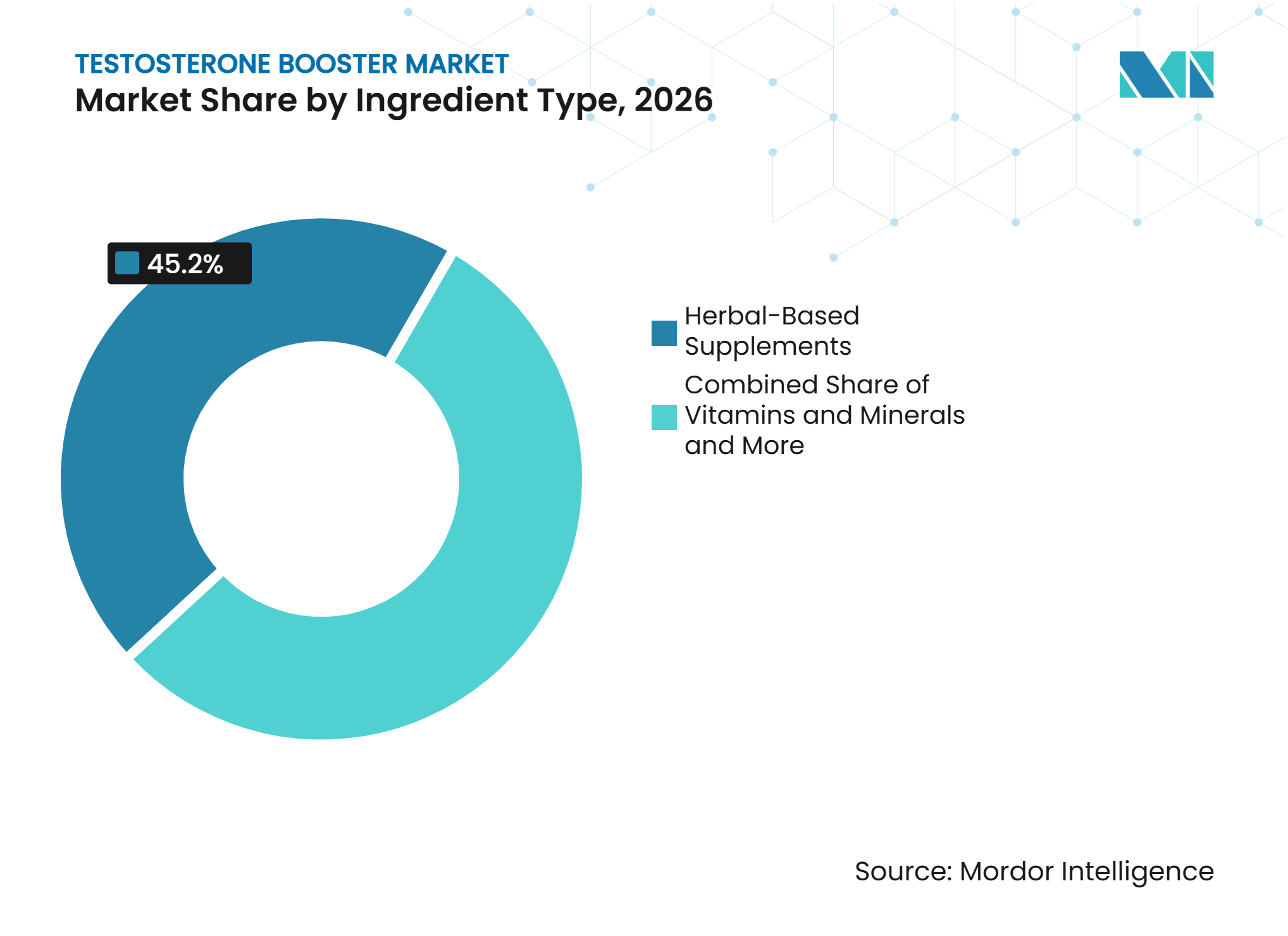
- By ingredient type, herbal-based supplements held 45.23% of the testosterone booster market share in 2026, while vitamins and minerals are forecast to expand at a 10.34% CAGR through 2032.
- By form, capsules and tablets accounted for 55.82% of the testosterone booster market size in 2026, while gummies and chewables are projected to grow at a 12.64% CAGR through 2032.
- By application, muscle growth and strength held 34.29% of the market in 2026, while energy and vitality is forecast to grow at a 10.63% CAGR through 2032.
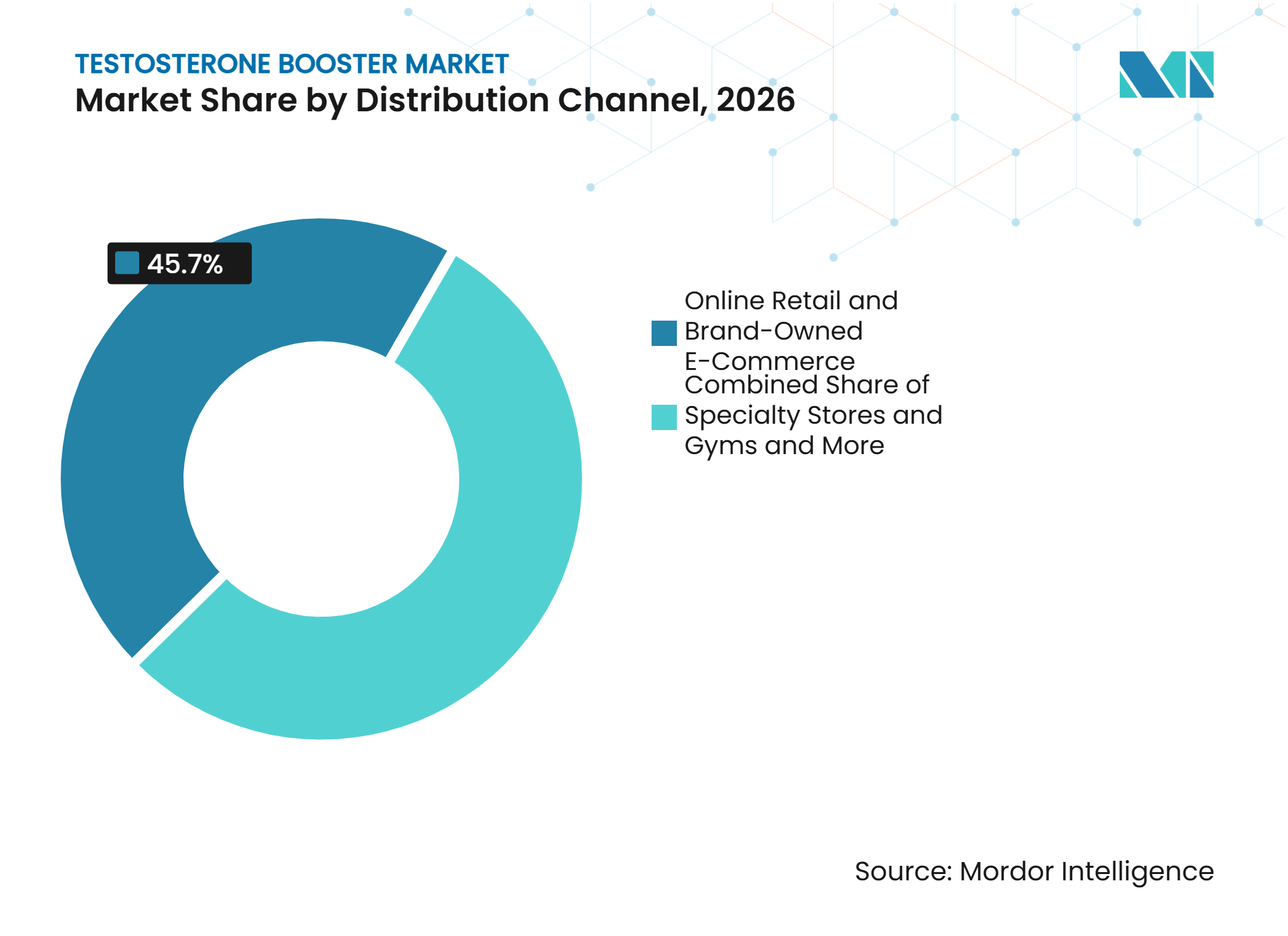
- By distribution channel, online retail and brand-owned e-commerce accounted for 45.67% of the market in 2026, while specialty stores and gyms are expected to grow at a 10.16% CAGR through 2032.
- By end user, general wellness consumers accounted for 47.23% of the market in 2026, while aging men and age-related testosterone support users are forecast to expand at a 10.45% CAGR through 2032.
- By geography, North America held 43.89% of the market in 2026, while Asia-Pacific is projected to grow at an 11.61% CAGR through 2032.
Note: Market numbers in this report are based on Mordor Intelligence's proprietary estimation framework, which combines nine months of actuals with Q4 projections for base year 2026.
Market Trends and Insights
Drivers Impact Analysis of Testosterone Booster Market*
| Driver | (~) % Impact on CAGR Forecast | Geographic Relevance | Impact Timeline |
|---|---|---|---|
| Aging Male Population and Testosterone Awareness | +2.5% | Global, with early concentration in North America and Western Europe | Long term (≥ 4 years) |
| Fitness, Bodybuilding, and Sports Nutrition Participation | +2.0% | North America, Europe, and urban Asia-Pacific | Medium term (2-4 years) |
| Natural and Herbal Testosterone Support Preference | +1.8% | Global, particularly Asia-Pacific | Medium term (2-4 years) |
| E-Commerce, Direct-to-Consumer Sales, and Subscriptions | +1.5% | North America, Europe, China, South Korea, and Brazil | Short term (≤ 2 years) |
| Biomarker-Led Product Personalization | +0.9% | North America and Europe | Long term (≥ 4 years) |
| Demand for Substantiated and Third-Party-Tested Formulas | +0.7% | North America and Europe | Medium term (2-4 years) |
| Source: Mordor Intelligence | |||
Aging Male Population and Rising Awareness of Testosterone Decline
Testosterone deficiency is increasingly discussed in relation to metabolic health and daily functioning, rather than only in relation to aging. A 2025 study reported that measured free testosterone declined by 4.5 pmol/L per year across adult male cohorts. The study also found that a BMI of 35 was associated with free testosterone that was 22.2% lower than the reference BMI of 22. Obesity and related metabolic conditions can therefore expand the pool of consumers seeking information about hormone support[1]. The testosterone booster market is becoming relevant to men in their 30s and 40s as well as older consumers. Products framed around energy, nutrition, and lifestyle support may reach these consumers without relying on age alone.
Expanding Fitness, Bodybuilding, and Sports-Nutrition Participation
Fitness participation creates a large audience for products associated with strength, recovery, and body composition. U.S. gym and fitness facilities recorded more than 100 million users and 7 billion visits in 2025. Dumbbell users reached 26.4 million in 2025 and increased at a 6.4% compound annual growth rate from 2021. Resistance-training consumers are likely to be familiar with sports nutrition products and their ingredient claims. This familiarity can lower the effort required to introduce testosterone-support products and expand consumer awareness across the testosterone booster market. Companies still need to distinguish lawful supplement messaging from claims that imply treatment or hormone replacement.
Consumer Preference for Natural and Herbal Testosterone Support
Consumer interest in botanical products supports demand for herbal testosterone-support formulations. A 2025 review found that ashwagandha supplementation may increase testosterone in adults without chronic disorders, with findings that were particularly relevant to strength-training populations. A 2025 randomized trial reported a 15.7% increase in testosterone among male participants receiving 200 mg of standardized Withania somnifera root extract twice daily. The study also assessed hematological, hepatic, renal, and lipid safety outcomes. Standardization matters because evidence from a defined extract does not automatically apply to a generic botanical powder. The market therefore favors companies that clearly identify ingredient source, dose, and product testing.
E-Commerce, Direct-to-Consumer Sales, and Subscription Models
Digital retail gives supplement brands direct access to consumers seeking product information and repeat purchases. Direct-to-consumer sites can explain ingredients, dosing, and intended product use in more detail than a retail shelf. Subscription programs can reduce the chance that a consumer forgets to reorder a product. They can also create a regular purchase cycle for brands that offer product bundles or tailored recommendations. This model is useful when consumers expect continued use before judging a wellness product, helping brands encourage repeat purchases in the testosterone booster market. Brands without a direct digital channel may have fewer opportunities to communicate formulation differences or build recurring customer relationships.
Restraints Impact Analysis of Testosterone Booster Market*
| Restraint | (~) % Impact on CAGR Forecast | Geographic Relevance | Impact Timeline |
|---|---|---|---|
| Inconsistent Product-Level Clinical Evidence | -1.8% | Global, with greater relevance in North America and Europe | Long term (≥ 4 years) |
| Scrutiny of Testosterone and Structure-Function Claims | -0.9% | North America and Europe | Medium term (2-4 years) |
| Ingredient Adulteration, Dose Variability, and Contamination Risk | -0.8% | Global, particularly online marketplace channels in North America and Asia-Pacific | Short term (≤ 2 years) |
| Trust Erosion From Proprietary Blends and Aggressive Digital Marketing | -0.6% | North America and Europe | Medium term (2-4 years) |
| Source: Mordor Intelligence | |||
Limited and Inconsistent Clinical Evidence for Product-Level Efficacy
The main evidence gap is not always the science behind an individual ingredient. It is the limited number of controlled trials on finished products that combine many active ingredients. The supplied research notes that formulas often contain 8 to 12 active compounds. Interactions across those ingredients are not always well understood. This makes it harder for consumers to know whether the results from a single-ingredient study apply to a blended product. A widely publicized product failure can damage confidence in the wider category, not just the implicated company. Smaller firms may find it difficult to fund product-specific clinical work and maintain strong substantiation records, creating a competitive challenge across the testosterone booster industry.
Regulatory Scrutiny of Testosterone and Structure-Function Claims
The U.S. framework allows dietary supplements to use structure-function claims when companies hold substantiation for those claims. Firms must notify the FDA within 30 days after first marketing a product with a qualifying structure-function claim. The system does not require FDA premarket approval for these claims. This can create differences between companies that invest in claim review and companies that enter the market with weaker documentation. The FDA issued a December 2025 warning letter concerning products marketed as dietary supplements that contained selective androgen receptor modulators. Companies selling across the United States and Europe must adapt claims and evidence to separate regulatory systems, increasing compliance requirements across the testosterone booster industry.
*Our forecasts treat driver/restraint impacts as directional, not additive. The impact forecasts reflect baseline growth, mix effects, and variable interactions.
Testosterone Booster Market Segment Analysis
By Ingredient Type:
Herbal Products Lead While Vitamins and Minerals Gain AttentionHerbal-based supplements held 45.23% of the Testosterone Booster Market share in 2026. The segment benefits from familiarity with ashwagandha, fenugreek, Tongkat Ali, and tribulus terrestris. These ingredients are associated with traditional wellness practices and are recognizable to consumers shopping for natural products. Ashwagandha has the strongest evidence base among the ingredients. A 2025 review found testosterone-related benefits in adults without chronic disorders, especially among people engaged in strength training. The 2025 controlled trial on standardized Withania somnifera also supported the importance of defined dose and extract quality[2].
Vitamins and minerals are forecast to grow at a 10.34% CAGR through 2032. This part of the Testosterone Booster Market is supported by interest in zinc, vitamin D3, and magnesium among consumers who view nutrient status as relevant to general wellness. Synthetic ingredients serve a more performance-focused audience that may place a higher value on potency. Amino acids and other functional compounds are often positioned for consumers seeking non-hormonal support for training performance. Vitamins and minerals may present a lower claim-risk path than complex herbal blends because their use is easier to explain within familiar nutrition language. The product opportunity lies in pairing clear nutrient doses with careful claims and avoiding the suggestion that a supplement treats a medical condition.



By Form:
Capsules and Tablets Retain Trust While Gummies Expand AccessCapsules and tablets accounted for 55.82% of the Testosterone Booster Market size in 2026. Consumers often associate these formats with dose precision and established supplement routines. Many clinical studies involving testosterone-support ingredients also use capsule delivery. This gives capsules and tablets a familiar position in practitioner-led and conventional supplement settings. The format can carry multiple ingredients without the taste and sugar constraints that affect chewable products. It also makes it easier for brands to communicate the amount of each ingredient on the label.
Gummies and chewables are expected to grow at a 12.64% CAGR through 2032. Their appeal comes from convenience and the ability to reach consumers who do not regularly take capsules. Younger men and general wellness buyers may encounter gummies in functional food or mainstream wellness settings before they look for traditional supplements. Powders remain relevant to bodybuilders and athletes who already use protein drinks or pre-workout products. Liquids remain a smaller format but may appeal to consumers interested in extract-based products and perceived absorption benefits. Companies need to balance convenience with ingredient stability, transparent dosing, and the amount of active material that each format can deliver.
By Application:
Muscle Growth Remains the Largest Use Case While Energy Broadens DemandMuscle growth and strength held 34.29% of the market in 2026. The application remains closely linked to the category’s roots in fitness and bodybuilding. More than 100 million people used U.S. gym and fitness facilities in 2025, creating a wide audience for products associated with strength and training. Dumbbell participation reached 26.4 million users in 2025. This environment supports demand for products that consumers see as compatible with resistance training. Claims still require care because a dietary supplement cannot be promoted as a treatment for hormone deficiency.
Energy and vitality is forecast to grow at a 10.63% CAGR through 2032. This application can extend the customer base beyond consumers who identify as athletes or bodybuilders. It is relevant to professional men with sedentary routines, older adults concerned about fatigue, and general wellness consumers. Libido and sexual wellness remain an important use case, but it requires especially cautious claim wording. Hormonal balance, age-related support, recovery, and endurance also reflect the movement of the category toward broader men’s wellness. Companies can widen their addressable audience when they connect products to permitted wellness motivations rather than only to gym performance.
By Distribution Channel:
Digital Sales Lead While Specialty Settings Offer Contextual DemandOnline retail and brand-owned e-commerce held 45.67% of the market in 2026. Digital channels allow brands to provide ingredient information, usage instructions, and product comparisons before a consumer buys. This is important for formulations that need explanation beyond a brief retail label. Brand-owned sites also give companies a direct relationship with consumers and can support subscriptions. Online channels are particularly useful for mid-tier and newer brands that do not have a broad physical retail network. They also make it easier to test new messaging and product bundles. The channel’s scale increases the importance of careful product-page claims and visible quality documentation.
Specialty stores and gyms are forecast to grow at a 10.16% CAGR through 2032. These locations reach consumers when they are already focused on training, recovery, or performance. Staff recommendations can influence purchase decisions for shoppers who want a quick explanation of a product. Pharmacies and drugstores remain relevant for people who prefer a clinical retail setting. Supermarkets and hypermarkets can introduce gummies and vitamin-mineral formats to mainstream buyers. Direct sales and practitioner-led channels remain smaller but can support premium products that use detailed protocols or clinician input. A balanced channel strategy can combine the convenience of online sales with the credibility and trial opportunity offered by physical locations.

By End User:
General Wellness Consumers Lead and Aging Men Grow FasterGeneral wellness consumers accounted for 47.23% of the market in 2026. This is evidence that the category extends beyond competitive athletes and bodybuilders. These buyers may focus on energy, cognitive performance, or maintaining a healthy routine. Their purchasing decisions are often shaped by lifestyle optimization rather than a specific sporting goal. Products designed for this group need simple explanations of ingredients, realistic usage guidance, and transparent labels. The segment gives brands room to offer accessible formats, including vitamins, minerals, and botanicals. It also requires companies to avoid messaging that overstates a supplement’s effect on a clinical condition.
Aging men and age-related testosterone support users are projected to grow at a 10.45% CAGR through 2032. The 2025 reference-range study found that free testosterone declined by 4.5 pmol/L per year across the adult male cohorts studied. The relationship between testosterone, body weight, and metabolic health can make this group attentive to wellness products. Athletes, fitness enthusiasts, and bodybuilders remain the original performance-focused audience. Their demand is tied to training intensity and familiarity with sports nutrition. Brands serving older consumers can differentiate by using clearly stated doses, standardized ingredients, and product education that recognizes age-related nutritional needs without making disease claims.
Geography Analysis
North America
North America accounted for 43.89% of the testosterone booster market share in 2026. The region has mature supplement purchasing habits, a large fitness population, and strong direct-to-consumer infrastructure. U.S. gym and fitness facilities had more than 100 million users and recorded 7 billion visits in 2025. This creates a large base of consumers who are already familiar with nutrition and performance products. The U.S. Food and Drug Administration administers dietary supplement structure-function claim requirements under the Dietary Supplement Health and Education Act framework. This regulatory influence favors firms that can maintain claim substantiation, label review, and quality documentation. Canada has a similar preference for products that communicate clinical support, while Mexico benefits from expanding urban fitness participation and wellness spending.
Asia-Pacific
Asia-Pacific is forecast to grow at an 11.61% CAGR through 2032. Aging demographics, urban fitness participation, and familiarity with traditional botanical approaches support demand across the region. China offers a large opportunity as urbanization, income growth, and gym infrastructure increase exposure to supplements among younger male consumers. Traditional Chinese medicine also provides cultural familiarity with herbal formulations. India has a strong heritage of Ayurvedic products and a growing fitness culture, which can support consumer interest in plant-based formulations. South Korea and Australia are premium-oriented markets where clear labels and third-party certification can carry greater weight in purchase decisions. The region’s varied regulatory systems require companies to adapt ingredient documentation, claims, and distribution to local conditions.
Europe, Middle East and Africa, and South America
Europe has a more restrictive health-claim environment for botanical products, and the European Food Safety Authority influences how companies present nutrition and health information. Products in the region may therefore place greater emphasis on zinc, vitamin D, and magnesium than on broad botanical claims. The United Kingdom has its own post-Brexit food regulation through the Food Standards Agency and shows demand for transparent labels and sport-focused certifications. Gulf Cooperation Council countries offer developing demand because of high consumer spending capacity and expanding urban fitness culture. Brazil remains an important South American fitness market, with strong bodybuilding interest supporting performance-related supplement demand. Other South American markets have uneven direct-to-consumer potential because logistics, payments, and distribution infrastructure vary across countries. Companies operating across these mixed markets need localized product education and compliance plans instead of a single global claim strategy.
Competitive Landscape
Market Concentration
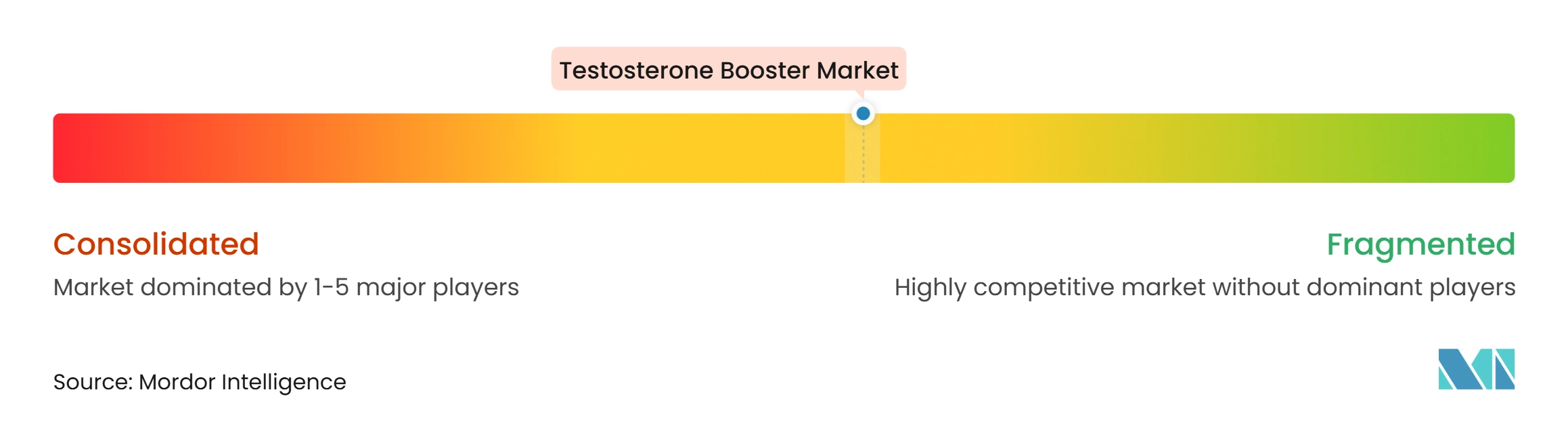
The testosterone booster market is fragmented at the brand level, with no single company identified as having a dominant share. Low barriers to formulation and online selling have allowed many smaller brands to compete alongside established nutrition companies. GNC Holdings, Iovate Health Sciences, Force Factor, and Thorne HealthTech are among the companies active in the mainstream North American commercial tier. Larger retail networks can give brands national product visibility and speed up trial in physical stores. Digital brands can compete by using direct customer communication, subscriptions, and focused product positioning. This mix keeps consumer switching costs low and makes brand differentiation dependent on quality signals, formula clarity, and channel execution. The large number of smaller online brands gives consumers many choices, but it also makes it harder to compare products on a consistent basis.
A recognizable brand, a clear label, and evidence tied to a stated dose can reduce that uncertainty. These features are particularly important when products carry several botanicals that may be unfamiliar to a first-time buyer. The competitive field therefore rewards companies that make their formulation and quality controls easy to understand. A low-cost formula can gain attention quickly, but it may struggle to retain consumers when it does not explain the purpose of each active ingredient. Established companies also have an advantage when they can combine retail availability with product education. The same company can still face pressure from smaller competitors that move quickly in digital channels. This makes the market active without making it concentrated.
Testosterone Booster Industry Leaders
-
Adaptive Health LLC
-
GNC Holdings, Inc.
-
Iovate Health Sciences International Inc.
-
Prime Male
-
Roar Ambition Ltd
- *Disclaimer: Major Players sorted in no particular order
Testosterone Booster Market Companies Covered in this Report
- Adaptive Health LLC
- BPI Sports
- Cellucor, Nutrabolt
- EVLution Nutrition
- Force Factor, LLC
- GAT Sport
- GNC Holdings, Inc.
- Health Nutrition Limited
- Herbalife Nutrition Ltd
- Himalaya
- Iovate Health Sciences International Inc.
- Jarrow Formulas
- JYM Supplement Science
- NOW Foods
- Optimum Nutrition, Glanbia Performance Nutrition
- Prime Male
- Roar Ambition Ltd
- Schwabe Group
- Thorne HealthTech, Inc.
- Universal Nutrition
- Vitabiotics
Recent Industry Developments in Testosterone Booster Market
- September 2026: Night Protein (Japan): Achieved dual No. 1 rankings for both Amazon Japan sales volume and product range breadth in Japan's testosterone booster category, per a September 2026 survey of nine major brands conducted by Japan Marketing Research Institute — signaling the domestic market's growing maturation.
- August 2026: HTLT: Launched G Test Platinum, a testosterone-supporting supplement, at GNC stores alongside five other performance nutrition products including creatine and GLP-1-adjacent formulas, as part of an initial GNC retail distribution arrangement.
Global Testosterone Booster Market Report Scope
As per the report's scope, the testosterone booster market covers dietary supplement products formulated to support testosterone-related wellness goals, including muscle growth and strength, energy and vitality, libido and sexual wellness, hormonal balance and age-related support, and recovery and endurance, offered through defined ingredient types, forms, distribution channels, and end-user groups.
The market is segmented by ingredient type, form, application, distribution channel, end user, and geography. By ingredient type, the market is segmented into herbal-based supplements, vitamins and minerals, synthetic ingredients, and amino acids and functional compounds. By form, the market is segmented into capsules and tablets, powders, liquids, and gummies and chewables. By application, the market is segmented into muscle growth and strength, energy and vitality, libido and sexual wellness, hormonal balance and age-related support, and recovery and endurance. By distribution channel, the market is segmented into online retail and brand-owned e-commerce, pharmacies and drugstores, specialty stores and gyms, supermarkets and hypermarkets, and direct sales and practitioner-led sales. By end user, the market is segmented into athletes and fitness enthusiasts, bodybuilders, aging men and age-related testosterone support users, and general wellness consumers. By geography, the market is segmented into North America, Europe, Asia-Pacific, the Middle East and Africa, and South America. The market report also covers estimated market sizes and trends for 17 countries across major regions worldwide. The report offers market size and forecasts in value (USD) for the above segments.
Segmentation Overview
| Herbal-Based Supplements |
| Vitamins and Minerals |
| Synthetic Ingredients |
| Amino Acids and Functional Compounds |
| Capsules and Tablets |
| Powders |
| Liquids |
| Gummies and Chewables |
| Muscle Growth and Strength |
| Energy and Vitality |
| Libido and Sexual Wellness |
| Hormonal Balance and Age-Related Support |
| Recovery and Endurance |
| Online Retail and Brand-Owned E-Commerce |
| Pharmacies and Drugstores |
| Specialty Stores and Gyms |
| Supermarkets and Hypermarkets |
| Direct Sales and Practitioner-Led Sales |
| Athletes and Fitness Enthusiasts |
| Bodybuilders |
| Aging Men and Age-Related Testosterone Support Users |
| General Wellness Consumers |
| North America | United States |
| Canada | |
| Mexico | |
| Europe | Germany |
| United Kingdom | |
| France | |
| Italy | |
| Spain | |
| Rest of Europe | |
| Asia-Pacific | China |
| Japan | |
| India | |
| Australia | |
| South Korea | |
| Rest of Asia-Pacific | |
| Middle East and Africa | GCC |
| South Africa | |
| Rest of Middle East and Africa | |
| South America | Brazil |
| Argentina | |
| Rest of South America |
| By Ingredient Type | Herbal-Based Supplements | |
| Vitamins and Minerals | ||
| Synthetic Ingredients | ||
| Amino Acids and Functional Compounds | ||
| By Form | Capsules and Tablets | |
| Powders | ||
| Liquids | ||
| Gummies and Chewables | ||
| By Application | Muscle Growth and Strength | |
| Energy and Vitality | ||
| Libido and Sexual Wellness | ||
| Hormonal Balance and Age-Related Support | ||
| Recovery and Endurance | ||
| By Distribution Channel | Online Retail and Brand-Owned E-Commerce | |
| Pharmacies and Drugstores | ||
| Specialty Stores and Gyms | ||
| Supermarkets and Hypermarkets | ||
| Direct Sales and Practitioner-Led Sales | ||
| By End User | Athletes and Fitness Enthusiasts | |
| Bodybuilders | ||
| Aging Men and Age-Related Testosterone Support Users | ||
| General Wellness Consumers | ||
| By Geography | North America | United States |
| Canada | ||
| Mexico | ||
| Europe | Germany | |
| United Kingdom | ||
| France | ||
| Italy | ||
| Spain | ||
| Rest of Europe | ||
| Asia-Pacific | China | |
| Japan | ||
| India | ||
| Australia | ||
| South Korea | ||
| Rest of Asia-Pacific | ||
| Middle East and Africa | GCC | |
| South Africa | ||
| Rest of Middle East and Africa | ||
| South America | Brazil | |
| Argentina | ||
| Rest of South America | ||
Key Questions Answered in the Report
What is the projected value of the Testosterone Booster Market by 2032?
The category is projected to reach USD 8.15 billion by 2032, up from USD 5.05 billion in 2027, with a 10.06% CAGR over 2027-2032.
Which ingredient category leads testosterone-support product sales?
Herbal-based supplements lead with a 45.23% share in 2026. Ashwagandha has published 2025 evidence in adults without chronic disorders, especially in strength-training settings.
What format is growing fastest for testosterone-support products?
Gummies and chewables are projected to grow at a 12.64% CAGR through 2032, although capsules and tablets remain the largest format with 55.82% share in 2026.
Why are energy and vitality products gaining attention?
Energy and vitality is forecast to grow at a 10.63% CAGR through 2032 because it can appeal to general wellness consumers, sedentary professionals, and older adults beyond the traditional fitness audience.
Which region is expected to grow the fastest through 2032?
Asia-Pacific is forecast to grow at an 11.61% CAGR, supported by urban fitness participation, aging populations, and familiarity with botanical wellness products.
What should buyers look for in a testosterone-support supplement?
Buyers should look for complete ingredient doses, standardized extracts where relevant, third-party testing, and claims that are supported under the applicable dietary supplement rules.