
Telecom Operator Procurement Intelligence Market Size and Share
Market Overview
| Study Period | 2020 - 2031 |
|---|---|
| Market Size (2026) | USD 1.28 Billion |
| Market Size (2031) | USD 2.01 Billion |
| Growth Rate (2026 - 2031) | 9.45 % |
| Fastest Growing Market | Asia-Pacific |
| Largest Market | North America |
| Market Concentration | Medium |
Major Players *Disclaimer: Major Players sorted in no particular order Image © Mordor Intelligence. Reuse requires attribution under CC BY 4.0. | |
Telecom Operator Procurement Intelligence Market Analysis by Mordor Intelligence
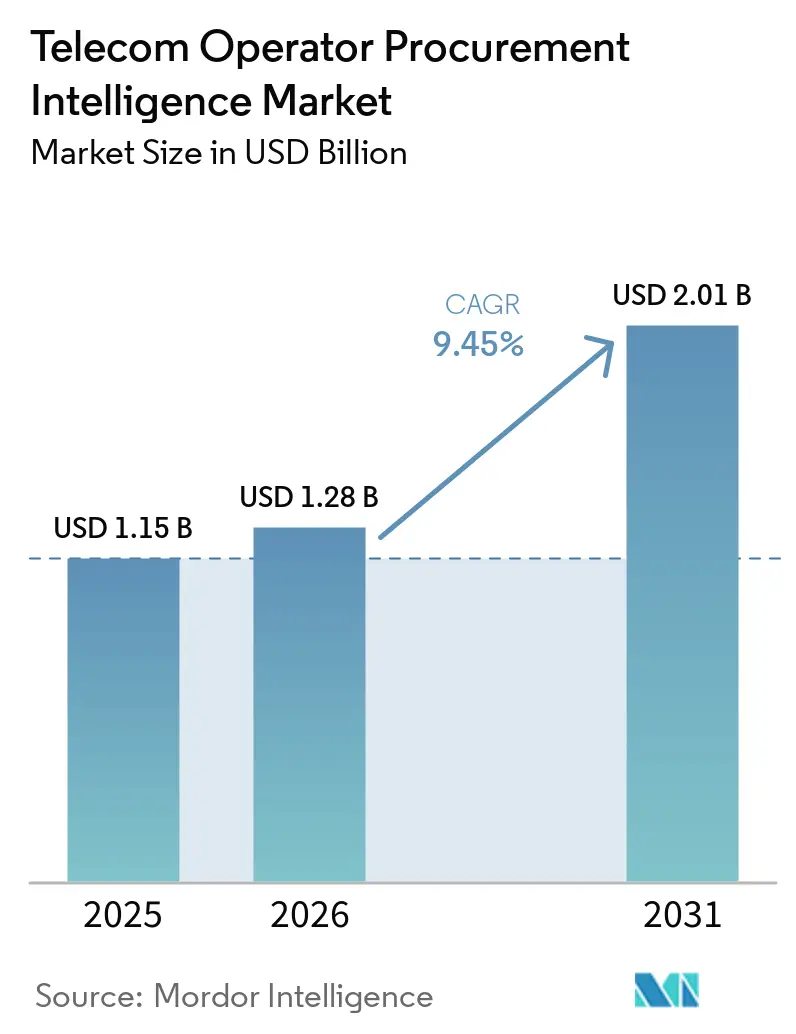
The Telecom Operator Procurement Intelligence Market size is projected to expand from USD 1.15 billion in 2025 to USD 1.28 billion in 2026, and to USD 2.01 billion by 2031, registering a CAGR of 9.45% between 2026 and 2031. External spending accounts for a major share of operator revenue, so better control of supplier costs can protect margins during periods of slow revenue growth. Procurement teams are moving beyond transactional buying as network modernization, supplier risk, and sustainability reporting drive more linked decision-making. Platforms are increasingly used to consolidate spend data, contract terms, supplier records, and compliance requirements into a single working view. The Telecom Operator Procurement Intelligence Market, therefore, favors tools that support data consolidation while integrating with existing enterprise systems.
Key Report Takeaways
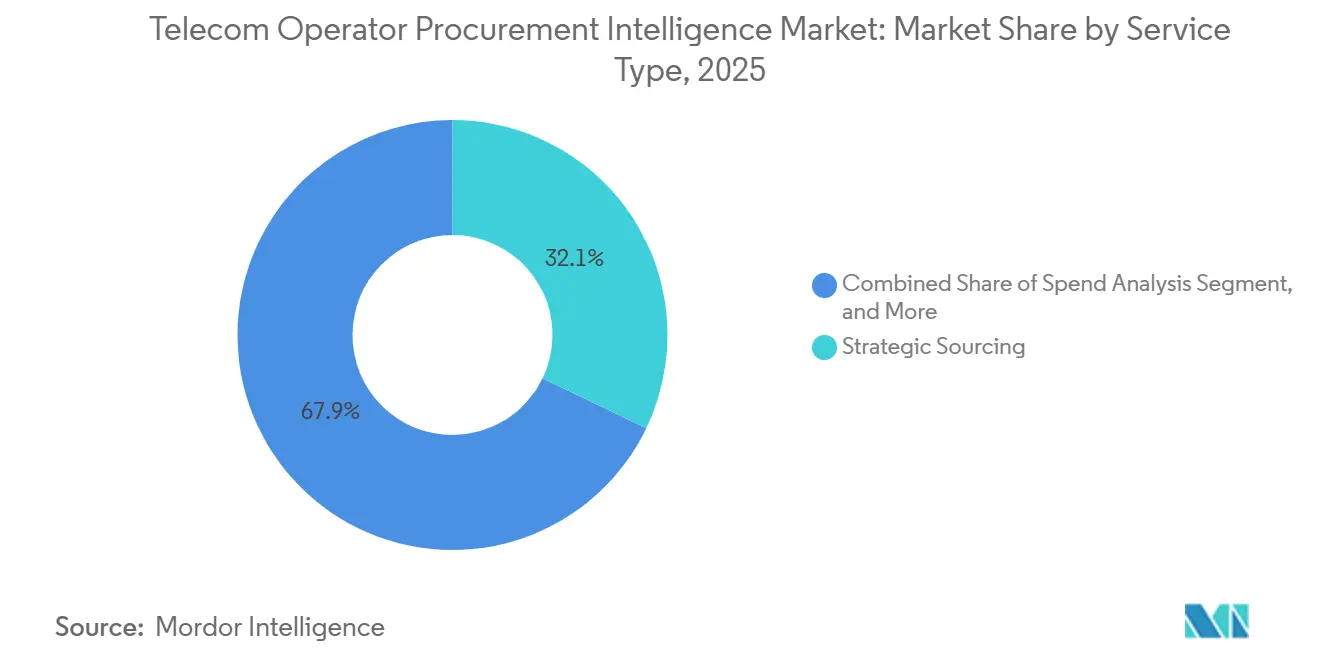
- By service type, Strategic Sourcing accounted for 32.14% of the Telecom Operator Procurement Intelligence Market 2025, while Spend Analysis recorded the highest projected CAGR at 12.61% through 2031.
- By deployment, Cloud-Based solutions held 76.42% in 2025, while Hybrid deployment recorded the highest projected CAGR at 12.73% through 2031.
- By organization size, Large Enterprises accounted for 83.16% of the Telecom Operator Procurement Intelligence Market 2025, while SMEs recorded the highest projected CAGR at 12.84% through 2031.
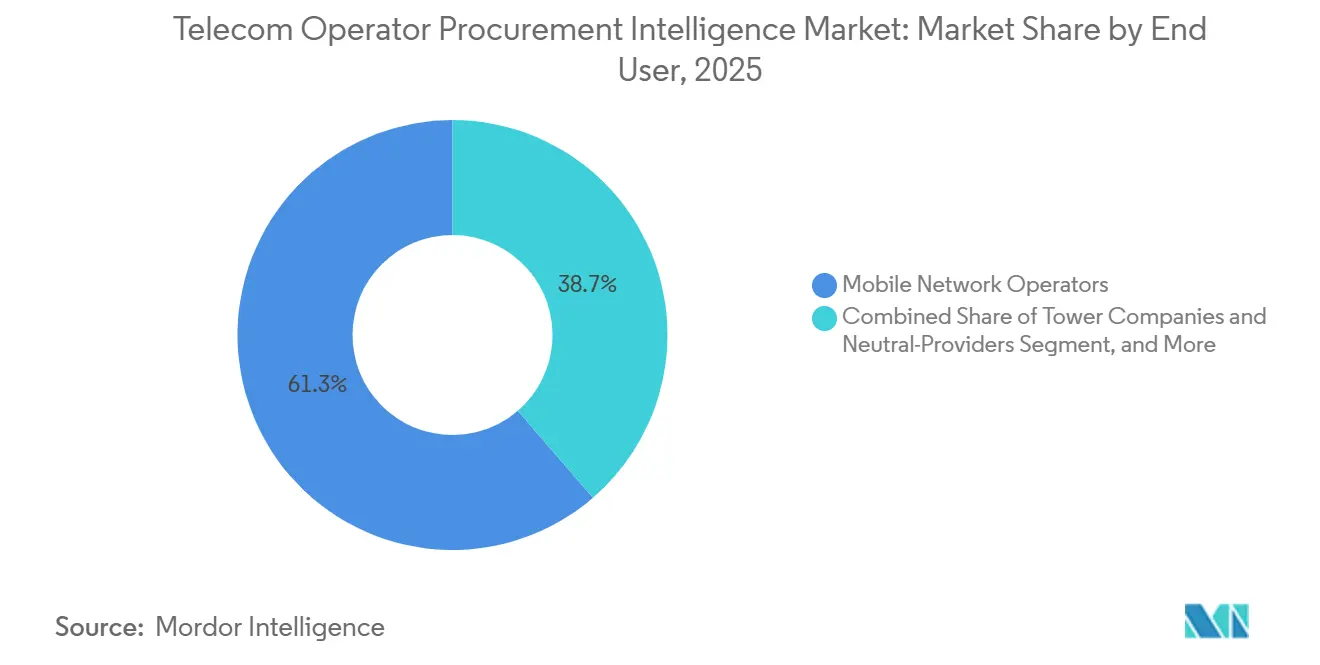
- By end user, Mobile Network Operators held 61.34% in 2025, while Tower Companies and Neutral-Host Providers recorded the highest projected CAGR at 12.96% through 2031.
- By procurement category, Radio Access Network Equipment accounted for 38.27% in the Telecom Operator Procurement Intelligence Market 2025, while Cloud, IT, and Software Services recorded the highest projected CAGR at 13.12% through 2031.
- By geography, North America held 38.42% in 2025, while Asia-Pacific recorded the highest projected CAGR at 13.24% through 2031.
Note: Market size and forecast figures in this report are generated using Mordor Intelligence’s proprietary estimation framework, updated with the latest available data and insights as of January 2026.
Market Trends and Insights
Drivers Impact Analysis of Telecom Operator Procurement Intelligence Market*
| Driver | (~) % Impact on CAGR Forecast | Geographic Relevance | Impact Timeline |
|---|---|---|---|
| Fragmented Telecom Procurement Data | +2.3% | Global | Short term (≤ 2 years) |
| 5G Standalone and Network Modernization Procurement | +2.1% | Asia-Pacific, North America, Middle East | Medium term (2-4 years) |
| Continuous Supplier Risk Monitoring | +1.8% | North America and Europe | Medium term (2-4 years) |
| Multi-Vendor and Open-Network Sourcing Complexity | +1.5% | Europe, Japan, North America | Medium term (2-4 years) |
| AI-Enabled Spend Classification and Contract Analytics | +1.2% | North America and Europe | Short term (≤ 2 years) |
| Sustainability and Scope 3 Reporting Requirements | +0.8% | Europe and North America | Long term (≥ 4 years) |
| Source: Mordor Intelligence | |||
Fragmented Telecom Procurement Data Creates Demand for Unified Intelligence
Telecom operators often use separate ERP, procurement, and finance systems across business units. These systems can leave category managers with inconsistent supplier names, contract records, and spending classifications. The resulting manual reconciliation makes it harder to compare categories such as managed services, software licenses, and professional fees. The Telecom Operator Procurement Intelligence Market addresses this problem by making normalized spend data usable in sourcing and contract decisions. Deutsche Telekom deployed SAP Business Network for Procurement across its supplier base, and SAP stated that the integration layer could be operational within 6 months.[1] Operators who delay data cleanup may find that automated tools perpetuate existing data-quality problems rather than resolving them.
5G Standalone and Network Modernization Procurement Intensifies Sourcing Complexity
5G standalone programs bring together contracts for radio access, core networks, transport, software, and managed services. Each agreement can use different performance obligations, licensing rules, and security requirements. Wind Tre signed a 7-year agreement with Ericsson for cloud-native dual-mode 5G Core modernization in 2026. Ericsson also agreed in March 2026 to expand and modernize SoftBank’s core network in Japan.[2] These programs show why the Telecom Operator Procurement Intelligence Market needs tools that connect supplier benchmarks, contract clauses, and forecasts before large frameworks are awarded. Open and cloud-native architectures also allow operators to reassess long-standing supplier relationships, but they add more interfaces and dependencies to manage.
Continuous Supplier Risk Monitoring Replaces Point-in-Time Reviews
Annual supplier reviews can miss financial, sanctions, cybersecurity, or environmental changes that occur during a contract. This weakness is greater where operators rely on a small number of vendors for essential network categories. Vodafone Telenor Procurement Company selected Exiger in May 2026 for supplier risk intelligence and third-party risk management transformation. The program covers continuous screening of supplier financial health, sanctions exposure, ESG compliance, and cybersecurity factors.[3] The Telecom Operator Procurement Intelligence Market is responding to this shift by offering tools that refresh risk information throughout the contract life cycle. Continuous monitoring can help teams intervene earlier when a critical supplier’s position changes.
Multi-Vendor and Open-Network Sourcing Complexity Demands Structured Procurement Intelligence
Open RAN and cloud-native network models require operators to coordinate equipment suppliers, software providers, systems integrators, and cloud partners. Procurement teams must then assess technical interfaces alongside pricing, delivery, and contract obligations. The United Kingdom’s independent telecom supply chain report noted that compliance in multi-vendor environments can be more complex than in single-vendor deployments.[4] The National Telecommunications and Information Administration identified interface compatibility, timing synchronization, and hardware dependencies as important integration issues in Open RAN deployments. The Telecom Operator Procurement Intelligence Market supports a common record of supplier commitments, performance measures, and sourcing events. Such records can make cross-supplier accountability more practical when the network design is disaggregated.
Restraints Impact Analysis of Telecom Operator Procurement Intelligence Market*
| Restraint | (~) % Impact on CAGR Forecast | Geographic Relevance | Impact Timeline |
|---|---|---|---|
| Integration Complexity Across ERP and Procurement Systems | -1.8% | Global, highest in emerging markets | Short term (≤ 2 years) |
| Data Sovereignty and Cross-Border Procurement Restrictions | -1.5% | Asia-Pacific, Europe, Middle East | Medium term (2-4 years) |
| Limited Standardization of Telecom Supplier and Contract Data | -1.2% | Global | Short term (≤ 2 years) |
| Procurement Budget Deferrals During Network Investment Cycles | -1.0% | North America and Europe | Medium term (2-4 years) |
| Source: Mordor Intelligence | |||
Integration Complexity Across ERP and Procurement Systems Delays Adoption Timelines
Procurement intelligence platforms depend on reliable links to existing ERP and procure-to-pay systems. Operators that expanded through mergers can have several data models and approval processes in place. This makes mapping, data replication, and interface testing a substantial part of deployment work. Colt Technology migrated procurement, finance, and human resources capabilities to SAP S/4HANA Cloud while integrating 5 enterprise platforms. The example shows why implementation can take longer than a standalone software purchase. The Telecom Operator Procurement Intelligence Market must therefore accommodate phased integration and robust information security controls.
Data Sovereignty and Cross-Border Procurement Restrictions Fragment Global Deployments
Multinational operators face different rules governing where transaction-, supplier-, and network-related data can be processed. India’s Telecommunications Authorization Rules, issued in July 2026, require network data, logs, and associated information to remain within India. Requirements of this kind can require local data environments for procurement functions that otherwise use a regional platform. The restriction may reduce the value of a single global spend view and increase governance work. The Telecom Operator Procurement Intelligence Market must offer deployment designs that preserve local control without completely separating supplier intelligence. These constraints are especially material where procurement records include security-sensitive supplier disclosures or contract terms.
*Our forecasts treat driver/restraint impacts as directional, not additive. The impact forecasts reflect baseline growth, mix effects, and variable interactions.
Telecom Operator Procurement Intelligence Market Segment Analysis
By Service Type:
Spend Analysis Expands Beyond Traditional SourcingStrategic Sourcing held 32.14% of the Telecom Operator Procurement Intelligence Market share in 2025. Its position reflects operators’ continued need for category strategy, request-for-proposal management, supplier negotiation, and framework agreement design. Supplier Management and Contract Management also remain important because performance monitoring continues after an award. Procurement teams need a clear record of obligations when contracts include network equipment, cloud services, and managed services. Spend Analysis is forecast to grow at a CAGR of 12.61% through 2031. The segment benefits when operators seek a consistent view of spending across different systems and entities. It can identify duplicate suppliers, unclassified transactions, and uneven buying patterns before a new sourcing event begins. This makes it useful alongside, rather than instead of, strategic sourcing processes.
The service mix is changing as procurement work becomes more closely linked to data management. A sourcing decision may require spending history, contract terms, supplier information, and operational requirements in the same workflow. This raises the value of platforms that can normalize raw transaction data without changing the underlying financial records. Spend analysis also supports demand management by showing where teams purchase similar products or services under different arrangements. Tail-spend management and compliance monitoring are included in the Others category. These applications matter when many small transactions collectively create a meaningful cost or control burden. The Telecom Operator Procurement Intelligence Market is likely to reward providers that connect these functions without forcing operators to replace every existing procurement application. The telecom operator procurement intelligence industry benefits from offerings that can start with one high-priority use case and broaden over time.

By Deployment:
Hybrid Architectures Address Control and Flexibility NeedsCloud-Based deployment held 76.42% of the Telecom Operator Procurement Intelligence Market in 2025. Cloud systems can offer faster feature updates and lower infrastructure management requirements than on-premises installations. SAP launched next-generation SAP Ariba on the SAP Business Technology Platform in March 2026, with Joule embedded across sourcing, contracting, and spend analytics workflows. This release supports operators seeking to align procurement functions with cloud-based enterprise systems. On-Premises deployment remains relevant where data residency, security, or internal control rules are strict. These conditions are particularly important for sensitive contract, supplier financial, and network security records. Cloud adoption does not remove the need to classify which records can be processed outside local environments.
Hybrid deployment is projected to grow at a CAGR of 12.73% between 2026 and 2031. It allows operators to retain sensitive data in controlled environments while using cloud resources for analytics and collaboration. This design can separate contract documents and security disclosures from lower-risk tasks such as supplier research and spend classification. Swisscom used SAP Ariba solutions to improve supplier management and achieve 100% e-invoice coverage across its supplier base. The case illustrates how connected procurement processes can improve visibility across a large supplier network. The Telecom Operator Procurement Intelligence Market can use hybrid models to serve regulated operators that do not want an all-cloud approach. Deployment choice will remain tied to local rules, existing applications, and the sensitivity of procurement data.
By Organization Size:
SMEs Gain Access Through Modular PlatformsLarge Enterprises accounted for 83.16% of the Telecom Operator Procurement Intelligence Market in 2025. These operators manage broad supplier portfolios across radio networks, core systems, fiber, managed services, and enterprise technology. They also have the resources to run multiyear programs covering sourcing, risk, contracts, and analytics. Their requirements often include integration with several systems acquired through prior business combinations. Large deployments may be introduced in phases to avoid disrupting operational purchasing and payment processes. The segment, therefore, remains the primary buyer base for full-suite procurement platforms. Its scale also supports specialized tools for discrete areas such as supplier risk or contract analysis. The Telecom Operator Procurement Intelligence Market continues to serve these customers with deep integration and governance capabilities.
SMEs are projected to grow at a CAGR of 12.84% through 2031. Regional carriers and virtual network operators can adopt a limited application, such as spend analytics or supplier onboarding, before considering a wider deployment. Subscription-based delivery lowers the upfront infrastructure burden for these organizations. Modular platforms can also reduce the need for a lengthy replacement program across all procurement processes. This approach helps smaller teams focus on categories where their purchasing data is most difficult to manage. It also allows internal users to assess data quality and operating value before expanding their investment. The telecom operator procurement intelligence industry is becoming more accessible to organizations below the largest operator tier. Suppliers that provide clear setup paths and relevant category structures may be better placed to serve this group.
By End User:
Tower Companies and Neutral Hosts Become Important BuyersMobile Network Operators held 61.34% of the Telecom Operator Procurement Intelligence Market share in 2025. MNOs purchase radio equipment, core software, transport capacity, managed services, and information technology simultaneously. Their contracts may cover several countries and several network generations. VodafoneThree announced a GBP 11 billion investment in 5G infrastructure in the United Kingdom, equal to USD 13.9 billion in the supplied material. Nokia is providing radio access network equipment for 7,000 sites under the related framework agreement. Such programs require clear supplier obligations, approval workflows, and records of category spending. Fixed-Line and Broadband Operators, as well as Integrated Telecommunications Operators, also have significant needs across fiber, active equipment, and enterprise service platforms.
Tower Companies and Neutral-Host Providers are forecast to grow at a CAGR of 12.96% through 2031. Their procurement needs cover new sites, maintenance, reinforcement, energy, and construction services. A 2025 European Wireless Infrastructure Association study stated that neutral-host tower companies invest EUR 2.5 billion annually in deployments, site reinforcement, and maintenance, equal to USD 2.7 billion in the supplied material. Nokia reported that the share of global telecom capital expenditure held by neutral hosts was expected to rise from 13% in 2024 to 17% by 2030. This shift gives the Telecom Operator Procurement Intelligence Market a buyer group with different categories and contracts from traditional mobile operators. It also increases the need for supplier comparisons in construction, energy, and network-sharing arrangements.
By Procurement Category:
Software and Cloud Services Grow Faster Than HardwareRadio Access Network Equipment held 38.27% of the Telecom Operator Procurement Intelligence Market in 2025. The category remains large because standalone 5G deployments require substantial investment in radio infrastructure. A radio framework can include hardware, virtualized software, energy tools, and network management applications. Vodafone selected Ericsson as its exclusive radio access network supplier for Ireland, the Netherlands, and Portugal under a 5-year agreement. Operators need separate performance measures and contract controls for each component of such an agreement. Optical Transport and Fiber Infrastructure, Core Network, and IP Equipment also remain major categories. Vendor consolidation in these categories can reduce integration burdens but can increase dependence on a narrower supplier base.
Cloud, IT, and Software Services are projected to grow at a CAGR of 13.12% through 2031. Operators are purchasing more cloud-native subscriptions, API-based services, and AI platform licenses as networks become more software-driven. These purchases use pricing and consumption models that differ from traditional equipment contracts. Procurement teams may need to review data use, usage thresholds, service levels, and licensing tiers before comparing offers. This increases the value of contract intelligence and structured supplier data. ISO/IEC 27001 and related assurance frameworks can also become part of supplier assessment for cloud and software purchases. The Telecom Operator Procurement Intelligence Market must support these nontraditional contract structures without treating them like standard hardware orders. Managed Services and other categories add further requirements for tracking performance and delivery outcomes.
Geography Analysis
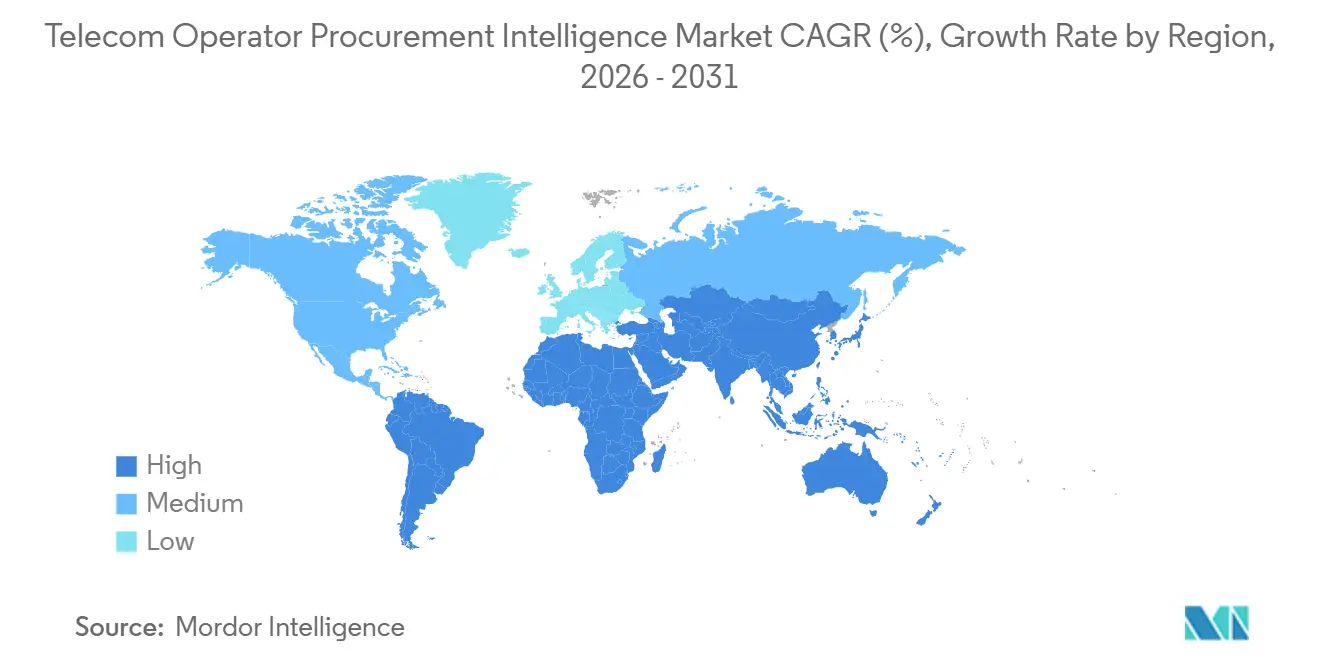
The Americas Telecom Operator Procurement Intelligence Market
North America held 38.42% in 2025. The region has a mature procurement technology environment and major carriers with large capital transformation programs. AT&T had earmarked USD 14 billion through 2027 for platform overhauls across the network, information technology, and operations functions, as stated in the supplied material. This scale creates demand for procurement records that connect technology spending with supplier performance. The region’s established source-to-pay systems can support adoption, but legacy system integration still slows some projects. South America is a smaller but growing area as Brazilian and Chilean operators formalize procurement programs within broader digital transformation work. The Telecom Operator Procurement Intelligence Market has room to expand, where operators move from dispersed buying practices toward category and supplier management.
APAC Telecom Operator Procurement Intelligence Market
Asia-Pacific is forecast to grow at a CAGR of 13.24% through 2031. China, Japan, India, and South Korea are advancing network modernization programs that increase the volume and complexity of procurement activity. India’s 2026 data localization requirement can favor localized procurement data environments. NTT DoCoMo has required major vendors to collaborate on multi-vendor Open RAN integration, which increases the value of shared performance and contract oversight. South Korea’s SK Telecom maintained a Sustainable Procurement Policy that requires suppliers to report ESG performance and align with Science-Based Targets. Ericsson’s March 2026 agreement with SoftBank also illustrates the large core modernization contracts in the region. These conditions create demand for tools that can manage local compliance and multi-vendor sourcing in the same environment.
MEA Telecom Operator Procurement Intelligence Market
The Middle East and Africa have a smaller aggregate position but a strong demand for modernization. Ooredoo Qatar selected Nokia in February 2025 to modernize its core network and enable 5G standalone services. The agreement reflects the need to compare technology, service, and operating requirements during core network sourcing. Procurement practices in Africa are at an earlier stage, with growing activity among South African and Nigerian operators. The GSMA stated in July 2026 that 3 quarters of mobile-sector carbon emissions come from Scope 3 value chain sources. Its Scope 3 Assessment Tool provides a common basis for supplier-related emissions work. The Telecom Operator Procurement Intelligence Market can support operators seeking to integrate supplier sustainability data into commercial sourcing decisions.
Competitive Landscape
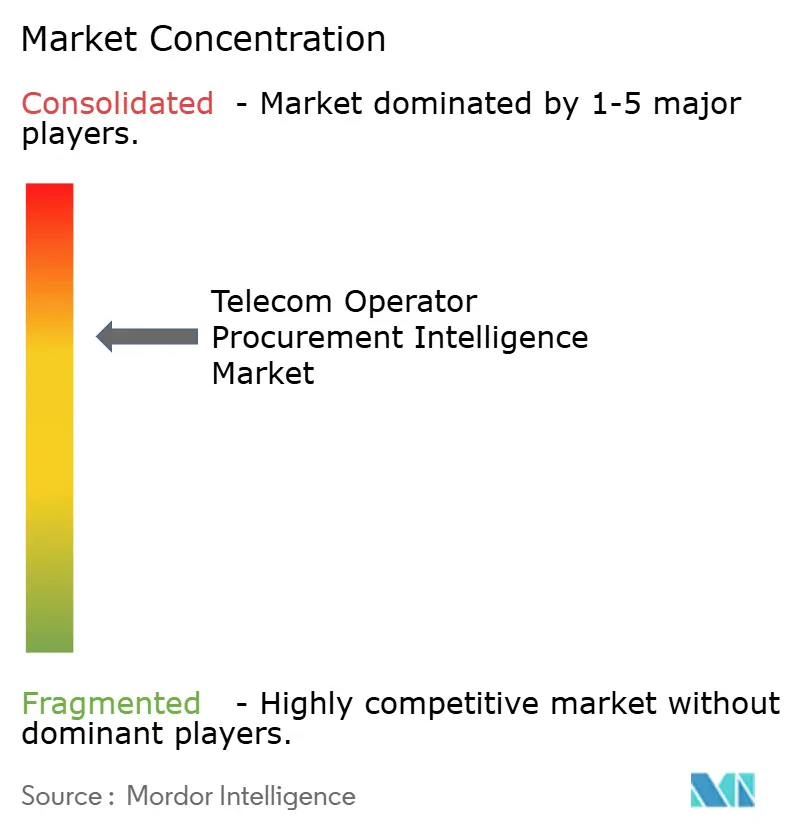
The Telecom Operator Procurement Intelligence Market is moderately consolidated. Competition includes broad source-to-pay platforms and more specialized procurement intelligence providers. SAP Ariba, Coupa, GEP Worldwide, Jaggaer, and Ivalua compete in the enterprise procurement suite market. Their selection often depends on ERP fit, integration options, data openness, and implementation cost. Specialized providers such as Suplari, Beroe, and SpendEdge focus on procurement analytics, category information, and faster deployment. These providers can work as an intelligence layer beside an existing transactional platform. The competitive field, therefore, includes both suite replacement decisions and targeted capability purchases. Providers must show that their software can work with the operator’s current systems and supplier records.
Artificial intelligence features are becoming central to supplier screening, contract extraction, and spend classification. GEP stated that its MINERVA capability supports predictive intelligence, contract extraction, and supplier risk monitoring. The company was named a Leader in the 2026 Gartner Magic Quadrant for Source-to-Pay Suites and ranked first in The Hackett Group’s 2026 Solution Map, as reported in the supplied material. This recognition indicates that procurement teams are placing more weight on usable intelligence than on transaction processing alone. Jaggaer introduced its Agent OS platform at its REV 2026 conference. Its 2026 deployment with Open Fiber included source-to-contract intelligence, bidirectional ERP integration, and a supplier risk control tower. Exiger’s selection by Vodafone Telenor Procurement Company shows that continuous supplier risk monitoring is also becoming a distinct area of buying.
Coupa expanded its capabilities through acquisitions that addressed supplier discovery, workflow automation, and document processing. It acquired Scoutbee in October 2025 to strengthen its supplier discovery and intelligence capabilities. It also acquired Rossum in May 2026 to add AI-native document processing for invoice capture and accounts payable automation. SAP’s March 2026 launch of next-generation SAP Ariba embedded intelligent assistance in core procurement workflows. These moves show a focus on building connected capabilities across intake, sourcing, contracts, suppliers, and invoices. Open RAN supplier mapping, telecom category taxonomies, and sustainability data remain areas where providers can differentiate. The Telecom Operator Procurement Intelligence Market is unlikely to favor a single standard approach because operators have different ERP landscapes, regulations, and network sourcing models.
Telecom Operator Procurement Intelligence Industry Leaders
-
Huawei Technologies Co., Ltd.
-
Nokia Corporation
-
Ericsson AB
-
ZTE Corporation
-
Cisco Systems, Inc.
- *Disclaimer: Major Players sorted in no particular order
Telecom Operator Procurement Intelligence Market Companies Covered in this Report
- Huawei Technologies Co., Ltd.
- Ericsson AB
- Nokia Corporation
- ZTE Corporation
- Samsung Electronics Co., Ltd.
- Cisco Systems, Inc.
- NEC Corporation
- Fujitsu Limited
- Ciena Corporation
- Juniper Networks, Inc.
- CommScope Holding Company, Inc.
- Corning Incorporated
- Infinera Corporation
- Ribbon Communications Inc.
- Adtran Holdings, Inc.
- FiberHome Telecommunication Technologies Co., Ltd.
- Mavenir Systems, Inc.
- Airspan Networks Inc.
- Sterlite Technologies Limited
- EXFO Inc.
- Tejas Networks Limited
- Ekinops S.A.
- Aviat Networks, Inc.
- Ceragon Networks Ltd.
- Cambium Networks Corporation
Recent Industry Developments in Telecom Operator Procurement Intelligence Market
- July 2026: JAGGAER announced a deep source-to-contract strategic partnership with Open Fiber, Italy’s leading FTTH operator, expanding the platform’s role from e-procurement management to full strategic intelligence, including supplier risk control tower capabilities and bidirectional ERP integration
- May 2026: Exiger was selected by Vodafone Telenor Procurement Company to deliver AI-driven supplier risk intelligence and third-party risk management transformation. Exiger’s platform will provide unified supplier screening across financial health, sanctions exposure, ESG compliance, and cybersecurity domains.
- May 2026: Coupa acquired Rossum to enhance invoice capture and accounts payable automation as a native platform capability.
- March 2026: SAP launched next-generation SAP Ariba on SAP Business Technology Platform as an AI-native source-to-pay rebuild with the Joule AI assistant embedded in procurement workflows.
Global Telecom Operator Procurement Intelligence Market Report Scope
The telecom operator procurement intelligence market comprises software solutions and services that optimize sourcing, purchasing, and supplier management for telecommunications service providers. This includes strategic sourcing, contract and supplier management, and spend analysis across critical procurement categories, including radio access network equipment, optical transport, core network infrastructure, and managed IT services. Deployed via cloud, on-premises, or hybrid models, these solutions help mobile network operators, tower companies, and broadband providers reduce capital and operational expenditures, mitigate supply chain risks, and improve vendor performance and contract compliance in a highly complex and capital-intensive industry.
The Telecom Operator Procurement Intelligence Market Report is Segmented by Service Type (Strategic Sourcing, Supplier Management, Contract Management, Spend Analysis, and Other Services), Deployment (Cloud-Based, On-Premises, and Hybrid), Organization Size (Large Enterprises, and Small and Medium-Sized Enterprises), End User (Mobile Network Operators, Fixed-Line and Broadband Operators, Integrated Telecommunications Operators, Tower Companies and Neutral-Host Providers, and Other End Users), Procurement Category (Radio Access Network Equipment, Optical Transport and Fiber Infrastructure, Core Network and IP Equipment, Cloud, IT, and Software Services, and Managed Network Services), and Geography (North America, South America, Europe, Asia-Pacific, Middle East, and Africa). The Market Forecasts are Provided in Terms of Value (USD).
Segmentation Overview
| Strategic Sourcing |
| Supplier Management |
| Contract Management |
| Spend Analysis |
| Other Service Types |
| Cloud-Based |
| On-Premises |
| Hybrid |
| Large Enterprises |
| Small and Medium-Sized Enterprises |
| Mobile Network Operators |
| Fixed-Line and Broadband Operators |
| Integrated Telecommunications Operators |
| Tower Companies and Neutral-Host Providers |
| Other End users |
| Radio Access Network Equipment |
| Optical Transport and Fiber Infrastructure |
| Core Network and IP Equipment |
| Cloud, IT, and Software Services |
| Managed Network Services |
| North America | United States |
| Canada | |
| Mexico | |
| South America | Brazil |
| Argentina | |
| Chile | |
| Rest of South America | |
| Europe | Germany |
| United Kingdom | |
| France | |
| Italy | |
| Spain | |
| Rest of Europe | |
| Asia-Pacific | China |
| Japan | |
| India | |
| South Korea | |
| Australia | |
| Rest of Asia-Pacific | |
| Middle East | United Arab Emirates |
| Saudi Arabia | |
| Qatar | |
| Rest of Middle East | |
| Africa | South Africa |
| Egypt | |
| Nigeria | |
| Rest of Africa |
| By Service Type | Strategic Sourcing | |
| Supplier Management | ||
| Contract Management | ||
| Spend Analysis | ||
| Other Service Types | ||
| By Deployment | Cloud-Based | |
| On-Premises | ||
| Hybrid | ||
| By Organization Size | Large Enterprises | |
| Small and Medium-Sized Enterprises | ||
| By End User | Mobile Network Operators | |
| Fixed-Line and Broadband Operators | ||
| Integrated Telecommunications Operators | ||
| Tower Companies and Neutral-Host Providers | ||
| Other End users | ||
| By Procurement Category | Radio Access Network Equipment | |
| Optical Transport and Fiber Infrastructure | ||
| Core Network and IP Equipment | ||
| Cloud, IT, and Software Services | ||
| Managed Network Services | ||
| By Geography | North America | United States |
| Canada | ||
| Mexico | ||
| South America | Brazil | |
| Argentina | ||
| Chile | ||
| Rest of South America | ||
| Europe | Germany | |
| United Kingdom | ||
| France | ||
| Italy | ||
| Spain | ||
| Rest of Europe | ||
| Asia-Pacific | China | |
| Japan | ||
| India | ||
| South Korea | ||
| Australia | ||
| Rest of Asia-Pacific | ||
| Middle East | United Arab Emirates | |
| Saudi Arabia | ||
| Qatar | ||
| Rest of Middle East | ||
| Africa | South Africa | |
| Egypt | ||
| Nigeria | ||
| Rest of Africa | ||
Key Questions Answered in the Report
How large is the Telecom Operator Procurement Intelligence Market?
Telecom Operator Procurement Intelligence Market is projected to rise from USD 1.28 billion in 2026 to USD 2.01 billion by 2031 at a 9.45% CAGR.
What is driving demand for telecom operator procurement intelligence?
Fragmented spend data, 5G sourcing, multi-vendor networks, and continuous supplier risk monitoring are key demand factors.
Which service type is growing fastest?
Spend Analysis is projected to expand at a 12.61% CAGR through 2031.
Why are hybrid deployment models growing?
Hybrid models preserve control over sensitive data while enabling cloud-based analytics and collaboration.
Which end users are expanding fastest?
Tower Companies and Neutral-Host Providers are forecast to grow at a 12.96% CAGR through 2031.
Which region is growing fastest?
Asia-Pacific is projected to grow at a 13.24% CAGR through 2031, supported by regional modernization programs.