
Telecom Marketing Services Market Size and Share
Market Overview
| Study Period | 2020 - 2031 |
|---|---|
| Market Size (2026) | USD 33.12 Billion |
| Market Size (2031) | USD 53.47 Billion |
| Growth Rate (2026 - 2031) | 10.05 % |
| Fastest Growing Market | Asia-Pacific |
| Largest Market | North America |
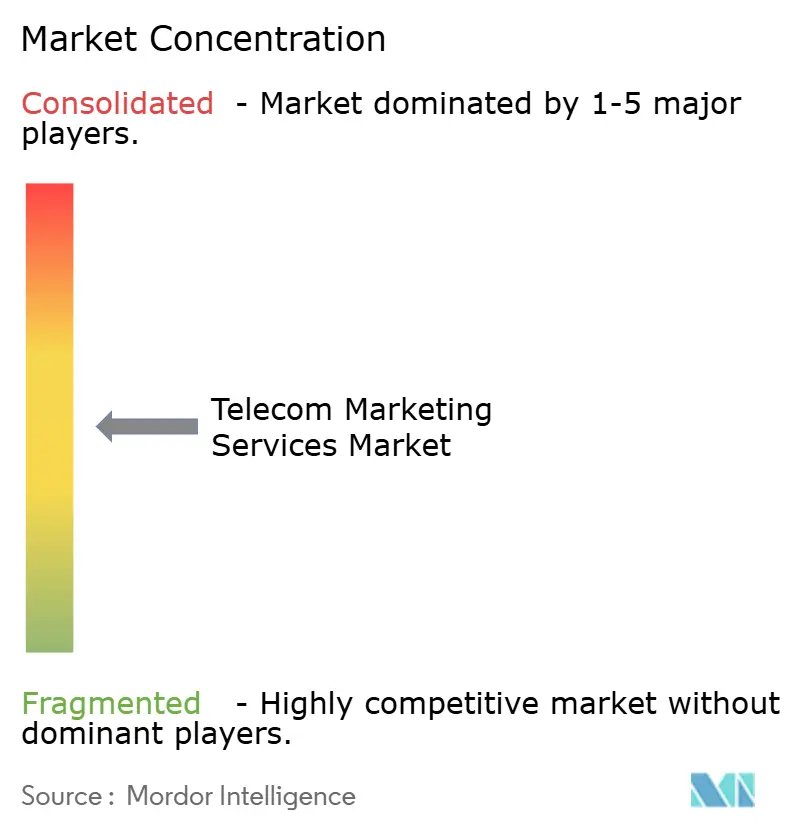
| Market Concentration | Medium |
Major Players *Disclaimer: Major Players sorted in no particular order Image © Mordor Intelligence. Reuse requires attribution under CC BY 4.0. | |
Telecom Marketing Services Market Analysis by Mordor Intelligence
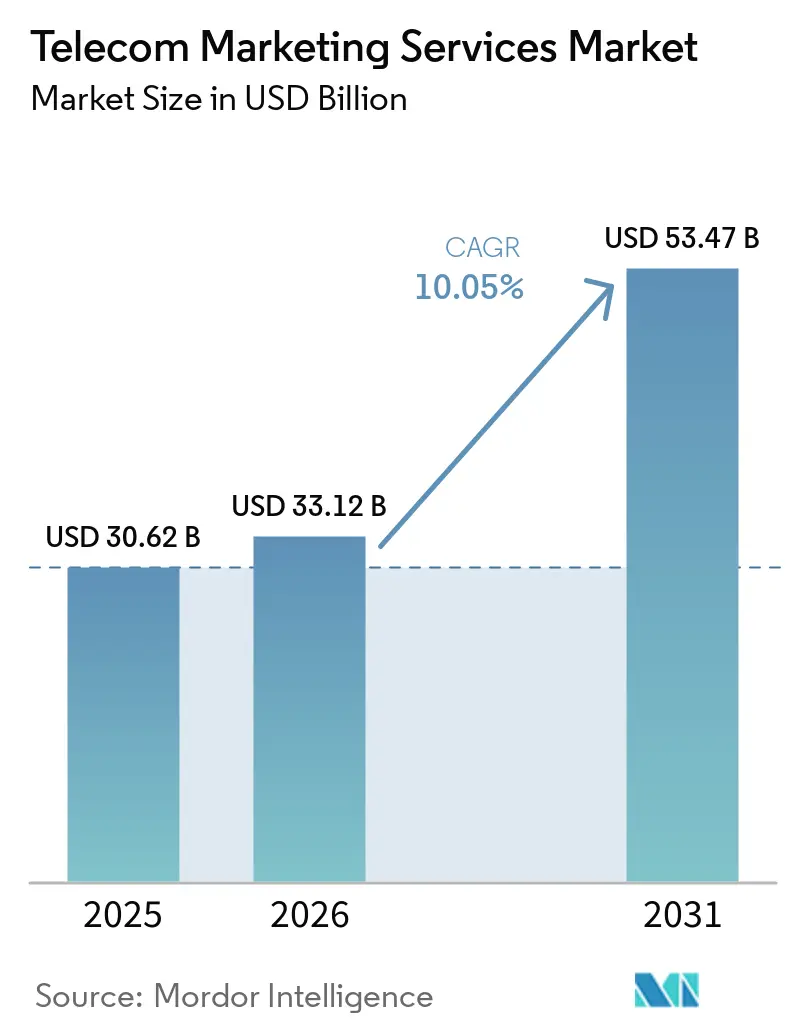
The telecom marketing services market size was valued at USD 30.62 billion in 2025 and estimated to grow from USD 33.12 billion in 2026 to reach USD 53.47 billion by 2031, at a CAGR of 10.05% during the forecast period (2026-2031). The Telecom Marketing Services Market is expanding as operators in mature subscriber markets place more weight on retention, customer value, and revenue per user. AI-based campaign management, real-time decisioning, and performance measurement are becoming central to how operators manage customer engagement. 5G growth is increasing the need for offers that reflect a customer's usage, service quality, and willingness to adopt bundled services. The Telecom Marketing Services Market also benefits when providers connect network experience information with customer interactions, since a service failure can prompt a timely retention action. Competition is shifting toward platforms and service providers that can combine network, billing, and customer data without adding complexity to existing systems.
Key Report Takeaways
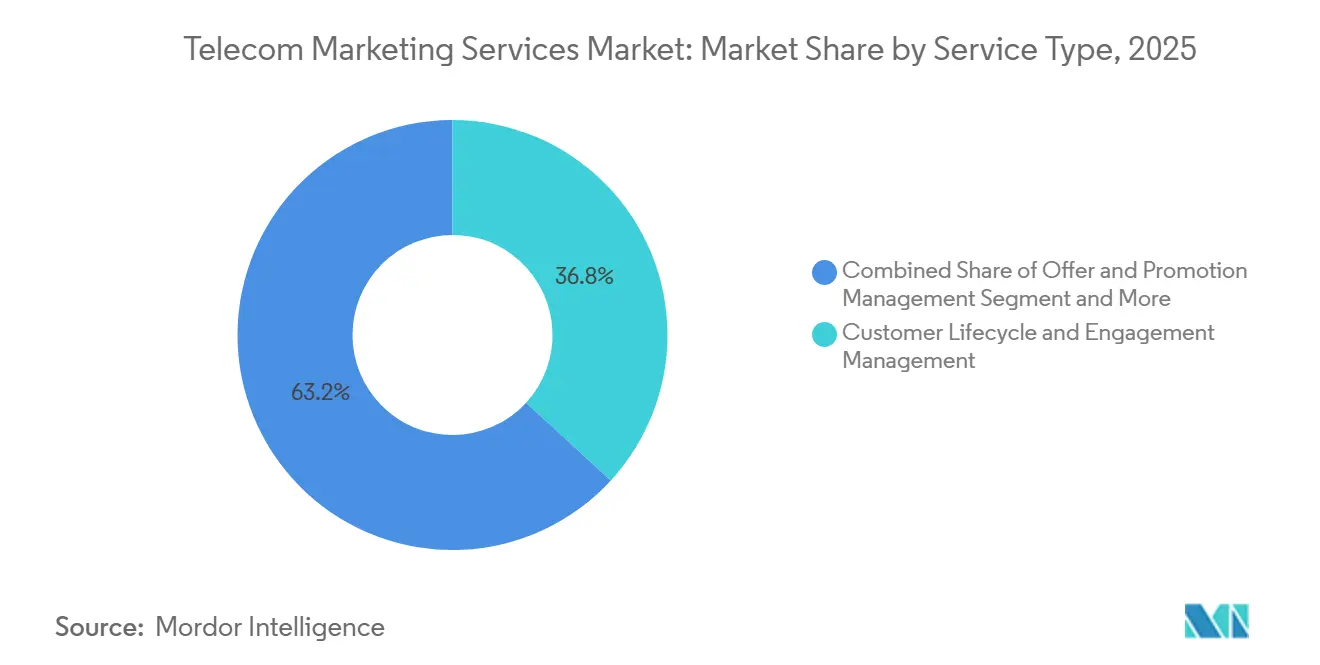
- By service type, Customer Lifecycle and Engagement Management held 36.8% share of the telecom marketing services market size in 2025, while Marketing Performance Measurement and Optimization is forecast to grow at a 10.9% CAGR through 2031.
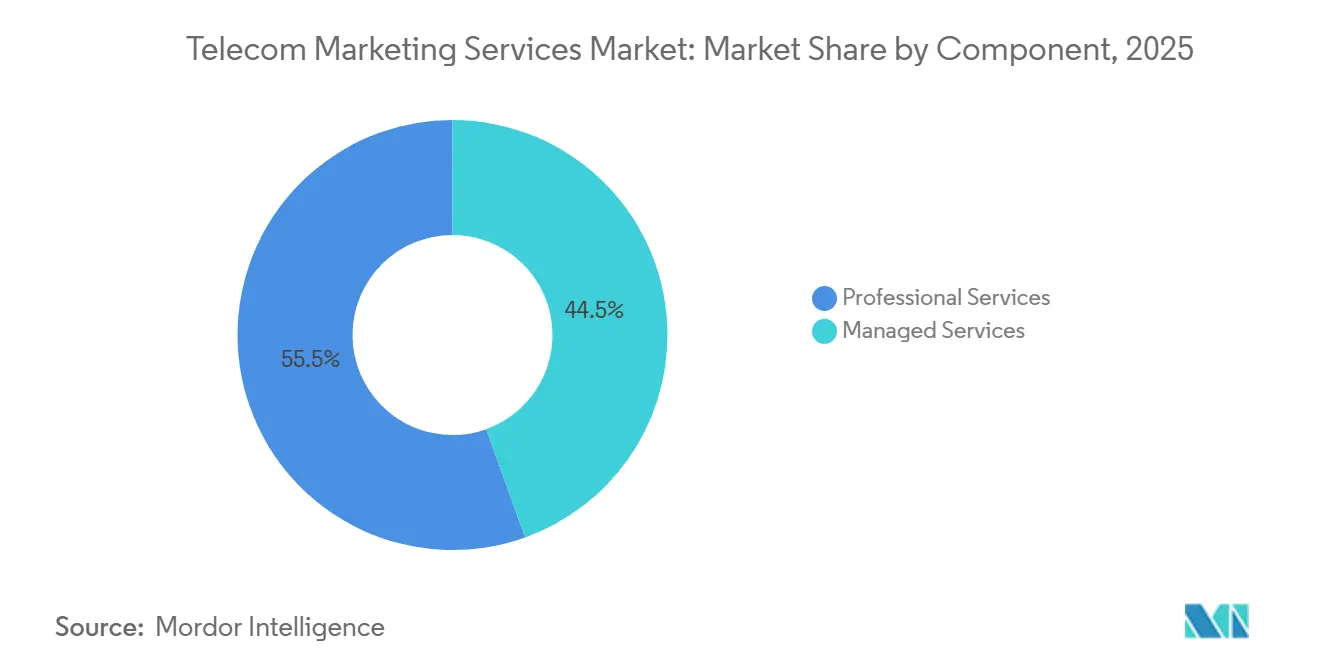
- By component, Professional Services held 55.5% share of the telecom marketing services market size in 2025, while Managed Services is forecast to grow at a 10.7% CAGR through 2031.
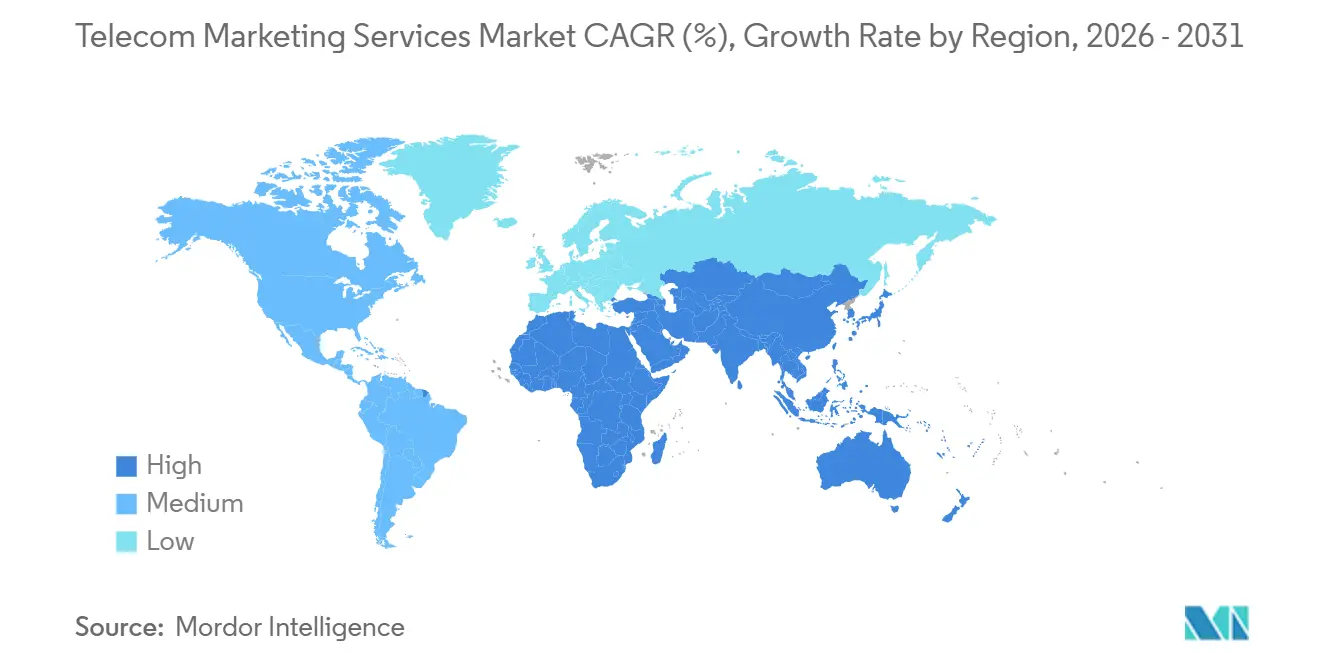
- By geography, North America held 34.7% share of the telecom marketing services market size in 2025, while the Asia-Pacific is forecast to grow at a 10.8% CAGR through 2031.
Note: Market size and forecast figures in this report are generated using Mordor Intelligence’s proprietary estimation framework, updated with the latest available data and insights as of January 2026.
Market Trends and Insights
Drivers Impact Analysis of Telecom Marketing Services Market*
| Driver | (~) % Impact on CAGR Forecast | Geographic Relevance | Impact Timeline |
|---|---|---|---|
| Reducing Subscriber Churn and Protecting Lifetime Value | +2.6% | Global | Short term (≤ 2 years) |
| Personalized Omnichannel Engagement | +2.1% | North America and Europe, with spillover to Asia-Pacific | Medium term (2-4 years) |
| AI-Driven Next-Best-Action and Campaign Automation | +1.9% | North America, Europe, and core Asia-Pacific markets | Medium term (2-4 years) |
| 5G and Converged Service Monetization | +1.4% | Asia-Pacific, Europe, and the Middle East | Long term (≥ 4 years) |
| Network Experience Telemetry for Retention | +0.8% | Global, with Asia-Pacific and Europe leading deployment | Medium term (2-4 years) |
| B2B Connectivity and Buyer-Group Orchestration | +0.6% | North America and Europe | Long term (≥ 4 years) |
| Source: Mordor Intelligence | |||
Rising Need to Reduce Subscriber Churn and Protect Lifetime Value
Subscriber churn remains a major source of revenue loss for telecom operators, especially in mature consumer markets. The Telecom Marketing Services Market is supported by operators that need to identify customers at risk before they move to another provider. AI-based churn models move retention work beyond fixed rules by integrating billing, usage, service, and customer contact data. A 2025 study reported that a Random Forest model achieved 95.1% accuracy and an AUC of 0.89 in a telecom churn dataset, with day charges and service-call volume among the strongest signals.[1] The models can also help staff prioritize cases where a service problem and a commercial risk occur together. This capability changes marketing from broad campaign delivery into targeted action for customers who may need a different plan, support response, or loyalty offer.
Shift to Omnichannel Personalized Engagement Across Digital and Assisted Channels
Many operators offer customers several channels, but the information from an app, website, store, and contact center often remains separated. The Telecom Marketing Services Market grows when vendors help operators preserve the context of an interaction as a customer moves between those channels. An integrated approach can reduce the need for customers to repeat account or service issues after switching channels. It can also give a service representative a clearer view of the action already taken in a digital channel. KDDI reported that its AI-based omnichannel approach helped its customer satisfaction rating reach 90%, its highest recorded level. Vendors with strong integration skills are therefore likely to compete more effectively than those that only offer a large number of isolated campaign features.
Expansion of AI-Driven Next-Best-Action and Campaign Automation
Next-best-action systems now support more than product recommendations, as they can guide or automate upgrades, retention offers, and bundle activation. This is a key demand driver for the Telecom Marketing Services Market because operators need relevant actions at the point a customer is most likely to respond. AI-based systems can support plan changes, retention offers, and bundle activation at the time when a customer is most likely to respond. The example shows why operators are considering AI tools that can complete selected customer actions rather than only recommend them to an employee. A reliable process also requires clear rules for human intervention when a customer request needs additional review. Specialized managed delivery is becoming more important because models must be trained, monitored, and updated with each operator's subscriber and network data.
5G and Converged Service Monetization Requiring Smarter Offer Managemen
5G services create more complicated commercial requirements than conventional mobile plans because offers can include network quality, usage, partner services, and changing prices. The Telecom Marketing Services Market benefits as operators need systems that can design, price, and manage these offers in real time. Comviva stated that fragmentation across legacy billing and product-catalog systems can extend the time to launch a 5G offer from an optimal 14 days to more than 6-8 months.[2] This delay can cause an operator to miss a sales opportunity even when the network and the underlying service are ready. It can also make testing a new bundle more difficult when its pricing must pass through separate systems. Amdocs acquired Matrixx Software for USD 200 million in late 2025 to strengthen real-time charging for 5G standalone monetization, showing the value placed on integrated charging and offer capabilities.
Restraints Impact Analysis of Telecom Marketing Services Market*
| Restraint | (~) % Impact on CAGR Forecast | Geographic Relevance | Impact Timeline |
|---|---|---|---|
| Data Privacy and Consent Limits on Customer Data | -0.6% | Europe, with spillover to North America and Asia-Pacific | Short term (≤ 2 years) |
| Legacy BSS and CRM Fragmentation | -0.5% | Global, with the Middle East, Africa, and South America most exposed | Long term (≥ 4 years) |
| Offer Fatigue and Promotional Saturation | -0.3% | North America and Europe | Short term (≤ 2 years) |
| Telecom Data Engineering Gaps for AI Models | -0.2% | Global, with emerging markets most exposed | Medium term (2-4 years) |
| Source: Mordor Intelligence | |||
Data Privacy and Consent Rules Limiting Customer Data Activation
Telecom operators hold detailed information on network usage, location, billing, and service experience, but they cannot use that information freely for marketing. The Telecom Marketing Services Market must operate within consent requirements that can restrict customer data activation. The European Union's ePrivacy Directive requires consent for processing traffic data for marketing purposes, and consent can be withdrawn.[3] These obligations make recordkeeping, consent management, and privacy-preserving analytics important parts of a telecom marketing program. They also require marketing teams to explain the purpose of a data request in a clear and accessible manner. Operators that relied on inferred consent or third-party customer lists may need to redesign their data flows, which can add cost and delay campaigns.
Legacy BSS and CRM Fragmentation Slowing Execution and ROI
Legacy business support systems and customer relationship management platforms limit the speed at which operators can use marketing data. The Telecom Marketing Services Market faces this constraint because billing, product catalogs, campaign tools, and customer records are often managed in separate systems. A disconnected environment makes it difficult to link a campaign message with a subscriber decision or revenue outcome. It also makes it harder to establish a single customer view, even when the operator has extensive data. Teams may then spend time matching records before they can test or assess a marketing action. This limitation is most difficult for operators who have added systems over many years without a common data model.
*Our forecasts treat driver/restraint impacts as directional, not additive. The impact forecasts reflect baseline growth, mix effects, and variable interactions.
Telecom Marketing Services Market Segment Analysis
By Service Type:
Lifecycle Management Leads While Measurement Optimization AcceleratesCustomer Lifecycle and Engagement Management accounted for 36.8% of service-type revenue in 2025. Its lead reflects the priority that operators place on reducing churn and increasing customer value through retention, loyalty, and context-based upsell activity. These services connect customer data with actions such as a renewal message, a plan review, or a loyalty benefit. Operators have invested for years in customer relationship management and decisioning tools, which support the segment's established position. The Telecom Marketing Services Market size for this service is supported by a move from periodic campaigns toward continuous customer management. AI-led customer value management can turn lifecycle programs into systems that support ongoing commercial action. The service also requires close coordination with service, billing, and network teams because a customer's experience can affect the best retention response. Providers that understand telecom data structures are better placed to deliver this coordination. Their work can include defining the practical rules that determine when an offer should be withheld rather than sent.
Marketing Performance Measurement and Optimization is forecast to expand at a 10.9% CAGR from 2026 to 2031, the fastest rate among service types. Operators are placing greater emphasis on closed-loop measurement as campaign budgets become larger and more closely reviewed. Measurement tools can show whether a message, offer, or channel interaction led to a customer action. This is difficult where data is split across marketing, billing, and service platforms, so the work often includes integration and data preparation. Offer and Promotion Management remains closely tied to 5G monetization because providers need to introduce, adjust, and retire consumer and enterprise bundles without long delays. The other service category includes partner marketing and retail media activities, which are receiving more attention as operators seek revenue beyond connectivity plans. The service scope is broadening as operators explore partner relationships and new customer-facing digital services. This expansion creates a need for systems that can govern partner offers while protecting customer consent. It also places greater value on clear reporting of which partner activity produces a customer response.

By Component:
Professional Services Lead While Managed Delivery ScalesProfessional Services represented 55.5% of the Telecom Marketing Services Market share in 2025. The segment's lead reflects the difficulty of deploying AI-based marketing tools across separate billing, customer relationship management, and product systems. Large operators often need support to design customer data structures, connect decisioning tools with charging platforms, and prepare models using their own subscriber information. These assignments are commonly long and involve several internal teams as well as platform suppliers. The Telecom Marketing Services Market size for Professional Services, therefore, depends on technical integration as much as on campaign strategy. Amdocs was selected by Three Scandinavia in June 2026 to deploy its Customer Engagement Platform across Sweden and Denmark through a phased implementation. The project illustrates how an operator may consolidate marketing, sales, and service functions over time rather than replace all systems at once. Telecom-specific experience remains important because implementation teams must work around embedded business rules in older systems. The same expertise helps them test new processes without disrupting billing or customer support.
Managed Services is forecast to grow at a 10.7% CAGR from 2026 to 2031. Operators increasingly seek outside support for the day-to-day operation of AI-intensive marketing platforms rather than build every capability internally. This model includes campaign execution, model management, and customer-journey orchestration. It changes vendor relationships from a one-time implementation project to an ongoing delivery agreement that can be linked to marketing performance. Flytxt partnered with Digicel Trinidad and Tobago in July 2026 to deploy its cloud-native Neon-dX platform for AI-powered customer value management across prepaid and postpaid subscribers. The company took responsibility for an always-on engagement approach rather than a single campaign deployment. Managed delivery can be particularly useful where an operator has limited internal data-science capacity. It also allows vendors to apply operating experience gained across multiple telecom deployments while keeping each operator's data environment separate. The arrangement can give operators more time to focus on commercial priorities and customer policy.
Geography Analysis
North America and Europe Telecom Marketing Services Market
North America held 34.7% of the Telecom Marketing Services Market share in 2025. The region benefits from mature digital customer engagement, extensive cloud infrastructure, and early use of AI in customer journeys. United States operators have increasingly used AI deployments with direct revenue objectives, which supports investment in marketing and monetization tools. Europe is another important regional base, led by Germany, the United Kingdom, and France, where operators use lifecycle tools under demanding privacy and consent requirements. The ePrivacy Directive and the General Data Protection Regulation increase implementation work while supporting demand for consent management and privacy-preserving analytics.
APAC Telecom Marketing Services Market
Asia-Pacific is forecast to record a 10.8% CAGR from 2026 to 2031, making it the fastest-growing geography in the Telecom Marketing Services Market. India, China, Japan, South Korea, and Southeast Asian countries combine large subscriber bases with growing interest in AI-led service and engagement models. India reached 1.2 billion telecom subscribers in 2025, including 394 million 5G subscriptions at year-end, creating intense competition for customer retention among major operators. In China, mobile internet traffic reached 395.8 billion gigabytes in 2025, while mobile data revenue declined, increasing the need for new personalized services and monetization methods. Investment in advanced connectivity and AI workloads, together with Comviva's February 2026 launch of a digital distribution system with CelcomDigi, supports demand for real-time offers and sales management.
MEA and South America Telecom Marketing Services Market
South America, the Middle East, and Africa are smaller regions in the Telecom Marketing Services Market, but they offer targeted growth opportunities. Infobip's February 2026 deployment with Vero in Brazil produced a 16x return on investment, BRL 500,000 (USD 85,000) in annual savings, and a 65% reduction in invoice resending within 3 months. Saudi Arabia and the United Arab Emirates are promoting telecom modernization through digital programs and 5G-focused network strategies. African demand is at an earlier stage, and infrastructure and data engineering constraints still affect subscriber monetization, although MTN Uganda's 2026 partnership with Infobip points to growing demand for AI-powered customer management capabilities.[4]
Competitive Landscape
The Telecom Marketing Services Market is moderately fragmented, as no supplier dominates every service type or region. Telecom-focused suppliers such as Amdocs, Comviva, Flytxt, and Netcracker compete through business-support-system integration and telecom-specific AI models. Salesforce, Oracle, and Adobe offer broader marketing cloud platforms, while Accenture and SAP SE often help operators assemble multivendor systems. Competitive strength increasingly depends on integrating network experience, customer behavior, and charging data into a single decisioning process.
Amdocs positioned its aOS product as an agentic operating system for telecommunications and expanded its relationship with T-Mobile across managed services, software development, and AI. The move supports contracts that combine software with recurring operational services. NEC completed its acquisition of CSG Systems in May 2026, and Netcracker took responsibility for the combined business. The transaction combined customer engagement, monetization, and AI automation capabilities for tier-1 and tier-2 operators. Huawei introduced SmartCare Intelligence in March 2026, featuring complaint management, network NPS improvement, customer experience assurance, and personalized marketing.
Comviva partnered with Aduna in November 2025 on NGAGE.ai, which is designed to provide enterprises with access to standardized network intelligence APIs for real-time marketing triggers. The partnership addresses an opening between network API monetization and enterprise customer engagement. Smaller AI-native providers compete by offering cloud-based, usage-oriented services that can lower initial integration costs. Larger vendors retain an advantage in long-term contracts where billing, product catalogs, customer data, and network information must be connected. The Telecom Marketing Services Market is likely to reward vendors that demonstrate commercial outcomes while meeting consent, security, and integration requirements.
Telecom Marketing Services Industry Leaders
-
Amdocs Limited
-
Netcracker Technology Corporation
-
Comviva Technologies Limited
-
Flytxt B.V.
-
Salesforce, Inc.
- *Disclaimer: Major Players sorted in no particular order
Telecom Marketing Services Market Companies Covered in this Report
- Amdocs Limited
- Netcracker Technology Corporation
- NEC Corporation
- Comviva Technologies Limited
- Flytxt B.V.
- Salesforce, Inc.
- Oracle Corporation
- Telefonaktiebolaget LM Ericsson
- Genesys Cloud Services, Inc.
- NICE Ltd.
- ServiceNow, Inc.
- Zendesk, Inc.
- Concentrix Corporation
- Teleperformance SE
- Infobip Ltd.
- Adobe Inc.
- Accenture plc
- SAP SE
- Microsoft Corporation
- Teradata Operations, Inc.
Recent Industry Developments in Telecom Marketing Services Market
- July 2026: Flytxt partnered with Digicel Trinidad and Tobago to deploy its cloud-native Neon-dX platform for AI-powered customer value management, covering prepaid and postpaid subscriber bases. The engagement expands Flytxt's relationship with the broader Digicel Group and extends the vendor's coverage to over 75 telecom partners globally, serving more than 1 billion mobile consumers with always-on omnichannel CVM capabilities. The deployment assigns platform support to an engagement model that covers the operator's prepaid and postpaid customer base.
- June 2026: Amdocs was selected by Three Scandinavia as a strategic partner to deploy its Customer Engagement Platform across Sweden and Denmark. The phased implementation is designed to consolidate marketing, sales, and service operations into a unified omnichannel experience, signaling renewed operator appetite for enterprise-wide engagement transformation in the Nordic market. The program follows a phased approach rather than a single replacement of all customer-facing systems.
- May 2026: NEC Corporation completed the acquisition of CSG Systems International, with Netcracker taking operational responsibility for the combined entity. The transaction brings together complementary capabilities in customer engagement, monetization, and AI-driven automation, creating a larger integrated software platform for tier-1 and tier-2 operators globally. The combined organization can address both customer engagement and monetization needs within one broader software offering.
- March 2026: Huawei unveiled its SmartCare Intelligence solution based on an AI-native architecture at MWC Barcelona 2026. The platform simultaneously launched 4 high-value scenarios: complaint management, network NPS improvement, high-value customer experience assurance, and hyper-personalized marketing, providing CSPs with a closed-loop framework that connects network telemetry to subscriber-level marketing actions. Its design connects experience management with commercial responses for higher-value customer groups.
Global Telecom Marketing Services Market Report Scope
The Telecom Marketing Services Market Report is Segmented by Service Type (Customer Lifecycle and Engagement Management, Offer and Promotion Management, Marketing Performance Measurement and Optimization, Other Service Types), Component (Professional Services, Managed Services), and Geography (North America (United States, Canada, and Mexico), South America (Brazil, Argentina, Chile, Reest of South America), Europe (Germany, United Kingdom, France, Italy, Spain, Russia, and the Rest of Europe), Asia-Pacific (China, Japan, India, South Korea, Australia, Indonesia, Singapore, and the Rest of Asia-Pacific), Middle East (Saudi Arabia, United Arab Emirates, Turkey, and the Rest of Middle East), Africa (South Africa, Nigeria, Egypt, Kenya, and the Rest of Africa)). The Market Forecasts are Provided in Terms of Value (USD).
Segmentation Overview
| Customer Lifecycle and Engagement Management |
| Offer and Promotion Management |
| Marketing Performance Measurement and Optimization |
| Other Service Types |
| Professional Services |
| Managed Services |
| North America | United States |
| Canada | |
| Mexico | |
| South America | Brazil |
| Argentina | |
| Chile | |
| Rest of South America | |
| Europe | Germany |
| United Kingdom | |
| France | |
| Italy | |
| Spain | |
| Russia | |
| Rest of Europe | |
| Asia-Pacific | China |
| Japan | |
| India | |
| South Korea | |
| Australia | |
| Indonesia | |
| Singapore | |
| Rest of Asia-Pacific | |
| Middle East | Saudi Arabia |
| United Arab Emirates | |
| Turkey | |
| Rest of Middle East | |
| Africa | South Africa |
| Nigeria | |
| Egypt | |
| Kenya | |
| Rest of Africa |
| By Service Type | Customer Lifecycle and Engagement Management | |
| Offer and Promotion Management | ||
| Marketing Performance Measurement and Optimization | ||
| Other Service Types | ||
| By Component | Professional Services | |
| Managed Services | ||
| By Geography | North America | United States |
| Canada | ||
| Mexico | ||
| South America | Brazil | |
| Argentina | ||
| Chile | ||
| Rest of South America | ||
| Europe | Germany | |
| United Kingdom | ||
| France | ||
| Italy | ||
| Spain | ||
| Russia | ||
| Rest of Europe | ||
| Asia-Pacific | China | |
| Japan | ||
| India | ||
| South Korea | ||
| Australia | ||
| Indonesia | ||
| Singapore | ||
| Rest of Asia-Pacific | ||
| Middle East | Saudi Arabia | |
| United Arab Emirates | ||
| Turkey | ||
| Rest of Middle East | ||
| Africa | South Africa | |
| Nigeria | ||
| Egypt | ||
| Kenya | ||
| Rest of Africa | ||
Key Questions Answered in the Report
What is the projected size of the Telecom Marketing Services Market by 2031?
The Telecom Marketing Services Market is forecast to reach USD 53.47 billion by 2031, from USD 33.12 billion in 2026, at a 10.05% CAGR.
Which service type leads telecom marketing services?
Customer Lifecycle and Engagement Management led service types with a 36.8% share in 2025 because operators prioritize retention, loyalty, and context-based customer actions.
Which component is growing fastest in telecom marketing delivery?
Managed Services is forecast to grow at a 10.7% CAGR through 2031 as operators outsource AI platform operations, campaign execution, model monitoring, and journey management.
Which region is growing fastest for telecom marketing services?
Asia-Pacific is forecast to grow at a 10.8% CAGR through 2031, supported by large subscriber bases and increasing AI, 5G, and digital-distribution investment.
Why do telecom operators use AI for customer engagement?
AI supports churn prediction, timely offers, customer-journey management, and measurement of campaign outcomes using relevant subscriber, billing, and service data.
What limits the use of customer data in telecom marketing?
Privacy and consent rules, especially in Europe, restrict how operators can activate traffic and customer data and require clear consent-management processes.