
Technology Scouting-as-a-Service Market Size and Share
Market Overview
| Study Period | 2020 - 2031 |
|---|---|
| Market Size (2026) | USD 1.67 Billion |
| Market Size (2031) | USD 3.39 Billion |
| Growth Rate (2026 - 2031) | 15.21 % |
| Fastest Growing Market | Asia-Pacific |
| Largest Market | North America |
| Market Concentration | Low |
Major Players *Disclaimer: Major Players sorted in no particular order Image © Mordor Intelligence. Reuse requires attribution under CC BY 4.0. | |
Technology Scouting-as-a-Service Market Analysis by Mordor Intelligence
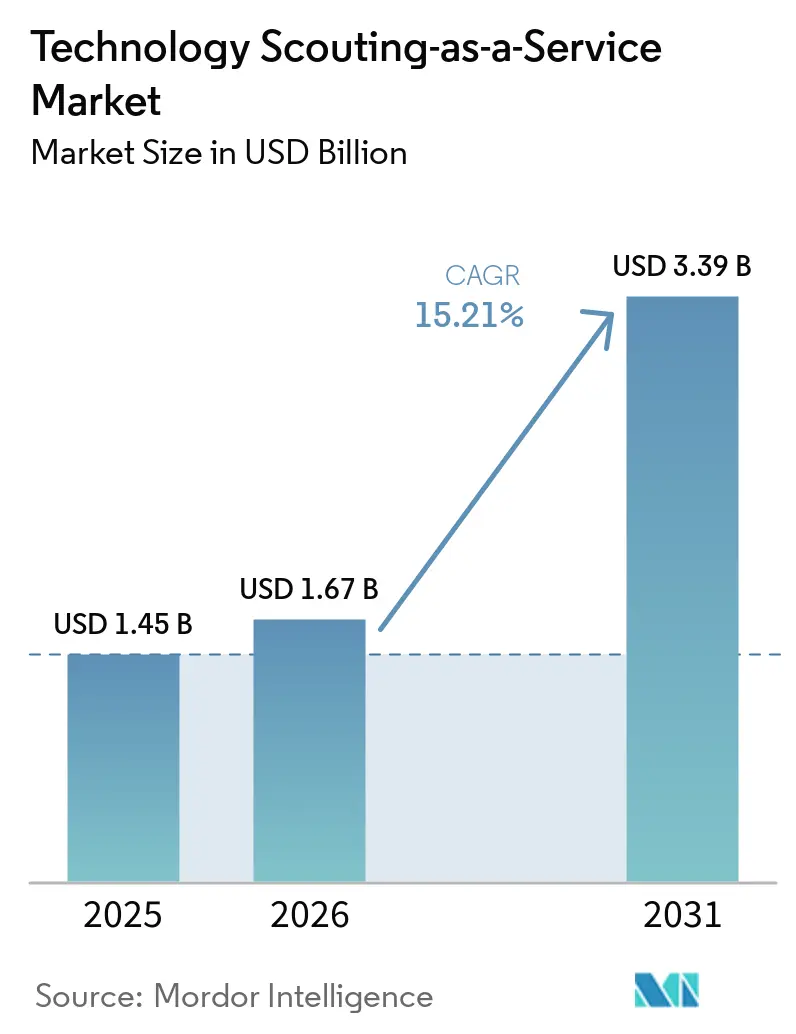
The Technology Scouting-as-a-Service Market size was valued at USD 1.45 billion in 2025 and estimated to grow from USD 1.67 billion in 2026 to reach USD 3.39 billion by 2031, at a CAGR of 15.21% during the forecast period (2026-2031). The Technology Scouting-as-a-Service Market is benefiting from a shift toward continuous external technology monitoring within corporate innovation programs. Business R&D spending by the largest investors rose 6% in real terms during 2025, while software and computer services R&D rose close to 15%, increasing the need to identify external technologies before internal teams duplicate work. Buyers increasingly expect platforms to connect patent intelligence, scientific literature, startup information, and competitive signals in a single workflow. Providers are responding by adding AI-supported search, clearer validation workflows, and managed research options. Data residency requirements and long paths from discovery to a commercial agreement remain material limits on adoption.
Key Report Takeaways
- By delivery model, software subscription held 42.14% of the Technology Scouting-as-a-Service Market share in 2025, while managed scouting service is forecast to grow at a 16.42% CAGR through 2031.
- By end user, corporate R&D and engineering held 38.42% of the Technology Scouting-as-a-Service Market share in 2025, while corporate venture capital and M&A teams are forecast to grow at a 17.36% CAGR through 2031.
- By enterprise size, large enterprises held 81.42% of revenue in 2025, while small and medium-sized enterprises are forecast to grow at an 18.42% CAGR through 2031.
- By technology and architecture, 4G and LTE held 41.26% of revenue in 2025, while 5G standalone is forecast to grow at a 19.14% CAGR through 2031.
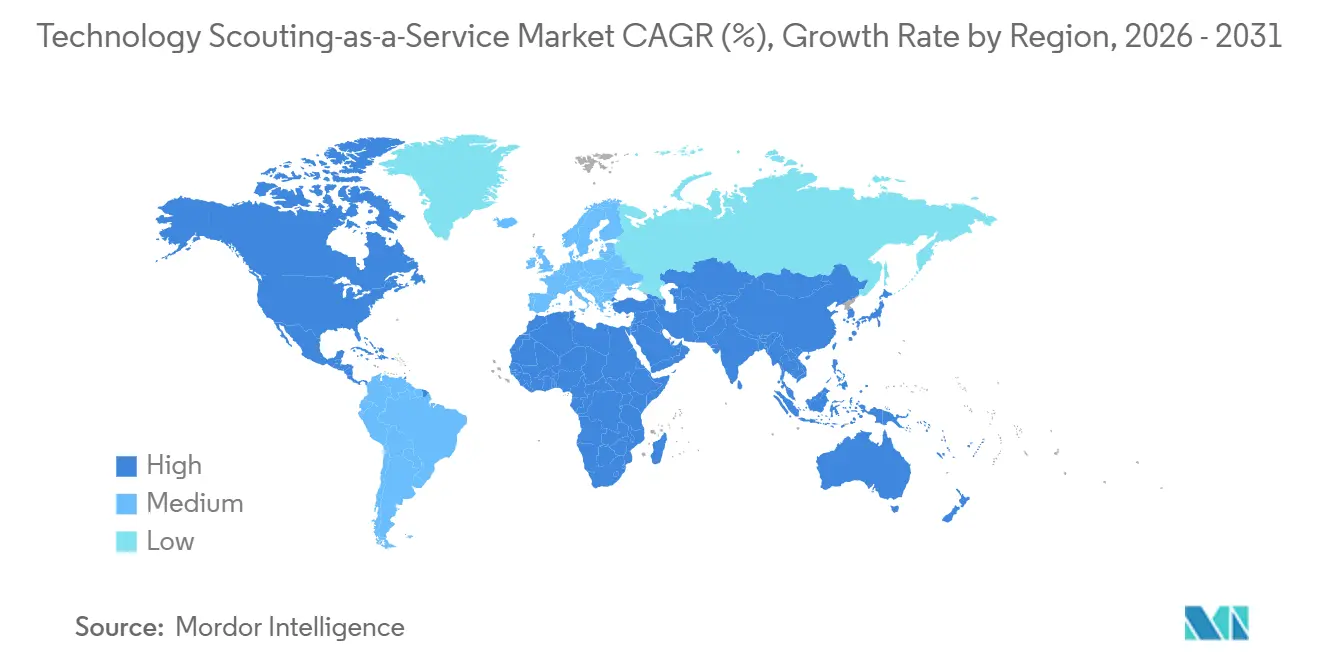
- By geography, North America held 38.14% of Technology Scouting-as-a-Service Market revenue in 2025, while Asia-Pacific is forecast to grow at a 21.42% CAGR through 2031.
Note: Market size and forecast figures in this report are generated using Mordor Intelligence’s proprietary estimation framework, updated with the latest available data and insights as of January 2026.
Market Trends and Insights
Drivers Impact Analysis of Technology Scouting-as-a-Service Market*
| Driver | (~) % Impact on CAGR Forecast | Geographic Relevance | Impact Timeline |
|---|---|---|---|
| Enterprise Pressure to Shorten Innovation Cycles | +3.2% | Global | Short term (≤ 2 years) |
| AI-Assisted Discovery Across Patents, Publications, and Startups | +3.8% | Global, with concentration in North America and Europe | Medium term (2-4 years) |
| Rising External R&D and Open Innovation Activity | +2.8% | Global, strongest in North America, Europe, and Asia-Pacific | Medium term (2-4 years) |
| Need to De-Risk Build-Versus-Buy and Partnership Decisions | +2.2% | North America and Europe, with growing relevance in Asia-Pacific | Medium term (2-4 years) |
| Expansion of Cross-Industry Technology Transfer | +1.5% | Global, particularly Asia-Pacific and Europe | Long term (≥ 4 years) |
| Demand for Continuous Weak-Signal and Competitive Monitoring | +1.1% | Global | Short term (≤ 2 years) |
| Source: Mordor Intelligence | |||
Enterprise Pressure to Shorten Innovation Cycles
The Technology Scouting-as-a-Service Market benefits when product and R&D leaders need faster external evidence for investment decisions. Shorter development schedules leave less time for teams to conduct separate patent, literature, and startup searches. The service model gives innovation leaders a structured way to keep external scanning active between major strategy reviews. This can support earlier identification of technologies that may complement an internal development program. It can also help teams compare external options before committing resources to a lengthy build program. As a result, subscriptions and repeat research assignments can become part of ongoing innovation operations rather than a one-time project.
AI-Assisted Discovery Across Patents, Publications, and Startups
AI is changing how providers search large and disconnected sources of technology evidence. In June 2026, PatSnap expanded Hiro to include conversational search across more than 208 million patents, 215 million non-patent literature records, and 1.6 billion legal data points from 174 jurisdictions.[1] This scale can reduce the time required to create an initial technology landscape. The Technology Scouting-as-a-Service Market, therefore, places increasing value on systems that can organize results for a specific commercial question. Search capability alone is not enough, as duplicate entities and incomplete records can undermine the reliability of the outputs. Providers with stronger data matching and review processes can make AI-supported research more useful for enterprise teams.
Rising External R&D and Open Innovation Activity
Higher external R&D activity broadens the number of technologies, companies, and research partners that buyers need to assess. The OECD reported that R&D spending by the largest business investors increased 6% in real terms in 2025.[2] Software and computer services R&D grew close to 15% during the same year, increasing the volume of technical activity that enterprise teams must track. The Technology Scouting-as-a-Service Market helps buyers scan this activity without building a large internal research function for every technology domain. Procurement and supply-chain groups can also use these services to identify alternative materials, suppliers, and production technologies. This expands demand beyond the traditional users in R&D and corporate strategy.
Need to De-Risk Build-Versus-Buy and Partnership Decisions
Technology investment decisions can require an early view of intellectual property, technical fit, and the availability of potential partners. A scouting process can provide a structured list of options before a buyer enters deeper due diligence. The Technology Scouting-as-a-Service Market supports this work by combining patent landscapes, startup profiles, and technology mapping within a single assignment. Corporate venture capital and M&A teams can use these outputs to identify potential targets and track competitive activity. R&D teams can use the same evidence to decide whether to develop a technology internally or source it externally. Providers that integrate signal monitoring with validation work are better positioned to support decisions with higher financial exposure.
Restraints Impact Analysis of Technology Scouting-as-a-Service Market*
| Restraint | (~) % Impact on CAGR Forecast | Geographic Relevance | Impact Timeline |
|---|---|---|---|
| Confidentiality and Data-Sovereignty Requirements | -2.3% | Global, particularly Europe and Asia-Pacific | Short term (≤ 2 years) |
| Difficulty Validating Technical Readiness and Commercial Fit | -1.5% | Global | Medium term (2-4 years) |
| Fragmented Data Rights and Inconsistent Entity Resolution | -1.0% | Global | Medium term (2-4 years) |
| Long Conversion Cycles From Scouting to Paid Partnerships | -0.7% | North America and Europe | Long term (≥ 4 years) |
| Source: Mordor Intelligence | |||
Confidentiality and Data-Sovereignty Requirements
Confidential client questions can limit the use of cloud-delivered technology scouting services. A proprietary search for technical gaps can reveal a company’s product priorities, partnership interests, and research direction. IBM reported in June 2026 that 68% of surveyed senior executives saw cross-jurisdictional data residency requirements as a material operational challenge.[3] The Technology Scouting-as-a-Service Market must therefore provide clear data controls for clients operating across multiple jurisdictions. Customer-controlled encryption, regional data storage, and transparent access rules can reduce procurement concerns. Providers that cannot explain how sensitive searches and associated outputs are handled may face longer enterprise sales cycles.
Difficulty Validating Technical Readiness and Commercial Fit
A promising technical signal does not guarantee that a technology can be integrated into a buyer’s existing product or operating model. Technology readiness assessments provide a common framework, but they do not fully address manufacturing constraints, customer requirements, or a startup’s capacity to support large-scale deployments. The Technology Scouting-as-a-Service Market can generate a broad list of candidates faster than a team can validate them. This difference between discovery volume and validation capacity can create user fatigue. Buyers may receive many relevant signals but still need specialist judgment to narrow them to viable partnership opportunities. Managed services that pair research tools with domain review can address this issue, although the added labor raises delivery costs.
*Our forecasts treat driver/restraint impacts as directional, not additive. The impact forecasts reflect baseline growth, mix effects, and variable interactions.
Technology Scouting-as-a-Service Market Segment Analysis
By Delivery Model:
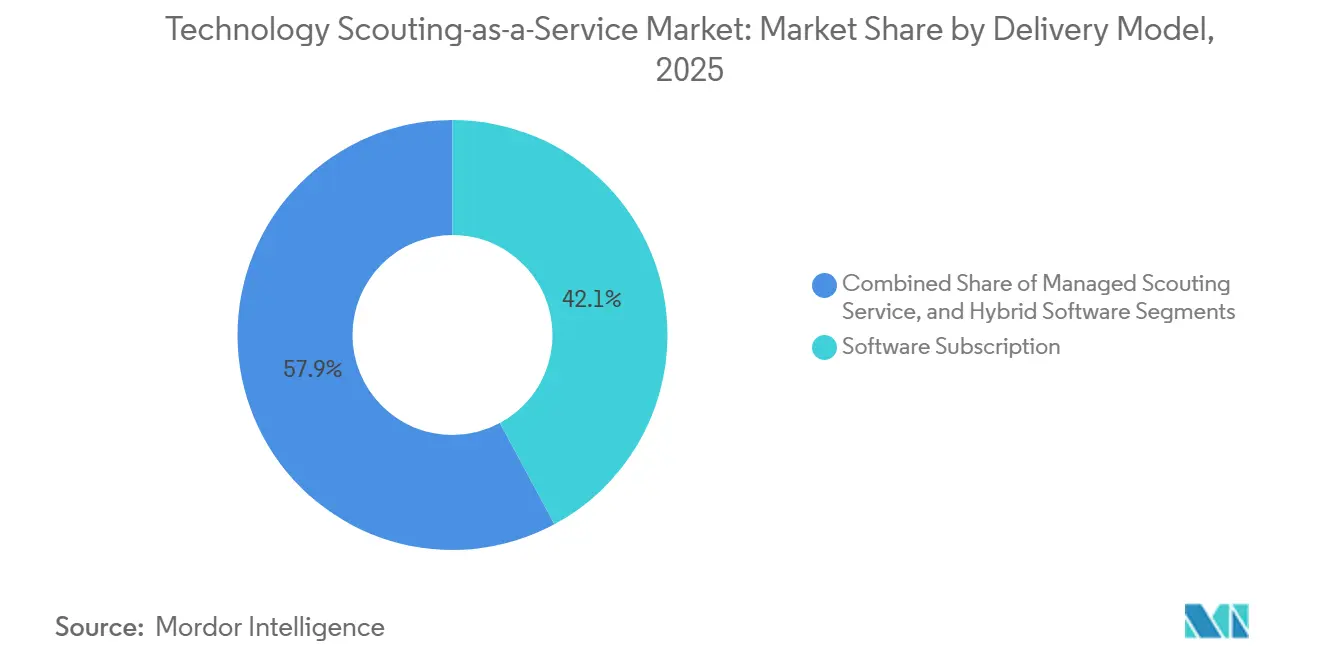
Software Subscriptions Lead as Managed Services Gain MomentumSoftware subscription held 42.14% of the Technology Scouting-as-a-Service Market share in 2025. It fits within established technology budgets and provides procurement teams with a predictable annual licensing model. The format also allows research, IP, and innovation staff to search for information directly when a question arises. Its lead reflects the value of continuing access to proprietary data, search tools, and monitoring functions. The Technology Scouting-as-a-Service Market size for this delivery model is supported by organizations that use scouting as an ongoing internal capability. However, users still need enough internal expertise to create clear searches and assess the results. This limits the appeal of a fully self-service offer for smaller innovation teams.
Managed scouting service is forecast to expand at a 16.42% CAGR from 2026 to 2031, the fastest rate within this segmentation. It meets the needs of buyers who need decision-ready output rather than access to a research portal. These clients can use external analysts for technology landscaping, partner screening, and targeted validation. Hybrid software and services remain relevant where an organization wants platform access alongside a defined research component. Government and defense users may favor this arrangement when procurement rules require a clear scope of services. The delivery mix is moving toward analyst-supported work as automated search handles more of the initial discovery task. Providers that keep both self-service and managed options can serve buyers with different internal capabilities.

By End User:
CVC and M&A Teams Drive Premium SpendCorporate R&D and engineering held 38.42% of the Technology Scouting-as-a-Service Market share in 2025. These teams use external intelligence to understand patents, research activity, and technological alternatives related to their development priorities. Long-standing links with internal IP and product teams can make the service part of a regular research process. This supports recurring use and makes switching providers more difficult when workflows are embedded. Corporate innovation and strategy teams also use scouting outputs to support portfolio planning and opportunity selection. Procurement and supply chain organizations are emerging users because resilience programs require greater visibility into potential suppliers and materials. The Technology Scouting-as-a-Service Market gives these groups a common evidence base for technology choices.
Corporate venture capital and M&A teams are forecast to grow at a 17.36% CAGR through 2031. They need rapid access to early-stage company signals, prior-art information, and competitive deal activity. A missed target or an unrecognized intellectual property risk can directly affect an acquisition or partnership decision. These teams, therefore, place value on tools that combine startup monitoring with patent and technology analysis. Their demand can support higher-value contracts when scouting is integrated into transaction workflows. Government and defense organizations remain a specialized user group because classification and procurement requirements can restrict the use of standard platforms. Universities and research institutions offer an additional customer base, although their budgets and service requirements differ from those of corporate users.
By Enterprise Size:
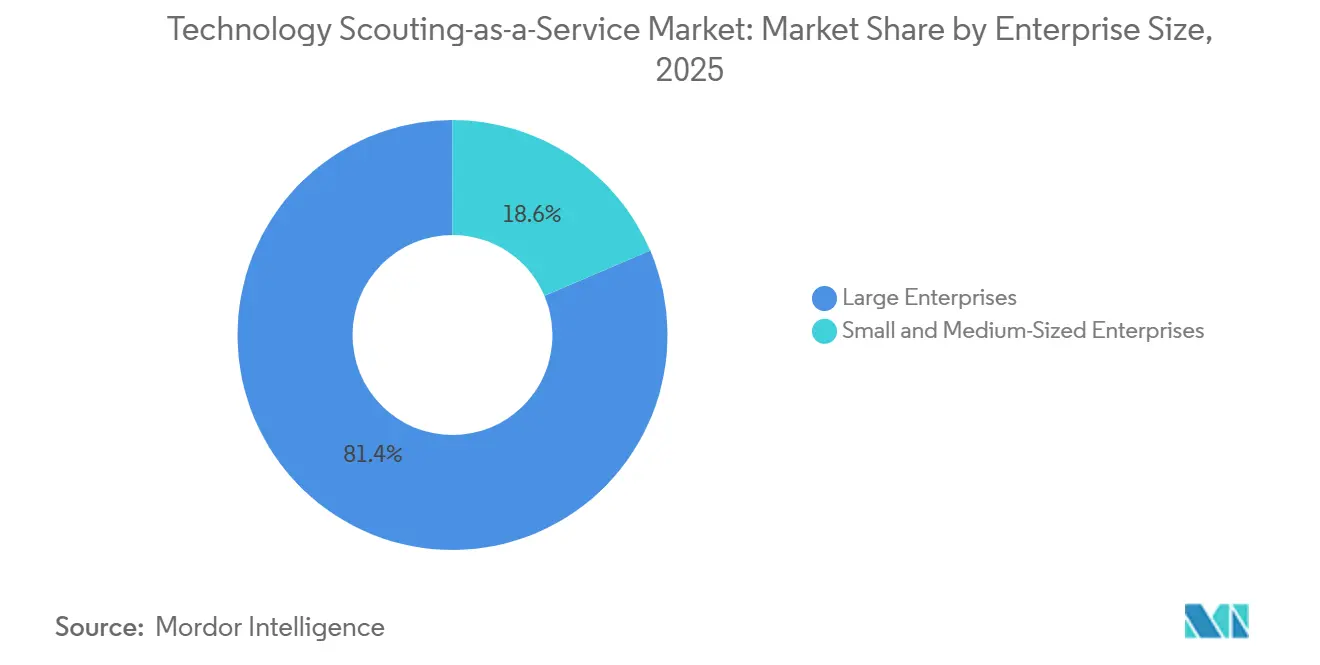
SME Adoption Accelerates on Modular PlatformsLarge enterprises accounted for 81.42% of 2025 revenue in the Technology Scouting-as-a-Service Market. Their scale supports multi-year contracts, enterprise data integrations, and internal teams that can act on continuous scouting outputs. These organizations often manage broad R&D portfolios and need coverage across multiple technology fields and regions. Their procurement processes also favor vendors that can meet data governance and security requirements. This keeps large enterprises central to current revenue. Their established budgets allow for both platform subscriptions and project-based managed services. The Technology Scouting-as-a-Service Market size continues to reflect this concentration of established purchasing power.
Small and medium-sized enterprises are forecast to grow at an 18.42% CAGR from 2026 to 2031. Modular offerings and usage-based pricing lower the barrier to entry for organizations that do not need an enterprise-wide platform. A 2026 review of 68 peer-reviewed studies found that AI adoption in small and medium-sized enterprises can improve decision-making efficiency and competitiveness, while resource constraints and technology complexity remain major barriers.[4] Government initiatives are also supporting digital adoption among smaller firms in the United Kingdom. This environment can widen the buyer base for scouting services that offer focused searches or limited user access. Providers need straightforward onboarding and clear use cases to convert this opportunity. Smaller firms may still require guidance to assess whether a discovered technology is commercially usable.
By Technology and Architecture:
5G Standalone Enables Real-Time Intelligence Delivery4G and LTE held 41.26% of the Technology Scouting-as-a-Service Market share in 2025. These networks remain the foundation for access for many enterprise users of cloud-based research platforms. Standard broadband and LTE connections are sufficient for many search, collaboration, and reporting workflows. The segment’s position reflects the installed base of enterprise connectivity rather than a specific platform preference. 4G and LTE will continue to support organizations that do not need a cloud-native 5G core. The Technology Scouting-as-a-Service Market benefits from this broad base because services can be delivered through common enterprise networks. Other connectivity options, including satellite and private wireless systems, can matter in remote or restricted operating environments.
5G standalone is forecast to grow at a 19.14% CAGR from 2026 to 2031. Its cloud-native architecture supports network slicing, lower-latency data transfer, and edge processing. These capabilities become more relevant as scouting moves from periodic reports toward ongoing monitoring across patent, funding, and publication data. In March 2026, NTT DOCOMO and AWS launched a commercial hybrid 5G core network in Asia-Pacific, and AWS stated that agentic AI automation reduced deployment time by 80%. In February 2026, AT&T and Cisco activated a 5G standalone-native IoT platform with integrated network slicing. 5G non-standalone serves as a transition path for organizations that have upgraded access networks but not their core infrastructure. The segment shows how the Technology Scouting-as-a-Service Market can align with broader enterprise connectivity upgrades.
Geography Analysis
North America Technology Scouting-as-a-Service Market
North America accounted for 38.14% of the global Technology Scouting-as-a-Service Market revenue in 2025. The United States has a large base of corporate R&D functions, corporate venture programs, and technology-intensive industries. These users increasingly need a structured way to identify external technology options. Life sciences and information and communications technology are important sources of demand because both sectors manage large volumes of research and intellectual property. Canada contributes through innovation programs and cross-border R&D links. Mexico adds potential demand through manufacturing technology upgrades. North America’s Technology Scouting-as-a-Service Market share reflects established enterprise budgets and mature innovation processes.
Europe and APAC Technology Scouting-as-a-Service Market
Europe is the second-largest regional market, supported by corporate R&D programs in Germany, the United Kingdom, and France. Buyers in these countries place particular emphasis on data governance, intellectual property review, and cross-border licensing questions. This supports demand for providers that can document research methods and protect client search activity. Italy, Spain, and other European countries are expanding their use of open innovation beyond the largest multinationals. Asia-Pacific is forecast to grow at a 21.42% CAGR through 2031, the fastest regional rate. China’s cross-border technology sourcing activity is documented in a 2026 study of patent transfer data from Shandong Province’s strategic emerging industries. Japan’s intellectual property practices and the development of technology ecosystems in India and South Korea add to regional demand.
South America, MEA and Oceania Technology Scouting-as-a-Service Market
Australia’s resource and clean technology activity broadens the regional opportunity for the Technology Scouting-as-a-Service Market. South America remains at an earlier stage, with Brazil’s open-innovation programs and Argentina’s research institutions supporting gradual growth in demand. The Middle East is also seeing growing demand for investment from sovereign wealth funds and industrial diversification programs in the United Arab Emirates, Saudi Arabia, and Qatar. These programs place technology transfer within wider economic development plans. Africa currently contributes modest revenue, but South Africa, Egypt, and Nigeria offer developing sources of enterprise and public-sector demand. Across these regions, providers need to adapt their research coverage and service model to local data, language, and procurement needs.
Competitive Landscape
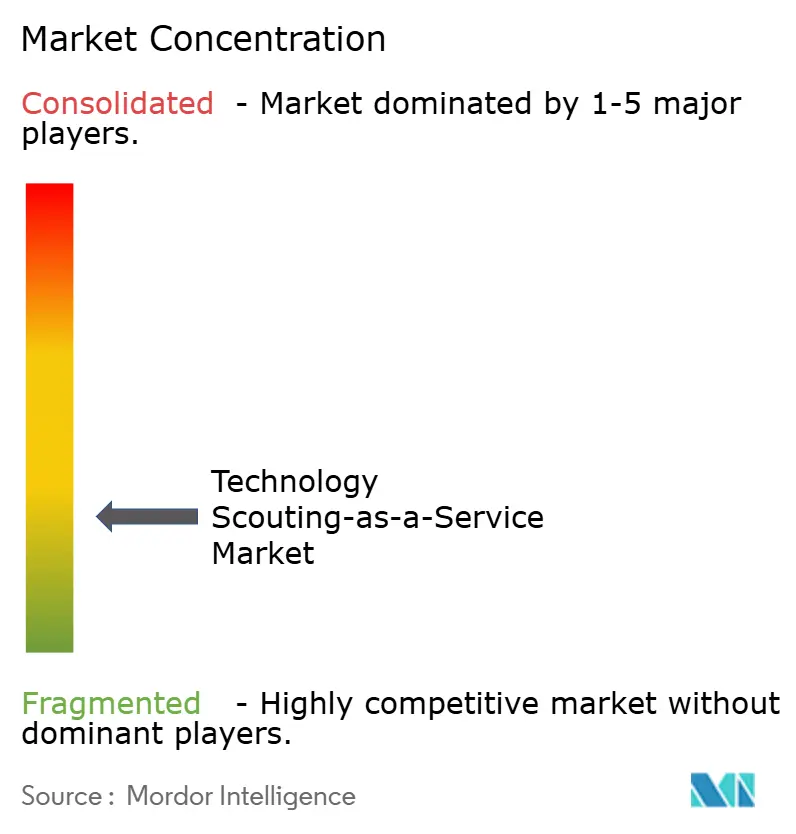
The Technology Scouting-as-a-Service Market is fragmented, with more than 20 active vendors offering overlapping patent intelligence, startup discovery, challenge management, and managed research capabilities. No single provider holds more than a low double-digit revenue share. Vendors compete on coverage of data sources, the quality of search results, and the ability to fit into an enterprise workflow. AI-supported search is becoming a common feature, which reduces its value as a stand-alone point of differentiation. Providers are therefore seeking deeper links with IP, research, corporate development, and innovation management systems. This can increase switching costs when a platform becomes part of a buyer’s normal decision process.
Clarivate introduced IPOne in May 2026, combining Derwent patent data, Darts-ip litigation intelligence, and CompuMark trademark data with AI agents and Model Context Protocol connectors. The move shows a strategy centered on integrating proprietary intelligence into customer AI workflows with governance controls. PatSnap expanded its Hiro AI capabilities in June 2026 through conversational search across patent, literature, and legal data. This approach focuses on reducing the specialist query skills needed to explore large technical datasets. Cognizant launched its Innovation Network in April 2026 to invest in early- to mid-stage enterprise software startups in AI, data, cybersecurity, and cloud. These actions show that providers and adjacent enterprise technology firms are strengthening access to data, startup ecosystems, and client workflows.
Government and defense customers remain an underserved group because commercial platform terms can conflict with classification requirements. University technology transfer offices are another potential customer group, although they are often price-sensitive and may require academic-tier offerings. Managed scouting remains relevant for buyers who want an expert-reviewed answer to a specific technology question. AI-native entrants can automate parts of multi-step research, particularly the early signal-discovery work that established vendors have traditionally sold. This pressure encourages incumbents to focus more on validation, recommendation, and ecosystem coordination. The Technology Scouting-as-a-Service Market is likely to remain fragmented, with buyer needs spanning self-service software, specialized research, and regulated use cases. Providers that balance automation with trusted validation can address both the scale and quality requirements of enterprise users.
Technology Scouting-as-a-Service Industry Leaders
-
Wellspring International, Inc.
-
Ezassi, Inc.
-
Praxie, Inc.
-
ITONICS GmbH
-
NetBase Quid, Inc.
- *Disclaimer: Major Players sorted in no particular order
Technology Scouting-as-a-Service Market Companies Covered in this Report
- Wellspring International, Inc.
- Ezassi, Inc.
- Praxie, Inc.
- ITONICS GmbH
- NetBase Quid, Inc.
- Questel SAS
- Qmarkets Ltd.
- Clarivate Plc
- IP.com, LLC
- The Lens
- Research Solutions, Inc.
- PatSnap Pte. Ltd.
- Findest B.V.
- NineSigma, Inc.
- yet2.com, Inc.
- Wazoku Limited
- Inpart Limited
- PreScouter, Inc.
- GreyB Services Private Limited
- TechScout, Inc.
- Novable SRL
- Linknovate GmbH
- Traction Technology, Inc.
- HYPE Innovation GmbH
Recent Industry Developments in Technology Scouting-as-a-Service Market
- June 2026: PatSnap expanded its Hiro AI layer with conversational natural-language querying across 208 million+ patents, 215 million non-patent literature records, and 1.6 billion legal data points across 174 jurisdictions, enabling IP and R&D teams to receive structured competitive intelligence without specialist query syntax.
- May 2026: Clarivate introduced IPOne, a unified IP intelligence platform combining AI agents with Derwent patent data, Darts-ip litigation intelligence, and CompuMark trademark data through Model Context Protocol connectors, enabling enterprise IP teams to embed Clarivate intelligence into their AI tooling with full governance and privacy controls.
- April 2026: Cognizant launched the Cognizant Innovation Network, a corporate investment arm targeting early- to mid-stage enterprise software startups in AI, data, cybersecurity, and cloud, providing portfolio companies access to Cognizant's Global 2000 client base.
- March 2026: NTT DOCOMO and AWS launched the first commercial 5G Core network in Asia-Pacific on hybrid cloud-plus-on-premises infrastructure, reducing deployment time by 80% through agentic AI automation.
Global Technology Scouting-as-a-Service Market Report Scope
The technology scouting-as-a-service market refers to the ecosystem of outsourced services and software platforms designed to help organizations systematically identify, evaluate, and monitor emerging technologies, startups, and intellectual property that align with their strategic objectives. This market includes software subscriptions for automated scouting, fully managed scouting services, and hybrid models delivered to corporate R&D, innovation teams, venture capital arms, and government agencies. Specifically tailored to track complex technological architectures such as 4G/LTE, 5G non-standalone, and 5G standalone, these services enable organizations of all sizes to accelerate open innovation, mitigate early-stage technology risks, optimize M&A pipelines, and maintain a competitive edge by rapidly discovering and integrating next-generation capabilities into their operations.
The Technology Scouting-as-a-Service Market Report is Segmented by Delivery Model (Software Subscription, Managed Scouting Service, and Hybrid Software and Services), End User (Corporate R&D and Engineering, Corporate Innovation and Strategy, Corporate Venture Capital and M&A, Procurement and Supply-Chain Organizations, Government and Defense Organizations, and Universities and Research Institutions), Enterprise Size (Large Enterprises, and Small and Medium-Sized Enterprises), Technology and Architecture (4G and LTE, 5G Non-Standalone, 5G Standalone, and Others Technologies), and Geography (North America, South America, Europe, Asia-Pacific, Middle East, and Africa). The Market Forecasts are Provided in Terms of Value (USD).
Segmentation Overview
| Software Subscription |
| Managed Scouting Service |
| Hybrid Software and Services |
| Corporate R&D and Engineering |
| Corporate Innovation and Strategy |
| Corporate Venture Capital and M&A |
| Procurement and Supply-Chain Organizations |
| Government and Defense Organizations |
| Universities and Research Institutions |
| Large Enterprises |
| Small and Medium-Sized Enterprises |
| 4G and LTE |
| 5G Non-Standalone |
| 5G Standalone |
| Others Technologies |
| North America | United States |
| Canada | |
| Mexico | |
| South America | Brazil |
| Argentina | |
| Chile | |
| Rest of South America | |
| Europe | Germany |
| United Kingdom | |
| France | |
| Italy | |
| Spain | |
| Rest of Europe | |
| Asia-Pacific | China |
| Japan | |
| India | |
| South Korea | |
| Australia | |
| Rest of Asia-Pacific | |
| Middle East | United Arab Emirates |
| Saudi Arabia | |
| Qatar | |
| Rest of Middle East | |
| Africa | South Africa |
| Egypt | |
| Nigeria | |
| Rest of Africa |
| By Delivery Model | Software Subscription | |
| Managed Scouting Service | ||
| Hybrid Software and Services | ||
| By End User | Corporate R&D and Engineering | |
| Corporate Innovation and Strategy | ||
| Corporate Venture Capital and M&A | ||
| Procurement and Supply-Chain Organizations | ||
| Government and Defense Organizations | ||
| Universities and Research Institutions | ||
| By Enterprise Size | Large Enterprises | |
| Small and Medium-Sized Enterprises | ||
| By Technology and Architecture | 4G and LTE | |
| 5G Non-Standalone | ||
| 5G Standalone | ||
| Others Technologies | ||
| By Geography | North America | United States |
| Canada | ||
| Mexico | ||
| South America | Brazil | |
| Argentina | ||
| Chile | ||
| Rest of South America | ||
| Europe | Germany | |
| United Kingdom | ||
| France | ||
| Italy | ||
| Spain | ||
| Rest of Europe | ||
| Asia-Pacific | China | |
| Japan | ||
| India | ||
| South Korea | ||
| Australia | ||
| Rest of Asia-Pacific | ||
| Middle East | United Arab Emirates | |
| Saudi Arabia | ||
| Qatar | ||
| Rest of Middle East | ||
| Africa | South Africa | |
| Egypt | ||
| Nigeria | ||
| Rest of Africa | ||
Key Questions Answered in the Report
What is the projected value of Technology Scouting-as-a-Service Market by 2031?
The Technology Scouting-as-a-Service Market is forecast to reach USD 3.39 billion by 2031, growing at a 15.21% CAGR from 2026. The outlook reflects wider use of continuous external technology intelligence across patents, research, startups, and competitive activity in global markets.
Which delivery model leads technology scouting services?
Software subscription led with 42.14% of revenue in 2025, while managed scouting service is forecast to record the fastest growth at 16.42% CAGR. Managed work supports buyers that need expert-reviewed outputs.
Which organizations are the primary users of technology scouting services?
Corporate R&D and engineering was the largest end-user group with 38.42% share in 2025. Corporate venture capital and M&A teams are forecast to grow fastest as they seek earlier target and IP signals.
Why are companies using AI in technology scouting?
AI can organize searches across patents, scientific literature, legal records, and startup information, helping teams create a faster initial technology landscape.
Which region is growing fastest for technology scouting services?
Asia-Pacific is forecast to grow at a 21.42% CAGR from 2026 to 2031, supported by expanding technology ecosystems and cross-border sourcing activity.
What limits adoption of Technology Scouting-as-a-Service Market solutions?
Data residency needs, confidentiality concerns, and the difficulty of validating technical and commercial fit can lengthen procurement and conversion cycles.