
Tarragon Market Size and Share
Market Overview
| Study Period | 2027 - 2032 |
|---|---|
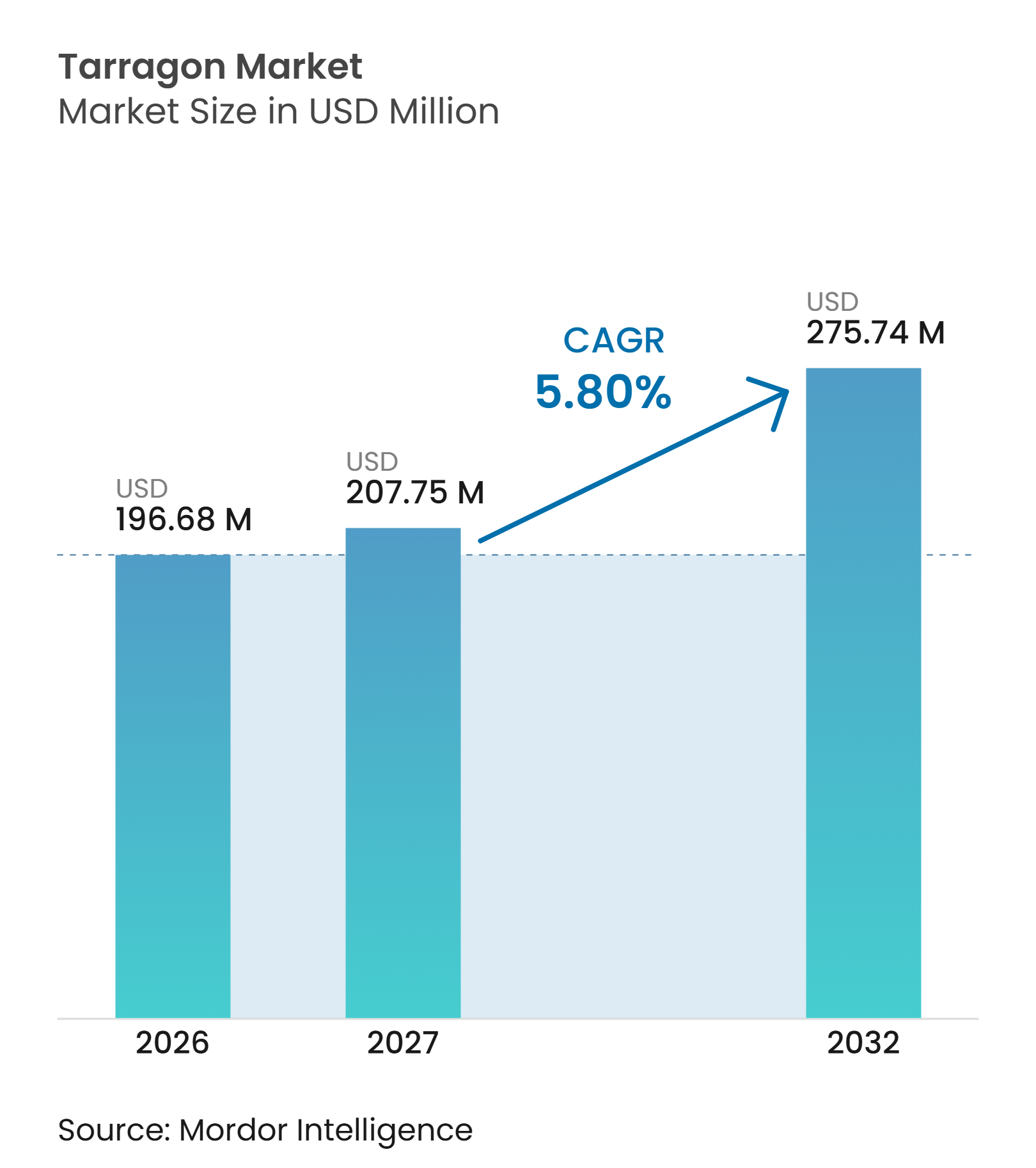
| Market Size (2027) | USD 207.75 Million |
| Market Size (2032) | USD 275.74 Million |
| Growth Rate (2027 - 2032) | 5.80 % |
| Fastest Growing Market | North America |
| Largest Market | Europe |
| Market Concentration | Medium |
Major Players *Disclaimer: Major Players sorted in no particular order Image © Mordor Intelligence. Reuse requires attribution under CC BY 4.0. | |
Tarragon Market Analysis by Mordor Intelligence
The tarragon market size is expected to increase from USD 196.68 million in 2026 to USD 207.75 million in 2027 and reach USD 275.74 million by 2032, growing at a CAGR of 5.8% over 2027–2032. Market growth is supported by rising demand for natural herbs, clean-label ingredients, and aromatic seasonings across food processing and commercial culinary applications. Increasing use of tarragon in sauces, condiments, dressings, and processed food products strengthens demand for dried and processed formats, while the expansion of foodservice and premium culinary offerings supports wider applications. Dried tarragon accounts for the largest product share at 51.88% in 2026, reflecting its longer shelf life, convenient storage, and suitability for industrial and household applications. Food processing represents the largest end-user segment, accounting for 45.46% of the market, while retail is projected to be the fastest-growing end-user segment, with a CAGR of 6.11% during 2027–2032. Geographically, Europe holds the largest market share at 39.62% in 2026, supported by established culinary traditions and demand for herbs and seasonings, whereas North America is expected to record the fastest growth at a CAGR of 6.80%.
Key Report Takeaways
- By product type, dried tarragon accounted for the largest share of the tarragon market size at 51.88% in 2026, while frozen tarragon is forecast to grow fastest at a 6.50% CAGR over 2027–2032.
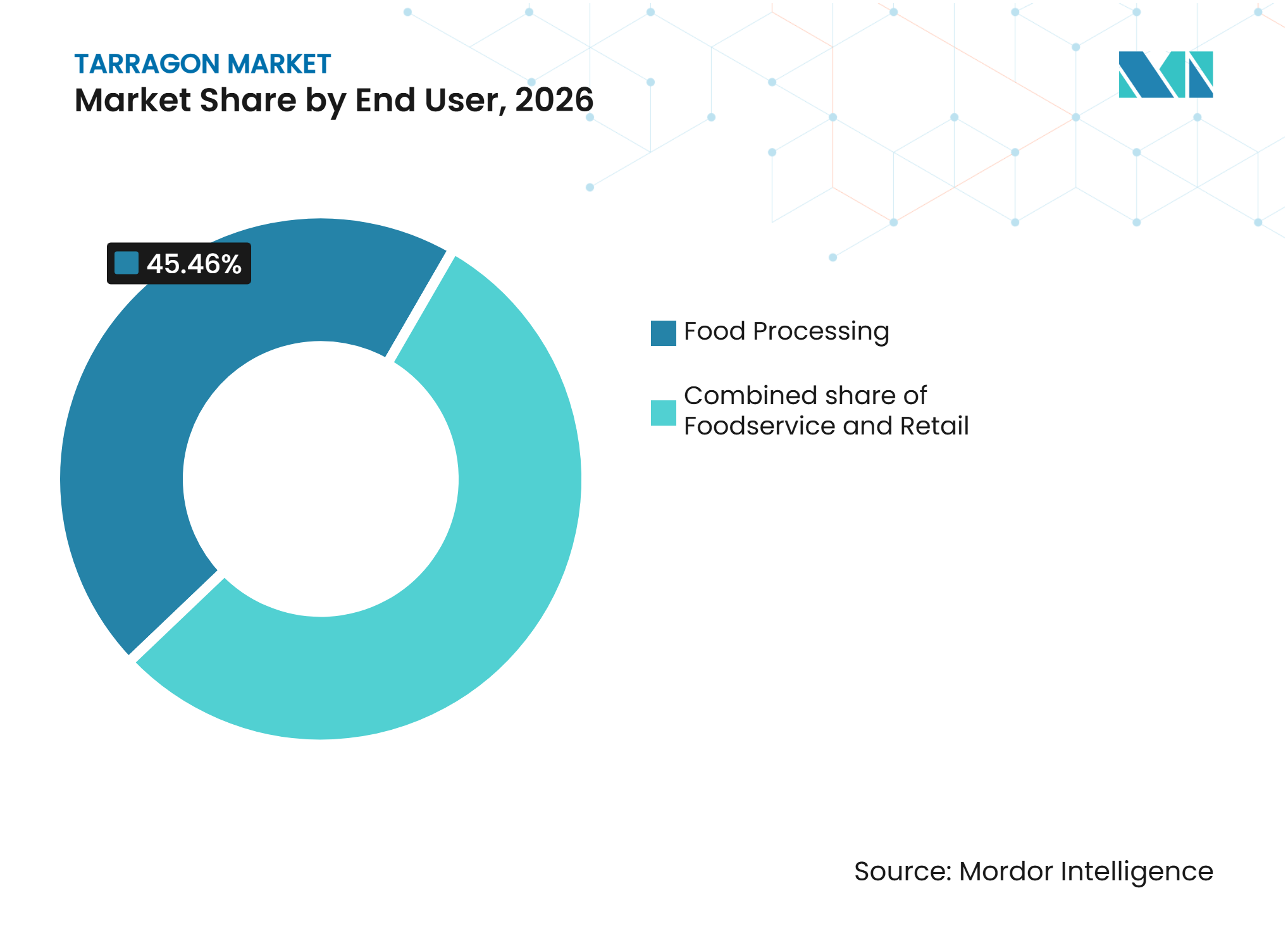
- By end user, food processing accounted for the largest share at 45.46% in 2026, while retail is projected to record the fastest growth at a 6.11% CAGR over 2027–2032.
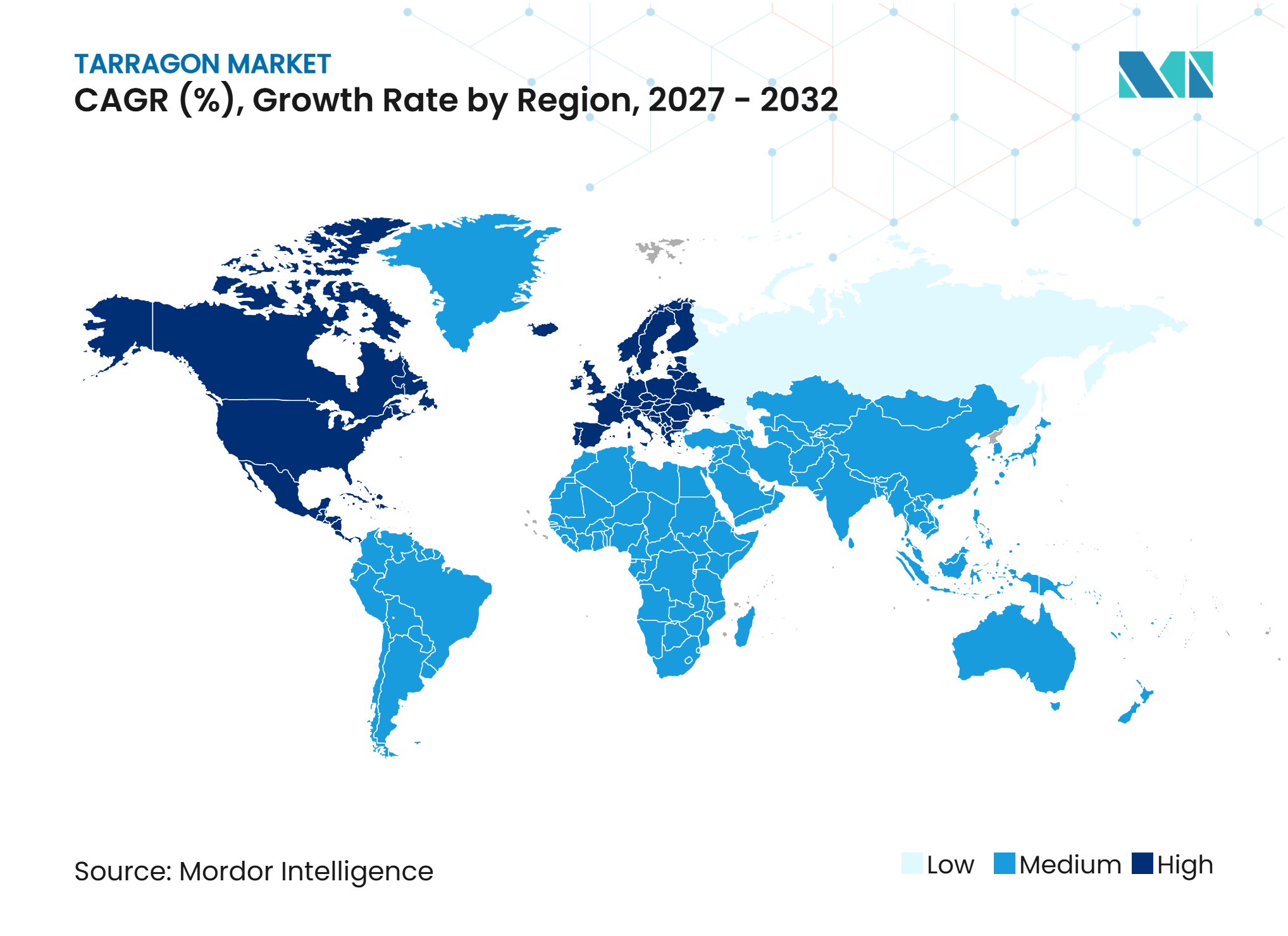
- Among geographies, Europe led with a 39.62% share of the tarragon market in 2026, while North America is forecast to grow fastest at a 6.80% CAGR over 2027–2032.
Note: Market numbers in this report are based on Mordor Intelligence's proprietary estimation framework, which combines nine months of actuals with Q4 projections for base year 2026.
Market Trends and Insights
Drivers Impact Analysis of Tarragon Market*
| Driver | (~) % Impact on CAGR Forecast | Geographic Relevance | Impact Timeline |
|---|---|---|---|
| Growing demand for natural herbs and clean-label food ingredients | +0.9% | Global, particularly North America and Europe, where demand for natural seasonings and clean-label food formulations is established | Medium term (2–4 years) |
| Increasing use of tarragon in processed foods, sauces, and condiments | +0.8% | Global, particularly Europe and North America, supported by established applications of culinary herbs in food manufacturing | Medium term (2–4 years) |
| Expansion of foodservice and commercial culinary applications | +0.7% | Global, particularly North America and Europe, with increasing opportunities across Asia-Pacific's expanding foodservice sector | Medium term (2–4 years) |
| Rising demand for fresh and specialty culinary herbs | +0.6% | Global, particularly Europe and North America, where specialty herbs are established in household and professional cooking | Short term (Less than 2 years) |
| Growing adoption of tarragon in premium culinary products and gourmet food preparations | +0.5% | Global, particularly Europe and North America, with emerging opportunities in premium urban food markets across Asia-Pacific | Long term (More than 4 years) |
| Source: Mordor Intelligence | |||
Growing Demand for Natural Herbs and Clean-Label Food Ingredients
The growing use of plant-derived ingredients in food formulations is creating opportunities for culinary herbs such as tarragon, which provide distinctive flavor and aroma without relying on artificial flavoring ingredients. The U.S. Food and Drug Administration (FDA) recognizes herbs and spices as food ingredients used for flavoring and requires food manufacturers to comply with applicable ingredient declaration and safety requirements. The U.S. Department of Agriculture (USDA) Economic Research Service also identifies natural labeling as an established product-positioning approach in the food industry, reflecting the commercial relevance of ingredient-related claims. Tarragon's aromatic leaves and characteristic anise-like flavor make it suitable for manufacturers seeking recognizable botanical ingredients in sauces, dressings, marinades, and seasoning blends. However, natural positioning must be supported by accurate ingredient declarations and compliant labeling practices.[1]
Increasing Use of Tarragon in Processed Foods, Sauces, and Condiments
The distinctive anise-like flavor of tarragon supports its application across processed foods, sauces, condiments, and seasoning preparations. The USDA's culinary herb information identifies tarragon as an ingredient in traditional French sauces, including béarnaise and tartare, as well as mustard sauces, salad dressings, poultry preparations, and flavored vinegars. The herb can also be incorporated into dried seasoning blends and preserved formulations, allowing food manufacturers to develop differentiated flavor profiles across multiple product categories. Its availability in fresh and dried forms further supports its use in different processing and formulation requirements. These applications create opportunities for suppliers of dried tarragon, powdered herb products, and tarragon-based extracts to serve commercial food manufacturers.[2]
Expansion of Foodservice and Commercial Culinary Applications
The expansion of commercial food preparation across restaurants, hotels, catering establishments, and institutional kitchens creates opportunities for specialty culinary herbs such as tarragon. The USDA Agricultural Marketing Resource Center identifies restaurants, grocery stores, and other food retailers as important marketing outlets for culinary herbs, which are supplied in fresh and dried forms. Tarragon's established use in poultry, fish, egg dishes, marinades, salad dressings, and classic sauces makes it suitable for professional kitchens seeking distinctive seasoning ingredients. Foodservice operators can also use fresh tarragon for immediate preparation and dried or preserved variants for standardized recipes and storage convenience. This supports demand from bulk herb suppliers and distributors serving restaurants and commercial food preparation businesses.[3]
Rising Demand for Fresh and Specialty Culinary Herbs
Interest in specialty culinary ingredients is supporting the use of fresh herbs in household cooking and professional food preparation. Tarragon offers a distinctive anise-like flavor and is used in salads, marinades, sauces, chicken preparations, and flavored vinegars, making it a specialty ingredient within the culinary herb category. The University of Maryland Extension recommends using fresh young tarragon leaves and identifies their applications in salads, marinades, chicken salad, and sauces. The USDA Agricultural Marketing Resource Center also identifies grocery stores, farmers' markets, restaurants, and natural food stores as potential marketing outlets for fresh culinary herbs. These applications create opportunities for growers, specialty herb suppliers, and retailers to expand fresh tarragon availability. However, maintaining leaf freshness, aroma, and visual quality remains important for retail acceptance.[4]
Restraints Impact Analysis of Tarragon Market*
| Restraint | (~) % Impact on CAGR Forecast | Geographic Relevance | Impact Timeline |
|---|---|---|---|
| Short shelf life and perishability of fresh tarragon | −0.7% | Global, particularly regions with longer distribution routes, limited cold-chain infrastructure, and high dependence on fresh herb imports | Medium term (2–4 years) |
| Seasonal production and inconsistent availability of quality raw materials | −0.6% | Global, particularly markets dependent on seasonal cultivation and imports from major herb-producing regions across Europe and Asia | Long term (More than 4 years) |
| Quality control challenges related to drying, storage, and aroma retention | −0.5% | Global, especially markets where herb processors face limitations in moisture control, storage conditions, and aroma-preservation technologies | Medium term (2–4 years) |
| Food safety, pesticide residue, and contamination compliance requirements | −0.4% | Global, particularly export-oriented markets and regions with stringent food safety, pesticide residue, and traceability requirements, including Europe and North America | Short term (Less than 2 years) |
| Source: Mordor Intelligence | |||
Short Shelf Life and Perishability of Fresh Tarragon
Fresh tarragon has a relatively short postharvest shelf life, making harvesting, handling, storage, and transportation important considerations for suppliers and distributors. Its delicate leaves can lose moisture, freshness, and characteristic aroma when exposed to unsuitable temperature and humidity conditions. These characteristics create additional requirements for refrigerated storage, careful packaging, and efficient distribution, particularly when fresh tarragon is transported over long distances or supplied to export markets. Unlike dried and powdered variants, fresh tarragon requires faster inventory turnover to maintain marketable quality, increasing the risk of spoilage and product losses for growers, wholesalers, and retailers. These challenges can restrict the geographical reach of fresh herb suppliers and increase distribution costs. Market participants therefore need to strengthen cold-chain management, postharvest handling, and preservation practices to maintain product quality and reduce wastage.
Seasonal Production and Inconsistent Availability of Quality Raw Materials
Tarragon cultivation is influenced by climatic conditions, growing seasons, and regional agricultural practices, which can create fluctuations in raw material availability throughout the year. Fresh tarragon production depends on suitable growing conditions, while variations in weather, cultivation practices, and harvesting schedules can affect leaf quality, aroma, and overall yields. Such fluctuations create procurement challenges for food processors, seasoning manufacturers, and distributors that require consistent supplies of culinary herbs for commercial formulations. Manufacturers relying on fresh tarragon may also need to source from multiple growing regions or maintain processed inventories to manage seasonal supply gaps. Inconsistent availability can increase procurement costs and complicate production planning, particularly for businesses supplying standardized seasoning blends, sauces, and processed food products. Suppliers therefore need diversified sourcing networks, appropriate preservation methods, and inventory planning to maintain year-round availability.
*Our forecasts treat driver/restraint impacts as directional, not additive. The impact forecasts reflect baseline growth, mix effects, and variable interactions.
Tarragon Market Segment Analysis
By Product Type:
Dried Tarragon Leads While Frozen Tarragon Expands FasterIn 2026, dried tarragon accounted for an estimated 51.88% of the tarragon market, making it the leading product type. Its position reflects demand for convenient, shelf-stable herb formats that offer easier storage, transportation, and integration into commercial food preparations. Dried tarragon is widely suitable for seasoning blends, sauces, dressings, marinades, and processed food formulations, where consistent flavor and longer storage periods are important. Meanwhile, frozen tarragon is projected to record the fastest growth, at an estimated CAGR of 6.50% through 2032. Freezing provides an alternative preservation method that can help retain the herb's fresh characteristics and flavor profile while extending its usability beyond the fresh harvest period.
Fresh tarragon serves household consumers, restaurants, and professional kitchens that prefer the herb's fresh aroma and flavor. Powdered tarragon offers convenience in standardized seasoning blends and industrial food formulations, while tarragon extracts and food-grade essential oils provide concentrated flavoring options for specialized applications. However, manufacturers across product categories need to manage aroma retention, moisture levels, processing conditions, and product consistency. The ability to balance preservation quality, flavor characteristics, and storage convenience will remain important for expanding consumption across food manufacturing, foodservice, and retail applications.
By End User:
Food Processing Leads While Retail Expands FasterIn 2026, food processing accounted for an estimated 45.46% of the tarragon market, making it the largest end-user segment. Its position reflects the use of tarragon as a flavoring ingredient in sauces, condiments, dressings, marinades, seasoning blends, and other processed food products. Food manufacturers incorporate fresh, dried, and powdered tarragon into formulations to develop distinctive flavor profiles and differentiate products across various food categories. Meanwhile, retail is projected to record the fastest growth, at an estimated CAGR of 6.11% through 2032. Increasing availability of packaged culinary herbs through supermarkets, specialty food stores, and online platforms creates opportunities for suppliers to reach household consumers seeking convenient ingredients for home cooking.
Foodservice represents another important end-user category, with restaurants, hotels, catering businesses, and commercial kitchens using tarragon in sauces, poultry, seafood, salads, and specialty culinary preparations. Demand across these channels varies according to purchasing requirements, with food processors prioritizing consistent ingredient specifications and bulk availability, while retail consumers place greater emphasis on packaging convenience, freshness, and product accessibility. Suppliers therefore need to offer suitable product formats, maintain consistent quality, and develop distribution networks that serve both industrial buyers and individual consumers.


Geography Analysis
Europe Tarragon Market
Europe accounted for an estimated 39.62% of the tarragon market in 2026, making it the largest regional market. The region has an established cultivation and culinary-use base, with France, Italy, Germany, and other European countries recognized as tarragon-growing markets. The Food and Agriculture Organization (FAO) identifies France, Italy, and Central Europe among the established cultivation areas for tarragon and notes its use in culinary sauces, salad dressings, and flavored vinegars. Tarragon's association with French cuisine, particularly specialty sauces and traditional food preparations, supports its incorporation into household cooking, foodservice, and processed food applications. These established culinary uses create opportunities for suppliers of fresh, dried, and processed tarragon products across European markets.
North America Tarragon Market
North America is projected to be the fastest-growing regional market, with an estimated CAGR of 6.80% over 2027–2032. The United States represents an important market for tarragon, supported by domestic cultivation and international sourcing of fresh and dried herb products. According to the USDA Animal and Plant Health Inspection Service (APHIS), the United States is the world's leading importer of tarragon, with Mexico identified as its largest supplying country, while domestic production is concentrated mainly in California. In December 2024, USDA APHIS also authorized imports of fresh tarragon leaves and stems from Ethiopia into the continental United States, subject to phytosanitary requirements. These sourcing channels provide opportunities for herb distributors, food manufacturers, and retailers to expand product availability across fresh and processed tarragon categories.
Asia-Pacific Tarragon Market
Asia-Pacific offers opportunities for tarragon suppliers through established cultivation areas and the growing availability of specialty culinary herbs. The FAO identifies tarragon as a perennial herb originating from Eurasia, with cultivation extending across parts of Central Asia and the Far East. India's Spices Board identifies Jammu and Kashmir and Himachal Pradesh as domestic cultivation areas, while also documenting the herb's applications in vinegar, pickles, prepared mustard, soups, salads, and meat dishes. These cultivation and culinary applications provide opportunities for regional growers, herb processors, and specialty ingredient distributors to serve foodservice and food manufacturing customers. However, market development depends on consumer familiarity with tarragon, cultivation suitability, and the availability of consistent-quality French and Russian varieties.
Competitive Landscape
Market Concentration
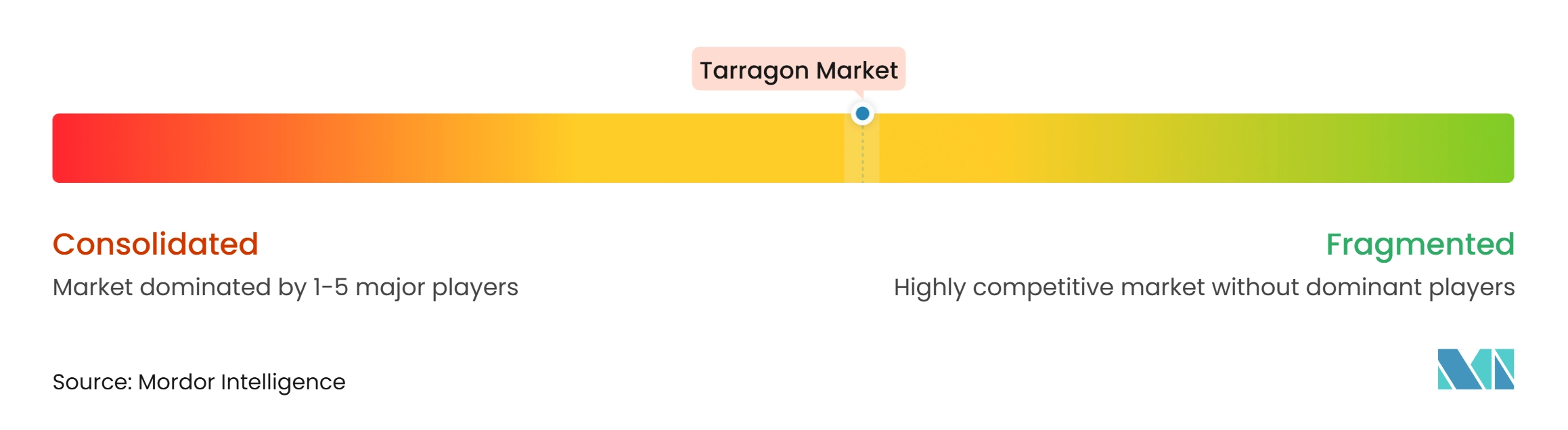
The tarragon market includes multinational spice companies, specialist herb suppliers, ingredient wholesalers, food processors, and regional culinary seasoning brands competing through product quality, sourcing capabilities, processing expertise, brand positioning, and distribution reach. The companies have varying levels of exposure to tarragon through packaged dried herbs, fresh culinary ingredients, bulk herb supplies, seasoning blends, and food-grade botanical ingredients. Larger spice companies can leverage established procurement networks, manufacturing capabilities, and retail distribution, while specialist suppliers focus on organic herbs, bulk ingredients, and customized specifications for commercial food manufacturers. Companies such as McCormick & Company, Frontier Co-op, Starwest Botanicals, Foodcom S.A., and Saatenberg H&C GmbH participate in different parts of the tarragon supply chain.
Competitive strategies in the tarragon market focus on expanding culinary herb portfolios, offering different product formats, strengthening organic positioning, and maintaining consistent raw-material quality. For example, McCormick & Company markets McCormick Gourmet All Natural Tarragon and dried tarragon leaves for household cooking applications, including sauces, vinaigrettes, poultry, and seafood preparations. Frontier Co-op offers certified organic cut-and-sifted tarragon sourced from Spain and Turkey, targeting consumers seeking organic culinary herbs. Starwest Botanicals also includes organic tarragon leaf in its botanical ingredient portfolio. These product strategies allow companies to differentiate through sourcing, organic certification, product specifications, and packaging formats.
Ingredient sourcing and B2B distribution remain important competitive considerations. Foodcom S.A. supplies tarragon for food manufacturing, catering, sauces, marinades, and herb blends, while Saatenberg H&C GmbH offers dried tarragon for industrial processing and international wholesale trade. Both companies emphasize product specifications, quality parameters, and suitability for further processing. These capabilities support food manufacturers seeking consistent raw materials for commercial formulations. However, seasonal availability, variations in leaf quality, moisture control, pesticide residue compliance, and aroma retention can affect procurement costs and product consistency. Manufacturers and suppliers therefore need to prioritize reliable sourcing, processing standards, quality assurance, and efficient distribution to strengthen their competitive positions.
Tarragon Industry Leaders
-
McCormick & Company, Inc.
-
Frontier Co-op
-
Starwest Botanicals, Inc.
-
Olam International Limited
-
Kalsec Inc.
- *Disclaimer: Major Players sorted in no particular order
Tarragon Market Companies Covered in this Report
- McCormick & Company, Inc.
- Foodcom S.A.
- Saatenberg H&C GmbH
- Frontier Co-op
- Starwest Botanicals, Inc.
- Spice World, LLC
- The Spice House
- Badia Spices, Inc.
- Penzeys Spices
- Watkins Incorporated
- Olam International Limited
- Dufour Gourmet
- The Organic Herb Company
- S&B Foods Inc.
- T. Marzetti Company
- Kalsec Inc.
- Herbaria Kräuterhaus GmbH
- The Fresh Herb Company
- Spice Jungle
- The Bart Ingredients Company Ltd.
Recent Industry Developments in Tarragon Market
- June 2026: The International Organization for Standardization (ISO) published the revised
- April 2026: Tarragon cultivation expanded in Kenya as demand increased from hotels, restaurants, and export markets. Growers in Nakuru, Murang'a, Embu, and Nyandarua increasingly adopted tarragon as a specialty horticultural crop, supported by its relatively short production cycle and high per-kilogram value. The development highlighted growing commercial opportunities for fresh tarragon production, export-oriented farming, and specialty herb distribution.
- February 2026: The Food Safety and Standards Authority of India (FSSAI) introduced updated requirements for dehydrated tarragon powder under its spices and condiments regulations, effective February 1, 2026. The requirements specify quality parameters, including moisture content, total ash, acid-insoluble ash, and volatile oil content, alongside botanical identity and chromatographic composition. The regulatory update reinforces quality assurance and compliance requirements for commercially traded dehydrated tarragon in India.
Global Tarragon Market Report Scope
For this study, the Tarragon Market is defined as the sales value of commercially produced tarragon and tarragon-based products derived from the Artemisia dracunculus herb, used as culinary seasonings, flavouring ingredients, and botanical extracts across food processing, foodservice, and retail applications. The market covers fresh tarragon, dried tarragon, frozen tarragon, powdered tarragon, and tarragon extracts and food-grade essential oils. By end user, the market is segmented into food processing, foodservice, and retail. Food processing includes the use of tarragon in sauces, dressings, condiments, processed foods, and seasoning formulations, while foodservice covers its application in restaurants, hotels, catering operations, and commercial kitchens. Retail includes tarragon products sold through supermarkets, hypermarkets, specialty stores, and other retail outlets for household culinary use. The market is analyzed across North America, Europe, Asia-Pacific, South America, and the Middle East and Africa, with country-level coverage as specified in the report. Market sizing and forecasts are presented in value terms (USD) across the defined product types, end users, and geographies.
Segmentation Overview
| Fresh Tarragon |
| Dried Tarragon |
| Frozen Tarragon |
| Powder Tarragon |
| Tarragon Extracts and Food-Grade Essential Oil |
| Food Processing |
| Foodservice |
| Retail |
| North America | United States |
| Canada | |
| Rest of North America | |
| Europe | France |
| Germany | |
| United Kingdom | |
| Italy | |
| Rest of Europe | |
| Asia-Pacific | |
| South America | |
| Middle East and Africa |
| By Product Type | Fresh Tarragon | |
| Dried Tarragon | ||
| Frozen Tarragon | ||
| Powder Tarragon | ||
| Tarragon Extracts and Food-Grade Essential Oil | ||
| By End User | Food Processing | |
| Foodservice | ||
| Retail | ||
| By Geography | North America | United States |
| Canada | ||
| Rest of North America | ||
| Europe | France | |
| Germany | ||
| United Kingdom | ||
| Italy | ||
| Rest of Europe | ||
| Asia-Pacific | ||
| South America | ||
| Middle East and Africa | ||
Key Questions Answered in the Report
What is the size of the Tarragon Market?
The Tarragon Market is estimated at USD 196.68 million in 2026 and is projected to reach USD 275.74 million by 2032.
What is the expected growth rate of the Tarragon Market?
The Tarragon Market is expected to register a CAGR of 5.8% during the forecast period 2027–2032.
Which product type dominates the Tarragon Market?
Dried tarragon is the largest product type segment, accounting for 51.88% of the Tarragon Market share in 2026, supported by its longer shelf life, ease of storage, and extensive use in seasonings, sauces, and food preparations.
Which region holds the largest share of the Tarragon Market?
Europe holds the largest regional share of the Tarragon Market, accounting for 39.62% in 2026. However, North America is expected to be the fastest-growing region, registering a CAGR of 6.80% during 2027–2032.