
Taiwan Color Cosmetics Products Market Size and Share
Market Overview
| Study Period | 2021 - 2031 |
|---|---|
| Forecast Data Period | 2026 - 2031 |
| Base Year Market Size (2025) | USD 642.85 Million |
| Market Size (2026) | USD 674.46 Million |
| Market Size (2031) | USD 880.36 Million |
| Growth Rate (2026 - 2031) | 5.47 % |
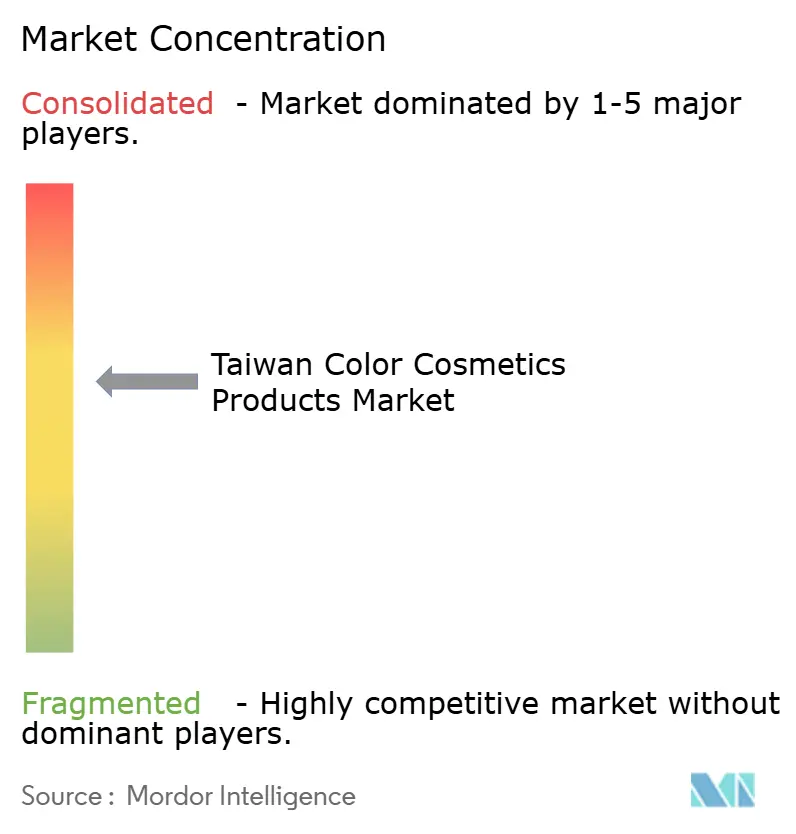
| Market Concentration | Medium |
Major Players
*Disclaimer: Major Players sorted in no particular order Image © Mordor Intelligence. Reuse requires attribution under CC BY 4.0. |
|
Taiwan Color Cosmetics Products Market Analysis by Mordor Intelligence
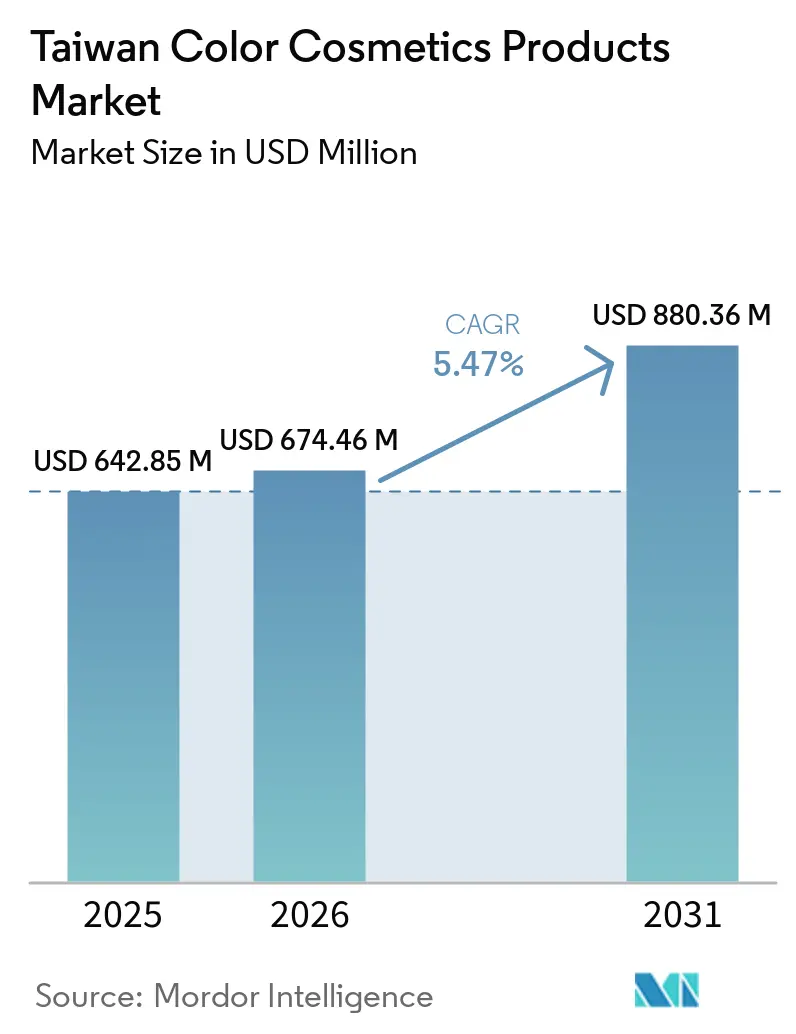
The Taiwan color cosmetics products market size is expected to grow from USD 642.85 million in 2025 to USD 674.46 million in 2026 and is forecast to reach USD 880.36 million by 2031 at 5.47% CAGR over 2026-2031. The market is experiencing steady growth, supported by sustained consumer spending on beauty and personal care products, evolving makeup preferences, and ongoing product innovation. The country's well-developed cosmetics retail ecosystem, combined with high consumer awareness of premium and functional beauty products, continues to create favorable conditions for market expansion. At the same time, stricter regulatory requirements governing product safety, quality documentation, and manufacturing standards are raising industry compliance benchmarks, encouraging greater product transparency and strengthening consumer confidence.
Key Report Takeaways
- By product type, facial make-up products held 38.04% of demand in Taiwan in 2025, while eye make-up products is forecast to expand at a 6.68% CAGR from 2026 to 2031.
- By category, premium products accounted for 56.96% of value in 2025, and is expected to grow at a 6.74% CAGR through 2031.
- By ingredient type, conventional/synthetic formulations held 68.91% of value in 2025, while natural/organic formulations are forecast to grow at a 7.02% CAGR from 2026 to 2031.
- By distribution channel, offline retail stores represented 61.09% of sales in 2025, while online retail stores are projected to advance at a 7.30% CAGR through 2031.
Note: Market size and forecast figures in this report are generated using Mordor Intelligence’s proprietary estimation framework, updated with the latest available data and insights as of January 2026.
Taiwan Color Cosmetics Products Market Trends and Insights
Drivers Impact Analysis*
| Driver | ~ (%) Impact on CAGR Forecast | Geographic Relevance | Impact Timeline |
|---|---|---|---|
| Urban millennials and Gen Z demand clean beauty and natural formulations | +1.1% | National; concentrated in Taipei, New Taipei, and Taichung metropolitan areas | Short term (≤ 2 years) |
| Influence of K-beauty and regional beauty trends | +0.9% | National; strongest in Taipei department store and specialty retail corridors | Short term (≤ 2 years) |
| Sustainability and eco-conscious packaging innovations | +0.6% | National; strongest uptake among northern Taiwan urban Gen Z demographics | Medium term (2-4 years) |
| Rising beauty consciousness and personal grooming awareness | +0.8% | National | Short term (≤ 2 years) |
| Growing demand for multifunctional and skin-friendly cosmetics | +0.7% | National; led by Gen Z consumers in Taipei and New Taipei | Medium term (2-4 years) |
| Expansion of e-commerce and social media influence | +1.0% | National; extends to non-metro areas through Shopee, momo, and LINE Shopping | Short term (≤ 2 years) |
| Source: Mordor Intelligence | |||
Urban Millennials and Gen Z Demand Clean Beauty and Natural Formulations
Taiwan's growing preference for clean beauty is driven by Millennials and Generation Z, who increasingly prioritize ingredient transparency, naturally derived formulations, and environmentally conscious products. According to the National Development Council's 2025 Population Projections, the country had more than 2.5 million people aged 20–29, representing a sizeable consumer base entering their peak spending years[1]National Development Council, " Taiwan in 2070, " pop-proj.ndc.gov.tw. This demographic is highly engaged with digital beauty content and tends to seek cosmetics formulated with plant-based ingredients, skin-friendly actives, and simplified ingredient lists. As beauty preferences evolve, younger consumers are increasingly favoring products that combine cosmetic performance with skincare benefits while avoiding ingredients perceived as harsh or unnecessary. Demand for vegan, cruelty-free, and sustainably packaged cosmetics is also rising, encouraging both domestic and international brands to expand their clean beauty portfolios. Supported by strong online engagement and increasing awareness of product safety and sustainability, this generational shift is expected to remain a key growth driver for Taiwan's color cosmetics market.
Influence of K-Beauty and Regional Beauty Trends
The growing popularity of K-beauty and broader Asian beauty trends has become a significant driver of Taiwan's color cosmetics market. According to the Korea Trade-Investment Promotion Agency (KOTRA), South Korea accounted for 19.6% of Taiwan's color cosmetics imports in 2024, up from 14.4% in 2020, reflecting the rising penetration of Korean beauty products in the domestic market[2]Korea Trade-Investment Promotion Agency, "Taiwan Color Cosmetics Market Trends, " dream.kotra.or.kr. Korean-inspired makeup aesthetics, including natural-looking base makeup, gradient lips, and soft eye looks, continue to influence consumer preferences, particularly among younger demographics. Beyond product imports, regional beauty trends are rapidly shaping product innovation and purchasing behavior in Taiwan. Social media platforms, beauty influencers, and cross-border e-commerce have accelerated the adoption of new makeup techniques, seasonal color palettes, and multifunctional cosmetics from neighboring Asian markets. In response, both international and domestic brands are introducing products with lightweight textures, skincare-infused formulations, and trend-driven color collections. The continued exchange of beauty trends across East Asia is expected to support product innovation and sustain demand in Taiwan's color cosmetics market.
Sustainability and Eco-Conscious Packaging Innovations Driving the Market
Growing environmental awareness is encouraging cosmetics manufacturers to adopt more sustainable packaging solutions and environmentally responsible product designs. Consumers are increasingly considering packaging recyclability, material sourcing, and overall environmental impact alongside product performance when making purchasing decisions. In response, brands are incorporating recyclable materials, refillable packaging systems, and reduced-plastic designs into their color cosmetics portfolios while improving transparency around their sustainability initiatives. These efforts are helping companies strengthen brand differentiation and meet evolving consumer expectations. Sustainability is also influencing product development across the broader beauty industry, with manufacturers placing greater emphasis on circular packaging principles, post-consumer recycled materials, and packaging designs that minimize waste without compromising product quality. At the same time, growing interest in clean beauty has reinforced demand for products that combine environmentally conscious packaging with responsibly sourced ingredients and ethical manufacturing practices. As sustainability becomes an increasingly important purchasing consideration, continued innovation in eco-friendly packaging is expected to support long-term growth in Taiwan's color cosmetics products market.
Expansion of E-Commerce and Social Media Influence
The expansion of digital commerce and social media platforms is reshaping how consumers discover, evaluate, and purchase color cosmetics in Taiwan. According to the 2025 Taiwan Internet Report published by the Taiwan Network Information Center (TWNIC), 53.28% of Taiwan's population engaged in online shopping in 2025, while 76.86% used social media services[3]Taiwan Network Information Center "2025 Taiwan Internet Report, " report.twnic.tw . These figures highlight the strong integration of digital platforms into consumers' daily lives and their growing role as touchpoints for beauty brands to showcase products, engage with consumers, and influence purchasing decisions. The growing influence of beauty creators, livestreaming, user-generated reviews, and short-form video content has accelerated the adoption of color cosmetics among digitally connected consumers. Social media platforms enable brands to launch products more rapidly, demonstrate product performance through tutorials, and build consumer engagement through influencer collaborations and real-time feedback. The continued growth of online retail also provides consumers with greater product accessibility, competitive pricing, and convenience, supporting higher purchase frequency and broader market reach.
Restraints Impact Analysis*
| Restraint | ~ (%) Impact on CAGR Forecast | Geographic Relevance | Impact Timeline |
|---|---|---|---|
| High market fragmentation and intense competition from global manufacturers | -0.9% | National; most acute in Taipei's premium and mid-tier channel | Short term (≤ 2 years) |
| Stringent cosmetic regulations and product approval requirements | -0.7% | National; uniform application with ISO 22716 alignment | Medium term (2-4 years) |
| Economic sensitivity and discretionary spending fluctuations | -0.8% | National; heightened in non-metro and value-oriented consumer segments | Medium term (2-4 years) |
| Growing consumer preference for natural and minimal makeup | -0.6% | National; higher incidence in urban professional and aesthetics-engaged demographics | Long term (≥ 4 years) |
| Source: Mordor Intelligence | |||
High Market Fragmentation and Intense Competition from Global Manufacturers
The presence of numerous global, regional, and domestic brands has intensified competition in Taiwan's color cosmetics market, making it increasingly difficult for companies to sustain growth and maintain pricing power. Frequent product launches, promotional discounts, and aggressive marketing campaigns create constant pressure on brands to differentiate their offerings, often resulting in reduced profit margins and higher customer acquisition costs. Emerging and smaller manufacturers face significant challenges in gaining consumer recognition, given the dominance of well-established international brands with extensive marketing budgets and strong retail presence. The rapid pace of changing beauty trends also shortens product life cycles, requiring continuous investment in product innovation and brand promotion. These factors increase operating costs and create barriers to long-term market expansion, particularly for new entrants and niche players.
Stringent Cosmetic Regulations and Product Approval Requirements
Taiwan's color cosmetics market operates under a regulatory framework governing product safety, ingredient usage, labeling, and manufacturing practices. The Taiwan Food and Drug Administration (TFDA) requires manufacturers to maintain appropriate product documentation and ensure that products meet applicable regulatory standards before and after market entry. These compliance requirements increase administrative and operational responsibilities for market participants. For manufacturers introducing new products, regulatory compliance may require additional time and resources to complete product documentation, labeling reviews, and quality management processes. Smaller companies and new entrants may face greater challenges in meeting these requirements due to limited regulatory expertise and financial resources. While these regulations protect consumer safety and improve product quality, they can increase compliance costs and lengthen the product commercialization process, thereby restraining market growth.
*Our forecasts treat driver/restraint impacts as directional, not additive. The impact forecasts reflect baseline growth, mix effects, and variable interactions.
Segment Analysis
By Product Type: Eye Makeup Ascends as Aesthetic References Evolve
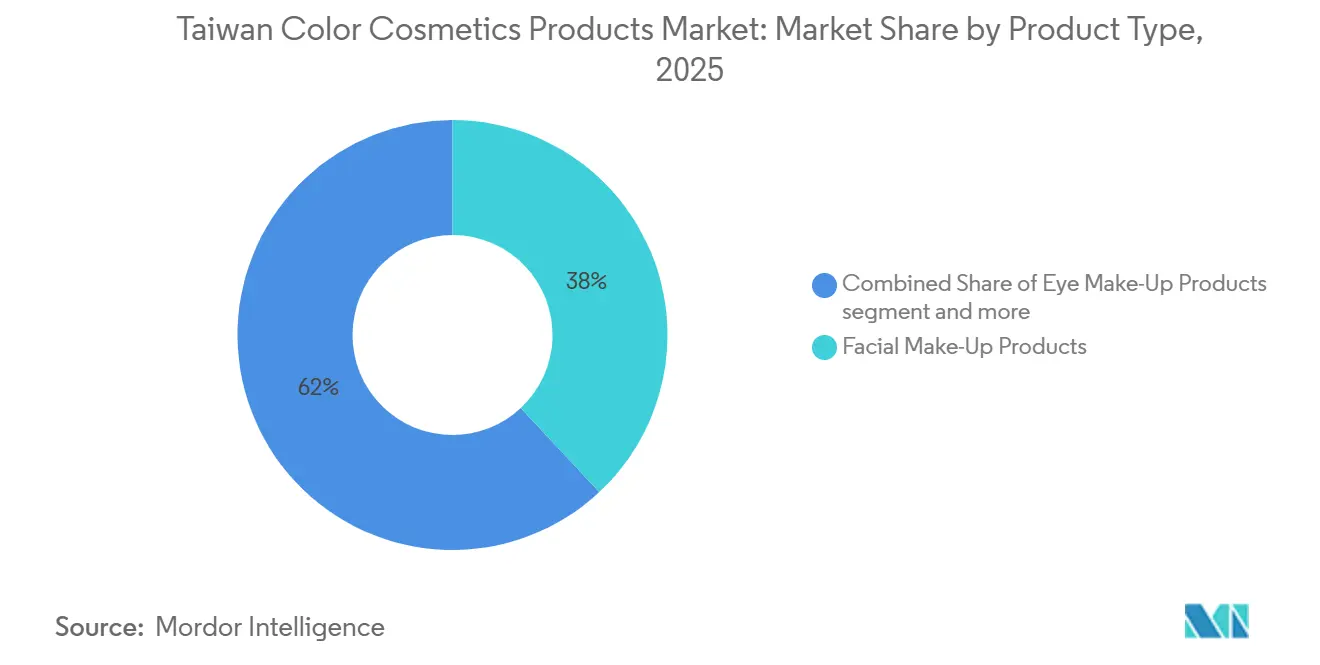
Facial make-up products, including foundation, compact and pressed powders, blush, highlighter, and concealer, accounted for 38.04% of the Taiwan color cosmetics market in 2025, making it the largest product segment. The category benefits from steady demand for complexion-enhancing products as consumers increasingly seek natural-looking finishes and multifunctional formulations. Growing interest in lightweight, skin-friendly makeup has encouraged brands to introduce hybrid products such as serum foundations, tinted moisturizers, and BB creams that combine cosmetic and skincare benefits, supporting the segment's market leadership.
Eye make-up products are projected to register the fastest growth, at a CAGR of 6.68% during 2026–2031. Rising influence of Korean and Japanese beauty trends, particularly soft eye-focused makeup styles, is driving demand for eyeshadows, eyeliners, mascaras, and brow products. Strong consumer engagement with eye cosmetics on Taiwan's digital beauty platforms, along with increasing launches of localized product ranges tailored to Asian skin tones and consumer preferences, is expected to further support the segment's growth.



By Category: Premium Consolidates Under Selective Consumer Splurging
Premium products accounted for 56.96% of the Taiwan color cosmetics market by value in 2025 and are projected to register the fastest CAGR of 6.74% during 2026–2031. The segment is supported by strong consumer preference for high-quality formulations, innovative product features, and internationally recognized beauty brands. Taiwan's well-established department store network, premium beauty counters, and growing demand for personalized shopping experiences continue to drive sales. Ongoing product innovation, omnichannel retail expansion, and localized product launches are expected to further strengthen the segment's market position.
Mass products remain an important segment of the Taiwan color cosmetics market, catering to consumers seeking affordable and accessible beauty products. The segment benefits from broad availability across supermarkets, drugstores, convenience stores, and online retail platforms, supported by frequent product launches and promotional activities. Demand is further sustained by increasing adoption among younger consumers and the availability of products across a wide range of price points and cosmetic categories.
By Ingredient Type: Natural Formulations Disrupt Synthetic Legacy
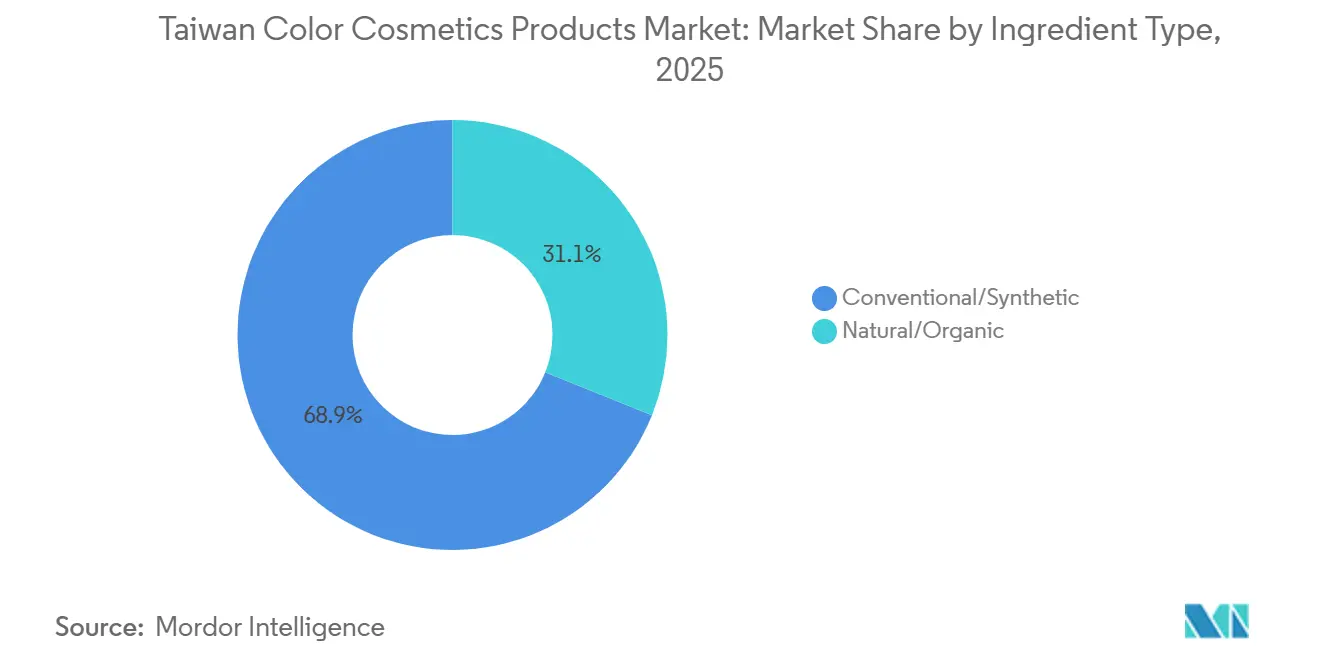
Conventional/synthetic formulations accounted for 68.91% of the Taiwan color cosmetics market by ingredient type in 2025, making them the dominant segment. Their widespread adoption is driven by superior color stability, longer wear performance, broader shade availability, and formulation consistency across a wide range of cosmetic products. These ingredients remain essential for achieving the durability and finish expected in products such as long-wear lipsticks, foundations, and eye makeup. Many manufacturers are also incorporating botanical extracts into conventional formulations to meet evolving consumer preferences while maintaining product performance.
Natural/organic formulations are projected to register the fastest growth, at a CAGR of 7.02% during 2026–2031. Rising consumer awareness of ingredient safety, clean beauty trends, and demand for environmentally responsible cosmetics are driving adoption of naturally derived formulations. Consumers are increasingly seeking products with transparent ingredient disclosures, dermatological testing, and recognized certifications, prompting brands to invest in safer and more sustainable product development. These trends are expected to continue driving demand for natural and organic color cosmetics in Taiwan.
By Distribution Channel: Online Platforms Rewire the Beauty Purchase Path
Offline retail stores accounted for 61.09% of the Taiwan color cosmetics market by distribution channel in 2025, making them the largest sales channel. The segment continues to benefit from consumers' preference for physically testing products before purchase, particularly for foundation, lipstick, and other shade-dependent cosmetics. Specialty beauty stores, pharmacies, drugstores, supermarkets, and department stores provide broad product accessibility and personalized shopping experiences, supporting the channel's dominant position.
Online retail stores are projected to register the fastest growth, at a CAGR of 7.30% during 2026–2031. Growth is driven by rising e-commerce adoption, increasing smartphone usage, and the integration of virtual try-on technologies and AI-powered shopping tools. The growing influence of social commerce, livestream shopping, beauty influencers, and digital marketplaces is further encouraging consumers, particularly younger demographics, to purchase color cosmetics through online platforms.
Geography Analysis
Taipei, along with the surrounding New Taipei City metropolitan area, represents the largest market for color cosmetics in Taiwan. The region has the highest concentration of premium department stores, specialty beauty retailers, and international flagship stores in the country, making it the primary destination for new product launches. High disposable incomes, strong consumer spending on prestige beauty products, and early adoption of Korean and Japanese beauty trends continue to reinforce Taipei's market leadership.
Taichung and Kaohsiung are expected to witness the fastest market growth during the forecast period, supported by rising disposable incomes, expanding modern retail infrastructure, and increasing demand for premium and affordable beauty products. The expansion of specialty beauty retailers, pharmacy chains, and lifestyle stores has improved product accessibility, while growing social media influence and digital marketing are accelerating color cosmetics adoption among younger consumers in these cities.
Other regions, including Hsinchu, Tainan, Yilan, Hualien, Keelung, and Pingtung, are gradually contributing to market expansion as e-commerce improves access to domestic and international beauty brands. The growing reach of online marketplaces, efficient nationwide delivery networks, and increasing smartphone penetration have reduced regional disparities in product availability. These developments are enabling consumers outside Taiwan's major metropolitan areas to access a wider range of color cosmetics, supporting steady market growth across the rest of the country.
Competitive Landscape
The Taiwan color cosmetics market is moderately concentrated, with competition from global manufacturers and established domestic brands. Major players include L'Oréal S.A., Shiseido Co., Ltd., The Estée Lauder Companies Inc., LVMH, Amorepacific Corporation, LG H&H Co., Ltd., Kao Corporation, and Unilever PLC. These companies maintain strong market positions through broad product portfolios, established brand recognition, extensive distribution networks, and continuous product innovation.
Leading companies continue to strengthen their market positions through new product launches, digital beauty technologies, and retail expansion. In 2026, LVMH introduced Louis Vuitton's first La Beauté Makeup Lab Salon in Taipei, marking the brand's entry into Taiwan's luxury color cosmetics retail segment. L'Oréal continues to invest in AI-enabled beauty solutions, including virtual try-on technologies, while Amorepacific is expanding its beauty brands across Asia-Pacific markets, including Taiwan.
Domestic brands such as Heme Cosmetics, Solone, Naruko, and Dr. Wu Skincare Co., Ltd. have established a strong presence in Taiwan by offering products tailored to local consumer preferences. These brands have expanded their reach through drugstores, beauty specialty retailers, and online platforms, enabling them to compete effectively with international companies. The presence of local manufacturers and OEM/ODM companies also supports product development and manufacturing for both domestic and global beauty brands.
Taiwan Color Cosmetics Products Industry Leaders
-
L'Oréal S.A.
-
Shiseido Co., Ltd.
-
The Estée Lauder Companies Inc.
-
LVMH
-
Amorepacific Corporation
- *Disclaimer: Major Players sorted in no particular order

Recent Industry Developments
- July 2026: KANEBO expanded its color cosmetics portfolio in Taiwan by launching new shades of its ROUGE STAR DRAMA lipstick collection, strengthening its premium lip makeup offering with additional limited-edition and permanent color variants.
- June 2026: Shiseido Taiwan introduced the new MAQuillAGE Nude Milk Foundation and updated powder foundation to the Taiwanese market, expanding its complexion makeup portfolio with skincare-inspired formulations designed for long-lasting wear.
- April 2026: Louis Vuitton opened its first La Beauté Makeup Lab Salon in Taiwan at its Breeze Xinyi boutique in Taipei, expanding its luxury beauty retail presence and introducing personalized beauty consultation services for its La Beauté cosmetics collection.
- April 2026: NARS introduced its Light Reflecting Blush collection in Taiwan, expanding its premium color cosmetics portfolio with skincare-inspired blush formulations designed to deliver a natural, radiant finish.


Taiwan Color Cosmetics Products Market Report Scope
Color cosmetics products are cosmetic formulations used to enhance facial appearance through products designed for the face, eyes, lips, and nails. The Taiwan color cosmetics products market is segmented by product type, category, ingredient type, and distribution channel. Product types include facial make-up products such as foundation, powders, blush, highlighters, and concealers; eye make-up products including eyeliners, mascaras, and eye shadows; lip make-up products such as lipsticks and lip glosses; and nail make-up products. The market is further segmented into premium products and mass products, as well as conventional/synthetic and natural/organic formulations. Distribution channels include online retail stores and offline retail stores, with the latter comprising supermarkets/hypermarkets, specialty stores, and other retail channels. For each segment, the market sizing and forecasting have been done in value terms (USD million).
| Facial Make-Up Products | Foundation |
| Compact and Pressed Powders | |
| Blush/Highlighter | |
| Concealer | |
| Others | |
| Eye Make-Up Products | Eyeliners |
| Mascara | |
| Eye Shadow | |
| Others | |
| Lip Make-Up Products | Lipsticks |
| Lip Gloss | |
| Others | |
| Nail Make-Up Products |
| Premium Products |
| Mass Products |
| Conventional/Synthetic |
| Natural/Organic |
| Online Retail Stores | |
| Offline Retail Stores | Supermarkets/Hypermarkets |
| Specialty Stores | |
| Other Distribution Channels |
| By Product Type | Facial Make-Up Products | Foundation |
| Compact and Pressed Powders | ||
| Blush/Highlighter | ||
| Concealer | ||
| Others | ||
| Eye Make-Up Products | Eyeliners | |
| Mascara | ||
| Eye Shadow | ||
| Others | ||
| Lip Make-Up Products | Lipsticks | |
| Lip Gloss | ||
| Others | ||
| Nail Make-Up Products | ||
| By Category | Premium Products | |
| Mass Products | ||
| By Ingredient Type | Conventional/Synthetic | |
| Natural/Organic | ||
| By Distribution Channel | Online Retail Stores | |
| Offline Retail Stores | Supermarkets/Hypermarkets | |
| Specialty Stores | ||
| Other Distribution Channels | ||


Key Questions Answered in the Report
What is the current size of Taiwan color cosmetics products sales?
The Taiwan color cosmetics products market was valued at USD 642.85 million in 2025 and stands at USD 674.46 million in 2026, with forecasts pointing to USD 880.36 million by 2031.
How fast are color cosmetics in Taiwan expected to grow through 2031?
The Taiwan color cosmetics products market is projected to expand at a 5.47% CAGR from 2026 to 2031, supported by strong daily use, premium spending, and digital discovery tools.
Are premium products still leading purchases in Taiwan?
Yes. Premium products represented 56.96% of value in 2025 and are also forecast to grow at a 6.74% CAGR through 2031, showing that consumers continue to spend more in visible and higher impact categories.
What is the biggest operating challenge for brands selling makeup in Taiwan?
The main challenge is the combination of heavier compliance requirements and crowded competition, since all brands now need full Product Information File and Good Manufacturing Practice readiness while competing with multiple active brands.
Page last updated on:


 Your data is secure and never sold or shared.


