
Tablet and Capsule Vision Inspection Systems Market Size and Share
Market Overview
| Study Period | 2020 - 2031 |
|---|---|
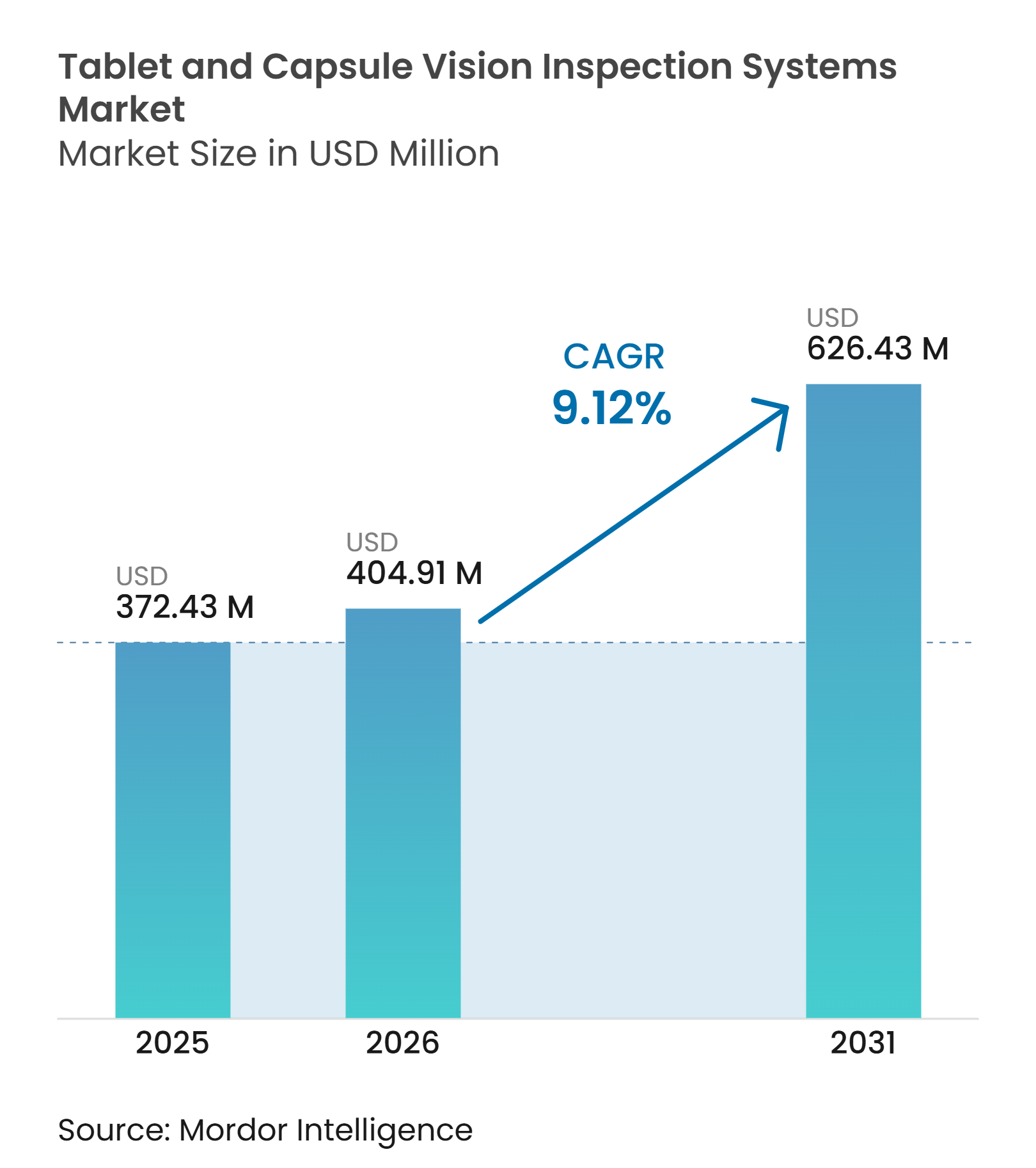
| Market Size (2026) | USD 404.91 Million |
| Market Size (2031) | USD 626.43 Million |
| Growth Rate (2026 - 2031) | 9.12 % |
| Fastest Growing Market | Asia-Pacific |
| Largest Market | North America |
| Market Concentration | Medium |
Major Players *Disclaimer: Major Players sorted in no particular order Image © Mordor Intelligence. Reuse requires attribution under CC BY 4.0. | |
Tablet and Capsule Vision Inspection Systems Market Analysis by Mordor Intelligence
The Tablet and Capsule Vision Inspection Systems Market size was valued at USD 372.43 million in 2025 and estimated to expand from USD 406.4 million in 2026 to reach USD 626.43 million by 2031, at a CAGR of 9.12% during the forecast period (2026-2031). Demand is supported by stricter requirements for unit-level inspection on solid-dose production lines. Manufacturers are replacing sampling approaches with systems that inspect each tablet or capsule as it moves through the line. Automation also matters because manufacturers need consistent records across product batches and facilities. Suppliers are combining inspection hardware, software, and validation support because buyers increasingly assess the full operating burden rather than the purchase price alone. The Tablet and Capsule Vision Inspection Systems Market also offers opportunities for suppliers that can support high-mix production, legacy-line upgrades, and new dosage forms without adding lengthy changeovers.
Key Report Takeaways
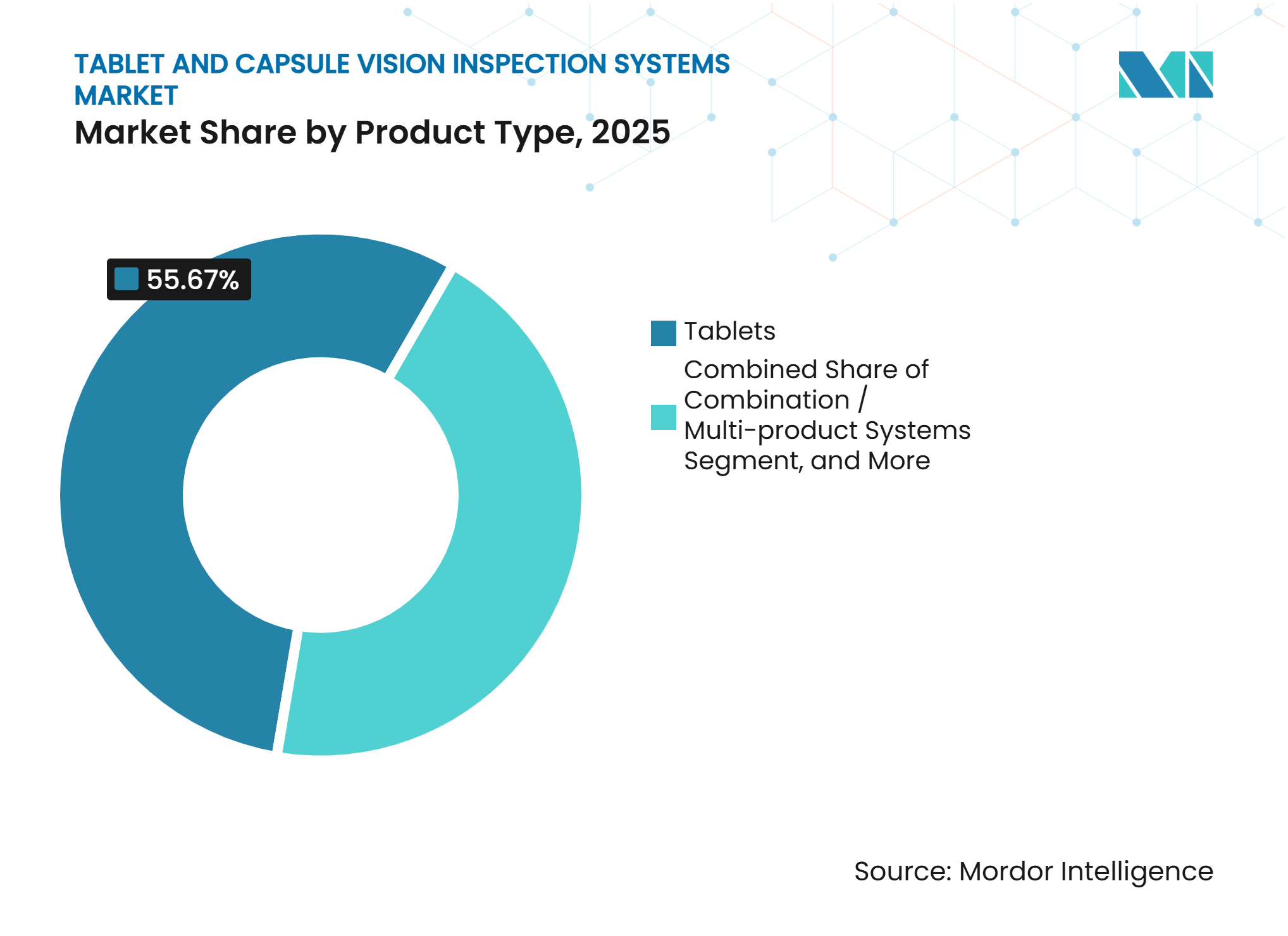
- By product type, tablets held 55.67% of the Tablet and Capsule Vision Inspection Systems Market share in 2025, while combination and multi-product inspection systems are projected to expand at a 9.44% CAGR through 2031.
- By technology, 2D vision inspection held 59.91% share in 2025, while AI-enabled vision inspection is projected to expand at a 9.72% CAGR through 2031.
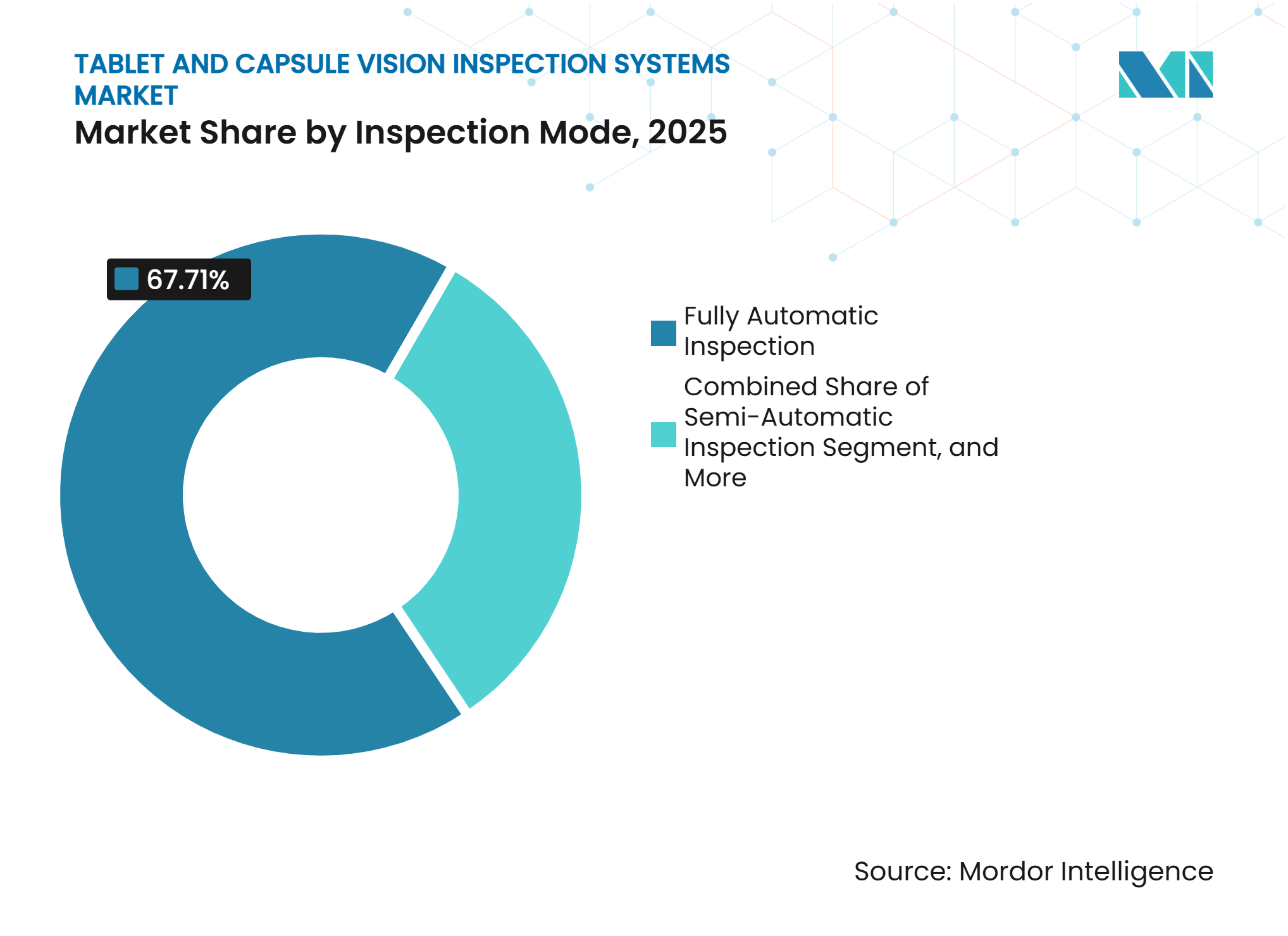
- By inspection mode, fully automatic inspection held 67.71% share in 2025 and is projected to remain the fastest-expanding mode through 2031.
- By inspection type, appearance and cosmetic defect inspection held 27.69% share in 2025, while identity and marking inspection is projected to expand at a 9.88% CAGR through 2031.
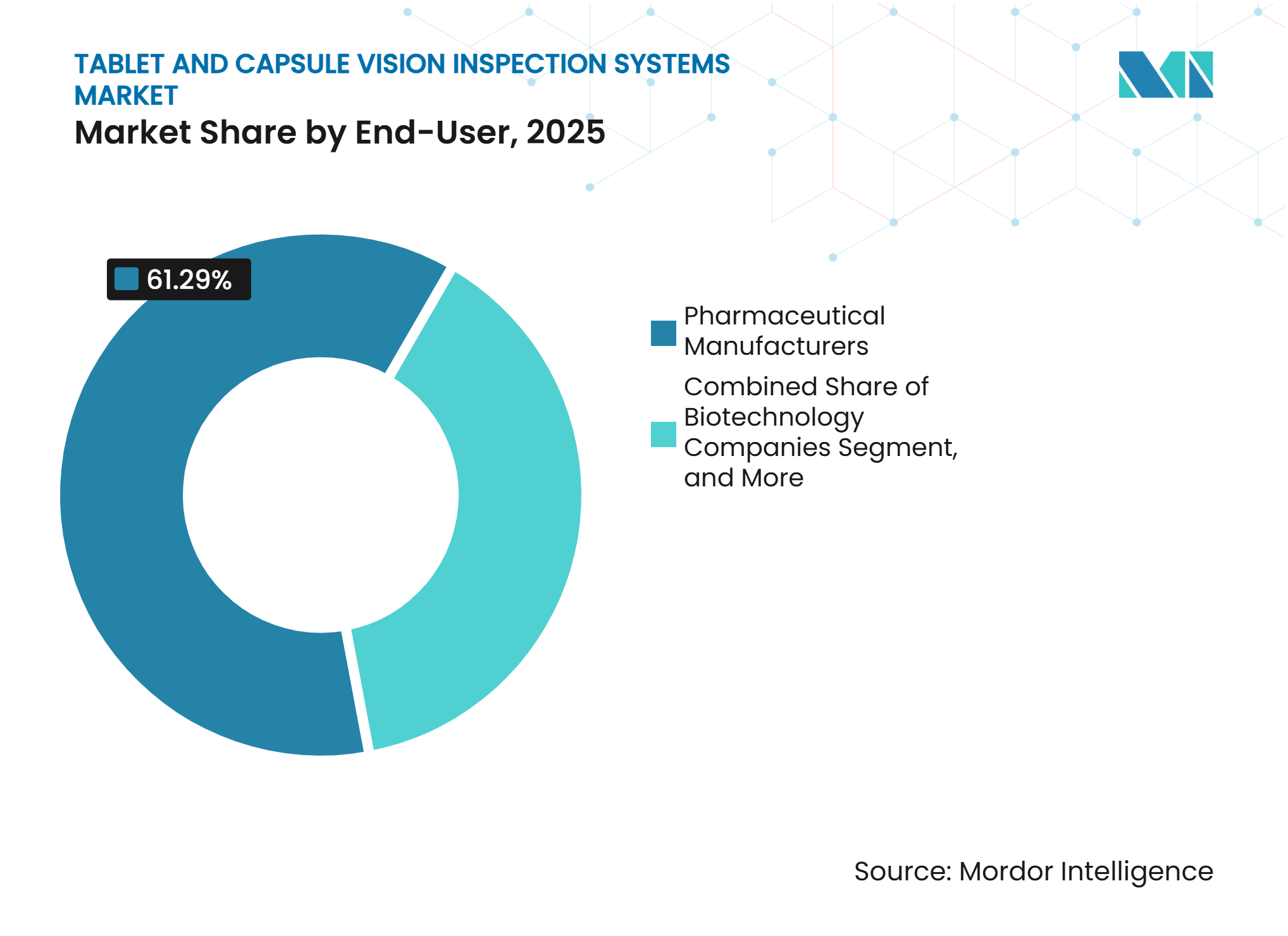
- By end-user, pharmaceutical manufacturers held 61.29% share in 2025, while biotechnology companies are projected to expand at a 9.48% CAGR through 2031.
- By packaging interface, blister-pack inspection held 43.44% share in 2025, while carton and secondary-packaging inspection is projected to expand at a 9.74% CAGR through 2031.
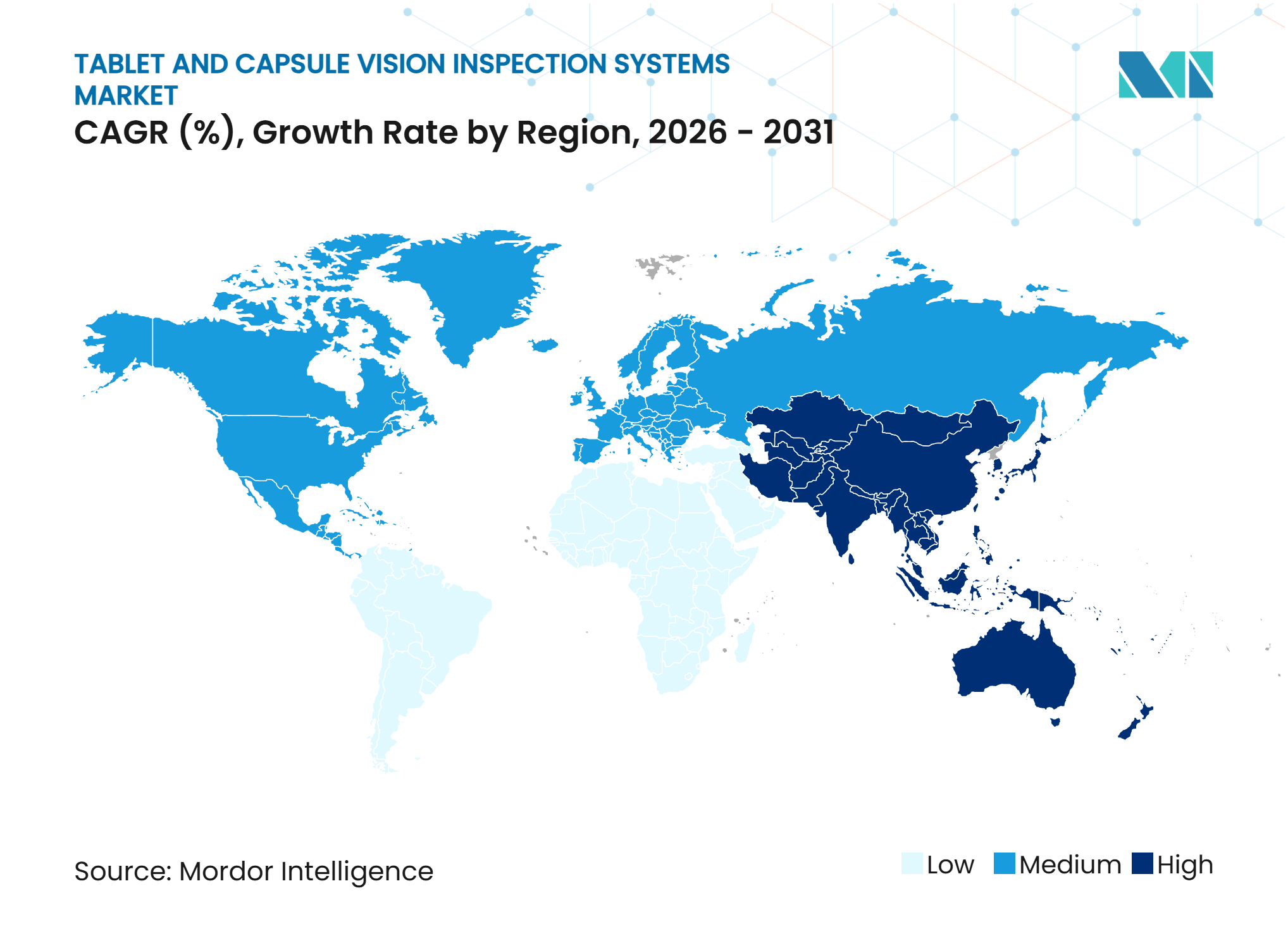
- By geography, North America held 29.44% of global demand in 2025, while Asia-Pacific is projected to expand at a 9.91% CAGR through 2031.
Note: Market size and forecast figures in this report are generated using Mordor Intelligence’s proprietary estimation framework, updated with the latest available data and insights as of January 2026.
Market Trends and Insights
Drivers Impact Analysis of Tablet and Capsule Vision Inspection Systems Market*
| Driver | (~) % Impact on CAGR Forecast | Geographic Relevance | Impact Timeline |
|---|---|---|---|
| Regulatory Enforcement of 100% Solid-Dose Inspection | +2.5% | Global, with concentrated enforcement in the United States, Europe, and Japan | Short term (≤ 2 years) |
| Expansion of High-Speed Automated Pharmaceutical Manufacturing | +1.8% | Global, with strongest capacity expansion in Asia-Pacific and North America | Medium term (2-4 years) |
| Adoption of AI-Enabled Defect Classification and Recipe Management | +1.6% | Global, with early adoption in Europe and North America | Long term (≥ 4 years) |
| Growth of Contract Manufacturing and Outsourced Quality Operations | +1.2% | Global, with highest activity in Asia-Pacific and North America | Medium term (2-4 years) |
| Retrofit Demand from Legacy Blister and Capsule Lines | +0.8% | Europe and North America, where older equipment remains widely installed | Short term (≤ 2 years) |
| Scarcity of Defect-Image Data for Rare Product and Coating Combinations | +0.4% | Global, affecting manufacturers that deploy AI inspection | Long term (≥ 4 years) |
| Source: Mordor Intelligence | |||
Regulatory Enforcement of 100% Solid-Dose Inspection
Regulatory requirements are encouraging pharmaceutical manufacturers to strengthen automated inspection procedures. U.S. finished-pharmaceutical rules require manufacturers to establish written procedures for production and process control, including controls designed to assure product quality.[1] The Tablet and Capsule Vision Inspection Systems Market benefits when plants must show that inspection processes are controlled, repeatable, and documented. European GMP guidance also requires automated inspection systems to be challenged with representative defects before use.[2] These expectations favor fully integrated equipment with controlled settings and traceable electronic records. They also make validated upgrades more important for plants that still rely on manual or semi-automatic review.
Expansion of High-Speed Automated Pharmaceutical Manufacturing
High-speed solid-dose production is increasing the need for inspection systems that can keep pace with tablet and capsule lines. Proditec states that its VISITAB 3 platform can inspect up to 600,000 products per hour across tablets, capsules, and softgels.[3] Sensum has presented its SPINE system as an all-in-one platform designed for high-throughput operations. Higher line speeds raise the importance of stable lighting, image capture, and defect classification. The Tablet and Capsule Vision Inspection Systems Market, therefore, favors suppliers that can maintain inspection quality without slowing output. New manufacturing capacity also creates demand at the design stage, when inspection equipment can be incorporated into a line before qualification begins.
Adoption of AI-Enabled Defect Classification and Recipe Management
AI-enabled inspection addresses the practical difficulty of distinguishing normal product variation from a true defect. Traditional rule-based systems can reject acceptable products when thresholds are too strict. Antares Vision Group introduced AI-GO in 2025 with separate environments for model training and production execution. Cognex introduced the In-Sight 3900 in May 2026 with embedded AI tools, resolution up to 25 megapixels, and processing speeds up to 4 times faster than the preceding platform. Recipe management is equally important because contract manufacturers often handle many formats with different coatings, imprints, and lighting requirements. The Tablet and Capsule Vision Inspection Systems Market is likely to reward systems that preserve validated settings while reducing manual changeover work.
Growth of Contract Manufacturing and Outsourced Quality Operations
Contract manufacturers need inspection systems that can handle multiple client products on shared production assets. A single site may process tablets, hard capsules, softgels, and products with different imprints or coatings. This operating model increases the value of flexible equipment, quick recipe recall, and audit-ready batch records. The Tablet and Capsule Vision Inspection Systems Market gains from this need because a modular platform can serve several dosage forms without separate inspection machines. Biotechnology companies are also introducing novel oral formats that require new defect libraries and specialized illumination. Suppliers that pair equipment with rapid model development and validation support can address this need. Flexible systems are especially relevant where outsourced production is expanding across Asia-Pacific and North America.
Restraints Impact Analysis of Tablet and Capsule Vision Inspection Systems Market*
| Restraint | (~) % Impact on CAGR Forecast | Geographic Relevance | Impact Timeline |
|---|---|---|---|
| High Validation and Change-Control Burden | -1.1% | Global, with the greatest burden in the United States, Europe, and Japan | Medium term (2-4 years) |
| Capital Intensity of High-Throughput Inspection Lines | -0.9% | Emerging markets and small to mid-sized manufacturers globally | Short term (≤ 2 years) |
| False Rejects From Reflective Coatings and Variable Product Appearance | -0.5% | Global | Short term (≤ 2 years) |
| Limited Availability of Market-Specific Training Data for New Dosage Forms | -0.4% | Global | Long term (≥ 4 years) |
| Source: Mordor Intelligence | |||
High Validation and Change-Control Burden
Validation requirements can delay the installation or replacement of automated inspection equipment. Manufacturers must show that computerized systems perform consistently for their intended use and maintain reliable records. U.S. regulations require controls for electronic records and signatures when these records are used to meet regulatory requirements. A new product, software update, or revised AI model can require documented testing before it enters production. The Tablet and Capsule Vision Inspection Systems Market faces slower adoption, where smaller manufacturers lack dedicated quality teams. The burden is heavier when systems must be compared with established manual methods or older, validated equipment. Preconfigured protocols, audit trails, and qualification workflows can reduce the operational burden, but they do not remove the need for controlled change management.
Capital Intensity of High-Throughput Inspection Lines
Fully automatic inspection systems require spending on hardware, integration, software, validation, and operator training. Retrofit projects can cost more than greenfield installations because they must fit around existing conveyors, packaging machines, and plant controls. The Tablet and Capsule Vision Inspection Systems Market can therefore face longer purchasing cycles among smaller generic manufacturers. The effect is stronger in fast-growing regions where demand is increasing, but capital budgets remain limited. Lower-throughput modular systems can provide a step toward automation for these operators. However, the performance gap between entry-level equipment and premium multi-camera systems can postpone a full upgrade. Suppliers that offer locally serviceable equipment and staged automation options may reduce this barrier.
*Our forecasts treat driver/restraint impacts as directional, not additive. The impact forecasts reflect baseline growth, mix effects, and variable interactions.
Tablet and Capsule Vision Inspection Systems Market Segment Analysis
By Product Type:
Tablets Lead While Combination Systems Gain GroundTablets held 55.67% of the Tablet and Capsule Vision Inspection Systems Market share in 2025. Their position reflects large oral solid-dose production volumes and a broad range of visible defects. Chips, cracks, coating voids, embossing errors, and color variation all require consistent inspection at operating speed. Tablet lines also require accurate handling because mechanical contact can create additional damage. The installed base of tablet presses and packaging lines supports replacement and retrofit demand. High-volume tablet production makes fully automated inspection easier to justify on a per-unit basis. In the Tablet and Capsule Vision Inspection Systems Market, tablet inspection remains the central application for suppliers with established pharmaceutical equipment portfolios. It also remains important for vendors that provide inspection systems to generic manufacturers.
Combination and multi-product inspection systems are projected to expand at a 9.44% CAGR through 2031. These platforms allow a manufacturer or contractor to move between tablets, hard capsules, and softgels without a separate machine for each format. This is valuable in high-mix plants where individual products have lower volumes. Hard capsules require lighting and defect models that account for shell materials such as HPMC and pullulan. Softgels present separate issues because translucency and fill-level verification can limit the usefulness of standard imaging. Qualicaps launched QUALIS-Pro in November 2025 as an integrated printing and inspection system with comprehensive inspection capabilities. Such integrated layouts can reduce the number of standalone machines in a production line.



By Technology:
2D Vision Holds Scale While AI Expands Capability2D vision inspection accounted for 59.91% of the Tablet and Capsule Vision Inspection Systems Market in 2025. The technology has a large, validated installed base across pharmaceutical plants. Quality teams are familiar with their camera settings, lighting arrangements, and qualification requirements. Long replacement cycles also support continued use of existing 2D systems. These systems remain suitable for many appearances, colors, prints, and surface checks. Their operating logic is well understood by plant personnel. 2D vision will therefore remain important where production conditions and defect types are stable. It also provides the foundation for many systems that add software-based classification tools.
AI-enabled vision inspection is projected to expand at a 9.72% CAGR through 2031. AI can help classify product variation that is difficult to capture through a fixed rule set. The approach depends on labeled images that represent both acceptable variation and relevant defects. It can be difficult to build these data sets for a new coating, a rare defect, or a novel capsule format. Three-dimensional inspection supports checks such as tablet thickness, capsule deformation, and edge-chip depth. Research published in 2025 demonstrated in-line multi-wavelength monitoring of pharmaceutical tablets using carbon nanotube imaging scanners, including non-destructive measurement across a broad spectral range. The Tablet and Capsule Vision Inspection Systems Market may gradually incorporate these methods where physical appearance alone cannot meet quality needs.
By Inspection Mode:
Fully Automatic Systems Maintain a Clear LeadFully automatic inspection held 67.71% of the Tablet and Capsule Vision Inspection Systems Market share in 2025. This mode supports continuous inspection and direct integration with high-speed production lines. It also creates a consistent electronic record for product disposition and batch review. Fully automatic systems are particularly relevant in facilities operating under strict process-control requirements. The mode reduces the dependence on manual review for routine high-volume inspection. It can also improve repeatability when product handling, lighting, and rejection are carefully controlled. For these reasons, fully automatic equipment remains the primary investment area for larger pharmaceutical manufacturing sites. Its lead is reinforced by requirements to demonstrate reliable and documented inspection performance.
Fully automatic inspection is also the fastest-expanding inspection mode through 2031. Its adoption is extending beyond very high-volume lines as suppliers introduce systems for high-mix, low-volume work. Körber launched ALVA at Interpack in May 2026 for high-mix, low-volume pharmaceutical applications. Semi-automatic systems retain a role in pilot plants, specialty products, and situations where output does not support a full line investment. Manual and benchtop equipment remains relevant for clinical supply, research, and small-scale production. These options may lose share as documentation requirements become more stringent. The Tablet and Capsule Vision Inspection Systems Market still needs scalable options for operators that cannot move immediately to complete automation.

By Inspection Type:
Identity and Marking Verification Gains ImportanceAppearance and cosmetic defect inspection held 27.69% of the Tablet and Capsule Vision Inspection Systems Market share in 2025. It serves as the basic quality check for a wide range of tablets and capsules. Manufacturers use it to identify defects such as chips, cracks, coating irregularities, color variation, and print faults. This work is needed across both branded and generic oral solid-dose production. Appearance inspection is often integrated with several other checks on one platform. It remains important even where a plant also uses more advanced dimensional or chemical methods. The broad use of visual appearance checks explains its leading position. It also supports demand for systems with stable imaging at production speed.
Identity and marking inspection is projected to expand at a 9.88% CAGR through 2031. Serialization and dose identifiers require suppliers to confirm that markings are present and legible. Shape and dimensional inspection can also provide feedback on thickness or other process variations. Surface and structural inspection becomes more relevant when extended-release, enteric, or other functional coatings have distinct failure patterns. Foreign particle detection remains a critical check, although it is often included with appearance inspection instead of supplied as a separate platform. Research published in 2026 described a portable visible and near-infrared multispectral imager for rapid pharmaceutical drug analysis. The Tablet and Capsule Vision Inspection Systems Market is moving toward methods that verify more than the external appearance of a product.
By End-User:
Pharmaceutical Manufacturers Anchor Demand While Biotech AdvancesPharmaceutical manufacturers accounted for 61.29% of demand in the Tablet and Capsule Vision Inspection Systems Market in 2025. These companies operate many of the largest tablet and capsule production lines. Their investment decisions are shaped by production speed, product quality, and regulatory documentation. Large manufacturing networks also create demand for software upgrades, service, and revalidation. Generic drug producers are an important part of this group because they often handle large volumes across established dosage forms. The size of the segment reflects the direct ownership of high-throughput production assets. It also reflects the need to inspect routine products consistently across multiple batches. Pharmaceutical manufacturers remain the most important end-user group for suppliers of established inspection platforms.
Biotechnology companies are projected to expand at a 9.48% CAGR through 2031. New biotech-derived oral products can use formats that conventional vision systems were not designed to inspect. These may include specialized capsules, softgel delivery systems, and multilayer tablets. This creates a need for new defect models and format-specific handling methods. CMOs and CDMOs are also important because they must satisfy client-specific audits and different regional requirements. ACG Inspection launched Life Sciences Cloud in December 2024 to provide connected analytical and traceability functions for pharmaceutical quality data. The Tablet and Capsule Vision Inspection Systems Market benefits when end users seek inspection hardware with data management and traceability capabilities.
By Packaging Interface:
Blister-Pack Inspection Leads While Cartons ExpandBlister-pack inspection held 43.44% of the Tablet and Capsule Vision Inspection Systems Market share in 2025. Blister lines require checks for tablet presence, correct product identity, cavity condition, and visible contamination. The format is widely used across Europe and Asia-Pacific for tablets and capsules. It also supports product-level separation and pack-level verification. These requirements make blister inspection a central packaging application for vision systems. Suppliers must combine product detection with dependable handling and reliable rejection. The installed base of blister equipment supports demand for both new systems and retrofits. The Tablet and Capsule Vision Inspection Systems Market has a strong need for platforms that can adapt to different cavity layouts and product sizes.
Carton and secondary-packaging inspection is projected to expand at a 9.74% CAGR through 2031. Each outer pack may require a legible and verifiable identifier that can be linked to the relevant batch record. This has made carton inspection a broader compliance function rather than a simple label check. Bottle inspection is more important in North America, where solid-dose products are commonly sold in HDPE bottles. Strip-pack inspection is relevant in South Asia and Africa, where the format is widely used for generic medicines. SEA Vision introduced HQBlister+ at Interpack 2026 with an AI-driven configuration wizard intended to simplify setup for new stock-keeping units. Flexible configuration is important as packaging lines run a wider variety of products.
Geography Analysis
North America led the Tablet and Capsule Vision Inspection Systems Market with 29.44% of global demand in 2025. The region has a large concentration of pharmaceutical manufacturing sites subject to U.S. quality requirements. It also has a well-capitalized generic drug sector with substantial tablet and capsule capacity. The United States supports demand for new inspection systems and for software upgrades on installed equipment. Service, revalidation, and lifecycle support are important revenue areas in this mature setting. Suppliers compete on documented performance as well as hardware capability. The regional position is also supported by manufacturers that need systems suitable for FDA-regulated production.
Europe is the second-largest regional area for the Tablet and Capsule Vision Inspection Systems Market. Germany, the United Kingdom, France, and Italy are core demand centers because they have established pharmaceutical production and packaging operations. European facilities are modernizing inspection systems as GMP expectations place greater emphasis on documented and representative defect challenges. Switzerland and Nordic countries contribute high spending per site because of their concentration of innovator and biotechnology manufacturing. Asia-Pacific is projected to expand at a 9.91% CAGR through 2031, the fastest regional rate in the Tablet and Capsule Vision Inspection Systems Market. New capacity in India, China, and Southeast Asia supports demand for line-integrated inspection. Export-oriented facilities also need systems that can support the expectations of major regulated destination markets.
Japan and South Korea contribute demand through stringent inspection and documentation expectations. Proditec has stated that a significant share of its VISITAB systems are deployed in Japan and South Korea. South America, the Middle East, and Africa remain smaller but expanding areas. Brazil leads South American demand as manufacturers align quality practices more closely with international expectations. Saudi Arabia, Turkey, and the United Arab Emirates are adding domestic pharmaceutical capacity that requires inspection systems for local and export production. South Africa remains the principal adoption center in Africa, while broader demand depends on regulatory harmonization and GMP-certified capacity. These regions offer opportunities for retrofit systems and modular platforms that can meet cost and service constraints.
Competitive Landscape
Market Concentration

The Tablet and Capsule Vision Inspection Systems Market is moderately fragmented. Pharmaceutical equipment specialists compete alongside broad industrial automation and machine-vision suppliers. Specialists focus on validated inspection performance, pharmaceutical documentation, and application-specific defect libraries. Broader vision suppliers compete through scalable technology platforms, global service resources, and integration with manufacturing systems. This structure gives buyers different options depending on their validation requirements and the complexity of their production lines. The Tablet and Capsule Vision Inspection Systems Market rewards vendors that can combine high throughput with practical site support. It also leaves room for suppliers that offer retrofit solutions for older blister and capsule lines. AI model-development services are another area of competition for novel dosage forms.
Technology investment is becoming a clearer basis for supplier differentiation. Cognex launched the In-Sight 3900 in May 2026 with embedded AI capabilities and a design that does not require an external PC. SEA Vision introduced its Harlequin inspection platform at Interpack 2026 and positioned it around AI-enabled pharmaceutical inspection. Specialist suppliers can differentiate through audit trails, validated protocol templates, and defect classifications aligned to pharmaceutical use. These features can be difficult to replicate through a general-purpose industrial vision platform. Suppliers also seek to reduce the work needed to deploy a model across multiple sites. Local processing can help support production-speed decisions while maintaining controlled system operation.
Syntegon recently launched the AIM9, combining automated visual inspection with container closure integrity testing for pharmaceutical applications. Apollo-managed funds acquired a significant minority stake in Syntegon Technology, while CVC retained a controlling majority stake. These moves show continuing investment in inspection and packaging capabilities. The Tablet and Capsule Vision Inspection Systems Market does not appear dominated by one supplier because customers select systems based on dosage form, line speed, validation needs, and site-service access. Competition is therefore likely to remain centered on technology, compliance support, and the ability to handle format changes. A supplier with both hardware and software capabilities may have an advantage in retention and lifecycle revenue.
Tablet and Capsule Vision Inspection Systems Industry Leaders
-
DAIICHI JITSUGYO VISWILL CO., LTD.
-
Antares Vision Group
-
Proditec S.L.
-
Sensum d.o.o.
-
ACG Worldwide
- *Disclaimer: Major Players sorted in no particular order
Tablet and Capsule Vision Inspection Systems Market Companies Covered in this Report
- DAIICHI JITSUGYO VISWILL CO., LTD.
- Antares Vision Group
- Proditec S.L.
- Sensum d.o.o.
- ACG Worldwide
- Syntegon Technology GmbH
- Korber AG
- Mettler-Toledo International Inc.
- Qualicaps Co., Ltd.
- NFA Corporation
- OPTEL GROUP INC.
- SEA Vision S.r.l.
- Accura Pharmaquip Pvt. Ltd.
- Yenchen Machinery Co., Ltd.
- SaintyCo
- Shree Bhagwati Machtech (India) Pvt. Ltd.
- Cognex Corporation
- Keyence Corporation
- OMRON Corporation
- Anritsu Corporation
- Ackley Machine Corporation
Recent Industry Developments in Tablet and Capsule Vision Inspection Systems Market
- August 2026: Syntegon Technology unveiled OpaqView at the PDA Visual Inspection Forum in Dublin, a new inspection technology targeting opaque injectables that uses advanced camera arrays, engineered illumination, and proprietary algorithms to detect particulate contamination in products that conventional automated visual inspection cannot reliably analyze. The technology is available on all Syntegon automated inspection platforms following a feasibility testing step, extending the addressable use-case range of the company's inspection portfolio.
- June 2026: Proditec launched the VISITAB 3 Series Gen2026, its next-generation inspection platform for tablets, capsules, and softgels, rated at up to 600,000 products per hour with 360-degree individual product inspection across 2 faces. The new generation is offered in single-track and dual-track configurations and incorporates the VisiEngine Pro 6.0 software suite. With over 500 installations across 60+ countries, including a high concentration in Japan and South Korea, Proditec designed the Gen2026 specifically for markets with stringent validated inspection documentation requirements.
- May 2026: Cognex Corporation launched the In-Sight 3900 Vision System, its highest-performance embedded AI vision platform, powered by Qualcomm Dragonwing technology. The system processes inspections up to 4 times faster than prior-generation Cognex platforms, supports resolutions up to 25 megapixels, and operates without an external PC, simplifying validation and lifecycle management for regulated pharmaceutical environments.
- May 2026: SEA Vision debuted the Harlequin AI-enabled inspection system at Interpack 2026 in Düsseldorf, alongside HQBlister+, an AI-enhanced next generation of its established Harleblister blister inspection software that incorporates an AI-driven configuration wizard for simplified SKU setup. Both launches position SEA Vision's pharmaceutical inspection portfolio around AI-native defect classification.
Global Tablet and Capsule Vision Inspection Systems Market Report Scope
The Tablet and Capsule Vision Inspection Systems Market comprises automated machine vision solutions that inspect solid-dose pharmaceutical products, tablets, capsules, and softgels for defects such as cracks, chips, discoloration, shape/size irregularities, foreign particles, coating flaws, and print/OCR errors.
The Tablet and Capsule Vision Inspection Systems Report is Segmented by Product Type (Tablets, Hard Capsules, Softgels, and Combination/Multi-product Systems), Technology (2D Vision, 3D Vision, Multispectral, AI-Enabled, and Other Technologies), Inspection Mode (Fully Automatic Inspection, Semi-Automatic Inspection, and Manual and Benchtop Inspection), Inspection Type (Appearance and Cosmetic Defect Inspection, Shape and Dimensional Inspection, Surface and Structural Inspection, Foreign Particle and Contamination Inspection, Identity / Marking Inspection, Capsule Integrity Inspection, and Other Inspection Types), End-User (Pharmaceutical Manufacturers, Contract Manufacturing Organizations, Contract Development and Manufacturing Organizations, Biotechnology Companies, and Research Institutions and Pilot Plants), Packaging Interface (Blister-Pack Inspection, Bottle and Container Inspection, Strip-Pack Inspection, and Carton and Secondary-Packaging Inspection), and Geography (North America, South America, Europe, Asia-Pacific, and Middle East and Africa). The Market Forecasts are Provided in Terms of Value (USD).
Segmentation Overview
| Tablets |
| Hard Capsules |
| Softgel Capsules |
| Combination / Multi-product Systems |
| 2D Vision Inspection |
| 3D Vision Inspection |
| Multispectral and Hyperspectral Vision |
| AI-Enabled Vision Inspection |
| Other Technologies |
| Fully Automatic Inspection |
| Semi-Automatic Inspection |
| Manual and Benchtop Inspection |
| Appearance and Cosmetic Defect Inspection |
| Shape and Dimensional Inspection |
| Surface and Structural Inspection |
| Foreign Particle and Contamination Inspection |
| Identity / Marking Inspection |
| Capsule Integrity Inspection |
| Other Inspection Types |
| Pharmaceutical Manufacturers |
| Contract Manufacturing Organizations |
| Contract Development and Manufacturing Organizations |
| Biotechnology Companies |
| Research Institutions and Pilot Plants |
| Blister-Pack Inspection |
| Bottle and Container Inspection |
| Strip-Pack Inspection |
| Carton and Secondary-Packaging Inspection |
| North America | United States | |
| Canada | ||
| Mexico | ||
| South America | Brazil | |
| Argentina | ||
| Rest of South America | ||
| Europe | Germany | |
| United Kingdom | ||
| France | ||
| Italy | ||
| Spain | ||
| Rest of Europe | ||
| Asia-Pacific | China | |
| Japan | ||
| India | ||
| South Korea | ||
| ASEAN | ||
| Rest of Asia-Pacific | ||
| Middle East and Africa | Middle East | Saudi Arabia |
| Turkey | ||
| United Arab Emirates | ||
| Rest of the Middle East | ||
| Africa | South Africa | |
| Rest of Africa | ||
| By Product Type | Tablets | ||
| Hard Capsules | |||
| Softgel Capsules | |||
| Combination / Multi-product Systems | |||
| By Technology | 2D Vision Inspection | ||
| 3D Vision Inspection | |||
| Multispectral and Hyperspectral Vision | |||
| AI-Enabled Vision Inspection | |||
| Other Technologies | |||
| By Inspection Mode | Fully Automatic Inspection | ||
| Semi-Automatic Inspection | |||
| Manual and Benchtop Inspection | |||
| By Inspection Type | Appearance and Cosmetic Defect Inspection | ||
| Shape and Dimensional Inspection | |||
| Surface and Structural Inspection | |||
| Foreign Particle and Contamination Inspection | |||
| Identity / Marking Inspection | |||
| Capsule Integrity Inspection | |||
| Other Inspection Types | |||
| By End-User | Pharmaceutical Manufacturers | ||
| Contract Manufacturing Organizations | |||
| Contract Development and Manufacturing Organizations | |||
| Biotechnology Companies | |||
| Research Institutions and Pilot Plants | |||
| By Packaging Interface | Blister-Pack Inspection | ||
| Bottle and Container Inspection | |||
| Strip-Pack Inspection | |||
| Carton and Secondary-Packaging Inspection | |||
| By Geography | North America | United States | |
| Canada | |||
| Mexico | |||
| South America | Brazil | ||
| Argentina | |||
| Rest of South America | |||
| Europe | Germany | ||
| United Kingdom | |||
| France | |||
| Italy | |||
| Spain | |||
| Rest of Europe | |||
| Asia-Pacific | China | ||
| Japan | |||
| India | |||
| South Korea | |||
| ASEAN | |||
| Rest of Asia-Pacific | |||
| Middle East and Africa | Middle East | Saudi Arabia | |
| Turkey | |||
| United Arab Emirates | |||
| Rest of the Middle East | |||
| Africa | South Africa | ||
| Rest of Africa | |||
Key Questions Answered in the Report
What is the size of the tablet and capsule vision inspection systems sector?
The tablet and capsule vision inspection systems market was valued at USD 372.43 million in 2025, is estimated at USD 406.4 million in 2026, and is forecast to reach USD 626.43 million by 2031.
What is driving demand for tablet and capsule inspection systems?
Demand is supported by stricter quality requirements, high-speed pharmaceutical manufacturing, greater use of automation, and the need for documented inspection records.
Which product type has the largest share of demand?
Tablets held 55.67% share in 2025 because of their high production volumes and the wide range of defects that require inspection.
Which technology is expanding fastest in tablet and capsule inspection?
AI-enabled vision inspection is projected to expand at a 9.72% CAGR through 2031, supported by its ability to classify product variation and defects.
Which region is expanding fastest for these systems?
Asia-Pacific is projected to expand at a 9.91% CAGR through 2031 as pharmaceutical capacity increases across India, China, and Southeast Asia.
Why are fully automatic inspection systems important?
Fully automatic inspection held 67.71% share in 2025 because it supports continuous product review, consistent records, and integration with high-speed production lines.