
Synthetic Media Marketing Services Market Size and Share
Market Overview
| Study Period | 2020 - 2031 |
|---|---|
| Market Size (2026) | USD 6.11 Billion |
| Market Size (2031) | USD 13.28 Billion |
| Growth Rate (2026 - 2031) | 16.80 % |
| Fastest Growing Market | Asia-Pacific |
| Largest Market | North America |
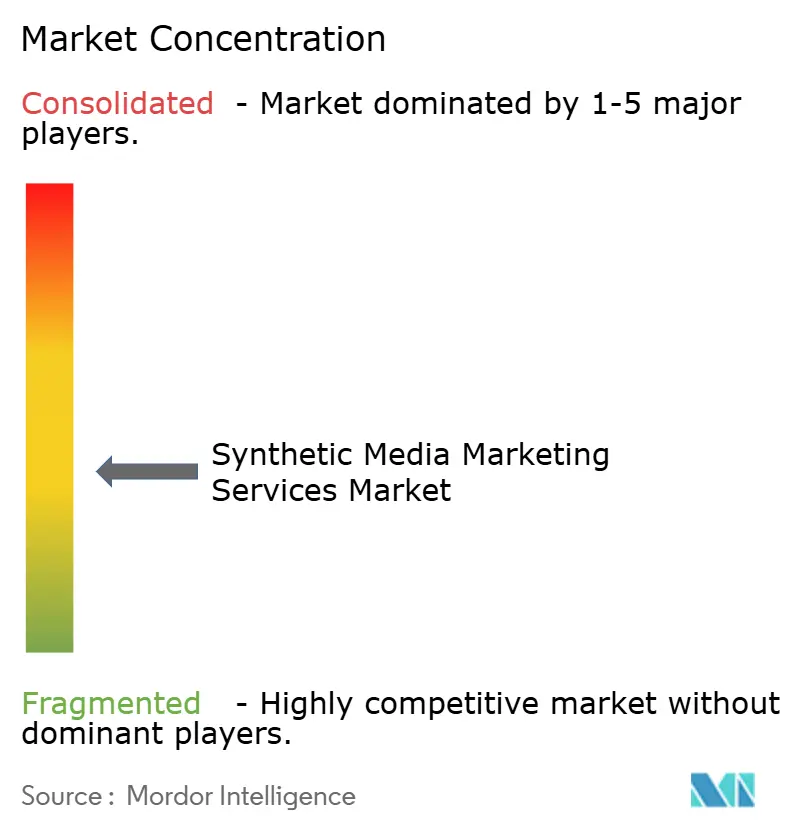
| Market Concentration | Medium |
Major Players *Disclaimer: Major Players sorted in no particular order Image © Mordor Intelligence. Reuse requires attribution under CC BY 4.0. | |
Synthetic Media Marketing Services Market Analysis by Mordor Intelligence
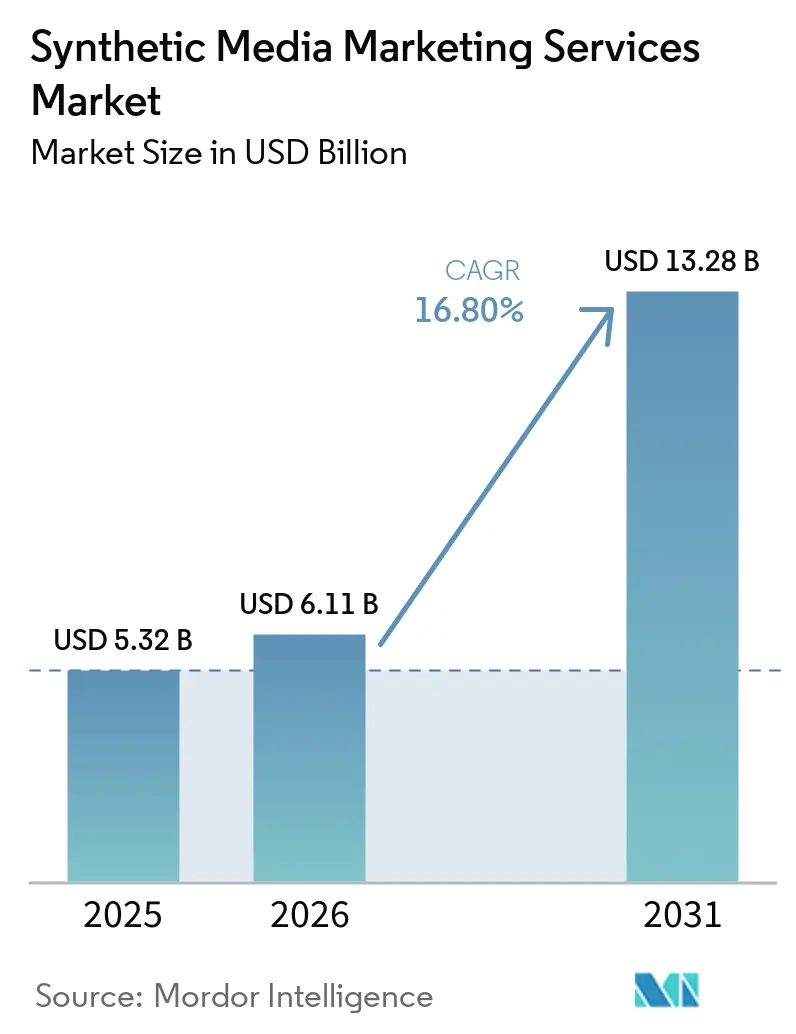
The synthetic media marketing services market size was valued at USD 5.32 billion in 2025 and is estimated to grow from USD 6.11 billion in 2026 to reach USD 13.28 billion by 2031, at a CAGR of 16.80% during the forecast period 2026-2031. The synthetic media marketing services market is moving from isolated creative experiments toward repeatable production systems that support high volumes of campaign assets. Lower inference costs and wider access to creative tools are making personalized video, voice, and image production more practical for marketing teams. Demand is also increasing because advertisers need more versions of the same message across formats, audiences, languages, and retail channels. Large platforms are extending their creative and advertising ecosystems, while specialist providers are building positions in avatar video, synthetic voice, and licensed likeness services. Legal exposure, content disclosure requirements, and consumer trust concerns are shaping vendor selection and the terms of enterprise contracts.
Key Report Takeaways
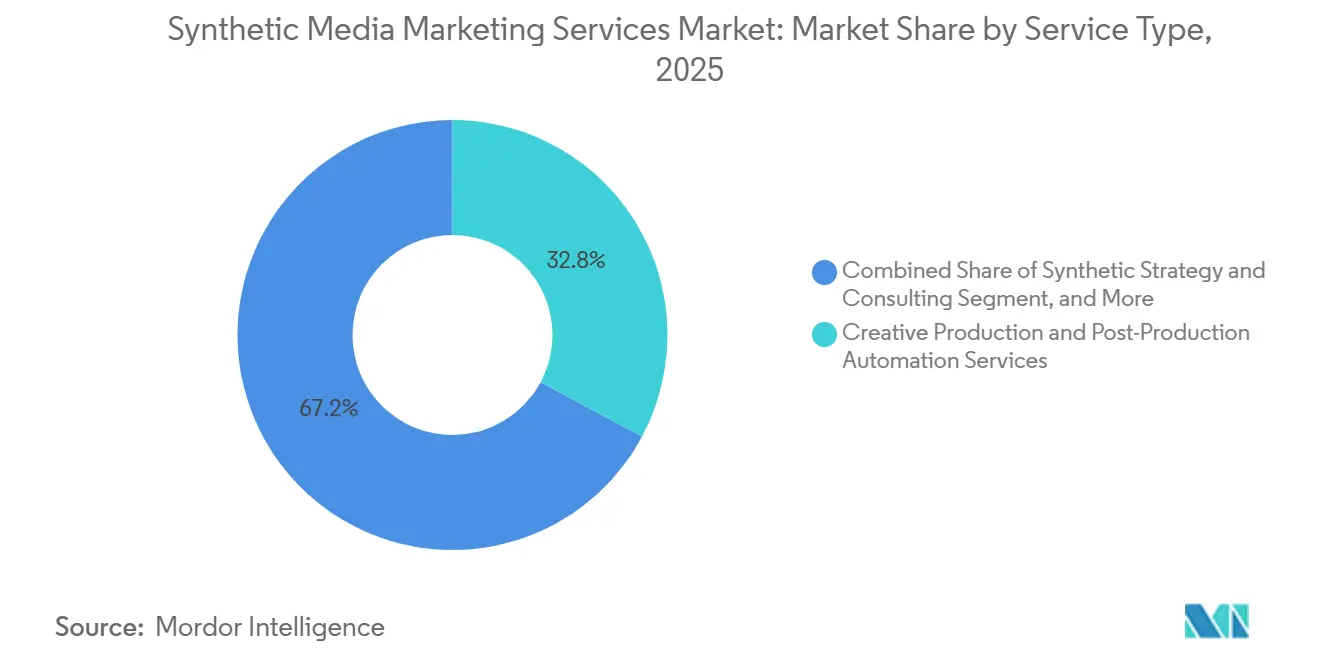
- By service type, Creative Production and Post-Production Automation Services held 32.83% of the synthetic media marketing services market share in 2025, while Virtual Influencer and Avatar Campaign Services are projected to expand at a 17.38% CAGR through 2031.
- By deployment model, Managed Services held 48.60% of revenue in 2025, while Private Model and Enterprise Customization Services are expected to grow at a 17.63% CAGR through 2031.
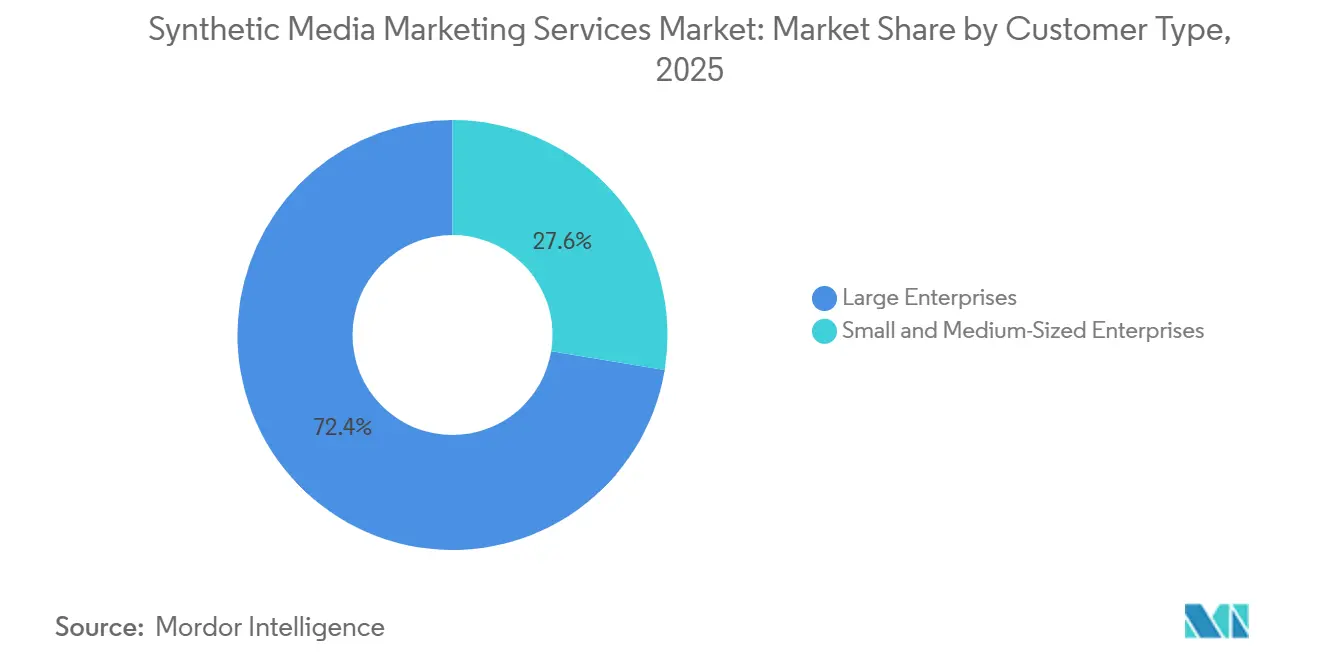
- By customer type, Large Enterprises accounted for 72.40% of demand in 2025, while Small and Medium-Sized Enterprises are projected to expand at a 17.28% CAGR through 2031.
- By end-use industry, Retail and E-commerce accounted for 27.30% of revenue in 2025, while Media and Entertainment is projected to grow at a 17.77% CAGR through 2031.
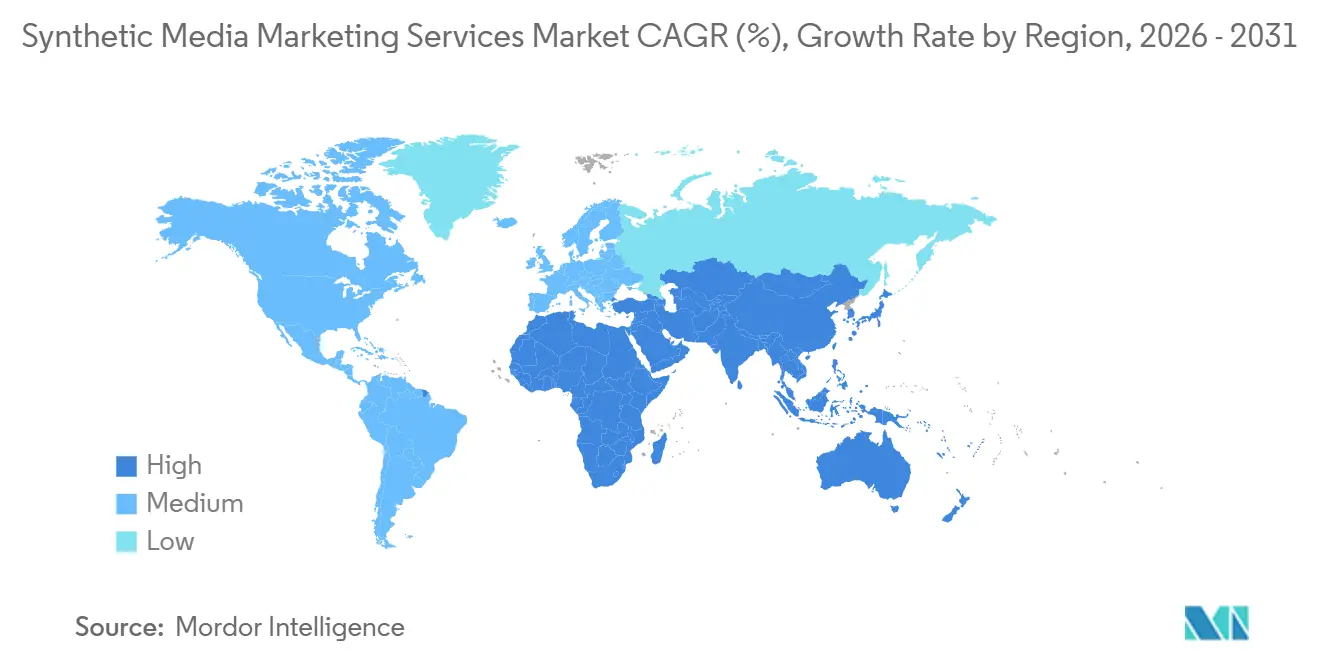
- By geography, North America accounted for 48.26% of revenue in 2025, while Asia-Pacific is expected to grow at a 17.59% CAGR through 2031.
Note: Market size and forecast figures in this report are generated using Mordor Intelligence’s proprietary estimation framework, updated with the latest available data and insights as of January 2026.
Market Trends and Insights
Drivers Impact Analysis of Synthetic Media Marketing Services Market*
| Driver | (~) % Impact on CAGR Forecast | Geographic Relevance | Impact Timeline |
|---|---|---|---|
| Rising Demand for Scalable, Personalized Marketing Content | +3.5% | Global | Short term (≤ 2 years) |
| Falling Inference Costs and Creative-Suite Integration | +2.8% | Global, led by North America | Short term (≤ 2 years) |
| Growth of Short-Form Video and Multilingual Social Commerce | +2.5% | Asia-Pacific core, spill-over to North America and Europe | Medium term (2-4 years) |
| Brand Adoption of Virtual Influencers and AI Avatars | +2.0% | Global, strongest in North America and Asia-Pacific | Medium term (2-4 years) |
| Retail Media Networks Needing Synthetic Creative Variants for Closed-Loop Testing | +1.8% | North America and Europe | Medium term (2-4 years) |
| Consent-Based Digital-Talent Marketplaces Unlocking Licensed Voice and Likeness Campaigns | +1.5% | North America, expanding to Europe | Long term (≥ 4 years) |
| Source: Mordor Intelligence | |||
Rising Demand for Scalable, Personalized Marketing Content
Brands with large product catalogs need more content versions than traditional production methods can deliver. A retail campaign may require different assets by audience, product, geography, device, and retail format. This changes work in the synthetic media marketing services market from producing a fixed set of advertisements to managing a continuing content pipeline. Adobe introduced GenStudio for Commerce Media Networks in 2025 to enable product listings and first-party data to be used in personalized advertising workflows, with LiveRamp integration for audience targeting and measurement. A meta-analysis of 210 experimental studies and 91,058 consumers found that virtual influencers can match human influencers in consumer engagement while delivering a stronger novelty effect. The synthetic media marketing services market, therefore, benefits where brands need frequent revisions without adding comparable production budgets.
Falling Inference Costs and Creative-Suite Integration
The cost of generating AI media assets has fallen across the technology stack. Stanford University’s 2025 AI Index, as cited by NVIDIA, reported a 280-fold reduction in inference costs for GPT-3.5-equivalent performance from November 2022 to October 2024. The same source reported that hardware efficiency improved by 40% annually. Adobe released Firefly AI Assistant in public beta across Photoshop, Premiere, Illustrator, InDesign, and Frame.io in 2026.[1] The assistant also entered workflows that use ChatGPT, Claude, Microsoft 365 Copilot, and Slack. These integrations reduce the need for users of synthetic media marketing services to move between separate creative, approval, and generation systems.
Growth of Short-Form Video and Multilingual Social Commerce
Short-form video has become a central advertising format on large social platforms. More than 50% of Instagram advertising ran on Reels in 2025, compared with 35% in 2024. This format requires a steady supply of new assets because synthetic media marketing services market campaigns are designed around short viewing windows and rapid creative testing. TikTok Shop exceeded USD 32 billion in gross merchandise value in 2025, increasing the need for local-language product content across multiple markets. Synthetic voice and video localization can shorten the time required to adapt the same campaign for different audiences. The synthetic media marketing services market is gaining support from this combination of high-volume video demand and multilingual commerce activity.
Brand Adoption of Virtual Influencers and AI Avatars
Brands are using AI avatars for campaign work that previously relied on one-time creator partnerships. This approach allows companies in the synthetic media marketing services market to maintain a persistent digital personality across product launches and regional campaigns. HeyGen reported annual recurring revenue above USD 200 million in June 2026, with more than 30 million users in 196 countries and adoption by 85% of the Fortune 100. Research on virtual influencer marketing found that design choices matter for campaign results, with different levels of human resemblance working better for different messaging and product contexts. Low-human-resemblance avatars performed better with emotional messaging and familiar products. Higher-human-resemblance avatars performed better in response to rational messages and new product introductions.
Restraints Impact Analysis of Synthetic Media Marketing Services Market*
| Restraint | (~) % Impact on CAGR Forecast | Geographic Relevance | Impact Timeline |
|---|---|---|---|
| Copyright, Likeness, and Training-Data Liability Exposure | -2.8% | North America and Europe | Short term (≤ 2 years) |
| Deepfake-Driven Trust Erosion and Brand Safety Risk | -2.2% | Global | Medium term (2-4 years) |
| Provenance Watermark Fragmentation Across Advertising Platforms | -1.5% | North America, Europe, and Asia-Pacific | Medium term (2-4 years) |
| Talent Union and Creator Contract Restrictions on Synthetic Replication | -1.2% | North America, extending to Europe | Long term (≥ 4 years) |
| Source: Mordor Intelligence | |||
Copyright, Likeness, and Training-Data Liability Exposure
Copyright, likeness, and training-data questions can delay marketing deployment even when the underlying technology is available. Advertisers need clarity on whether voices, faces, images, and training material were obtained with valid permissions. This makes contractual protection and supplier documentation important in synthetic media marketing services market procurement. The EU AI Act includes transparency obligations for certain AI-generated content, adding a compliance consideration for cross-border campaign operations. Buyers are paying closer attention to model documentation, content records, and indemnification terms. The synthetic media marketing services market favors providers that can show a clear consent process and assign responsibilities for legal risk.
Deepfake-Driven Trust Erosion and Brand Safety Risk
Consumer trust can limit the use of virtual influencers and synthetic presenters. Research across 210 studies found that virtual influencers had lower perceived credibility than human influencers, and that this credibility gap affected brand attitudes and purchase intention. Unauthorized content can also imitate a brand ambassador or executive at a low cost. This creates an uneven risk for brands in the synthetic media marketing services market that follow consent and disclosure rules, while bad actors do not. Financial services and healthcare brands face stricter audience expectations and regulatory oversight. These factors make brand safety review a continuing requirement rather than a single approval step.
*Our forecasts treat driver/restraint impacts as directional, not additive. The impact forecasts reflect baseline growth, mix effects, and variable interactions.
Synthetic Media Marketing Services Market Segment Analysis
By Service Type:
Production Automation Holds the Largest Revenue PositionCreative Production and Post-Production Automation Services held 32.83% of service-type revenue in 2025. It gives buyers in the synthetic media marketing services market a practical way to increase the number of assets produced from an approved campaign brief. Agencies can automate resizing, editing, localization, and format adaptation without redesigning their full creative process. This makes the service easier to adopt than a complete replacement of established agency and in-house production teams. Virtual Influencer and Avatar Campaign Services are projected to expand at a 17.38% CAGR through 2031.
The faster growth reflects a move from isolated avatar activations toward recurring digital personalities used across product launches and regional campaigns. HeyGen reported USD 200 million in annual recurring revenue in June 2026, indicating material demand for avatar video services. The company also reported that it remained cash-flow break-even in 2026. Research indicates that newer virtual personas can retain a novelty advantage in consumer engagement. Synthetic Voice and Localization Services, consulting, real-time ad serving, and audience simulation extend the range of work available to providers in the synthetic media marketing services market.

By Deployment Model:
Managed Delivery Leads as Customization ExpandsManaged Services accounted for 48.60% of deployment-model revenue in 2025. Enterprise buyers in the synthetic media marketing services market often choose managed delivery because it assigns parts of governance, quality assurance, and brand safety work to the provider. This structure is useful when teams lack specialist staff to assess models, manage fine-tuning, and review compliance. It also creates a defined contract for buyers who need a campaign result rather than separate software access. Private Model and Enterprise Customization Services are projected to record a 17.63% CAGR through 2031.
The growth rate shows that large users are beginning to develop proprietary content capabilities after gaining experience with managed programs. Synthesia raised USD 200 million in a Series E round at a USD 4 billion valuation in January 2026. The company had surpassed USD 100 million in annual recurring revenue in April 2025. Self-Service SaaS-Enabled Services give smaller buyers an entry point, while Integration and API Enablement Services connect generation to campaign and customer systems. Adobe expanded GenStudio integrations with Amazon Ads, Google Marketing Platform, LinkedIn, and TikTok in 2025.
By Customer Type:
Large Enterprises Lead While Smaller Firms Add DemandLarge Enterprises accounted for 72.40% of customer-type revenue in 2025. These synthetic media marketing services enable buyers to access multilingual production, enterprise integration, legal review, and cross-channel campaign management. Their content volumes also make the cost benefits of automated production more visible. Large enterprises generally prioritize brand safety controls, IP indemnification, and compatibility with established marketing systems. Small and Medium-Sized Enterprises is projected to expand at a 17.28% CAGR through 2031.
Self-service products are reducing the technical and financial barriers that once restricted production-quality avatar and voice work to larger organizations. HeyGen reported more than 30 million users across individual creators and large enterprises in June 2026. Its user base illustrates how tiered products can serve both independent teams and corporate customers. Smaller teams can create platform-specific assets and localize video across 175+ languages and dialects. Consent-based talent marketplaces can further help smaller buyers by reducing the need for individual likeness negotiations.
By End-Use Industry:
Retail and E-commerce Leads While Media and Entertainment Grows FastestRetail and E-commerce held 27.30% of end-use revenue in 2025. Retailers in the synthetic media marketing services market need a variety of creative variations to test messages against shopper behavior and purchase outcomes. Retail media networks are well-suited to this work because they link advertising activity to closed-loop measurement. Tesco Media introduced an AI-powered creative studio in 2025 to generate compliant advertising variants for on-site and off-site formats. Dollar General and QSIC announced an AI-enabled in-store audio network across 12,000 stores in 48 U.S. states in April 2026.[2] Media and Entertainment is projected to record the highest end-use CAGR at 17.77% through 2031.
Streaming platforms, game publishers, and studios need visual, video, and audio assets at volumes that can make conventional production costly. Adobe introduced Firefly Foundry for Media and Entertainment in January 2026, with tuned models based on enterprise intellectual property. The company named Walt Disney Imagineering is among the partners associated with this work. BFSI, Healthcare and Life Sciences, IT and Telecom, travel, automotive, and education are also using synthetic voice, avatar, product demonstration, and training content.
Geography Analysis
North America Synthetic Media Marketing Services Market
North America accounted for 48.26% of global revenue in 2025, the largest share of the synthetic media marketing services market. The region benefits from a concentration of synthetic media marketing services and advertising technology, early enterprise adoption, and well-funded specialist suppliers. The United States combines a large advertiser base with an active environment for platform development. ElevenLabs completed 2025 with more than USD 330 million in annual recurring revenue and raised USD 500 million in a Series D round during February 2026.[3]Synthesia exceeded USD 100 million in annual recurring revenue in April 2025 before its January 2026 funding round.
APAC Synthetic Media Marketing Services Market
Asia-Pacific is projected to register a 17.59% CAGR through 2031, the highest regional growth rate. China is expanding enterprise AI advertising tools into Japan and Southeast Asia, intensifying regional competition on price and product capabilities. Japan is developing local-language avatar systems that address linguistic and cultural requirements not fully served by global platforms. Shiseido introduced AI avatar live commerce on its official e-commerce site for younger consumers.
MEA and South America Synthetic Media Marketing Services Market
India provides an example of adoption in a regulated sector through Shriram Life Insurance’s multilingual campaign. South Korea adds demand from its entertainment sector and global virtual-content audience. South America is at an earlier stage, with Brazil and Argentina acting as key demand centers. The Middle East is supported by digital transformation programs in Saudi Arabia and the United Arab Emirates. Africa remains nascent, with South Africa, Nigeria, and Egypt leading demand from mobile-first advertising and international brand localization.
Competitive Landscape
The synthetic media marketing services market is moderately fragmented, with large technology platforms and specialized vendors operating in different parts of the value chain. Adobe, Alphabet, Microsoft, Meta, and Amazon distribute synthetic media capabilities through existing marketing and creative products. Their strengths include cross-product integration, broad customer access, and investments in brand safety systems. Specialized vendors compete through depth in avatar video, synthetic voice, and consent-based likeness services.
HeyGen reported USD 200 million in annual recurring revenue in June 2026 after doubling that figure over 8 months. Competition increasingly depends on documentation, consent management, content credentials, and IP indemnification terms. Buyers are assessing provenance records and legal safeguards as part of procurement, particularly for work involving a voice or likeness. Adobe expanded Firefly AI Assistant across established design and production applications in 2026.[4] Adobe also expanded GenStudio connections to major advertising platforms in 2025.
ElevenLabs’ 2026 Series D round supported the expansion of its voice platform and the development of voice-related products. Providers can differentiate through multilingual consent frameworks for Asia-Pacific brands. There is also a need for systems that combine content generation, creative testing, and retail attribution in one workflow. Industry-specific avatar libraries may be relevant in regulated sectors such as BFSI and healthcare. DeepBrain AI, Soul Machines, and UneeQ are developing interactive AI presenter services for customer-facing uses.
Synthetic Media Marketing Services Industry Leaders
-
Adobe Inc.
-
Alphabet Inc.
-
Microsoft Corporation
-
Meta Platforms, Inc.
-
Amazon.com, Inc.
- *Disclaimer: Major Players sorted in no particular order
Synthetic Media Marketing Services Market Companies Covered in this Report
- Adobe Inc.
- Alphabet Inc.
- Microsoft Corporation
- Meta Platforms, Inc.
- Amazon.com, Inc.
- Canva Pty Ltd.
- OpenAI, L.L.C.
- Synthesia Limited
- HeyGen Technology Inc.
- Runway AI, Inc.
- D-ID Ltd.
- ElevenLabs Inc.
- Stability AI Ltd.
- Descript, Inc.
- Lightricks Ltd.
- Midjourney, Inc.
- Sprinklr, Inc.
- Salesforce, Inc.
- Persado Inc.
- DeepBrain AI Inc.
- Soul Machines Limited
- UneeQ Limited
Recent Industry Developments in Synthetic Media Marketing Services Market
- July 2026: Loti AI launched Interchange, the first platform integration enabling consented and compensated use of digital likenesses and creative works in generative AI. The platform allows individuals and entities to define permissions for AI training and generation, automatically tracks usage across participating AI ecosystems, and facilitates transparent revenue sharing. This addresses the consent and compensation gap that has constrained brands from deploying licensed likeness campaigns at scale, particularly for global campaigns requiring rapid talent clearance across multiple jurisdictions.
- June 2026: HeyGen surpassed USD 200 million in annual recurring revenue, doubling in 8 months, with more than 30 million users across 196 countries and 118 million videos created. The company serves 85% of the Fortune 100 and shipped 63 products and features in 3 months, including Avatar V and HyperFrames, an open-source framework for agentic video creation. This milestone established HeyGen as the revenue leader among pure-play AI avatar video platforms, achieved while remaining cash-flow break-even for 2026.
- June 2026: Adobe launched Firefly AI Assistant in public beta across Premiere, Photoshop, Illustrator, InDesign, and Frame.io, simultaneously extending the tool into ChatGPT, Claude, Microsoft 365 Copilot, and Slack. The assistant, powered by Adobe's creative agent, executes multi-step synthetic media production workflows from natural language prompts, drawing on more than 30 third-party AI models and covering image, video, audio, and design workflows. Adobe's AI-related recurring revenue surpassed USD 500 million, driven by this broader creative AI studio platform positioning.
- April 2026: Dollar General partnered with QSIC to deploy an AI-enabled in-store audio advertising network across approximately 6,000 additional stores, bringing total coverage to 12,000 stores across 48 U.S. states. The network uses QSIC's platform for intelligent targeting backed by first-party data, in-flight optimization responding to real purchases, and closed-loop measurement tied to point-of-sale data. This represents one of the largest-scale deployments of AI-generated, personalized audio advertising in a physical retail environment globally.
Global Synthetic Media Marketing Services Market Report Scope
The synthetic media marketing services market includes services that use artificial intelligence and related technologies to create, personalize, manage, and distribute digitally generated or modified content for marketing purposes. The scope of the report covers synthetic media marketing services used across applications such as advertising, brand promotion, customer engagement, social media marketing, and content personalization.
The Synthetic Media Marketing Services Market Report is Segmented by Service Type (Synthetic Creative Strategy and Consulting, Virtual Influencer and Avatar Campaign Services, Synthetic Voice and Localization Services, Creative Production and Post-Production Automation Services, and Other Service Types), Deployment Model (Managed Services, Self-Service SaaS-Enabled Services, Integration and API Enablement Services, and Private Model and Enterprise Customization Services), Customer Type (Large Enterprises, and Small and Medium-Sized Enterprises), End-use Industry (Retail and E-commerce, Media and Entertainment, IT and Telecom, BFSI, Healthcare and Life Sciences, and Other End-use industries), and Geography (North America, South America, Europe, Asia-Pacific, Middle East, and Africa). The Market Forecasts are Provided in Terms of Value (USD).
Segmentation Overview
| Synthetic Strategy and Consulting |
| Virtual Influencer and Avatar Campaign Services |
| Synthetic Voice and Localization Services |
| Creative Production and Post-Production Automation Services |
| Other Service Types |
| Managed Services |
| Self-Service SaaS-Enabled Services |
| Integration and API Enablement Services |
| Private Model and Enterprise Customization Services |
| Large Enterprises |
| Small and Medium-Sized Enterprises |
| Retail and E-commerce |
| Media and Entertainment |
| IT and Telecom |
| BFSI |
| Healthcare and Life Sciences |
| Other End-use industries |
| North America | United States |
| Canada | |
| Mexico | |
| South America | Brazil |
| Argentina | |
| Chile | |
| Rest of South America | |
| Europe | Germany |
| United Kingdom | |
| France | |
| Italy | |
| Spain | |
| Rest of Europe | |
| Asia-Pacific | China |
| Japan | |
| India | |
| South Korea | |
| Australia | |
| Rest of Asia-Pacific | |
| Middle East | Saudi Arabia |
| United Arab Emirates | |
| Qatar | |
| Rest of Middle East | |
| Africa | South Africa |
| Egypt | |
| Nigeria | |
| Rest of Africa |
| By Service Type | Synthetic Strategy and Consulting | |
| Virtual Influencer and Avatar Campaign Services | ||
| Synthetic Voice and Localization Services | ||
| Creative Production and Post-Production Automation Services | ||
| Other Service Types | ||
| By Deployment Model | Managed Services | |
| Self-Service SaaS-Enabled Services | ||
| Integration and API Enablement Services | ||
| Private Model and Enterprise Customization Services | ||
| By Customer Type | Large Enterprises | |
| Small and Medium-Sized Enterprises | ||
| By End-use Industry | Retail and E-commerce | |
| Media and Entertainment | ||
| IT and Telecom | ||
| BFSI | ||
| Healthcare and Life Sciences | ||
| Other End-use industries | ||
| By Geography | North America | United States |
| Canada | ||
| Mexico | ||
| South America | Brazil | |
| Argentina | ||
| Chile | ||
| Rest of South America | ||
| Europe | Germany | |
| United Kingdom | ||
| France | ||
| Italy | ||
| Spain | ||
| Rest of Europe | ||
| Asia-Pacific | China | |
| Japan | ||
| India | ||
| South Korea | ||
| Australia | ||
| Rest of Asia-Pacific | ||
| Middle East | Saudi Arabia | |
| United Arab Emirates | ||
| Qatar | ||
| Rest of Middle East | ||
| Africa | South Africa | |
| Egypt | ||
| Nigeria | ||
| Rest of Africa | ||
Key Questions Answered in the Report
What is the size of the synthetic media marketing services market?
The synthetic media marketing services market was valued at USD 6.11 billion in 2026 and is projected to reach USD 13.28 billion by 2031 at a 16.80% CAGR.
What is driving demand for synthetic media marketing services?
Demand is supported by lower inference costs, short-form video, multilingual social commerce, and the need for more personalized campaign assets.
Which service category held the largest revenue share?
Creative Production and Post-Production Automation Services held 32.83% of revenue in 2025.
Which customer group is expected to grow fastest?
Small and Medium-Sized Enterprises is projected to grow at a 17.28% CAGR through 2031 as self-service platforms become more accessible.
Which end-use sector is expected to expand fastest?
Media and Entertainment is projected to record a 17.77% CAGR through 2031 as studios and platforms require content at larger production volumes.
Which region is expected to grow fastest?
Asia-Pacific is projected to advance at a 17.59% CAGR through 2031, supported by multilingual commerce, avatar adoption, and regional advertising technology investment.