
Synthetic Data Services For Enterprise AI Market Size and Share
Market Overview
| Study Period | 2020 - 2031 |
|---|---|
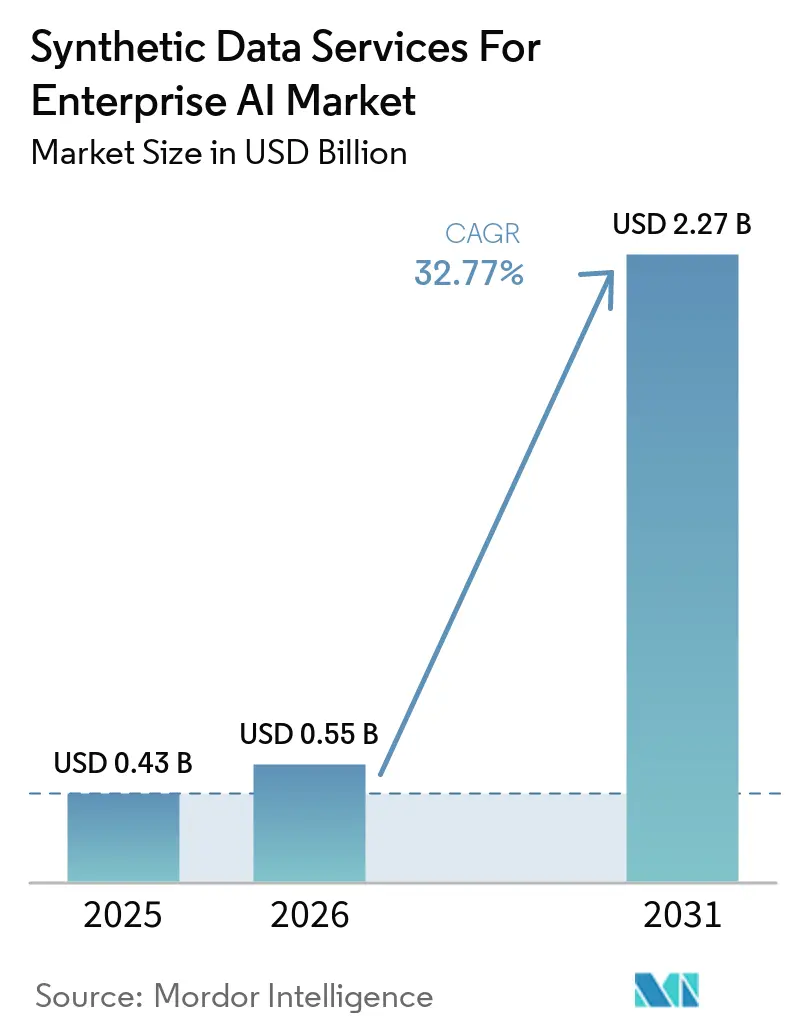
| Market Size (2026) | USD 0.55 Billion |
| Market Size (2031) | USD 2.27 Billion |
| Growth Rate (2026 - 2031) | 32.77 % |
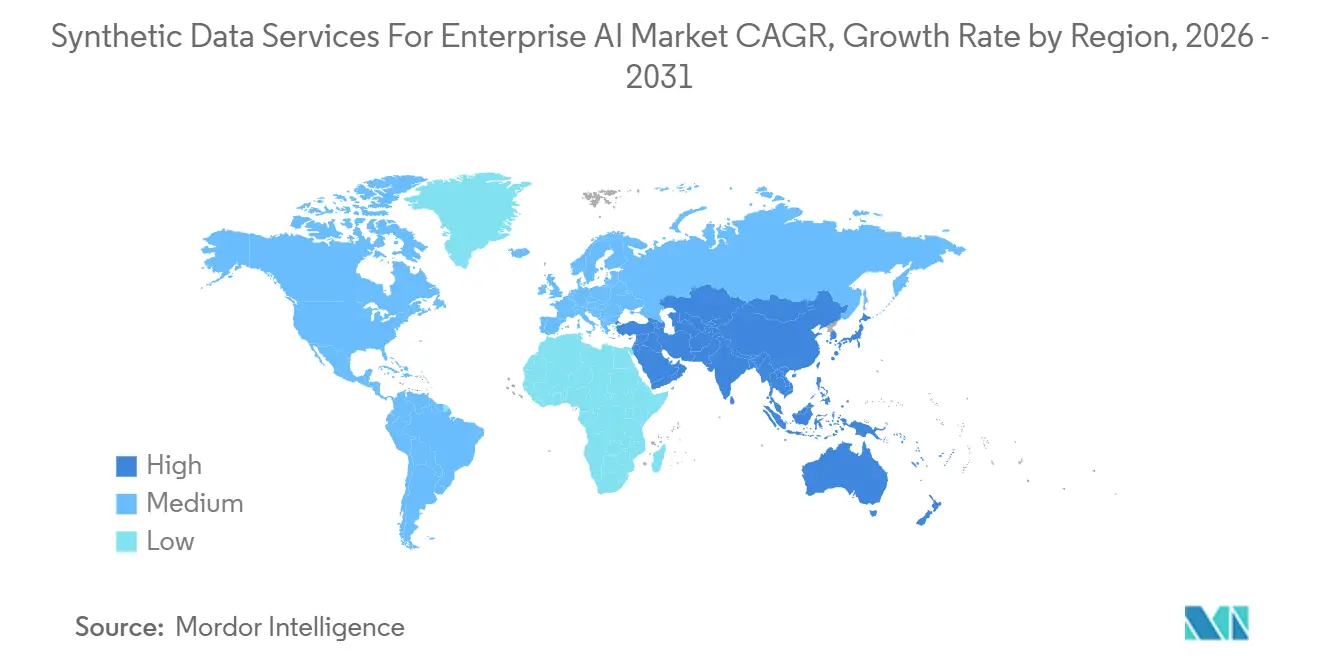
| Fastest Growing Market | Asia-Pacific |
| Largest Market | North America |
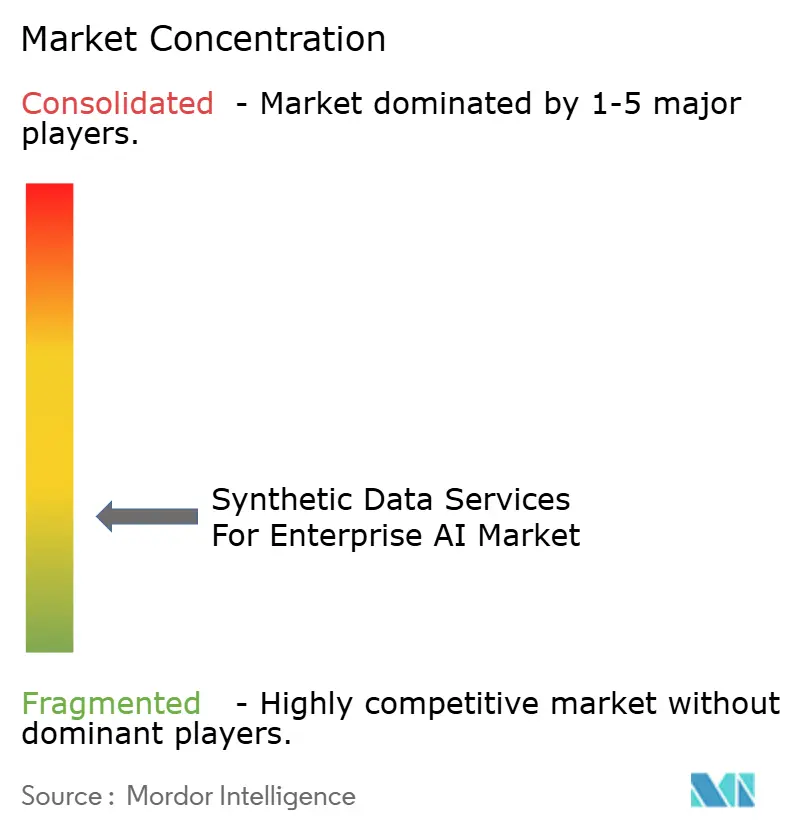
| Market Concentration | Low |
Major Players *Disclaimer: Major Players sorted in no particular order Image © Mordor Intelligence. Reuse requires attribution under CC BY 4.0. | |
Synthetic Data Services For Enterprise AI Market Analysis by Mordor Intelligence
The Synthetic data services for enterprise AI market size is projected to expand from USD 0.42 billion in 2025 to USD 0.55 billion in 2026, and to USD 2.27 billion by 2031, registering a CAGR of 32.77% between 2026 and 2031. The Synthetic data services for enterprise AI market is being shaped by limited access to high-quality enterprise data, especially where records are proprietary or sensitive. Privacy requirements make generated datasets more relevant for development, testing, and controlled data sharing. Demand also reflects the growing need to test AI systems against rare events that are difficult to observe in production. Suppliers are moving beyond generation tools toward governance, quality testing, and integration with enterprise workflows. The Synthetic data services for enterprise AI market, therefore, favors providers that can demonstrate data lineage, privacy controls, and reliable performance in real deployment settings.
Key Report Takeaways
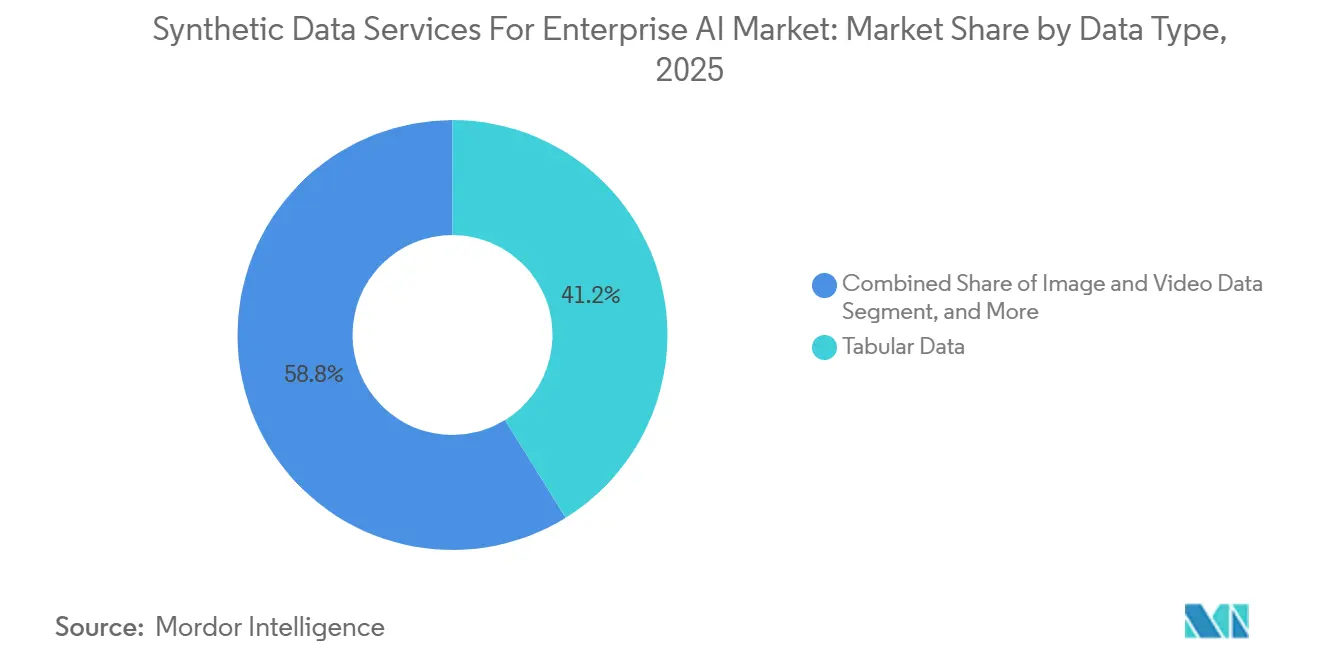
- By data type, tabular data held 41.18% of the Synthetic data services for enterprise AI market share in 2025, while image and video data are forecast to grow at a 33.28% CAGR through 2031.
- By offering synthetic data generation platforms, it captured 60.48% of revenue in 2025, while professional and managed services are forecast to grow at a 33.39% CAGR through 2031.
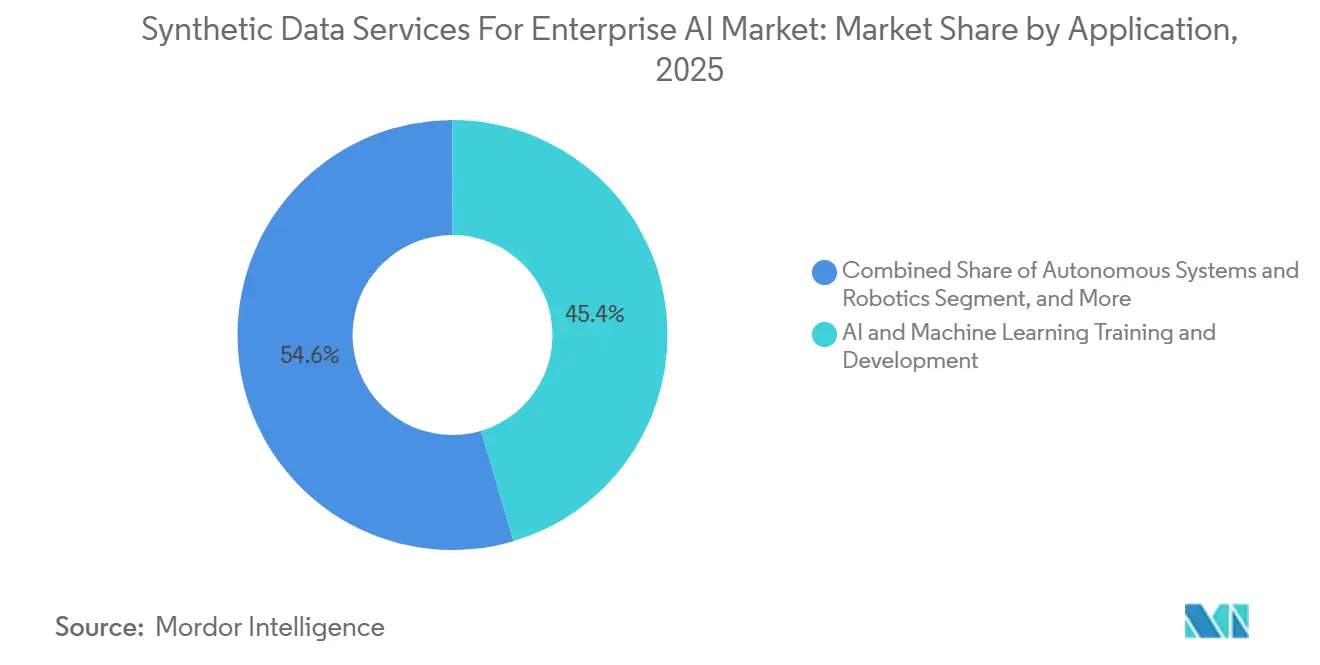
- By application, AI and machine learning training and development accounted for 45.42% of Synthetic data services for enterprise AI market revenue in 2025, while autonomous systems and robotics simulation are forecast to grow at a 33.53% CAGR through 2031.
- By end-user industry, banking, financial services, and insurance held 23.25% of revenue in 2025, while automotive and transportation are forecast to grow at a 33.48% CAGR through 2031.
- By geography, North America held 41.34% of Synthetic data services for enterprise AI market revenue in 2025, while Asia-Pacific is forecast to grow at a 33.41% CAGR through 2031.
Note: Market size and forecast figures in this report are generated using Mordor Intelligence’s proprietary estimation framework, updated with the latest available data and insights as of January 2026.
Market Trends and Insights
Drivers Impact Analysis of Synthetic Data Services For Enterprise AI Market*
| Driver | (~) % Impact on CAGR Forecast | Geographic Relevance | Impact Timeline |
|---|---|---|---|
| Generative AI Training Data Shortages | +8.5% | Global, with greatest concentration in North America and Europe | Short term (≤ 2 years) |
| Privacy-Preserving Access to Sensitive Enterprise Data | +7.2% | Global, especially the EU, United Kingdom, and APAC markets with data-localization mandates | Medium term (2-4 years) |
| Rising Demand for AI Model Testing and Validation | +5.8% | North America and Europe, expanding into APAC financial and public sectors | Medium term (2-4 years) |
| Autonomous Systems and Digital-Twin Simulation | +4.9% | North America, East Asia, and Germany | Long term (≥ 4 years) |
| Enterprise Data-Productization Workflows | +3.1% | North America and Europe, with spillover into APAC technology hubs | Medium term (2-4 years) |
| Synthetic Data Benchmarking for Underrepresented and Long-Tail Events | +2.4% | Global, particularly healthcare and autonomous systems | Long term (≥ 4 years) |
| Source: Mordor Intelligence | |||
Generative AI Training Data Shortages Drive Synthetic Pipeline Investment
The Synthetic data services for enterprise AI market benefits when enterprises lack sufficient real data for model training. Public data is increasingly irrelevant to specialized business tasks, while proprietary records are often too limited or restricted for broader use. Financial institutions and healthcare providers face the strongest combination of data value and privacy limits. This makes generated data useful both for expanding training volume and for retaining control of sensitive records. Enterprises also use it to create labeled examples that would be expensive to collect manually. The Synthetic data services for enterprise AI market gains when suppliers can demonstrate that generated records remain suitable for the intended model task.
Privacy-Preserving Access to Sensitive Enterprise Data Becomes a Compliance Mandate
Stricter expectations for personal-data protection support the Synthetic data services for enterprise AI market. The European Data Protection Board stated that an AI model cannot be considered anonymous if personal data can be extracted from it, thereby raising the standard for privacy claims.[1] Germany’s data protection conference recommended synthetic and anonymized data as technical and organizational measures for AI development in its June 2025 guidance. The Financial Conduct Authority has also set out governance considerations for the use of synthetic data in financial services. These requirements shift buyer attention from simple data generation to evidence of privacy, security, and governance. Providers with auditable processes are better placed in regulated procurement.
Rising Demand for AI Model Testing and Validation Unlocks Non-Training Revenue Streams
Testing and validation provide a recurring use case for the Synthetic data services for enterprise AI market. Enterprises often lack real examples of fraud, compliance failures, or operational edge cases. IBM released version 1.1.0 of Synthetic Data Sets in October 2025 with labeled instant-payment transactions that include simulated criminal activity patterns. The FCA’s anti-money-laundering work demonstrates how a controlled banking dataset can support the development of financial-crime tools without exposing customer records.[2] These workloads place greater value on repeatability, labels, and deployment within testing workflows. Vendors that connect generation to engineering and model-risk processes can serve broader enterprise budgets.
Autonomous Systems and Digital-Twin Simulation Create a Physics-Rich Data Tier
Autonomous systems extend the Synthetic data services for enterprise AI market beyond structured records into sensor-based simulation. Robotics and vehicle developers need scenes that include rare, hazardous, and varied operating conditions. NVIDIA introduced Cosmos 3 in 2026 as an open model that combines physical reasoning, multimodal generation, and action prediction for physical AI workloads. Hitachi and Astemo announced a collaboration in May 2026 that applies NVIDIA Cosmos Transfer and 3D Gaussian Splatting to autonomous driving AI development. In this area, the data value depends on the consistency among the camera, lidar, radar, and scene behavior. That requirement makes domain-focused simulation platforms more relevant than generic generation tools.
Restraints Impact Analysis of Synthetic Data Services For Enterprise AI Market*
| Restraint | (~) % Impact on CAGR Forecast | Geographic Relevance | Impact Timeline |
|---|---|---|---|
| High Compute and Infrastructure Costs | -3.8% | Global, with greater pressure on smaller enterprises and regulated markets | Short term (≤ 2 years) |
| Uncertain Legal Treatment of Synthetic Data | -2.9% | EU, United Kingdom, United States, and APAC markets with data-localization rules | Medium term (2-4 years) |
| Synthetic-to-Synthetic Model Collapse | -1.7% | Global, especially recursive-generation pipelines without real-data anchoring | Long term (≥ 4 years) |
| Hidden Leakage Through Metadata and Rare Records | -1.2% | Global, with heightened exposure in healthcare and financial services | Long term (≥ 4 years) |
| Source: Mordor Intelligence | |||
High Compute and Infrastructure Costs Constrain Mid-Market Adoption
High-fidelity generation can limit adoption within the Synthetic data services for enterprise AI market. Image, video, and multimodal sensor data require considerable computing capacity. Smaller organizations may struggle to run generation and evaluation pipelines at the volume required for production use. This issue is especially relevant when teams must preserve privacy while generating large test datasets. Financial institutions also face limits on the use of production data in testing environments, which can increase the need for alternatives. Consumption-based services can reduce the initial commitment, but they do not remove the cost of large workloads.
Uncertain Legal Treatment of Synthetic Data Creates Governance Overhang
The Synthetic data services for enterprise AI market faces uncertainty because generated data lacks uniform legal treatment across jurisdictions. The EDPB said supervisory authorities must assess anonymity claims on a case-by-case basis, rather than accept a label at face value. This makes source data controls and documented generation methods important for enterprise buyers. Privacy risk can persist where rare records, metadata, or patterns allow reidentification. A 2026 study in Scientific Reports also cautioned that analyses based on synthetic data may produce misleading results without appropriate methods.[3] Suppliers must therefore support validation, governance review, and limits on permitted use.
*Our forecasts treat driver/restraint impacts as directional, not additive. The impact forecasts reflect baseline growth, mix effects, and variable interactions.
Synthetic Data Services For Enterprise AI Market Segment Analysis
By Data Type:
Tabular Data Supports Regulated Workflows While Visual Data Gains MomentumTabular data held 41.18% of revenue in 2025, giving it the leading position in the Synthetic data services for enterprise AI market. Financial risk models, healthcare records, and insurance workflows require records that preserve useful statistical patterns. The FCA worked with the Alan Turing Institute to create a synthetic retail banking dataset that includes anti-money-laundering scenarios. Text and natural-language data also help companies adapt models to confidential documents, while time-series and audio data support narrower industrial and voice applications. These uses make privacy controls, practical utility, and reliable evaluation central to buyer decisions.
Image and video data are forecast to grow at a 33.28% CAGR through 2031. This part of the Synthetic data services for enterprise AI market supports computer vision, robotics, and vehicle development programs that require scenes that are difficult to collect safely. Simulation can provide consistently labeled examples across large datasets and varied operating conditions. NVIDIA’s Cosmos platform reflects the shift toward a generation that accounts for physical behavior and multiple sensor types. Visual data suppliers compete on sensor consistency and scenario realism, rather than image quality alone.[4]

By Offering:
Platforms Lead While Managed Services Address Execution GapsSynthetic data generation platforms captured 60.48% of revenue in 2025. The Synthetic data services for enterprise AI market industry serves organizations with in-house data engineering teams through software for generation, quality assessment, and workflow integration. MOSTLY AI released an open-source Synthetic Data SDK under the Apache 2.0 license in January 2025, enabling organizations to generate data inside their own infrastructure. Open tooling increases the importance of governance and lineage functions for commercial providers. Tonic AI, Syntho, and K2view compete in test data management, relational synthesis, and enterprise connectors.
Professional and managed services are forecast to grow at a 33.39% CAGR through 2031. The Synthetic data services for enterprise AI market also serves buyers that need external help with program design, privacy review, and operation. This pattern is most visible in healthcare, financial services, and public-sector work, where accountability and service levels are important. Managed delivery can help teams integrate generated data into existing governance practices. It does not eliminate the need for customer oversight of data quality and permitted use.
By Application:
AI Development Leads While Autonomous Simulation Grows FastestAI and machine learning training and development accounted for 45.42% of revenue in 2025. This Synthetic data services for enterprise AI market size reflects demand for task-specific records that can be used without broad exposure of confidential source data. Databricks expanded Agent Bricks in June 2026 and stated that more than 100,000 enterprise agents had been built since launch. Test data management, data analytics, and visualization also use production-like records to check software, dashboards, and reporting processes. Data sharing and monetization allow companies to provide partners with synthetic versions of proprietary datasets.
Autonomous systems and robotics simulation are forecast to grow at a 33.53% CAGR through 2031. The Synthetic data services for enterprise AI market supports this application through scenes and sensor data that expose models to rare conditions. IPG Automotive completed the nxtAIM simulation framework specification in June 2026, in collaboration with more than 20 automotive OEMs, suppliers, technology companies, and research institutions. Simulation enables controlled testing before physical deployment but depends on credible scenario design and validation. Providers must document how generated conditions relate to the intended operating environment.
By End-User Industry:
Financial Services Anchors Revenue While Automotive Demand AcceleratesBanking, financial services, and insurance held 23.25% of revenue in 2025. The Synthetic data services for enterprise AI market is useful to this group for fraud detection, credit-risk modeling, stress testing, and anti-money-laundering scenarios. The FCA’s governance work recognizes the potential for synthetic data to support innovation while maintaining safeguards. Healthcare and life sciences are also material because clinical and patient records are highly sensitive. A 2026 Scientific Reports study highlights both the value and the methodological risks of using generated tabular data in clinical research.
Automotive and transportation are forecast to grow at a 33.48% CAGR through 2031. The Synthetic data services for enterprise AI market gives mobility developers a way to create difficult road, weather, and traffic cases before testing on public roads. Korea Aerospace Industries acquired a 9.87% stake in GenGenAI in March 2025 for KRW 6 billion (USD 4.3 million) to support AI pilot development. Automotive buyers increasingly need multimodal sensor consistency and compatibility with safety documentation. This creates a need for specialized simulation capabilities beyond generic tabular generation.
Geography Analysis
North America Synthetic Data Services for Enterprise AI Market
North America accounted for 41.34% of revenue in 2025, representing the largest regional share in the Synthetic data services for enterprise AI market. The region combines major cloud and AI infrastructure with enterprises developing AI systems. SAS launched SAS Data Maker on the Microsoft Marketplace in November 2025, expanding access to its synthetic-data tooling for Azure customers. The United States has major activity in autonomous systems, financial services, and enterprise software testing. Canada adds financial services use cases, while Mexico drives demand for manufacturing-related digital twins.
Europe Synthetic Data Services for Enterprise AI Market
Privacy obligations and AI development goals shape Europe's demand. Germany’s 2025 guidance recommended synthetic and anonymized data for AI systems. Syntho joined the University of Amsterdam-led ELSA Lab initiative for fair and inclusive healthcare AI in April 2025. The FCA opened applications in March 2026 for its Synthetic Data Anti-Money Laundering Solution Sprint. The EU AI Act’s high-risk AI obligations take effect in August 2026, increasing the need for documented provenance and auditability.
APAC, South America and MEA Synthetic Data Services for Enterprise AI Market
Asia-Pacific is forecast to grow at a 33.41% CAGR through 2031. The Synthetic data services for enterprise AI market is supported by automotive development, financial-sector adoption, and national AI programs. CUBIG completed a Series A round in August 2025 and identified Kyobo Life Insurance and IBK Enterprise Bank among its customers. Tier IV and Astemo announced a joint autonomous-driving AI platform in August 2026 that includes large-scale synthetic data generation. South America is supported by fintech and open-banking use cases, particularly in Brazil. The Middle East and Africa remain early in adoption, although national AI programs in Saudi Arabia and the United Arab Emirates support public-sector demand.
Competitive Landscape
The Synthetic data services for enterprise AI market is fragmented and is changing through acquisition and platform integration. NVIDIA acquired Gretel Labs in March 2025 and integrated the technology into its cloud AI services, strengthening its data-generation capabilities. SAS acquired the principal software assets from Hazy in 2024 and then brought SAS Data Maker to the Microsoft Marketplace in November 2025. These moves place synthetic-data functions inside broader AI and analytics stacks. Independent suppliers such as Tonic AI, Syntho, GenRocket, Betterdata, and MDClone focus on vertical depth and integration capabilities.
The Synthetic data services for enterprise AI market is moving from standalone tools toward embedded data infrastructure. Databricks includes generation capabilities in its enterprise agent development environment. NVIDIA’s open Cosmos models make physical AI generation more accessible to developers. MOSTLY AI’s open-source SDK pressures vendors whose proposition is limited to generation. Buyers compare suppliers on governance controls, audit trails, evaluation, and integration with existing systems.
NVIDIA’s Cosmos 3 launch is a strategic move toward integrated physical-AI tooling for robotics and autonomous vehicles. The Tier IV and Astemo partnership is another example of large-scale generated data within a production-oriented autonomous-driving platform. SAS’s marketplace distribution broadens access to its offering for Azure customers. The competitive focus is shifting toward privacy, lineage, and data-quality documentation. This is important for high-risk AI systems with strict recordkeeping expectations.
Synthetic Data Services For Enterprise AI Industry Leaders
-
Microsoft Corporation
-
Amazon Web Services, Inc.
-
NVIDIA Corporation
-
Alphabet Inc.
-
Databricks, Inc.
- *Disclaimer: Major Players sorted in no particular order
Synthetic Data Services For Enterprise AI Market Companies Covered in this Report
- Amazon Web Services, Inc.
- Microsoft Corporation
- NVIDIA Corporation
- Google Inc
- International Business Machines Corporation
- Databricks, Inc.
- MOSTLY AI GmbH
- Gretel Labs, Inc.
- Synthesis AI, Inc.
- Tonic AI, Inc.
- GenRocket, Inc.
- Hazy Limited
- Datagen Technologies Ltd.
- Parallel Domain, Inc.
- Rendered.ai, Inc.
- MDClone Ltd.
- Syntho B.V.
- Betterdata Pte. Ltd.
- K2view Ltd.
- Informatica Inc.
- Sogeti S.A.
Recent Industry Developments in Synthetic Data Services For Enterprise AI Market
- August 2026: Tier IV Inc. and Astemo Ltd. announced a joint next-generation autonomous driving AI development platform incorporating large-scale synthetic data generation for end-to-end AI model training and mass-production quality validation, targeting Level 4+ autonomous driving deployment in Japan.
- June 2026: NVIDIA Corporation launched Cosmos 3 at COMPUTEX in Taipei, a frontier world foundation model combining physical reasoning, multimodal generation, and action prediction in a single open model. The 64-billion-parameter Super variant targets datacenter-scale synthetic data generation for robotics and autonomous vehicle developers.
- June 2026: IPG Automotive completed the specification of the nxtAIM simulation framework as part of a three-year initiative involving more than 20 automotive OEMs, Tier-1 suppliers, and research institutions, enabling unified large-scale synthetic data generation and generative trajectory plan validation for next-generation autonomous driving development.
- June 2026: Databricks, Inc. expanded Agent Bricks as a comprehensive enterprise agent platform at the 2026 Data and AI Summit, with over 100,000 agents built since launch, embedding synthetic data generation into agentic AI development for enterprise customers.
Global Synthetic Data Services For Enterprise AI Market Report Scope
The Synthetic Data Services For Enterprise AI Market refers to platforms and managed services that generate synthetic data that mirror real-world datasets without containing sensitive or personally identifiable information. These services produce tabular, text, image, and video data used for AI model training, test data management, and robotic simulation. They enable enterprises across industries like finance, healthcare, and automotive to accelerate AI development, enhance data privacy, and overcome real-world data scarcity or regulatory restrictions.
The Synthetic Data Services for Enterprise AI Market Report is Segmented by Data Type (Tabular Data, Text and Natural Language Processing Data, Image and Video Data, and Other Data Type), Offering (Synthetic Data Generation Platforms and Professional and Managed Services), Application (AI and Machine Learning Training and Development, Test Data Management, Data Sharing and Monetization, Data Analytics and Visualization, Autonomous Systems and Robotics Simulation, and Other Applications), End-User Industry (Banking, Financial Services and Insurance, Healthcare and Life Sciences, Automotive and Transportation, Retail and E-Commerce, Information Technology and Telecommunications, Manufacturing and Industrial Automation, and Other End-User Industries), and Geography (North America, South America, Europe, Asia-Pacific, Middle East, and Africa). The Market Forecasts are Provided in Terms of Value (USD).
Segmentation Overview
| Tabular Data |
| Text and Natural Language Processing Data |
| Image and Video Data |
| Other Data Type |
| Synthetic Data Generation Platforms |
| Professional and Managed Services |
| AI and Machine Learning Training and Development |
| Test Data Management |
| Data Sharing and Monetization |
| Data Analytics and Visualization |
| Autonomous Systems and Robotics Simulation |
| Other Applications |
| Banking, Financial Services and Insurance |
| Healthcare and Life Sciences |
| Automotive and Transportation |
| Retail and E-Commerce |
| Information Technology and Telecommunications |
| Manufacturing and Industrial Automation |
| Other End-User Industries |
| North America | United States |
| Canada | |
| Mexico | |
| South America | Brazil |
| Argentina | |
| Chile | |
| Rest of South America | |
| Europe | Germany |
| United Kingdom | |
| France | |
| Italy | |
| Spain | |
| Rest of Europe | |
| Asia-Pacific | China |
| Japan | |
| India | |
| South Korea | |
| Australia | |
| Rest of Asia-Pacific | |
| Middle East | United Arab Emirates |
| Saudi Arabia | |
| Qatar | |
| Rest of Middle East | |
| Africa | South Africa |
| Egypt | |
| Nigeria | |
| Rest of Africa |
| By Data Type | Tabular Data | |
| Text and Natural Language Processing Data | ||
| Image and Video Data | ||
| Other Data Type | ||
| By Offering | Synthetic Data Generation Platforms | |
| Professional and Managed Services | ||
| By Application | AI and Machine Learning Training and Development | |
| Test Data Management | ||
| Data Sharing and Monetization | ||
| Data Analytics and Visualization | ||
| Autonomous Systems and Robotics Simulation | ||
| Other Applications | ||
| By End-User Industry | Banking, Financial Services and Insurance | |
| Healthcare and Life Sciences | ||
| Automotive and Transportation | ||
| Retail and E-Commerce | ||
| Information Technology and Telecommunications | ||
| Manufacturing and Industrial Automation | ||
| Other End-User Industries | ||
| By Geography | North America | United States |
| Canada | ||
| Mexico | ||
| South America | Brazil | |
| Argentina | ||
| Chile | ||
| Rest of South America | ||
| Europe | Germany | |
| United Kingdom | ||
| France | ||
| Italy | ||
| Spain | ||
| Rest of Europe | ||
| Asia-Pacific | China | |
| Japan | ||
| India | ||
| South Korea | ||
| Australia | ||
| Rest of Asia-Pacific | ||
| Middle East | United Arab Emirates | |
| Saudi Arabia | ||
| Qatar | ||
| Rest of Middle East | ||
| Africa | South Africa | |
| Egypt | ||
| Nigeria | ||
| Rest of Africa | ||
Key Questions Answered in the Report
What is the Synthetic data services for enterprise AI market size?
The market size is USD 0.55129 billion in 2026 and is forecast to reach USD 2.27451 billion by 2031, at a 32.77% CAGR.
What is driving demand for synthetic data services in enterprise AI?
Demand is supported by restricted access to sensitive data, the need for rare-event testing, and development of AI systems that require larger and better-labeled datasets.
Which data type has the largest revenue share?
Tabular data led with 41.18% of revenue in 2025, supported by financial services, healthcare, and insurance workflows.
Which application is growing the fastest?
Autonomous systems and robotics simulation is projected to grow at a 33.53% CAGR through 2031 as developers require controlled sensor-based testing data.
Which end-user sector is expanding fastest?
Automotive and transportation is forecast to expand at a 33.48% CAGR through 2031, driven by simulation needs for vehicle and robotics programs.
Which region is forecast to grow the fastest?
Asia-Pacific is forecast to grow at a 33.41% CAGR through 2031, supported by automotive, financial services, and national AI initiatives.