
Swimming Pool Treatment Chemicals Market Size and Share
Market Overview
| Study Period | 2021 - 2031 |
|---|---|
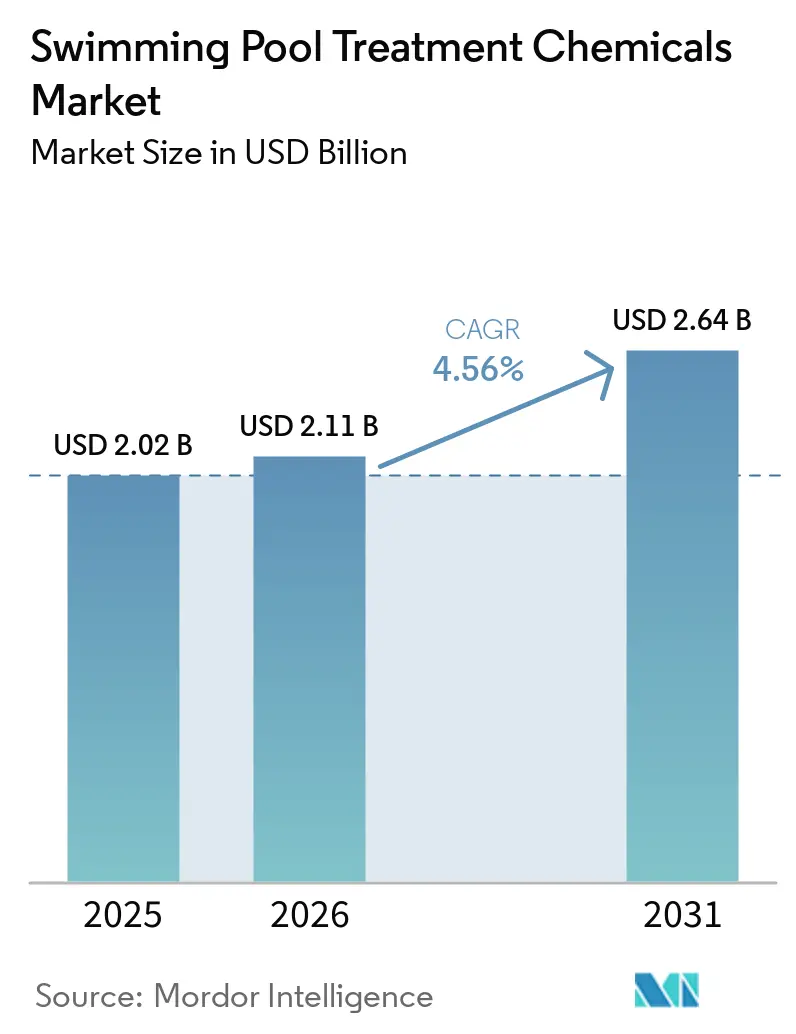
| Market Size (2026) | USD 2.11 Billion |
| Market Size (2031) | USD 2.64 Billion |
| Growth Rate (2026 - 2031) | 4.56 % |
| Fastest Growing Market | Asia-Pacific |
| Largest Market | North America |
| Market Concentration | Medium |
Major Players *Disclaimer: Major Players sorted in no particular order Image © Mordor Intelligence. Reuse requires attribution under CC BY 4.0. | |
Swimming Pool Treatment Chemicals Market Analysis by Mordor Intelligence
The Swimming Pool Treatment Chemicals Market size was valued at USD 2.02 billion in 2025 and is estimated to grow from USD 2.11 billion in 2026 to reach USD 2.64 billion by 2031, at a CAGR of 4.56% during the forecast period (2026-2031). The swimming pool treatment chemicals market is supported by recurring purchases of sanitizers, oxidizers, pH adjusters, and algaecides after a pool is installed. Demand remains established in North America and Western Europe, where a large installed base requires routine water treatment, repeat service visits, and seasonal replenishment of products that maintain sanitation and water balance across different pool sizes. Growth is increasingly shifting toward Asia-Pacific as higher incomes and new hospitality projects add pools in urban and resort locations, creating requirements for local availability, reliable distribution, and products that suit both private properties and multi-pool commercial sites. The swimming pool treatment chemicals market is also moving beyond bulk products as suppliers promote multifunctional formulations, automated dosing, and connected water-management systems. These changes within the swimming pool treatment chemicals market favor suppliers that can combine dependable chemical supply with products suited to repeat maintenance and controlled dosing, while supporting customers that need consistent handling guidance, product availability, and water-treatment performance.
Key Report Takeaways
- By product type, calcium hypochlorite held 28.13% of the swimming pool treatment chemicals market share in 2025, while trichloroisocyanuric acid is projected to advance at a 5.45% CAGR through 2031.
- By pool type, residential pools held 49.45% of the swimming pool treatment chemicals market share in 2025, while commercial pools are projected to advance at a 5.84% CAGR through 2031.
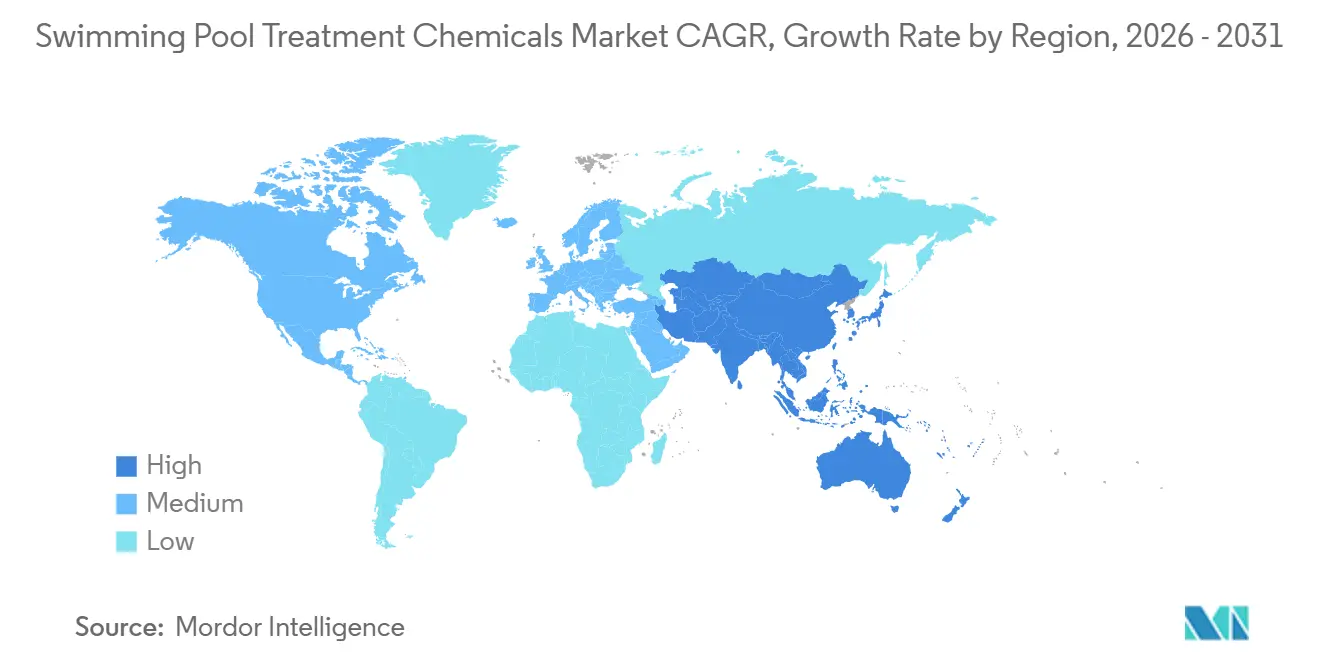
- By geography, North America held 38.74% of the swimming pool treatment chemicals market share in 2025, while Asia-Pacific is projected to advance at a 5.71% CAGR through 2031.
Note: Market size and forecast figures in this report are generated using Mordor Intelligence’s proprietary estimation framework, updated with the latest available data and insights as of January 2026.
Global Swimming Pool Treatment Chemicals Market Trends and Insights
Drivers Impact Analysis*
| Driver | (~) % Impact on CAGR Forecast | Geographic Relevance | Impact Timeline |
|---|---|---|---|
| Expansion of Residential and Hospitality Pool Installations | +1.4% | Global, concentration in North America, APAC, and MEA | Medium term (2–4 years) |
| Rising Public Health and Recreational Water Hygiene Requirements | +1.0% | Global; regulatory spillover strongest in North America & EU | Long term (≥ 4 years) |
| Growth of Automated Chemical Dosing and Monitoring | +0.8% | North America & Europe; emerging in APAC core, spillover to MEA | Medium term (2–4 years) |
| Expansion of Pool-Service and Contractor-Led Maintenance | +0.6% | North America, Australia, Western Europe | Short term (≤ 2 years) |
| Increasing Adoption of Low-Maintenance Multifunctional Formulations | +0.4% | Global, early adoption in North America & Europe | Short term (≤ 2 years) |
| Source: Mordor Intelligence | |||
Expansion of Residential and Hospitality Pool Installations
New pool installations create a continuing requirement for chemicals rather than a single purchase at construction. Each pool needs sanitizers, oxidizers, pH adjusters, and algaecides throughout its operating life. Full-service hotel chains add commercial capacity across multiple properties and need consistent treatment practices, which can make standardized product selection, staff handling procedures, and continuous supply more important than a single low purchase price. Boutique resorts in the Association of Southeast Asian Nations (ASEAN) and the Middle East often specify specialty formulations instead of bulk chlorine, as these locations place greater weight on maintenance simplicity, controlled application, and the appearance of consistently maintained water. This preference can raise revenue per kilogram because suppliers can sell formats designed for maintenance convenience and water-quality control. The swimming pool treatment chemicals market, therefore, benefits when pool construction expands in both private residential settings and organized hospitality developments. The demand effect is recurring because sanitation, oxidation, pH control, and algae prevention are routine operating needs after the construction contract ends. Suppliers can address this demand through products sized for household maintenance as well as higher-volume formats used by hotel engineering and pool-service teams.
Rising Public Health and Recreational Water Hygiene Requirements
Water-quality requirements are drawing increasing attention to how pool operators manage disinfection and by-products. A 2025 review identified trichloromethane, trichloroacetic acid, and dichloroacetic acid as priority disinfection by-products in chlorinated indoor pools. These compounds arise from chlorination and create a need for closer management of water chemistry. Operators must avoid both inadequate disinfection and excessive dosing that can increase by-product levels, a requirement that makes regular testing and measured adjustment central to daily water-care routines for facilities with changing bather loads. This operating balance supports demand across the swimming pool treatment chemicals market for the use of monitoring reagents and precision multi-oxidant formulations. The swimming pool treatment chemicals market can gain from higher spending per pool even when the base sanitizer dose does not rise. Chemical suppliers must therefore balance products intended for disinfection with products that help operators test, monitor, and adjust water conditions. This need is most visible in indoor and high-use pools, where water chemistry changes require regular attention from trained operators.
Growth of Automated Chemical Dosing and Monitoring
Automated systems measure free chlorine, pH, and oxidation-reduction potential before injecting chemicals when needed. Their use is moving from commercial pools into premium residential installations. Automation can reduce avoidable waste while raising the need for products that work reliably with specified equipment, because a dosing system functions best when the operator well understands chemical concentration, feed characteristics, and routine maintenance procedures. Pentair IntelliChem, BAYROL Automatic CL-pH, and Innowater monitoring controllers illustrate the type of systems used in commercial and residential projects. Suppliers that align their formulations with dosing equipment can develop repeat purchasing channels over the equipment's life. The growing link between chemical selection, monitoring equipment, and routine service practices therefore shapes the swimming pool treatment chemicals market. This link can favor formulations with predictable concentration and dissolution characteristics because automated equipment depends on repeatable inputs. It also makes technical support and compatibility information more relevant to the supplier relationship.
Expansion of Pool-Service and Contractor-Led Maintenance
Professional pool service is a recurring maintenance activity in locations where outdoor pools operate throughout the year. Contractors commonly select a limited group of products across sanitizers, algaecides, clarifiers, and oxidizers. This purchasing pattern favors suppliers that can provide a complete product line and dependable delivery, allowing contractors to use familiar products across pools while reducing the time needed to manage separate purchasing relationships for each water-care need. Standardized contractor recommendations can also guide repeat purchases by pool owners. Pool service software and route planning can embed chemical recommendations into routine operating decisions. The swimming pool treatment chemicals market gains a more predictable maintenance channel when contractor-led service expands. Service companies need products that can be carried, stored, applied, and replenished across scheduled routes. Their preference for dependable stock availability can strengthen the role of distributors with broad local coverage.
Restraints Impact Analysis*
| Restraint | (~) % Impact on CAGR Forecast | Geographic Relevance | Impact Timeline |
|---|---|---|---|
| Raw Material, Energy and Chlor-Alkali Cost Volatility | -0.7% | Global; acute in Europe and Asia import markets | Short to medium term (≤ 4 years) |
| Health and Environmental Concerns Related to Disinfection By-Products | -0.5% | North America & EU; emerging in APAC core | Long term (≥ 4 years) |
| Seasonal Demand and Underutilization of Commercial Facilities | -0.3% | North America, Europe (temperate zones) | Short term (≤ 2 years) |
| Source: Mordor Intelligence | |||
Raw Material, Energy and Chlor-Alkali Cost Volatility
Chlor-alkali production supplies chlorine and caustic soda, used in many pool sanitizers. Electricity is a major chlor-alkali production cost, which links pool-chemical pricing to power costs. The cost position of suppliers can vary across regions because energy-intensive production faces different electricity prices, and this difference can affect manufacturing margins, shipment decisions, and the ability to pass cost increases through the distribution chain. Production disruptions can constrain chlorine-related supply and affect chemical pricing for pool operators, particularly where a region relies on a limited group of plants or where distributors need to replenish inventory during an active pool season. Olin Corporation reported USD 40.1 million earnings before interest, taxes, depreciation, and amortization impact in its Chlor Alkali segment from a vinyl chloride monomer plant disruption at Freeport, Texas, in the second quarter of 2026. The swimming pool treatment chemicals market remains exposed to these upstream costs because many core sanitizers depend on chlor-alkali output. Energy cost differences can shape where chlorine and sodium hypochlorite are produced and where suppliers are able to serve customers competitively. Solid tablet formats can also have different storage and transport characteristics from liquid chlorine, which affects product choices when logistics costs are volatile.
Health and Environmental Concerns Related to Disinfection By-Products
Pool chemistry is increasingly assessed for its effect on disinfection by-products as well as pathogen control. A 2025 scientific review reported total chloramine concentrations averaging 650 ± 490 µg/L in sampled pools. The finding highlights the challenge of controlling water quality while maintaining effective disinfection. European requirements for biocidal active substances add compliance obligations for pool disinfectant suppliers, requiring established producers to maintain technical documentation and product registrations that can be difficult for smaller or imported product lines to support. Consumer concern about trihalomethanes and chloramines can encourage the use of ultraviolet, ozone, and low-chlorine hybrid systems, leading operators to evaluate treatment programs that retain sanitation while changing how chlorine is applied and monitored. These options are a gradual substitution risk, especially where regulatory requirements are strict. Suppliers of conventional chlorine products need to respond to this concern through controlled dosing, water testing, and formulations that help customers manage treatment conditions. The issue does not remove the need for sanitation, but it can alter the mix of products and equipment selected by operators.
*Our forecasts treat driver/restraint impacts as directional, not additive. The impact forecasts reflect baseline growth, mix effects, and variable interactions.
Segment Analysis
By Product Type: Calcium Hypochlorite Anchors Revenue, Trichloroisocyanuric Acid Drives Fastest Growth
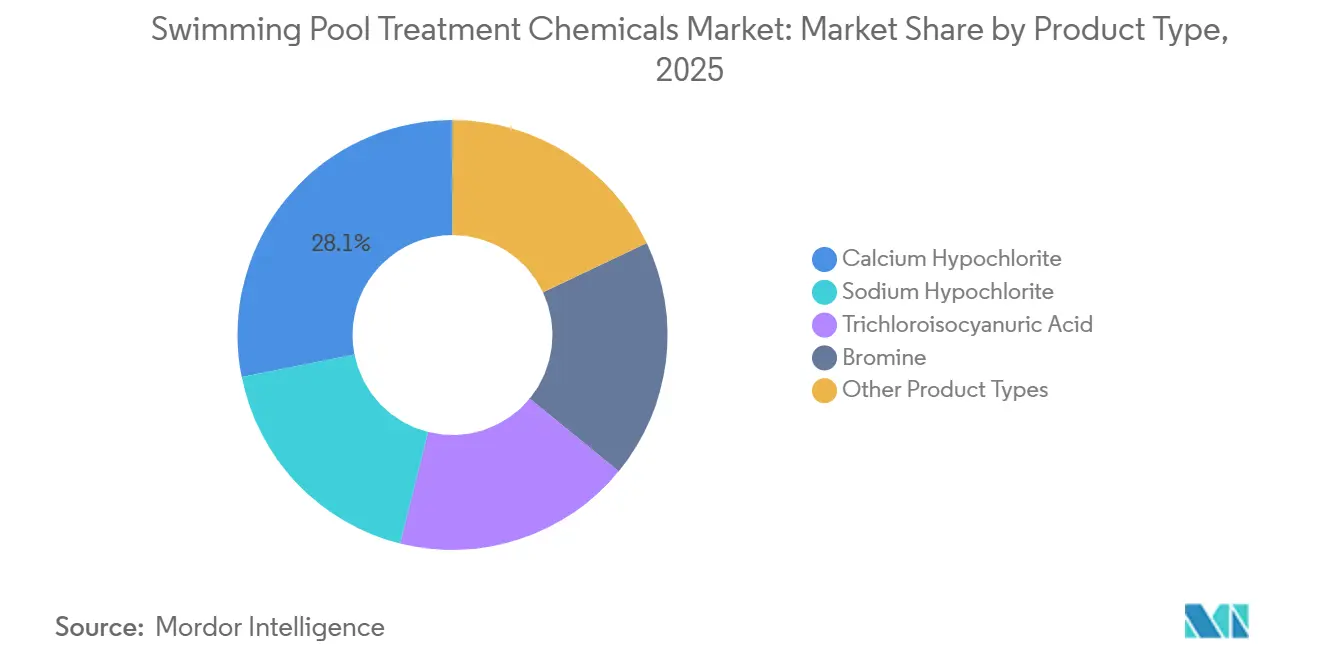
Calcium hypochlorite held 28.13% of the market share in 2025. Its available chlorine concentration of 65% to 73% supports use in commercial applications that require dependable sanitization, including facilities where operators need a practical solution that can be used with feeder systems and established water-care procedures. The product is compatible with automated calcium hypochlorite feeder systems used in many commercial pools. It does not add cyanuric acid to pool water, which is important where heavy pool use requires frequent chlorination. Repeated dosing of stabilized chlorine products can raise cyanuric acid levels and reduce chlorine effectiveness in high-turnover settings. This makes calcium hypochlorite a practical option for operators managing high bather loads, particularly when they need dependable performance from an automated feeder and want to avoid the accumulation associated with repeated stabilized chlorine dosing.
Sodium hypochlorite remains relevant in automated commercial systems because it dissolves quickly, making it suitable for applications where equipment is designed to inject liquid chemicals and operators need a timely response to changing water-treatment conditions. Bromine serves a more specialized role in spa environments where water temperatures exceed 40 °C. Trichloroisocyanuric acid is projected to advance at a 5.45% CAGR through 2031 within the swimming pool treatment chemicals market size. Its slow-release tablet format reduces maintenance frequency and suits residential users and hospitality operators with several facilities. Ercros S.A. operated its Sabiñánigo facility in Spain with 28,000 metric tons of annual capacity and reported a 5.8% increase in chlorine-derivatives selling prices in the first half of 2026. Multifunctional tablets that include stabilizer, clarifier, and algaecide are expanding their role in the premium residential category, where customers value simpler maintenance routines, lower handling complexity, and products that bring several water-care functions together in a single format.

By Pool Type: Residential Pools Lead Revenue, Commercial Pools Set the Pace for Expansion
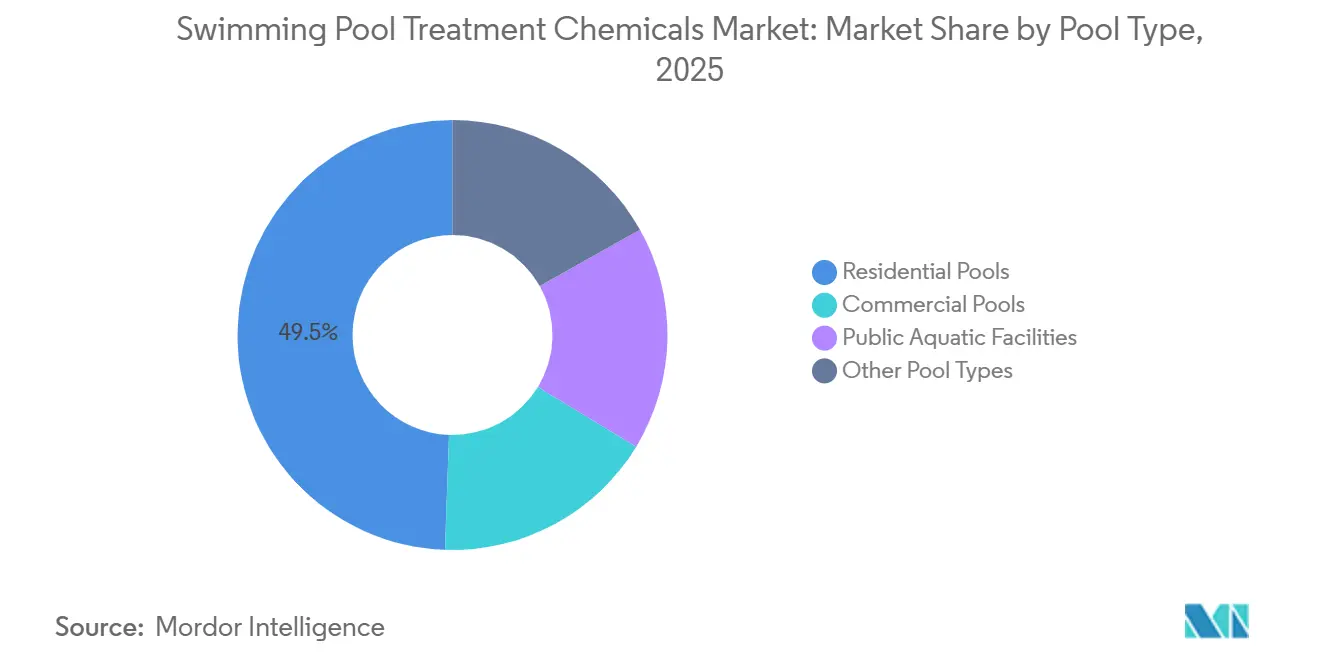
Residential pools accounted for 49.45% of the swimming pool treatment chemicals market size in 2025. Their position reflects established private pool ownership in North America, Western Europe, and Australia. Residential owners purchase sanitizers, algaecides, and pH adjusters throughout the operating season, and their choices can vary with pool size, climate, water-use frequency, equipment configuration, and the level of assistance provided by a contractor. Above-ground pools form an entry-level customer group that continues to require routine water-care products. Aging pools can also create demand when owners add saltwater conversion systems or automation. These upgrades can change product requirements and raise spending per maintained pool because an automated or converted pool requires owners and service providers to select products that fit the new treatment method and the system’s operating requirements.
Commercial pools are projected to advance at a 5.84% CAGR through 2031. Hotel, resort, and water park development in Asia-Pacific and the Middle East supports this outlook. Commercial facilities usually operate over longer periods than seasonal residential pools, creating more continuous procurement and placing greater importance on inventory planning, documented treatment routines, and supplier reliability during periods of regular visitor use. Public aquatic facilities face close attention to disinfection by-products and need precise monitoring of chemicals. Fitness clubs, schools, and apartment complexes combine commercial compliance needs with smaller operator purchasing practices. New commercial specifications increasingly include automated dosing, which favors liquid and pre-measured tablet formats with consistent dissolution. Suppliers with formulation expertise and equipment relationships are better placed to address these requirements because commercial customers need consistent dosing results, products that are straightforward for staff to handle, and supply arrangements that support uninterrupted operation.
Geography Analysis
North America held 38.74% of the swimming pool treatment chemicals market share in 2025. Its established pool base supports recurring purchases through professional service providers, distributors, and retail channels. The swimming pool treatment chemicals market in the region has strong demand for contractor-led maintenance, especially in warmer states with extended outdoor pool seasons, where service teams conduct recurring visits and select products that can be applied consistently across a broad base of customer pools. BioLab Inc. decided not to rebuild its Conyers, Georgia, facility after the 2024 fire, changing the regional supply situation for tableted products. The company committed at least USD 8 million to expand tableting and blending capability at Westlake, Louisiana, with operations expected in early 2027.
Asia-Pacific is projected to advance at a 5.71% CAGR through 2031 in the swimming pool treatment chemicals market. China serves as a large domestic consumer and an important production base for trichloroisocyanuric acid, giving the country a dual role in regional demand and supply for tablet products used by residential owners, hospitality sites, and commercial operators. India and ASEAN countries are adding pools in luxury residential developments and tourism infrastructure. Japan and South Korea provide demand from an established pool base, while Australia and New Zealand apply rigorous water-quality standards. Hotel projects in Thailand, Vietnam, Indonesia, and Malaysia add facilities that require regular chemical procurement. Aditya Birla Chemicals showcased its Powerit IPC swimming pool cleaner at Chem Expo India 2026, reflecting its focus on water treatment and pool chemical applications[1].
Europe has meaningful demand for premium formulations and products that meet biocidal compliance requirements. These requirements favor established producers able to manage product registration and technical documentation. Southern European countries benefit from leisure tourism and high residential pool density. Nordic countries add demand from indoor wellness and commercial facilities. ICL is developing a sodium hypochlorite manufacturing facility at Port Clarence in the United Kingdom, and its final investment decision is expected in December 2026[2]. South America has demand from residential pool development and public recreation infrastructure. The Middle East and Africa demand is linked to large commercial developments, including hospitality and leisure projects. These regions broaden the geographic opportunity for suppliers that can meet local distribution and water-treatment needs, including product formats matched to commercial facilities, residential users, and the operating conditions of tourism-oriented sites.
Competitive Landscape
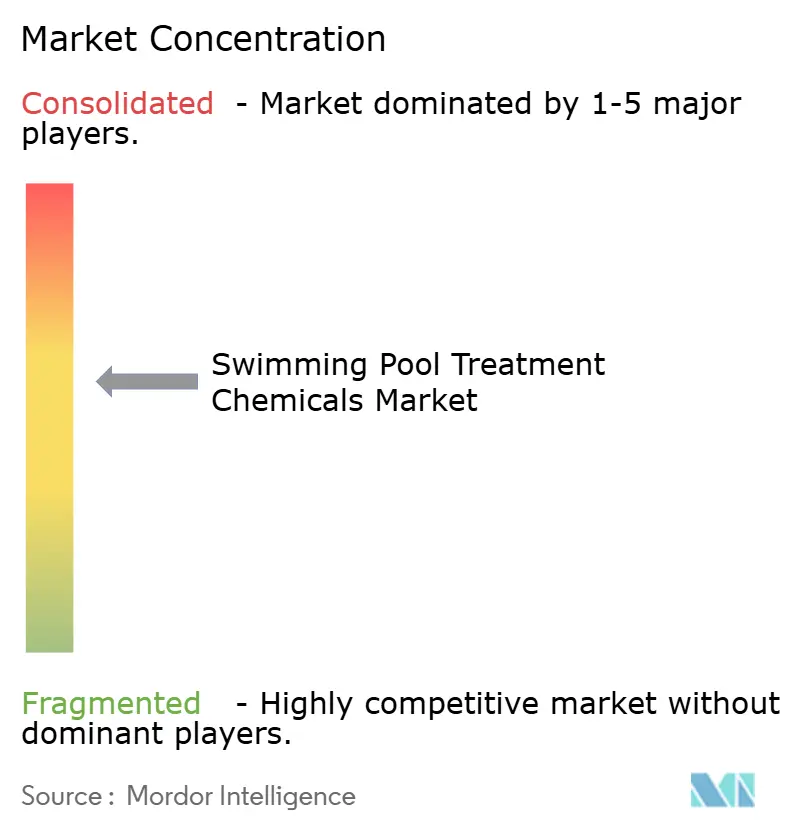
The swimming pool treatment chemicals market is moderately concentrated, with the top five players including Occidental Chemical Corporation, Olin Corporation, Solvay, ICL, and Arxada AG. These suppliers influence the availability of chlorine and caustic soda used in treatment chemicals. Specialty formulators compete through distribution relationships, product brands, and formulation development, with their success depending on whether customers view the offering as easy to use, consistently available, compatible with equipment, and suited to local service practices. This structure allows upstream suppliers to retain influence over inputs while formulated product suppliers compete for customer loyalty. The swimming pool treatment chemicals market, therefore, has different competitive conditions across the value chain, with raw-material scale and production economics carrying greater weight upstream and channel reach, product features, and customer support carrying greater weight in finished formulations.
Olin Corporation announced a proposed all-stock merger with Huntsman Corporation on June 16, 2026. The proposed transaction is expected to close in the first half of 2027, subject to shareholder and regulatory approvals, and its outcome will be relevant to buyers who monitor North American chlorine-derivatives supply, contract arrangements, and the balance of upstream production assets. It could influence North American supply relationships for chlorine derivatives used by institutional buyers. Ercros S.A. pursued its 3D Plan, which covers digitalization, decarbonization, and portfolio diversification, at its Sabiñánigo facility. This program links operating efficiency and portfolio changes to the company’s pool-chemical production base.
Chemical suppliers are increasingly pairing formulations with digital water-management systems. Preferred-reagent arrangements with automated dosing equipment can support repeat purchases over the service life of the equipment, because operators often value a known product and process that has been tested with the controller, pump, and monitoring system in use. NIPPON SODA CO., LTD. and Nankai Chemical Co., Ltd. compete in Asia-Pacific through local distribution and cost-efficient production. Aditya Birla Chemicals is extending the commercial presence of Powerit IPC across India and Southeast Asia. Product development in the swimming pool treatment chemicals market is focused on dosing accuracy, multifunctional chemistry, and sustainability-related requirements. Compliance costs related to the Biocidal Products Regulation and Registration, Evaluation, Authorisation and Restriction of Chemicals (REACH) can be difficult for smaller producers to absorb. The swimming pool treatment chemicals industry is consequently shaped by both scale in raw materials and specialized capabilities in finished formulations, including the ability to meet regulatory requirements, tailor products for dosing systems, and maintain distribution relationships in local pool-care channels.
Swimming Pool Treatment Chemicals Industry Leaders
-
Occidental Chemical Corporation
-
Olin Corporation
-
Solvay
-
ICL
-
Arxada AG
- *Disclaimer: Major Players sorted in no particular order
Recent Industry Developments
- July 2026: Fluidra agreed to acquire Hydrapro, a French manufacturer of pool and spa chemical water-treatment products serving professional and consumer channels. The acquisition expands Fluidra’s presence in pool water-treatment chemicals and strengthens its offering across residential and professional pool applications.
- June 2026: HASA Inc. acquired Bio-Dex Laboratories, adding specialty swimming pool and spa chemicals, including algicides, clarifiers, filter cleaners, and stain and scale prevention products. The acquisition expands the portfolio of treatment chemicals used to maintain pool water quality, clarity, and sanitation.
Global Swimming Pool Treatment Chemicals Market Report Scope
Swimming pool treatment chemicals are formulated substances used to maintain water quality, clarity, and hygiene in swimming pools. They help control microorganisms, adjust water chemistry, prevent unwanted deposits, and maintain suitable conditions for pool use.
The Swimming Pool Treatment Chemicals Market is segmented by product type, pool type, and geography. By product type, the market is segmented into calcium hypochlorite, sodium hypochlorite, trichloroisocyanuric acid, bromine, and other product types. By pool type, the market is segmented into residential pools, commercial pools, public aquatic facilities, and other pool types. The report also covers the market size and forecasts for swimming pool treatment chemicals in 15 countries across major regions. For each segment, the market sizing and forecasts have been done on the basis of value (USD).
| Calcium Hypochlorite |
| Sodium Hypochlorite |
| Trichloroisocyanuric Acid |
| Bromine |
| Other Product Types |
| Residential Pools |
| Commercial Pools |
| Public Aquatic Facilities |
| Other Pool Types |
| Asia-Pacific | China |
| India | |
| Japan | |
| South Korea | |
| ASEAN Countries | |
| Rest of Asia-Pacific | |
| North America | United States |
| Canada | |
| Mexico | |
| Europe | Germany |
| United Kingdom | |
| France | |
| Italy | |
| NORDIC Countries | |
| Rest of Europe | |
| South America | Brazil |
| Argentina | |
| Rest of South America | |
| Middle East and Africa | Saudi Arabia |
| South Africa | |
| Rest of Middle East and Africa |
| By Product Type | Calcium Hypochlorite | |
| Sodium Hypochlorite | ||
| Trichloroisocyanuric Acid | ||
| Bromine | ||
| Other Product Types | ||
| By Pool Type | Residential Pools | |
| Commercial Pools | ||
| Public Aquatic Facilities | ||
| Other Pool Types | ||
| By Geography | Asia-Pacific | China |
| India | ||
| Japan | ||
| South Korea | ||
| ASEAN Countries | ||
| Rest of Asia-Pacific | ||
| North America | United States | |
| Canada | ||
| Mexico | ||
| Europe | Germany | |
| United Kingdom | ||
| France | ||
| Italy | ||
| NORDIC Countries | ||
| Rest of Europe | ||
| South America | Brazil | |
| Argentina | ||
| Rest of South America | ||
| Middle East and Africa | Saudi Arabia | |
| South Africa | ||
| Rest of Middle East and Africa | ||
Key Questions Answered in the Report
What is the size of the swimming pool treatment chemicals market?
The swimming pool treatment chemicals market stands at USD 2.11 billion in 2026 and is projected to reach USD 2.64 billion by 2031.
What is driving demand for swimming pool treatment chemicals?
Recurring water-care needs, new residential and hospitality pools, automated dosing, and professional maintenance services support demand.
Which product type held the largest market share in 2025?
Calcium hypochlorite held a 28.13% share in 2025, supported by its high chlorine content and use in commercial feeder systems.
Which pool type is projected to advance fastest through 2031?
Commercial pools are projected to advance at a 5.84% CAGR through 2031 as hotels, resorts, and water parks add facilities.