
Superconductors Market Size and Share
Market Overview
| Study Period | 2021 - 2031 |
|---|---|
| Market Size (2026) | USD 1.45 Billion |
| Market Size (2031) | USD 2.12 Billion |
| Growth Rate (2026 - 2031) | 7.89 % |
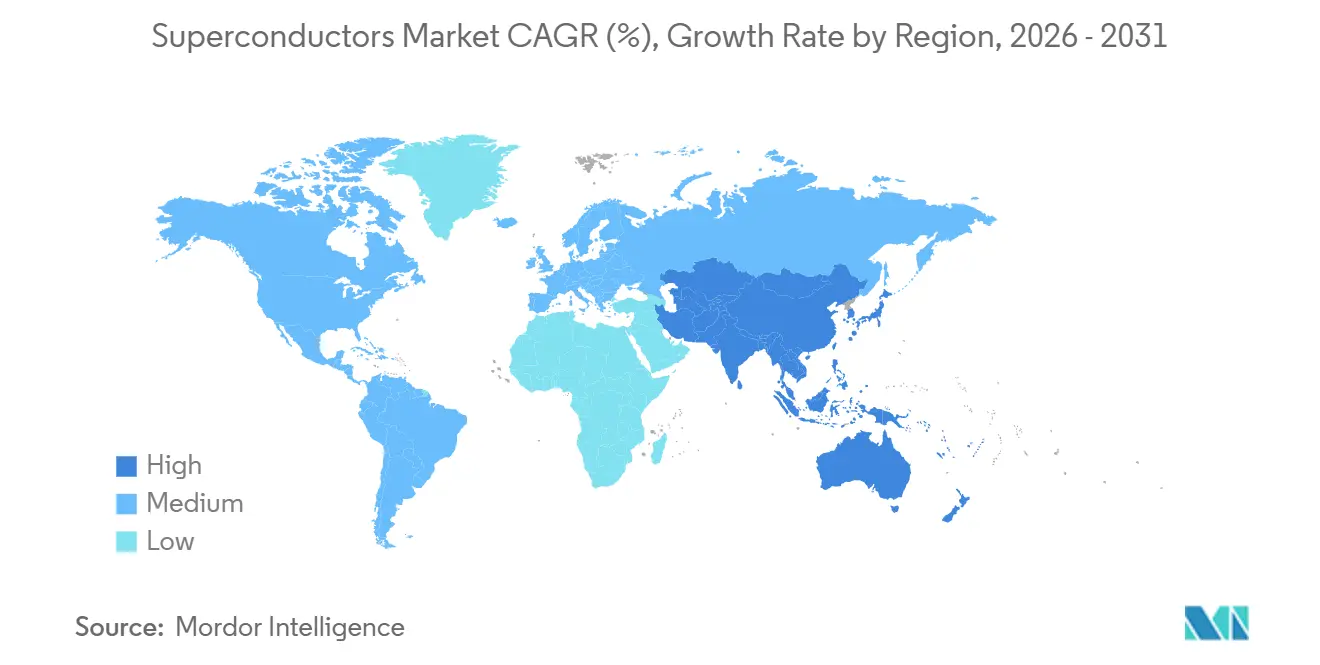
| Fastest Growing Market | Asia-Pacific |
| Largest Market | North America |
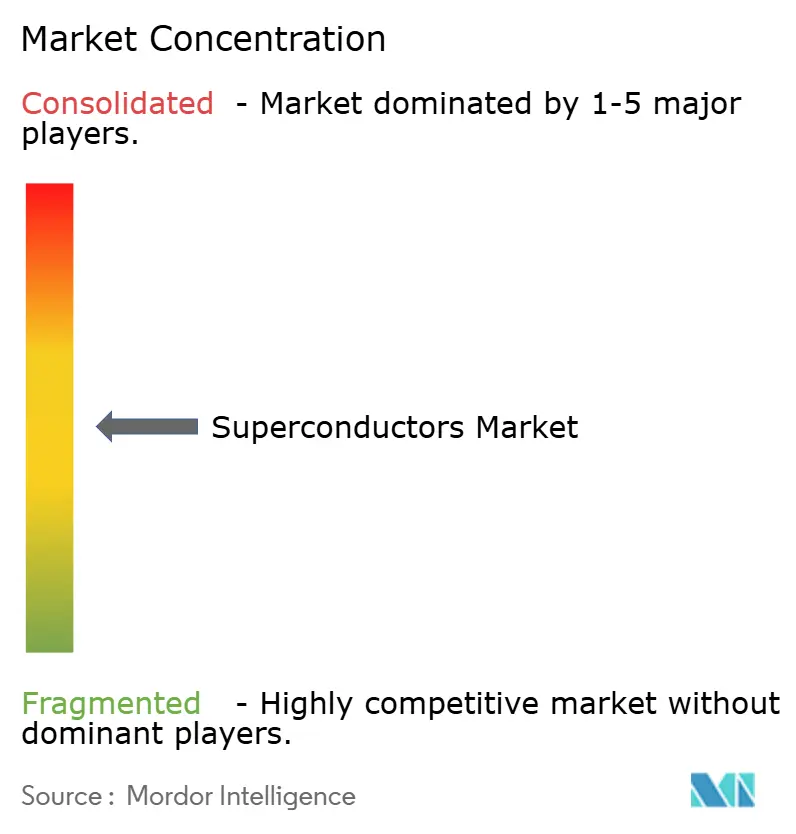
| Market Concentration | Medium |
Major Players *Disclaimer: Major Players sorted in no particular order Image © Mordor Intelligence. Reuse requires attribution under CC BY 4.0. | |
Superconductors Market Analysis by Mordor Intelligence
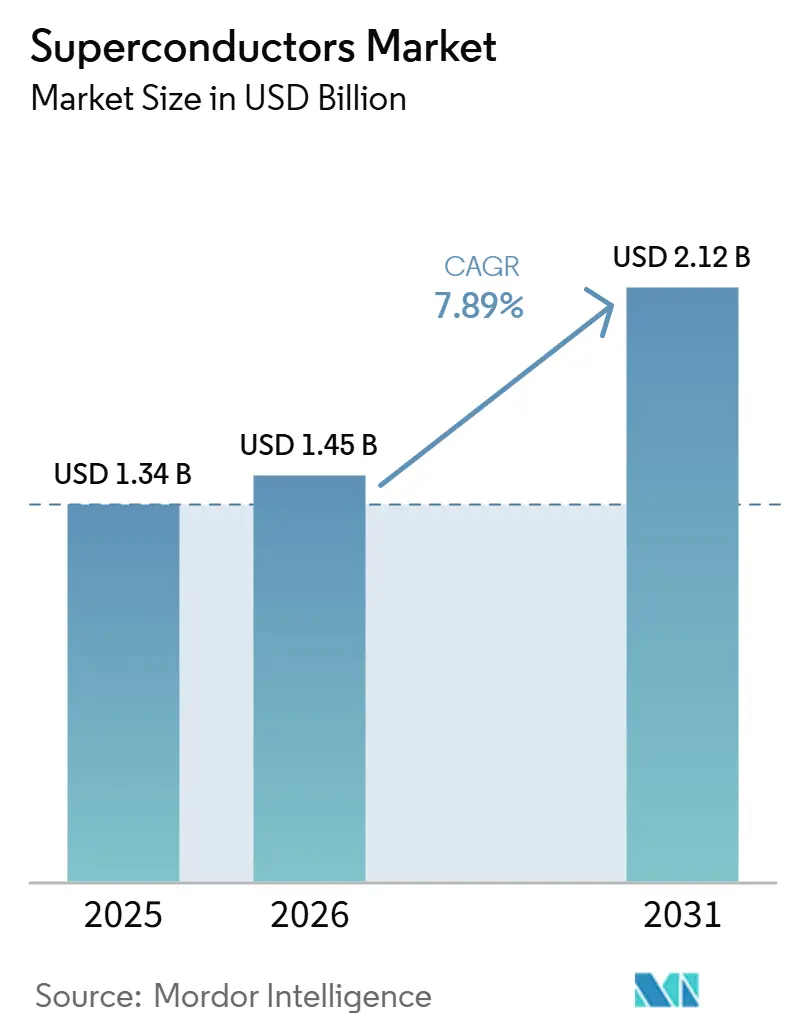
The Superconductors Market size was valued at USD 1.34 billion in 2025 and is estimated to grow from USD 1.45 billion in 2026 to reach USD 2.12 billion by 2031, at a CAGR of 7.89% during the forecast period (2026-2031). The superconductors market is supported by replacement demand for clinical imaging equipment, investment in fusion energy projects, and growing interest in data center power systems. Healthcare procurement provides a stable base, as many installed MRI and nuclear magnetic resonance (NMR) systems continue to rely on superconducting magnets. Fusion projects are creating longer-term demand for high-performance conductors, particularly materials used in high-field magnets. Suppliers are also adjusting their manufacturing plans to meet requirements for longer, more uniform tape. These conditions favor companies that can combine conductor production with system engineering and reliable field support.
Key Report Takeaways
- By type, high-temperature superconductors (HTS) held 52.82% of revenue in 2025, while the segment is forecast to grow at a 9.47% CAGR through 2031.
- By material type, cuprate superconductors accounted for 55.71% of revenue in 2025, while magnesium diboride superconductors are forecast to expand at a 9.42% CAGR through 2031.
- By application, medical imaging held 42.68% of revenue in 2025, while fusion energy and particle accelerators are forecast to grow at an 11.35% CAGR through 2031.
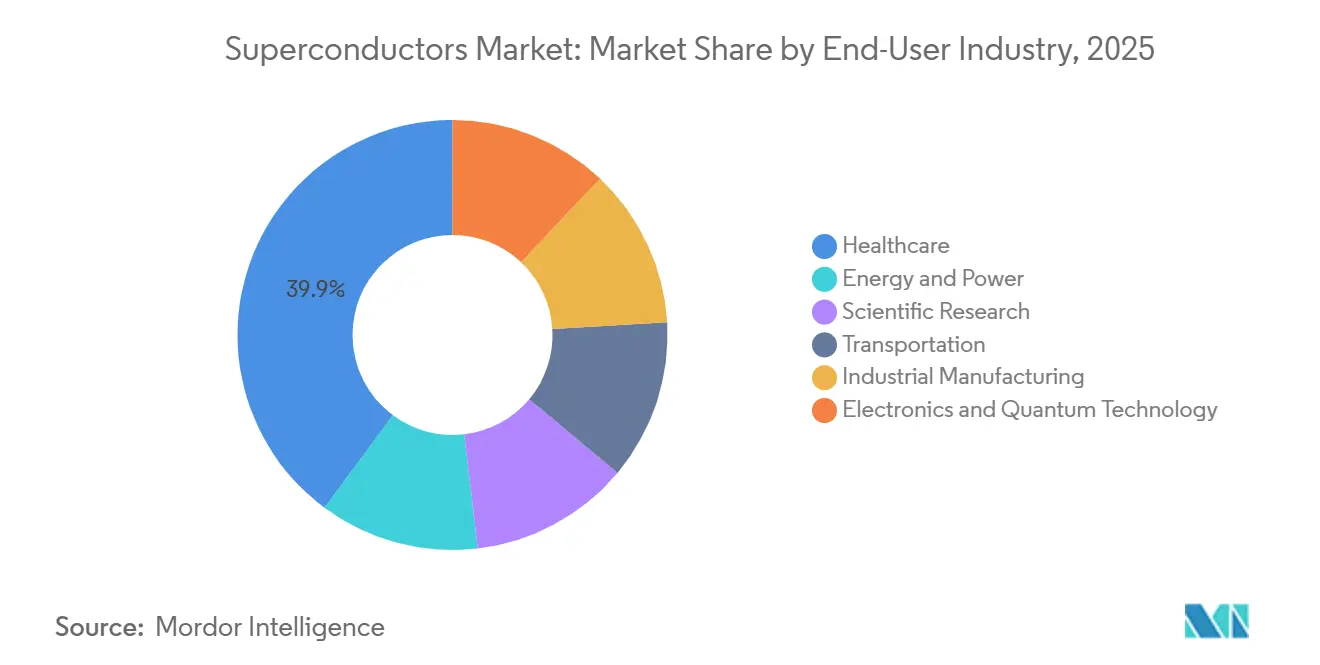
- By end-user industry, healthcare accounted for 39.85% of revenue in 2025, while electronics and quantum technology are forecast to advance at a 10.83% CAGR through 2031.
- By geography, North America held 37.44% of revenue in 2025, while Asia-Pacific is forecast to grow at a 9.27% CAGR through 2031.
Note: Market size and forecast figures in this report are generated using Mordor Intelligence’s proprietary estimation framework, updated with the latest available data and insights as of January 2026.
Market Trends and Insights
Drivers Impact Analysis of Superconductors Market*
| Drivers | (~) % Impact on CAGR Forecast | Geographic Relevance | Impact Timeline |
|---|---|---|---|
| High-Field MRI Demand and Aging Imaging Infrastructure Replacement | +2.1% | Global, with upgrades concentrated in North America and Western Europe | Short term (≤ 2 years) |
| Grid Modernization and High-Capacity Power Transmission Investment | +1.5% | North America and Europe, with spillover into the Asia-Pacific | Medium term (2-4 years) |
| Superconducting Magnet Deployment in Fusion and Particle Accelerator Projects | +1.8% | Global, centered on the International Thermonuclear Experimental Reactor (ITER) Europe-Japan axis and expanding in South Korea and the United States | Long term (≥ 4 years) |
| High-Temperature Superconductor (HTS) Manufacturing Capacity and Long-Length Tape Production Expansion | +1.2% | Japan and China, with demand spillover across the Asia-Pacific and Europe | Medium term (2-4 years) |
| Superconducting Power Components for AI Data Centers and Dense Electrical Infrastructure | +1.4% | North America and Europe initially, with Asia-Pacific scale-up expected by 2028 | Medium term (2-4 years) |
| Source: Mordor Intelligence | |||
Rising Demand for High-Field MRI Systems and Replacement of Aging Medical Imaging Infrastructure
The superconductors market benefits from the replacement of 1.5 T and 3.0 T MRI systems installed between 2000 and 2010. Many of these systems are approaching the end of their operating lives, supporting demand for replacement magnets and related conductors. Higher-field equipment improves signal quality for functional imaging, cancer staging, and neurovascular assessment. In January 2026, Bruker announced USD 500 million in multi-year supply agreements with two global healthcare companies for MRI superconductors, including a seven-year agreement. Bruker also reported that its Ascend Evo 700 and 800 magnets reduced helium consumption by 33% to 40% and extended refill intervals to 180 to 240 days. These requirements increase the value of consistent wire performance and support established suppliers in the superconductors market.
Increasing Investments in Grid Modernization and High-Capacity Power Transmission Networks
The superconductors market is also supported by grid constraints in dense urban areas. Utilities in Europe, North America, and East Asia require additional capacity in corridors where overhead line expansion is difficult. High-temperature superconducting cables can carry 3 to 5 times the power of conventional cross-linked polyethylene (XLPE) cables while using corridors up to 10 times narrower. This provides an option for upgrading underground links without the extended approvals required for new overhead transmission routes. A 2026 technology roadmap from Superconductor Science and Technology reviewed the development of high-power superconducting cables and their role in future electricity systems[1]. The opportunity depends on integrated systems that combine conductors, cryogenic envelopes, cable terminations, and fault-current protection, rather than wire supply alone.
Growing Deployment of Superconducting Magnets in Fusion Energy and Particle Accelerator Projects
Fusion energy projects are creating direct procurement demand for high-performance superconducting conductors. In May 2026, the International Thermonuclear Experimental Reactor (ITER) began operations at its Magnet Cold Test Facility following the successful cooldown of a 330-ton Nb3Sn toroidal field coil to 4 K. The facility supports full-current testing before the magnets are installed in the reactor. ITER's program demonstrates how large research programs can change supplier requirements for Nb3Sn production, testing, and traceability. The superconductors market also benefits from privately funded compact tokamak programs that use high-field rare-earth barium-copper oxide (REBCO) magnets. Qualification standards remain demanding, giving proven suppliers an advantage when projects require dependable delivery against fixed construction schedules.
Expansion of HTS Manufacturing Capacity and Long-Length Tape Production
The availability of long and uniform REBCO tape is an important supply condition for the superconductors market. Fusion magnets, high-field nuclear magnetic resonance (NMR) systems, grid equipment, and advanced data center designs all require conductors that maintain consistent performance over long lengths. Production improvements can reduce qualification waste and improve the economics of large projects. The technical challenge is particularly relevant at the edges of wide coated-conductor substrates, where thin-film consistency can decline. Research from the National High Magnetic Field Laboratory documented critical-current fluctuations and flux jumps in REBCO coated conductors. A 2025 scientific review identified pulsed laser deposition scale-up and long-length tape manufacturing as central issues for commercial fusion demand.
Restraints Impact Analysis of Superconductors Market*
| Restraints | (~) % Impact on CAGR Forecast | Geographic Relevance | Impact Timeline |
|---|---|---|---|
| Cryogenic Cooling Complexity and Limited Helium Availability | -1.3% | Global, with greater exposure in regions dependent on Middle-Eastern or Russian helium supply | Short term (≤ 2 years) |
| REBCO Tape Yield, Uniformity, and Long-Length Manufacturing Challenges | -0.8% | Global, with pressure concentrated in projects with fixed fusion timelines | Medium term (2-4 years) |
| Long Project Development and Superconducting System Qualification Cycles | -0.7% | Global, particularly North America and Europe | Long term (≥ 4 years) |
| Source: Mordor Intelligence | |||
Complexity of Cryogenic Cooling Systems and Limited Helium Availability
Cryogenic cooling remains a central operating constraint for many superconducting systems. Most installed clinical and physics magnets use low-temperature superconductors that operate near 4.2 K and require liquid helium. This makes service continuity dependent on helium storage, replenishment, and maintenance planning. Helium-saving designs can reduce exposure, but they do not eliminate the need for specialized cooling systems across the installed base. Bruker's 2025 magnet launch demonstrated the practical value of reducing helium use while maintaining high-field capability. High-temperature superconducting systems that operate above 30 K can use alternative cooling approaches, yet a broad transition to such equipment will take time.
Manufacturing Challenges Related to REBCO Tape Yield, Uniformity, and Long-Length Production
REBCO-coated conductors are important for compact fusion magnets, high-field nuclear magnetic resonance (NMR), and grid fault-current limiters. However, their economics remain difficult at the lengths required by large energy projects. Critical current can vary along the tape, particularly where substrate and thin-film conditions change across a wide format. The National High Magnetic Field Laboratory reported evidence of lengthwise variations in the critical current of commercially relevant coated conductors[2]. The superconductors market depends on production methods that deliver consistent quality at scale, rather than laboratory performance alone. Utility buyers also require additional field evidence before committing to large cable programs, which delays the translation of technical readiness into orders.
*Our forecasts treat driver/restraint impacts as directional, not additive. The impact forecasts reflect baseline growth, mix effects, and variable interactions.
Superconductors Market Segment Analysis
By Type:
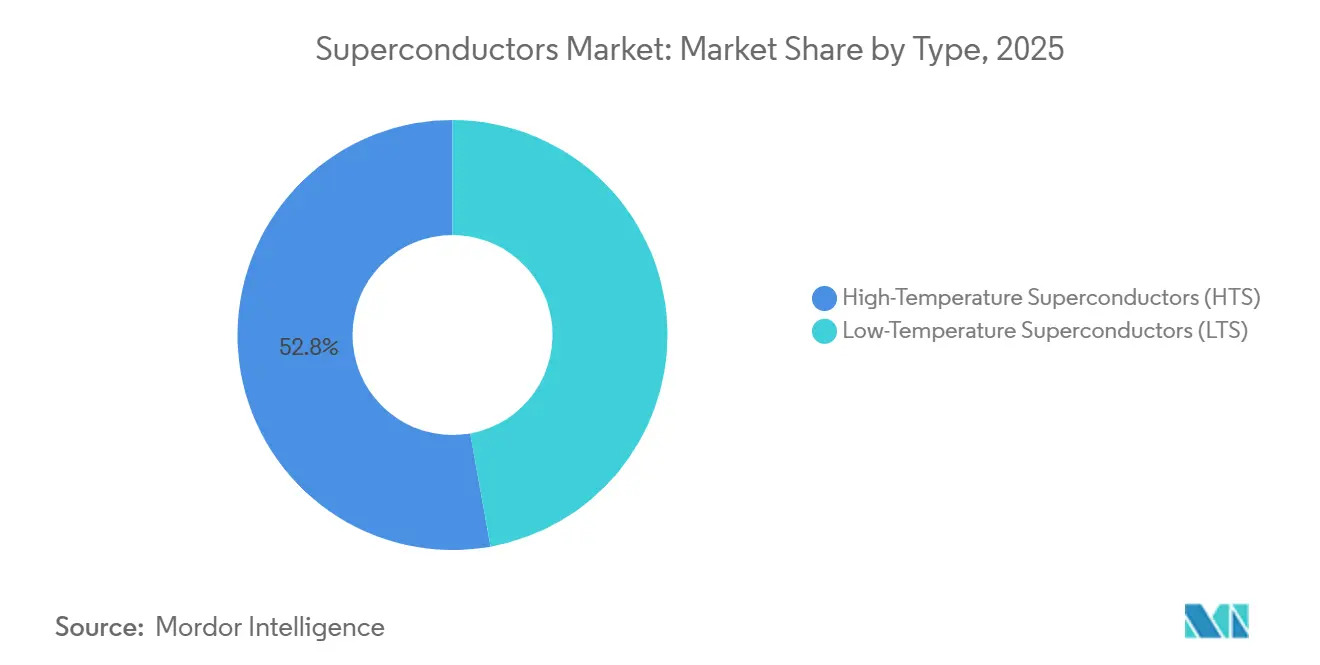
HTS Holds a Majority Position While LTS Supports the Installed BaseHigh-temperature superconductors captured 52.82% of the superconductors market share in 2025. The segment is forecast to grow at a 9.47% CAGR between 2026 and 2031, supported by fusion magnets, fault-current limiters, and data center cable pilots. Rare Earth Barium Copper Oxide (REBCO) conductors are suited to applications requiring high current density in strong magnetic fields. Their ability to operate at higher temperatures can reduce dependence on liquid helium in selected designs. The market has shifted toward these applications as customers seek compact, high-capacity electrical systems. Manufacturing capacity and conductor uniformity will determine whether suppliers can meet the resulting demand.
Low-temperature superconductors remain essential for much of the installed base of MRI, NMR, and particle accelerators. Their established use creates steady replacement and service demand even as high-temperature alternatives expand. Medical systems have long qualification cycles, which keep approved conductor designs in use for extended periods. The IEC 61788 series of standards continues to influence wire characterization and procurement decisions in medical and research settings. The type segment, therefore, combines a growing high-temperature opportunity with a durable low-temperature installed base. This balance helps the superconductors market maintain revenue stability while new applications develop.

By Material Type:
Cuprate Superconductors Lead While MgB₂ Gains GroundCuprate superconductors accounted for 55.71% of the superconductors market size in 2025. Their positions reflect the established roles of Bismuth Strontium Calcium Copper Oxide (BSCCO) in clinical wire and Yttrium Barium Copper Oxide (YBCO) or REBCO in magnet and grid applications. These materials have accumulated a large qualification base in demanding applications, supported by performance requirements that smaller or newer materials may not yet meet at an industrial scale. Work on coated-conductor manufacturing continues to focus on improving long-length performance and production reliability. Iron-based superconductors remain at an earlier stage, as production-scale and uniformity requirements remain unresolved.
Magnesium diboride superconductors are forecast to grow at a 9.42% CAGR from 2026 to 2031. The material can operate at 20 K to 39 K, which supports cryocooler-based designs rather than direct reliance on liquid helium. This can simplify supporting equipment in applications where those temperatures are acceptable. The Istituto Nazionale di Fisica Nucleare (INFN) reported work with ASG Superconductors on the SURE project for an MgB₂ cable designed for AI data center power supply. The material offers cost and operational advantages in selected power applications. Its adoption will depend on system validation, cable design, and end-user confidence in long-term operation.
By Application:
Medical Imaging Leads Revenue While Fusion and Accelerators Grow FastestMedical imaging accounted for 42.68% of the superconductors market share in 2025. This position is supported by a globally installed MRI base that requires replacement magnets, service, and periodic technology upgrades. Bruker introduced a 1.3 GHz Nuclear Magnetic Resonance (NMR) system in April 2025 using a hybrid Low Temperature Superconductor-High Temperature Superconductor (LTS-HTS) magnet with a Rare Earth Barium Copper Oxide (REBCO) insert at 30.5 tesla. This shows that established imaging and spectroscopy systems can incorporate advanced material specifications. Regulatory review requirements also make approved conductor choices durable across equipment upgrade cycles. Medical imaging, therefore, remains an important revenue base for the superconductors market.
Fusion energy and particle accelerators are forecast to grow at an 11.35% CAGR from 2026 to 2031. ITER completed all superconducting magnets in 2025 after a long production program, creating a reference point for mass-scale fusion magnet supply. Higher-field magnets can support smaller fusion devices by increasing magnetic confinement. A 2025 paper on the ARC fusion power plant described the physics basis for a compact high-field design. Power transmission and transportation also provide additional applications, although their pace depends on demonstration and qualification outcomes. This application mix broadens the longer-term market opportunity for superconductors.
By End-User Industry:
Healthcare Provides Stability While Electronics and Quantum Technology ExpandHealthcare accounted for 39.85% of the superconductors market in 2025. MRI replacement cycles and NMR demand in pharmaceutical research support this position. Buyers in healthcare place strong value on reliability, consistent magnet performance, and established service processes. This gives the segment a stable role even when new applications face changing investment conditions. Bruker's multiyear MRI supply agreements announced in 2026 indicate continuing procurement activity in this end-user group. Healthcare will continue to provide a dependable demand base for the superconductors market.
Electronics and quantum technology are forecast to grow at a 10.83% CAGR through 2031. Superconducting transmon qubit systems use dilution refrigerators that operate at 10-20 millikelvins. As developers increase qubit counts and build more capable processors, equipment requirements expand, creating demand for cryogenic infrastructure, specialized wiring, and high-performance materials. The timing of orders will depend on the pace at which quantum hardware programs move from research installations to larger computing systems. Energy and power, scientific research, transportation, and industrial manufacturing provide additional end-user channels with different procurement cycles and technical requirements.
Geography Analysis
North America Superconductors Market
North America held 37.44% of the superconductors market share in 2025. The region benefits from the procurement of magnetic resonance imaging (MRI) systems, high-energy physics facilities, naval programs, and private fusion investment in the United States. Government programs in fusion and quantum technology provide longer planning horizons for specialized equipment. The U.S. Department of Energy published its Fusion Science and Technology Roadmap in 2025, outlining research and development priorities for the field. These programs support demand visibility for conductors, magnets, and related cryogenic systems. North American universities and national laboratories also sustain research use of superconducting hardware.
APAC Superconductors Market
Asia-Pacific is forecast to grow at a 9.27% CAGR from 2026 to 2031. Japan has a vertically integrated high-temperature superconducting ecosystem spanning tape, magnets, motors, and medical components. China, Japan, and South Korea each play different roles in materials production, research, and fusion development. The region's manufacturers benefit from proximity to major supply chains for electronics, transport, and power equipment. The superconductors market in Asia-Pacific may also benefit from investment in domestic material capability and high-capacity electricity infrastructure. Growth will depend on qualified production expansion and project-level demand from energy and industrial users.
EMEA and South America Superconductors Market
Europe holds a position in the superconductors market, with Germany hosting industrial research clusters and France hosting the ITER project. The ITER program continues to connect European suppliers with a global fusion magnet supply chain. Europe is also developing superconducting power cables and grid technologies. The regional opportunity is supported by energy-transition objectives and constrained urban transmission corridors. South America, the Middle-East, and Africa retain smaller positions in the superconductors market. Their demand potential is tied to future industrial electrification, research infrastructure, and power system investment.
Competitive Landscape
The superconductors market is moderately fragmented. Key suppliers include Fujikura, Sumitomo Electric, Bruker, American Superconductor (AMSC), Western Superconducting, Furukawa Electric, and Luvata. Competition is based on material performance, length uniformity, manufacturing capacity, and application-specific qualification. Companies that combine wire production with cryogenic engineering and field support can offer more complete solutions. This is particularly relevant in MRI, grid, and fusion projects, where system performance depends on more than the conductor alone. The competitive structure, therefore, favors suppliers with established technical and service capabilities.
In January 2026, Bruker announced USD 500 million in multi-year MRI superconductor supply agreements, including one contract with a duration of up to 7 years. The agreements cover next-generation helium-free MRI magnet architectures and illustrate how technical collaboration can support long-term commercial relationships. The International Thermonuclear Experimental Reactor's (ITER's) Magnet Cold Test Facility entered operation in May 2026, marking an important milestone for the magnet supply chain. In April 2026, Tokamak Energy published a study on high-temperature superconducting power distribution for data centers. These developments reflect a broader trend toward applications where technical validation is closely linked to commercial adoption.
New Rare Earth Barium Copper Oxide (REBCO) capacity could increase competitive pressure, particularly if suppliers improve yield and long-length consistency. However, fusion project schedules and medical device qualifications favor vendors with proven supply records. International Electrotechnical Commission (IEC) 61788 standards and medical device approval processes raise entry barriers in higher-value applications. Competition in the superconductors market is not determined solely by tape price, as customers must also consider reliability, system integration, and certification. Data center power systems represent an open opportunity, as broad commercial supply agreements for this application have not yet been established. Suppliers that meet quality and cost requirements may gain access to this emerging area. However, the same qualification requirements that protect established suppliers can also slow the entry of new competitors.
Superconductors Industry Leaders
-
Sumitomo Electric Industries, Ltd.
-
Fujikura Ltd.
-
Bruker
-
FURUKAWA ELECTRIC CO., LTD.
-
American Superconductor Corporation
- *Disclaimer: Major Players sorted in no particular order
Superconductors Market Companies Covered in this Report
- American Superconductor Corporation
- ASG Superconductors S.p.A.
- Bruker
- Cryomagnetics
- Fujikura Ltd.
- FURUKAWA ELECTRIC CO., LTD.
- JAPAN SUPERCONDUCTOR TECHNOLOGY,INC.
- Kiswire Advanced Technology Co., Ltd..
- Luvata
- NEXANS
- Sumitomo Electric Industries, Ltd.
- SuNAM Co., Ltd.
- THEVA Dünnschichttechnik GmbH
- Toshiba Corporation
- Western Superconducting Technologies Co., Ltd.
Recent Industry Developments in Superconductors Market
- July 2026: American Superconductor Corporation secured a USD 25 million turnkey contract from a North American utility for an integrated power quality solution supporting a large-scale mining development. The contract covers design, engineering, installation, and commissioning of superconductor-based power quality infrastructure, combining Static Synchronous Compensator (STATCOM) technology, a 138 kV power transformer, switchgear, and protection equipment, with delivery expected in fiscal year 2027.
- January 2026: Bruker Energy & Supercon Technologies announced USD 500 million in multiyear superconductor supply agreements with 2 global healthcare companies for MRI applications, including 1 agreement extending up to 7 years, covering helium-free MRI magnet architectures.
Global Superconductors Market Report Scope
Superconductors are materials that conduct electricity with zero electrical resistance and expel magnetic fields when cooled below a specific critical temperature. Key examples include aluminum, niobium, and yttrium barium copper oxide.
The superconductors market is segmented by type, material type, application, end-user industry, and geography. By type, the market is segmented into low-temperature superconductors (LTS) and high-temperature superconductors (HTS). By material type, the market is segmented into cuprate superconductors, iron-based superconductors, and magnesium diboride (MgB₂) superconductors. By application, the market is segmented into medical imaging, power transmission and grid, fusion energy and particle accelerators, transportation, and industrial equipment and electronics. By end-user industry, the market is segmented into healthcare, energy and power, scientific research, transportation, industrial manufacturing, and electronics and quantum technology. The report also covers market size and forecasts for superconductors across 16 countries in major regions. The market sizes and forecasts are provided in terms of value (USD).
Segmentation Overview
| Low-Temperature Superconductors (LTS) |
| High-Temperature Superconductors (HTS) |
| Cuprate Superconductors |
| Iron-Based Superconductors |
| Magnesium Diboride (MgB₂) Superconductors |
| Medical Imaging |
| Power Transmission and Grid |
| Fusion Energy and Particle Accelerators |
| Transportation |
| Industrial Equipment and Electronics |
| Healthcare |
| Energy and Power |
| Scientific Research |
| Transportation |
| Industrial Manufacturing |
| Electronics and Quantum Technology |
| Asia-Pacific | China |
| India | |
| Japan | |
| South Korea | |
| Rest of Asia-Pacific | |
| North America | United States |
| Canada | |
| Mexico | |
| Europe | Germany |
| United Kingdom | |
| France | |
| Italy | |
| Russia | |
| Rest of Europe | |
| South America | Brazil |
| Argentina | |
| Rest of South America | |
| Middle-East and Africa | Saudi Arabia |
| South Africa | |
| Rest of Middle-East and Africa |
| By Type | Low-Temperature Superconductors (LTS) | |
| High-Temperature Superconductors (HTS) | ||
| By Material Type | Cuprate Superconductors | |
| Iron-Based Superconductors | ||
| Magnesium Diboride (MgB₂) Superconductors | ||
| By Application | Medical Imaging | |
| Power Transmission and Grid | ||
| Fusion Energy and Particle Accelerators | ||
| Transportation | ||
| Industrial Equipment and Electronics | ||
| By End-User Industry | Healthcare | |
| Energy and Power | ||
| Scientific Research | ||
| Transportation | ||
| Industrial Manufacturing | ||
| Electronics and Quantum Technology | ||
| By Geography | Asia-Pacific | China |
| India | ||
| Japan | ||
| South Korea | ||
| Rest of Asia-Pacific | ||
| North America | United States | |
| Canada | ||
| Mexico | ||
| Europe | Germany | |
| United Kingdom | ||
| France | ||
| Italy | ||
| Russia | ||
| Rest of Europe | ||
| South America | Brazil | |
| Argentina | ||
| Rest of South America | ||
| Middle-East and Africa | Saudi Arabia | |
| South Africa | ||
| Rest of Middle-East and Africa | ||
Key Questions Answered in the Report
What is current market size of Superconductors Market?
The Superconductors Market size was valued at USD 1.34 billion in 2025 and is estimated to grow from USD 1.45 billion in 2026 to reach USD 2.12 billion by 2031, at a CAGR of 7.89% during the forecast period (2026-2031).
Which superconductor type leads in revenue?
High-temperature superconductors led with 52.82% revenue share in 2025 and are forecast to grow at a 9.47% CAGR through 2031. Their use of high-field magnets and power equipment supports this position.
Which application is growing fastest?
Fusion energy and particle accelerators are forecast to expand to 11.35% CAGR from 2026 to 2031. Large magnet programs and compact high-field fusion designs are increasing the demand for high-performance conductors.
Why are high-temperature superconductors relevant for data centers?
They can support high-capacity power distribution in constrained facilities and have been tested in a 3 MW rack-connected cable prototype. This case could reduce the physical burden of conventional copper distribution.