
Super Fruit Juices Market Size and Share
Market Overview
| Study Period | 2027 - 2032 |
|---|---|
| Market Size (2027) | USD 12.08 Billion |
| Market Size (2032) | USD 18.04 Billion |
| Growth Rate (2027 - 2032) | 8.31 % |
| Fastest Growing Market | Asia-Pacific |
| Largest Market | North America |
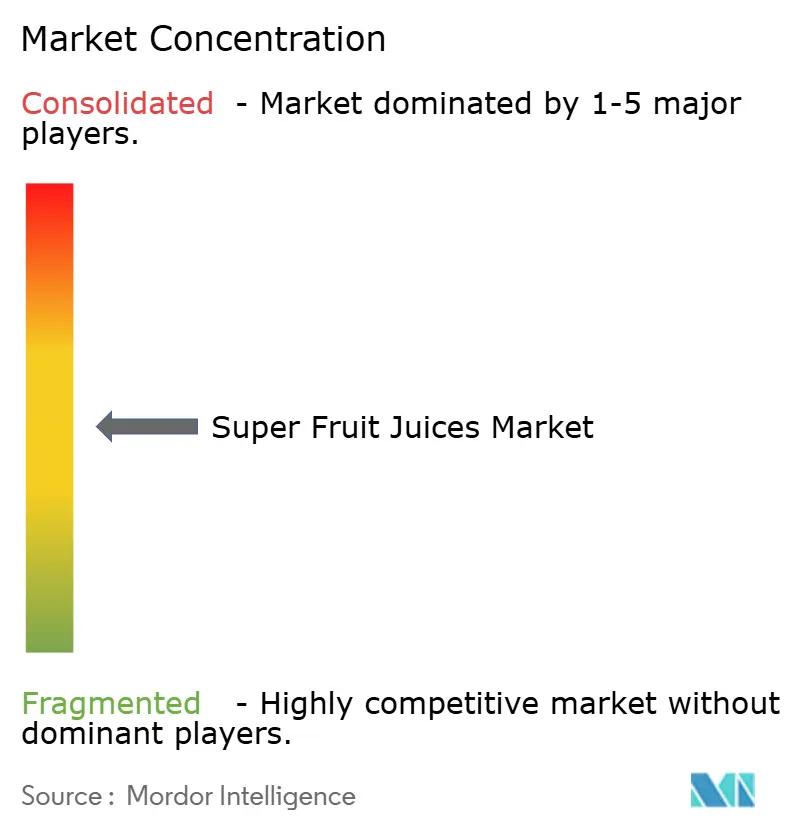
| Market Concentration | Medium |
Major Players *Disclaimer: Major Players sorted in no particular order Image © Mordor Intelligence. Reuse requires attribution under CC BY 4.0. | |
Super Fruit Juices Market Analysis by Mordor Intelligence
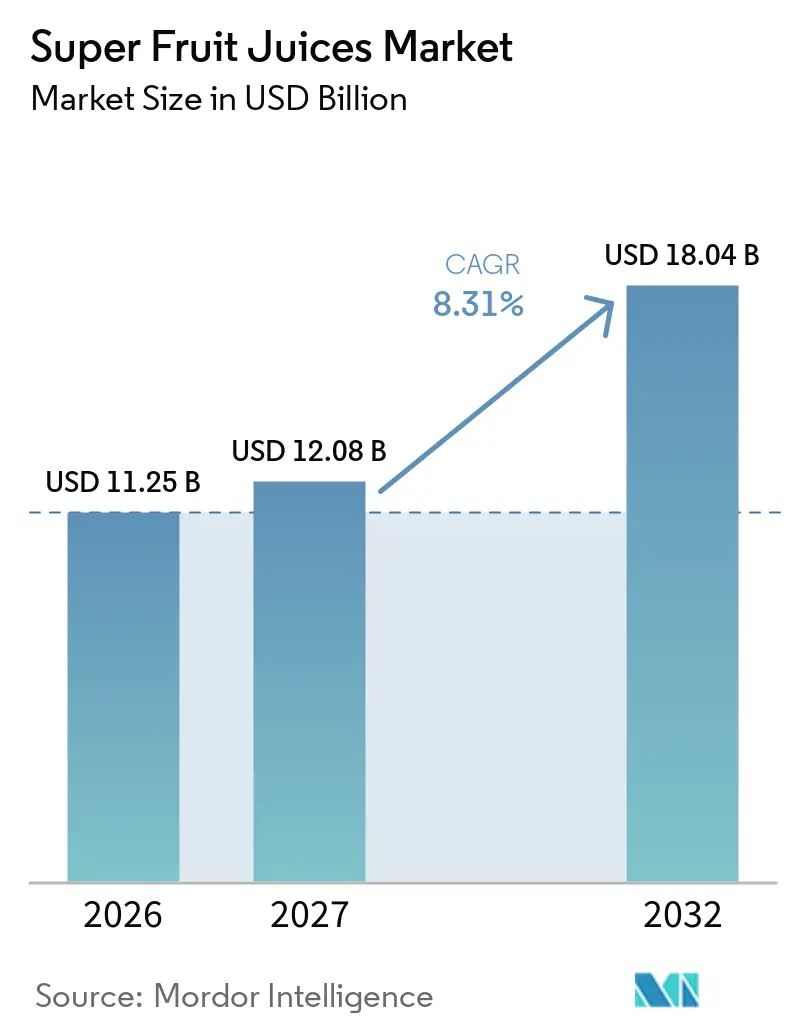
The super fruit juices market size is expected to increase from USD 11.25 billion in 2026 to USD 12.08 billion in 2027 and reach USD 18.04 billion by 2032, growing at a CAGR of 8.31% over 2027–2032. Growth depends on expanding the nutritional positioning of superfruit juices while maintaining product quality, supply availability, and commercially viable processing economics. Rising consumer preference for antioxidant-rich beverages, organic formulations, and exotic fruit varieties supports demand for premium juice products. Product innovation in blended superfruit beverages and cold-pressed formats creates opportunities for differentiation, while ready-to-drink offerings and online retail expansion improve consumer accessibility. However, high production costs, seasonal availability of exotic fruits, and nutrient degradation during processing complicate market expansion. Growth therefore favors producers that can secure reliable superfruit sourcing, maintain nutritional quality, and scale differentiated juice formulations across retail channels.
Key Report Takeaways
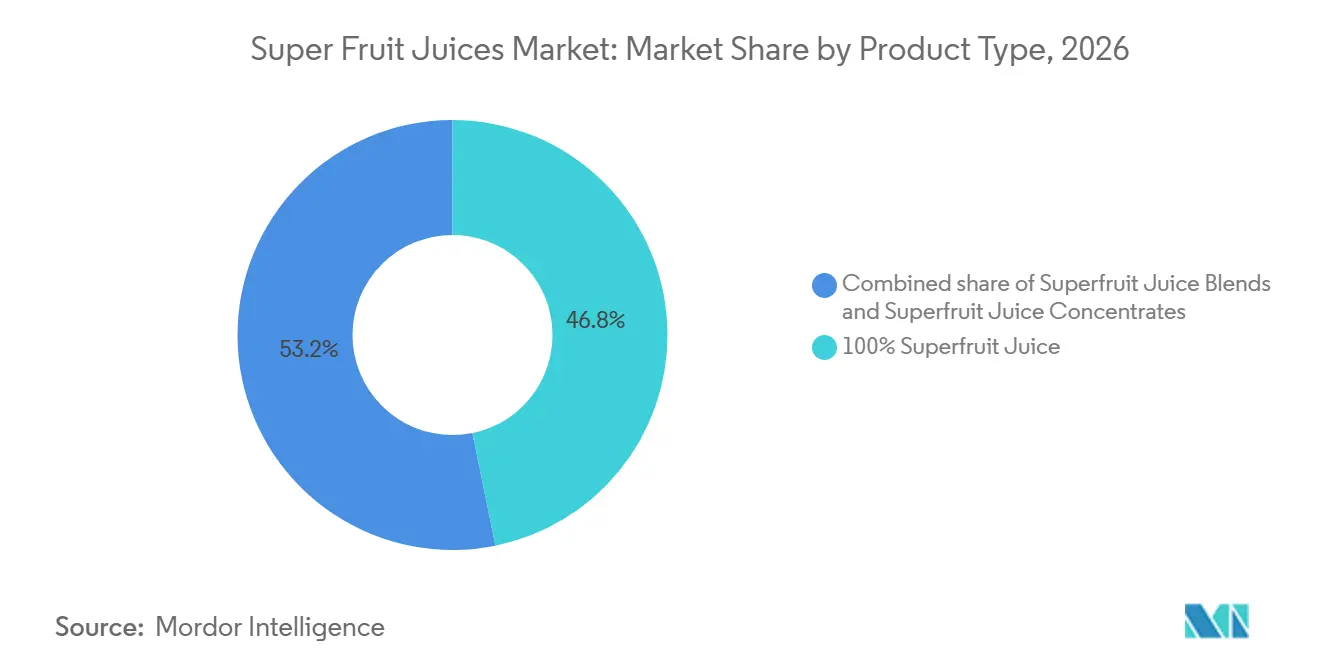
- By product type, 100% superfruit juice led with a 46.80% share of the super fruit juices market size in 2026, while superfruit juice blends are forecast to grow fastest at a 9.25% CAGR over 2027–2032.
- By nature, conventional superfruit juices accounted for the largest share at 76.40% in 2026, while organic superfruit juices are forecast to grow fastest at a 10.20% CAGR over 2027–2032.
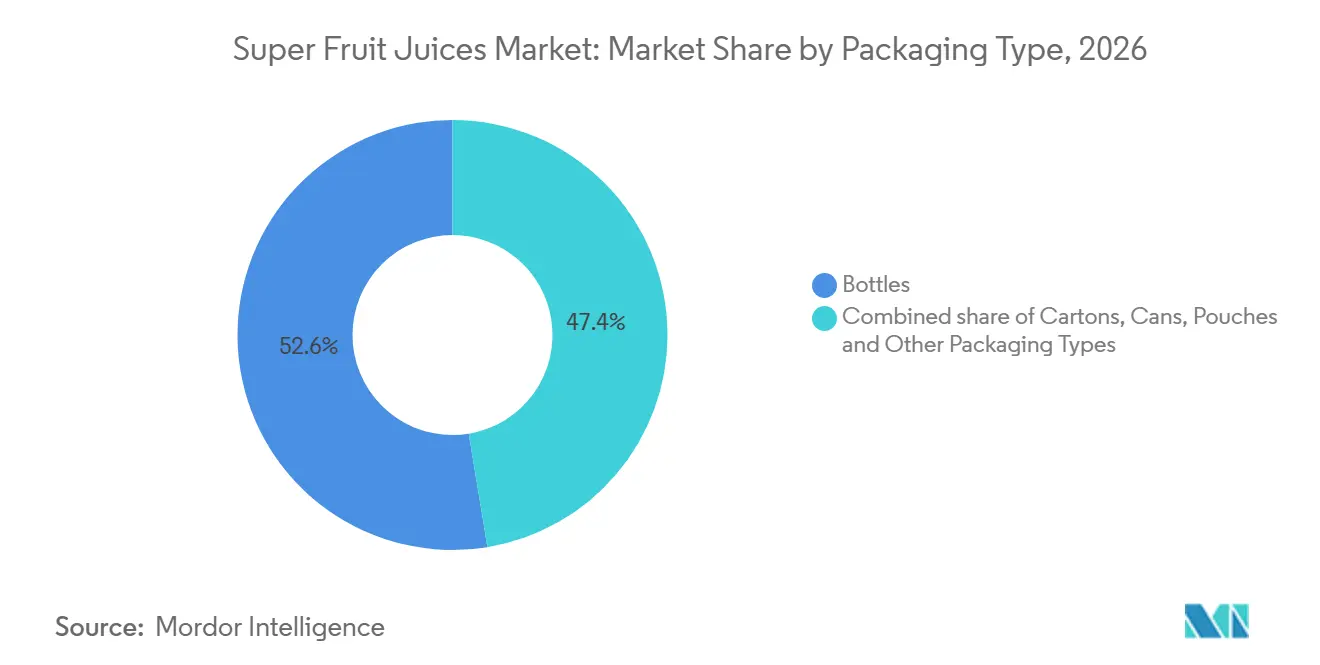
- By packaging type, bottles dominated with a 52.60% market share in 2026, while pouches are projected to record the fastest growth at a 9.40% CAGR over 2027–2032.
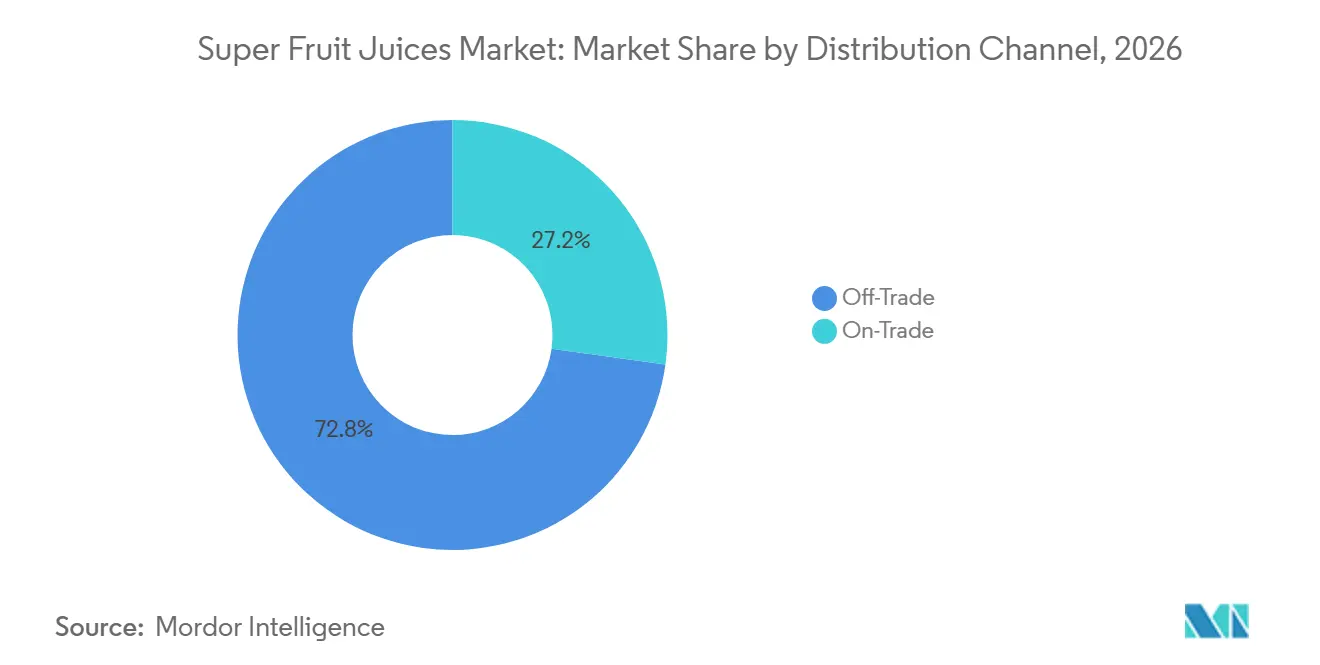
- By distribution channel, off-trade accounted for the largest share at 72.80% in 2026, while online retail is expected to grow fastest at a 10.80% CAGR over 2027–2032.
- Among geographies, North America led with a 32.40% share of the super fruit juices market in 2026, while Asia-Pacific is forecast to grow fastest at a 9.60% CAGR over 2027–2032.
Note: Market numbers in this report are based on Mordor Intelligence's proprietary estimation framework, which combines nine months of actuals with Q4 projections for base year 2026.
Market Trends and Insights
Drivers Impact Analysis of Super Fruit Juices Market*
| DRIVER | (~) % IMPACT ON CAGR FORECAST | GEOGRAPHIC RELEVANCE | IMPACT TIMELINE |
|---|---|---|---|
| Rising consumer preference for antioxidant-rich and nutrient-dense beverages | +1.0% | Global, particularly North America and Europe, where demand for health-oriented and functional beverages is established | Medium term (2–4 years) |
| Growing demand for natural, organic and clean-label juice products | +0.8% | Global, particularly North America and Europe, with increasing opportunities across Asia-Pacific | Medium term (2–4 years) |
| Increasing popularity of exotic and tropical superfruit varieties | +0.7% | Global, particularly Asia-Pacific and North America, supported by the availability and growing awareness of tropical fruit ingredients | Long term (More than 4 years) |
| Product innovation in functional and blended superfruit beverages | +0.6% | Global, particularly North America, Europe and Asia-Pacific, where beverage manufacturers are expanding differentiated product offerings | Medium term (2–4 years) |
| Expansion of premium and cold-pressed superfruit juice offerings | +0.5% | Global, particularly North America and Europe, with opportunities in premium urban retail markets across Asia-Pacific | Medium term (2–4 years) |
| Rising demand for convenient ready-to-drink superfruit formats | +0.4% | Global, particularly urban markets across Asia-Pacific, North America and Europe | Short term (Less than 2 years) |
| Source: Mordor Intelligence | |||
Rising Consumer Preference for Antioxidant-Rich and Nutrient-Dense Beverages
Consumer interest in beverages associated with nutritional value is creating opportunities for juices made from fruits such as acai, acerola, cranberry, blueberry, pomegranate, and goji berry. These fruits are commonly positioned as superfruits because of their antioxidant and other bioactive compound content. The Centre for the Promotion of Imports from developing countries (CBI) identifies antioxidants and anthocyanins as characteristics commonly associated with superfruits and notes that specific compounds, including vitamin C, proanthocyanidins, and polyphenols, are important quality parameters for certain superfruit juice ingredients [1]. For manufacturers, these nutritional attributes provide opportunities to differentiate superfruit juices from conventional fruit beverages and develop products with clearly communicated ingredient and nutritional propositions. However, nutritional positioning needs to be supported by accurate product information and substantiated claims to maintain consumer confidence.
Growing Demand for Natural, Organic and Clean-Label Juice Products
Consumer interest in products with identifiable ingredients, natural positioning, and organic credentials is creating opportunities for differentiated fruit juice products. In its March 2026 review of the European processed fruit and vegetable market, CBI reported renewed growth in imports of organic processed products and identified tropical and citrus juices among the product categories showing increasing organic import volumes. The report also noted that organic certification schemes are becoming more popular in Europe, with organic products moving beyond their earlier niche-market positioning [2]. For superfruit juice manufacturers, organic sourcing and clear ingredient declarations can strengthen product differentiation among consumers seeking alternatives to conventional beverages. However, certification requirements and the cost of maintaining compliant supply chains can increase production expenses, making sourcing efficiency and transparent product labelling important.
Increasing Popularity of Exotic and Tropical Superfruit Varieties
The expanding range of fruits marketed for their nutritional properties is supporting product development across the superfruit juice category. Superfruit ingredients include established varieties such as cranberry, pomegranate, and blueberry, as well as more exotic options such as acai, acerola, noni, camu camu, and passion fruit. CBI's review of the European superfruit juice market identifies these fruits in commercial juice, puree, and concentrate applications, while its 2026 processed-fruit market review highlights continued opportunities for products such as passion fruit juice and other tropical fruit ingredients [3]. For manufacturers, incorporating less conventional fruit varieties can help broaden flavour portfolios, target specialist consumer groups, and create premium product propositions. Nevertheless, the commercial viability of these products depends on reliable sourcing, consistent ingredient quality, and consumer acceptance of unfamiliar flavours.
Product Innovation in Functional and Blended Superfruit Beverages
Product innovation is allowing manufacturers to incorporate superfruit ingredients into a wider range of beverage formats rather than relying exclusively on single-fruit juices. CBI notes that superfruit juices are frequently used in mixed juices and that superfruit ingredients also find applications in smoothies and soft drinks. Its European market review further identifies small-format juice shots containing combinations of superfruit juices and functional ingredients, including probiotics, herbs, ginger, and turmeric [4]. These applications allow manufacturers to combine distinctive fruit flavours with additional ingredient propositions and address different consumption occasions. Blended formulations can also help balance the acidity or strong taste of certain superfruits, making them more suitable for mainstream beverage consumption. For producers, continued formulation development and sensory testing are therefore important to commercialise differentiated products while maintaining consistent taste and quality.
Expansion of Premium and Cold-Pressed Superfruit Juice Offerings
Demand for juice products positioned around processing quality and ingredient characteristics is creating opportunities for premium superfruit juice offerings. CBI's analysis of the European superfruit juice market identifies a positive outlook for several not-from-concentrate juices, including products manufactured through cold pressing. The report also notes that not-from-concentrate juice consumption has performed more favourably than several other juice categories in the European market. For superfruit juice manufacturers, cold-pressed and not-from-concentrate formulations can provide a basis for premium positioning, particularly when the product's fruit content, processing method, and storage requirements are clearly communicated. However, manufacturers need to manage processing conditions, shelf life, and distribution requirements carefully to preserve product quality and maintain commercial viability.
Market Restraints of Super Fruit Juices Market*
| RESTRAINT | (~) % IMPACT ON CAGR FORECAST | GEOGRAPHIC RELEVANCE | IMPACT TIMELINE |
|---|---|---|---|
| High production costs and premium retail pricing of superfruit juices | −0.8% | Global, particularly price-sensitive markets across Asia-Pacific, South America and the Middle East and Africa | Medium term (2–4 years) |
| Limited availability and seasonal supply of exotic superfruits | −0.7% | Global, particularly regions dependent on imports of açaí, acerola, goji berry and other exotic fruit inputs | Long term (More than 4 years) |
| Nutrient degradation during juice processing and extended storage | −0.5% | Global, especially markets with longer distribution routes and limited access to advanced processing and preservation technologies | Medium term (2–4 years) |
| Taste and sensory challenges associated with certain superfruit varieties | −0.4% | Global, particularly markets where consumers have limited familiarity with the taste profiles of exotic superfruits | Short term (Less than 2 years) |
| Source: Mordor Intelligence | |||
High Production Costs and Premium Retail Pricing
Superfruit juice production can involve higher raw-material and processing costs than conventional fruit juice, particularly when manufacturers use exotic fruits, organic ingredients, or specialised processing methods. Many superfruit varieties are sourced from specific growing regions, while their conversion into juice, puree, or concentrate can require additional handling, quality control, and transportation. Cold-pressed and not-from-concentrate products may also carry higher production and distribution costs than concentrate-based alternatives. These expenses can translate into premium retail prices, limiting accessibility among price-sensitive consumers and making frequent purchases more difficult. Manufacturers therefore need to balance ingredient quality and product differentiation with sourcing efficiency, processing scale, and pack-price strategies.
Limited Availability and Seasonal Supply of Exotic Superfruits
The availability of superfruit raw materials can be affected by seasonal harvest cycles, geographic concentration of production, weather conditions, and agricultural disease. This creates sourcing challenges for manufacturers that depend on less widely cultivated fruits such as acai, acerola, camu camu, and noni. Broader fruit-juice industry analysis published in April 2026 identifies climate change, disease pressure, and weather shocks as factors increasing agricultural supply volatility and affecting sourcing costs and production planning. For superfruit juice producers, inconsistent availability can disrupt procurement schedules, create fluctuations in ingredient prices, and make it difficult to maintain uniform product formulations throughout the year. Companies may need to diversify sourcing regions, work with multiple suppliers, and use suitable puree or concentrate inventories to reduce supply interruptions.
*Our forecasts treat driver/restraint impacts as directional, not additive. The impact forecasts reflect baseline growth, mix effects, and variable interactions.
Super Fruit Juices Market Segment Analysis
By Product Type:
100% Superfruit Juice Leads While Blends Expand FasterIn 2026, 100% superfruit juice accounted for an estimated 46.80% of the Super Fruit Juices Market, making it the leading product type. Its position reflects demand for beverages that provide a direct fruit-based proposition, with products made from ingredients such as pomegranate, cranberry, acai, blueberry, and other superfruit varieties. Meanwhile, superfruit juice blends are projected to record the fastest growth, at an estimated CAGR of 9.25% through 2032. Blended formulations allow manufacturers to combine different superfruit ingredients, balance distinctive flavour profiles, and develop products with broader sensory appeal. They also provide opportunities to incorporate complementary fruit ingredients and create differentiated beverage propositions.
Superfruit juice concentrates serve a separate role by providing concentrated ingredients for beverage formulation and further processing. Their use can support manufacturers developing blended beverages and other juice applications. However, producers across all three product categories need to manage ingredient quality, flavour consistency, and processing requirements. The ability to balance nutritional positioning, taste, and product affordability will remain important for expanding consumption.

By Nature:
Conventional Products Lead While Organic Offerings Gain MomentumIn 2026, conventional superfruit juices accounted for an estimated 76.40% of the market, reflecting their wider availability and established position across retail beverage categories. Conventional products allow manufacturers to source and process a broad range of superfruit ingredients without the additional certification requirements associated with organic production. Meanwhile, organic superfruit juices are projected to register the fastest growth, at an estimated CAGR of 10.20% through 2032. Growing interest in organic ingredients, production transparency, and clean-label beverage formulations creates opportunities for manufacturers to develop certified organic superfruit products.
Organic formulations can help brands differentiate their offerings among consumers seeking products made with certified agricultural ingredients. However, organic certification requirements, sourcing limitations, and higher procurement costs can affect product pricing and availability. Manufacturers therefore need to maintain reliable certified supply chains while communicating organic credentials clearly and keeping premium pricing aligned with consumer expectations.
By Packaging Type:
Bottles Lead While Pouches Expand FasterIn 2026, bottles accounted for an estimated 52.60% of the Super Fruit Juices Market, making them the leading packaging format. Bottles offer convenient handling, portability, and compatibility with different juice formulations, including single-serve and larger-volume products. They also provide visible product presentation and can accommodate packaging requirements across refrigerated and shelf-stable beverage categories. Meanwhile, pouches are projected to record the fastest growth, at an estimated CAGR of 9.40% through 2032. Their lightweight construction, portability, and suitability for smaller serving sizes create opportunities for manufacturers targeting convenient consumption formats.
Pouches can support the development of juice shots and single-serve superfruit beverages, while bottles remain relevant across mainstream retail and premium juice offerings. Cartons and cans provide additional packaging alternatives for manufacturers seeking different storage, distribution, and product-positioning options. However, packaging selection must account for product stability, oxygen and light protection, shelf-life requirements, and compatibility with processing systems. Manufacturers will need to balance convenience and packaging costs with the need to preserve juice quality.
By Distribution Channel:
Off-Trade Leads While Online Retail Expands FasterIn 2026, off-trade channels accounted for an estimated 72.80% of the Super Fruit Juices Market, reflecting the importance of retail outlets in making packaged superfruit beverages accessible to consumers. Supermarkets and hypermarkets, convenience stores, and specialty and health food stores provide opportunities for manufacturers to reach different consumer groups through established retail networks. Meanwhile, online retail is projected to register the fastest growth, at an estimated CAGR of 10.80% through 2032. E-commerce platforms provide opportunities for brands to showcase specialised superfruit varieties, communicate ingredient and nutritional information, and reach consumers seeking niche or premium beverage products.
Supermarkets and hypermarkets can support product visibility through established beverage sections, while specialty and health food stores provide a route to consumers interested in differentiated and functional beverage offerings. Online platforms can further support product discovery through brand websites and digital marketplaces. However, manufacturers must address distribution costs, product handling, and storage requirements, particularly for chilled or short-shelf-life juices. Maintaining product quality across retail and online fulfilment networks will remain important for channel expansion
Geography Analysis
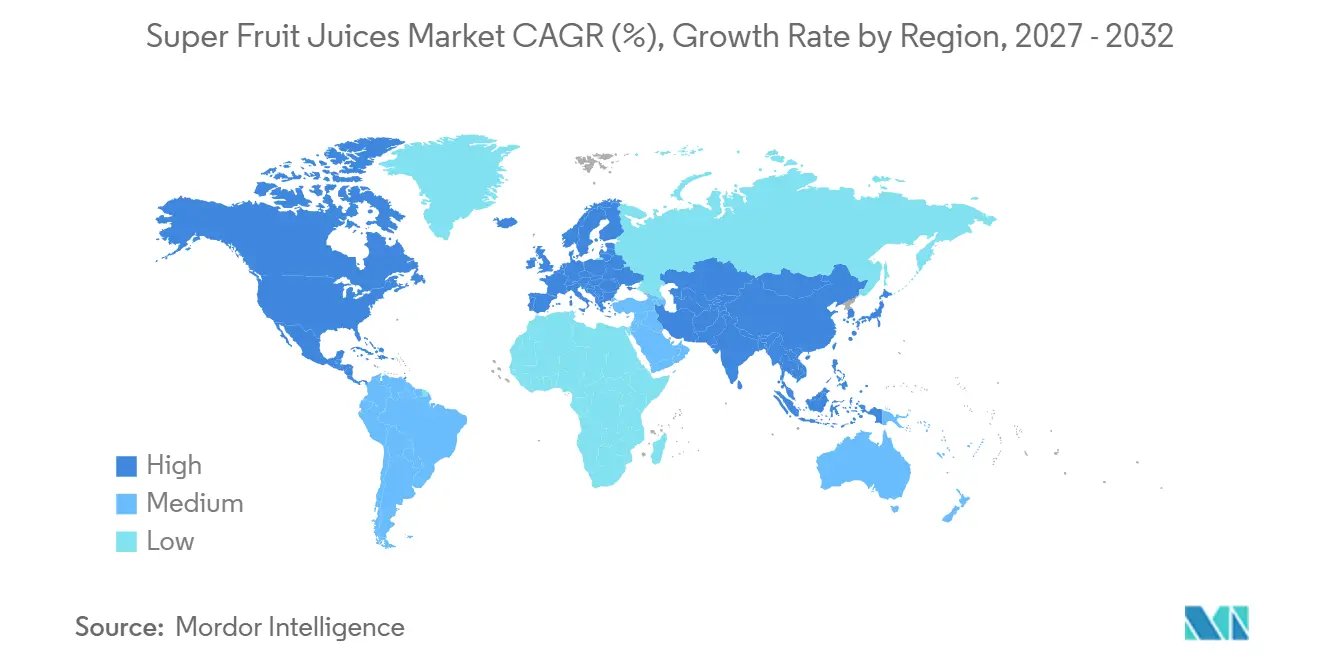
North America Super Fruit Juices Market
North America accounted for an estimated 32.40% of the Super Fruit Juices Market in 2026, making it the largest regional market. The United States is an important destination for international superfruit ingredients, particularly açaí. According to USDA Foreign Agricultural Service data, Brazil exported 55,798 metric tons of açaí products in 2025, with 30,531 metric tons shipped to the United States. This established sourcing relationship supports opportunities for manufacturers to develop açaí-based juices, blends, and other specialty beverages.
Asia-Pacific Super Fruit Juices Market
Asia-Pacific is projected to be the fastest-growing regional market, with an estimated CAGR of 9.60% over 2027–2032. Brazil's açaí exports to Australia reached 7,238 metric tons in 2025, while Japan was also among the leading destinations for Brazilian açaí products. These trade connections create opportunities for regional beverage manufacturers to develop superfruit-based juices and blended formulations. Local fruit availability and established processing industries further support product diversification, although manufacturers need to adapt flavours and pricing to country-level preferences.
Europe, South America, and Middle East and Africa
Europe offers opportunities through demand for exotic fruit ingredients, including açaí, acerola, pomegranate, and berry-based products. South America benefits from Brazil's substantial açaí production, which supports domestic processing and international ingredient supply. In the Middle East and Africa, demand for premium and differentiated fruit beverages creates opportunities for superfruit-based formulations, particularly pomegranate juice products. Across these regions, manufacturers must manage raw-material sourcing, processing requirements, import costs, and local consumer preferences.
Competitive Landscape
The Super Fruit Juices Market includes multinational beverage companies, fruit-processing businesses, specialist juice brands, and regional producers competing through product innovation, ingredient sourcing, brand positioning, and distribution reach. The companies have varying levels of exposure to superfruit juices through branded beverages, fruit ingredients, concentrates, and broader juice portfolios. Specialist brands can differentiate through focused superfruit offerings, while larger beverage companies can leverage established manufacturing capabilities and retail distribution networks.
Competitive strategies in the Super Fruit Juices Market focus on expanding fruit-based product portfolios, introducing blended formulations, and strengthening premium and functional beverage positioning. For example, POM Wonderful offers 100% pomegranate juice and pomegranate-blueberry and pomegranate-cherry blends, while Sambazon markets organic açaí juice and blended superfruit beverages. Suja also offers cold-pressed juices and wellness shots featuring functional ingredients. These product strategies allow specialist brands to differentiate through fruit selection, organic positioning, and formulation innovation. Larger beverage companies can use established brand portfolios and distribution capabilities to improve market access, although their overall juice operations should not automatically be treated as direct participation in the superfruit juice segment.
Sourcing and distribution remain important competitive considerations. Companies with access to reliable fruit-processing networks and established retail relationships can improve ingredient availability and product reach, while specialist brands can use online channels and health-focused retail outlets to target niche consumers. However, seasonal availability of exotic fruits, raw-material price fluctuations, processing requirements, and shelf-life management can affect operating costs and product consistency. Manufacturers must also ensure that nutritional, organic, and other product claims comply with applicable regulations in their target markets. These factors make reliable sourcing, quality control, product differentiation, and efficient distribution important areas of competition.
Super Fruit Juices Industry Leaders
-
POM Wonderful LLC
-
Sambazon Inc.
-
Ocean Spray Cranberries Inc.
-
Suja Life LLC
-
1. Lakewood Organic
- *Disclaimer: Major Players sorted in no particular order
Super Fruit Juices Market Companies Covered in this Report
- The Coca-Cola Company
- PepsiCo Inc.
- Ocean Spray Cranberries Inc.
- POM Wonderful LLC
- Sambazon Inc.
- Bolthouse Farms Inc.
- Suja Life LLC
- Lakewood Organic
- Dole Food Company Inc.
- Del Monte Foods Inc.
- Welch Foods Inc.
- The Hain Celestial Group Inc.
- SunOpta Inc.
- Genesis Today Inc.
- Dabur India Ltd.
- Ceres Fruit Juices (Pty) Ltd.
- Rauch Fruchtsäfte GmbH & Co OG
- The J.M. Smucker Company (R.W. Knudsen)
- Tropicana Brands Group
- Nestlé S.A.
Recent Industry Developments in Super Fruit Juices Market
- September 2026: Superfruit Juice Company LLC launched SOPREME Soursop on Amazon, expanding the US availability of its 100% pure soursop juice with pulp. The single-ingredient, non-GMO product launch represents an expansion of specialist tropical superfruit beverages into online retail and wholesale distribution channels.
- August 2026: Ananta Svastha Pvt. Ltd. introduced STHORN in India, a sparkling superfruit beverage combining Himalayan sea buckthorn, amla, and lemon. The launch in Pune extended the use of regional superfruit ingredients into a convenient sparkling beverage format, with availability through Blinkit and the brand's website.
- August 2026: Playa Bowls launched its Surf Quenchers beverage range, introducing four made-to-order refreshers prepared with its signature superfruit bases, natural fruit purees, organic agave, and lemon juice. The launch extended the company's superfruit ingredient portfolio beyond bowls and smoothies into customised beverage offerings.
- February 2026: Jelley Brown entered the wellness juice segment with two new formulations: Sea Buckthorn, Turmeric, Carrot and Orange Juice, and Blueberry, Goji Berry, Carrot and Grape Juice. The launches expanded the brand's beverage portfolio into fruit-and-vegetable combinations incorporating superfruit ingredients.
Global Super Fruit Juices Market Report Scope
For this study, the Super Fruit Juices Market is defined as the sales value of commercially produced juices derived from fruits recognised for their nutritional and bioactive properties, including açaí, acerola, blueberry, cranberry, goji berry, noni, and pomegranate. The market covers 100% superfruit juice, superfruit juice blends, and superfruit juice concentrates, segmented by nature into conventional and organic products; by packaging type into bottles, cartons, cans, pouches, and other packaging types; and by distribution channel into off-trade and on-trade. Off-trade includes supermarkets and hypermarkets, convenience stores, specialty and health food stores, online retail, and other distribution channels. The market is analyzed across North America, Europe, Asia-Pacific, South America, and the Middle East and Africa, with country-level coverage as specified in the report. Market sizing and forecasts are presented in value terms (USD) across the defined segments and geographies.
Segmentation Overview
| 100% Superfruit Juice |
| Superfruit Juice Blends |
| Superfruit Juice Concentrates |
| Conventional |
| Organic |
| Bottles |
| Cartons |
| Cans |
| Pouches |
| Other Packaging Types |
| Off-Trade | Supermarkets/Hypermarkets |
| Convenience Stores | |
| Specialty and Health Food Stores | |
| Online Retail | |
| Other Distribution Channels | |
| On-Trade |
| North America | United States |
| Canada | |
| Mexico | |
| Rest of North America | |
| Europe | United Kingdom |
| Germany | |
| France | |
| Italy | |
| Spain | |
| Sweden | |
| Belgium | |
| Poland | |
| Netherlands | |
| Rest of Europe | |
| Asia-Pacific | China |
| Japan | |
| India | |
| Thailand | |
| Singapore | |
| Indonesia | |
| South Korea | |
| Australia | |
| Rest of Asia-Pacific | |
| South America | Brazil |
| Argentina | |
| Colombia | |
| Peru | |
| Chile | |
| Rest of South America | |
| Middle East and Africa | South Africa |
| Saudi Arabia | |
| United Arab Emirates | |
| Nigeria | |
| Egypt | |
| Morocco | |
| Turkey | |
| Rest of Middle East and Africa |
| By Product Type | 100% Superfruit Juice | |
| Superfruit Juice Blends | ||
| Superfruit Juice Concentrates | ||
| By Nature | Conventional | |
| Organic | ||
| By Packaging Type | Bottles | |
| Cartons | ||
| Cans | ||
| Pouches | ||
| Other Packaging Types | ||
| By Distribution Channel | Off-Trade | Supermarkets/Hypermarkets |
| Convenience Stores | ||
| Specialty and Health Food Stores | ||
| Online Retail | ||
| Other Distribution Channels | ||
| On-Trade | ||
| By Geography | North America | United States |
| Canada | ||
| Mexico | ||
| Rest of North America | ||
| Europe | United Kingdom | |
| Germany | ||
| France | ||
| Italy | ||
| Spain | ||
| Sweden | ||
| Belgium | ||
| Poland | ||
| Netherlands | ||
| Rest of Europe | ||
| Asia-Pacific | China | |
| Japan | ||
| India | ||
| Thailand | ||
| Singapore | ||
| Indonesia | ||
| South Korea | ||
| Australia | ||
| Rest of Asia-Pacific | ||
| South America | Brazil | |
| Argentina | ||
| Colombia | ||
| Peru | ||
| Chile | ||
| Rest of South America | ||
| Middle East and Africa | South Africa | |
| Saudi Arabia | ||
| United Arab Emirates | ||
| Nigeria | ||
| Egypt | ||
| Morocco | ||
| Turkey | ||
| Rest of Middle East and Africa | ||
Key Questions Answered in the Report
What is the current size of the Super Fruit Juices Market?
The Super Fruit Juices Market is estimated at USD 11.25 billion in 2026 and is projected to reach USD 18.04 billion by 2032, growing at an estimated CAGR of 8.31% over 2027–2032.
Which product type holds the largest share of the Super Fruit Juices Market?
100% superfruit juice is estimated to hold the largest share, accounting for 46.80% of the market in 2026.
Which region is the fastest-growing market for superfruit juices?
Asia-Pacific is projected to be the fastest-growing regional market, with an estimated CAGR of 9.60% over 2027–2032.
What are the major factors driving the Super Fruit Juices Market?
The market is driven by rising consumer preference for antioxidant-rich beverages, growing demand for natural and organic juice products, increasing popularity of exotic superfruit varieties, product innovation in functional blends, and expansion of premium and convenient ready-to-drink formats.