
Sulfur Hexafluoride Replacement Electrical Insulating Gases Market Size and Share
Market Overview
| Study Period | 2021 - 2031 |
|---|---|
| Market Size (2026) | USD 250.23 Million |
| Market Size (2031) | USD 456.56 Million |
| Growth Rate (2026 - 2031) | 12.78 % |
| Fastest Growing Market | Asia-Pacific |
| Largest Market | Europe |
| Market Concentration | Medium |
Major Players *Disclaimer: Major Players sorted in no particular order Image © Mordor Intelligence. Reuse requires attribution under CC BY 4.0. | |
Sulfur Hexafluoride Replacement Electrical Insulating Gases Market Analysis by Mordor Intelligence
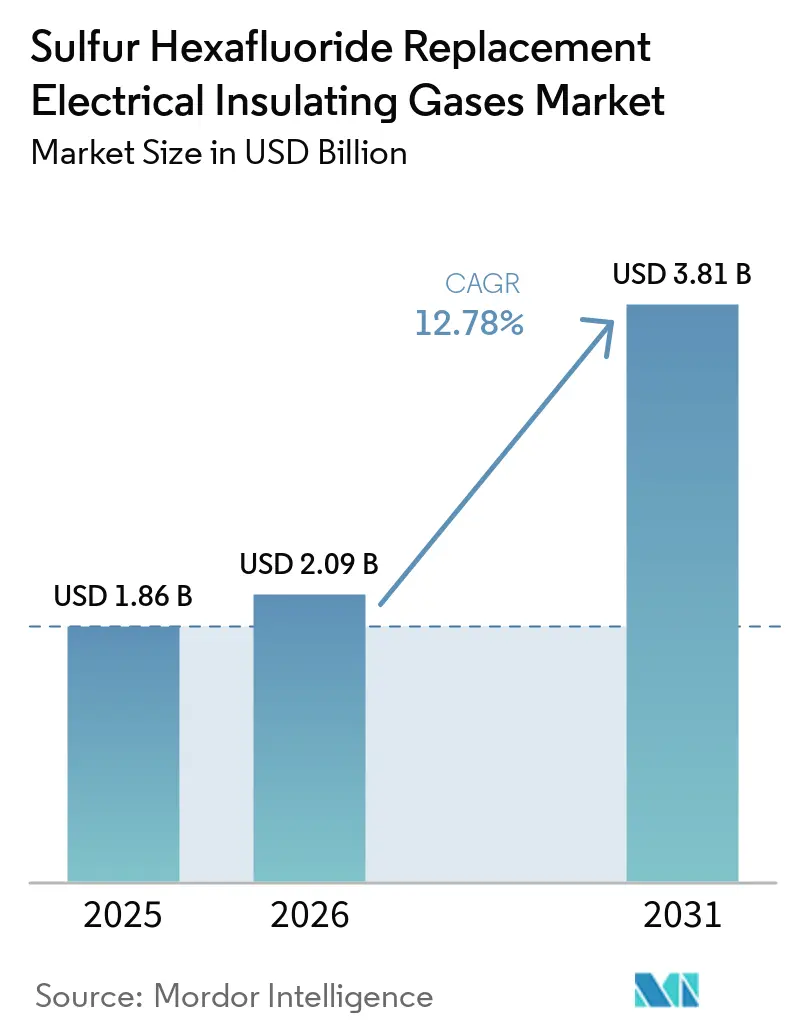
The Sulfur Hexafluoride Replacement Electrical Insulating Gases Market size was valued at USD 225.43 million in 2025 and is estimated to grow from USD 250.23 million in 2026 to reach USD 456.56 million by 2031, at a CAGR of 12.78% during the forecast period (2026-2031). EU Regulation 2024/573 is shifting equipment procurement from a voluntary environmental choice to a mandatory compliance requirement, beginning with new restrictions on medium-voltage switchgear in 2026. The SF₆-replacement electrical insulating gases market is also gaining support from grid replacement programs, offshore transmission projects, and the need for compact equipment in dense urban and marine locations. Technical qualifications at transmission voltages have shifted buyer attention toward delivery schedules, certified service capacity, and the cost of managing installed assets. Equipment suppliers are responding by combining gas formulations, switchgear, and maintenance support within longer supply arrangements. These conditions create opportunities for suppliers that can provide certified products, dependable gas handling, and support for both new installations and legacy equipment.
Key Report Takeaways
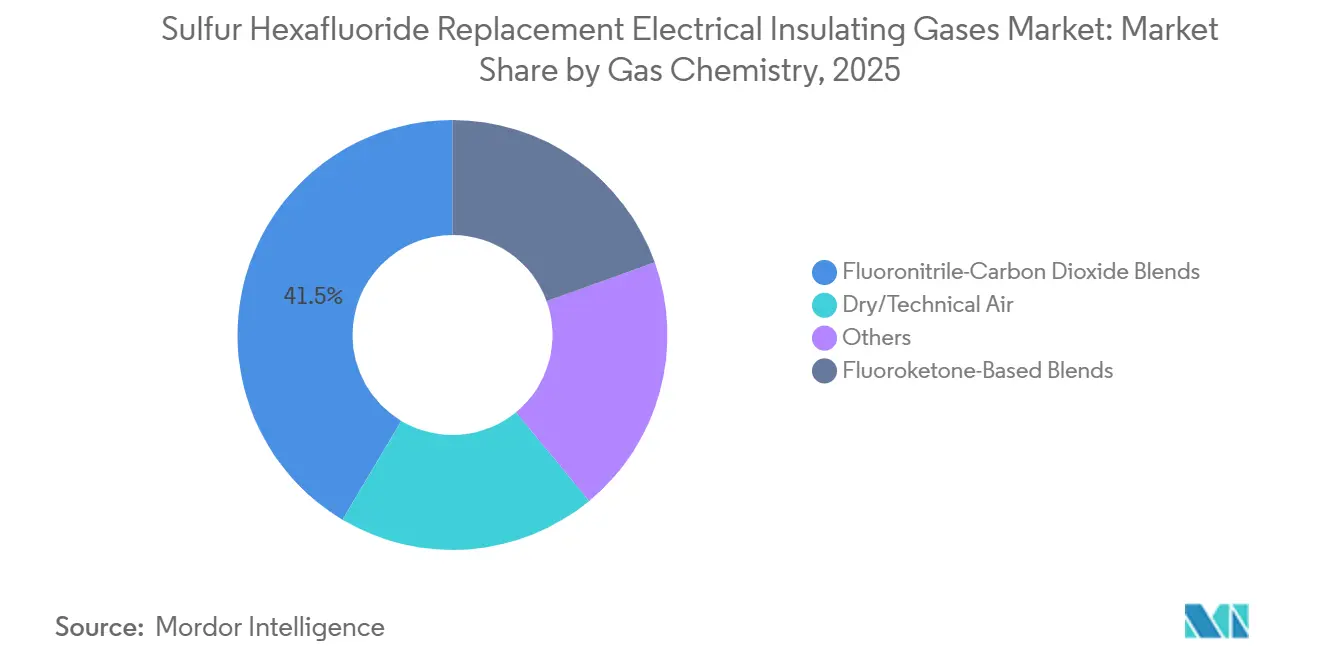
- By gas chemistry, Fluoronitrile-CO₂ Blends held 41.45% of the SF₆-Replacement Electrical Insulating Gases Market share in 2025 and are forecast to grow at a 13.12% CAGR through 2031.
- By application, Gas-Insulated Switchgear accounted for 47.23% of the SF₆-Replacement Electrical Insulating Gases Market size in 2025, while Gas-Insulated Lines are forecast to expand at a 13.31% CAGR through 2031.
- By demand type, OEM First-Fill represented 58.21% of demand type in 2025, while Retrofit and Retrofill are forecast to grow at a 13.53% CAGR through 2031.
- By technology configuration, Gas-Insulated Technology accounted for 54.78% of 2026 revenue and is forecast to grow at a 12.93% CAGR through 2031.
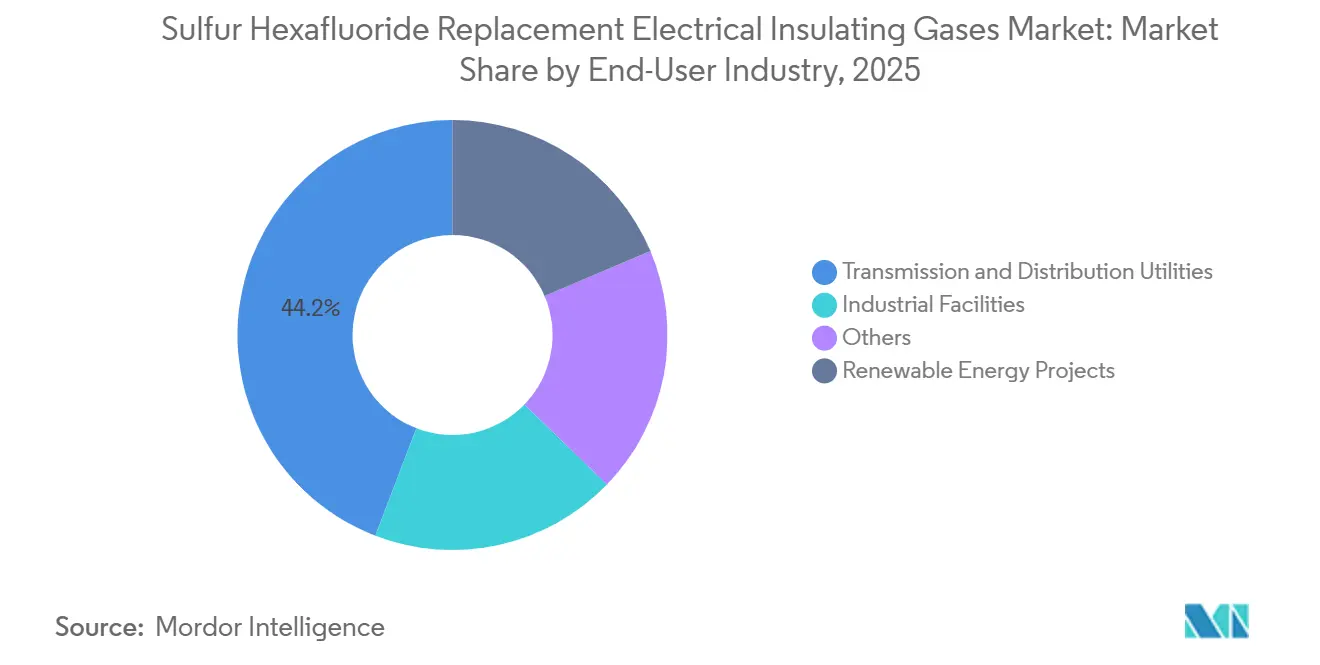
- By end-user industry, Transmission and Distribution Utilities represented 44.15% of demand in 2025, while Renewable Energy Projects are forecast to expand at a 14.05% CAGR through 2031.
- By geography, Europe held 38.12% of revenue in 2025, while Asia-Pacific is forecast to grow at a 13.50% CAGR through 2031.
Note: Market size and forecast figures in this report are generated using Mordor Intelligence’s proprietary estimation framework, updated with the latest available data and insights as of January 2026.
Market Trends and Insights
Drivers Impact Analysis of Sulfur Hexafluoride Replacement Electrical Insulating Gases Market*
| Drivers | % Impact on CAGR Forecast | Geographic Relevance | Impact Timeline |
|---|---|---|---|
| SF₆ Phase-Out Rules and Utility Procurement Conversion | +4.5% | Global, most acute in the EU-27 and the UK | Short-term (≤2 years) |
| Grid Modernization and Aging High-Voltage Asset Replacement | +2.8% | North America and the EU, expanding to APAC | Medium-term (2-4 years) |
| Offshore Wind and HVDC Substation Expansion | +2.3% | EU (North Sea, Baltic Sea), APAC East | Medium-term (2-4 years) |
| Urban Space Constraints Favoring Compact Gas Insulated Switchgear (GIS) | +1.2% | APAC core, spillover to MEA | Long-term (≥4 years) |
| High-Voltage Retrofill Demand for Installed Gas Insulated Lines (GIL) Assets | +1.9% | UK, Germany, France, APAC | Medium-term (2-4 years) |
| Utility Digitalization and Condition-Based Maintenance | +0.8% | Global, led by the EU and North America | Long-term (≥4 years) |
| Source: Mordor Intelligence | |||
SF₆ Phase-Out Rules and Utility Procurement Conversion
EU Regulation 2024/573 establishes a phased restriction schedule for SF₆ in new switchgear, giving utilities a firm timetable for updating specifications. Restrictions on new medium-voltage equipment up to 24 kV took effect in January 2026, while restrictions for 52-145 kV equipment are due in 2028 and for equipment above 145 kV in 2032. Commission Implementing Regulation 2025/627 also requires certified personnel to handle stationary electrical switchgear, increasing the operational burden of retaining SF₆ equipment[1]European Union, “Regulation (EU) 2024/573 of the European Parliament and of the Council on Fluorinated Greenhouse Gases,” EUR-Lex, eur-lex.europa.eu. The 2026 rule applies to new equipment held in warehouses and to planned installations that were not operational by December 31, 2025. Thüga pre-qualified SF₆-free product ranges from Siemens Energy and Schneider Electric before the deadline, offering a procurement approach that other European utilities can replicate. The SF₆-replacement electrical insulating gases market, therefore, depends on early framework agreements that secure compliant products before deadline-driven demand increases.
Grid Modernization and Aging High-Voltage Asset Replacement
Aging grid equipment is creating a replacement cycle that favors SF₆-free designs as utilities renew high-voltage assets. A 2026 Conseil International des Grands Réseaux Électriques (CIGRE) analysis projected a 40-60% increase in the AC circuit breaker population by 2050 as networks expand and older assets retire. The same analysis found that a faster transition to SF₆-free technology could reduce SF₆ emissions by nearly 20% relative to a business-as-usual scenario, while a delayed rollout could require up to 75% more circuit breakers. National transmission operators influence demand because their technical specifications determine which products can enter long-term procurement frameworks. Utilities that include SF₆-free requirements in those frameworks can improve access to certified equipment during periods of constrained supply. For the SF₆-replacement electrical insulating gases market, the replacement cycle extends beyond simple equipment substitution, as it also requires new testing protocols, service arrangements, and gas management practices.
Offshore Wind and High Voltage Direct Current (HVDC) Substation Expansion
Offshore transmission platforms require compact switchgear because deck space is limited and air-insulated designs are difficult to accommodate. GE Vernova received the Ostwind 4 contract from 50Hertz in December 2024 for a 2 GW HVDC connection in the German Baltic Sea, with g³ GIS specified for the offshore converter platform. The MISSION project is developing a 550 kV HVDC SF₆-free GIS design involving Siemens Energy, SINTEF, Statnett, and RTE, with the design expected to reduce switchyard footprint by up to 95% compared with air-insulated alternatives. This use case links equipment selection to site design rather than solely to environmental compliance. The SF₆-replacement electrical insulating gases market benefits when offshore projects specify SF₆-free equipment at the design stage, as this avoids the need for installed-base conversion decisions later.
High-Voltage Retrofill Demand for Installed Gas-Insulated Assets
Retrofill offers an alternative to replacing long-life gas-insulated lines before their planned retirement. An IEEE study reported the full type-test qualification of a 420 kV gas-insulated line (GIL) using a nitrogen-oxygen-fluoronitrile mixture and documented a pilot installation at a UK substation, demonstrating that primary equipment can remain in place during gas conversion. In July 2026, Hitachi Energy and the Electricity Generating Authority of Thailand (EGAT) announced a 550 kV eco-efficient retrofill at Thailand's Nan Substation using an EconiQ gas mixture. The project is set to replace 800 kg of SF₆ and avoid 97 tons of CO₂-equivalent emissions without modifying primary equipment. The SF₆-replacement electrical insulating gases market stands to benefit from this approach, as the 2035 restriction on virgin SF₆ for maintenance purposes accelerates retrofit decisions.
Restraints Impact Analysis of Sulfur Hexafluoride Replacement Electrical Insulating Gases Market*
| Restraints | % Impact on CAGR Forecast | Geographic Relevance | Impact Timeline |
|---|---|---|---|
| Higher Initial Cost of Non-SF₆ Equipment | -0.7% | Global, most acute in South America and MEA | Short-term (≤2 years) |
| High-Voltage Procurement Lead Times and Limited Production Slots | -0.4% | Global | Medium-term (2-4 years) |
| Voltage-Class and Footprint Limits of Dry-Air Systems | -0.3% | APAC, emerging markets | Long-term (≥4 years) |
| Long Replacement Cycles and Economical SF₆ Leak-Repair Programs | -0.5% | North America, APAC | Medium-term (2-4 years) |
| Source: Mordor Intelligence | |||
Higher Initial Cost of Non-SF₆ Equipment
Initial equipment prices remain a barrier for utilities that evaluate projects primarily through annual capital expenditure budgets. This cost difference is particularly significant in South America, the Middle-East, and Africa, where compliance mandates are less immediate. Total ownership costs can improve over a 30-year equipment life when operators account for gas purchases, leak detection, and regulatory reporting. However, this longer-term view does not always determine investment approvals for individual projects. Medium-voltage clean-air products may benefit from higher manufacturing volumes, while extra-high-voltage gas systems still require specialist conditioning and handling. As a result, the SF₆-replacement electrical insulating gases market is likely to show varying adoption rates across regions with differing regulatory pressures and financing practices.
High-Voltage Procurement Lead Times and Limited Production Slots
Only a limited number of manufacturers offer type-tested and utility-approved SF₆-free gas-insulated switchgear (GIS) at 245 kV and above. Their production capacity is increasingly committed to multiyear high-voltage direct current (HVDC) and grid modernization programs. Backlogs extending beyond 24 months can shift the primary decision risk from price to the ability to meet grid project schedules. Utilities that delay product selection may need to compete for remaining manufacturing slots before the 2028 high-voltage compliance deadline. This issue is particularly relevant at 52-145 kV, where qualified product availability is more limited than at medium voltage. This constraint can limit the SF₆-replacement electrical insulating gases market even where demand and policy support are strong.
*Our forecasts treat driver/restraint impacts as directional, not additive. The impact forecasts reflect baseline growth, mix effects, and variable interactions.
Sulfur Hexafluoride Replacement Electrical Insulating Gases Market Segment Analysis
By Gas Chemistry:
Fluoronitrile Blends Lead the Chemistry TransitionFluoronitrile-CO₂ blends held 41.45% of 2025 gas chemistry revenue and are forecast to grow at a 13.12% CAGR through 2031, giving the category the leading position in high-voltage applications. The blends support installations where dielectric requirements limit the use of simpler insulating gases. Their compatibility with existing SF₆ enclosure footprints can reduce civil changes during equipment replacement. Fluoronitrile systems support compact designs for transmission substations and offshore applications. The SF₆-Replacement Electrical Insulating Gases Market size for this chemistry is supported by utilities seeking equipment that fits existing sites.
Dry or technical air serves a distinct role at medium voltage, where it works with vacuum interruption in metal-enclosed switchgear. Its lower dielectric performance compared to SF₆ may require larger dimensions or higher pressure at higher voltage levels. CIGRE reported acceptable long-term reliability for clean-air GIS, including seal performance and gas tightness within International Electrotechnical Commission (IEC) 62271-4 thresholds. Fluoroketone-based blends also serve sealed-for-life medium-voltage products where mixture stability is important. The resulting chemistry mix is complementary, with clean air serving simpler medium-voltage needs and fluoronitrile blends addressing demanding transmission conditions.



By Application:
GIS Commands Revenue Share, GILs Define the Growth TrajectoryGas-Insulated Switchgear (GIS) held 47.23% of the SF₆-Replacement Electrical Insulating Gases Market share in 2025, reflecting its role in compact transmission and distribution substations. GIS remains important where urban land constraints, underground sites, and offshore installations make air-insulated designs impractical. It can accommodate digital sensors within sealed equipment enclosures. Ring Main Units and circuit breakers remain important application categories in secondary distribution. European distribution operators have begun structured medium-voltage replacement programs as new equipment restrictions take effect.
Gas-Insulated Lines (GIL) are forecast to grow at a 13.31% CAGR through 2031, making them the fastest-growing application segment. This rate reflects the commercial qualification of on-site retrofill procedures for installed GIL corridors. Type testing at 420 kV and the Nan Substation project give utilities examples of gas substitution in place of complete asset replacement. The 2035 maintenance restriction on virgin SF₆ creates a defined decision point for asset owners. The SF₆-Replacement Electrical Insulating Gases Market is supported by both new GIS orders and earlier decisions to convert installed GIL systems.
By Demand Type:
First-Fill Anchors Revenue, Retrofill Reshapes the Mid-Term PipelineOriginal Equipment Manufacturer (OEM) First-Fill represented 58.21% of 2025 demand-type, confirming that new-build orders remain the primary source of demand. New GIS substations in Europe and Asia, as well as offshore wind projects, support this position. Equipment manufacturers commonly provide the initial gas charge with their products and warranties. This model links the first equipment purchase with later gas supply and service needs. The SF₆-Replacement Electrical Insulating Gases Market has not reached the point where conversion of large installed SF₆ inventories exceeds new-build demand.
Retrofit and Retrofill are forecast to grow at a 13.53% CAGR through 2031. In-situ conversion of GIL equipment avoids premature replacement of long-life assets. The work requires gas recovery, purification, testing, and supply of the replacement blend. Service infrastructure remains limited outside Europe, creating a capability gap in other regions. Maintenance Refill remains relevant because the 2035 regime permits only reclaimed or recycled SF₆ for top-up, creating demand for recovery and recycling services.
By Technology Configuration:
Gas-Insulated Architecture Leads, Vacuum-Clean-Air Narrows the GapGas-Insulated Technology accounted for 54.78% of 2026 revenue and is forecast to grow at a 12.93% CAGR through 2031. It holds the lead at medium, high, and extra-high voltage where gas mixtures provide dielectric performance within compact metallic enclosures. This configuration is suited to urban underground substations, offshore platforms, and HVDC converter stations. IEC 62271-4 remains important for gas handling, leak testing, and staff qualification. The SF₆-Replacement Electrical Insulating Gases Market size for this configuration is driven by projects where space constraints outweigh the additional handling requirements.
Vacuum interruption with clean-air insulation is growing in new medium-voltage units. This technology eliminates fluorinated gas from both insulation and arc-quenching functions. Siemens Energy's Blue portfolio and ABB's dry-air GIS offerings represent this technology in the medium-voltage range. In April 2026, Toshiba confirmed laboratory performance for a 300 kV GIS and GCB using natural-origin gases. In December 2025, Toshiba Energy Systems & Solutions Corporation commercialized a 420/550 kV gas-insulated bus using natural-origin gases.
By End-User Industry:
Utilities Anchor Spend, Renewables Projects Redefine Demand StructureTransmission and Distribution Utilities accounted for 44.15% of end-user revenue in 2025, making them the largest spending group. Their procurement specifications influence which technologies enter grid replacement programs. A transmission operator's decision can also establish a technical reference for industrial buyers and distribution utilities. Utilities manage the installed base that requires leak repair, gas recovery, retrofill, or replacement. The SF₆-Replacement Electrical Insulating Gases Market is closely tied to their investment schedules and compliance planning.
Renewable Energy Projects are forecast to grow at a 14.05% CAGR through 2031, the highest rate among end-user categories. Offshore wind and solar interconnection substations can specify SF₆-free GIS before equipment reaches the site. The Ostwind 4 contract illustrates this design-stage approach for offshore HVDC infrastructure. Industrial facilities, including data centers, manufacturing campuses, and petrochemical installations, make up the remaining demand. The broad end-user base helps balance demand between regulated utility replacement and new connection projects.
Geography Analysis
Europe and North America Sulfur Hexafluoride Replacement Electrical Insulating Gases Market
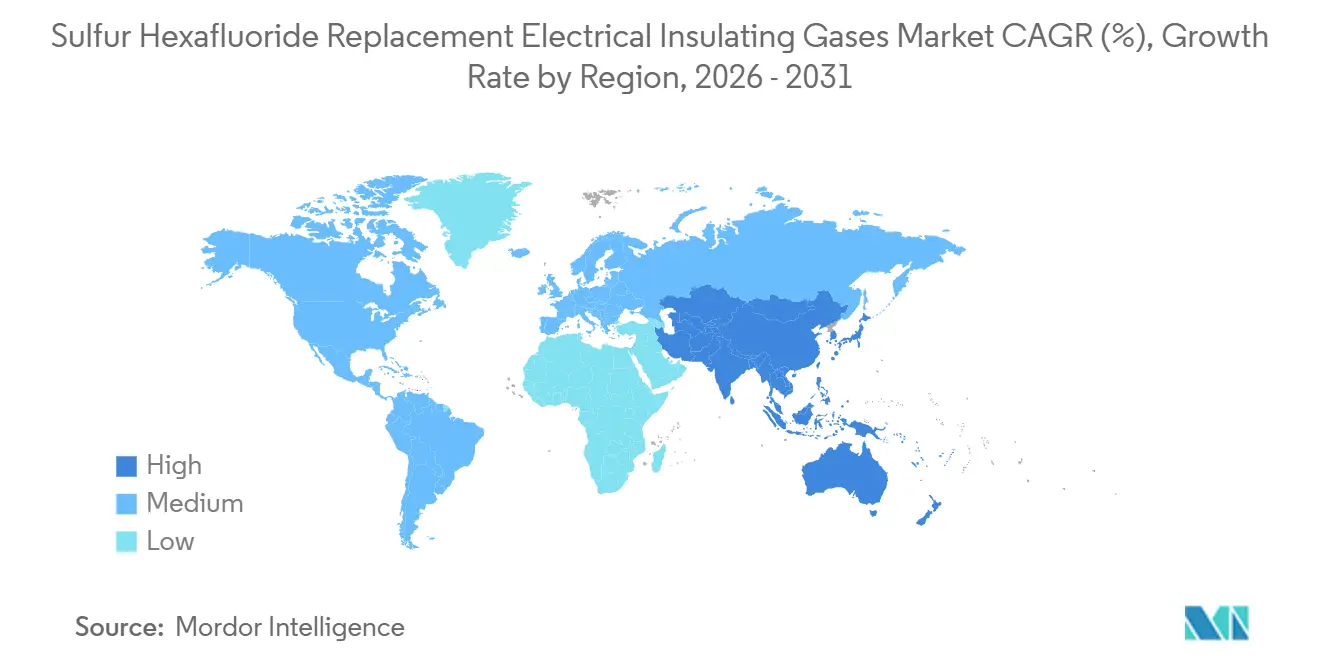
Europe held 38.12% of the SF₆-replacement electrical insulating gases market share in 2025. The region benefits from binding restrictions, established OEM supply chains, and active procurement by transmission system operators. Germany serves as a key reference market, with TenneT Germany completing testing of a 420 kV SF₆-free GIS at Erzhausen in June 2026. GE Vernova is set to deliver the first 245 kV SF₆-free gas-insulated substation for RTE, extending high-voltage reference activity in France[2]GE Vernova, “GE Vernova to Deliver the World’s First 245 kV SF6-Free Gas-Insulated Substation for RTE,” GE Vernova Press Release, gevernova.com. North America has no federal SF₆ mandate, but state procurement guidelines and grid modernization programs are increasingly favoring SF₆-free requirements.
APAC Sulfur Hexafluoride Replacement Electrical Insulating Gases Market
Asia-Pacific is forecast to grow at a 13.50% CAGR through 2031, making it the fastest-growing geography. China is advancing at the highest voltage levels through State Grid deployments. Hitachi Energy reported that a 550 kV SF₆-free GIS was energized at SGCC's Yuxian 500 kV substation in Wuhan in May 2026. Japan is progressing through utility-led programs, with Chubu Electric Power Grid ordering 550 kV EconiQ GIS in March 2026 for an installation in which all 550 kV GIS components will be SF₆-free. This regional activity supports the SF₆-replacement electrical insulating gases market through both new transmission construction and equipment standardization.
South America, MEA and Oceania Sulfur Hexafluoride Replacement Electrical Insulating Gases Market
South America, the Middle-East, and Africa are at an earlier stage of adoption, as equipment costs and specialist service capacity remain constraints. Brazil's grid expansion and Saudi Arabia's power infrastructure programs create new-build GIS opportunities. Local adoption depends on products and supply schedules from European and Asia-Pacific manufacturers. Australia provides a nearby reference case, with ElectraNet accepting its first EconiQ 145 kV and 72.5 kV live-tank circuit breakers from Hitachi Energy in March 2026.

Competitive Landscape
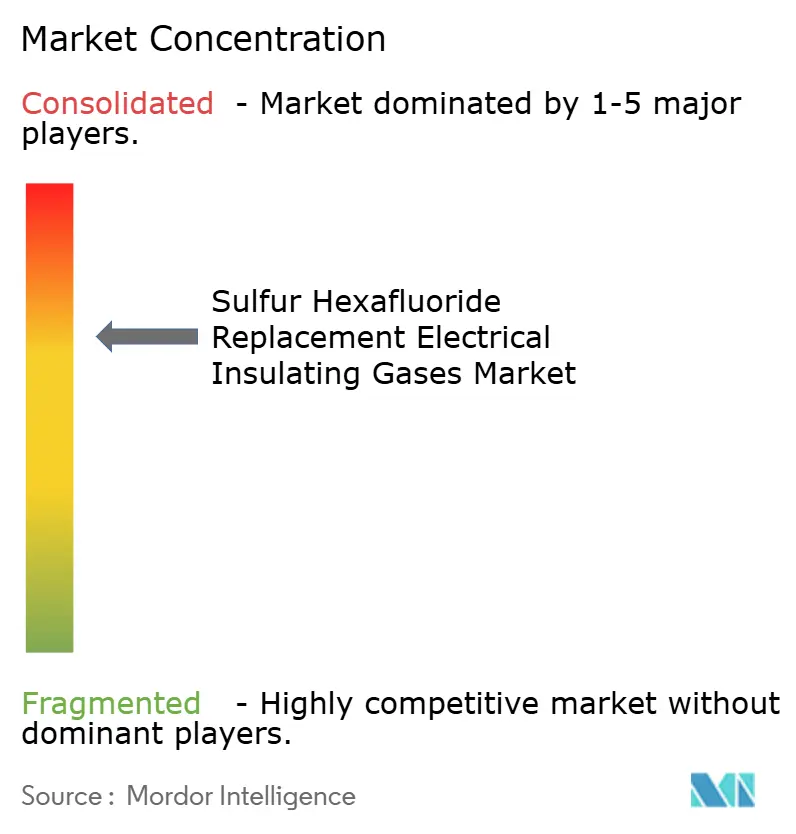
The SF₆-replacement electrical insulating gases market is moderately consolidated. Hitachi Energy, GE Vernova, Siemens Energy, ABB, and Schneider Electric supply equipment and gas solutions for key applications. Their market position is supported by certified product lines at 145 kV and above, technical service capabilities, and established utility relationships. Proprietary formulations such as g³, EconiQ, and Blue enable suppliers to link equipment sales with gas supply and maintenance services. The market has high entry requirements, as utilities require type-tested high-voltage equipment.
Project bundling is a central competitive approach. Original equipment manufacturers (OEMs) can package gas-insulated switchgear (GIS) with converter stations, transformers, and digital monitoring systems for high-voltage direct current (HVDC) and offshore projects. GE Vernova's Ostwind 4 award is an example of SF₆-free GIS within the scope of a large offshore grid connection. Hitachi Energy's work with TenneT and the Electricity Generating Authority of Thailand (EGAT) provides high-voltage and retrofit reference projects in Germany and Thailand. Toshiba's AEROXIA launch represents a strategic move toward equipment using gases of natural origin.
Medium-voltage competition is broadening as regional suppliers introduce SF₆-free equipment. The primary service gap remains lifecycle support for mixed fleets of legacy SF₆ and new SF₆-free equipment. Standardization through the International Electrotechnical Commission (IEC) and the International Council on Large Electric Systems (CIGRE) can reduce bespoke qualification requirements for new products. Incumbent suppliers retain an advantage where they have prior type-test experience and approved service processes.
Sulfur Hexafluoride Replacement Electrical Insulating Gases Industry Leaders
Siemens Energy
ABB
Hitachi Energy Ltd
GE Vernova
Schneider Electric
- *Disclaimer: Major Players sorted in no particular order
Sulfur Hexafluoride Replacement Electrical Insulating Gases Market Companies Covered in this Report
- ABB
- CG Power & Industrial Solutions Ltd.
- Eaton
- Fuji Electric Co.,Ltd.
- GE Vernova
- HD Hyundai Electric Co., Ltd.
- Hitachi Energy Ltd
- Hyosung
- Lucy Group Ltd.
- MEIDENSHA CORPORATION
- Mitsubishi Electric Corporation
- NISSIN ELECTRIC Co.,Ltd.
- Schneider Electric
- Siemens Energy
- TE Connectivity
- TOSHIBA CORPORATION

Recent Industry Developments in Sulfur Hexafluoride Replacement Electrical Insulating Gases Market
- July 2026: Hitachi Energy and the Electricity Generating Authority of Thailand announced the world's first 550 kV eco-efficient gas retrofill on existing GIL assets at the Nan Substation. The project is upgrading 130 meters of 550 kV gas-insulated line (GIL) using EconiQ gas mixture, eliminating 800 kg of SF₆ and avoiding 97 tons of CO₂-equivalent emissions, representing a 95% reduction in climate impact, without modifying primary equipment. The project is scheduled for completion in December 2026.
- April 2026: Toshiba confirmed fundamental laboratory performance of a 300 kV GIS and GCB using exclusively natural-origin gases. The company introduced the AEROXIA™ brand for transmission and distribution equipment that uses natural-origin gases with a global warming potential (GWP) lower than CO₂. The natural-origin gases used in AEROXIA™-branded equipment are designed to reduce environmental impact while maintaining performance standards comparable to conventional SF₆-based solutions. Toshiba announced a commercialization target of fiscal year 2028.


Global Sulfur Hexafluoride Replacement Electrical Insulating Gases Market Report Scope
Sulfur Hexafluoride replacement electrical insulating gases are alternatives to sulfur hexafluoride, including fluoronitrile mixtures, clean air (nitrogen/oxygen blends), and carbon dioxide mixes, designed to reduce environmental impact in electrical insulation applications.
The sulfur hexafluoride replacement electrical insulating gases market is segmented by gas chemistry, application, demand type, technology configuration, end-user industry, and geography. By gas chemistry, the market is segmented into fluoronitrile-CO₂ blends, fluoroketone-based blends, dry/technical air, and others. By application, the market is segmented into gas-insulated switchgear (GIS), ring main units (RMUs), circuit breakers, gas-insulated lines (GIS), and others. By demand type, the market is segmented into OEM first-fill, retrofit and retrofill, and maintenance refill. By technology configuration, the market is segmented into gas-insulated technology, vacuum interruption with clean-air insulation, and others. By end-user industry, the market is segmented into transmission and distribution utilities, renewable energy projects, industrial facilities, and others. The report also covers market size and forecasts for sulfur hexafluoride replacement electrical insulating gases across 15 countries in major regions. The market sizes and forecasts are provided in terms of value (USD).
| Fluoronitrile-CO₂ Blends |
| Fluoroketone-Based Blends |
| Dry/Technical Air |
| Others |
| Gas-Insulated Switchgear (GIS) |
| Ring Main Units (RMUs) |
| Circuit Breakers |
| Gas-Insulated Lines (GILs) |
| Others |
| OEM First-Fill |
| Retrofit and Retrofill |
| Maintenance Refill |
| Gas-Insulated Technology |
| Vacuum Interruption with Clean-Air Insulation |
| Others |
| Transmission and Distribution Utilities |
| Renewable Energy Projects |
| Industrial Facilities |
| Others |
| Asia-Pacific | China |
| India | |
| Japan | |
| South Korea | |
| ASEAN Countries | |
| Rest of Asia-Pacific | |
| North America | United States |
| Canada | |
| Mexico | |
| Europe | Germany |
| United Kingdom | |
| France | |
| Italy | |
| NORDIC Countries | |
| Rest of Europe | |
| South America | Brazil |
| Argentina | |
| Rest of South America | |
| Middle-East and Africa | Saudi Arabia |
| South Africa | |
| Rest of Middle-East and Africa |
| By Gas Chemistry | Fluoronitrile-CO₂ Blends | |
| Fluoroketone-Based Blends | ||
| Dry/Technical Air | ||
| Others | ||
| By Application | Gas-Insulated Switchgear (GIS) | |
| Ring Main Units (RMUs) | ||
| Circuit Breakers | ||
| Gas-Insulated Lines (GILs) | ||
| Others | ||
| By Demand Type | OEM First-Fill | |
| Retrofit and Retrofill | ||
| Maintenance Refill | ||
| By Technology Configuration | Gas-Insulated Technology | |
| Vacuum Interruption with Clean-Air Insulation | ||
| Others | ||
| By End-User Industry | Transmission and Distribution Utilities | |
| Renewable Energy Projects | ||
| Industrial Facilities | ||
| Others | ||
| By Geography | Asia-Pacific | China |
| India | ||
| Japan | ||
| South Korea | ||
| ASEAN Countries | ||
| Rest of Asia-Pacific | ||
| North America | United States | |
| Canada | ||
| Mexico | ||
| Europe | Germany | |
| United Kingdom | ||
| France | ||
| Italy | ||
| NORDIC Countries | ||
| Rest of Europe | ||
| South America | Brazil | |
| Argentina | ||
| Rest of South America | ||
| Middle-East and Africa | Saudi Arabia | |
| South Africa | ||
| Rest of Middle-East and Africa | ||


Key Questions Answered in the Report
What is current market size of Sulfur Hexafluoride Replacement Electrical Insulating Gases Market?
The Sulfur Hexafluoride Replacement Electrical Insulating Gases Market size was valued at USD 225.43 million in 2025 and is estimated to grow from USD 250.23 million in 2026 to reach USD 456.56 million by 2031, at a CAGR of 12.78% during the forecast period (2026-2031).
Which gas chemistry leads the transition away from SF₆?
Fluoronitrile-CO₂ Blends led with 41.45% of 2025 gas chemistry revenue, supported by their use in high-voltage equipment.
Which application is growing fastest through 2031?
Gas-Insulated Lines are forecast to expand at a 13.31% CAGR as utilities consider retrofilling existing corridors.
Which region is expanding most quickly?
Asia-Pacific is forecast to grow at a 13.50% CAGR through 2031, led by high-voltage deployments in China and utility programs in Japan.
Page last updated on:


 Your data is secure and never sold or shared.


