
Sulfate Free Shampoo Market Size and Share
Market Overview
| Study Period | 2021 - 2031 |
|---|---|
| Market Size (2026) | USD 5.91 Billion |
| Market Size (2031) | USD 8.52 Billion |
| Growth Rate (2026 - 2031) | 7.59 % |
| Fastest Growing Market | Asia-Pacific |
| Largest Market | North America |
| Market Concentration | Medium |
Major Players *Disclaimer: Major Players sorted in no particular order Image © Mordor Intelligence. Reuse requires attribution under CC BY 4.0. | |
Sulfate Free Shampoo Market Analysis by Mordor Intelligence
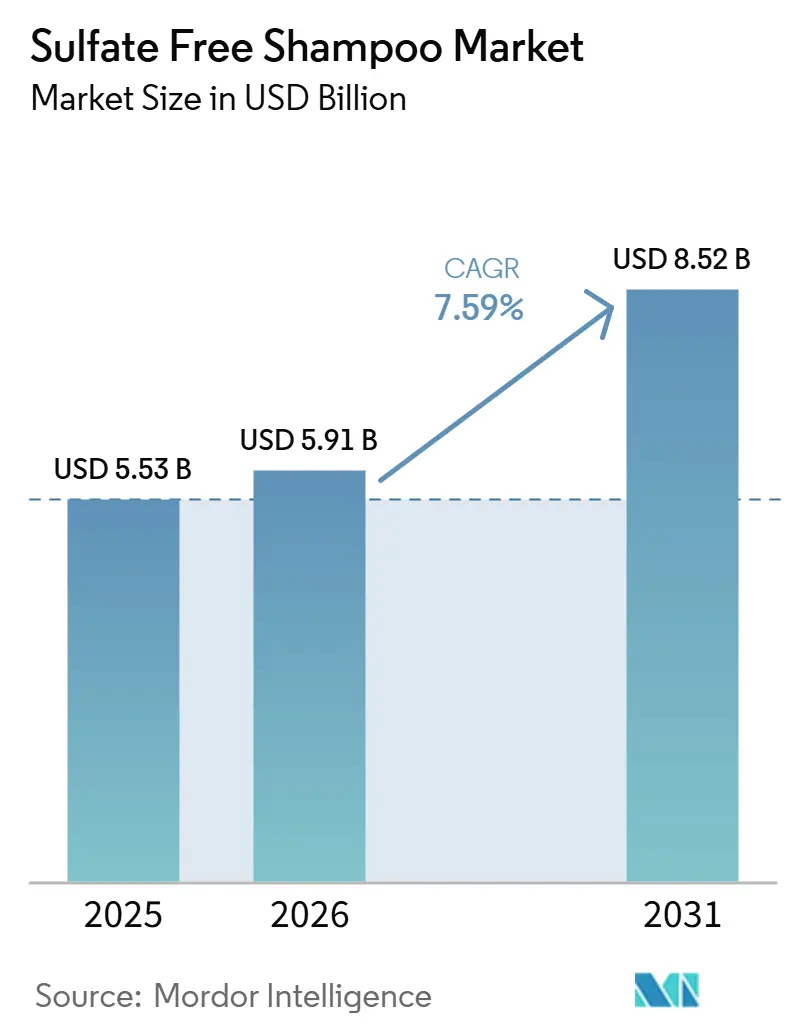
The sulfate free shampoo market size was valued at USD 5.53 billion in 2025 and is estimated to grow from USD 5.91 billion in 2026 to reach USD 8.52 billion by 2031, at a CAGR of 7.6% during the forecast period (2026-2031). The sulfate free shampoo market is moving beyond a premium niche as shoppers place greater weight on scalp comfort, ingredient transparency, and hair-condition benefits. Manufacturers are expanding sulfate-free formulas across mass, professional, and private-label lines, which is making these products easier to find at different price points. This wider availability supports repeat purchases, particularly when products combine color-safe, vegan, biodegradable, or scalp-care claims. Alternative surfactants based on amino acids and glucosides are helping brands improve cleansing performance without using conventional sulfates. The sulfate free shampoo market also faces pressure from higher specialty-ingredient costs, changing cosmetic rules, and the persistent consumer preference for a dense lather.
Key Report Takeaways
- By product type, liquid shampoo led with 88.94% of the sulfate free shampoo market share in 2025, while shampoo bars are forecast to grow at an 8.93% CAGR through 2031.
- By category, conventional products held 92.51% of the sulfate free shampoo market share in 2025, while organic variants are forecast to grow at a 9.02% CAGR through 2031.
- By price range, mass products accounted for 71.03% of revenue in 2025, while premium products are forecast to expand at an 8.26% CAGR through 2031.
- By end user, women represented 51.92% of demand in 2025, while the men’s segment is forecast to grow at an 8.61% CAGR through 2031.
- By distribution channel, hypermarkets and supermarkets held 47.38% of revenue in 2025, while online retail stores are forecast to grow at an 8.98% CAGR through 2031.
- By geography, North America held 39.81% of revenue in 2025, while Asia-Pacific is forecast to expand at an 8.73% CAGR through 2031.
Note: Market size and forecast figures in this report are generated using Mordor Intelligence’s proprietary estimation framework, updated with the latest available data and insights as of January 2026.
Market Trends and Insights
Drivers Impact Analysis of Sulfate Free Shampoo Market*
| Driver | (~) % Impact on CAGR Forecast | Geographic Relevance | Impact Timeline |
|---|---|---|---|
| Rising consumer preference for clean beauty | +2.2% | Global | Medium term (2–4 years) |
| Increasing prevalence of sensitive scalp conditions | +1.5% | Global | Long term (≥ 4 years) |
| Growing demand for color-safe haircare products | +1.0% | North America and Europe | Medium term (2–4 years) |
| Growing consumer awareness of sulfate-free haircare benefits | +0.9% | Global | Short term (≤ 2 years) |
| Rising adoption of natural ingredient formulations | +0.7% | The Asia-Pacific core, spill-over to the Middle East and Africa | Medium term (2–4 years) |
| Premiumization across global haircare product categories | +0.6% | North America and Europe | Long term (≥ 4 years) |
| Source: Mordor Intelligence | |||
Rising consumer preference for clean beauty
Rising consumer preference for clean beauty is significantly driving the global sulfate-free shampoo market as consumers increasingly seek ingredient transparency, milder formulations, and products free from harsh surfactants. Regulatory developments have strengthened this trend; for example, the U.S. FDA, under the Modernization of Cosmetics Regulation Act (MoCRA), has expanded oversight of cosmetic safety and labeling, encouraging greater consumer attention to ingredient disclosures, while also monitoring adverse events associated with hair cleansing products. Additionally, industry collaborations such as the Know Better, Do Better (KBDB) Collaborative, supported by major beauty retailers and brands, are promoting standardized ingredient safety assessments, reinforcing consumer confidence in clean beauty products. Manufacturers are responding through innovation; in April 2025, Unilever's CLEAR introduced its SCALPCEUTICALS PRO sulfate-free anti-dandruff range developed with more than 200 dermatologists, while in 2026, IFF Beauty and Personal Care reported sustained growth in sulfate-free shampoo launches, citing Mintel GNPD data showing continued expansion of sulfate-free claims across new shampoo introductions[1]Source: Unilever, “The skinification of scalp care: Unilever’s expertise delivers on demand”, unilever.com. These developments are accelerating global adoption of sulfate-free shampoos.
Increasing prevalence of sensitive scalp conditions
The increasing prevalence of sensitive scalp conditions is a key driver of the global sulfate-free shampoo market, as consumers seek gentler cleansing products that minimize irritation, dryness, itching, and scalp discomfort. The American Academy of Dermatology (AAD) advises using mild, fragrance-free shampoos and avoiding harsh cleansing agents for individuals with sensitive scalps and inflammatory scalp conditions, reinforcing demand for sulfate-free formulations. Additionally, the U.S. FDA's oversight of cosmetic safety and adverse event reporting under the Modernization of Cosmetics Regulation Act (MoCRA) has heightened consumer awareness of ingredient safety and scalp-friendly products. Manufacturers are responding with targeted innovations. In April 2025, Unilever's CLEAR launched its SCALPCEUTICALS PRO range, developed with more than 200 dermatologists to address scalp sensitivity and health through advanced sulfate-free formulations. In 2025, Procter & Gamble introduced Head & Shoulders Bare Minimal Ingredients Sensitive Scalp Care Shampoo, a 0% sulfates formulation specifically designed for sensitive scalps, with updated FDA-listed product information published in 2026.
Growing demand for color-safe haircare products
Growing demand for color-safe haircare products is driving the global sulfate-free shampoo market as consumers increasingly seek shampoos that preserve hair color while providing gentle cleansing. Sulfates are recognized for their strong cleansing action, which can accelerate fading of dyed hair by stripping natural oils and color pigments, prompting consumers to shift toward sulfate-free alternatives formulated specifically for color-treated hair. The U.S. Food and Drug Administration (FDA) regulates hair dyes and cosmetic labeling, contributing to greater consumer awareness of proper post-color haircare and ingredient selection for maintaining colored hair. Additionally, the American Academy of Dermatology (AAD) recommends using shampoos formulated for color-treated hair to help retain hair color and reduce damage after chemical treatments. Responding to this demand, K18 Hair expanded its Damage Shield pH Protective Shampoo portfolio in 2025, promoting a sulfate-free, color-safe formulation designed to protect color-treated hair while maintaining scalp health. In 2026, Aveda strengthened its Color Control collection by promoting its sulfate-free shampoo system for improved color longevity and fade protection, reflecting continued innovation tailored specifically to consumers with color-treated hair.
Growing consumer awareness of sulfate-free haircare benefits
Growing consumer awareness of sulfate-free haircare benefits is accelerating the global sulfate-free shampoo market as consumers become more informed about the long-term effects of harsh cleansing agents on hair and scalp health. Educational campaigns by dermatologists, beauty professionals, and industry organizations have increased recognition that sulfate-free shampoos help retain natural moisture, reduce frizz, minimize protein loss, and support healthier hair with regular use. The Personal Care Products Council (PCPC) continues to promote science-based consumer education on cosmetic ingredient safety and transparent product communication, while Cosmetics Europe advocates informed ingredient understanding through its consumer information initiatives, strengthening confidence in specialized haircare formulations. Capitalizing on this shift, L'Oréal Professionnel introduced its Metal Detox Pre-Shampoo Treatment alongside its sulfate-free cleansing regimen in 2025, educating consumers on protecting hair from metal-induced damage during washing. In 2026, Davines expanded professional education around its Essential Haircare sulfate-free shampoo range through salon-led sustainability and hair wellness programs, further reinforcing consumer understanding of the functional benefits of sulfate-free haircare beyond simple cleansing.
Restraints Impact Analysis of Sulfate Free Shampoo Market*
| Restraint | (~) % Impact on CAGR Forecast | Geographic Relevance | Impact Timeline |
|---|---|---|---|
| Higher product prices limiting mass adoption | -1.8% | Global (concentrated in developing markets) | Long term (≥ 4 years) |
| Lower foam perception affecting consumer preference | -0.9% | Global | Medium term (2–4 years) |
| Limited awareness across developing regional markets | -0.8% | South America, the Middle East and Africa, and the Asia-Pacific Tier-2/3 | Long term (≥ 4 years) |
| Competition from conventional shampoo product offerings | -0.7% | Global | Short term (≤ 2 years) |
| Source: Mordor Intelligence | |||
Higher product prices limiting mass adoption
Higher product prices are restraining the global sulfate-free shampoo market by limiting adoption among price-sensitive consumers, particularly in emerging economies where conventional shampoos remain significantly more affordable. Sulfate-free formulations often require milder surfactants, naturally derived ingredients, and specialized manufacturing processes, increasing production costs that are ultimately reflected in retail prices. While demand for premium haircare is rising, affordability remains a major purchasing criterion for mainstream consumers, restricting penetration into mass-market segments. The Organisation for Economic Co-operation and Development (OECD) has highlighted persistent inflationary pressures on household spending in recent years, causing consumers to prioritize essential purchases and shift toward lower-cost personal care products. Similarly, Cosmetics Europe has noted that escalating raw material, packaging, and energy costs continue to challenge cosmetic manufacturers, putting upward pressure on product pricing across the industry. Reflecting these cost pressures, L'Oréal Professionnel introduced its premium Vitamino Color Spectrum Sulfate-Free Shampoo in 2025, while Redken expanded its high-end Acidic Color Gloss Sulfate-Free Shampoo range in 2026, reinforcing the market's premium positioning but limiting accessibility for budget-conscious consumers.
Lower foam perception affecting consumer preference
Lower foam perception is restraining the global sulfate-free shampoo market because many consumers continue to associate abundant lather with superior cleansing performance, making them hesitant to switch from conventional sulfate-based shampoos. Since sulfate-free formulations use milder surfactants, they typically generate less foam despite offering effective cleansing, creating a perception gap that influences purchasing decisions and repeat usage. The Personal Care Products Council (PCPC) emphasizes that the cleansing performance of cosmetic products is determined by formulation rather than foam volume, yet consumer misconceptions remain widespread. Likewise, Cosmetics Europe has highlighted the importance of science-based consumer education to improve understanding of cosmetic ingredients and product performance, indicating that sensory perceptions often outweigh technical benefits during purchase decisions. To address this challenge, manufacturers are reformulating products to improve the user experience. In 2025, Kérastase expanded its Gloss Absolu Bain Hydra-Glaze sulfate-free shampoo with an enhanced sensorial cleansing profile, while in 2026, Kevin Murphy broadened its EVERLASTING.COLOUR WASH sulfate-free range, emphasizing rich cleansing performance and color protection to overcome consumer concerns about reduced lather without compromising sulfate-free benefits.
*Our forecasts treat driver/restraint impacts as directional, not additive. The impact forecasts reflect baseline growth, mix effects, and variable interactions.
Sulfate Free Shampoo Market Segment Analysis
By Product Type:
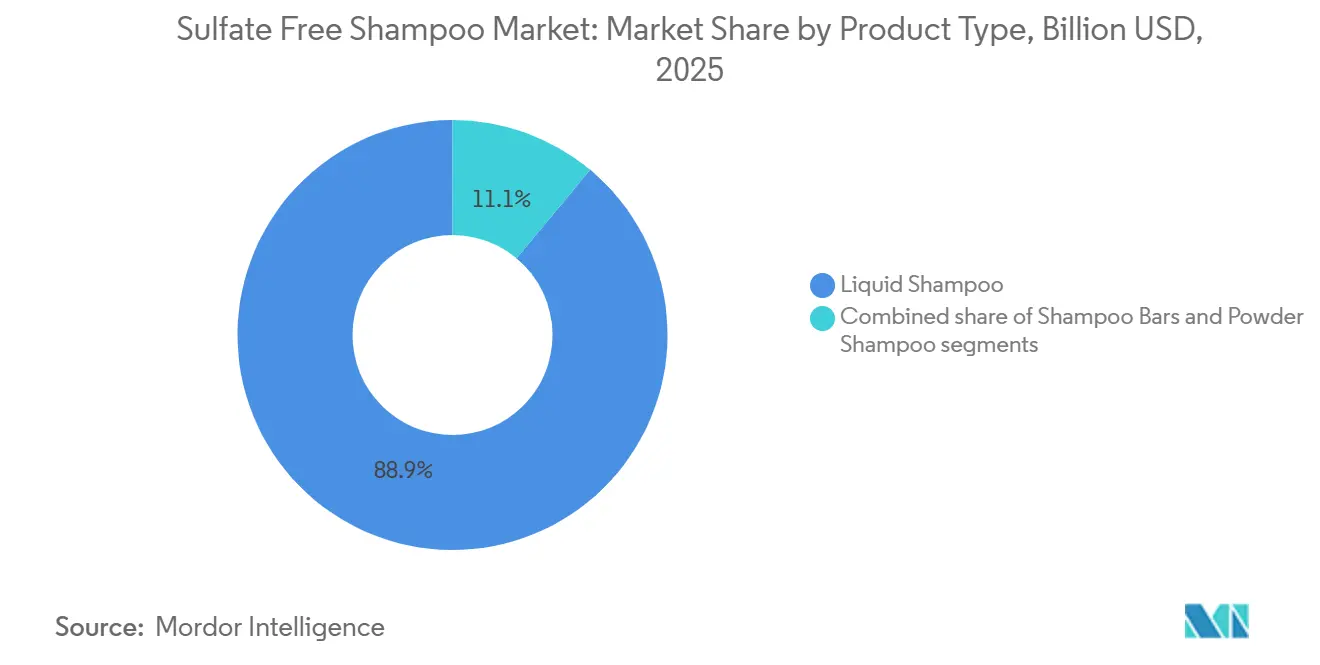
Liquid Formats Retain Broad Reach While Bars Grow FasterLiquid shampoo held 88.94% of the sulfate free shampoo market share in 2025, reflecting familiarity, broad retail availability, and flexibility in fragrance and surfactant design. Liquid products remain practical for households that prefer familiar dispensing formats and established supermarket choices. The format also gives manufacturers room to adapt products for dry hair, colored hair, curly hair, and scalp-focused routines. Shampoo bars are forecast to expand at an 8.93% CAGR through 2031, supported by lower-plastic packaging and interest in waterless beauty. Bars can offer useful per-wash economics and can appeal to hotels and travel settings that seek lower packaging use. Powder shampoo remains a smaller format, but it has gained attention among waterless-beauty users in humidity-sensitive urban areas of the Asia-Pacific.
Product innovation is gradually narrowing the performance gap between sulfate-free and conventional shampoos. BASF introduced Naternal Care XTRA in April 2025, a fenugreek-sourced conditioning polymer for highly damaged hair that it described as readily biodegradable and boron-free[2]Source: BASF SE, “BASF Launches Natural-Based Innovations for Personal Care at in-cosmetics Global 2025,” BASF, basf.com.. Such ingredients can help formulators pair gentle cleansing with conditioning benefits. This supports solid formats and advanced liquids that need to deliver a clear sensory benefit. Kao launched its melt brand in 2024 with sulfate-free, silicone-free, and pH-balanced products, showing continued interest in differentiated haircare formats. The sulfate free shampoo industry will continue to depend on product performance because packaging benefits alone are unlikely to change routine use.



By Category:
Conventional Products Lead While Organic Products Gain MomentumConventional products represented 92.51% of the sulfate free shampoo market size in 2025 because most mild formulas do not rely exclusively on natural surfactants. This category offers a broad route into sulfate-free haircare for consumers who want gentler cleansing without requiring formal organic certification. Its larger base also reflects the ability of mass and professional brands to introduce sulfate-free claims in existing product lines. Organic variants are forecast to grow at a 9.02% CAGR through 2031, the highest rate reported across the category dimensions. This growth reflects closer consumer attention to the origin of ingredients used in personal care. Organic products can also command higher prices, which makes the tier relevant to specialty retailers and direct-to-consumer brands.
Certification is becoming more important as organic products enter specialty beauty channels. Frameworks associated with COSMOS and NATRUE can help consumers identify products that meet recognized requirements for natural or organic claims. The additional formulation and documentation work can favor companies with established technical resources. BASF launched Dehyton PK45 GA/RA in April 2025, a betaine derived from Rainforest Alliance Certified coconut oil, to support more responsible personal-care formulations. This kind of ingredient development gives product teams more options for combining sourcing claims with cleansing performance. As this part of the sulfate free shampoo market matures, clinical documentation and product results are likely to matter as much as ingredient stories.
By Price Range:
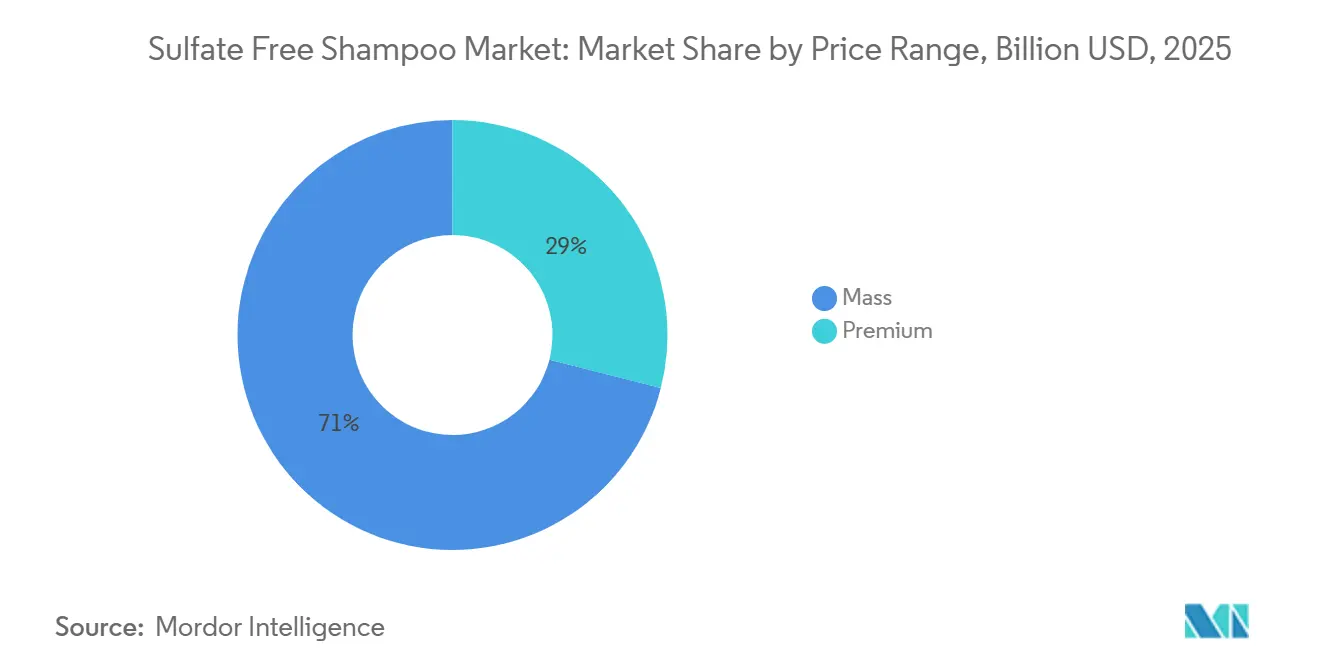
Mass Anchors Volume While Premium Accelerates Revenue GrowthMass products accounted for 71.03% of the sulfate free shampoo market share in 2025, supported by growing availability in supermarkets, pharmacies, and mass beauty outlets. Entry-level formulas make it easier for consumers to try sulfate-free cleansing without making a large spending commitment. Major manufacturers can use existing distribution systems to place these products alongside conventional shampoos. Premium products are forecast to grow at an 8.26% CAGR through 2031 as brands add scalp care, repair, color protection, and higher-value ingredient claims. This creates a practical split in consumer behavior, where shoppers can buy an everyday shampoo at mass retail and pay more for targeted hair treatments. The sulfate free shampoo market size for premium products is supported by a willingness to spend when the product benefit is specific and credible.
Premium positioning needs more than an elevated price to remain durable. Brands need to explain how ingredients, testing, and use routines respond to a hair or scalp concern. Honasa Consumer reported FY2025 revenue of INR 20,669 million, equivalent to USD 248 million, and 7.7% year-over-year growth in its May 2025 filing[3]Source: Honasa Consumer Limited, “Press Release: Financial Results for Q4 and FY2026,” BSE India Filing, bseindia.com.. Its experience shows how a natural haircare brand can use focused product lines and broader distribution in a price-sensitive setting. In May 2026, the company reported that Mamaearth’s Rosemary Anti-Hair Fall Shampoo was among its faster-scaling launches. These examples show that mid-premium products can gain traction when botanical or functional claims are communicated clearly.
By End User:
Women Lead Current Demand While Men Create New GrowthWomen represented 51.92% of sulfate-free shampoo demand in 2025, making them the largest end-user group in the sulfate free shampoo market. Color-treated, chemically processed, and textured hair are important use cases because mild cleansing provides a visible functional rationale. Women also have a broad choice of product formats and claims across salon, specialty, and mass channels. The men’s segment is forecast to grow at an 8.61% CAGR through 2031 as more men adopt routine hair and scalp care. Growth is strongest in urban Asia-Pacific and North America, where product discovery and grooming routines are more developed. Rural areas in South America and the Middle East and Africa remain less developed for these products.
Brands seeking men’s demand need to explain product value in clear and relevant terms. Scalp health, hair strength, dandruff management, and simple routines can be more useful messages than a broad clean-beauty label. Honasa Consumer reported that its Reginald Men brand exceeded an annualized revenue run rate of INR 100 crore in its first quarter of consolidation in FY2026 and doubled revenue year over year. This points to a viable route for dedicated natural haircare brands that address men’s needs directly. Products developed for curly and coily hair also show that mainstream brands are looking for practical points of entry. The sulfate free shampoo industry has room to expand among men when brands make product benefits easy to understand and easy to use.
By Distribution Channel:
Store Reach Supports Volume While Online Sales Expand ChoiceHypermarkets and supermarkets held 47.38% of the sulfate free shampoo market size in 2025 because they offer routine access, familiar brands, and immediate product availability. The category’s presence in mainstream retail shows that it has moved beyond health-food aisles and narrow specialist distribution. Physical stores remain useful for value-focused shoppers who want to compare pack sizes and prices. Specialty beauty stores retain a strong role for premium products that require more education before purchase. Online retail stores are forecast to grow at a 8.98% CAGR through 2031, as digital channels make it easier to compare claims, reviews, and ingredients. Online retail also supports regular replenishment for consumers who have already identified a suitable formula.
Digital channels are especially useful for brands with a narrower product range or a differentiated formulation story. They can explain scalp, color, or ingredient benefits with more space than a shelf label allows. Specialty retail can then help established brands reach consumers who want professional or premium product guidance. Salon networks and direct-to-consumer subscriptions remain smaller channels, but they can serve consumers seeking curated sulfate-free regimens. These channels can support higher-value purchases when brands provide clear routines and credible product information. The sulfate free shampoo market will continue to rely on a mix of broad physical distribution and digital discovery.
Geography Analysis
North America Sulfate Free Shampoo Market
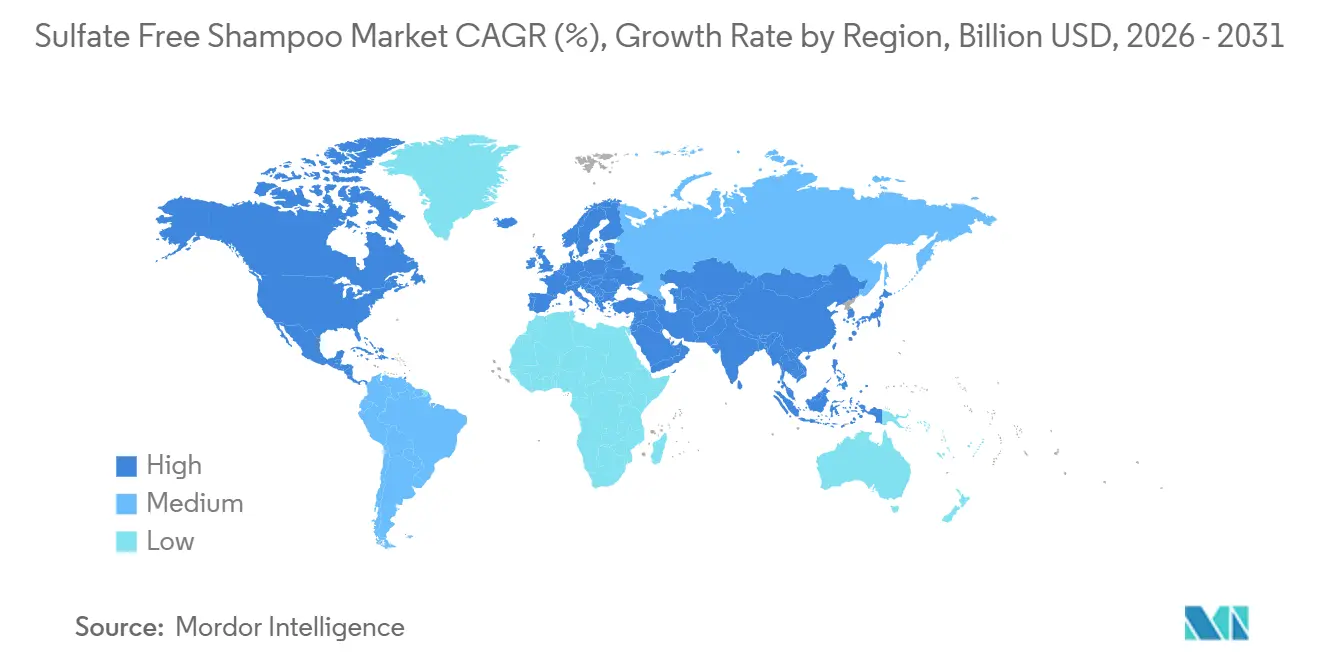
North America held 39.81% of the sulfate free shampoo market share in 2025, supported by strong consumer familiarity with clean beauty, premium haircare, and specialty retail. The United States remains central to this position because of its mature salon, mass retail, and digital beauty channels. Consumers in the region are more likely to recognize claims related to ingredient transparency, color protection, and scalp comfort. Digital buying also supports replenishment among shoppers who have found a formula that suits their hair type. Canada and Mexico provide additional room for brands that adapt price points and distribution to local conditions.
APAC Sulfate Free Shampoo Market
Asia-Pacific is forecast to grow at an 8.73% CAGR through 2031, making it the fastest-growing regional part of the sulfate free shampoo market. India and China provide the main volume opportunity because urban consumers are increasing their use of branded personal-care products. India’s familiarity with Ayurvedic ingredients can make gentle and botanical product messages easier to understand. In China, premiumization and livestreaming-led discovery can support adoption in first-tier cities. Japan and South Korea are mature, high-value markets where experiential premium launches remain important. Kao’s sulfate-free melt launch in Japan shows how companies are using new product concepts to serve this more developed consumer base.
EMEA and South America Sulfate Free Shampoo Market
Europe held an important position in 2025, led by the United Kingdom, Germany, and France, where cosmetics regulation and sustainability expectations influence product development. Commission Regulation (EU) 2025/877 was published in May 2025 and required compliance from May 1, 2026, affecting the cosmetics framework for listed CMR substances. These requirements can encourage brands to reassess ingredient choices and documentation. Brazil leads South America, where natural-hair preferences and Natura &Co’s domestic distribution support relevant product demand. The United Arab Emirates, Saudi Arabia, and South Africa offer growth potential through premium retail, younger urban consumers, and specialty beauty channels.

Competitive Landscape
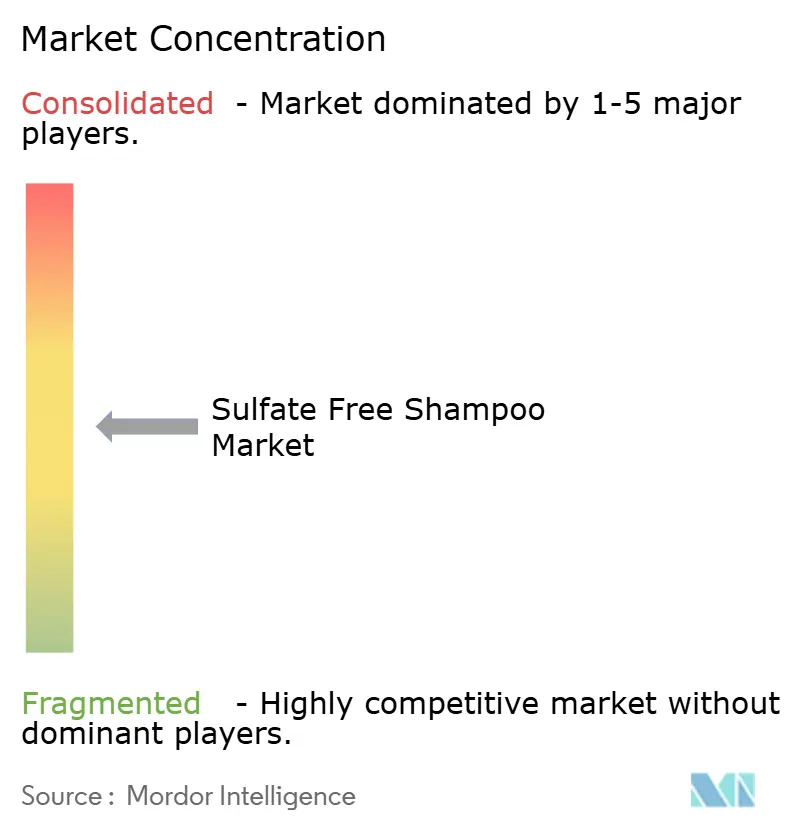
The sulfate free shampoo market is moderately fragmented because global consumer-goods companies compete alongside specialist and direct-to-consumer brands. L’Oréal, Procter & Gamble, Unilever, Henkel, and Kao can serve several price points, channels, and regions through established brand portfolios. Their scale helps them extend sulfate-free claims across mass and professional product lines. Smaller brands can still compete by focusing on solid formats, certification, targeted hair needs, or social commerce. No single participant has a controlling position in the category, leaving room for niche products to gain attention. The sulfate free shampoo market therefore rewards companies that connect a clear product claim with a reliable route to the consumer.
Ingredient development is an important part of competition because product results need to match sulfate-free positioning. BASF’s 2025 personal-care launches included Verdessence Maize, Naternal Care XTRA, and Dehyton PK45 GA/RA, giving formulators options related to biodegradability, conditioning, and responsible sourcing. These materials can support products that combine sensory performance with sustainability claims. Companies that can support performance claims with formulation expertise are better placed to protect margins as ingredient and compliance needs become more demanding. The sulfate free shampoo market also gives value to clinical support because it can make a product’s scalp-care proposition more credible.
Kao launched its melt brand in 2024 with sulfate-free, silicone-free, and pH-balanced products, demonstrating a strategic focus on differentiated premium haircare formats. Honasa Consumer reported in May 2026 that Mamaearth’s Rosemary Anti-Hair Fall Shampoo was among its faster-scaling products, while Reginald Men reached an annualized revenue run rate of INR 100 crore in its first quarter of consolidation. These moves show different ways companies are building relevance through product differentiation and focused consumer needs. Brands that rely on social discovery still need well-supported claims to sustain conversion after a first purchase. Accessible products with credible dermatological support remain an open opportunity because few competitors have established that position at scale. Competition will remain active as more established brands and focused challengers seek repeat buyers in the sulfate free shampoo market.
Sulfate Free Shampoo Industry Leaders
L’Oréal S.A.
Procter & Gamble
Unilever PLC
Henkel AG & Co. KGaA
Kao Corporation
- *Disclaimer: Major Players sorted in no particular order
Sulfate Free Shampoo Market Companies Covered in this Report
- L’Oréal S.A.
- Procter & Gamble
- Unilever PLC
- Henkel AG & Co. KGaA
- The Estée Lauder Companies Inc.
- Johnson & Johnson Services, Inc.
- Kao Corporation
- Shiseido Company, Limited
- Beiersdorf AG
- Natura &Co Holding S.A.
- Honasa Consumer Limited
- Hain Celestial Group, Inc.
- Amway Corp.
- Avlon Industries, Inc.
- Giovanni Cosmetics, Inc.
- Babo Botanicals, Inc.
- DevaCurl LLC
- Moroccanoil, Inc.
- The Honest Company, Inc.
- Ethique Consumer End Uses, Inc.

Recent Industry Developments in Sulfate Free Shampoo Market
- February 2026: Procter & Gamble launched upgraded Head & Shoulders collections, including a sulfate-free Shea Butter Shampoo and Conditioner specifically designed for curly and coily hair. The expansion marked P&G's direct entry into the textured-hair sulfate-free segment at a mass price point.
- August 2025: Moroccanoil launched across 800 Ulta Beauty doors in the United States, with committed expansion into an additional 600 doors in 2026. The move marked a strategic pivot for the salon-origin premium brand toward mainstream specialty retail and broader consumer-facing distribution.
- April 2025: Unilever's CLEAR brand launched the SCALPCEUTICALS PRO Range, a sulfate-free anti-dandruff system developed in collaboration with over 200 dermatologists across five research and development laboratories. Patented Selenium Disulfide and Piroctone Olamine technologies were clinically validated to remove dandruff flakes in one wash and improve scalp barrier resistance by 500%.


Global Sulfate Free Shampoo Market Report Scope
Sulphate-free shampoo is a hair cleanser made without harsh chemical detergents like Sodium Lauryl Sulphate (SLS) and Sodium Laureth Sulphate (SLES). The sulfate free shampoo report is segmented by product type, category, price range, end user, distribution channel, and geography. By product type, the market is segmented into shampoo bars, liquid shampoo, and powder shampoo. By category, the market is segmented into conventional and organic. By price range, the market is segmented into mass and premium. By end user, the market is segmented into men and women. By distribution channel, the market is segmented into hypermarkets/supermarkets, specialty beauty stores, online retail stores, and other channels. By geography, the market is segmented into North America, Europe, Asia-Pacific, South America, and Middle East and Africa). Market forecasts are provided in value (USD).
| Shampoo Bars |
| Liquid Shampoo |
| Powder Shampoo |
| Conventional |
| Organic |
| Mass |
| Premium |
| Men |
| Women |
| Hypermarkets and Supermarkets |
| Specialty Beauty Stores |
| Online Retail Stores |
| Other Distribution Channels |
| North America | United States |
| Canada | |
| Mexico | |
| Rest of North America | |
| Europe | United Kingdom |
| Germany | |
| France | |
| Italy | |
| Rest of Europe | |
| Asia-Pacific | China |
| Japan | |
| India | |
| Australia | |
| Rest of Asia-Pacific | |
| South America | Brazil |
| Argentina | |
| Rest of South America | |
| Middle East and Africa | United Arab Emirates |
| South Africa | |
| Saudi Arabia | |
| Rest of Middle East and Africa |
| Product Type | Shampoo Bars | |
| Liquid Shampoo | ||
| Powder Shampoo | ||
| Category | Conventional | |
| Organic | ||
| Price Range | Mass | |
| Premium | ||
| End User | Men | |
| Women | ||
| Distribution Channel | Hypermarkets and Supermarkets | |
| Specialty Beauty Stores | ||
| Online Retail Stores | ||
| Other Distribution Channels | ||
| Geography | North America | United States |
| Canada | ||
| Mexico | ||
| Rest of North America | ||
| Europe | United Kingdom | |
| Germany | ||
| France | ||
| Italy | ||
| Rest of Europe | ||
| Asia-Pacific | China | |
| Japan | ||
| India | ||
| Australia | ||
| Rest of Asia-Pacific | ||
| South America | Brazil | |
| Argentina | ||
| Rest of South America | ||
| Middle East and Africa | United Arab Emirates | |
| South Africa | ||
| Saudi Arabia | ||
| Rest of Middle East and Africa | ||


Key Questions Answered in the Report
What is driving demand for sulfate-free shampoo?
Demand is supported by consumer interest in scalp comfort, ingredient transparency, color-safe care, and gentler cleansing. The sensitive scalp evidence base also gives consumers a direct reason to consider milder formulas.
How large is the sulfate free shampoo market?
The sulfate free shampoo market size is estimated at USD 5.91 billion in 2026 and is forecast to reach USD 8.52 billion by 2031, growing at a 7.59% CAGR.
Which product format is growing fastest?
Shampoo bars are forecast to grow at an 8.93% CAGR through 2031, supported by lower-plastic packaging and demand for waterless beauty formats.
Why do consumers choose sulfate-free products for colored hair?
Sulfates can remove oil from the scalp and hair and disrupt barrier integrity, which makes mild cleansing relevant to color-care routines.
Page last updated on:





