
Still Wine Market Size and Share
Market Overview
| Study Period | 2021 - 2031 |
|---|---|
| Market Size (2026) | USD 267.52 Billion |
| Market Size (2031) | USD 326.89 Billion |
| Growth Rate (2026 - 2031) | 4.09 % |
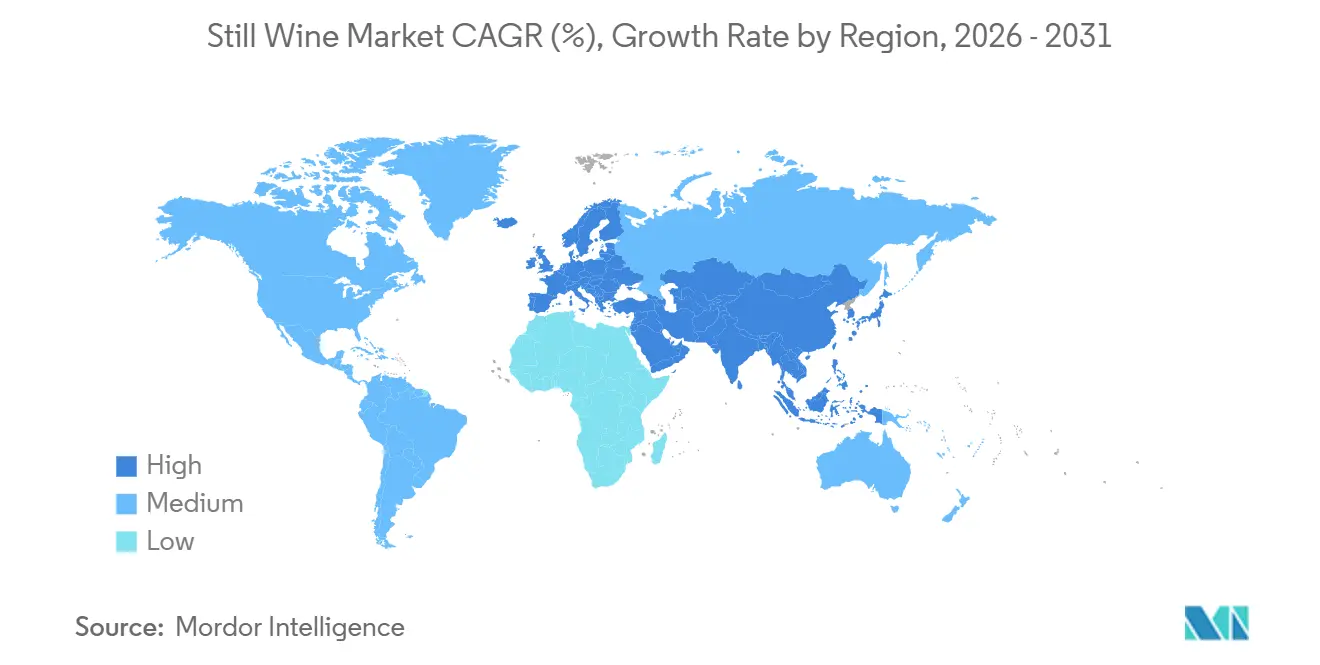
| Fastest Growing Market | Asia-Pacific |
| Largest Market | Europe |
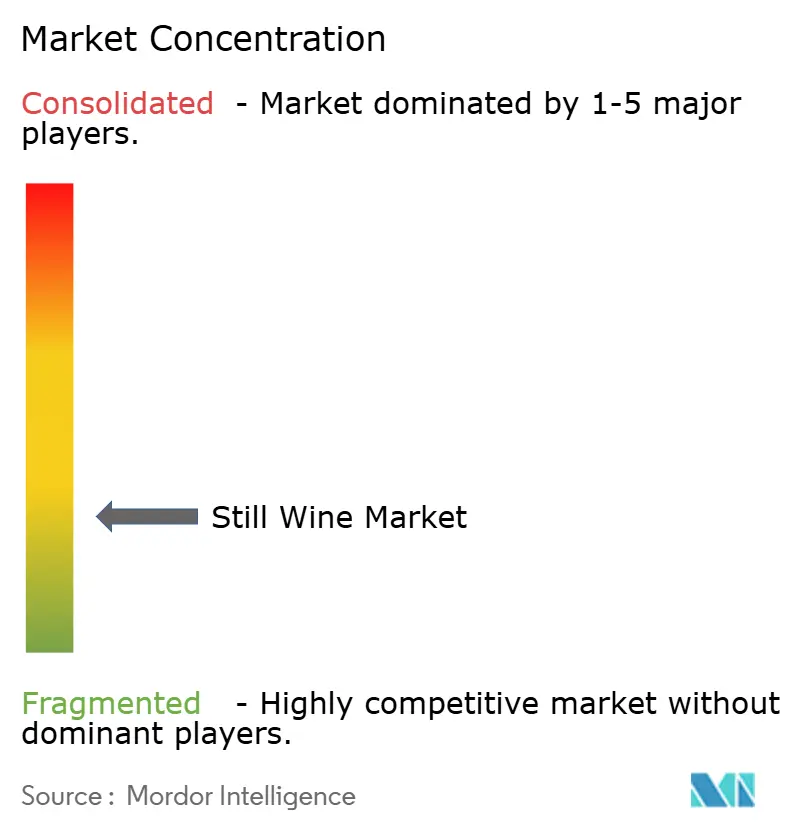
| Market Concentration | Low |
Major Players
*Disclaimer: Major Players sorted in no particular order Image © Mordor Intelligence. Reuse requires attribution under CC BY 4.0. |
|
Still Wine Market Analysis by Mordor Intelligence
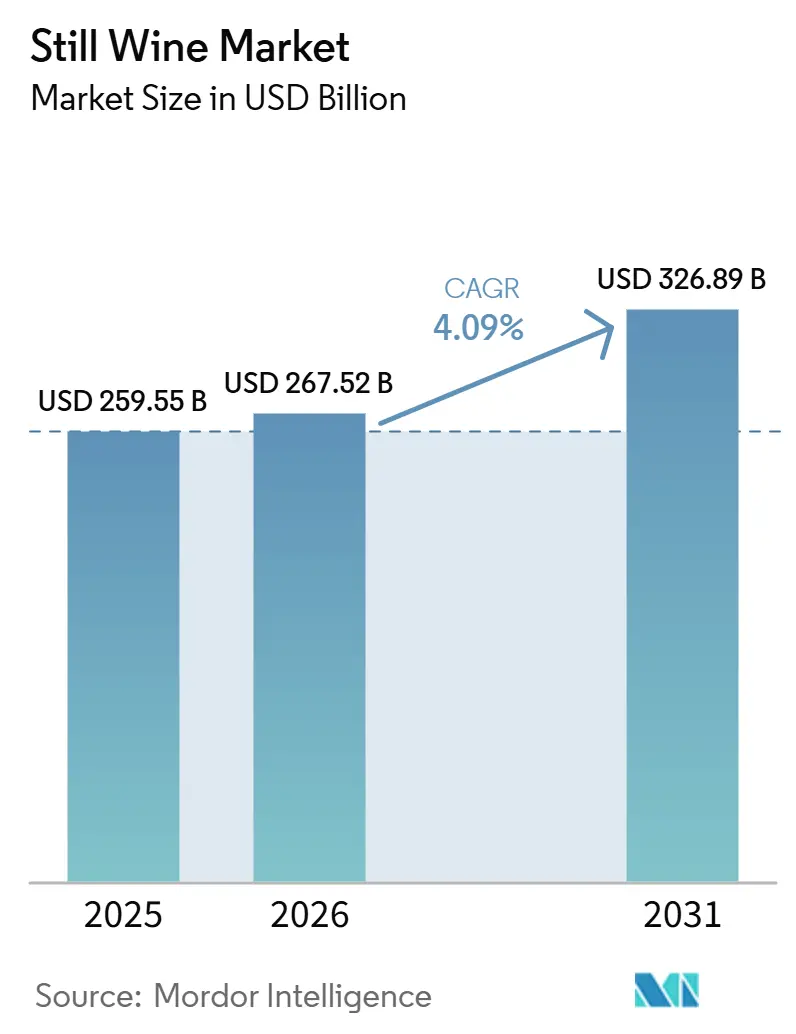
The still wine market was valued at USD 259.55 billion in 2025 and is estimated to reach USD 267.52 billion in 2026, growing to USD 326.89 billion by 2031, at a CAGR of 4.09% during the forecast period (2026–2031). Market growth is primarily driven by increasing consumer preference for premium and artisanal wines, rising demand for wines with protected geographical origins, and the growing popularity of wine tourism and vineyard experiences. The expanding culture of wine education, appreciation programs, and food-and-wine pairing experiences is further strengthening consumer engagement and encouraging premium wine purchases. In addition, continuous advancements in viticulture and winemaking technologies, along with the increasing adoption of sustainable and organic production practices, are supporting the long-term growth of the global still wine market.
Key Report Takeaways
- By product type, Red Wine held 47.73% of the wine market share in 2025, while Rosé Wine is forecast to record the highest CAGR of 5.87% through 2031.
- By end-user, Women accounted for 62.34% of wine market revenue in 2025, while Men are projected to grow at the highest CAGR of 5.13% through 2031.
- By distribution channel, Off-Trade captured 58.45% of wine market revenue in 2025, while On-Trade is expected to expand at the highest CAGR of 4.87% through 2031.
- By geography, Europe accounted for 42.34% of the wine market share in 2025, while Asia-Pacific is projected to grow at the highest CAGR of 5.65% through 2031.
Note: Market size and forecast figures in this report are generated using Mordor Intelligence’s proprietary estimation framework, updated with the latest available data and insights as of January 2026.
Market Trends and Insights
Drivers Impact Analysis of Still Wine Market*
| Driver | (~) % Impact on CAGR Forecast | Geographic Relevance | Impact Timeline |
|---|---|---|---|
| Expansion of wine tourism and vineyard experiences | +0.7% | Europe (Italy, France, Spain); Asia-Pacific spill-over; South America emerging | Medium term (2–4 years) |
| Consumer preference for premium and artisanal wines | +1.0% | Global; strongest in North America, Western Europe, and Asia-Pacific premium tier | Medium term (2–4 years) |
| Rising popularity of wine education and appreciation culture | +0.5% | Global; accelerating in Asia-Pacific, United Kingdom, Australia, and South Africa | Long term (≥ 4 years) |
| Increasing preference for food and wine pairing experiences | +0.4% | Global; strongest in fine-dining markets: North America, Europe, Japan | Medium term (2–4 years) |
| Adoption of sustainable and innovative packaging formats | +0.5% | Global; led by Australia and Western Europe; gaining in North America | Short term (≤ 2 years) |
| Innovation in grape varieties and winemaking techniques | +0.4% | Global; most impactful in climate-stressed southern Europe and Southern Hemisphere | Long term (≥ 4 years) |
| Source: Mordor Intelligence | |||
Expansion of wine tourism and vineyard experiences
The expansion of wine tourism and vineyard experiences is strengthening the still wine market by creating additional revenue streams and deepening consumer engagement with wineries and regional wine cultures. Vineyard tours, wine festivals, educational workshops, and estate hospitality experiences enable producers to enhance brand visibility, strengthen direct-to-consumer sales, and increase the perceived value of premium wine offerings. These experiences also encourage wineries to invest in visitor infrastructure and destination-based wine experiences that support long-term customer loyalty. According to the United Nations Tourism Global Wine Tourism Report 2025, more than 1,300 wineries from 47 countries participated in the global survey, providing comprehensive insights into the evolving wine tourism landscape and supporting evidence-based development of the market [1]Source: UN Tourism, "Global Wine Tourism Report 2025", untourism.int. The growing integration of tourism with wine production is reinforcing market expansion by creating new sales opportunities, strengthening winery revenues, and increasing global awareness of still wines.
Consumer preference for premium and artisanal wines
Growing consumer preference for premium and artisanal wines is driving the still wine market, as wineries increasingly focus on high-quality production, limited-edition labels, single-vineyard expressions, and distinctive grape varietals that emphasize craftsmanship and authenticity. Producers are expanding their portfolios with estate-grown wines, region-specific offerings, and carefully curated winemaking techniques to differentiate products and strengthen brand value. This shift toward premiumization enables wineries to build stronger consumer loyalty while reinforcing the perception of quality and exclusivity. For instance, Moët Hennessy offers Chandon Aurva, a premium 100% Shiraz still red wine crafted at Chandon India's Nashik estate, reflecting the company's focus on producing premium still wines that highlight regional terroir, meticulous winemaking, and artisanal craftsmanship.
Rising popularity of wine education and appreciation culture
The growing popularity of wine education and appreciation culture is supporting the growth of the still wine market by improving consumer knowledge of grape varieties, wine styles, production methods, tasting techniques, and food pairing. Greater awareness enables consumers to make more informed purchasing decisions, encourages exploration of premium and region-specific wines, and strengthens long-term engagement with the category. Educational initiatives also contribute to the development of qualified wine professionals, improving product recommendations across retail and hospitality channels. For instance, the Wine & Spirit Education Trust (WSET) delivers globally recognized wine education through a network of more than 800 Approved Programme Providers (APPs) across over 70 countries and in 15 languages, expanding access to structured wine learning and fostering greater appreciation of still wines worldwide.
Increasing preference for food and wine pairing experiences
The growing preference for food and wine pairing experiences is emerging as a significant driver for the still wine market, as consumers increasingly view wine as an integral part of the overall dining experience rather than a standalone beverage. The growing emphasis on gastronomic experiences has encouraged restaurants, wineries, hotels, and culinary institutions to develop pairing menus that highlight the compatibility of different still wine styles with regional and international cuisines. These experiences help consumers better understand flavor profiles, acidity, tannin structure, and varietal characteristics, fostering greater appreciation for premium and geographically distinctive wines. The growing presence of sommelier-led tastings, chef collaborations, wine festivals, and experiential dining concepts is further improving consumer knowledge, strengthening brand engagement, and encouraging the trial of a broader range of still wines, thereby supporting sustained market growth.
Restraints Impact Analysis of Still Wine Market*
| Restraint | (~) % Impact on CAGR Forecast | Geographic Relevance | Impact Timeline |
|---|---|---|---|
| Stringent regulations on alcohol production, labeling, and marketing | -0.5% | Global; most restrictive in Europe, Nordic markets, Middle East, and parts of Asia-Pacific | Short term (≤ 2 years) |
| Climate change affecting grape cultivation | -0.7% | Global; highest acute risk in Mediterranean Europe, California, and Southern Hemisphere | Long term (≥ 4 years) |
| High susceptibility to pests and vineyard diseases | -0.4% | Europe (powdery/downy mildew); California; South America; Asia-Pacific | Medium term (2–4 years) |
| Intense competition from alternative alcoholic beverages | -0.5% | Global; most acute in North America, United Kingdom, Japan, and Australia | Short term (≤ 2 years) |
| Source: Mordor Intelligence | |||
Stringent regulations on alcohol production, labeling, and marketing
Stringent regulations on alcohol production, labeling, and marketing increase compliance requirements across manufacturing, packaging, distribution, and promotional activities, acting as a significant restraint on the still wine market. Wine producers must adhere to diverse country-specific regulations governing ingredient disclosures, geographical indications, alcohol content declarations, health warnings, labeling formats, advertising standards, and product traceability before entering domestic or international markets. Differences in regulatory frameworks across regions further complicate cross-border trade, requiring wineries to modify packaging, certifications, and marketing materials to meet local legal requirements. These compliance obligations increase operational complexity, extend product approval timelines, and limit promotional flexibility, posing challenges for both established producers and smaller wineries seeking to expand into new markets.
Climate change affecting grape cultivation
Climate change poses a significant challenge to the still wine market, as grape cultivation is highly sensitive to variations in temperature, rainfall patterns, and seasonal weather conditions. Rising temperatures, prolonged droughts, unseasonal frosts, heatwaves, wildfires, and excessive rainfall can alter grape ripening cycles, reduce vineyard productivity, and affect the balance of sugar, acidity, and phenolic compounds that determine wine quality. Changing climatic conditions are also forcing wine producers to modify harvest schedules, adopt climate-resilient grape varieties, and invest in advanced vineyard management practices to maintain production standards. These environmental challenges create uncertainty in grape supply, affect consistency in wine quality and vintage characteristics, and increase operational complexity for wineries across major wine-producing regions.
*Our forecasts treat driver/restraint impacts as directional, not additive. The impact forecasts reflect baseline growth, mix effects, and variable interactions.
Still Wine Market Segment Analysis
By Product Type:
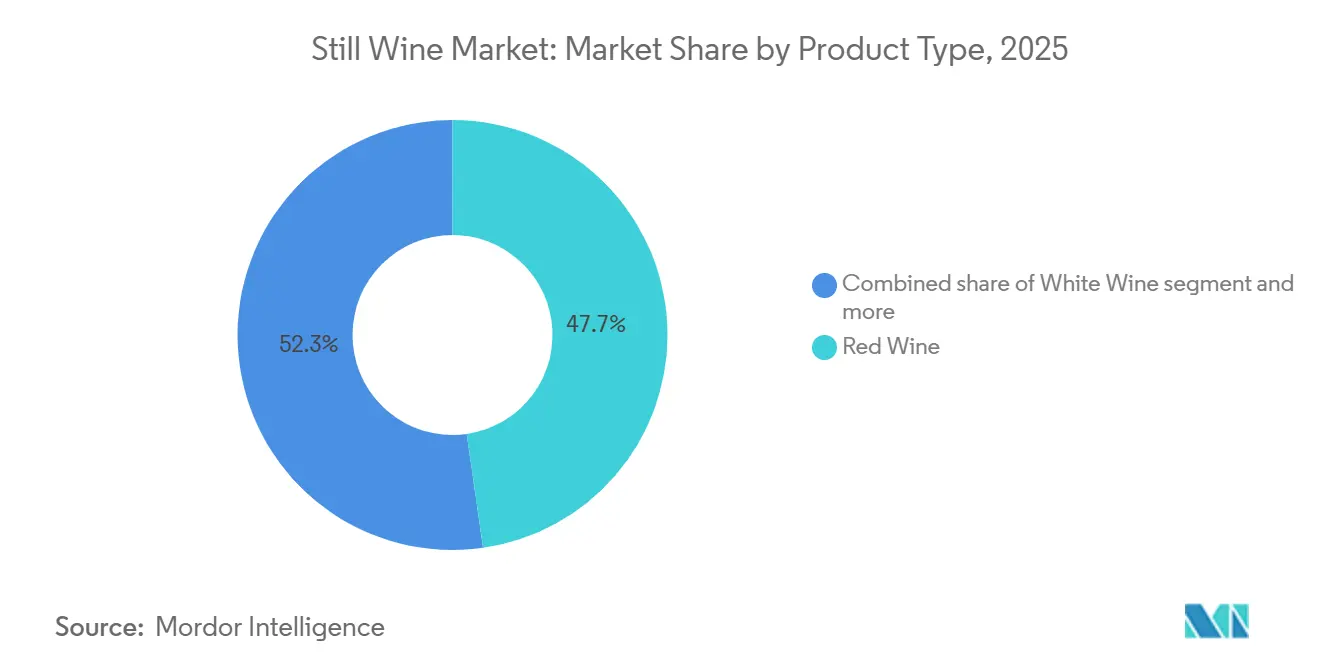
Red Wine Anchors Value, Rosé Disrupts the Growth CurveRed Wine dominated the still wine market, accounting for the largest share of 47.73% in 2025, driven by its strong premium positioning, extensive portfolio of geographically protected wines, and continued emphasis on quality-focused production across leading wine-producing regions. A substantial share of internationally recognized red wines is produced under Protected Designation of Origin (PDO) and Protected Geographical Indication (PGI) frameworks, strengthening consumer confidence in product authenticity, traceability, and regional heritage. Data from the Italian National Institute of Statistics (ISTAT) shows that in 2024, the export value of Italian PDO red wines reached approximately EUR 866 million, while PGI red wines recorded exports of around EUR 472 million, highlighting the robust international demand for certified premium red wines and reinforcing the segment's leadership in the global still wine market [2]Source: Italian National Institute of Statistics (ISTAT), "Export value of Italian red wines", istat.it.
Rosé Wine is the fastest-growing product type, projected to expand at a CAGR of 5.87% during 2026–2031, supported by increasing innovation in premium rosé production, expanding availability of region-specific varietals, and growing recognition of rosé as a distinct premium wine category. Wineries are introducing new grape blends, refining vinification techniques, and expanding portfolios with geographically certified rosé wines to strengthen product differentiation and quality perception. The segment is also benefiting from greater emphasis on limited-edition vintages, sustainable vineyard practices, and premium packaging, which enhance brand positioning and consumer appeal. Furthermore, leading wine-producing countries are increasing investments in rosé production to diversify export portfolios and capitalize on rising international demand, reinforcing rosé wine's position as the fastest-growing product type in the global still wine market.



By End-User:
Women Anchor Demand, Men Drive Incremental GrowthWomen dominated the still wine market by end user, accounting for the largest share of 62.34% in 2025. This is supported by increasing preference for premium wines, greater participation in wine appreciation programs, and stronger engagement with quality-focused purchasing decisions. Wineries are expanding product portfolios with refined flavor profiles, premium packaging, and region-specific labels that align with evolving consumer preferences. The growing influence of wine education, tasting events, and digital wine communities has enhanced product awareness and strengthened brand loyalty among female consumers. Producers are also increasingly emphasizing authenticity, sustainability, and provenance in product positioning, further reinforcing women's contribution to the growth of the global still wine market.
Men are the fastest-growing end-user segment, projected to expand at a CAGR of 5.13% during 2026–2031. This growth is driven by increasing interest in premium wine collections, greater participation in wine tasting culture, and growing appreciation for aged and geographically certified wines. Producers are introducing limited-edition labels, reserve collections, and single-vineyard offerings to cater to evolving preferences for distinctive, high-quality products. Innovation in winemaking techniques, broader availability of diverse grape varietals, and expanding access to wine education are further strengthening engagement among male consumers. These developments are accelerating product adoption and supporting the segment's growth through the forecast period.
By Distribution Channel:
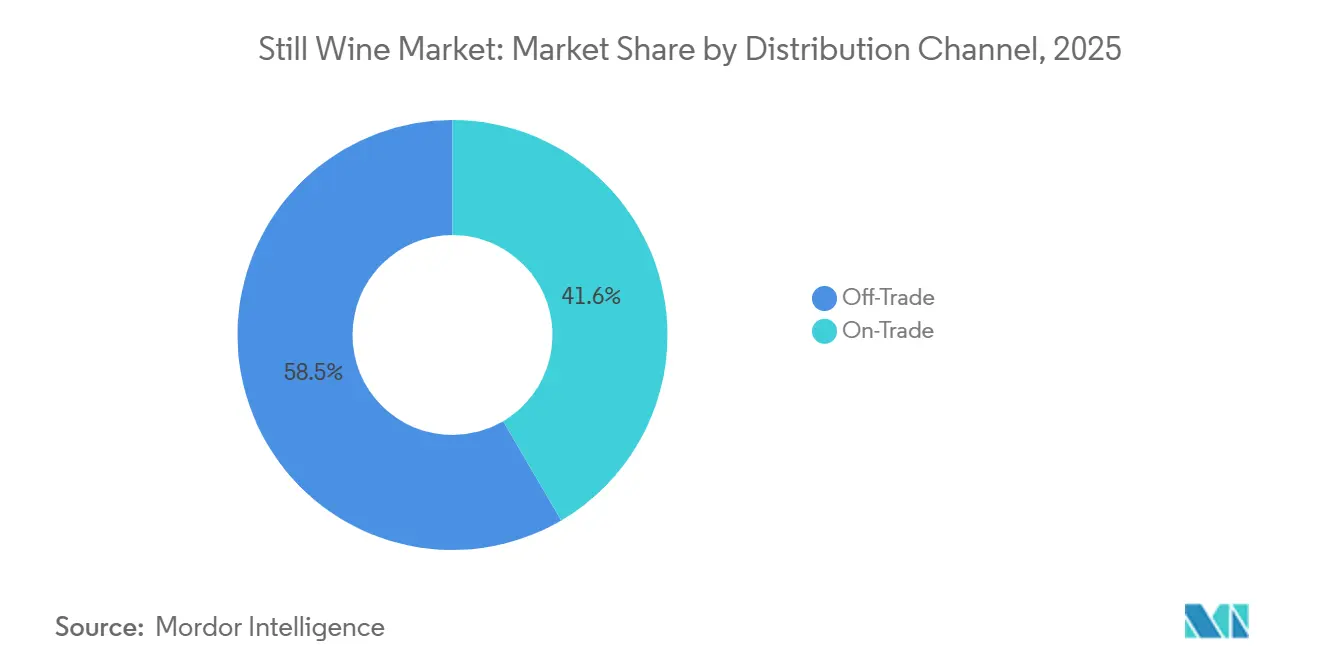
Off-Trade Commands Volume, On-Trade Gains GroundOff-trade channels accounted for the largest share of 58.45% in the still wine market by distribution channel in 2025. This dominance is supported by extensive retail reach, broad product assortment, and the ability to offer wines across multiple price points and regions. Specialty wine retailers, liquor stores, supermarkets, and online retail platforms provide consumers access to a wide selection of domestic and imported still wines, enabling informed purchasing through product comparisons, expert recommendations, and promotional offerings. The continued expansion of organized retail infrastructure and digital commerce has further strengthened product availability, while winery direct-to-consumer initiatives have improved accessibility to exclusive labels and limited-production vintages.
On-trade channels are the fastest-growing distribution channel, projected to expand at a CAGR of 4.87% during 2026–2031. Growth is driven by increasing emphasis on premium dining experiences, curated wine lists, and professional sommelier services that encourage consumers to explore a wider variety of still wines. Restaurants, hotels, wine bars, and hospitality venues are increasingly featuring region-specific labels, food-pairing menus, and exclusive wine-by-the-glass programs to enhance the overall consumption experience. The expansion of wine-focused events, tasting sessions, and experiential hospitality concepts is further supporting consumer engagement and brand discovery, contributing to sustained growth of the on-trade channel throughout the forecast period.
Geography Analysis
Europe Still Wine Market
Europe dominated the still wine market, accounting for 42.34% of global revenue in 2025, supported by its long-established viticulture heritage, extensive vineyard acreage, and leadership in premium wine production. The region benefits from internationally recognized appellation systems, advanced winemaking expertise, and a high concentration of geographically protected wines that reinforce product authenticity and quality. According to the International Organisation of Vine and Wine (OIV), Italy, France, and Spain were the world's three largest wine producers in 2025, with France producing approximately 44.4 million hectoliters of wine [3]Source: International Organisation of Vine and Wine (OIV), "Leading wine-producing countries worldwide in 2025", oiv.int. The strong production capacity of these countries ensures a consistent supply of high-quality still wines for both domestic consumption and international exports, reinforcing Europe's position in the global still wine market.
APAC Still Wine Market
Asia-Pacific is the fastest-growing regional market, projected to expand at a CAGR of 5.65% during 2026–2031, driven by the rapid development of domestic wine industries, increasing investments in modern vineyard cultivation, and the expansion of premium wine production across several countries. Regional producers are adopting advanced viticulture practices, introducing new grape varietals suited to local climates, and improving winemaking technologies to enhance product quality and international competitiveness. The expansion of wine education, tasting culture, and premium retail infrastructure is further strengthening consumer awareness and supporting greater acceptance of still wines across the region.
The Americas and MEA Still Wine Market
North America, South America, and the Middle East & Africa continue to strengthen their presence in the global still wine market, supported by ongoing product innovation, vineyard modernization, and expanding premium wine portfolios. North America remains a key market due to continuous investments in sustainable viticulture, premiumization, and technologically advanced winemaking. South America benefits from favorable grape-growing conditions and increasing international recognition of wines from countries such as Chile and Argentina, supported by growing exports of premium varietals. The Middle East and Africa is witnessing gradual market expansion through the development of hospitality infrastructure, premium retail channels, and the growing international recognition of South Africa as a significant wine-producing nation, contributing to the region's increasing role in the global still wine market.

Competitive Landscape
The global still wine market is fragmented, with no single company holding a dominant market share, resulting in strong competition among multinational wine producers, regional wineries, and premium estate-owned vineyards. Companies such as E. & J. Gallo Winery, Treasury Wine Estates, and Constellation Brands maintain strong positions across the value and masstige segments through broad product portfolios, established distribution networks, and diversified brand offerings. Their ability to serve multiple price tiers, grape varieties, and regional preferences enables them to maintain extensive market reach while expanding their presence across domestic and international markets.
Competition is increasingly shaped by premiumization, with producers focusing on high-quality wines, geographically protected labels, reserve collections, and vineyard-specific offerings to differentiate their portfolios. Companies including Viña Concha y Toro and Castel Frères continue to strengthen their competitive positions by expanding premium product ranges, investing in vineyard management, and enhancing winemaking capabilities to deliver wines with superior quality, authenticity, and regional identity. This focus on premium offerings enables producers to capture greater value while responding to evolving consumer preferences for distinctive and certified wines.
Sustainability-focused supply chains represent another key competitive differentiator, with environmental stewardship increasingly integrated into sourcing, production, packaging, and distribution. Wine producers are adopting sustainable vineyard practices, lightweight and recyclable packaging, water conservation initiatives, renewable energy, and traceable sourcing systems to improve operational resilience and strengthen access to global distribution channels. Sustainability has become an important mechanism for meeting retailer requirements, supporting export market access, and enhancing long-term competitiveness within the global still wine market, rather than functioning solely as a branding initiative.
Still Wine Industry Leaders
-
E. & J. Gallo Winery
-
The Wine Group
-
Treasury Wine Estates Limited
-
Constellation Brands, Inc.
-
Viña Concha y Toro S.A.
- *Disclaimer: Major Players sorted in no particular order
Still Wine Market Companies Covered in this Report
- E. & J. Gallo Winery
- The Wine Group
- Treasury Wine Estates Limited
- Constellation Brands, Inc.
- Vina Concha y Toro S.A.
- Casella Family Brands
- Vinarchy
- Castel Freres
- Pernod Ricard
- Diageo plc
- Bacardi Limited
- Bronco Wine Company
- Trinchero Family Estates
- Jackson Family Wines
- Grupo Penaflor
- Caviro Group
- Changyu Pioneer Wine Co., Ltd.
- LVMH Moet Hennessy Louis Vuitton SE
- Foley Family Wines
- Chapel Down Group plc

Recent Industry Developments in Still Wine Market
- July 2026: BOLLE announced the launch of BOLLE Sauvignon Blanc, further expanding its still wine portfolio and reinforcing its commitment to producing alcohol-free wines defined by taste, structure, and quality.
- April 2026: Pernod Ricard completed the disposal of Mumm sparkling wine activities (excluding champagne) in the United States, covering Mumm Sparkling California, Mumm Napa, and DVX, to Trinchero Family Wine and Spirits.
- February 2026: Viña Concha y Toro, through its VCT Europe arm, announced the acquisition of Maison Mirabeau, a rosé wine brand from the Provence region of France.


Global Still Wine Market Report Scope
Still wine is a wine whose carbon dioxide content is so low that it neither sparkles nor foams. The still wine market is segmented by product type, end-user, distribution channel, and geography. Based on product type, the market is segmented into red wine, white wine, rosé wine, and others. Based on end-user, the market is segmented into men and women. Based on distribution channel, the market is segmented into on-trade and off-trade. The off-trade segment is further categorized into specialty/liquor stores and other off-trade channels. Based on geography, the market is segmented into North America, Europe, Asia-Pacific, South America, and Middle East and Africa. The report provides market size and forecasts in both value (USD) and volume (liters) for all the mentioned segments.
| Red Wine |
| White Wine |
| Rose Wine |
| Others |
| Men |
| Women |
| On-Trade | |
| Off-Trade | Specialty/Liquor Stores |
| Other off-Trade Channels |
| North America | United States |
| Canada | |
| Mexico | |
| Rest of North America | |
| Europe | United Kingdom |
| Germany | |
| France | |
| Italy | |
| Spain | |
| Netherlands | |
| Poland | |
| Belgium | |
| Sweden | |
| Rest of Europe | |
| Asia-Pacific | China |
| Japan | |
| India | |
| Australia | |
| Indonesia | |
| South Korea | |
| Thailand | |
| Singapore | |
| Rest of Asia-Pacific | |
| South America | Brazil |
| Argentina | |
| Colombia | |
| Chile | |
| Peru | |
| Rest of South America | |
| Middle East and Africa | South Africa |
| Saudi Arabia | |
| United Arab Emirates | |
| Nigeria | |
| Egypt | |
| Morocco | |
| Turkey | |
| Rest of Middle East and Africa |
| By Product Type | Red Wine | |
| White Wine | ||
| Rose Wine | ||
| Others | ||
| By End-User | Men | |
| Women | ||
| By Distribution Channel | On-Trade | |
| Off-Trade | Specialty/Liquor Stores | |
| Other off-Trade Channels | ||
| By Geography | North America | United States |
| Canada | ||
| Mexico | ||
| Rest of North America | ||
| Europe | United Kingdom | |
| Germany | ||
| France | ||
| Italy | ||
| Spain | ||
| Netherlands | ||
| Poland | ||
| Belgium | ||
| Sweden | ||
| Rest of Europe | ||
| Asia-Pacific | China | |
| Japan | ||
| India | ||
| Australia | ||
| Indonesia | ||
| South Korea | ||
| Thailand | ||
| Singapore | ||
| Rest of Asia-Pacific | ||
| South America | Brazil | |
| Argentina | ||
| Colombia | ||
| Chile | ||
| Peru | ||
| Rest of South America | ||
| Middle East and Africa | South Africa | |
| Saudi Arabia | ||
| United Arab Emirates | ||
| Nigeria | ||
| Egypt | ||
| Morocco | ||
| Turkey | ||
| Rest of Middle East and Africa | ||


Key Questions Answered in the Report
What is the projected size of the global wine market by 2031?
The global wine market is projected to reach USD 326.89 billion by 2031, growing at a CAGR of 4.09% from 2026 to 2031.
Which wine product type has the largest revenue share?
Red Wine held the largest revenue share at 47.73% in 2025. Rosé Wine is forecast to be the fastest-growing product type, with a 5.87% CAGR through 2031.
Which consumer group generates the most wine revenue?
Women accounted for 62.34% of wine revenue in 2025. Men are expected to record the faster growth rate, at a CAGR of 5.13% through 2031.
Which distribution channel leads wine sales globally?
Off-Trade channels, including supermarkets, specialty stores, and online retail, accounted for 58.45% of revenue in 2025. On-Trade channels are forecast to grow at a 4.87% CAGR through 2031.
Page last updated on:





