
Startup Scouting Platforms Market Size and Share
Market Overview
| Study Period | 2020 - 2031 |
|---|---|
| Market Size (2026) | USD 1.41 Billion |
| Market Size (2031) | USD 2.31 Billion |
| Growth Rate (2026 - 2031) | 10.38 % |
| Fastest Growing Market | Asia-Pacific |
| Largest Market | North America |
| Market Concentration | Low |
Major Players *Disclaimer: Major Players sorted in no particular order Image © Mordor Intelligence. Reuse requires attribution under CC BY 4.0. | |
Startup Scouting Platforms Market Analysis by Mordor Intelligence
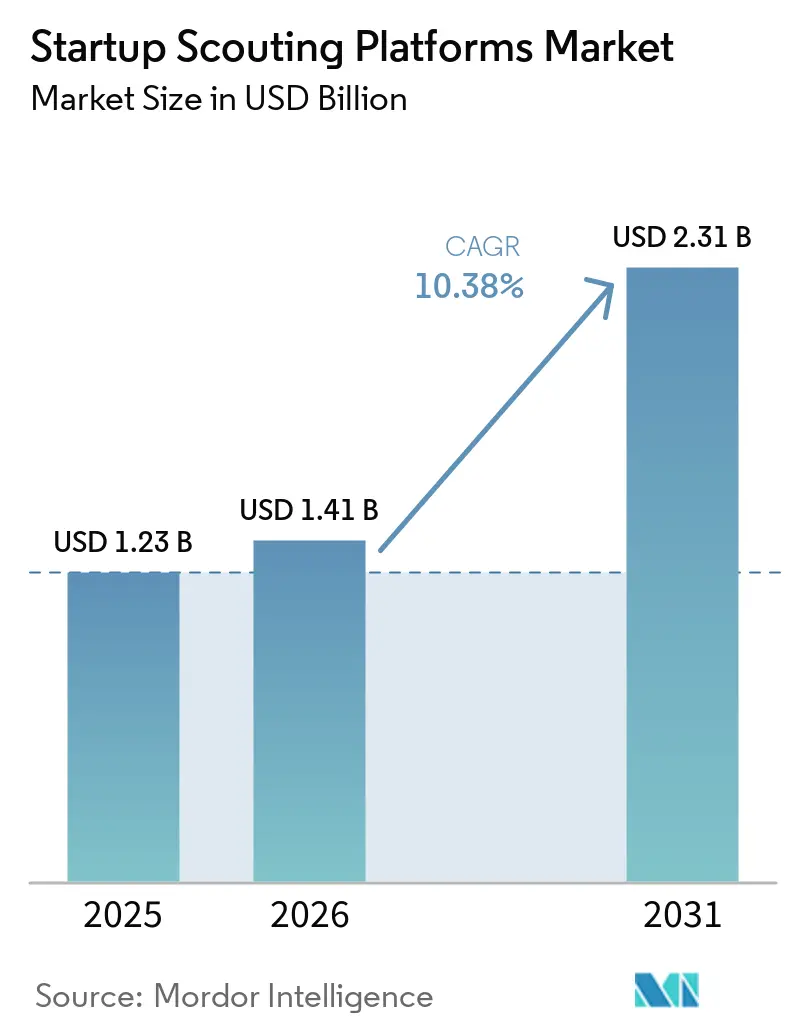
The Startup Scouting Platforms Market size was valued at USD 1.23 billion in 2025 and is estimated to grow from USD 1.41 billion in 2026 to reach USD 2.31 billion by 2031, at a CAGR of 10.38% during the forecast period (2026-2031). Enterprise buyers are treating structured startup discovery as an ongoing operating need rather than a limited innovation exercise, especially where early partner identification has become part of annual planning and regular supplier review. This reflects a broader move toward repeatable processes in the Startup Scouting Platforms Market, where external technology search is increasingly measured against business-unit needs, connecting it with procurement, R&D planning, and corporate development priorities. Platform selection increasingly depends on current data and the relevance of activity signals, not only the number of companies in a database, because teams need a defensible explanation of why a firm appears at the relevant moment. Providers are moving from searchable lists toward AI-supported tools that flag patents, hiring activity, research output, and regulatory filings before a company reports a funding round, creating scope for companies that were previously missed by funding-led databases. This shift can shorten discovery work and bring scouting into procurement, corporate development, and R&D processes, where several internal groups must agree before a pilot can begin. It also underscores the value of clear data provenance, reliable updates, and workflow connections that help teams act on a shortlist, compare it with strategic requirements, and maintain a clear record of the decision.
Key Report Takeaways
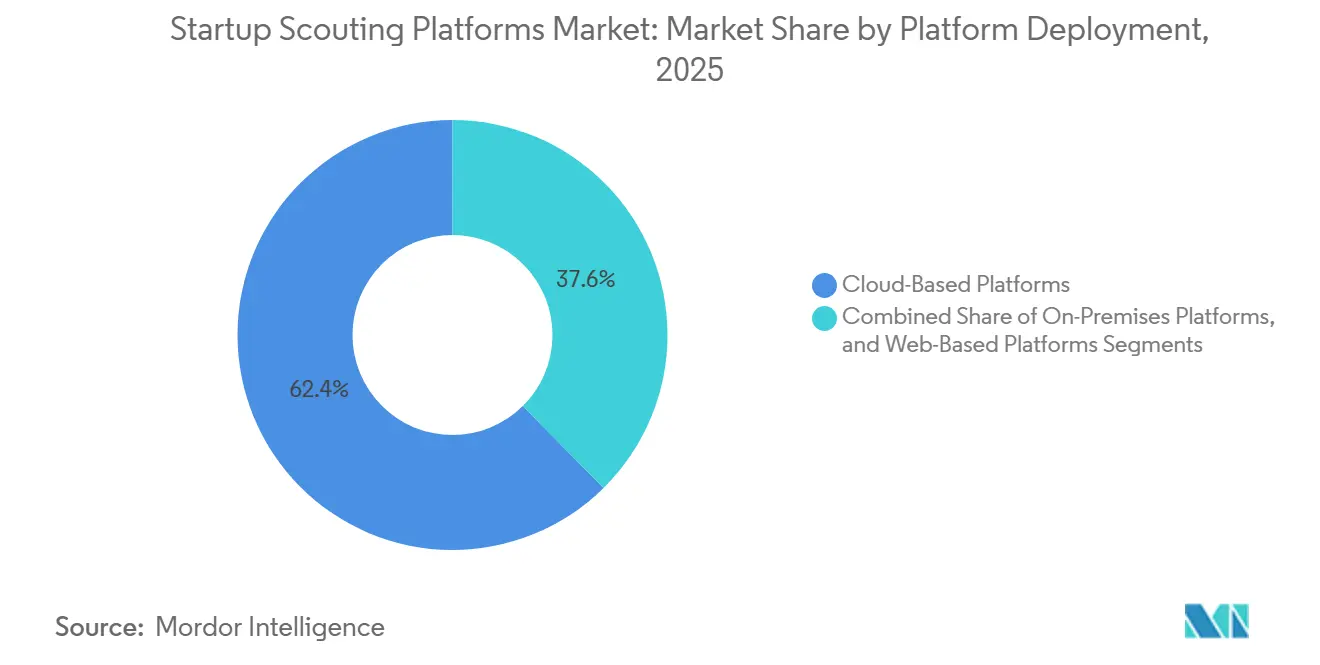
- By deployment, cloud-based platforms held 62.41% of the Startup Scouting Platforms Market share in 2025, while on-premises platforms are forecast to grow at a 13.86% CAGR through 2031.
- By core functionality, startup discovery and search accounted for 34.12% of the Startup Scouting Platforms Market share in 2025, while pilot and proof-of-concept management is forecast to grow at a 13.92% CAGR through 2031.
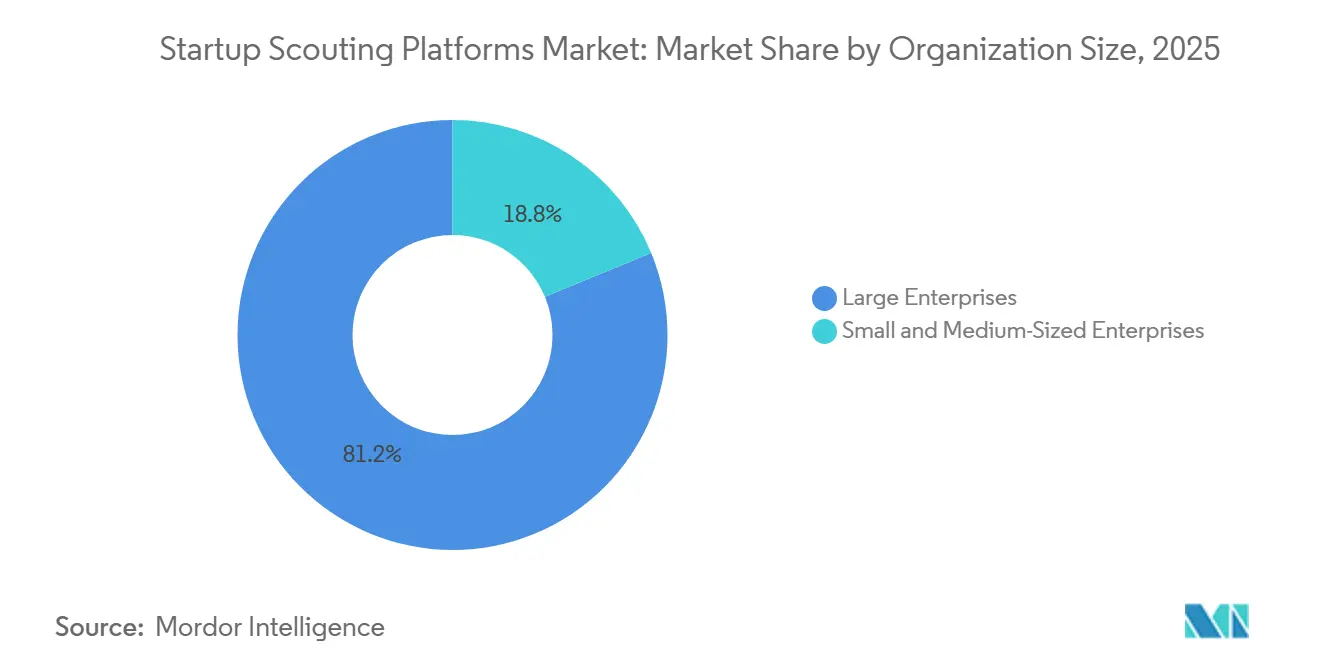
- By organization size, large enterprises accounted for 81.23% of spending in the Startup Scouting Platforms Market 2025, while small and medium-sized enterprises are forecast to grow at a 14.16% CAGR through 2031.
- By industry vertical, information technology and software held 41.23% of spending in 2025, while healthcare and life sciences are forecast to grow at a 14.23% CAGR through 2031.
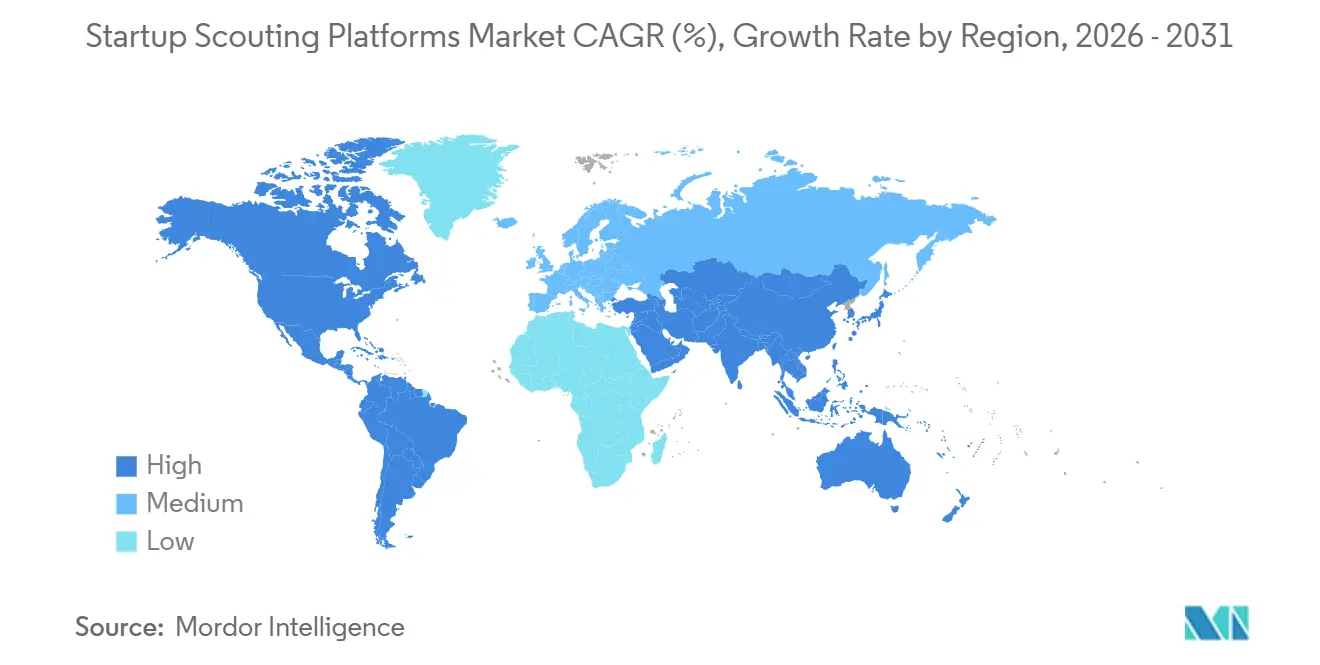
- By geography, North America accounted for 38.41% of spending in the Startup Scouting Platforms Market 2025, while Asia-Pacific is forecast to grow at a 14.31% CAGR through 2031.
Note: Market size and forecast figures in this report are generated using Mordor Intelligence’s proprietary estimation framework, updated with the latest available data and insights as of January 2026.
Market Trends and Insights
Drivers Impact Analysis of Startup Scouting Platforms Market*
| Driver | (~) % Impact on CAGR Forecast | Geographic Relevance | Impact Timeline |
|---|---|---|---|
| Enterprise Adoption of AI-Assisted Startup Discovery | +3.2% | Global, concentrated in North America and Western Europe | Short term (≤ 2 years) |
| Corporate Open-Innovation and Venture-Clienting Programs | +2.5% | Global, with faster expansion in Asia-Pacific and Europe | Medium term (2-4 years) |
| Shorter Technology-Partner Identification Cycles | +1.8% | Global, particularly North America, Japan, and Germany | Short term (≤ 2 years) |
| Startup Funding and Deal-Flow Intelligence Use Cases | +1.5% | North America and Europe, with spillover to Asia-Pacific | Medium term (2-4 years) |
| Activity-Signal Coverage for Pre-Database Companies | +1.3% | Global, with high value in Asia-Pacific and the Middle East and North Africa | Long term (≥ 4 years) |
| Automated University and Stealth Innovation Mapping | +1.0% | Europe and Asia-Pacific, with spillover to North America | Long term (≥ 4 years) |
| Source: Mordor Intelligence | |||
Enterprise Adoption of AI-Assisted Startup Discovery
Large enterprises have moved AI-supported discovery from pilot programs into regular operating workflows across corporate development, R&D, investment, and procurement teams. Crunchbase stated that the annual contract value for its Predictions and Insights offering grew 900% year over year in the first quarter of 2026, with financial services, investment firms, and software companies contributing to its largest contracts.[1] The Startup Scouting Platforms Market benefits when buyers can embed company intelligence within the systems used across the Market, where research findings must be shared among commercial, technical, and legal teams that already use these systems to research deals, partnerships, potential suppliers, and strategic technology themes. Natural-language queries can reduce the time needed to translate a strategic priority into search filters. This changes product expectations because customers increasingly seek semantic search alongside structured company records and clear links to supporting evidence. Platforms also need transparent evidence behind results when a recommendation affects a commercial decision.
Corporate Open-Innovation and Venture-Clienting Programs
Venture clienting lets a corporation buy a startup’s product or service as an early customer without taking an equity stake. The Mack Institute at the Wharton School reported that corporate venturing has become a structured activity at many of the world’s largest companies, with procurement serving as a channel for innovation.[2] This practice broadens the buyer base for the Startup Scouting Platforms Market, as innovation teams need repeatable ways to find, assess, engage, and monitor potential suppliers. A structured pipeline can replace isolated research assignments with a documented process that preserves decisions, responsibilities, and agreed-upon next steps. It can also help procurement, legal, business sponsors, and technical reviewers work from the same company record. The value is strongest when the platform supports the move from an initial discovery to a paid pilot.
Shorter Technology-Partner Identification Cycles
Organizations have traditionally spent long periods identifying and onboarding a suitable startup technology partner through manual landscape work. Hitachi Ventures stated that AI has become an integral part of its investment team and helps accelerate market analysis that previously required larger analyst teams. The Startup Scouting Platforms Market gains relevance when a scouting tool reduces the manual steps between an emerging signal, an internal review, and a qualified discussion with a potential partner. ITONICS stated that its PRISM capability can return startup results from a natural-language query and enrich them with information on funding, technology maturity, and team composition. Faster discovery matters because competing buyers may contact the same company before a manual research team completes its review. Speed, therefore, affects access to potential partners as well as internal research efficiency.
Startup Funding and Deal-Flow Intelligence Use Cases
The volume of private-company activity is expanding the use of scouting platforms beyond corporate innovation teams. Crunchbase reported USD 510 billion in global startup investment during the first half of 2026, a level of deal activity that is difficult to sift through manually. Financial services firms, M&A teams, and go-to-market groups now use the same information to build pipelines, prioritize targets, and identify early-stage prospects. DealRoom and PitchBook announced a 2026 integration that lets M&A teams bring verified company data into deal pipelines without manual enrichment. The Startup Scouting Platforms Market is, therefore, overlapping more closely with transaction, relationship management, and commercial planning workflows. Auditable records become more important as users handle investment and acquisition decisions.
Restraints Impact Analysis of Startup Scouting Platforms Market*
| Restraint | (~) % Impact on CAGR Forecast | Geographic Relevance | Impact Timeline |
|---|---|---|---|
| Data Quality, Duplication, and Stale Company Records | -0.8% | Global, with greatest exposure in Asia-Pacific and the Middle East and North Africa | Short term (≤ 2 years) |
| High Implementation and Data-Integration Costs for Smaller Organizations | -0.7% | Global, most acute in South America and Africa | Medium term (2-4 years) |
| Confidentiality, Consent, and Cross-Border Data-Compliance Exposure | -0.7% | Europe, Asia-Pacific, and expanding globally | Medium term (2-4 years) |
| Explainability and False-Positive Risk in AI-Generated Shortlists | -0.5% | North America and the European Union, with global spillover | Long term (≥ 4 years) |
| Source: Mordor Intelligence | |||
Data Quality, Duplication, and Stale Company Records
Data quality remains a central constraint because weak records become apparent when a team begins assessing a recommended company. FounderNest identified shallow profiles, outdated financial information, weak coverage outside North America, and duplicate entities as recurring issues for innovation scouting teams. Deep technology, biotechnology, and regulated sectors can be especially difficult to map because company information changes quickly, ownership can shift, and material developments are not always disclosed. A stale record can cause a team to pursue a company that has changed direction, been acquired, or ceased operations. This risk supports demand for providers that combine automated collection, source review, and expert validation before a record informs a business decision. Novable describes expert-supported sourcing and assessment as part of its platform approach.
High Implementation and Data-Integration Costs for Smaller Organizations
Subscription fees are only one part of the cost for a smaller organization adopting a scouting platform. Connecting a platform to CRM, ERP, or internal pipeline tools may require API work, data field mapping, user training, and agreement on who maintains each record. The OECD reported that smaller firms across member economies continue to invest less in digital and data capabilities than larger firms. This capacity gap can delay the time until a buyer receives value from the platform and limit its use beyond a small internal team.[3] Prebuilt connectors and onboarding services can reduce the burden on resource-constrained teams. Security reviews and data-processing requirements can add further time for buyers in healthcare and financial services.
*Our forecasts treat driver/restraint impacts as directional, not additive. The impact forecasts reflect baseline growth, mix effects, and variable interactions.
Startup Scouting Platforms Market Segment Analysis
By Platform Deployment:
Sovereignty Requirements Support On-Premises AdoptionCloud-based platforms accounted for 62.41% of the Startup Scouting Platforms Market in 2025. Their position reflects lower initial cost, flexible scaling, frequent product updates, and the ability to support dispersed teams without an internal hosting project. Subscription delivery can help lean innovation teams get started without a large infrastructure project or lengthy license negotiations. It also supports trials and makes it easier for buyers to change vendors when requirements shift. Web-based platforms serve organizations that need browser access but do not require the full data isolation of an on-premises installation. These users often value quick access for external partners, regional offices, and temporary evaluation teams.
Web-based products are common among startup ecosystems, public innovation bodies, and academic institutions. On-premises platforms are forecast to grow at a 13.86% CAGR through 2031. Financial services and healthcare buyers may keep competitive intelligence, investment theses, and contact data within their own environments due to data residency requirements and internal policies. Large organizations with established data centers may also evaluate the long-run cost of sustained AI workloads differently from smaller cloud users. They may prefer direct control over access rights, retention schedules, and the movement of sensitive internal documents. The Startup Scouting Platforms Industry consequently includes a growing deployment choice for buyers whose governance needs outweigh the convenience of shared cloud infrastructure.

By Core Functionality:
Proof-of-Concept Management Expands Platform ScopeStartup discovery and search accounted for 34.12% of the Startup Scouting Platforms Market size in 2025. This function is usually the starting point for a new scouting program because teams first need a credible list of potential companies and an initial view of their relevance. Its growth is steadier than newer functions because broad discovery tools are widely available and increasingly offered as entry-level features. Startup evaluation and scoring help teams compare companies against a defined set of technical, commercial, and operating requirements. Deal-flow and relationship-management functions then capture contacts, discussions, internal decisions, and follow-up actions across the buying team.
Ecosystem intelligence and benchmarking support public agencies and organizations that map regional innovation activity. Dealroom states that it supports more than 120 technology ecosystems through this type of work. Pilot and proof-of-concept management is forecast to grow at a 13.92% CAGR through 2031. A dedicated venture client unit was associated with higher pilot activity and shorter procurement cycles than firms without one, according to the State of Venture Client Report 2024.[4] Tools that support legal templates, milestones, stakeholder sign-off, and accountable ownership address the gap between finding a startup and starting commercial work. The Startup Scouting Platforms Industry thus extends into managing the execution steps that follow a shortlist.
By Organization Size:
Small and Medium-Sized Enterprises Gain AccessLarge enterprises held 81.23% of spending in 2025. Comprehensive API access, expert-reviewed shortlists, and CRM connections remain expensive for many smaller buyers. Large customers also use scouting in several groups at once, including R&D, procurement, corporate development, business units, and ecosystem teams. Multi-seat contracts and several use cases increase per-account spending and create a need for shared oversight. Their compliance requirements can further favor established vendors with recognized security, data-processing, and integration practices.
Small and medium-sized enterprises are forecast to grow at a 14.16% CAGR through 2031. Tiered SaaS plans, freemium options, and modular features lower the cost of entry for these organizations. In manufacturing and biotechnology, smaller firms can use scouting to identify alternative technology partners and reduce dependence on a limited supplier base when supply conditions change. The Startup Scouting Platforms Market is becoming more accessible, although lower subscription prices do not eliminate integration work or the need for internal ownership. No-code workflow tools and AI-assisted data mapping may reduce this remaining obstacle. Smaller buyers still need support that fits limited internal IT capacity and avoids extensive customization.
By Industry Vertical:
Healthcare and Life Sciences Increase UseInformation technology and software held 41.23% of spending in 2025. Companies in this vertical regularly monitor acquisition candidates, API partners, emerging competitive threats, and startups that can complement their existing product lines. The segment includes software firms, cloud infrastructure providers, and semiconductor companies. Bitkom’s startup screening work maps the German semiconductor ecosystem across the value chain from chip design through packaging. Financial services, automotive, and mobility also use structured scouting programs to identify relevant technologies, suppliers, and commercial partnership opportunities.
Healthcare and life sciences are forecast to grow at a 14.23% CAGR through 2031. Pharmaceutical and medtech firms use scouting to identify companies working in AI drug discovery, synthetic biology, digital health, and related areas to supplement their internal research programs. Founder Nest states that its healthcare scouting data covers 160 million patents and 550,000 clinical trial records. The Startup Scouting Platforms Market can help these buyers identify firms before they appear in conventional funding databases or become widely known to competing partners. Healthcare users also need strong evidence, data controls, and processes that can support review by specialized internal teams. This combination can support willingness to pay for deeper vertical coverage.
Geography Analysis
North America Startup Scouting Platforms Market
North America held 38.41% of spending in 2025. Within the Startup Scouting Platforms Market, the region combines a large number of innovation-active corporations, major platform headquarters, and high enterprise budgets for private-company intelligence. Crunchbase reported 900% year-over-year annual contract value growth for its Predictions and Insights offering in the first quarter of 2026. Financial services, software, and AI companies contributed to this demand as buyers sought intelligence inside AI-supported research workflows.
Europe and South America Startup Scouting Platforms Market
Europe in the Startup Scouting Platforms Market is a distinct buying environment because of GDPR requirements, active industrial open-innovation programs, and fragmented national startup ecosystems. Germany has a substantial base of industrial and financial companies that engage startups through structured collaboration, supporting demand for cross-border company intelligence and documented data sources. Local providers can compete through country coverage, language support, data provenance, and knowledge of national filing practices. Compliance requirements also increase procurement work in financial services and healthcare. South America remains an emerging area, where budget limits and infrastructure gaps constrain adoption compared with North America and Europe, while Brazil has shown demand for ecosystem mapping among public and local innovation organizations.
APAC and MEA Startup Scouting Platforms Market
Asia-Pacific in the Startup Scouting Platforms Market is forecast to grow at a 14.31% CAGR through 2031. Corporate venture activity in Japan, South Korea, China, and India is expanding the pool of organizations that need repeatable startup engagement processes. NTT expanded its Startup Challenge to Australia and India in May 2026, alongside markets in Southeast Asia, South Korea, Taiwan, and Hong Kong. Japan’s corporate venture landscape and South Korea’s technology-focused conglomerates support separate sources of demand. The Middle East, including the United Arab Emirates and Saudi Arabia, is developing formal startup engagement programs under national innovation agendas, while Africa remains an early-stage opportunity where tiered pricing may better match cost sensitivity.
Competitive Landscape
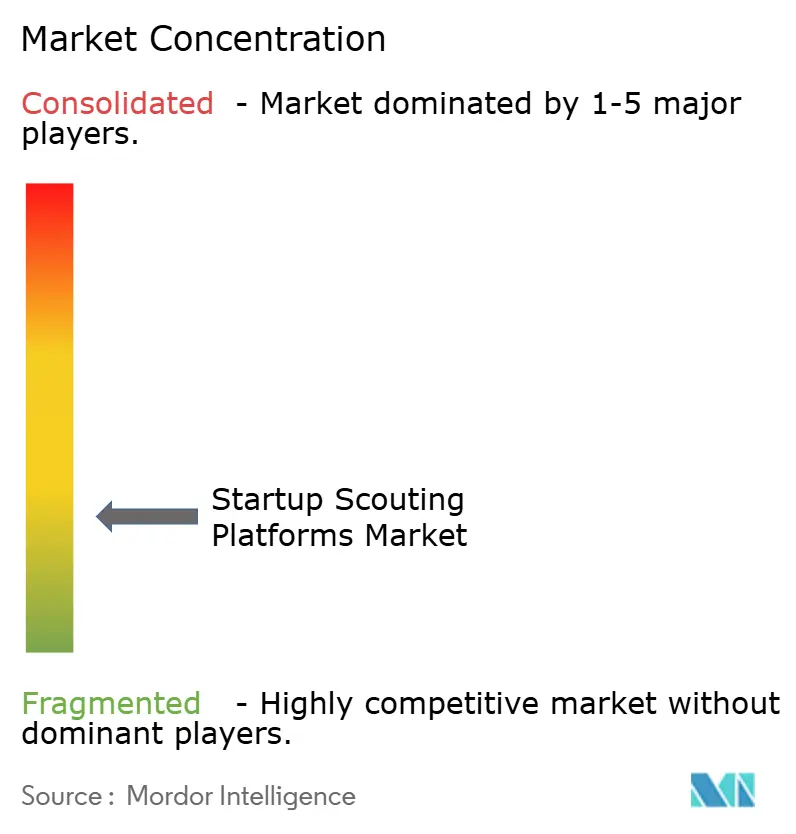
The Startup Scouting Platforms Market remains moderately fragmented, with broad data-intelligence providers competing alongside specialists focused on specific regions, verticals, or workflow stages. Established providers have built broad company databases, AI models, and APIs that can make switching harder after a customer completes an integration. Their advantage lies in connecting data, activity signals, and internal workflows for customers with different evaluation needs. Crunchbase stated that its prediction models anticipated 84% of real-world funding events before they occurred, using 39 billion private-market signals and 80 million user-interaction data points.
Leading providers in the Startup Scouting Platforms Market are adding intelligence to adjacent workflows rather than relying only on direct platform visits. PatSnap announced that its data platform includes 172 million patent records and can connect intelligence to AI-supported R&D work. In November 2025, PatSnap partnered with Intellegens to bring IP intelligence into AI-driven formulation design. In June 2026, ITONICS added Lens.org content to its PRISM AI layer, including 172.2 million patent records and 325.9 million scholarly works. These moves show how early patent and research signals can surface activity before a company enters a conventional startup database, thereby requiring quality controls and clear evidence to support the resulting shortlist.
University and stealth-innovation mapping remain areas with limited coverage. Wellspring reported that more than 80 universities, research institutes, and corporations had selected its Evolve platform by February 2026. Its technology-transfer focus helps organizations assess research-based licensing and spinout opportunities. General-purpose AI tools can help teams conduct exploratory research, but enterprise users still require governance, procurement records, shared review steps, and an audit trail. The Startup Scouting Platforms Market, therefore, retains room for broad platforms and specialists that validate complex signals.
Startup Scouting Platforms Industry Leaders
-
Tracxn Technologies Limited
-
Crunchbase, Inc.
-
Dealroom.co
-
Harmonic Technologies, Inc.
-
Clarivate Plc
- *Disclaimer: Major Players sorted in no particular order
Startup Scouting Platforms Market Companies Covered in this Report
- Dealroom.co
- Tracxn Technologies Limited
- Crunchbase, Inc.
- Harmonic Technologies, Inc.
- Novable SA
- Kuanta AI, Inc.
- Kaiku Technologies Limited
- Specter Technologies, Inc.
- Synaptic Technologies, Inc.
- Babele Technologies Srl
- GlassDollar GmbH
- Innopipe GmbH
- Traction Technology Ltd.
- Co:cubed Limited
- Savvy Innovation, Inc.
- OpenI Technologies, Inc.
- Wellspring International, Inc.
- Ezassi, Inc.
- ITONICS GmbH
- Questel SAS
- Qmarkets GmbH
- Clarivate Plc
- PatSnap Pte. Ltd.
- Wazoku Limited
Recent Industry Developments in Startup Scouting Platforms Market
- July 2026: Crunchbase launched a model context protocol connector that brought private-market intelligence into LLM-native environments. The product drew on 39 billion signals and 15 million predictions, allowing enterprise dealmakers to query startup data through Claude, ChatGPT, and custom AI agents within their primary workflow
- May 2026: NTT Group launched its 3rd consecutive NTT Startup Challenge and expanded target regions to Australia and India, alongside Southeast Asia, South Korea, Taiwan, and Hong Kong. The program included NTT DATA as a co-host and used the Synexia Ventures corporate venture fund established in December 2025.
- March 2026: PatSnap released updates to Eureka AI Agent, including prereasearch analysis, visual outputs for technology evaluation, and a rebuilt retrieval system with enhanced multilingual search.
- February 2026: Wellspring announced that its Evolve platform had been selected by more than 80 universities, research institutes, and corporations ahead of AUTM 2026. The platform supports IP management and technology-transfer operations for research-based innovation
Global Startup Scouting Platforms Market Report Scope
The startup scouting platforms market refers to software solutions that help enterprises, investors, and innovation teams systematically identify, evaluate, and engage with emerging startups. These platforms provide core functionalities such as AI-driven startup discovery, data-backed evaluation and scoring, deal-flow and relationship management, and tools for managing innovation challenges, open calls, and proof-of-concept (PoC) projects. Deployed via cloud-based, web-based, or on-premises models, these solutions serve organizations of all sizes across industries, including IT, financial services, healthcare, and automotive. By offering ecosystem intelligence and benchmarking, startup scouting platforms enable organizations to streamline their open innovation processes, reduce the time and resources required to find the right technological partners, and effectively manage pilot programs to drive strategic growth and digital transformation.
The Startup Scouting Platforms Market Report is Segmented by Platform Deployment (Cloud-Based Platforms, Web-Based Platforms, and On-Premises Platforms), Core Functionality (Startup Discovery and Search, Startup Evaluation and Scoring, Deal-Flow and Relationship Management, Innovation Challenge and Open-Call Management, Pilot and Proof-of-Concept Management, and Ecosystem Intelligence and Benchmarking), Organization Size (Large Enterprises, and Small and Medium-Sized Enterprises), Industry Vertical (Information Technology and Software, Financial Services, Healthcare and Life Sciences, Automotive and Mobility, and Other Industry Verticals), and Geography (North America, South America, Europe, Asia-Pacific, Middle East, and Africa). The Market Forecasts are Provided in Terms of Value (USD).
Segmentation Overview
| Cloud-Based Platforms |
| Web-Based Platforms |
| On-Premises Platforms |
| Startup Discovery and Search |
| Startup Evaluation and Scoring |
| Deal-Flow and Relationship Management |
| Innovation Challenge and Open-Call Management |
| Pilot and Proof-of-Concept Management |
| Ecosystem Intelligence and Benchmarking |
| Large Enterprises |
| Small and Medium-Sized Enterprises |
| Information Technology and Software |
| Financial Services |
| Healthcare and Life Sciences |
| Automotive and Mobility |
| Other Industry Verticals |
| North America | United States |
| Canada | |
| Mexico | |
| South America | Brazil |
| Argentina | |
| Chile | |
| Rest of South America | |
| Europe | Germany |
| United Kingdom | |
| France | |
| Italy | |
| Spain | |
| Rest of Europe | |
| Asia-Pacific | China |
| Japan | |
| India | |
| South Korea | |
| Australia | |
| Rest of Asia-Pacific | |
| Middle East | United Arab Emirates |
| Saudi Arabia | |
| Qatar | |
| Rest of Middle East | |
| Africa | South Africa |
| Egypt | |
| Nigeria | |
| Rest of Africa |
| By Platform Deployment | Cloud-Based Platforms | |
| Web-Based Platforms | ||
| On-Premises Platforms | ||
| By Core Functionality | Startup Discovery and Search | |
| Startup Evaluation and Scoring | ||
| Deal-Flow and Relationship Management | ||
| Innovation Challenge and Open-Call Management | ||
| Pilot and Proof-of-Concept Management | ||
| Ecosystem Intelligence and Benchmarking | ||
| By Organization Size | Large Enterprises | |
| Small and Medium-Sized Enterprises | ||
| By Industry Vertical | Information Technology and Software | |
| Financial Services | ||
| Healthcare and Life Sciences | ||
| Automotive and Mobility | ||
| Other Industry Verticals | ||
| By Geography | North America | United States |
| Canada | ||
| Mexico | ||
| South America | Brazil | |
| Argentina | ||
| Chile | ||
| Rest of South America | ||
| Europe | Germany | |
| United Kingdom | ||
| France | ||
| Italy | ||
| Spain | ||
| Rest of Europe | ||
| Asia-Pacific | China | |
| Japan | ||
| India | ||
| South Korea | ||
| Australia | ||
| Rest of Asia-Pacific | ||
| Middle East | United Arab Emirates | |
| Saudi Arabia | ||
| Qatar | ||
| Rest of Middle East | ||
| Africa | South Africa | |
| Egypt | ||
| Nigeria | ||
| Rest of Africa | ||
Key Questions Answered in the Report
What is the projected size of Startup Scouting Platforms Market by 2031?
The Startup Scouting Platforms Market is forecast to reach USD 2.31 billion by 2031, expanding at a 10.38% CAGR from 2026. Growth reflects demand for repeatable startup discovery, current company data, and shared workflows across procurement, R&D, corporate development, and business-unit teams.
Which deployment model led startup scouting platform demand in 2025?
Cloud-based platforms led with a 62.41% share in 2025 because they offer flexible scaling, lower initial cost, and faster product updates. On-premises demand is increasing among organizations that need direct control over data location, access rights, retention, and internal security review.
Which platform function is growing fastest through 2031?
Pilot and proof-of-concept management is forecast to grow at a 13.92% CAGR through 2031 as buyers seek support after startup discovery. It helps teams manage evaluations, legal steps, milestones, stakeholder approvals, and the documented handoff into commercial engagement.
Why are small and medium-sized enterprises adopting scouting platforms?
Tiered SaaS plans, modular features, and freemium options are lowering barriers, and this group is forecast to grow at a 14.16% CAGR through 2031. Adoption still depends on straightforward integration, limited customization, accessible pricing, and onboarding that works with small internal technology teams.
Which region is expected to expand fastest through 2031?
Asia-Pacific is forecast to grow at a 14.31% CAGR, supported by corporate venture activity in Japan, South Korea, China, and India. Buyers across the region need tools that can support cross-border startup engagement, local data requirements, and coordination among corporate venture and operating teams.
What data-quality issues affect platform users?
Users can encounter duplicate records, outdated company information, shallow profiles, and incomplete coverage, especially in complex and regulated sectors. Providers can limit this risk through traceable sources, regular updates, expert review, and evidence that allows internal users to assess why a company was surfaced.