
Sprinkler Gun Market Size and Share
Market Overview
| Study Period | 2021 - 2031 |
|---|---|
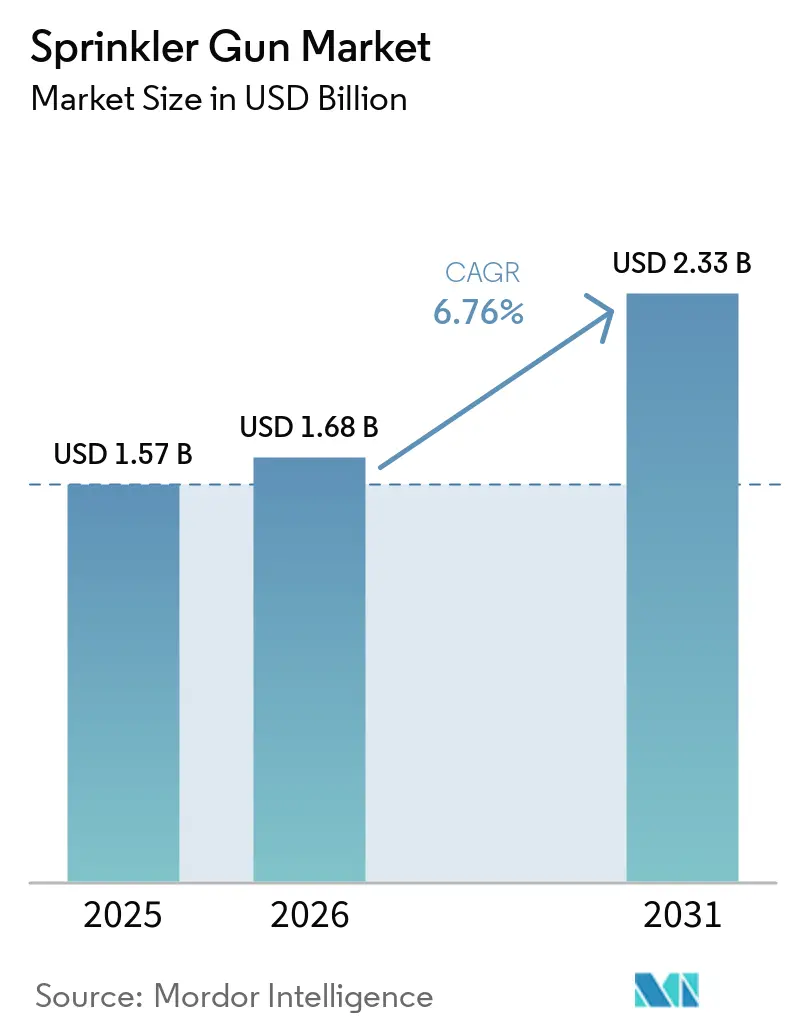
| Market Size (2026) | USD 1.68 Billion |
| Market Size (2031) | USD 2.33 Billion |
| Growth Rate (2026 - 2031) | 6.76 % |
| Fastest Growing Market | Africa |
| Largest Market | Asia-Pacific |
| Market Concentration | Medium |
Major Players *Disclaimer: Major Players sorted in no particular order Image © Mordor Intelligence. Reuse requires attribution under CC BY 4.0. | |
Sprinkler Gun Market Analysis by Mordor Intelligence
The sprinkler gun market size was valued at USD 1.57 billion in 2025 and is forecast to grow from USD 1.68 billion in 2026 to USD 2.33 billion by 2031, at a CAGR of 6.76% from 2026 to 2031. The market is influenced by factors such as increasing freshwater scarcity, growing demand for higher agricultural output, and a shift away from flood irrigation in large-scale grain and forage systems. The market is also benefiting from trends such as the adoption of reclaimed water, advancements in durable nozzle materials, and increased interest in automated controls for portable and traveler-mounted systems. However, the sprinkler gun market faces challenges from competition with drip irrigation in high-value crops, rising pumping costs, and performance limitations under windy conditions. Competitive intensity remains moderate to high due to the presence of established global brands and a diverse range of regional manufacturers, which sustains active pricing dynamics even as demand for premium features grows.
Key Report Takeaways
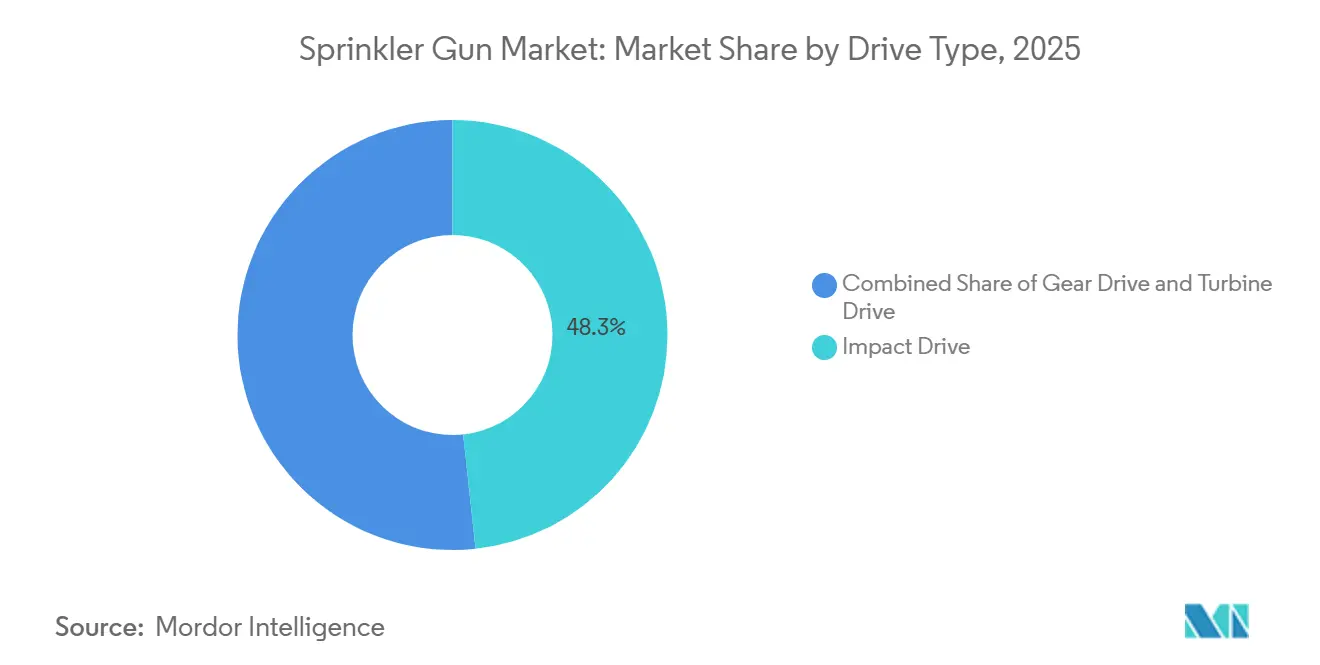
- By drive type, the sprinkler gun market share for impact drive accounted for the largest share at 48.3% in 2025, while the gear drive segment is forecast to grow at the fastest CAGR of 6.9% from 2026 to 2031.
- By coverage radius, the less than 35 m category accounted for the largest share at 53.0% in 2025, while the above 60 m category is forecast to grow at the fastest CAGR of 7.3% from 2026 to 2031.
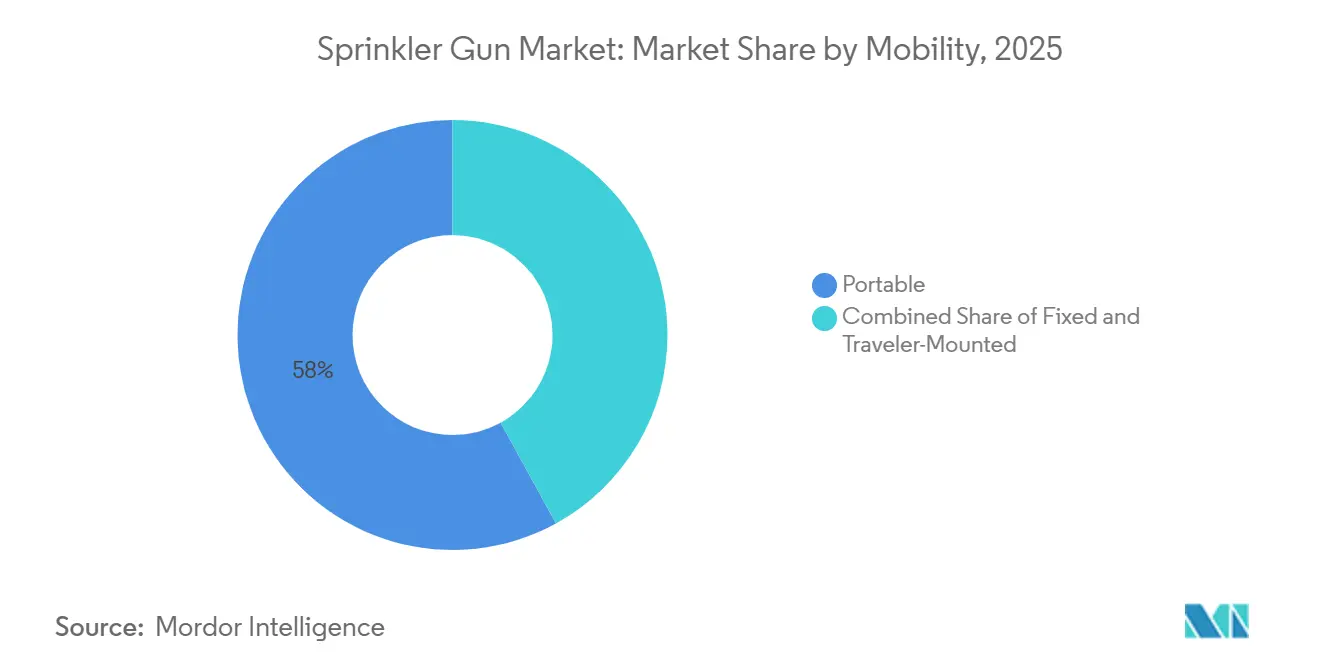
- By mobility, the portable segment accounted for 58.0% of the sprinkler gun market size in 2025 and is forecast to grow at a CAGR of 6.9% from 2026 to 2031.
- By application, field crops and broadacre farming accounted for the largest share at 44.0% in 2025, while horticulture and orchards are forecast to grow at the fastest CAGR of 7.0% from 2026 to 2031.
- By geography, Asia-Pacific accounted for the largest share at 34.1% in 2025, while Africa is forecast to grow at the fastest CAGR of 7.1% from 2026 to 2031.
Note: Market size and forecast figures in this report are generated using Mordor Intelligence’s proprietary estimation framework, updated with the latest available data and insights as of January 2026.
Global Sprinkler Gun Market Trends and Insights
Drivers Impact Analysis*
| Driver | (~) % Impact on CAGR Forecast | Geographic Relevance | Impact Timeline |
|---|---|---|---|
| Water-Scarcity-Led Shift From Flood Irrigation | +2.0% | Global, concentrated in Southern Asia, Northern Africa, and the Middle East | Medium term (2-4 years) |
| Food-Output Intensification and Commercial Farming Expansion | +1.7% | Asia-Pacific, South America, and Sub-Saharan Africa | Medium term (2-4 years) |
| Subsidized Irrigation Modernization in Water-Stressed Farming Belts | +1.3% | India, China, Morocco, Egypt, and Saudi Arabia | Medium term (2-4 years) |
| Automation and Remote Irrigation Control Adoption | +1.0% | North America, Europe, Australia, and irrigated Asia-Pacific belts | Medium term (2-4 years) |
| Treated Wastewater Land Application Creating New Raingun Demand Pockets | +0.7% | Saudi Arabia, European Union member states, California, and Australia | Long term (≥ 4 years) |
| Aftermarket Nozzle and Wear-Part Replacement Demand in Abrasive-Water Use Cases | +0.4% | Global, with stronger need across Asia-Pacific agricultural belts and the Middle East | Long term (≥ 4 years) |
| Source: Mordor Intelligence | |||
Water-Scarcity-Led Shift from Flood Irrigation
Water scarcity is a significant factor driving the sprinkler gun market, as growers increasingly transition from flood irrigation to pressurized irrigation systems that enhance water-use efficiency and field coverage. According to the Food and Agriculture Organization's AQUASTAT update released in 2025, renewable water availability per person has declined by 7% over the past decade[1]. The increasing strain on agricultural water resources is promoting the adoption of sprinkler gun systems, which provide flexible application across grain, forage, and commercial farming operations while enabling more efficient irrigation practices in water-stressed areas.
Food-Output Intensification and Commercial Farming Expansion
The expansion of commercial farming and the demand for increased agricultural productivity are driving the adoption of sprinkler gun systems. Farmers are increasingly turning to these irrigation systems to enhance crop consistency, operational flexibility, and water-use efficiency across extensive agricultural fields. Sprinkler gun systems are particularly favored in grain farming, forage cultivation, orchards, and horticulture due to their ability to irrigate large areas without the need for permanent irrigation infrastructure. Their portability and adaptability to various crop systems make them a practical choice for farmers seeking to stabilize yields, support crop protection efforts, and improve overall farm productivity amidst changing climatic conditions and water availability challenges.
Subsidized Irrigation Modernization in Water-Stressed Farming Belts
Public irrigation modernization programs are reducing upfront cost barriers and supporting the adoption of sprinkler guns in water-stressed farming regions. For example, India's Per Drop More Crop (PDMC) scheme provides 55% financial assistance to small and marginal farmers and 45% to other farmers for installing sprinkler and drip systems. Procurement flows through state-approved vendors, creating steady channels for suppliers and installers. Sprinkler guns benefit from quick installation across large fields. These programs also increase farmer familiarity with pressurized irrigation, sustaining repeat demand for expansions and replacements after subsidy periods end.
Automation and Remote Irrigation Control Adoption
The sprinkler gun market is witnessing a growing transition toward automated sprinkler gun irrigation systems as growers focus on water conservation, operational efficiency, and labor optimization. A study published in Applied Water Science in January 2026 reported that sensor-triggered irrigation reduced water usage by 25% to 35% compared to fixed-schedule irrigation systems during a 30-day field evaluation. These findings are driving the adoption of remote monitoring technologies, soil moisture sensors, and automated irrigation controls in sprinkler gun systems. Suppliers are increasingly incorporating digital control features to enhance irrigation precision, minimize operational losses, and promote efficient water management practices in commercial agriculture.
Restraints Impact Analysis*
| Restraint | (~) % Impact on CAGR Forecast | Geographic Relevance | Impact Timeline |
|---|---|---|---|
| High Upfront Equipment and Pumping Energy Burden | -1.4% | Smallholder-dominated markets across Sub-Saharan Africa and South and Southeast Asia | Long term (≥ 4 years) |
| Competition from Drip and Subsurface Drip Systems | -1.2% | Horticulture belts across Europe, North America, the Middle East, and Australia | Medium term (2-4 years) |
| Wind Drift and Droplet-Impact Limits on Delicate Crops | -0.7% | Coastal Europe, the Great Plains in North America, and semi-arid Asia-Pacific zones | Short term (≤ 2 years) |
| Pressure Dependency and Weak Farm Utility Infrastructure | -0.5% | Sub-Saharan Africa, parts of South and Southeast Asia, and rural South America | Long term (≥ 4 years) |
| Source: Mordor Intelligence | |||
High Upfront Equipment and Pumping Energy Burden
High upfront equipment costs and pumping energy expenses remain significant barriers to the adoption of sprinkler gun systems, particularly in lower-income and smallholder farming operations. A 2025 study published in Environmental Challenges reported that irrigation pumping systems in the United States consumed approximately 26.2 terawatt-hours of electricity annually, underscoring the substantial energy demands of pressurized irrigation systems. The high costs associated with pumping energy, fuel, irrigation infrastructure, and maintenance continue to place financial strain on growers utilizing sprinkler gun systems. Consequently, the sprinkler gun market is highly influenced by factors such as energy prices, access to financing, irrigation subsidies, and the reliability of rural power in cost-sensitive agricultural regions.
Competition from Drip and Subsurface Drip Systems
Competition from drip and subsurface drip irrigation systems continues to constrain growth in the sprinkler gun market, particularly in high-value crops where precise water delivery and irrigation efficiency are critical. Subsurface drip irrigation provides higher irrigation water productivity and reduces evaporation losses compared to sprinkler irrigation under field crop conditions. This performance advantage is driving growers to adopt precision irrigation technologies that enhance water-use efficiency and nutrient management. Consequently, the sprinkler gun market is facing increasing competitive pressure in horticulture, orchards, and water-constrained agricultural applications, where irrigation precision significantly influences equipment selection.
*Our forecasts treat driver/restraint impacts as directional, not additive. The impact forecasts reflect baseline growth, mix effects, and variable interactions.
Segment Analysis
By Drive Type: Impact Drive Leads, Gear Drive Gain Ground
The sprinkler gun market share for the impact drive segment was the largest at 48.3% in 2025. These sprinkler guns maintain their leading position due to their reliable operation, ease of maintenance, and higher tolerance for sediment-heavy water conditions, making them ideal for large agricultural fields. Their mechanical simplicity makes them well-suited for broadacre farming, forage cultivation, and irrigation systems operating under uneven field conditions. Farmers in developing agricultural economies favor impact-drive systems for their durability and lower servicing complexity. Additionally, the category benefits from widespread availability through agricultural distributors and suppliers worldwide.
The sprinkler gun market size for the gear drive segment is forecast to grow at a CAGR of 6.9% from 2026 to 2031, making it the fastest-growing segment by drive type. These sprinkler guns are gaining traction as growers increasingly prioritize smoother water distribution, quieter operation, and enhanced irrigation uniformity for commercial farming applications. They are particularly appealing in water-sensitive agricultural environments where efficient irrigation coverage and reduced runoff are critical. Manufacturers are driving adoption by introducing improved nozzle designs, automated rotation systems, and compatibility with traveler-mounted sprinkler gun equipment. The growing preference for precision-oriented irrigation practices continues to support the shift toward gear-drive and turbine-based sprinkler gun configurations.

By Coverage Radius: Less Than 35 Meter Holds the Base, Above 60 Meter Expands Faster
The less than 35 meter category accounted for the largest share at 53.0% in 2025. Smaller-coverage-radius sprinkler guns are widely adopted for their practical irrigation control capabilities in compact agricultural plots, horticultural fields, nurseries, and managed landscapes. Their lower pump pressure requirements and operational flexibility make them suitable for farms with moderate water availability and limited infrastructure. These systems are also easier to deploy across uneven terrain and mixed cropping systems, where targeted irrigation is essential. Demand for these sprinkler guns is driven by their widespread use in small and medium-scale agricultural operations, particularly in developing irrigation economies and water-sensitive cultivation environments.
The above 60 meter category is forecast to grow at a CAGR of 7.3% from 2026 to 2031, making it the fastest-growing segment by coverage radius. Long-range sprinkler guns are increasingly used by large commercial farms to achieve broader irrigation coverage with fewer units, particularly in broadacre farming operations. These systems improve operational efficiency by minimizing field movement and extending irrigation reach across expansive agricultural areas. Adoption is notably high in regions focused on large-scale grain cultivation, pasture irrigation, and commercial forage production. In 2025, Nelson Irrigation Corporation bolstered this segment with the introduction of the R65VT and R65iVT sprinkler series, designed to deliver high-flow irrigation performance for extensive agricultural applications[2].
By Mobility: Portable Systems Stay Dominant Across End Uses
Portable systems accounted for the largest share at 58.0% in 2025 and are forecast to grow at the fastest CAGR of 6.9% from 2026 to 2031. These systems are highly preferred due to their operational flexibility, which accommodates changing crop layouts, seasonal irrigation needs, and rotational farming practices. Farmers favor portable configurations as they enable irrigation across multiple fields without requiring permanent infrastructure. This adaptability makes them particularly appealing to small- and medium-scale growers seeking lower initial investment than fixed irrigation networks. Strong demand for portable systems persists in developing agricultural economies and water-scarce farming regions.
Portable sprinkler gun systems also remain important in commercial agriculture because they support rapid deployment across temporary irrigation zones and changing cultivation patterns. Large farming operations increasingly rely on portable systems to address field expansion, crop rotation, and variable irrigation demands, all of which require flexible water-application methods. Traveler-mounted systems further enhance this segment by combining portability with extensive field coverage for large agricultural layouts. Meanwhile, fixed irrigation systems remain in demand for applications such as sports fields, industrial facilities, and permanent landscaping, where long-term infrastructure investment is justified. The balance between mobility, reduced infrastructure complexity, and irrigation flexibility continues to drive the adoption of portable systems across diverse end-use environments.
By Application: Field Crops and Broadacre Farming Anchors Demand, Horticulture and Orchards Moves Faster
Field crops and broadacre farming accounted for the largest share at 44.0% in 2025. Large-scale agricultural operations remain the primary driver of demand, as sprinkler gun systems provide efficient irrigation coverage for grain cultivation, forage production, and pasture management. These systems are valued for their ability to irrigate extensive field areas without requiring permanent drip infrastructure, providing growers with flexible and scalable irrigation solutions. Additionally, sprinkler gun systems accommodate varying field conditions, rotational cropping practices, and temporary irrigation needs commonly encountered in commercial agriculture. The demand is further supported by increasing pressure to enhance crop productivity and irrigation efficiency, particularly in water-constrained farming regions.
Horticulture and orchards are forecast to grow at the fastest CAGR of 7.0% from 2026 to 2031. Adoption in this segment is rising as sprinkler gun systems provide frost protection, evaporative cooling, and overhead irrigation, which are essential for specialty crop production. Growers are increasingly utilizing these systems to enhance crop protection and ensure consistent irrigation under changing climatic conditions. The demand is further driven by the expansion of commercial fruit cultivation, greenhouse irrigation activities, and water-efficient farming practices in high-value crop categories. Manufacturers are continuously improving nozzle precision and irrigation control features to enhance the suitability of these systems for orchard, nursery, and horticulture applications.
Geography Analysis
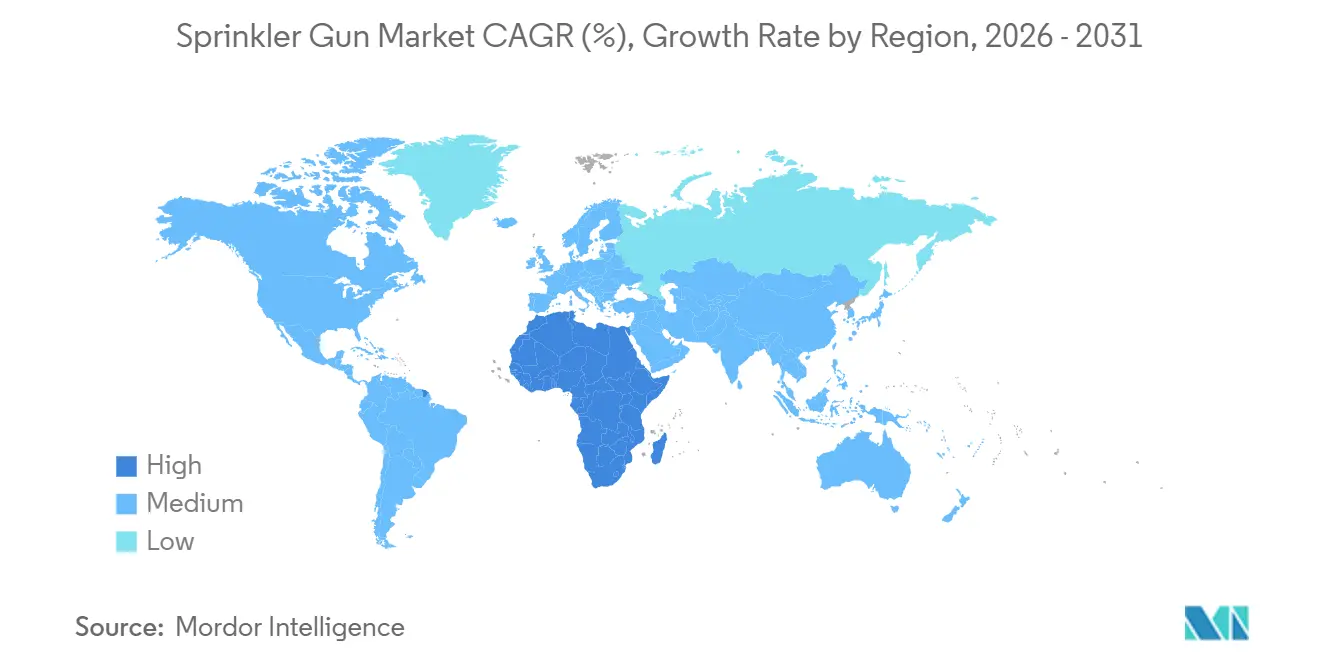
Asia-Pacific accounted for the largest share of the sprinkler gun market, at 34.1% in 2025. This dominance is driven by its extensive irrigated agricultural base, rising water stress, and the increasing adoption of pressurized irrigation systems in commercial farming operations. China and India are key contributors to demand, as large grain-producing regions focus on enhancing irrigation efficiency and water conservation practices. Additionally, the growth of mechanized farming activities, commercial horticulture, and government-supported irrigation modernization programs is boosting equipment adoption. The region's strong agricultural dependence, rising food demand, and emphasis on improving irrigation productivity in water-constrained farming environments further support its market leadership.
Africa is forecast to grow at the fastest CAGR of 7.1% from 2026 to 2031. This growth is attributed to increasing water scarcity, irrigation modernization initiatives, and the expansion of commercial farming activities in arid agricultural regions. Governments and agricultural operators are prioritizing water-use efficiency and mechanized irrigation systems to enhance crop productivity under limited freshwater conditions. The growing use of treated water, rising investments in irrigation infrastructure, and the expansion of horticulture cultivation are further driving demand. Portable and mid-range sprinkler gun systems are particularly appealing due to their lower infrastructure requirements in developing agricultural environments.
North America and Europe remain technologically advanced regions for sprinkler gun systems, with growers placing greater emphasis on irrigation efficiency, operational reliability, and precise water management in commercial agriculture and managed landscapes. The demand for sprinkler gun equipment is driven by the widespread adoption of mechanized irrigation practices, the growth of water-efficient farming systems, and an increasing focus on sustainable irrigation infrastructure. Commercial farms favor sprinkler gun systems due to their ability to cover large fields, provide operational flexibility, and integrate with large-scale irrigation operations. In Europe, demand is further supported by the use of reclaimed-water irrigation practices and agricultural policies focused on sustainability, which influence the selection of sprinkler gun equipment.
Competitive Landscape
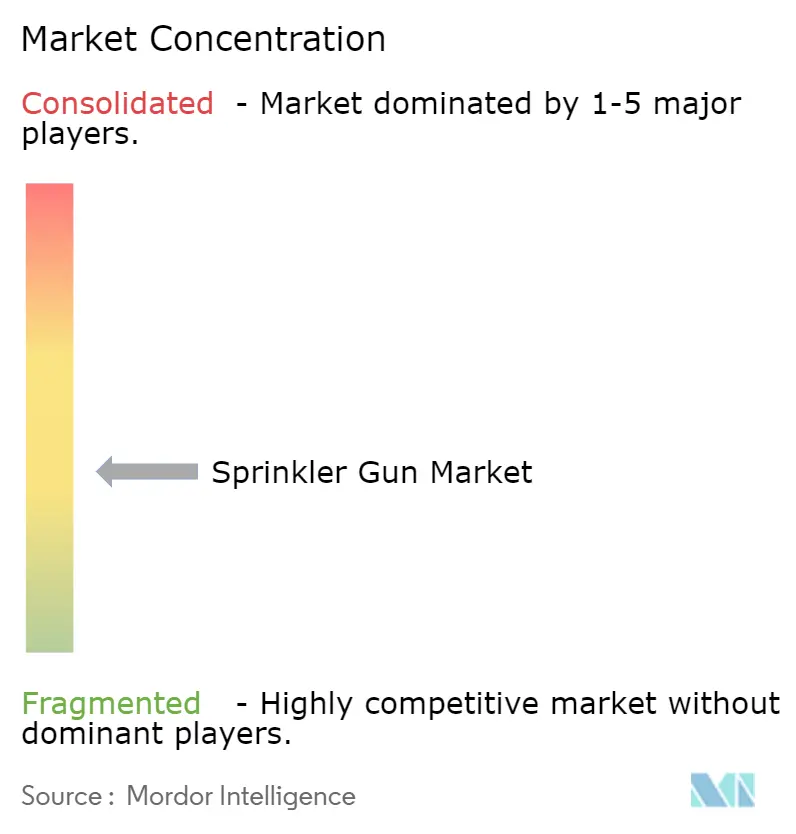
The sprinkler gun market remains moderately fragmented in 2025, with major companies such as Nelson Irrigation Corporation, Komet Austria GmbH, Jain Irrigation Systems, SIME IDROMECCANICA S.r.L., and Wade Rain, Inc. competing across agricultural, landscaping, industrial, and commercial irrigation applications. Companies differentiate themselves through advancements in nozzle engineering, pressure management, water distribution efficiency, and system durability tailored to diverse agricultural conditions. Global suppliers benefit from extensive distribution networks, established dealer relationships, and diversified portfolios of irrigation products. Meanwhile, regional manufacturers compete aggressively in entry-level and replacement product categories. Market competition is further shaped by irrigation modernization programs, water-efficiency mandates, and the growing demand for portable irrigation systems in developing agricultural economies.
Competitive strategies are increasingly shifting toward integrated irrigation systems, compatibility with automation, and improvements in operational efficiency. For instance, Rain Bird Corporation acquired Rachio, Inc. in October 2025 to enhance its capabilities in smart irrigation and connected control systems for residential and commercial sprinkler applications[3]. This acquisition highlights the industry's growing emphasis on remote monitoring, automated irrigation scheduling, and digital water management technologies. Manufacturers are aligning sprinkler gun equipment with connected control platforms, telemetry systems, and water-efficiency solutions to enhance value-added offerings. The shift toward integrated irrigation ecosystems is redefining competitive differentiation in the agricultural and commercial sprinkler gun equipment markets.
Manufacturers are also strengthening competitive positioning through product durability, reclaimed-water compatibility, and operational reliability under variable field conditions. Suppliers are increasingly developing irrigation systems designed to handle abrasive water conditions, pressure fluctuations, and high-flow agricultural applications in water-scarce farming regions. Product development efforts emphasize easier installation, reduced maintenance, and improved irrigation precision for commercial agriculture and managed landscape applications. Additionally, there is a growing convergence between digital irrigation controls and water-efficient sprinkler technologies, as growers seek integrated solutions that enhance irrigation performance, operational efficiency, and sustainable water management practices across diverse agricultural environments.
Sprinkler Gun Industry Leaders
-
Nelson Irrigation Corporation
-
Komet Austria GmbH
-
Jain Irrigation Systems Limited
-
SIME IDROMECCANICA S.r.l.
-
Wade Rain, Inc.
- *Disclaimer: Major Players sorted in no particular order
Recent Industry Developments
- March 2026: Rain Bird Corporation and Centaur Asia-Pacific have expanded their golf irrigation distribution partnership to include Malaysia and Brunei. This expansion extends Rain Bird's commercial sprinkler footprint into two rapidly growing Southeast Asian markets, aligning with increased regional investment in golf infrastructure.
- October 2025: Rain Bird Corporation acquired Rachio, Inc. to enhance its smart irrigation and connected control capabilities for agricultural and commercial irrigation systems. This acquisition aims to facilitate the integration of automated water management and remote irrigation monitoring technologies within the sprinkler gun market.
- September 2025: Hunter Industries, Inc. introduced the Senninger 7125PC Part-Circle Impact Sprinkler, designed for high-flow agricultural irrigation applications. This launch enhances its sprinkler gun portfolio, catering to field crops, nurseries, dust suppression, and effluent irrigation systems.
Global Sprinkler Gun Market Report Scope
A sprinkler gun is a high-pressure irrigation device used to distribute water across extensive agricultural fields. It operates through rotating nozzles and long-range water spray patterns. This device is commonly utilized in field crops, forage farming, orchards, horticulture, dust suppression, and landscape irrigation due to its broad coverage, portability, and efficient water application over large cultivation areas.
The sprinkler gun market report is segmented by drive type (impact drive, gear drive, and turbine drive), by coverage radius (less than 35 meter, 35 to 60 meter, and above 60 meter), by mobility (portable, fixed, and traveler-mounted), by application (field crops and broadacre farming, horticulture and orchards, turf and landscaping, dust suppression and industrial, and sports fields and golf courses), and by geography (North America, South America, Europe, Asia-Pacific, Middle East, and Africa). The market size and forecasts are provided in terms of value (USD).
| Impact Drive |
| Gear Drive |
| Turbine Drive |
| Less Than 35 Meter |
| 35 to 60 Meter |
| Above 60 Meter |
| Portable |
| Fixed |
| Traveler-Mounted |
| Field Crops and Broadacre Farming |
| Horticulture and Orchards |
| Turf and Landscaping |
| Dust Suppression and Industrial |
| Sports Fields and Golf Courses |
| North America | United States |
| Canada | |
| Mexico | |
| Rest of North America | |
| South America | Brazil |
| Argentina | |
| Chile | |
| Rest of South America | |
| Europe | Germany |
| France | |
| United Kingdom | |
| Italy | |
| Spain | |
| Russia | |
| Rest of Europe | |
| Asia-Pacific | China |
| India | |
| Japan | |
| Australia | |
| Indonesia | |
| Thailand | |
| Rest of Asia-Pacific | |
| Middle East | Saudi Arabia |
| United Arab Emirates | |
| Turkey | |
| Rest of Middle East | |
| Africa | South Africa |
| Egypt | |
| Morocco | |
| Rest of Africa |
| By Drive Type | Impact Drive | |
| Gear Drive | ||
| Turbine Drive | ||
| By Coverage Radius | Less Than 35 Meter | |
| 35 to 60 Meter | ||
| Above 60 Meter | ||
| By Mobility | Portable | |
| Fixed | ||
| Traveler-Mounted | ||
| By Application | Field Crops and Broadacre Farming | |
| Horticulture and Orchards | ||
| Turf and Landscaping | ||
| Dust Suppression and Industrial | ||
| Sports Fields and Golf Courses | ||
| By Geography | North America | United States |
| Canada | ||
| Mexico | ||
| Rest of North America | ||
| South America | Brazil | |
| Argentina | ||
| Chile | ||
| Rest of South America | ||
| Europe | Germany | |
| France | ||
| United Kingdom | ||
| Italy | ||
| Spain | ||
| Russia | ||
| Rest of Europe | ||
| Asia-Pacific | China | |
| India | ||
| Japan | ||
| Australia | ||
| Indonesia | ||
| Thailand | ||
| Rest of Asia-Pacific | ||
| Middle East | Saudi Arabia | |
| United Arab Emirates | ||
| Turkey | ||
| Rest of Middle East | ||
| Africa | South Africa | |
| Egypt | ||
| Morocco | ||
| Rest of Africa | ||
Key Questions Answered in the Report
What is the sprinkler gun market size in 2026?
The sprinkler gun market size is estimated at USD 1.68 billion in 2026.
Which mobility type is expanding the fastest?
Portable systems are forecast to grow at the fastest CAGR of 6.9% from 2026 to 2031.
Why does Asia-Pacific lead regional demand?
Asia-Pacific accounted for the largest share of the sprinkler gun market at 34.1% in 2025, supported by its extensive irrigated land base, rising water stress, and increasing emphasis on irrigation efficiency. China, India, and Australia are key demand centers in the region.
How strong is the competitive pressure from drip systems?
Drip and subsurface drip create real pressure in specialty crops and permanent crops where very precise water delivery matters. Still, sprinkler guns retain an advantage in broadacre fields, mobility-heavy use cases, frost protection, and certain industrial and turf applications.