
Sports Marketing Services Market Size and Share
Market Overview
| Study Period | 2020 - 2031 |
|---|---|
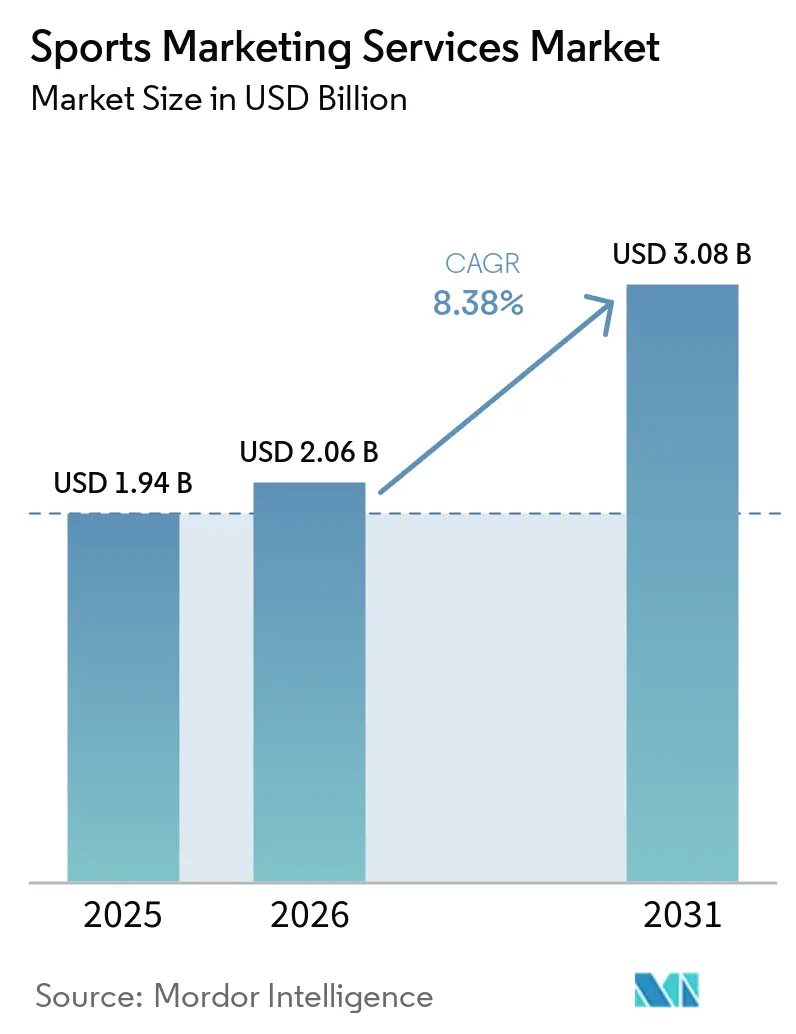
| Market Size (2026) | USD 2.06 Billion |
| Market Size (2031) | USD 3.08 Billion |
| Growth Rate (2026 - 2031) | 8.38 % |
| Fastest Growing Market | Asia-Pacific |
| Largest Market | North America |
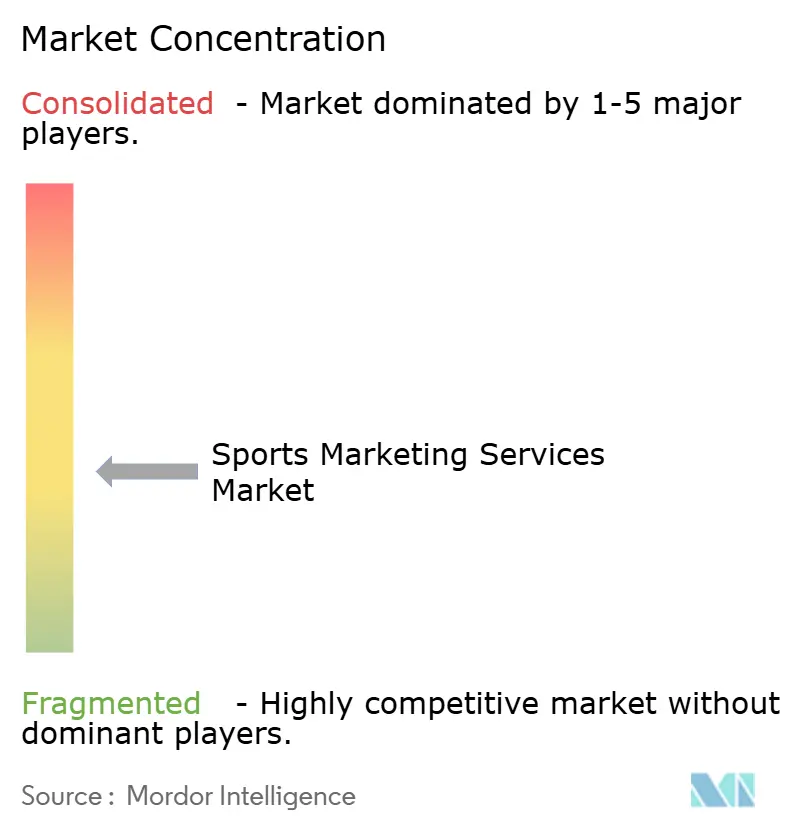
| Market Concentration | Medium |
Major Players *Disclaimer: Major Players sorted in no particular order Image © Mordor Intelligence. Reuse requires attribution under CC BY 4.0. | |
Sports Marketing Services Market Analysis by Mordor Intelligence
The sports marketing services market size was USD 1.94 billion in 2025 and is estimated to grow from USD 2.06 billion in 2026 to reach USD 3.08 billion by 2031, at a CAGR of 8.38% during the forecast period 2026-2031. The sports marketing services market is moving from logo placement toward agreements that connect commercial investment with measurable audience and business outcomes. Streaming, social platforms, and creator channels are expanding the places where brands can reach fans, while making campaign planning more complex. Women’s sports, college athlete name, image, and likeness rights, and esports are creating additional commercial inventory outside established men’s professional leagues. The FIFA World Cup 2026 is concentrating activation spending on fan programs, creator campaigns, and retail integrations across North America. Providers that combine audience intelligence, measurement, and activation services have a stronger position as clients seek clearer evidence of return.
Key Report Takeaways
- By service type, Brand Experience held 31.60% of the sports marketing services market share in 2025, while Content, Media and Creator Services are projected to expand at an 8.90% CAGR through 2031.
- By sport, Football/Soccer accounted for 36.90% of spending in 2025, while Esports is projected to grow at a CAGR of 9.22% through 2031.
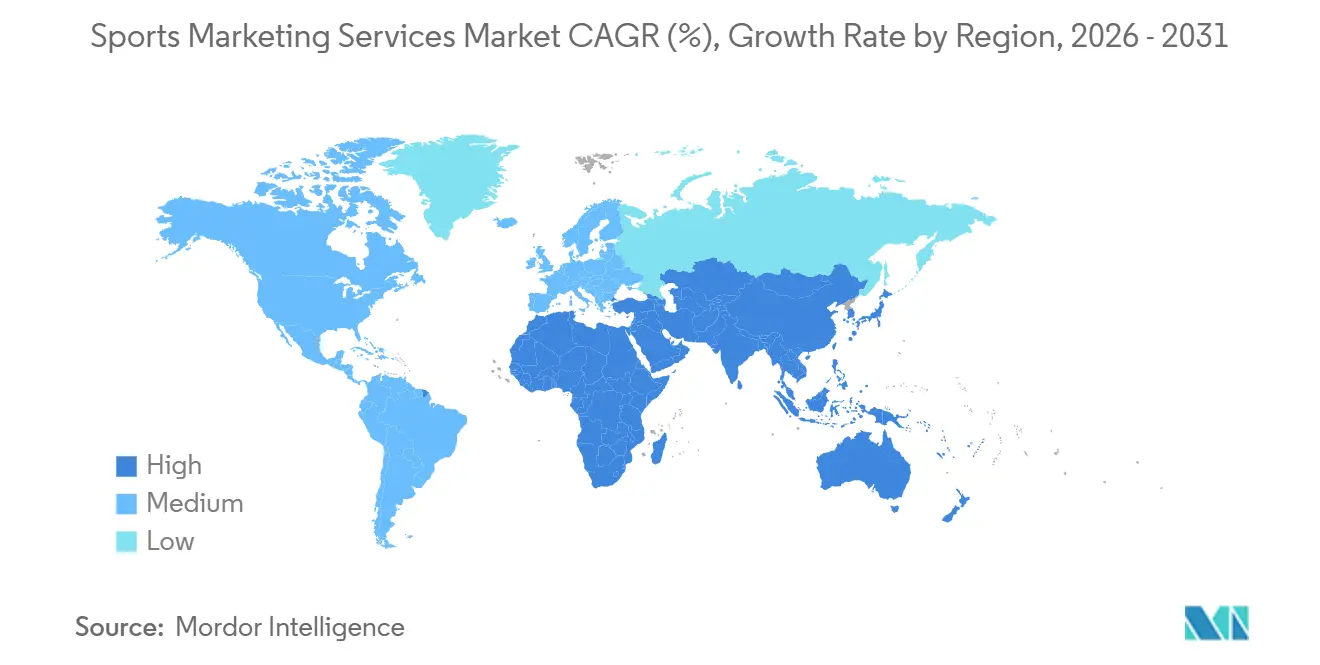
- By geography, North America held 42.80% of the global sports marketing services market in 2025, while Asia-Pacific is projected to expand at a 8.72% CAGR through 2031.
Note: Market size and forecast figures in this report are generated using Mordor Intelligence’s proprietary estimation framework, updated with the latest available data and insights as of January 2026.
Market Trends and Insights
Drivers Impact Analysis of Sports Marketing Services Market*
| Driver | (~) % Impact on CAGR Forecast | Geographic Relevance | Impact Timeline |
|---|---|---|---|
| Rising Demand for Measurable Sponsorship ROI | +2.0% | Global | Medium term (2-4 years) |
| Expansion of Streaming and Social-First Sports Consumption | +1.8% | Global, with Asia-Pacific acceleration | Short term (≤ 2 years) |
| Commercial Acceleration of Women’s Sports Inventory | +1.5% | North America and Europe, with spillover to Asia-Pacific | Medium term (2-4 years) |
| Brand Shift Toward Experiential Fan Engagement | +1.2% | North America and Europe | Short term (≤ 2 years) |
| Scaling of NIL and College Athlete Commercialization Infrastructure | +0.8% | North America | Medium term (2-4 years) |
| Adoption of AI-Native Sponsorship Planning and Optimization Workflows | +0.6% | Global, with early gains in North America | Long term (≥ 4 years) |
| Source: Mordor Intelligence | |||
Rising Demand for Measurable Sponsorship ROI
The gap between sponsorship spending and credible performance measurement remains a central issue for the sports marketing services market. A 2025 survey of global brand owners identified ROI measurement as the leading sponsorship management challenge, ahead of activation integration and budget governance.[1] Measurement often remains fragmented across teams, limiting a complete view of commercial return. Agencies that integrate measurement systems with creative and activation work can compete for mandates that previously depended more on network relationships. SponsorUnited introduced its 4.0 platform in February 2026, featuring data on more than 403,000 brands and 2.2 million deals, underscoring that benchmarking is becoming a standard service expectation. A peer-reviewed study found that a reinforcement learning framework improved sponsorship ROI by 25-35% and brand exposure by 20-30% against conventional approaches.
Expansion of Streaming and Social-First Sports Consumption
The shift of audiences from linear television to streaming and social channels is expanding the commercial surface area of the global sports marketing services market. Fans now engage with live games, clips, creators, team channels, and athlete accounts across several formats. This pattern creates separate engagement pools that need different creative assets, distribution plans, and measurement methods. It also makes content deal structuring and creator partnership management central services rather than optional additions. Platforms that secure sports rights are increasing the value of platform-native distribution, fan engagement, and campaign coordination skills. Agencies are responding by connecting sports activations with creator programs and digital retail activity, producing a broader service need and a more difficult attribution environment.
Commercial Acceleration of Women’s Sports Inventory
Women’s sports is creating a larger and more established source of work for the global sports marketing services market. Commercial programs need audience strategy, sponsorship packaging, content production, and longer-term partner management. The category has attracted brands that want inventory with strong engagement potential and lower entry pricing than comparable men’s properties. A 2025 Women’s Rugby World Cup campaign using Opta data produced a 29% increase in brand awareness and a 49% increase in brand affinity among Gen Z audiences. This type of activation places data and tailored content at the center of commercial planning. Agencies with established rosters and audience knowledge can help brands enter women’s sports without simply applying existing men’s sports playbooks.
Brand Shift Toward Experiential Fan Engagement
Brands are placing more emphasis on in-person programs that can build trust and create content for wider distribution. This supports demand in the global sports marketing services market for fan festivals, interactive venue programs, hospitality, and creator-led events. World Cup activations are increasing this requirement because brands must connect host-city activity with digital audiences and retail participation. Experience-led programs can create earned media and social sharing when they give fans useful or distinctive reasons to participate. Capital One’s 2026 Major League Baseball activity used exclusive cardholder experiences to connect fan engagement with customer acquisition and retention. Providers that act as strategic experience partners can move beyond event delivery into planning, data capture, commercial design, and ongoing partner value.
Restraints Impact Analysis of Sports Marketing Services Market*
| Restraint | (~) % Impact on CAGR Forecast | Geographic Relevance | Impact Timeline |
|---|---|---|---|
| Fragmented Cross-Platform Measurement and Attribution | -1.5% | Global | Short term (≤ 2 years) |
| Escalating Rights Fees and Activation Costs | -1.2% | North America and Europe | Medium term (2-4 years) |
| Privacy and Data Governance Friction in Fan Personalization | -0.8% | Europe and Asia-Pacific with EU regulatory alignment | Medium term (2-4 years) |
| Streaming Fragmentation and Subscription Fatigue | -0.6% | Global, concentrated in North America | Long term (≥ 4 years) |
| Source: Mordor Intelligence | |||
Fragmented Cross-Platform Measurement and Attribution
Streaming platforms, social channels, and creator networks divide sports audiences into engagement pools that many measurement systems cannot reconcile. This limits buyers' ability to compare exposure and outcomes across a complete campaign. ESPN adopted Comscore’s cross-platform measurement system in January 2026 to bring together linear television, streaming, digital, and social audience data. The development signals progress, but it does not create a common standard across rights holders, platforms, and countries. Sports marketing services firms must invest in their own measurement tools, which creates a heavier burden for mid-tier agencies without dedicated analytics divisions. In Europe, privacy rules also limit user-level tracking and make cross-platform attribution more difficult.
Escalating Rights Fees and Activation Costs
Higher media rights prices are putting pressure on the budgets supporting the sports marketing services market. When a larger share of the marketing budget is allocated to securing rights, less can be directed to activation, measurement, and agency services. The effect is most pronounced for mid-market agencies that cannot combine rights procurement with broader commercial contracts. Costs are also rising in esports, where premium partnerships require both rights fees and separate activation budgets. Brands may reduce the number of properties in their portfolios or seek more evidence before approving renewals. This puts pressure on providers to demonstrate commercial value beyond visibility and can encourage boutique firms to partner with larger networks.
*Our forecasts treat driver/restraint impacts as directional, not additive. The impact forecasts reflect baseline growth, mix effects, and variable interactions.
Sports Marketing Services Market Segment Analysis
By Service Type:
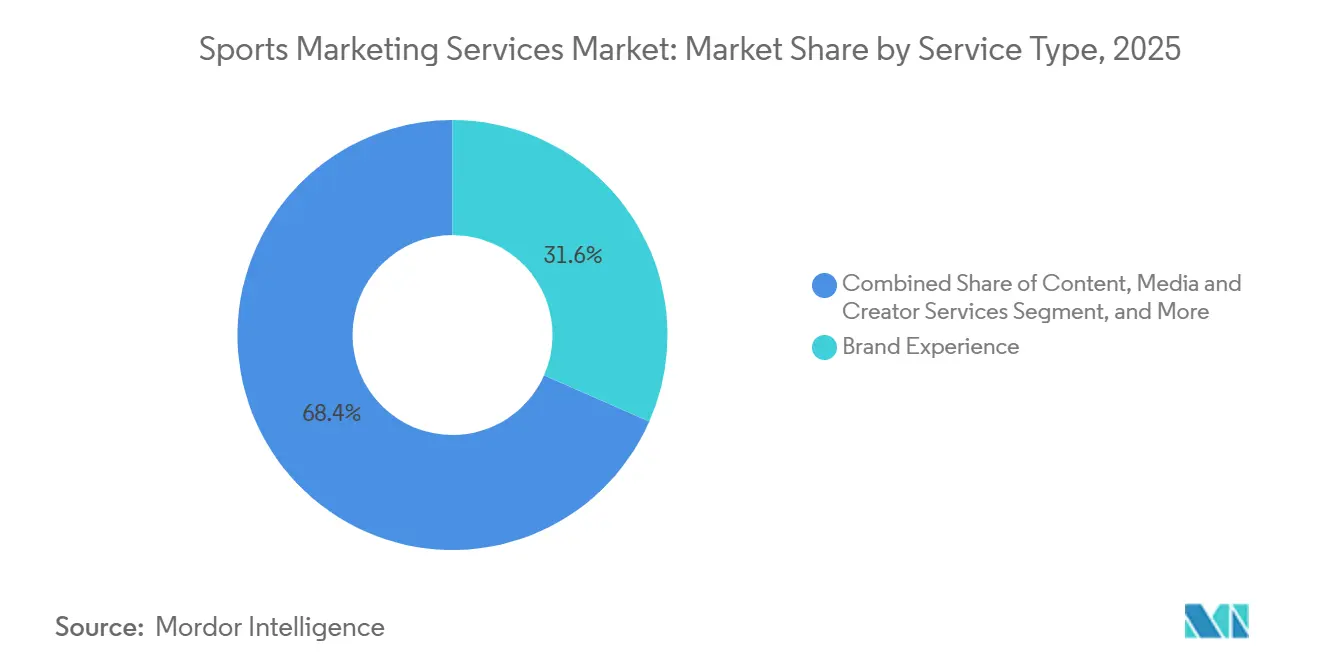
Creator Services Grow as Brand Experience Anchors the PortfolioBrand Experience held 31.60% of service-type spending in 2025, reflecting continued investment in venue activations, experiential pop-ups, and sponsored fan events. It accounted for the largest share of the sports marketing services market among the service categories. The World Cup cycle is directing more budgets toward host-city festivals, interactive venue programs, and creator-integrated activity. These programs are designed to create value beyond a stadium placement. Strategic Advisory and Commercial Intelligence Services remains relevant as clients address name, image, and likeness commercialization, streaming rights strategy, and changes in college athletic programs. Learfield reported more than USD 300 million in NIL-linked sponsorship revenue for 2025-26, up from more than USD 140 million in 2024-25, across more than 1,300 brands and 5,000 student-athletes.[2] Commercial Rights Sales and Partnership Management Services also benefit from expanding deal activity across professional and college properties. Audience Development and Engagement Services are gaining importance as teams and leagues develop first-party data capabilities.
Content, Media and Creator Services is projected to grow at a 8.90% CAGR from 2026 to 2031. The sports marketing services market size for this service line is supported by the formal adoption of creator networks as sports distribution infrastructure. Athlete creators are increasingly managed as media partners rather than as occasional influencers. This shift broadens agency work from creative production into partner selection, rights management, distribution, and performance reporting. Major League Soccer announced a multiyear collaboration with DataGrail in March 2026 to deploy a league-wide data privacy and governance platform across its central operations and 30 clubs. The arrangement shows that audience development now includes consent management and data governance. Agencies that combine content work with legal and technology capabilities are better placed to meet these requirements. Privacy compliance is becoming part of contracts for personalization and audience development services.

By Sport:
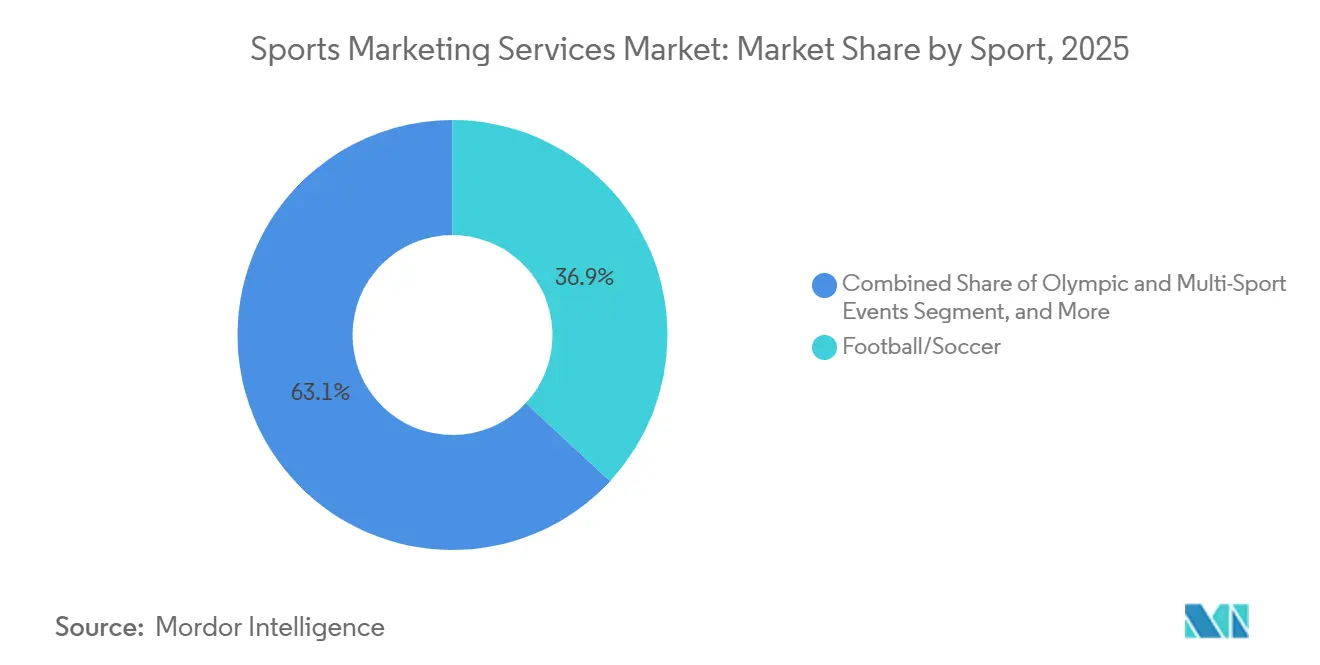
Football/Soccer Leads Spending as Esports Attracts New Brand CategoriesFootball/Soccer held 36.90% of sport-level spending in 2025, making it the leading sport category in the sports marketing services market. Its position reflects the international commercial appeal of club football and the World Cup 2026 activation cycle. The return of the World Cup to North America is drawing financial services, quick-service restaurants, and consumer technology brands into football sponsorship. This raises demand for agencies that can manage local activations alongside global partner requirements. Basketball remains a large category because major media agreements support sponsor interest and deal activity. Cricket retains commercial importance across South Asia, the United Kingdom, and Africa. The ICC Women’s T20 Cricket World Cup 2026 is providing another opportunity for brands to enter women’s cricket programs. Football/Soccer will remain a key volume base for the sports marketing services market as properties seek more commercial partners and better activation outcomes.
Esports is projected to expand at a 9.22% CAGR from 2026 to 2031, the fastest rate among sport categories. Non-endemic brands in consumer goods, financial services, and automotive are becoming important sponsors because esports provides access to Gen Z audiences. The category functions as a cultural channel as well as a conventional sports sponsorship vehicle. Premium esports properties are attracting substantial commercial budgets, which makes sponsorship strategy and activation quality more important. Tennis, golf, baseball, and softball retain stable brand ecosystems with established sponsor categories. The Milan-Cortina 2026 Winter Games supported European brand activation and hospitality activity across Olympic and multisport properties. Formula 1 and other motorsport properties continue to attract new sponsor categories through their expanding global audiences. These audiences have meaningful overlap with esports viewers, giving agencies options for cross-sport activation portfolios.
Geography Analysis
North America Sports Marketing Services Market
North America held 42.80% of the global sports marketing services market in 2025. The region combines high media rights values, mature sponsorship practices, regular live attendance, and brand budgets that support the sports marketing services market. The name, image, and likeness economy is adding a commercial layer for audience development, content, and partnership services, while the World Cup 2026 is increasing demand for host-city activations, fan festivals, creator campaigns, and retail connections. Opendorse projected the U.S. NIL market would reach USD 4.5 billion in the 2026-27 academic year. North America remains the primary regional base for providers offering integrated rights, activation, data, measurement, and performance reporting.
Europe Sports Marketing Services Market
Europe is the second-largest regional base in the sports marketing services market. European sports sponsorship is expected to reach EUR 24.79 billion (USD 28.5 billion) in 2025.[3] Germany is expected to remain Europe’s largest national sports sponsorship market at EUR 6.26 billion (USD 7.19 billion), while Spain is projected to rise by 14% to EUR 2.18 billion (USD 2.5 billion). The United Kingdom is expected to reach EUR 6.15 billion (USD 7.07 billion), France EUR 1.85 billion (USD 2.13 billion), and Italy EUR 2.01 billion (USD 2.31 billion). Mature media rights and advertising markets support stable demand for specialist services, while privacy governance, talent-led partnerships, and audience data rules shape campaign design.
APAC and Africa Sports Marketing Services Market
Asia-Pacific is projected to grow at an 8.72% CAGR from 2026 to 2031, the fastest regional rate. This creates an expanding sports marketing services market size for agencies serving India, China, and South Korea. India’s cricket ecosystem and growing digital distribution are building demand for structured sponsorship, content, and rights services, while China’s streaming environment requires localized digital partnership models. Dentsu’s agreement with the World Baseball Softball Confederation continued its role in commercializing media and marketing rights across international baseball and softball events. Africa remains an earlier-stage region, although established South African sponsorship activity, growing Nigerian football media, and Egypt’s event-hosting ambitions are creating need for specialist support.
Competitive Landscape
The sports marketing services market remains fragmented. Large integrated networks, including Octagon, Dentsu, and IMG under TKO Group Holdings, and SPORTFIVE, compete across the sports marketing services market with specialized agencies and data-led firms. Scale matters because major clients increasingly require rights knowledge, creative work, technology, measurement, and commercial planning as part of a combined program. Private equity activity is changing the structure as investors seek businesses with durable rights and client relationships. TKO Group Holdings completed its acquisition of IMG, On Location, and Professional Bull Riders from Endeavor in November 2025.[4] The acquisition brought media rights management for more than 200 rights holders into the wider TKO organization and increased its ability to connect rights management with commercial services.
Leading firms are also embedding data tools and operating systems within client organizations rather than relying solely on periodic advisory work. Learfield’s July 2026 partnership with SponsorCX added sponsorship management, brand partner reporting, and real-time performance tools across its college athletics portfolio. Major League Soccer’s DataGrail collaboration added privacy and consent management across league operations and 30 clubs. EDO launched Sponsored Ad Outcomes in June 2026 to detect and quantify brand integrations across live sports broadcasts.
College sports infrastructure, women’s sports, and AI-enabled sponsorship tools remain areas where the sports marketing services market offers specialist providers new work. AI tools may reduce manual valuation and benchmarking tasks, while increasing demand for agency judgment in strategy and implementation. The sports marketing services market will reward providers that combine technology, credible commercial advice, and privacy governance capabilities.
Sports Marketing Services Industry Leaders
-
Octagon, Inc.
-
Wasserman Media Group, LLC
-
Dentsu Group Inc.
-
Infront Sports & Media AG
-
SPORTFIVE Global Holding GmbH
- *Disclaimer: Major Players sorted in no particular order
Sports Marketing Services Market Companies Covered in this Report
- Octagon, Inc.
- Wasserman Media Group, LLC
- Dentsu Group Inc.
- Infront Sports & Media AG
- SPORTFIVE Global Holding GmbH
- Creative Artists Agency, LLC
- William Morris Endeavor Entertainment, LLC
- IMG Worldwide, LLC
- Learfield Communications, LLC
- Two Circles Ltd
- Publicis Groupe S.A.
- GMR Marketing LLC
- TEAM Marketing AG
- CSM Sport and Entertainment LLP
- Excel Sports Management, LLC
- Momentum Worldwide
- Abler Sports & Entertainment
- Right Formula Ltd
Recent Industry Developments in Sports Marketing Services Market
- August 2026: Associated Press reported a 123% increase in female athlete participation in NIL compensation activities within Learfield-managed programs during 2025-26, with the athlete count rising from 2,136 to 4,772. The increase reflects growing commercial activity in women’s sports marketing services.
- July 2026: Learfield announced a strategic partnership with SponsorCX to deploy advanced sponsorship management, enhanced brand partner reporting, and real-time performance insights across its college athletics portfolio, enhancing the data infrastructure supporting its brand partnership operations.
- June 2026: Opendorse formally introduced Opendorse One, a curated network of more than 1,000 college athlete creators for full-service NIL campaign execution, and Athlete Commerce Media, which connects athlete-generated content to retailer purchase data for closed-loop attribution.
- May 2026: TPG reached an agreement to acquire Learfield in a deal valued at USD 2 billion, one of the largest transactions in college sports media and marketing, expected to close in Q3 2026.
Global Sports Marketing Services Market Report Scope
The sports marketing services market comprises agencies and service providers that help sports organizations, teams, leagues, athletes, brands, and sponsors plan, execute, and measure marketing activities, including sponsorship management, brand partnerships, fan engagement, event promotion, media rights activation, digital marketing, and merchandising strategies.
The Sports Marketing Services Market Report is Segmented by Service Type (Strategic Advisory and Commercial Intelligence Services, Commercial Rights Sales and Partnership Management Services, Brand Experience, Audience Development and Engagement Services, and Content, Media and Creator Services), By Sport (Football/Soccer, Basketball, Cricket, Baseball and Softball, Tennis, Golf, Esports, Olympic and Multi-Sport Events, and Other Sports), and Geography (North America, South America, Europe, Asia-Pacific, Middle East, and Africa). The Market Forecasts are Provided in Terms of Value (USD).
Segmentation Overview
| Strategic Advisory and Commercial Intelligence Services |
| Commercial Rights Sales and Partnership Management Services |
| Brand Experience |
| Audience Development and Engagement Services |
| Content, Media and Creator Services |
| Football/Soccer |
| Basketball |
| Cricket |
| Baseball and Softball |
| Tennis |
| Golf |
| Esports |
| Olympic and Multi-Sport Events |
| Other Sports |
| North America | United States |
| Canada | |
| Mexico | |
| South America | Brazil |
| Argentina | |
| Chile | |
| Rest of South America | |
| Europe | Germany |
| United Kingdom | |
| France | |
| Italy | |
| Spain | |
| Rest of Europe | |
| Asia-Pacific | China |
| Japan | |
| India | |
| South Korea | |
| Australia | |
| Rest of Asia-Pacific | |
| Middle East | United Arab Emirates |
| Saudi Arabia | |
| Qatar | |
| Rest of Middle East | |
| Africa | South Africa |
| Egypt | |
| Nigeria | |
| Rest of Africa |
| By Service Type | Strategic Advisory and Commercial Intelligence Services | |
| Commercial Rights Sales and Partnership Management Services | ||
| Brand Experience | ||
| Audience Development and Engagement Services | ||
| Content, Media and Creator Services | ||
| By Sport | Football/Soccer | |
| Basketball | ||
| Cricket | ||
| Baseball and Softball | ||
| Tennis | ||
| Golf | ||
| Esports | ||
| Olympic and Multi-Sport Events | ||
| Other Sports | ||
| By Geography | North America | United States |
| Canada | ||
| Mexico | ||
| South America | Brazil | |
| Argentina | ||
| Chile | ||
| Rest of South America | ||
| Europe | Germany | |
| United Kingdom | ||
| France | ||
| Italy | ||
| Spain | ||
| Rest of Europe | ||
| Asia-Pacific | China | |
| Japan | ||
| India | ||
| South Korea | ||
| Australia | ||
| Rest of Asia-Pacific | ||
| Middle East | United Arab Emirates | |
| Saudi Arabia | ||
| Qatar | ||
| Rest of Middle East | ||
| Africa | South Africa | |
| Egypt | ||
| Nigeria | ||
| Rest of Africa | ||
Key Questions Answered in the Report
What is the sports marketing services market size?
It is estimated at USD 2.06 billion in 2026 and is forecast to reach USD 3.08 billion by 2031, reflecting an 8.38% CAGR during 2026-2031. The estimate reflects demand for commercial planning, activation, content, measurement, and partner reporting work.
What is driving demand for sports marketing services?
Demand comes from stronger ROI measurement requirements, streaming and creator channels, women’s sports commercialization, live fan programs, and college athlete commercialization. These needs increase work across planning, rights, activation, content, reporting, partner management, and audience development.
Which service type leads sports marketing services?
Brand Experience led service-type spending with 31.60% in 2025. Host-city programs, interactive venues, hospitality, fan festivals, and creator participation support this position and reinforce the need for coordinated in-person, social, retail, and digital experiences.
Which sport category is growing fastest?
Esports is projected to grow at a 9.22% CAGR from 2026 to 2031. Consumer goods, financial services, and automotive sponsors use esports to reach Gen Z audiences through culturally relevant content, creator activity, live events, and community-based engagement.
Which region has the strongest growth outlook?
Asia-Pacific is projected to grow at an 8.72% CAGR through 2031. India’s cricket economy and China’s streaming ecosystem are increasing demand for localized sponsorship, content, rights, partnership, audience development, and performance measurement services.
Why is measurement important for sponsorship programs?
Cross-platform reporting helps brands assess outcomes across television, streaming, social channels, creators, and live activity. Better evidence can support partner renewals, budget decisions, campaign adjustment, resource allocation, and the design of future activation programs.