
Sponsorship Marketing Services Market Size and Share
Market Overview
| Study Period | 2020 - 2031 |
|---|---|
| Market Size (2026) | USD 16.06 Billion |
| Market Size (2031) | USD 21.10 Billion |
| Growth Rate (2026 - 2031) | 5.61 % |
| Fastest Growing Market | Asia-Pacific |
| Largest Market | North America |
| Market Concentration | Medium |
Major Players *Disclaimer: Major Players sorted in no particular order Image © Mordor Intelligence. Reuse requires attribution under CC BY 4.0. | |
Sponsorship Marketing Services Market Analysis by Mordor Intelligence
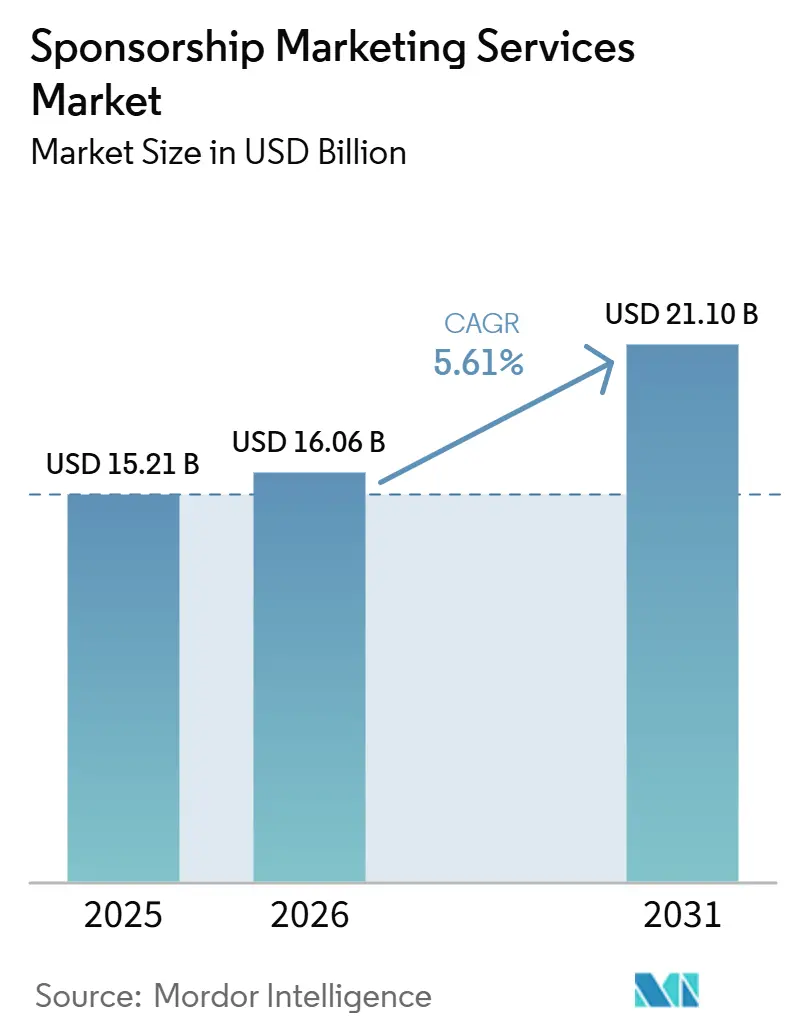
The Sponsorship marketing services market size was valued at USD 15.21 billion in 2025 and estimated to grow from USD 16.06 billion in 2026 to reach USD 21.10 billion by 2031, at a CAGR of 5.61% during the forecast period (2026-2031). The Sponsorship marketing services market is moving toward contracts that link sponsorship activity to commercial results, rather than relying solely on audience impressions. Brand owners are placing more value on agencies that can link activation activity to customer acquisition, sales lift, and customer value. Digital distribution, creator partnerships, and live-event content are expanding the scope of services required after a sponsorship right is purchased. Women’s sports, creator-led properties, and fan events are expanding the available inventory for brands seeking more targeted entry points. Consolidation among large marketing groups is also raising the importance of data systems, first-party audience information, and cross-channel measurement in the Sponsorship marketing services market.
Key Report Takeaways
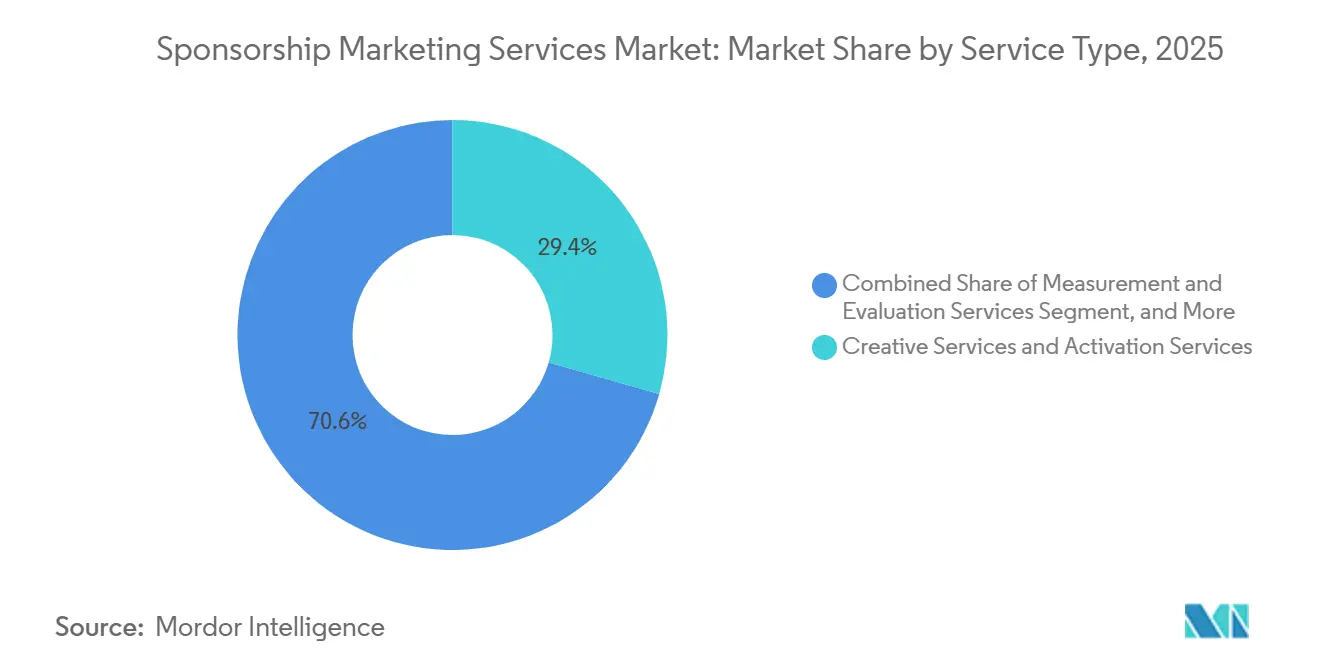
- By service type, Creative Services and Activation Services held 29.43% of the Sponsorship marketing services market share in 2025, while Measurement and Evaluation Services is projected to expand at a 6.13% CAGR through 2031.
- By sponsorship model, Brand Sponsorship held 55.18% of the Sponsorship marketing services market share in 2025, while Creator Sponsorship is projected to expand at a 6.48% CAGR through 2031.
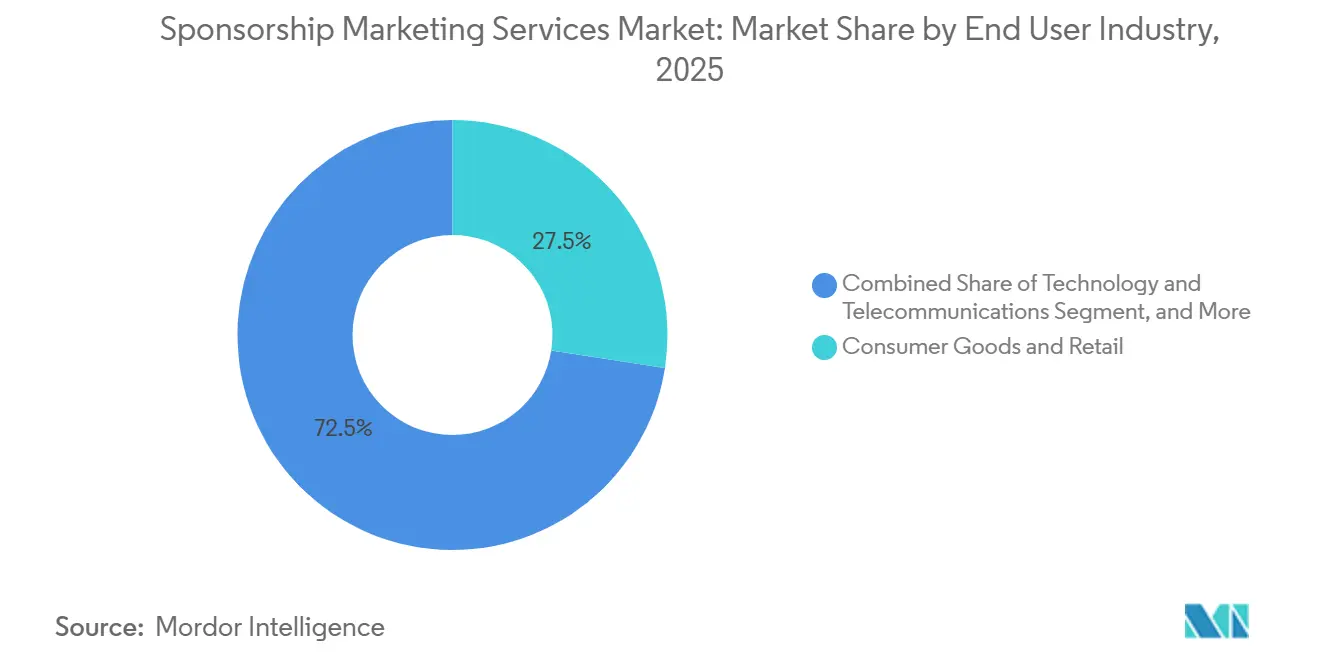
- By end-user industry, Consumer Goods and Retail held 27.46% of revenue in 2025, while Media and Entertainment is projected to expand at a 5.91% CAGR through 2031.
- By geography, North America held 42.71% of revenue in 2025, while Asia-Pacific is projected to expand at a 5.98% CAGR through 2031.
Note: Market size and forecast figures in this report are generated using Mordor Intelligence’s proprietary estimation framework, updated with the latest available data and insights as of January 2026.
Market Trends and Insights
Drivers Impact Analysis of Sponsorship Marketing Services Market*
| Driver | (~) % Impact on CAGR Forecast | Geographic Relevance | Impact Timeline |
|---|---|---|---|
| Rising Demand for Measurable Sponsorship ROI | +2.1% | Global | Medium term (2-4 years) |
| Expansion of Digital and Social Activation | +2.3% | Global, concentrated in North America and the Asia-Pacific | Short term (≤ 2 years) |
| Creator and Talent-Led Partnership Scaling | +1.8% | North America, Europe, Asia-Pacific | Short term (≤ 2 years) |
| Mega-Event and Fan Festival Expansion | +1.6% | North America, Europe, and spill-over to the Asia-Pacific and the Middle East | Short term (≤ 2 years) |
| Commercial Acceleration of Women's Sports Rights | +1.2% | North America, Europe, early-stage gains in Asia-Pacific, and the Middle East | Medium term (2-4 years) |
| AI-Enabled Sponsorship Valuation and Optimization | +0.9% | Global | Long term (≥ 4 years) |
| Source: Mordor Intelligence | |||
Rising Demand for Measurable Sponsorship ROI
Finance teams have applied tighter scrutiny to sponsorship budgets since 2024, and they increasingly expect attribution standards that mirror those used in paid digital media. With 76% of global brand owners naming ROI measurement as their biggest challenge, while less than 1% of sponsorship budgets are allocated to measurement, the gap between spend and proof is creating durable demand for evaluation services across the sponsorship marketing services market. Brands are moving away from awareness and familiarity as stand-alone success markers and are placing more weight on qualified pipeline, customer actions, and commercial contribution. The Sponsorship Effectiveness Forum found that the most effective programs used 3.1 measurement approaches on average, compared with 2.4 in less effective cases, suggesting that better outcomes are linked to broader, more disciplined methodology stacks.[1]Sponsorship Effectiveness Forum, “The Sponsorship Effect,” GSIQ, gsiq.com Live Nation’s Q1 2026 reporting also showed how properties compete through data-rich packages, with sponsorship segment AOI up 21% year on year and 85% of full-year commitments booked by the end of April. As more brand owners concentrate budgets into fewer and larger relationships, agencies with unified measurement systems are gaining an advantage over narrower activation specialists in the sponsorship marketing services market.
Expansion of Digital and Social Activation
Digital and social execution now serves as the primary amplification layer for sponsorships that were once built primarily around venue signage and broadcast presence. Unilever’s 2026 FIFA World Cup activation used a 24-7 real-time social content hub called The Locker Room, staffed by creator and community specialists, demonstrating how sponsorship programs now run as continuous content operations rather than short campaign bursts. This shift changes service demand inside the sponsorship marketing services market because always-on editorial response, creator coordination, and platform-specific production require recurring labor and creative fees. In Japan, total advertising expenditure reached JPY 8,062.3 billion (USD 52.7 billion) in 2025, and internet advertising exceeded 50% of total spend for the first time, materially widening the digital inventory base that sponsorship agencies can activate against. When brand partners follow audiences into short-form video, creator commentary, and socially shared event moments, campaign design becomes more modular and less dependent on a single media outlet. That operating change supports faster expansion in digital sponsorship and raises the importance of social-first activation talent across the sponsorship marketing services market.
Creator and Talent-Led Partnership Scaling
Creator partnerships have shifted from support tactics to formal sponsorship vehicles that can run across several markets and over much longer periods. Expedia’s April 2026 partnership with IShowSpeed reached more than 400 million people through its opening activation and included a dedicated platform, demonstrating that creator-led deals can now serve as central branded properties rather than side campaigns. That matters for the sponsorship marketing services market because it increases demand for agencies that can combine rights negotiation, content planning, talent management, and reporting within one account structure. The model also attracts brands that want stronger audience trust and more direct cultural relevance than traditional placements can deliver on their own. Dentsu Group began the global expansion of its Sports and Entertainment business in FY2025 after previously concentrating that capability in Japan, indicating that major agency groups are building broader infrastructure around global event and talent opportunities. Agencies that cannot manage both property relationships and creator ecosystems are facing pressure from integrated operators with deeper talent access and more flexible production networks. As that shift continues, the sponsorship marketing services market is likely to reward firms that treat creators as a permanent commercial channel rather than a campaign extension.
Mega-Event and Fan Festival Expansion
Mega-events continue to widen the commercial footprint of sponsorship by creating more activation zones, more inventory layers, and more opportunities for local adaptation. The FIFA World Cup 2026 expanded to 48 teams across 16 North American host cities, which materially increases the number of venues, fan touchpoints, and surrounding activation windows available to agencies and brand owners. Host-city agreements also allow fan festivals to operate as separate activation channels beyond the stadium perimeter, broadening the service opportunities for event production, local partnerships, staffing, and content development. Live Nation reported mid-teens sponsorship growth across its global venue portfolio in FY2025, and its Q1 2026 sponsorship segment revenue reached USD 259 million, up 20% year on year, which supports the view that live event ecosystems are monetizing broader commercial programs around gatherings rather than only the core ticketed event. The Milan-Cortina 2026 Winter Olympics added another major event platform this year, which kept premium activation demand elevated across Europe as well. Together, these conditions support the sponsorship marketing services market by expanding the range of billable services that surround large properties, from planning and local execution to post-event reporting.
Restraints Impact Analysis of Sponsorship Marketing Services Market*
| Restraint | (~) % Impact on CAGR Forecast | Geographic Relevance | Impact Timeline |
|---|---|---|---|
| Premium Rights-Fee Inflation | -1.8% | Global, most acute in North America and Western Europe | Short term (≤ 2 years) |
| Fragmented Cross-Channel Measurement Standards | -1.2% | Global | Medium term (2-4 years) |
| Data Privacy and API Access Constraints | -0.8% | Europe (GDPR), North America (CCPA), Asia-Pacific (PIPL) | Medium term (2-4 years) |
| Real-Time Reputation and Brand Safety Exposure | -0.5% | Global | Short term (≤ 2 years) |
| Source: Mordor Intelligence | |||
Premium Rights-Fee Inflation
Rights-fee inflation is tightening the economics of mid-market sponsorship programs, as fee growth is outpacing many activation budgets. Average rights-fee spend per brand rose 58% to USD 3.83 million in 2024, and 45% of brands renegotiated, exited, or shortened deals in response, which shows that pricing pressure is already changing portfolio behavior. This matters for the sponsorship marketing services market because higher entry costs reduce the number of properties some clients can support, shifting demand toward fewer, more scrutinized partnerships. The broader media rights environment also continued to harden into 2026, keeping pressure on sponsorship pricing for premium sports and entertainment properties. As prices rise, brands look more closely at whether a property can deliver measurable business outcomes rather than simply provide access to a broad audience. Agencies with stronger valuation methods and better portfolio discipline are therefore better placed than firms that rely on transaction volume across a wide but shallow client base.
Fragmented Cross-Channel Measurement Standards
The lack of a unified sponsorship currency still forces brands to compare broadcast, digital, social, out-of-home, and live experience results through incompatible frameworks. Different agencies, properties, and platforms often assign very different ROI values to the same activation, making year-on-year comparisons and portfolio optimization much harder than budget owners would like. Less than 1% of sponsorship budgets are allocated to measurement in most surveyed portfolios, yet 76% of brand owners still identify ROI proof as the central problem, confirming that the sponsorship marketing services market recognizes the issue but has not resolved it. Incumbent firms also protect proprietary valuation systems as competitive moats, and that can limit transparency for brand-side buyers who want cleaner comparisons across potential partners. The problem is sharper in newer digital channels because platform API changes can undermine third-party audience analytics and disrupt reporting continuity over time. Until a more accepted cross-channel standard emerges, the sponsorship marketing services market will continue to carry friction in pitch processes, internal approvals, and post-campaign evaluation.
*Our forecasts treat driver/restraint impacts as directional, not additive. The impact forecasts reflect baseline growth, mix effects, and variable interactions.
Sponsorship Marketing Services Market Segment Analysis
By Service Type:
Activation Leads While Measurement Gains ImportanceCreative Services and Activation Services accounted for 29.43% of the Sponsorship marketing services market size in 2025. The segment remained the largest because brands need visible work that turns sponsorship rights into experiences, content, and audience engagement. Activation helps brands distinguish similar rights portfolios when several competitors sponsor the same property. Relo Metrics expanded its Census product into Formula 1 in March 2025, using NVIDIA’s NV-CLIP model to identify brand placement on race cars at speed. The launch demonstrated how computer vision can deliver faster information to sponsors and rights holders.
Measurement and Evaluation Services is projected to grow at a 6.13% CAGR through 2031. This reflects demand for systems that connect visual exposure, social activity, broadcast reach, and customer information. The Sponsorship marketing services industry is shifting toward services that support commercial accountability across the sponsorship lifecycle. Strategy and Consulting supports brands that need independent advice on portfolio selection and investment planning. Sponsorship Management Services is becoming more technology-based, as illustrated by Two Circles’ KORE platform work for the German Football Association sponsorship program.



By Sponsorship Model:
Brand Sponsorship Retains Scale While Creator Deals GrowBrand Sponsorship accounted for 55.18% of the Sponsorship marketing services market in 2025. It remained the largest model because it gives companies association rights across sports, entertainment, culture, and social properties. Brands use these agreements to build familiarity before customers enter a purchase process. Product Sponsorship offers a narrower path for food, technology, and automotive brands seeking campaigns tied to specific product lines. It can offer a more focused entry point than a full brand partnership.
Creator Sponsorship is projected to grow at a 6.48% CAGR through 2031. The model benefits from longer agreements that support recurring content and more consistent brand association. It also requires careful selection because high-performing creators may be unavailable for several months before a campaign begins. Naming rights, broadcast sponsorships, and purpose-led agreements continue to serve institutional needs, especially for financial services companies. The Sponsorship marketing services industry must manage brand, product, and creator agreements across several markets and properties.
By End-User Industry:
Consumer Goods and Retail Lead While Media and Entertainment AcceleratesConsumer Goods and Retail accounted for 27.46% of the Sponsorship marketing services market in 2025. Large consumer goods companies can use sports and entertainment to build awareness across broad customer groups. Unilever’s World Cup program covered more than 35 brands in 120 markets, showing the scale of execution that multinational consumer goods businesses can support. The segment also uses retail, social content, and product promotions to extend an event beyond the venue. Financial services companies remain significant buyers of naming rights, major event sponsorships, and fan experiences.
Media and Entertainment is projected to expand at a 5.91% CAGR through 2031. Streaming services are using sports rights to support subscriber acquisition and retention, while studios use athlete and talent partnerships to extend content promotion. Automotive and Mobility brands are changing their portfolios as they connect brand positioning with electric vehicles and urban mobility. Healthcare and Pharmaceuticals participation remains focused on wellness, mental health, and athletic performance properties. These programs require careful compliance with relevant U.S. Food and Drug Administration disclosure requirements.
Geography Analysis
North America and APAC Sponsorship Marketing Services Market
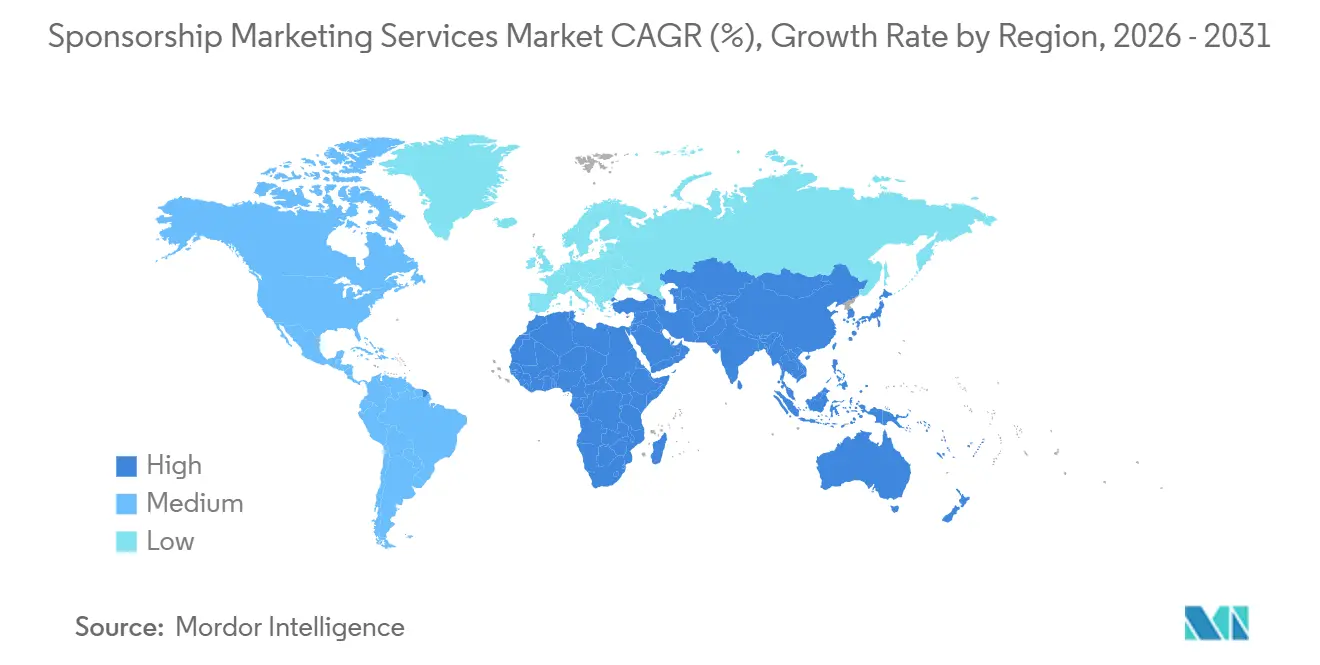
North America led the sponsorship marketing services market, while Asia-Pacific is projected to expand at a 5.98% CAGR through 2031, making it the fastest-growing regional segment. North America’s lead rests on its dense base of premium sports rights, deep corporate advertiser budgets, and the ability of leagues and promoters to package sponsorships across broadcast, digital, venue, and live-experience layers. The FIFA World Cup 2026, with 16 host cities across North America, increased the need for local activations, fan events, and support services throughout the tournament ecosystem. Canada and Mexico added to this depth, and Live Nation’s upgraded Estadio GNP Seguros in Mexico showed how venue modernization can quickly improve sponsorship and premium monetization potential in the region.[3]Live Nation Entertainment, “Live Nation Entertainment Q1 2026 Supplemental Disclosure,” SEC EDGAR, sec.gov The NBA’s USD 1.62 billion in team-level sponsorship revenue during the 2024-2025 season also showed that corporate demand in North America remains strong even as pricing rises.
Europe Sponsorship Marketing Services Market
Europe remained the second-largest regional block, with the total market reaching EUR 34.45 billion (USD 37.4 billion) in 2025, up 4.7% year on year, and sport accounting for EUR 24.79 billion (USD 26.9 billion), equal to 72% of the total. That composition kept sports at the center of demand for agency services, while also leaving room for broader commercial growth in entertainment and cultural properties. Spain was the fastest-growing major European market in 2025, with 14% growth, pointing to continued demand for new premium inventory and international event-led commercialization. The Milan Cortina 2026 Winter Olympics supported additional activity in the current year and reinforced Europe’s relevance for premium activation and management services across the sponsorship marketing services market.
APAC, South America and MEA Sponsorship Marketing Services Market
Asia-Pacific’s 5.98% CAGR reflected stronger cricket and esports momentum, ongoing digitalization in Japan, and rising brand participation across several large consumer markets. Japan’s advertising market reached JPY 8,062.3 billion (USD 52.7 billion) in 2025, and internet advertising exceeded 50% of total spend for the first time, which structurally widened the digital sponsorship inventory base across the region. India and South Korea continued to support regional momentum through strong sports and digital audience engagement, even though the service mix differs across properties and platforms. South America benefited from stronger festival infrastructure, and Live Nation linked part of its Q1 2026 sponsorship AOI growth to the strength of international festivals in that region. The Middle East is still building a longer-term commercial ecosystem through sovereign-backed sports and entertainment hosting, while Africa remains an emerging geography where infrastructure gaps limit near-term scale but do not remove demand for management and activation support.

Competitive Landscape
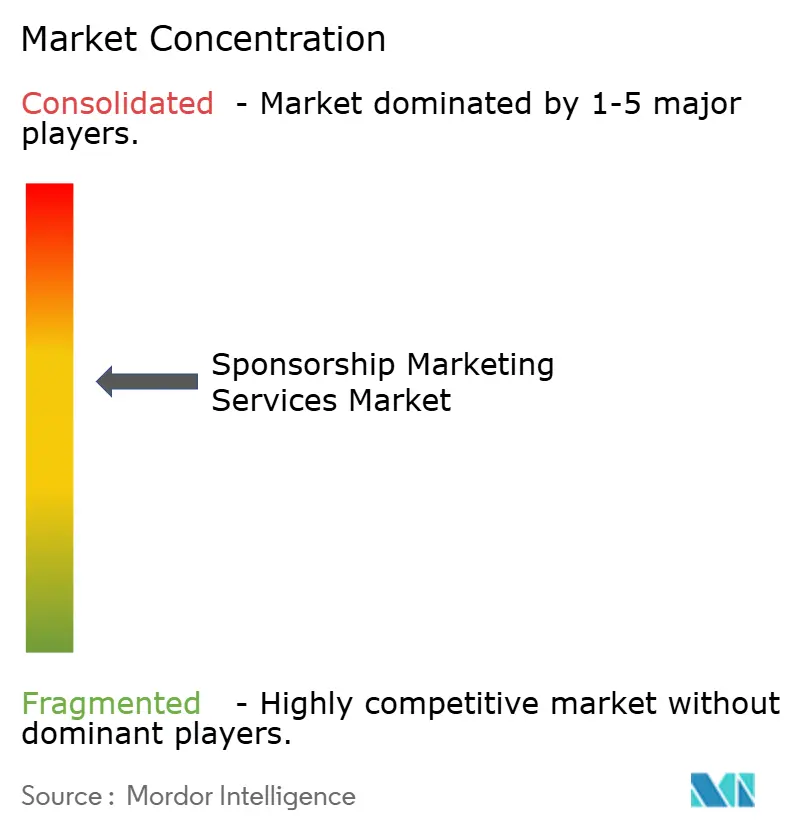
The sponsorship marketing services market is moderately consolidated at the top tier and highly fragmented beneath it, where many specialist agencies still compete on category depth, local access, or execution quality. This structure means the largest global groups can shape standards in data, talent, and cross-market delivery, but they do not fully control demand across the long tail of regional and niche mandates. Omnicom’s acquisition of Interpublic Group, completed in November 2025, created the world’s largest marketing group with combined 2024 pro forma revenues of USD 26.38 billion, which materially strengthened its position in integrated client mandates.[4]Omnicom Group Inc., “Omnicom Group Inc. 10-K Annual Report,” SEC EDGAR via Last10K, last10k.com These moves raised the operating benchmark for the sponsorship marketing services market because large clients now have clearer access to end-to-end platforms that combine rights strategy, media, execution, and data under one roof.
Publicis also integrated Epsilon's identity infrastructure into its sports intelligence platform, demonstrating how data ownership is becoming a structural advantage rather than a support tool. Dentsu Group’s global Sports and Entertainment expansion beginning in FY2025 pointed in the same direction, as major holding companies treated sports and culture sponsorship as a strategic growth category rather than a side capability. This leaves independent and mid-scale firms under pressure because they often lack proprietary data systems, broad geographic delivery, or integrated talent access. At the same time, fragmentation below the top tier remains meaningful because many clients still value local execution skill, category knowledge, or specialist relationships that larger networks do not always replicate efficiently.
One of the clearest white spaces in the sponsorship marketing services market is measurement-as-a-service, where brands want cleaner cross-platform attribution and finance-acceptable reporting. Relo Metrics added NVIDIA-powered computer vision and multi-modal AI to its analytics platforms in 2025, enabling real-time sponsor valuation and logo-exposure tracking, which illustrates how technology-led firms are starting to challenge traditional agency control over valuation systems. That type of capability matters because measurement credibility can influence who wins the mandate before activation work even begins. The competitive picture, therefore, combines consolidation at the top with continuous specialist entry below, especially in analytics, creator operations, and event execution. As a result, the sponsorship marketing services market is likely to remain only partly consolidated, with scale advantages growing in enterprise accounts while specialist firms continue to hold space in narrower, faster-moving niches.
Sponsorship Marketing Services Industry Leaders
Creative Artists Agency, LLC
Dentsu Group Inc.
Omnicom Group Inc.
Publicis Groupe S.A.
WPP plc
- *Disclaimer: Major Players sorted in no particular order
Sponsorship Marketing Services Market Companies Covered in this Report
- Creative Artists Agency, LLC
- Wasserman Media Group, LLC
- Dentsu Group Inc.
- Omnicom Group Inc.
- Publicis Groupe S.A.
- WPP plc
- Havas N.V.
- Genesco Sports Enterprises, Inc.
- Excel Sports Management, LLC
- Two Circles Limited
- SPORTFIVE Global Holding GmbH
- Infront Sports & Media AG
- Live Nation Entertainment, Inc.
- WME Group
- Stagwell Inc.
- SponsorUnited, Inc.
- Horizon Media, Inc.
- Lagardère SA

Recent Industry Developments in Sponsorship Marketing Services Market
- June 2026: The FIFA World Cup 2026 opened with brand activations underway at fan festivals across all 16 North American host cities. FIFA confirmed that its 2026 commercial program surpassed the Qatar 2022 record, with all top-tier sponsor slots sold out across 3 commercial tiers, including Adidas, Coca-Cola, Hyundai, Saudi Aramco, and Visa.
- June 2026: WPP Enterprise Solutions signed a multiyear Strategic Collaboration Agreement with Amazon Web Services to operationalize agentic AI across commerce, customer experience, and marketing operations for enterprise brands. The partnership positions WPP's Amazon Marketing Cloud center of excellence on AWS generative and agentic AI infrastructure.
- April 2026: Publicis Groupe and Microsoft expanded their strategic partnership to build a full-stack agentic marketing solution that combines Microsoft Azure and Microsoft 365 Copilot and is deployed to all 114,000+ Publicis employees. The expanded partnership also transferred Microsoft's estimated USD 700 million global media account from Dentsu to Publicis, as reported by The Drum.
- April 2026: Expedia announced a multi-phase, global partnership with creator IShowSpeed as Official Travel Partner, reaching more than 400 million people through an opening 5-country activation and building a dedicated platform, Exspeedia.com, around the creator.


Global Sponsorship Marketing Services Market Report Scope
The Sponsorship Marketing Services Market refers to the industry that facilitates partnerships between brands and events, organizations, or individuals to promote products or services. This market encompasses activities such as sponsorship agreements, activation strategies, and performance measurement to enhance brand visibility and consumer engagement. It includes various sponsorship types, such as sports, entertainment, arts, and corporate sponsorships, which are tailored to align with the target audience and marketing objectives.
The Sponsorship Marketing Services Report is Segmented by Service Type (Strategy and Consulting, Sponsorship Sales and Acquisition Services, Sponsorship Management Services, Creative Services and Activation Services, and Measurement and Evaluation Services), Sponsorship Model (Brand Sponsorship, Product Sponsorship, Creator Sponsorship, and Other Sponsorship Models), End User Industry (Consumer Goods and Retail, BFSI, Technology and Telecommunications, Automotive and Mobility, Media and Entertainment, Healthcare and Pharmaceuticals, Education, Travel and Hospitality, and Other End User Industries), and Geography (North America, South America, Europe, Asia-Pacific, Middle East, and Africa). The Market Forecasts are Provided in Terms of Value (USD).
| Strategy and Consulting |
| Sponsorship Sales and Acquisition Services |
| Sponsorship Management Services |
| Creative Services and Activation Services |
| Measurement and Evaluation Services |
| Brand Sponsorship |
| Product Sponsorship |
| Creator Sponsorship |
| Other Sponsorship Models |
| Consumer Goods and Retail |
| BFSI |
| Technology and Telecommunications |
| Automotive and Mobility |
| Media and Entertainment |
| Healthcare and Pharmaceuticals |
| Education |
| Travel and Hospitality |
| Other End User Industries |
| North America | United States |
| Canada | |
| Mexico | |
| South America | Brazil |
| Argentina | |
| Chile | |
| Rest of South America | |
| Europe | Germany |
| United Kingdom | |
| France | |
| Italy | |
| Spain | |
| Rest of Europe | |
| Asia-Pacific | China |
| Japan | |
| India | |
| South Korea | |
| Australia | |
| Rest of Asia-Pacific | |
| Middle East | Saudi Arabia |
| United Arab Emirates | |
| Qatar | |
| Rest of Middle East | |
| Africa | South Africa |
| Egypt | |
| Nigeria | |
| Rest of Africa |
| By Service Type | Strategy and Consulting | |
| Sponsorship Sales and Acquisition Services | ||
| Sponsorship Management Services | ||
| Creative Services and Activation Services | ||
| Measurement and Evaluation Services | ||
| By Sponsorship Model | Brand Sponsorship | |
| Product Sponsorship | ||
| Creator Sponsorship | ||
| Other Sponsorship Models | ||
| By End User Industry | Consumer Goods and Retail | |
| BFSI | ||
| Technology and Telecommunications | ||
| Automotive and Mobility | ||
| Media and Entertainment | ||
| Healthcare and Pharmaceuticals | ||
| Education | ||
| Travel and Hospitality | ||
| Other End User Industries | ||
| By Geography | North America | United States |
| Canada | ||
| Mexico | ||
| South America | Brazil | |
| Argentina | ||
| Chile | ||
| Rest of South America | ||
| Europe | Germany | |
| United Kingdom | ||
| France | ||
| Italy | ||
| Spain | ||
| Rest of Europe | ||
| Asia-Pacific | China | |
| Japan | ||
| India | ||
| South Korea | ||
| Australia | ||
| Rest of Asia-Pacific | ||
| Middle East | Saudi Arabia | |
| United Arab Emirates | ||
| Qatar | ||
| Rest of Middle East | ||
| Africa | South Africa | |
| Egypt | ||
| Nigeria | ||
| Rest of Africa | ||


Key Questions Answered in the Report
What is the size of the sponsorship marketing services sector?
The Sponsorship marketing services market is estimated at USD 16.06 billion in 2026 and is forecast to reach USD 21.10 billion by 2031, growing at a 5.61% CAGR.
What services generate the most demand in sponsorship programs?
Creative Services and Activation Services led with 29.43% in 2025 because brands need visible content, experiences, and audience engagement around their rights. Measurement and Evaluation Services is expected to be the fastest-growing category, with a 6.13% CAGR through 2031, as companies seek clear commercial reporting that supports investment decisions, program renewal, and future rights selection.
Why are brands investing more in sponsorship measurement?
Brands need evidence that sponsorship supports sales, acquisition, and customer value. This increases demand for providers that connect activation data with commercial outcomes, coordinate information from broadcast, social media, events, retail, and customer systems, and explain results clearly during budget reviews and renewal decisions.
Which sponsorship model is growing fastest?
Creator Sponsorship is forecast to grow at a 6.48% CAGR through 2031. Longer-term creator and ambassador relationships can provide recurring content, repeated brand association, and more coordinated campaign execution.
Which end-user group is expanding fastest?
Media and Entertainment is projected to grow at a 5.91% CAGR through 2031. Streaming platforms use sports rights and talent partnerships to support subscriber activity, retention, and content promotion.
Which region offers the strongest growth outlook?
Asia-Pacific is projected to record the fastest regional growth at a 5.98% CAGR through 2031. Cricket commercialization, mobile-first fan engagement, and creator-led activity support its outlook.
Page last updated on:





