
Specialty Crop Harvesters Market Size and Share
Market Overview
| Study Period | 2022 - 2032 |
|---|---|
| Market Size (2027) | USD 5.70 Billion |
| Market Size (2032) | USD 8.57 Billion |
| Growth Rate (2027 - 2032) | 8.50 % |
| Fastest Growing Market | Asia-Pacific |
| Largest Market | North America |
| Market Concentration | Medium |
Major Players *Disclaimer: Major Players sorted in no particular order Image © Mordor Intelligence. Reuse requires attribution under CC BY 4.0. | |
Specialty Crop Harvesters Market Analysis by Mordor Intelligence
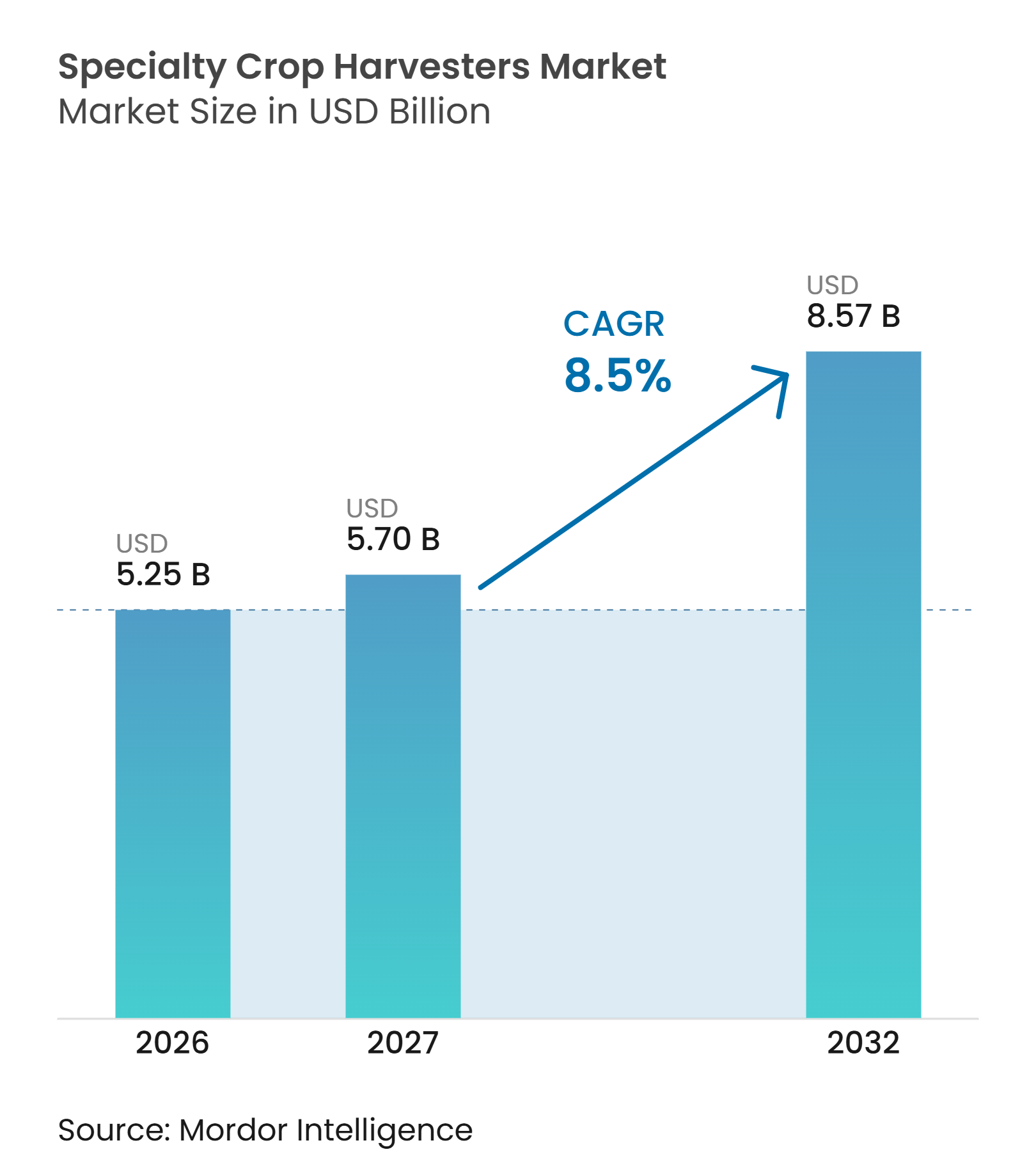
The specialty crop harvesters market size was valued at USD 5.25 billion in 2026 and is forecast to grow from USD 5.70 billion in 2027 to USD 8.57 billion by 2032, at a CAGR of 8.5% from 2027 to 2032. The market is driven by persistent farm labor shortages, rising seasonal wages, and the wider adoption of vision systems, gentle-handling mechanisms, and autonomous navigation. These pressures are most acute in high-value berry, nut, orchard fruit, and vegetable operations, where harvest timing and produce condition directly affect returns. The market also benefits from larger planted areas across several fruit and nut categories, expanding the potential installed base for purpose-built equipment. Conventional self-propelled machines continue to support revenue, while robotic systems are shaping product development priorities. Short harvest windows, high ownership costs, and uneven service coverage limit adoption among smaller operations and in emerging agricultural regions.
Key Report Takeaways
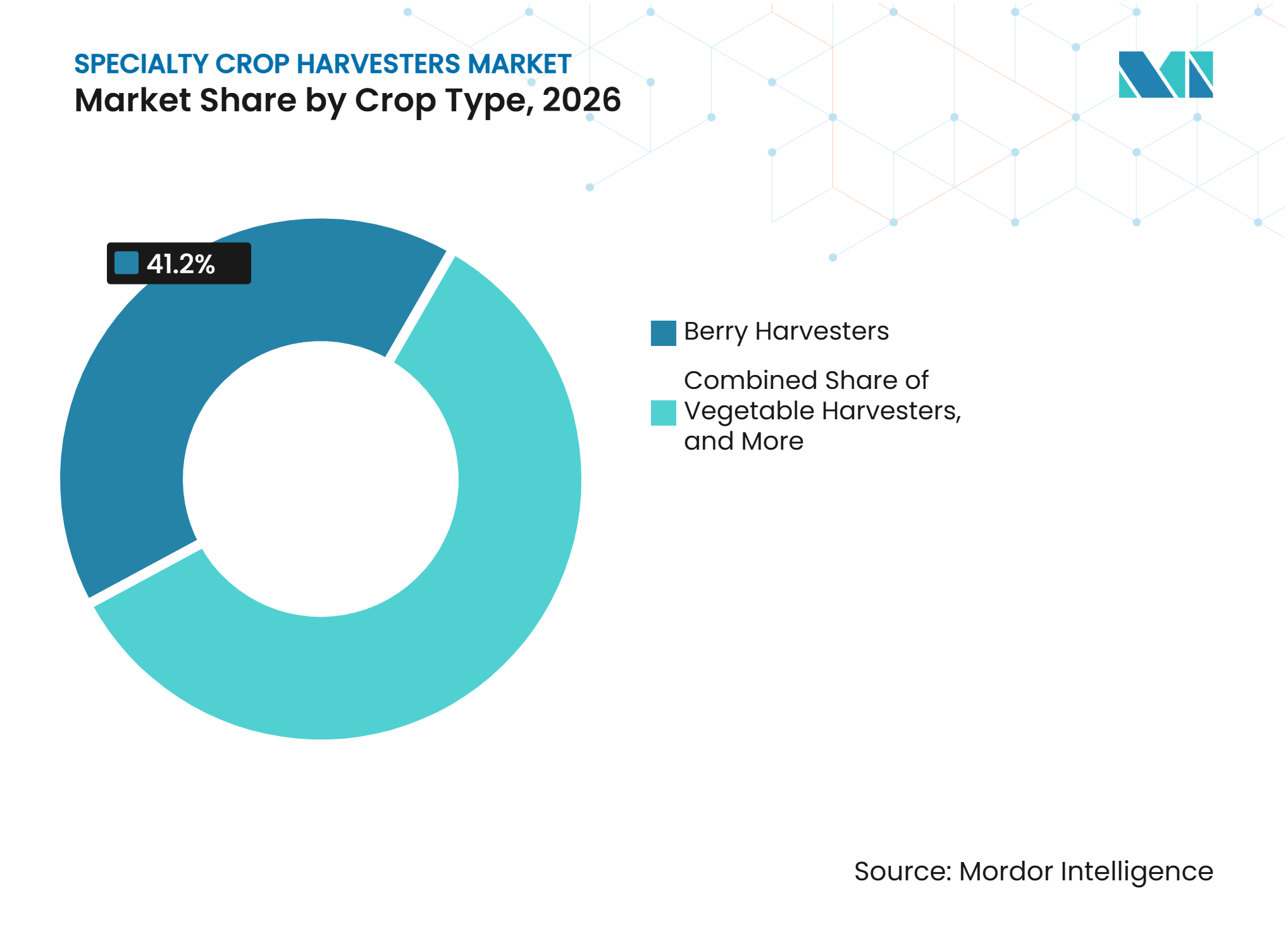
- By crop type, berry harvesters accounted for 41.2% of the specialty crop harvesters market share in 2026, while orchard fruit harvesters are forecast to grow at a CAGR of 8.8% from 2027 to 2032.
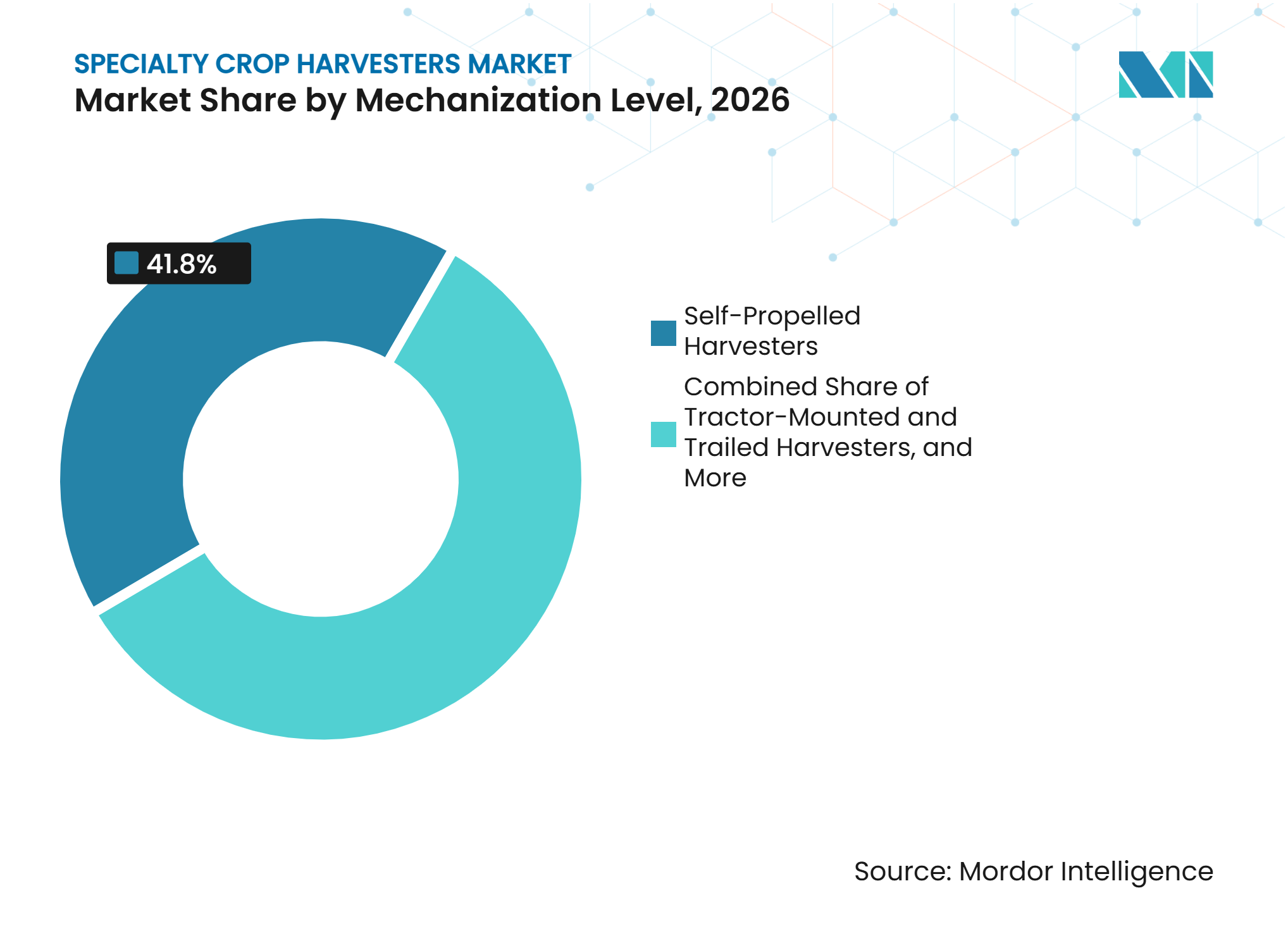
- By mechanization level, self-propelled harvesters accounted for 41.8% of the specialty crop harvesters market share in 2026, while robotic and autonomous harvesters are forecast to grow at a CAGR of 10.7% from 2027 to 2032.
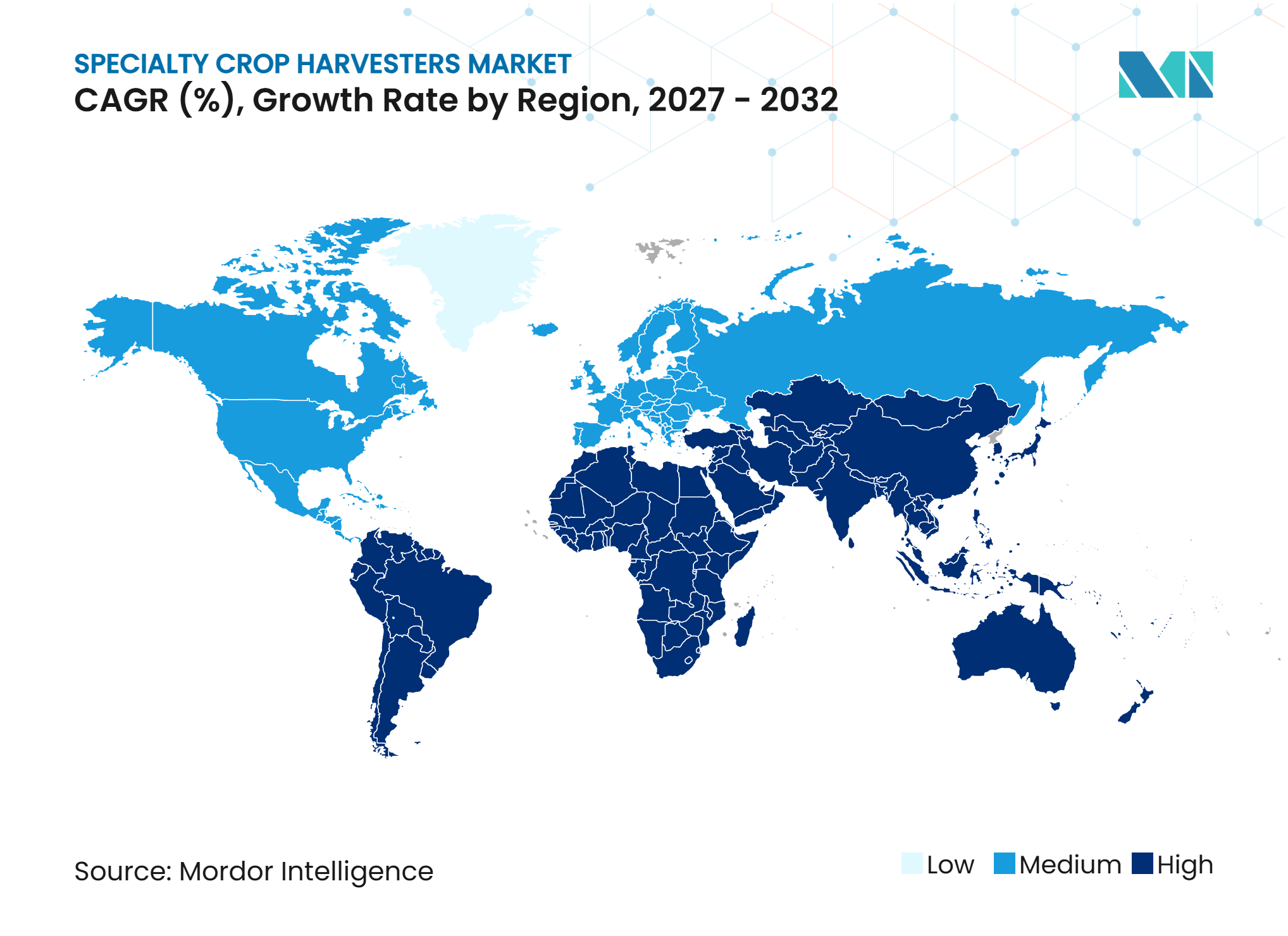
- By geography, North America accounted for 35.0% of the specialty crop harvesters market share in 2026, while Asia-Pacific is forecast to grow at a CAGR of 10.1% from 2027 to 2032.
Note: Market numbers in this report are based on Mordor Intelligence's proprietary estimation framework, which combines nine months of actuals with Q4 projections for base year 2026.
Market Trends and Insights
Drivers Impact Analysis of Specialty Crop Harvesters Market*
| Driver | (~) % Impact on CAGR Forecast | Geographic Relevance | Impact Timeline |
|---|---|---|---|
| Structural Labor Shortages and Seasonal Wage Inflation | +2.5% | Global, especially North America, Europe, Japan, South Korea, Australia, and Chile | Short term (≤ 2 years) |
| AI Vision and Gentle-Handling Mechanisms Reducing Harvest Damage | +1.5% | North America and Europe, with emerging gains in the Asia-Pacific | Medium term (2-4 years) |
| Expansion of Commercial Berry, Fruit, and Tree-Nut Acreage | +1.2% | Global, led by South America, North America, and the Asia-Pacific | Medium term (2-4 years) |
| Robotics-as-a-Service Lowering Upfront Capital Barriers | +1.0% | North America, Europe, Asia-Pacific, and spillover into the Middle East and Africa | Medium term (2-4 years) |
| Retail Quality Specifications Rewarding Selective Harvesting | +0.8% | North America, the European Union, Japan, and Brazil | Medium term (2-4 years) |
| Contract Harvesting Fleets Improving Specialized Machine Utilization | +0.7% | India, Brazil, China, South Africa, and the United States | Long term (≥ 4 years) |
| Source: Mordor Intelligence | |||
Structural Labor Shortages and Seasonal Wage Inflation
Labor scarcity remains a key demand factor in the specialty crop harvesters market. Certified H-2A temporary agricultural positions in the United States increased from approximately 48,000 in fiscal year 2005 to 385,000 in fiscal year 2024, reflecting growing reliance on temporary foreign workers to meet seasonal farm labor requirements[1]. Field workers earned an average of USD 18.58 per hour during the April 2025 reference week, up 2% from the same period a year earlier. Foreign-born workers account for 70% of the U.S. farm sector workforce, highlighting the sector's dependence on this labor pool[2]. These labor pressures strengthen the business case for mechanized harvesting, particularly for labor-intensive specialty crops where seasonal worker availability affects timely crop collection.
AI Vision and Gentle-Handling Mechanisms Reducing Harvest Damage
Machine vision and adaptive end-effectors help address a major barrier to the mechanical harvesting of fresh specialty crops: fruit damage during picking. Vision-based fruit detection, adaptive gripping, and precise detachment enable harvesting systems to locate fruit and adjust picking movements to reduce damage. A 2025 study published in the journal Computers and Electronics in Agriculture evaluated an artificial intelligence-driven citrus-harvesting robot with adaptive grasping and precise detachment mechanisms designed to minimize fruit damage. These technologies are particularly relevant to fresh-market crops, where bruising and surface damage can affect marketability. In September 2026, Oxbo introduced AutoHarvest, a machine-learning technology that uses onboard cameras and algorithms to adjust berry-harvester functions in response to changing field conditions. By adjusting harvesting operations to crop conditions and production goals, these technologies can help growers manage the trade-off between minimizing fruit damage and maximizing harvesting efficiency[3].
Expansion of Commercial Berry, Fruit, and Tree-Nut Acreage
Growing acreage of high-value specialty crops expands the potential market for dedicated harvesting equipment. U.S. fruit, tree nut, and berry acreage reached 6.6 million acres in 2022, up 10% from 2017, with tree nut acreage increasing 23% and berry acreage increasing 18%. California almond bearing acreage reached approximately 1.40 million acres in 2025, while Oregon hazelnut bearing acreage reached 92,000 acres in 2025. The OECD-FAO Agricultural Outlook 2025–2034 also examines production and consumption trends for fruit and other agricultural commodities across global markets. As commercial crop acreage expands, growers may have greater incentives to invest in specialized harvesters where mechanization can improve harvesting efficiency and address seasonal labor requirements.
Robotics-as-a-Service Lowering Upfront Capital Barriers
Robotics-as-a-Service (RaaS) can reduce the upfront financial burden of adopting specialized harvesting equipment, particularly for farms that cannot justify purchasing machinery used only during short seasonal windows. Under this model, growers pay for harvesting services based on measures such as harvested volume rather than purchasing and maintaining the equipment themselves. This approach can make mechanized harvesting more accessible to farms with limited capital or insufficient acreage to support equipment ownership. Harvest CROO Robotics, for example, provides a strawberry-harvesting service under a pay-as-you-go model in which payments are linked to the volume harvested. By spreading equipment costs across service users and reducing the need for individual ownership, RaaS models can support wider access to specialized harvesting technologies among growers.
Restraints Impact Analysis of Specialty Crop Harvesters Market*
| Restraint | (~) % Impact on CAGR Forecast | Geographic Relevance | Impact Timeline |
|---|---|---|---|
| Crop Variability and Delicate Produce Limit Harvesting Efficiency | -1.2% | Global, especially North America, Spain, Italy, Japan, and Chile | Medium term (2-4 years) |
| High Capital Cost Versus Small-Farm Cash Flow | -1.0% | Asia-Pacific, the Middle East and Africa, and South America | Long term (≥ 4 years) |
| Narrow Harvest Windows Increase Underutilization Risk | -0.8% | Canada, Poland, Turkey, South Africa, and Argentina | Medium term (2-4 years) |
| Limited Local Service and Calibration Infrastructure | -0.6% | The Middle East, Africa, rural South America, and the Asia-Pacific | Long term (≥ 4 years) |
| Source: Mordor Intelligence | |||
Crop Variability and Delicate Produce Limit Harvesting Efficiency
Plant architecture, fruit maturity, and canopy geometry vary across crops and growing conditions, making it difficult for harvesting machines to maintain consistent operating efficiency. Differences in ripeness may require multiple harvesting passes or increase the risk of missed fruit and crop damage. A 2025 review published in the journal Agriculture identified low harvesting efficiency, high breakage rates, and contamination as continuing barriers to mechanized chili harvesting. Changes in crop conditions and canopy structure can also reduce the effectiveness of machine settings calibrated before the harvesting season. These challenges are particularly significant for fresh-market crops, where bruising and surface damage can reduce marketability. Consequently, the need to balance harvesting speed with crop-specific handling requirements can limit the suitability of mechanical harvesting for certain specialty crops.
High Capital Cost Versus Small-Farm Cash Flow
Purpose-built harvesters can be difficult to finance for farms that lack sufficient acreage to generate an acceptable return on investment. This constraint is particularly relevant to small-scale growers, whose seasonal production volumes may not justify purchasing specialized machinery. Even tractor-mounted harvesting attachments can require substantial investment relative to the income generated by specialty crops. Financing, leasing, and cooperative ownership arrangements can help reduce individual ownership costs, although their availability varies across markets. Consequently, high initial equipment costs can limit mechanization among smaller growers, even where harvesting machinery could help address seasonal labor constraints.
*Our forecasts treat driver/restraint impacts as directional, not additive. The impact forecasts reflect baseline growth, mix effects, and variable interactions.
Specialty Crop Harvesters Market Segment Analysis
By Crop Type:
Berry Harvesters Dominate, While Orchard Fruit Harvesters Record the Fastest GrowthBerry harvesters accounted for 41.2% of the specialty crop harvesters market in 2026, supported by their use in commercial berry production. U.S. cultivated blueberry area harvested totaled 104,700 acres in 2025 and produced 768.7 million pounds of fruit. Washington, Oregon, and Georgia accounted for the largest share of blueberry output. USDA fruit grade standards establish requirements for uniformity, firmness, and mechanical damage, reinforcing the need for reliable harvesting methods at a commercial scale.
Vegetable harvester growth is supported by processing demand and the use of mechanized leaf-vegetable and root-crop harvesting in European contract supply chains. Orchard fruit harvesters are forecast to grow at a CAGR of 8.8% from 2027 to 2032. The 2025 U.S. apple crop was forecast to rise 6% from the prior year, with Washington projected to reach a record 8 billion pounds, according to USDA ERS. Nut harvesters are gaining momentum as almond and hazelnut acreage expands. Grape harvesters retain stable demand in European viticulture and the Americas, while equipment for coffee, olives, and other specialty crops is expanding in Brazil and Mediterranean production areas.



By Mechanization Level:
Self-Propelled Harvesters Lead, While Robotic and Autonomous Harvesters Grow FastestSelf-propelled harvesters accounted for 41.8% of the specialty crop harvesters market share in 2026, supported by their suitability for commercial harvesting operations. Tractor-mounted and trailed harvesters serve specialized applications, including vineyard and orchard operations, while manual and handheld powered harvesting equipment remains relevant for smaller-scale operations and crop-specific harvesting requirements.
Robotic and autonomous harvesters are forecast to grow at a CAGR of 10.7% from 2027 to 2032. Tevel develops flying autonomous fruit-harvesting robots designed for automated fruit picking in commercial orchards and lists HMC Farms in California and Unifrutti Group in Chile among its industry partners. The International Organization for Standardization (ISO) published ISO 18497-1:2024, which establishes design principles and terminology for agricultural machinery with partially automated, semi-autonomous, and autonomous functions. These developments support the advancement of autonomous harvesting technologies, although the extent of commercial deployment across specialty crop operations requires further validation.

Geography Analysis
North America accounted for 35.0% of the specialty crop harvesters market share in 2026, supported by large berry, nut, and orchard fruit operations. U.S. sales of fruit, tree nuts, and berries totaled USD 34.2 billion in the 2022 Census of Agriculture, up 20% from 2017. California, Washington, and Florida accounted for 83% of those sales. Oxbo opened a 200,000-square-foot manufacturing facility in Bergen, New York, in April 2026, employing 250 workers. Berry and avocado export operations in Canada and Mexico are also developing demand.
Asia-Pacific is the fastest-growing regional area and is forecast to grow at a 10.1% CAGR from 2027 to 2032. India produced 335.5 million metric tons of fruit and vegetables across 19 million hectares in fiscal year 2025. Rising farm wages in Japan, South Korea, and Australia are occurring alongside horticultural expansion in China and India. Government-backed programs in China support harvester adoption in apple, grape, and vegetable production, especially in northern provinces. Europe's growth is led by Spain, Italy, France, and Germany; PELLENC launched the Optimum XXL80 in January 2026 for olive, almond, and vineyard applications.
South America’s growth is led by export-oriented blueberry, table grape, and coffee operations in Chile and Brazil. Oxbo introduced its 940 tow-behind coffee harvester for Brazil in July 2025, with compatibility for 75-horsepower tractors. In the Middle East, companies in Israel are developing automated fruit-harvesting systems. Africa remains the smallest regional segment, although fruit and vegetable exports from South Africa, Egypt, and Morocco support demand for harvesting equipment. Limited service infrastructure remains a constraint on market adoption across the continent.
Competitive Landscape
Market Concentration

The specialty crop harvesters market was moderately concentrated in 2026. Key competitors include Oxbo International Corporation, CNH Industrial N.V., GRIMME Landmaschinenfabrik SE and Co. KG, SDF S.p.A., and PELLENC SAS, alongside regional specialists such as Dewulf NV, AVR bv, Tumoba B.V., Koppert Machines B.V., Ortomec S.r.l., JAGODA JPS Agromachines Sp. z o.o., Weremczuk FMR Sp. z o.o., Littau Harvester, Inc., Orchard Machinery Corporation, and Tevel Aerobotics Technologies Ltd. Regional specialists often differentiate themselves through application-specific expertise and equipment tailored to particular crops and harvesting requirements.
CNH acquired assets and intellectual property from Advanced Farm in May 2025, integrating a six-arm vision-guided robotic apple-picking system and much of its engineering team. This move reflects the importance that established equipment manufacturers place on proprietary robotic harvesting capability. PELLENC launched the Optimum XXL80 in January 2026, extending a single machine platform across olive, almond, and grape harvesting applications. Oxbo introduced AutoHarvest in September 2026 for its 7440 and 7450 berry harvesters, using cameras and algorithms to adjust machine settings. These developments focus on automation, broader crop coverage, and improved performance in variable field conditions.
Opportunities remain in modular systems for mid-sized farms, attachments that extend use beyond a single peak season, and machine vision or fleet analytics software offered separately from hardware. Tevel holds intellectual property related to autonomous flying robot coordination, fruit detection, and ground-carrier integration. Fieldwork Robotics and Harvest CROO Robotics are pursuing harvesting-as-a-service models that lower equipment entry costs. The UK Government opened a GBP 20 million (USD 26 million) competition for Farming Futures Automation and Robotics in August 2026, as part of a GBP 123 million (USD 160 million) package for agricultural research and technology. This public funding supports the technology pipeline relevant to the specialty crop harvesters market.
Specialty Crop Harvesters Industry Leaders
-
Oxbo International Corporation
-
CNH Industrial N.V.
-
GRIMME Landmaschinenfabrik SE & Co. KG
-
SDF S.p.A.
-
PELLENC SAS
- *Disclaimer: Major Players sorted in no particular order
Specialty Crop Harvesters Market Companies Covered in this Report
- Oxbo International Corporation
- GRIMME Landmaschinenfabrik SE & Co. KG
- CNH Industrial N.V.
- SDF S.p.A.
- PELLENC SAS
- Dewulf NV
- AVR bv
- Tumoba B.V.
- Koppert Machines B.V.
- Ortomec S.r.l.
- JAGODA JPS Agromachines Sp. z o.o.
- Weremczuk FMR Sp. z o.o.
- Littau Harvester, Inc.
- Tevel Aerobotics Technologies Ltd.
- Orchard Machinery Corporation
Recent Industry Developments in Specialty Crop Harvesters Market
- September 2026: Oxbo International Corporation introduced AutoHarvest, a machine-learning technology for its 7440 and 7450 berry harvesters. The system uses onboard cameras and algorithms to adjust ground speed, picking head speed, head pinch, belt speed, and fan speed based on field conditions. It allows operators to configure harvesting settings through a two-slider interface and is designed to maintain harvesting performance under varying operating conditions.
- March 2026: Tevel Aerobotics Technologies Ltd. secured USD 18 million in Series C funding led by Sound Media Ventures, with participation from Kubota Corporation, Maverick Ventures Israel, AgFunder, and OurCrowd. The funding will support the development and commercial deployment of its autonomous flying robots for harvesting orchard crops, including apples, peaches, apricots, nectarines, plums, and pears.
- April 2025: CNH Industrial N.V. acquired the assets and intellectual property of Advanced Farm Technologies, a California-based developer of robotic apple-harvesting systems. The transaction included integrating most of Advanced Farm’s engineering team into CNH’s technology and innovation divisions. The harvesting system had undergone field trials in Washington state during the 2024 harvest season, meeting or exceeding performance targets. The acquisition expands CNH’s capabilities in robotic harvesting technology for specialty crops.
Global Specialty Crop Harvesters Market Report Scope
Specialty crop harvesters are agricultural machines designed to harvest crops that require specialized handling, including berries, orchard crops, vegetables, nuts, and other high-value crops. These machines range from manual and tractor-mounted equipment to self-propelled and robotic systems, helping improve harvesting efficiency, reduce labor requirements, and minimize crop damage.
The Specialty Crop Harvesters Market Report is Segmented by Crop Type (Orchard Fruit Harvesters, Vegetable Harvesters, Nut Harvesters, Berry Harvesters, Grape Harvesters, and Other Specialty Crop Harvesters), by Mechanization Level (Manual and Handheld Powered Harvesting Equipment, Self-Propelled Harvesters, Tractor-Mounted and Trailed Harvesters, and Robotic and Autonomous Harvesters), and by Geography (North America, South America, Europe, Asia-Pacific, Middle East, and Africa). The Market Forecasts are Provided in Terms of Value (USD) and Volume (Metric Tons).
Segmentation Overview
| Orchard Fruit Harvesters |
| Vegetable Harvesters |
| Nut Harvesters |
| Berry Harvesters |
| Grape Harvesters |
| Other Specialty Crop Harvesters |
| Manual and Handheld Powered Harvesting Equipment |
| Self-Propelled Harvesters |
| Tractor-Mounted and Trailed Harvesters |
| Robotic and Autonomous Harvesters |
| North America | United States |
| Canada | |
| Mexico | |
| Rest of North America | |
| South America | Brazil |
| Chile | |
| Argentina | |
| Rest of South America | |
| Europe | Germany |
| France | |
| Spain | |
| Italy | |
| Russia | |
| Rest of Europe | |
| Asia-Pacific | China |
| Japan | |
| South Korea | |
| India | |
| Australia | |
| Rest of Asia-Pacific | |
| Middle East | Turkey |
| Israel | |
| Saudi Arabia | |
| United Arab Emirates | |
| Rest of Middle East | |
| Africa | South Africa |
| Egypt | |
| Morocco | |
| Rest of Africa |
| By Crop Type | Orchard Fruit Harvesters | |
| Vegetable Harvesters | ||
| Nut Harvesters | ||
| Berry Harvesters | ||
| Grape Harvesters | ||
| Other Specialty Crop Harvesters | ||
| By Mechanization Level | Manual and Handheld Powered Harvesting Equipment | |
| Self-Propelled Harvesters | ||
| Tractor-Mounted and Trailed Harvesters | ||
| Robotic and Autonomous Harvesters | ||
| By Geography | North America | United States |
| Canada | ||
| Mexico | ||
| Rest of North America | ||
| South America | Brazil | |
| Chile | ||
| Argentina | ||
| Rest of South America | ||
| Europe | Germany | |
| France | ||
| Spain | ||
| Italy | ||
| Russia | ||
| Rest of Europe | ||
| Asia-Pacific | China | |
| Japan | ||
| South Korea | ||
| India | ||
| Australia | ||
| Rest of Asia-Pacific | ||
| Middle East | Turkey | |
| Israel | ||
| Saudi Arabia | ||
| United Arab Emirates | ||
| Rest of Middle East | ||
| Africa | South Africa | |
| Egypt | ||
| Morocco | ||
| Rest of Africa | ||
Key Questions Answered in the Report
What is the forecast value of the specialty crop harvesters market by 2032?
The specialty crop harvesters market is forecast to reach USD 8.57 billion by 2032, at a CAGR of 8.5% from 2027 to 2032.
Which crop type accounted for the highest market share in 2026?
Berry harvesters accounted for 41.2% of the specialty crop harvesters market in 2026, supported by established commercial harvesting operations.
Which region accounted for the highest market share in 2026?
North America accounted for 35.0% of the specialty crop harvesters market in 2026, supported by large berry, nut, and orchard fruit operations.
What limits the adoption of specialty crop harvesters on small farms?
High initial equipment costs, short harvesting windows, and limited local service support can make specialized harvesting equipment less economical for smaller farms.