
Specialty Biocides Market Size and Share
Market Overview
| Study Period | 2021 - 2031 |
|---|---|
| Market Size (2026) | USD 13.97 Billion |
| Market Size (2031) | USD 18.72 Billion |
| Growth Rate (2026 - 2031) | 6.03 % |
| Fastest Growing Market | Asia-Pacific |
| Largest Market | Asia-Pacific |
| Market Concentration | Medium |
Major Players *Disclaimer: Major Players sorted in no particular order Image © Mordor Intelligence. Reuse requires attribution under CC BY 4.0. | |
Specialty Biocides Market Analysis by Mordor Intelligence
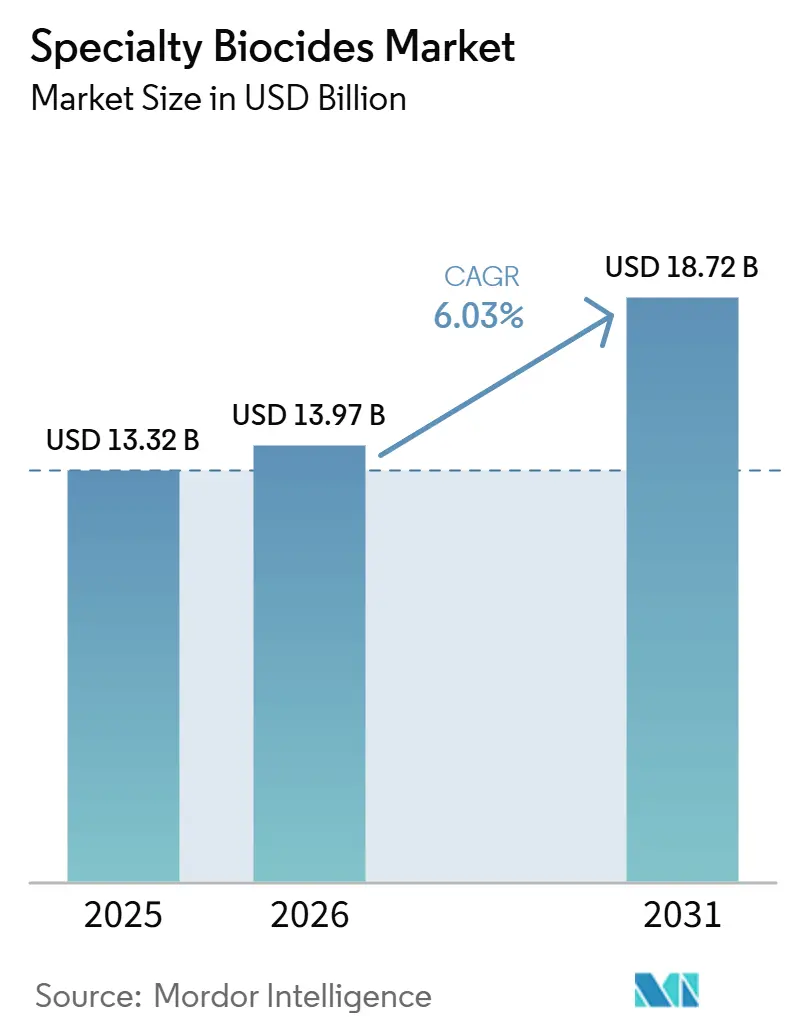
The Specialty Biocides Market was valued at USD 13.32 billion in 2025 and is estimated to grow from USD 13.97 billion in 2026 to reach USD 18.72 billion by 2031, at a CAGR of 6.03% during the forecast period (2026–2031). Tighter wastewater rules, more water reuse, and more demanding oilfield water programs are supporting demand for higher-performance antimicrobial treatments. Healthcare spending on infection control is also supporting the use of surface disinfection and related institutional applications. Buyers increasingly need lower active loading, wider antimicrobial coverage, and documentation that supports environmental compliance. These requirements favor specialty formulations and service-led suppliers that can combine chemistry, dosing support, and regulatory knowledge.
Key Report Takeaways
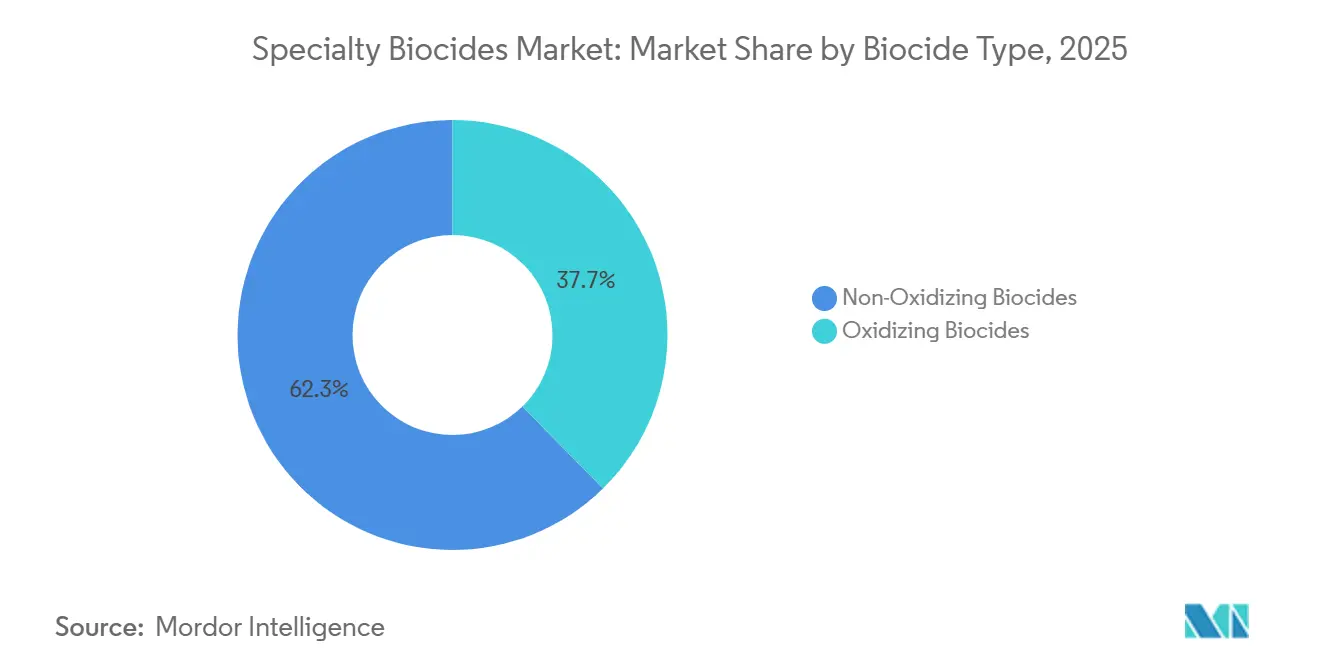
- By biocide type, non-oxidizing biocides held 62.34% of the specialty biocides market share in 2025, while oxidizing biocides are forecast to grow at a 6.72% CAGR through 2031.
- By product type, halogen-based biocides accounted for 24.17% of the specialty biocides market share in 2025, while quaternary ammonium compounds (quats) are projected to expand at a 6.97% CAGR through 2031.
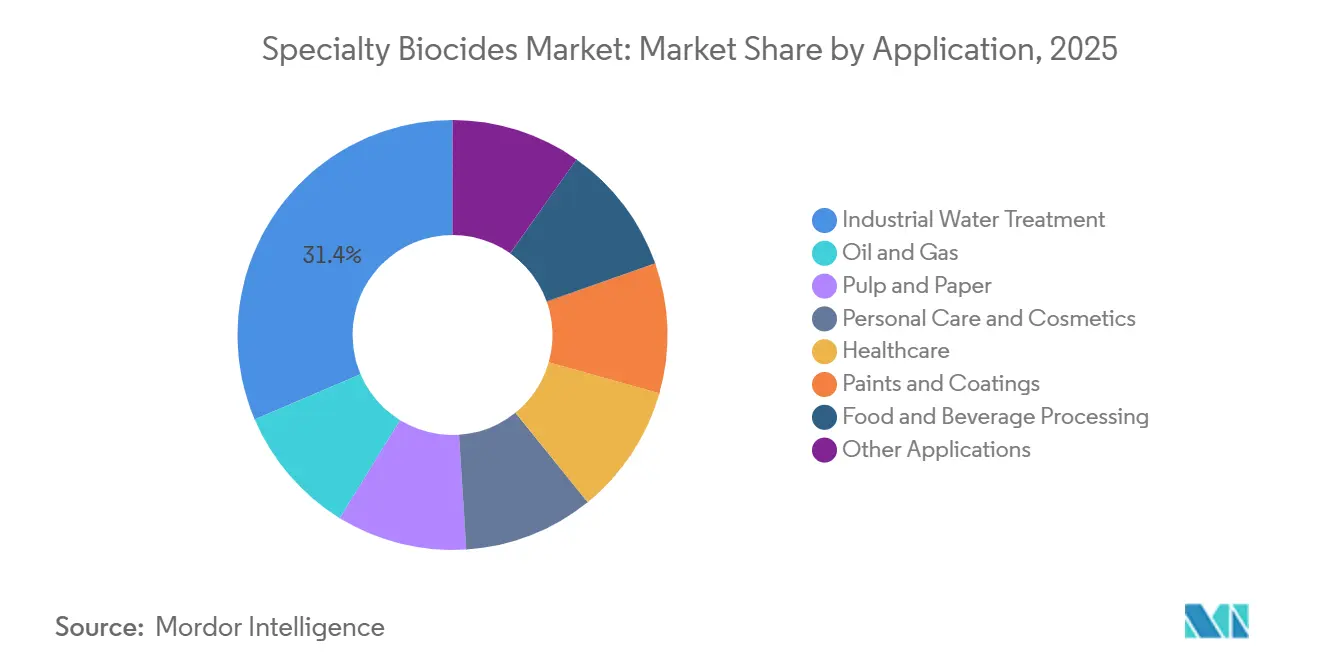
- By application, industrial water treatment accounted for 31.42% of the specialty biocides market size in 2025, while healthcare is forecast to grow at a 7.22% CAGR through 2031.
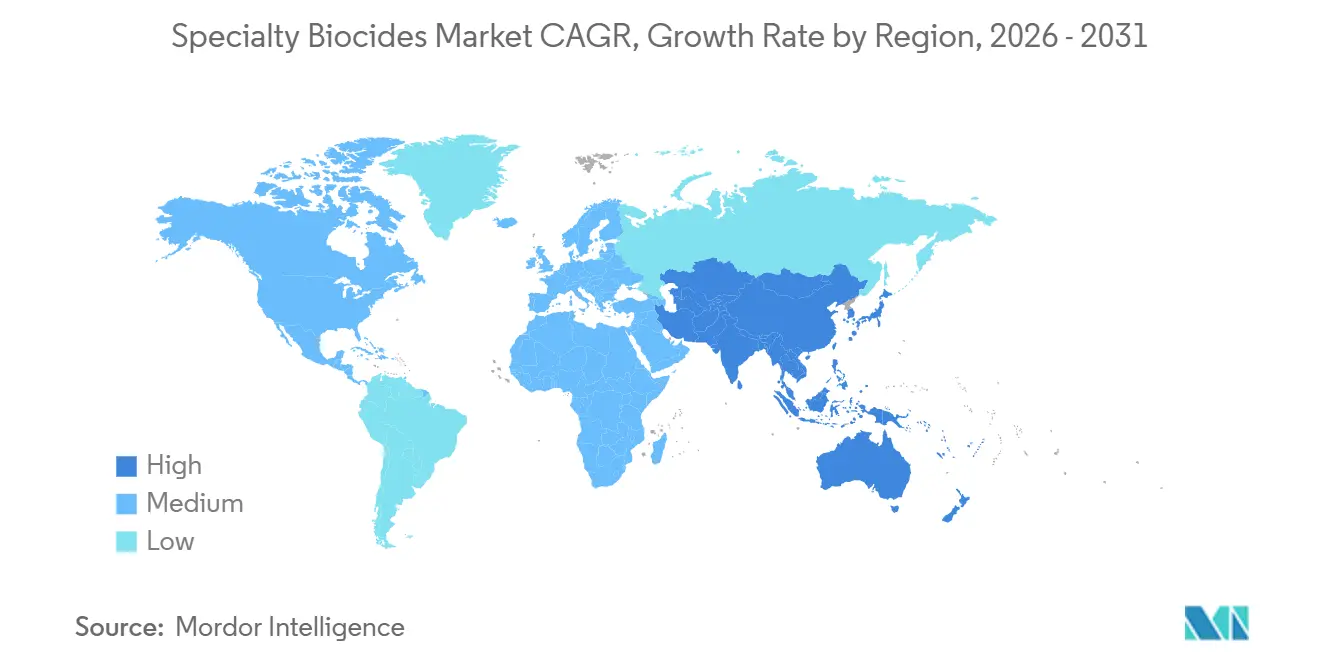
- By geography, Asia-Pacific held 41.66% of the specialty biocides market share in 2025 and is forecast to grow at a 6.83% CAGR through 2031.
Note: Market size and forecast figures in this report are generated using Mordor Intelligence’s proprietary estimation framework, updated with the latest available data and insights as of January 2026.
Market Trends and Insights
Drivers Impact Analysis of Specialty Biocides Market*
| Driver | (~) % Impact on CAGR Forecast | Geographic Relevance | Impact Timeline |
|---|---|---|---|
| Increasing Demand for Water Reuse and Compliance with Industrial Wastewater Regulations | +1.5% | Global; concentration in North America, Europe, and APAC core | Medium term (2–4 years) |
| Growing Demand for Institutional Hygiene and Infection Control Solutions | +1.3% | Global; highest intensity in North America and Europe, with accelerating APAC healthcare spend | Medium term (2–4 years) |
| Increasing Use of Specialty Biocides in Oilfield Water Management and Asset Protection | +1.1% | Middle-East and Africa, North America, spill-over to Latin America | Short term (≤ 2 years) |
| Advancements in In-Situ Biocide Generation and Digital Biocide Dosing Technologies | +0.9% | Global; early adopters concentrated in North America and Western Europe | Long term (≥ 4 years) |
| Growing Focus on Low-Carbon and Bio-Based Specialty Biocide Formulations | +0.7% | Regulatory push concentrated in Europe; commercialization expanding to APAC and North America | Long term (≥ 4 years) |
| Source: Mordor Intelligence | |||
Increasing Demand for Water Reuse and Compliance with Industrial Wastewater Regulations
Industrial effluent rules and water recycling requirements are strengthening demand for specialty biocides. The US Environmental Protection Agency (EPA) industrial zero liquid discharge water reuse rule took effect on July 16, 2026, and expanded monitoring for micropollutants, including per- and polyfluoroalkyl substances (PFAS) precursors and nanosilver residues. A July 2026 European Chemicals Agency (ECHA) restriction affecting phosphite-containing reverse osmosis antiscalants, which raises interest in non-chlorine active systems. Tetrakis(hydroxymethyl)phosphonium sulfate (THPS), 2,2-dibromo-3-nitrilopropionamide (DBNPA), and peracetic acid systems are suited to zero liquid discharge and reverse osmosis pretreatment because they can reduce membrane fouling concerns. Demand in the specialty biocides market, therefore, remains linked to compliance needs even when treated water volumes do not rise.
Growing Demand for Institutional Hygiene and Infection Control Solutions
Healthcare-associated infections continue to support institutional demand for effective surface disinfection in the specialty biocides market. The World Health Organization reported that healthcare-associated infections affect one in ten patients in high-income countries and 1 in 4 patients in low- and middle-income countries at any given time[1]World Health Organization, “Health Care-Associated Infections Fact Sheet,” World Health Organization, who.int. Quaternary ammonium compounds remain important because they are effective against common hospital pathogens, including multidrug-resistant Klebsiella pneumoniae and Acinetobacter baumannii. A 2025 review identified gaps in standardized biocide susceptibility testing, which can complicate resistance surveillance and future stewardship measures. Arxada announced a June 2026 agreement with Clorox Healthcare to introduce its EPA-registered Quanticare sporicidal technology in North American healthcare facilities. Hospital procurement requirements for EPA Safer Choice-certified products can favor suppliers with established compliance credentials.
Increasing Use of Specialty Biocides in Oilfield Water Management and Asset Protection
Microbiologically influenced corrosion in produced water and injection systems is encouraging specialty biocide market customers to adopt integrated biocide programs. Sulfate-reducing and acid-producing bacteria can damage assets, making routine microbial control more important than occasional shock treatment. A 2025 scientific review described plant-derived candidates with 66–99.8% inhibition efficiency against relevant biofilms. The same review reported 99.36% inhibition by Cistus ladanifer extract against Pseudomonas aeruginosa biofilm on SS 304L and 99.8% inhibition by catechin hydrate. These findings give operators with ESG-linked commitments alternatives to conventional glutaraldehyde programs. Society of Petroleum Engineers (SPE) research also reported that adenosine triphosphate (ATP) diagnostics combined with optimized dosing reduced operating costs in upstream microbial control programs.
Advancements in In-Situ Biocide Generation and Digital Biocide Dosing Technologies
On-site generation is becoming more relevant in the specialty biocides market, where users want to reduce supply, storage, and handling risks for concentrated biocides. The European Committee for Standardization (CEN) published EN 18087:2026 in January 2026, setting requirements for in-situ chlorine dioxide generation devices used in drinking water, process water, and surface disinfection. The standard covers chlorite-acid, chlorite-chlorine gas, and chlorite-sodium peroxodisulfate processes. Harmonized requirements can make procurement decisions easier across European markets. Kemira completed a full-scale US trial of its chlorine-free KemConnect DEX wastewater treatment technology in March 2026. The system uses real-time bacterial-load data to automate treatment dosing, while its performance data can strengthen customer relationships with integrated suppliers.
Restraints Impact Analysis of Specialty Biocides Market*
| Restraint | (~) % Impact on CAGR Forecast | Geographic Relevance | Impact Timeline |
|---|---|---|---|
| Stringent Toxicological and Environmental Regulations Governing Active Biocidal Substances | -0.9% | Europe (BPR framework), North America (EPA/FIFRA), spill-over to APAC | Medium term (2–4 years) |
| Increasing Concerns Regarding Microbial Resistance and Reduced Biocide Effectiveness | -0.7% | Global; most acute in healthcare and oilfield segments across North America and Europe | Long term (≥ 4 years) |
| Formulation Compatibility Challenges and Variations in Regional Regulatory Labeling Requirements | -0.5% | Global, with highest compliance burden in Europe and Southeast Asia | Short term (≤ 2 years) |
| Source: Mordor Intelligence | |||
Stringent Toxicological and Environmental Regulations Governing Active Biocidal Substances
Active-substance reviews can slow product approvals and increase compliance costs across the specialty biocides market, especially in Europe. The Biocidal Products Regulation reviews can take 5–10 years for an active substance. Joint ECHA and European Food Safety Authority (EFSA) guidance applies to biocide applications submitted from April 1, 2026, and requires review of transformation products under realistic drinking-water treatment conditions[2]European Food Safety Authority, “Guidance Document on the Impact of Water Treatment Processes on Residues of Active Substances or Their Metabolites in Water Abstracted for the Production of Drinking Water,” EFSA Journal, efsa.europa.eu. The required assessment covers byproducts from processes such as chlorination and ozonation. EU Implementing Regulation 2026/1331 took effect on June 4, 2026 and changed administrative and compliance requirements for authorized calcium hypochlorite biocides. Large suppliers can spread dossier-development costs across broader portfolios, while smaller regional firms face a heavier burden.
Increasing Concerns Regarding Microbial Resistance and Reduced Biocide Effectiveness
Evidence on microbial adaptation to biocides is adding complexity to specialty biocides market product design and use protocols. A 2025 review reported that isothiazolone exposure changed the expression of more than 1,500 genes in Pseudomonas aeruginosa, while chlorhexidine exposure changed 675 genes in Streptococcus mutans. Research published in 2025 also found that bronopol can promote conjugative transfer of antibiotic resistance genes, including blaNDM-4, in E. coli. The 2025 American Chemical Society (ACS) review found that sub-minimum effective THPS concentrations can increase biocorrosion by promoting corrosive P. aeruginosa biofilms. Suppliers may need rotation programs and combination chemistries to maintain performance. These requirements can raise development costs and reduce the simplicity of single-active treatment programs.
*Our forecasts treat driver/restraint impacts as directional, not additive. The impact forecasts reflect baseline growth, mix effects, and variable interactions.
Specialty Biocides Market Segment Analysis
By Biocide Type:
Non-Oxidizing Biocides Anchor Industrial Water ProgramsNon-oxidizing biocides held 62.34% of the specialty biocides market share in 2025. Their position in the specialty biocides market reflects compatibility with reverse osmosis pretreatment, produced-water reuse, and cooling-tower systems. These systems can be damaged by oxidizing actives, which gives non-oxidizing products a practical role in membrane-intensive operations. THPS and DBNPA are used widely in oilfield applications. Isothiazolinone formulations, including MIT, CMIT, and BIT, are used in in-can preservation and cooling-water programs across manufacturing. Organosulfur and aldehyde-based biocides, including glutaraldehyde, serve similar needs but face regulatory pressure in some jurisdictions.
Plant-derived alternatives could become more relevant within this specialty biocides market segment during 2026-2031. A 2025 review found that these alternatives achieved 80–99.8% inhibition efficiency in relevant applications. This performance creates room for lower-toxicity active systems where conventional chemistries face review. Oxidizing biocides are forecast to grow at a 6.72% CAGR through 2031. In-situ generation and demand for sporicidal healthcare disinfection support that growth. EN 18087:2026 supports chlorine dioxide generation systems, while Arxada introduced a patented on-site peracetic acid generation technology in October 2025.


By Product Type:
Halogen-Based Biocides Lead, Quats Accelerate on Healthcare TailwindsHalogen-based biocides accounted for 24.17% of the specialty biocides market share in 2025. Their position in the specialty biocides market is supported by cost competitiveness, regulatory familiarity, and established performance in municipal water treatment, food processing, and industrial cooling. Chlorine-based products remain important where residual disinfection is needed. Bromine-based and mixed-oxidant systems are used in higher-temperature settings where chlorine stability is lower. Organosulfur products serve specialized paper manufacturing and oilfield water applications. Metallic biocides retain roles in marine antifouling and specialty coatings.
Calcium hypochlorite authorization changes can increase renewal and compliance costs for specialty biocides market formulators with narrow portfolios. Quats are forecast to expand at a CAGR of 6.97% through 2031. Their broad-spectrum efficacy and formulation flexibility support use in healthcare and food processing. Phenolic biocides remain secondary actives in personal care and healthcare combinations. Organic-acid variants, including propionic and sorbic acid products, are gaining use in food and beverage preservation, while research on mobile resistance genes may prompt further review of QAC concentrations.
By Application:
Industrial Water Treatment Dominates, Healthcare Defines the Growth StoryIndustrial water treatment accounted for 31.42% of global revenue in 2025. This application is the largest part of the specialty biocides market because cooling towers, boilers, and membrane circuits in power, chemicals, and manufacturing create the broadest demand base. The move toward membrane-based treatment supports the use of non-oxidizing treatment programs. Digital dosing can improve chemical efficiency, but the technical demands of these sites continue to support specialty offerings. In oil and gas, microbial corrosion can cause remediation costs, production losses, and environmental exposure. Pulp and paper, paints and coatings, and food and beverage processing are other important applications with separate compliance needs.
Arxada expanded its distribution relationship with Azelis in France for industrial biocides and coatings additives in 2025. The partnership reflects the role of technical distribution in the specialty biocides market. Healthcare is forecast to expand at a CAGR of 7.22% through 2031. Expanding healthcare infrastructure in Asia-Pacific and the Middle-East supports this outlook. Healthcare-Associated Infections (HAI) control protocols also support the regular demand for surface disinfectants. In personal care, tighter limits on Methylisothiazolinone (MIT) and Chloromethylisothiazolinone (CMIT) in leave-on products are prompting interest in alternative preservation systems. LANXESS introduced Neolone PH Max in 2026, combining phenoxyethanol with sunflower-oil-derived pelargonic acid.

Geography Analysis
APAC Specialty Biocides Market
Asia-Pacific held 41.66% of global revenue in 2025, making it the largest regional specialty biocides market. China’s contribution is supported by water treatment demand and movement toward non-chlorine actives under absorbable organic halogen discharge requirements. India’s demand is supported by wastewater compliance needs in pharmaceutical, textile, and food-processing clusters. THOR China opened a Benzisothiazolinone (BIT) plant in Zhenjiang, Jiangsu, in January 2025. The facility includes a solvent-recycling process and is intended to expand production and service capacity in the Asia-Pacific.
North America and Europe Specialty Biocides Market
North America has a mature but active demand base in the specialty biocides market, supported by water reuse requirements, power and chemical processing, and healthcare investment. US demand benefits from high-purity formulations and digital dosing services supplied by Ecolab, Solenis, and Kemira. These offerings can obtain premium pricing compared with commodity supplies. Europe has the most demanding compliance setting because of the EU Biocidal Products Regulation. Suppliers can use that regulatory experience when serving less-regulated export markets.
MEA and South America Specialty Biocides Market
South America is an emerging demand center in the specialty biocides market, with Brazil supporting municipal water treatment and food and beverage processing. Argentina’s Vaca Muerta development supports demand for oilfield microbial control. An SPE paper described a tailored solution for Halanaerobium microorganisms in Argentine unconventional operations. This work shows why local microbial conditions can require customized programs. The Middle-East and Africa are supported by oilfield water management in the Arabian Gulf and growing desalination capacity in Saudi Arabia and the UAE. Biocides are used to manage biological fouling in multi-stage flash and reverse osmosis desalination systems.

Competitive Landscape
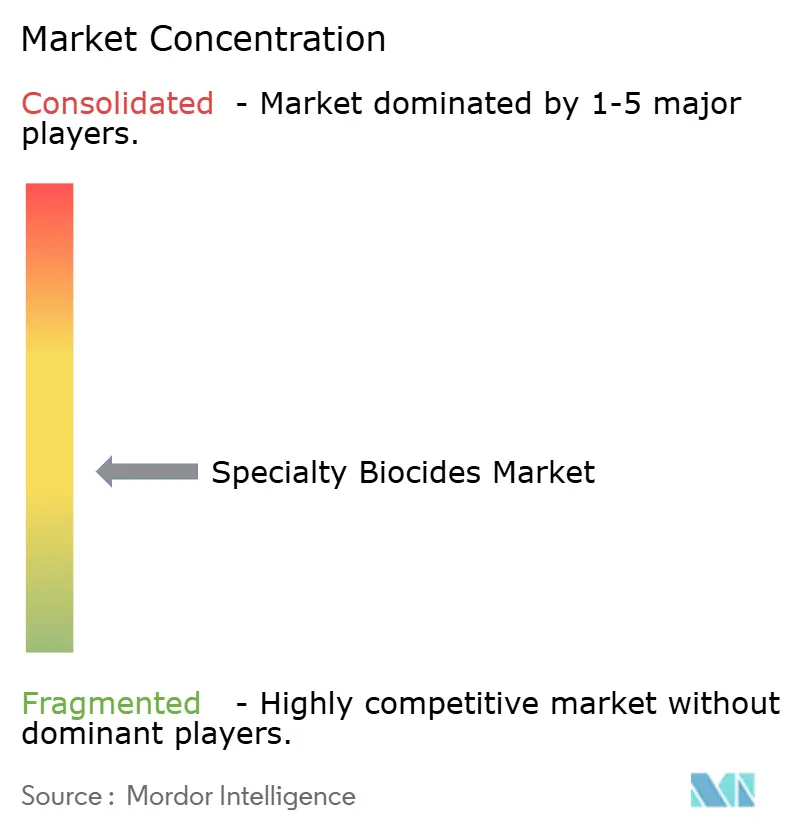
The specialty biocides market is moderately concentrated, with the top five players, including Ecolab Inc., Solenis, BASF, LANXESS, and Nouryon. These companies use regulatory capabilities, digital monitoring, and multi-product service packages to defend customer relationships. Arxada, THOR Group, and Nouryon also compete through formulation differentiation and regulatory responsiveness. Arxada’s patented on-site peracetic acid technology illustrates the importance of delivery-system intellectual property. THOR’s AMME microencapsulation technology is stated to reduce biocide leaching from coatings by up to 85%, supporting a differentiated approach in coatings applications.
Companies are also using distribution and portfolio actions to refine their positions in the specialty biocides market. LANXESS expanded its distribution partnership with Lintech International in January 2026 to cover industrial preservation biocides in the Northeast, Southeast, and Southwest United States. BASF completed the sale of its Aseptrol chlorine dioxide biocide portfolio to Oxidium Technologies in March 2026. The sale allows BASF to focus on Home Care and Industrial and Institutional Cleaning Solutions, while Oxidium can expand Aseptrol into other sectors. Solenis completed its acquisition of NCH Corporation in November 2025, expanding its presence to more than 160 countries and strengthening its mid-market water-treatment offering. Ecolab also finalized its acquisition of Ovivo’s Electronics Ultra-Pure Water business in December 2025, improving its position in semiconductor water management.
Bio-based biocides, digital microbial corrosion management, and underserved markets in Southeast Asia and Africa are areas of competitive interest in the specialty biocides market. Nanobiocide developers are examining silver nanoparticles, zinc oxide, and copper oxide products because of their potential biofilm-penetration advantages. Approval pathways for nanomaterials remain complex under European and US rules. Healthcare buyers place significant weight on EPA registration, safety information, and brand credibility. Industrial water buyers prioritize technical support, digital monitoring, and service coverage. Oilfield buyers increasingly assess documented operating-cost results and field validation when selecting a biocide program.
Specialty Biocides Industry Leaders
LANXESS
Ecolab Inc.
BASF
Nouryon
Solenis
- *Disclaimer: Major Players sorted in no particular order
Specialty Biocides Market Companies Covered in this Report
- Accepta Ltd.
- Arxada AG
- Baker Hughes Company
- BASF
- Clariant
- Dow
- Ecolab Inc.
- Kemira Oyj
- Lanxess
- Neogen Corporation
- Nouryon
- Solenis
- Thor Group Limited
- Troy Corporation
- Veolia Water Technologies

Recent Industry Developments in Specialty Biocides Market
- May 2026: Azelis announced that it had expanded its partnership with Arxada to distribute industrial biocides in the French market. The development strengthened the companies’ existing collaborations across multiple regions, including the DACH area, Benelux, the United Kingdom and Ireland, Greece, and Ukraine.
- January 2025: South Korea's Ministry of Environment approved 15 daily-life biocidal products under the Consumer Chemical Products and Biocides Safety Act (K-BPR), marking the country's first official product approvals. The approved products included disinfectants, insecticides, and repellents, following safety assessments by the National Institute of Chemical Safety.


Global Specialty Biocides Market Report Scope
Specialty biocides are chemical agents formulated to control or eliminate harmful microorganisms such as bacteria, fungi, algae, and yeasts in industrial and commercial applications. These products are designed to provide targeted antimicrobial protection, preserve product integrity, enhance operational efficiency, and comply with hygiene, safety, and environmental regulations across diverse end-use sectors.
The Specialty Biocides Market is segmented by biocide type, product type, application, and geography. By biocide type, the market is segmented into non-oxidizing biocides and oxidizing biocides. By product type, the market is segmented into halogen-based biocides, organosulfur biocides, quaternary ammonium compounds (quats), aldehyde biocides, phenolic biocides, organic acid biocides, metallic biocides, and other specialty biocides. By application, the market is segmented into industrial water treatment, oil and gas, pulp and paper, personal care and cosmetics, healthcare, paints and coatings, food and beverage processing, and other applications. The report also covers the market size and forecasts for specialty biocides in 16 countries across major regions. For each segment, the market sizing and forecasts have been done on the basis of value (USD).
| Non-Oxidizing Biocides |
| Oxidizing Biocides |
| Halogen-Based Biocides |
| Organosulfur Biocides |
| Quaternary Ammonium Compounds (Quats) |
| Aldehyde Biocides |
| Phenolic Biocides |
| Organic Acid Biocides |
| Metallic Biocides |
| Other Specialty Biocides |
| Industrial Water Treatment |
| Oil and Gas |
| Pulp and Paper |
| Personal Care and Cosmetics |
| Healthcare |
| Paints and Coatings |
| Food and Beverage Processing |
| Other Applications |
| Asia-Pacific | China |
| India | |
| Japan | |
| South Korea | |
| Rest of Asia-Pacific | |
| North America | United States |
| Canada | |
| Mexico | |
| Europe | Germany |
| United Kingdom | |
| France | |
| Italy | |
| Russia | |
| Rest of Europe | |
| South America | Brazil |
| Argentina | |
| Rest of South America | |
| Middle-East and Africa | Saudi Arabia |
| South Africa | |
| Rest of Middle-East and Africa |
| By Biocide Type | Non-Oxidizing Biocides | |
| Oxidizing Biocides | ||
| By Product Type | Halogen-Based Biocides | |
| Organosulfur Biocides | ||
| Quaternary Ammonium Compounds (Quats) | ||
| Aldehyde Biocides | ||
| Phenolic Biocides | ||
| Organic Acid Biocides | ||
| Metallic Biocides | ||
| Other Specialty Biocides | ||
| By Application | Industrial Water Treatment | |
| Oil and Gas | ||
| Pulp and Paper | ||
| Personal Care and Cosmetics | ||
| Healthcare | ||
| Paints and Coatings | ||
| Food and Beverage Processing | ||
| Other Applications | ||
| By Geography | Asia-Pacific | China |
| India | ||
| Japan | ||
| South Korea | ||
| Rest of Asia-Pacific | ||
| North America | United States | |
| Canada | ||
| Mexico | ||
| Europe | Germany | |
| United Kingdom | ||
| France | ||
| Italy | ||
| Russia | ||
| Rest of Europe | ||
| South America | Brazil | |
| Argentina | ||
| Rest of South America | ||
| Middle-East and Africa | Saudi Arabia | |
| South Africa | ||
| Rest of Middle-East and Africa | ||


Key Questions Answered in the Report
What is the size of the specialty biocides market?
The specialty biocides market stands at USD 13.97 billion in 2026 and is forecast to reach USD 18.72 billion by 2031.
Which biocide type led the market share in 2025?
Non-oxidizing biocides held 62.34% of revenue in 2025 because of their compatibility with membrane-intensive water treatment systems.
Which application is projected to grow fastest through 2031?
Healthcare is projected to grow at a 7.22% CAGR through 2031, supported by infection-control protocols and healthcare infrastructure investment.
Which product type is projected to grow fastest through 2031?
Quaternary Ammonium Compounds (Quats) are forecast to expand at a 6.97% CAGR through 2031, supported by healthcare and food-processing disinfection needs.
Page last updated on:





