
Spain Senior Living Market Size and Share
Market Overview
| Study Period | 2021 - 2032 |
|---|---|
| Forecast Data Period | 2027 - 2032 |
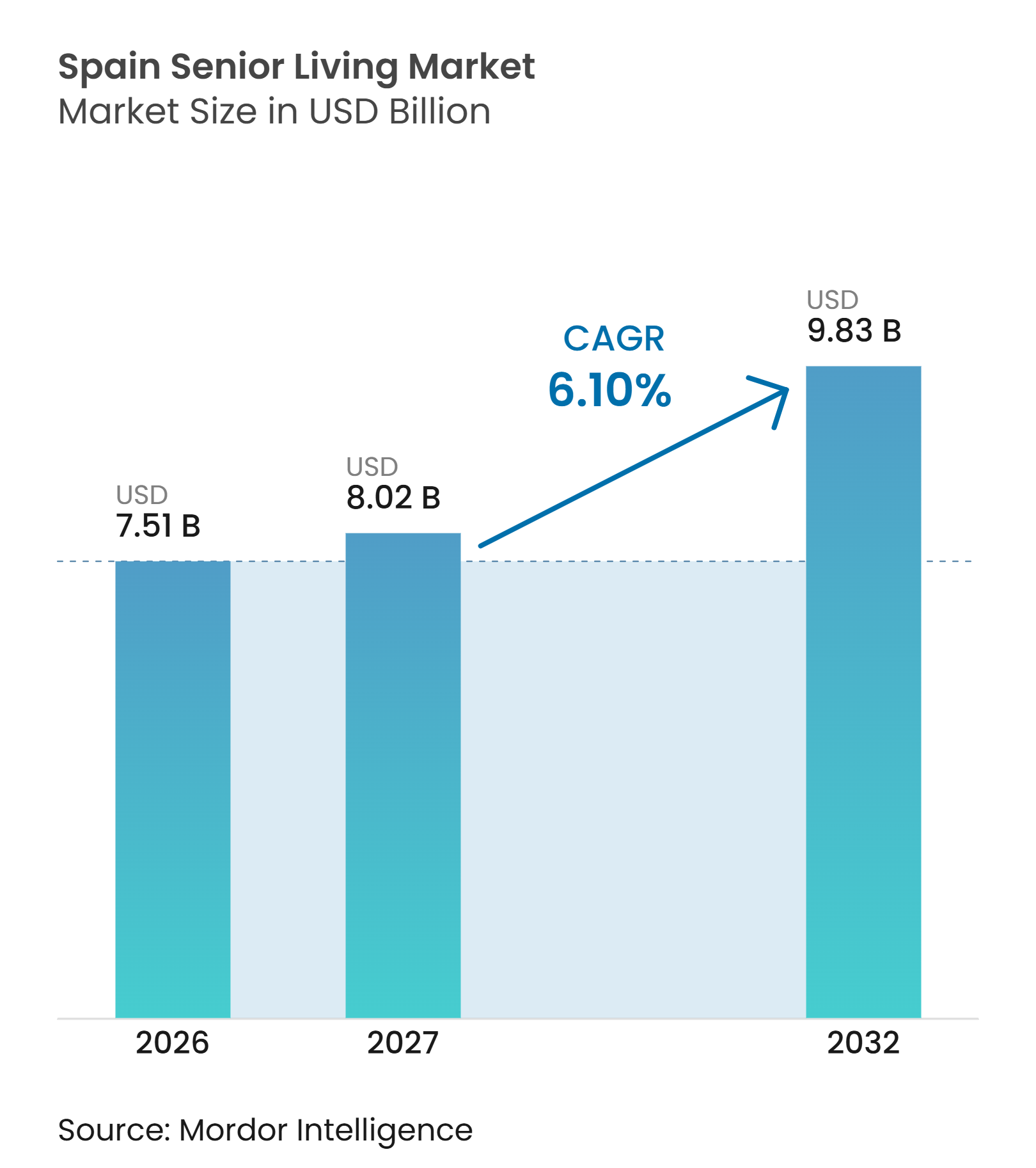
| Base Year Market Size (2026) | USD 7.51 Billion |
| Market Size (2027) | USD 8.02 Billion |
| Market Size (2032) | USD 9.83 Billion |
| Growth Rate (2027 - 2032) | 6.10 % |
| Market Concentration | Low |
Major Players *Disclaimer: Major Players sorted in no particular order Image © Mordor Intelligence. Reuse requires attribution under CC BY 4.0. | |
Spain Senior Living Market Analysis by Mordor Intelligence
The Spain Senior Living Market size was valued at USD 7.51 billion in 2026, is projected to reach USD 8.02 billion in 2027, and USD 9.83 billion by 2032, growing at a CAGR of 6.10% from 2027 to 2032.
Demand is supported by the growing need for residential, assisted, and medical care among older residents. The sector also faces a persistent gap between care needs and available capacity, which supports demand for new facilities. Public policy is moving toward more person-centered care, telecare, and community-based services under Spain’s long-term care reforms. This shift favors operators that can combine residential care with flexible support services. Investment activity and platform expansion indicate that established operators and real estate owners continue to see opportunities in the Spain senior living industry.
Key Report Takeaways
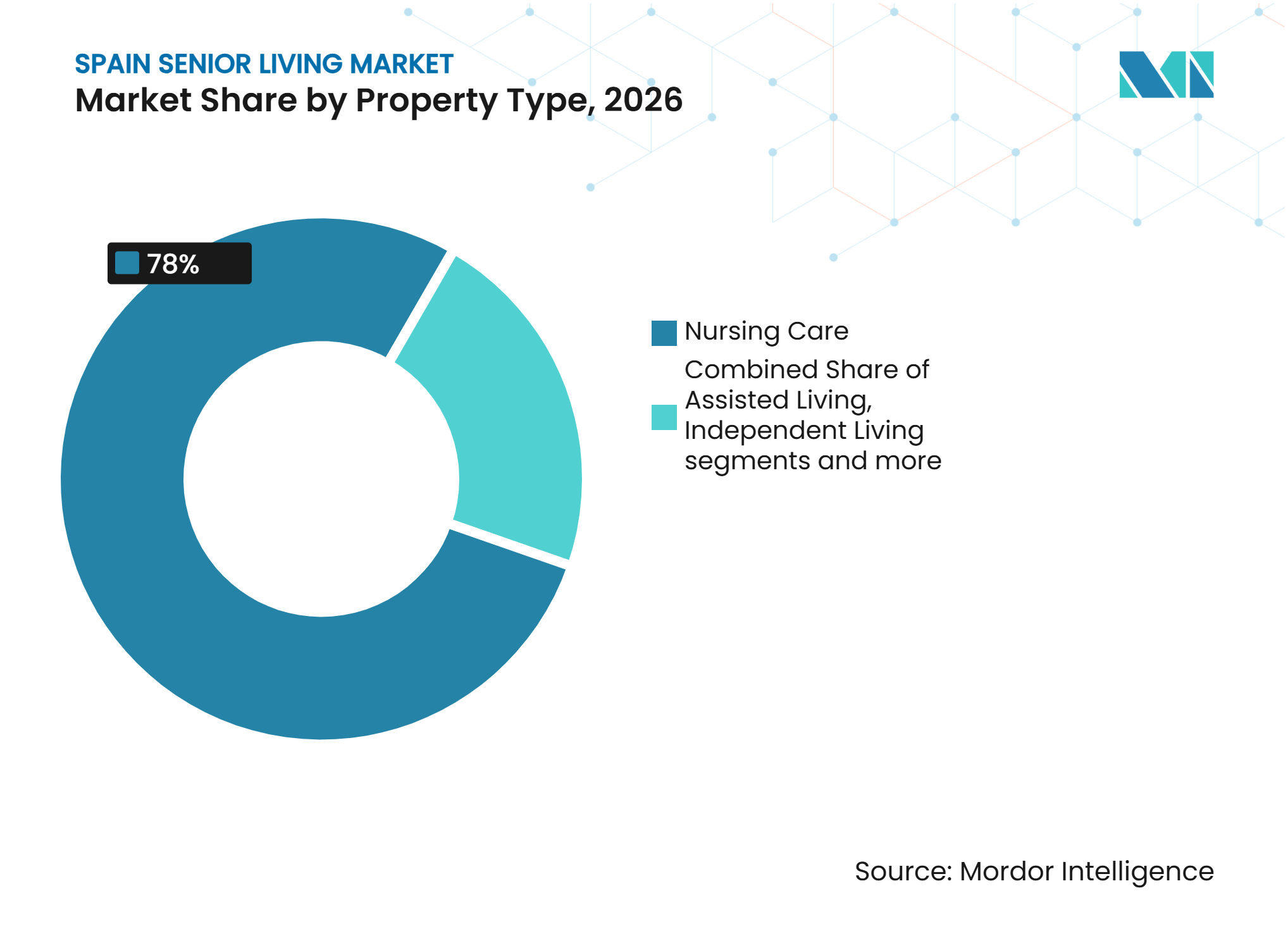
• By property type, nursing care held 78% of the Spain senior living market share in 2026, while Independent Living is forecast to expand at a 10% CAGR through 2032.
• By business model, long-lease / rental held a 53% share in the Spain senior living market and is forecast to grow at an 8.6% CAGR within the Spain senior living market size through 2032.
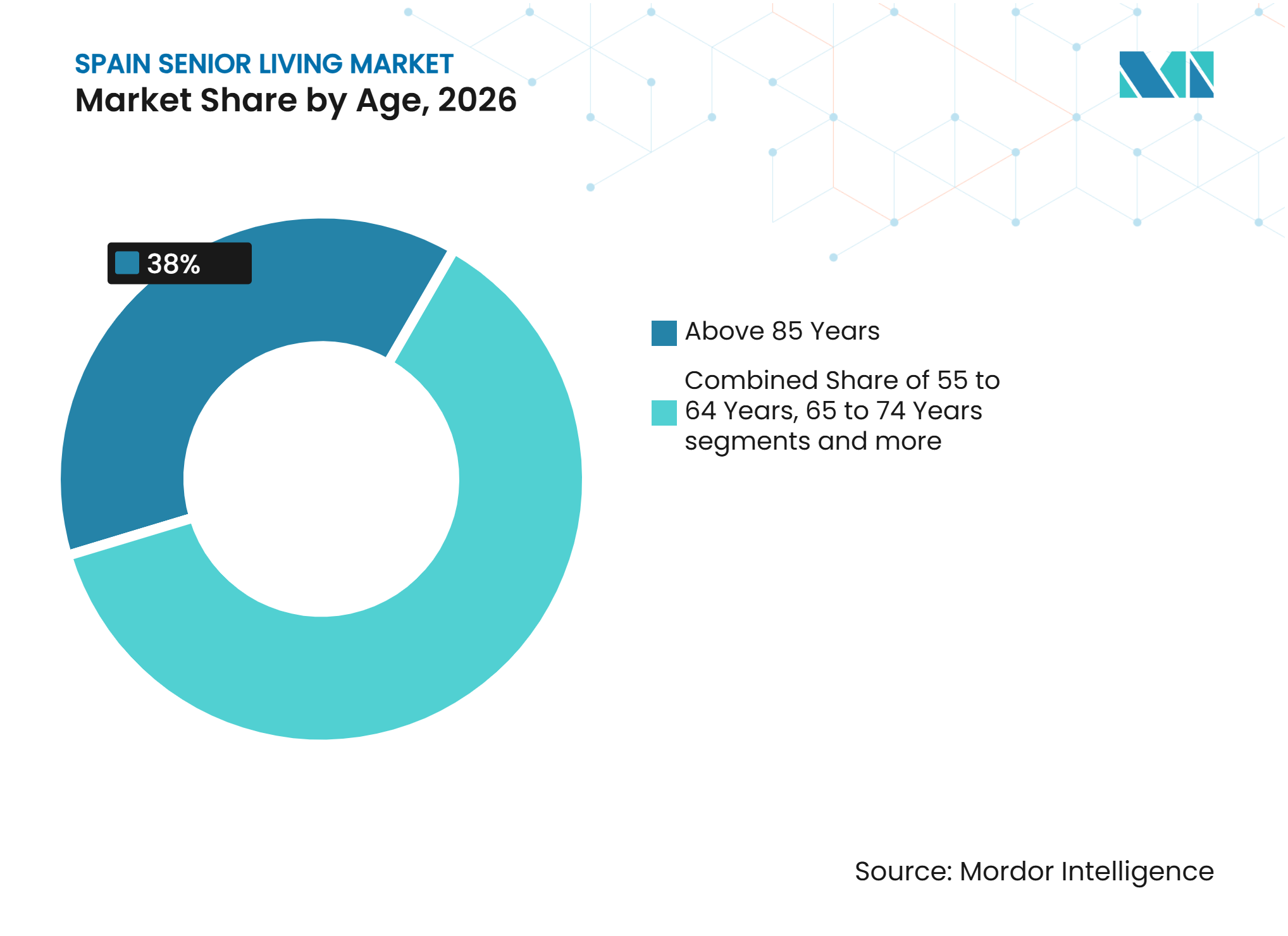
• By age group, the above-85-years cohort accounted for 38% of the Spain senior living market share in 2026, while the 65-to-74-Years cohort is forecast to grow at an 8.5% CAGR in the Spain senior living market size through 2032.
• By geography, East Spain accounted for 30% of the Spain senior living market size in 2026, while South Spain is forecast to expand at an 8.8% CAGR through 2032.
Note: Market numbers in this report are based on Mordor Intelligence's proprietary estimation framework, which combines nine months of actuals with Q4 projections for base year 2026.
Market Trends and Insights
Drivers Impact Analysis of Spain Senior Living Market*
| Drivers | (~) % Impact on CAGR Forecast | Geographic Relevance | Impact Timeline |
|---|---|---|---|
| Aging Population and Rising Longevity | +1.8% | National, with higher relevance in Castilla y León, Galicia, and Asturias | Long term (≥ 4 years) |
| Structural Shortage of Residential Care Places | +1.5% | National, with acute deficits in Andalucía and Valencia | Medium term (2-4 years) |
| Retirement Migration and International Senior Demand | +0.9% | South Spain, the Canary Islands, and the Balearic Islands | Medium term (2-4 years) |
| Growing Institutional Investment and Operating-Platform Formation | +0.8% | National, with activity in Madrid, Barcelona, and coastal cities | Short term (≤ 2 years) |
| Shift Toward Independent, Service-Enriched Living | +0.7% | Coastal regions, Madrid, and Barcelona | Medium term (2-4 years) |
| Decentralized Care Reform and Person-Centered Models | +0.6% | National, with early gains in Catalonia and the Basque Country | Short term (≤ 2 years) |
| Source: Mordor Intelligence | |||
Aging Population and Rising Longevity
Spain’s aging population continues to create demand for care settings that can support different levels of independence and dependency. The Spain senior living market benefits as residents move from informal family support toward more organized care options that combine housing with professional help. Higher life expectancy also extends the period during which residents may need accommodation, health support, personal assistance, or regular monitoring. This creates demand for services that can adapt as a resident’s needs change, rather than requiring a disruptive move at every stage of aging. Public long-term care reform recognizes the need to strengthen services for people with dependency needs and support more integrated models of provision[1]. Operators with trained care teams, accessible facilities, strong local referral networks, and clear communication with families are better placed to respond to this long-term need.
Shortage of Residential Care Places
Limited residential care capacity remains an important source of demand across the Spain senior living industry, especially where families have few practical alternatives. The shortage is not identical in every location because local incomes, public funding, staffing levels, land availability, and municipal planning affect whether new capacity can be added. This makes location selection important for developers and operators, since a visible demand gap does not automatically create a viable project. The opportunity is strongest where care needs are clear, local authorities support access, and operating models can remain affordable for residents or public purchasers. Spain’s public commitment to overhaul long-term care shows that capacity, access, and service quality remain national policy concerns. Providers that align developments with local care priorities, realistic staffing plans, and sustainable payment structures may have a clearer path to stable admissions and occupancy.
Retirement Migration and International Senior Demand
International retirees add a distinct source of demand in coastal areas of the Spain senior living market. Older residents from the United Kingdom, Germany, and other European countries often look for settings that combine housing, healthcare access, daily services, and social connection in one location. Reporting on older United Kingdom residents in Spain shows that post-Brexit care access has become a practical concern for some households, particularly when needs increase later in life. This can increase interest in privately funded assisted and independent living options with transparent service descriptions. Providers in coastal locations can differentiate through multilingual support, clear care pathways, support for family communication, and practical help with local service coordination. The demand profile also supports smaller, service-led communities that preserve independence for longer rather than relying only on large traditional care facilities.
Growing Institutional Investment and Operating-Platform Formation
Institutional capital is helping established operators build larger platforms and expand into new locations within the Spain senior living market. The sector attracts interest because real estate ownership can be paired with long-term operating income when the care provider and asset owner have aligned responsibilities. Investors are also supporting service-led formats that serve residents before they require full nursing care. This approach can broaden the customer base, but it requires operators to maintain service quality, recruit appropriately, and control staffing costs as sites grow. Recent financing for Vitalia’s construction of new care centers shows how public-backed finance can support new capacity and platform development. The operating model remains important because finance alone does not solve local workforce shortages, resident affordability, referral needs, or the day-to-day demands of care delivery.
Restraints Impact Analysis of Spain Senior Living Market*
| Restraints | (~) % Impact on CAGR Forecast | Geographic Relevance | Impact Timeline |
|---|---|---|---|
| Shortage and Retention Risk of Qualified Care Workers | -1.4% | National, with acute pressure in Madrid, Castilla y León, and Extremadura | Long term (≥ 4 years) |
| High Land, Construction, Wage, and Compliance Costs | -1.2% | National, with stronger pressure in Madrid, Barcelona, and coastal cities | Medium term (2-4 years) |
| Fragmented Regional Regulation and Lengthy Approvals | -0.9% | National, across autonomous communities | Long term (≥ 4 years) |
| Affordability Gap and Recurring Service-Charge Sensitivity | -0.7% | National, with greater price sensitivity in rural and lower-income regions | Medium term (2-4 years) |
| Source: Mordor Intelligence | |||
Shortage and Retention Risk of Qualified Care Workers
Staff availability is a central operating constraint for the Spain senior living market because a facility cannot provide safe care without an adequately trained workforce. Care facilities need nurses, caregivers, therapists, coordinators, and support staff to open beds, maintain safe services, and respond to changing resident needs. The General Nursing Council (CGE) has highlighted shortages of specialist nursing capacity in residential care settings[2]. The Spanish Association of Care Services Companies (AESTE) has also linked care employment with the long-term sustainability of the dependency care system[3]. When staffing is limited, operators can face slower admissions, pressure on existing teams, and difficulty opening capacity even when buildings and licenses are in place. Recruitment, retention, training, career development, and workforce planning will therefore remain core parts of expansion strategy.
High Land, Construction, Wage, and Compliance Costs
High development, wage, and compliance costs can limit the pace at which new senior living capacity is added. Projects must balance design quality, accessibility, safety, service delivery, and operating affordability from the earliest stage. Spain’s care reforms raise the importance of accredited provision, person-centered care, and service integration across the wider support system. Operators need to assess local regulatory expectations, staffing availability, resident payment capacity, and care pathways before committing to a new project. A model that works in a high-income urban district may not be viable in a lower-income location with different funding conditions. Care providers that use flexible layouts, plan services around local needs, and maintain close relationships with public authorities can reduce some execution risk.
*Our forecasts treat driver/restraint impacts as directional, not additive. The impact forecasts reflect baseline growth, mix effects, and variable interactions.
Spain Senior Living Market Segment Analysis
By Property Type:
Nursing Care Dominates, While Independent Living Records the Fastest GrowthNursing care held 78% of the Spain senior living market share in 2026. Its leading position reflects the needs of residents who require continuous medical supervision and daily personal support. Spain’s long-established residential care network also supports the format. Nursing Care remains essential for people with advanced dependency needs and for families that cannot provide full-time support at home. The Spain senior living market will continue to require this level of care even as new formats expand. The scale of Nursing Care means that changes in staffing, accreditation, and public purchasing can materially affect the wider sector.
Independent living is the fastest-growing property type, with a projected 10% CAGR from 2027 to 2032. This format serves active older adults who want a more independent setting with access to amenities and optional support. It gives operators a way to engage residents before they require nursing-level care. Assisted Living can support residents who need regular help but do not need continuous clinical supervision. Memory Care also addresses a specialized need where staff training and facility design are particularly important. The long-term care reforms encourage more person-centered and community-integrated provision, which supports more varied residential formats. The property mix is therefore expected to become more diverse while Nursing Care remains the central care category.



By Business Model:
Long-Lease / Rental Supports Platform GrowthLong-lease / rental held 53% of the Spain senior living industry share by business model in 2026 and is also the fastest-growing model, with an 8.6% CAGR projected from 2027 to 2032. It provides property owners with recurring income while allowing operators to direct more capital toward care delivery and expansion. The structure can support platform growth because operators can add sites without purchasing every underlying asset. Clear agreements are needed to set responsibilities for maintenance, investment, compliance, and service quality. This is particularly important in care settings, where property standards and daily operations directly affect residents.
Outright sale remains relevant for established owner-operators that prefer direct control of their properties. Hybrid sale-and-lease structures can help operators and developers release capital while retaining an operational role. The Spain senior living market is also seeing larger platforms use acquisitions and financing to broaden their footprint. Vitalia’s financing support for the construction of 9 new centers illustrates the link between capital access and platform growth. The most suitable business model depends on the operator’s capital position, local partnerships, staffing capability, and ability to maintain care standards.
By Age:
Above 85 Years Holds the Largest Share, While the 65 to 74 Years Segment Records the Fastest GrowthThe above-85-years cohort accounted for 38% of the Spain senior living market share in 2026. Residents in this group are more likely to need regular medical monitoring, personal assistance, and adapted living spaces. Their care needs support demand for Nursing Care, Assisted Living, Memory Care, and rehabilitation services. Providers must manage more complex staffing needs when serving this group. Facility layouts also need to support mobility, infection control, privacy, and family access. These requirements make operating capability as important as physical capacity.
The 65-to-74-year cohort is forecast to grow at an 8.5% CAGR from 2027 to 2032. This age group can be served by Independent Living and service-light models that emphasize convenience, community, and optional support. The group may later transition into higher-acuity settings, which creates a reason for providers to offer more than one format. The Spain senior living market can benefit when providers establish a clear care pathway across these stages. The 75-to-85-year group sits between active retirement and intensive dependency care. Its needs can change quickly, so flexibility in services and property design is valuable. Providers that understand these changing needs can improve continuity for residents and families.

Geography Analysis
East Spain
East Spain held 30% of Spain's senior living market share in 2026. Barcelona and Valencia combine large urban populations with established healthcare and residential property ecosystems. The region also has clear public care needs, which have encouraged investment and policy action. The Government of Catalonia has committed funding for 20,000 new public care places by 2030. This supports a larger role for operators that can work within public care requirements and deliver accessible residential services. Providers also need to coordinate closely with local care systems because urban demand does not remove the need for affordable, well-staffed, and appropriately located facilities.
South Spain
South Spain is forecast to grow at an 8.8% CAGR from 2027 to 2032. International retirees create additional demand in coastal areas where housing, healthcare access, and lifestyle services are important to older residents. Coverage and service needs vary by municipality, so providers must assess local demand rather than treat the region as one uniform market. The experience of older United Kingdom residents after Brexit shows why care access and private funding options matter for some international households. Multilingual resident support and clear information on care arrangements can strengthen the position of operators serving these communities. Providers also need service models that can respond when residents who moved for lifestyle reasons later require regular clinical or personal support.
North, Central, and Canary Islands and Balearic Islands
North Spain and Central Spain face different demand conditions from the coastal regions. Northern areas have older resident profiles and strong reliance on public care, while Madrid combines great urban demand with pressure on available care capacity. The Community of Madrid has launched the Plan 40-40 program for 40 residences and 40 day centers, with the first facility targeted for 2028. The Canary Islands and the Balearic Islands serve domestic residents while also attracting international retirees. Neinor Homes has identified alternative living, including independent senior living, as part of its strategic focus. These mixed geographies give operators room to tailor products to local funding, staffing, and resident needs. The varied regional picture means that a single national format is less likely to meet every location’s resident preferences and service requirements.
Competitive Landscape
Market Concentration
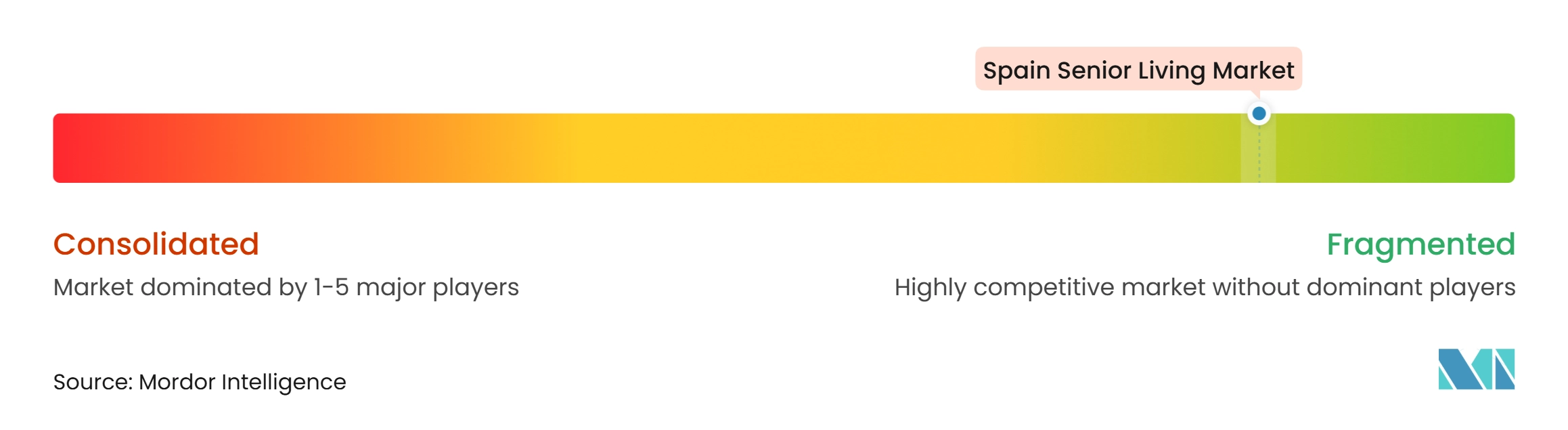
The Spain senior living market includes large national operators as well as many local and regional providers. This creates a competitive environment where scale can help with financing, workforce systems, procurement, and quality processes. Smaller operators can still compete through local knowledge, established referral networks, and strong resident relationships. The balance between scale and local operating capability is likely to shape future consolidation. Providers that can maintain care quality while growing across regions will be better positioned to win new opportunities. Competition will also depend on the ability to deliver reliable family communication, transparent services, and a stable resident experience across every location.
Vitalia has continued to develop its platform through corporate and financing activity. Vitalia Plus completed the merger by absorption of Vivaly Inversiones Globales in November 2026, according to the commercial registry notice. The Instituto de Crédito Oficial also confirmed financing of up to USD 101.1 million for the construction of nine new Vitalia care centers. These actions show how platform growth can be supported by both corporate restructuring and project finance. The competitive effect will depend on whether new sites can recruit staff and meet the service expectations of local markets. Expansion therefore needs disciplined site selection, realistic opening schedules, and operating teams that understand the different requirements of each local care system.
Amavir is expanding its network through targeted acquisition. In February 2026, the company added the El Encinar-Leganés residence in Madrid, including 132 residential places and 30 day-care places. Neinor Homes is pursuing alternative living opportunities that include independent senior living. These examples show that competition involves both specialist care operators and residential developers. Specialist operators retain an advantage where clinical standards, staffing management, and resident care pathways are decisive. Developers entering the segment will need strong operating partnerships if they want to translate real estate delivery capability into trusted care provision.
Spain Senior Living Industry Leaders
-
DomusVi
-
Vitalia Home
-
Clece
-
Ballesol
-
Amavir
- *Disclaimer: Major Players sorted in no particular order
Spain Senior Living Market Companies Covered in this Report
- DomusVi
- Vitalia Home
- Clece
- Ballesol
- Amavir
- Colisée España
- Sanitas Mayores
- Caser Residencial
- Grupo Albertia
- Orpea
- Ilunion VidaSénior
- Bupa Sanitas
- Seniors Residencias
- La Vostra Llar
- Geroresidencias La Saleta
- Grupo Mutuam
- Grupo Santa Clara
- Forum Mare Nostrum
- Senior Living Costa Daurada
- El Encinar de Santo Domingo
- Evoca by Smartrental
- Silverspring and Adapta Socios
- Healthcare Activos SOCIMI, S.A.
- Neinor Homes and Octopus Real Estate
- Care Property Invest N.V.
Recent Industry Developments in Spain Senior Living Market
- September 2026: The President of the Generalitat de Catalunya committed USD 964.8 million for 20,000 new public care places by 2030.
- February 2026: The Community of Madrid launched Plan 40-40, an initiative to develop 40 new residential care facilities and 40 day centers for older people and individuals with dependency needs and it initiated procurement for the first residence and day center, with further projects to be tendered progressively.
- February 2026: Amavir acquired the El Encinar-Leganés residence from Geroplan, adding 132 residential places and 30 day-care places to its network.
Spain Senior Living Market Report Scope
Segmentation Overview
| Assisted Living |
| Independent Living |
| Memory Care |
| Nursing Care |
| Outright Sale (Freehold) |
| Long-Lease / Rental |
| Hybrid (Sale + Lease) |
| 55 to 64 Years |
| 65 to 74 Years |
| 75 to 85 Years |
| Above 85 Years |
| North Spain |
| Central Spain |
| East Spain |
| South Spain |
| Canary Islands and Balearic Islands |
| By Property Type | Assisted Living |
| Independent Living | |
| Memory Care | |
| Nursing Care | |
| By Business Model | Outright Sale (Freehold) |
| Long-Lease / Rental | |
| Hybrid (Sale + Lease) | |
| By Age | 55 to 64 Years |
| 65 to 74 Years | |
| 75 to 85 Years | |
| Above 85 Years | |
| By Geography | North Spain |
| Central Spain | |
| East Spain | |
| South Spain | |
| Canary Islands and Balearic Islands |
Key Questions Answered in the Report
What is the projected growth rate for senior living in Spain?
The Spain senior living market is projected to grow at a 6.1% CAGR and reach USD 9.83 billion by 2032.
Which property type has the largest share in Spain?
Nursing care leads with 78% of the Spain senior living market share in 2026.
Which senior living format is growing fastest in Spain?
Independent living is forecast to grow at a 10% CAGR from 2027 to 2032.
Why is demand for senior living rising in Spain?
An aging population, care capacity gaps, and long-term care reform support demand.
Which region has the highest share of senior living in Spain?
East Spain held 30% of the Spain senior living market share in 2026.
Which region is forecast to grow fastest?
South Spain is projected to expand at an 8.8% CAGR from 2027 to 2032.