
Spain Hydroponics Market Size and Share
Market Overview
| Study Period | 2021 - 2031 |
|---|---|
| Forecast Data Period | 2026 - 2031 |
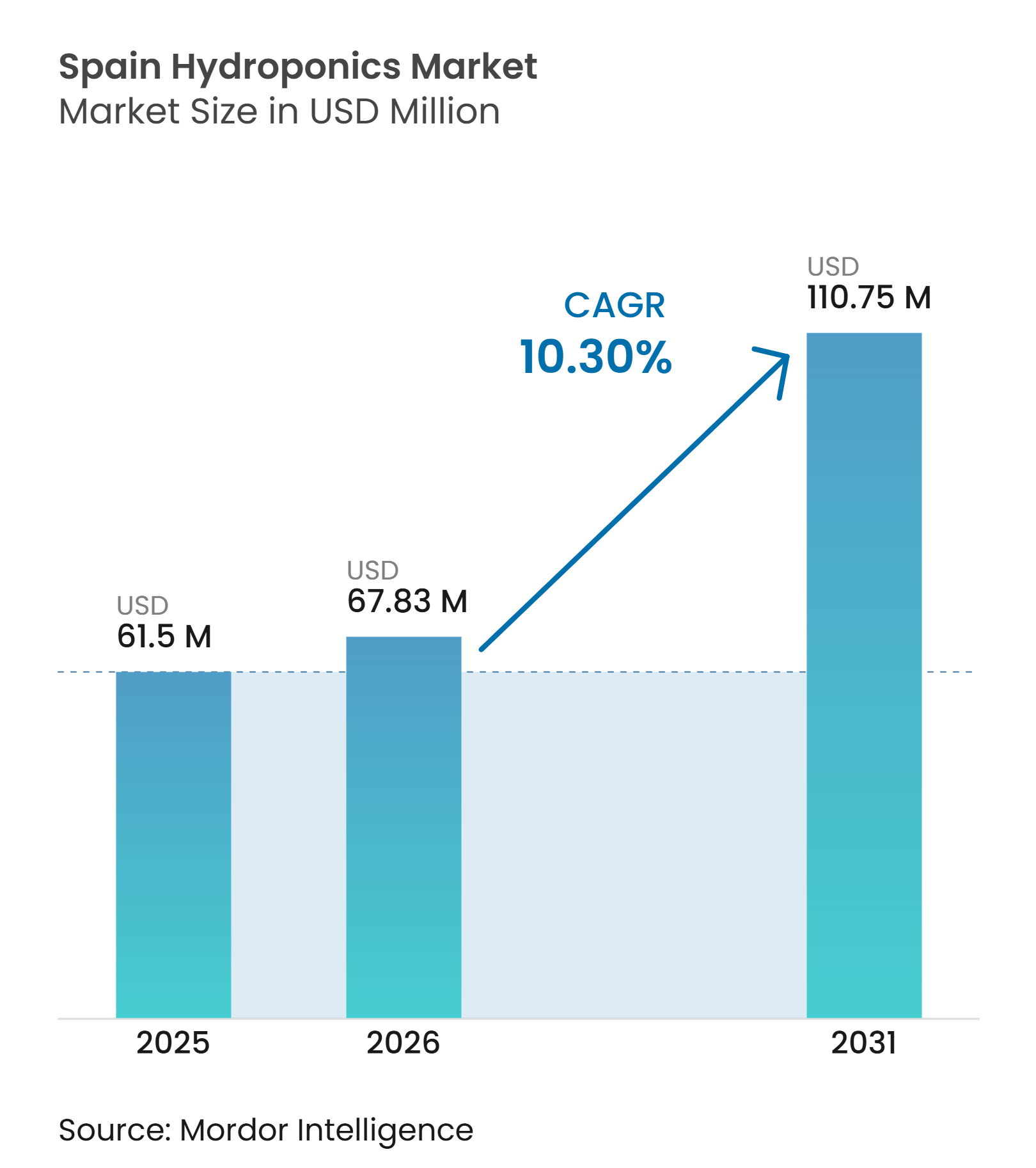
| Base Year Market Size (2025) | USD 61.5 Million |
| Market Size (2026) | USD 67.83 Million |
| Market Size (2031) | USD 110.75 Million |
| Growth Rate (2026 - 2031) | 10.30 % |
| Market Concentration | Low |
Major Players *Disclaimer: Major Players sorted in no particular order Image © Mordor Intelligence. Reuse requires attribution under CC BY 4.0. | |
Spain Hydroponics Market Analysis by Mordor Intelligence
The Spain hydroponics market size was valued at USD 61.5 million in 2025 and is estimated to grow from USD 67.83 million in 2026 to reach USD 110.75 million by 2031, at a CAGR of 10.3% during the forecast period (2026-2031). Water constraints in southeastern Spain are strengthening the case for systems that reuse water and nutrients. Almería’s reservoir level was 7.7% during the 2025/26 season, which increased the need for production methods that reduce freshwater demand[1]. Existing greenhouse infrastructure offers growers a practical path to adopt soilless production through upgrades rather than building entirely new facilities. Operators are also using automation and nutrient monitoring to manage limited skilled labor and improve crop consistency. The Spain hydroponics market is expanding across several regions, although Andalusia remains the main center for investment and commercial activity.
Key Report Takeaways
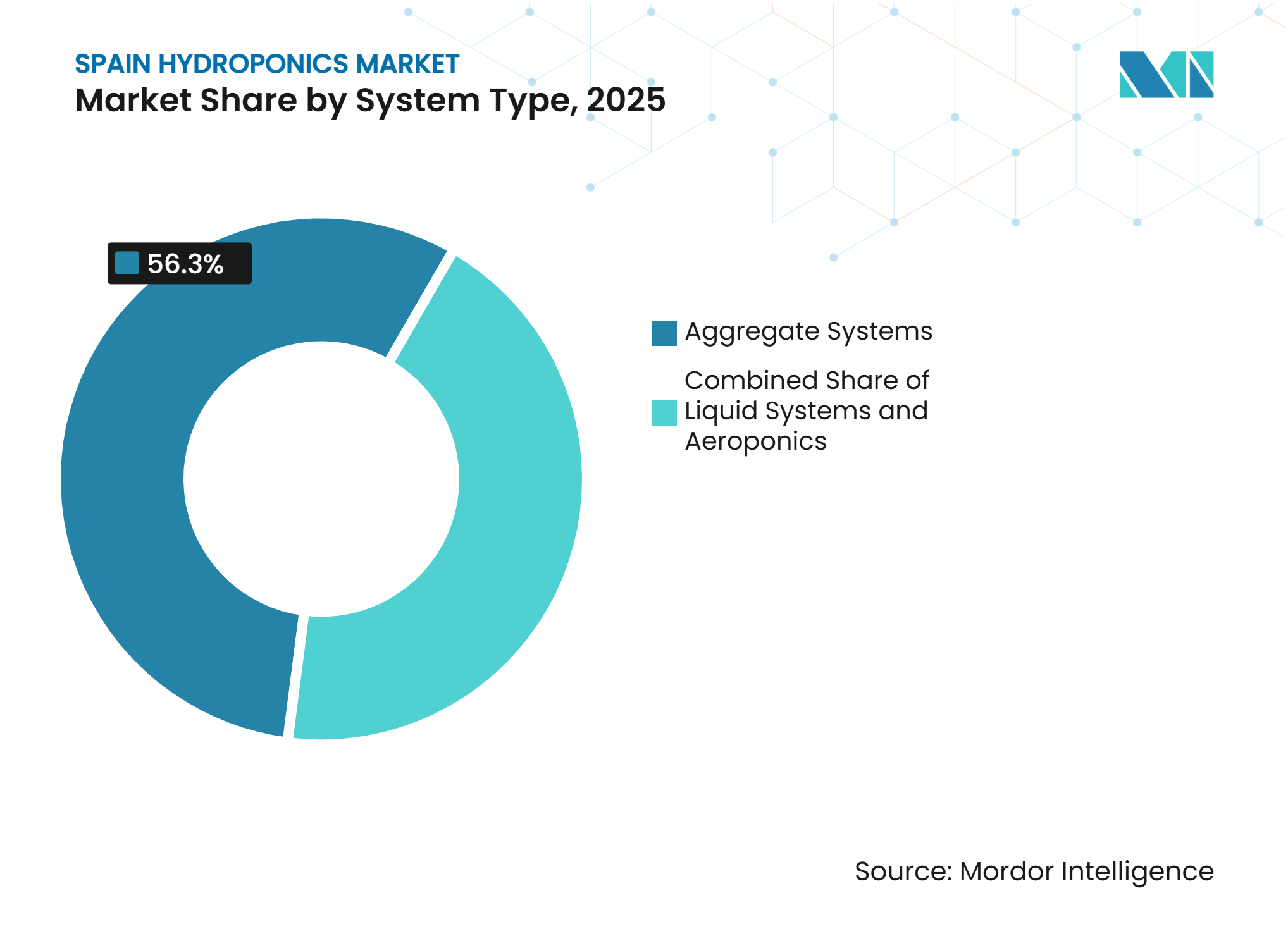
- By system type, aggregate systems accounted for the largest 56.3% of the Spain hydroponics market share in 2025, while liquid systems are forecast to grow at a CAGR of 11.8% from 2026 to 2031.
- By farming type, commercial greenhouses accounted for the largest revenue share in 2025, at 72.4%, while indoor farms are forecast to grow at a CAGR of 13.5% from 2026 to 2031.
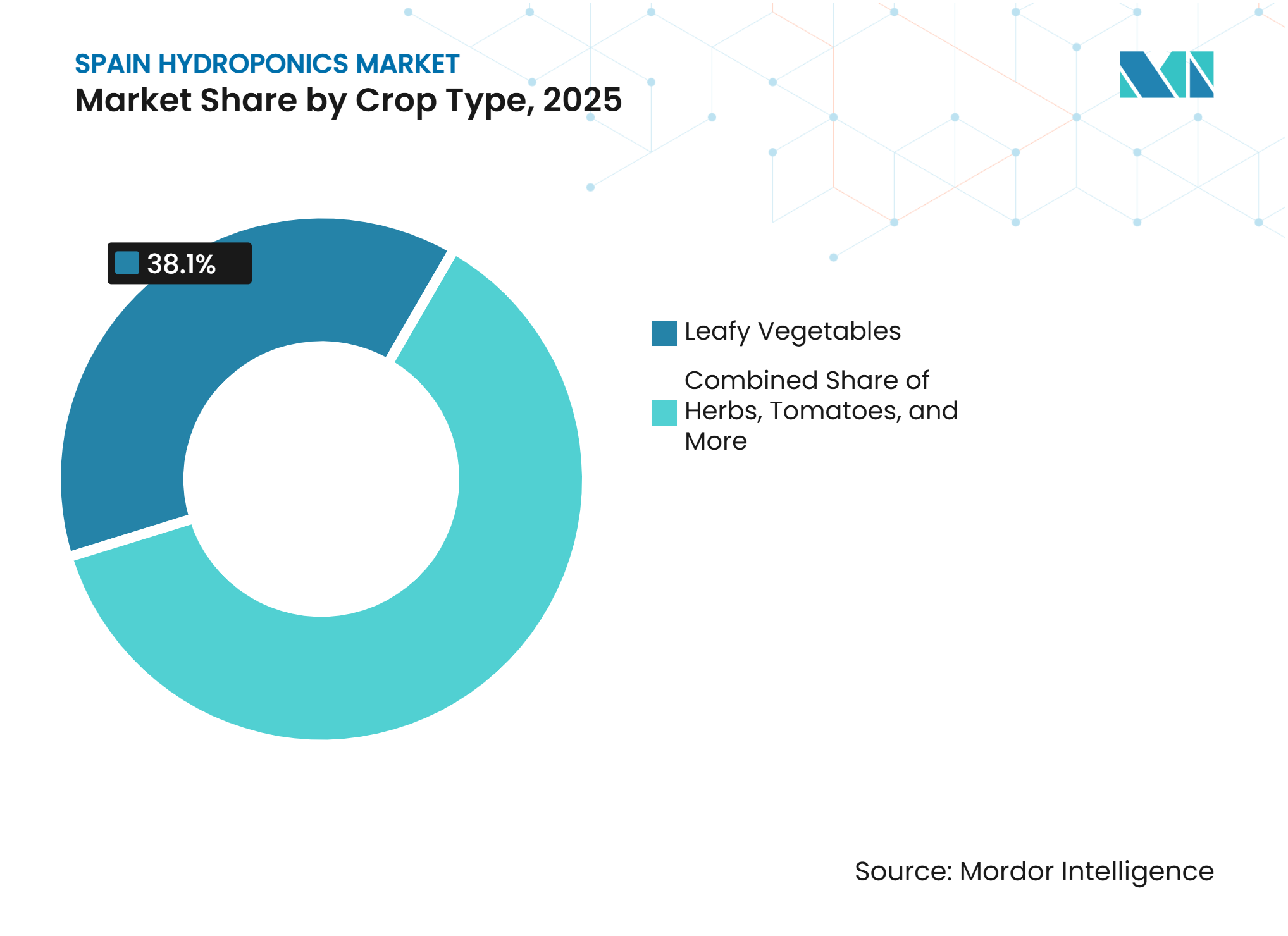
- By crop type, leafy vegetables accounted for the largest revenue share of 38.1% in 2025, while herbs are forecast to grow at a CAGR of 12.9% from 2026 to 2031.
Note: Market size and forecast figures in this report are generated using Mordor Intelligence’s proprietary estimation framework, updated with the latest available data and insights as of January 2026.
Market Trends and Insights
Drivers Impact Analysis of Spain Hydroponics Market*
| Driver | (~) % Impact on CAGR Forecast | Geographic Relevance | Impact Timeline |
|---|---|---|---|
| Water Scarcity and Recirculation Economics Drive Structural Adoption | +2.1% | Spain-wide, with the greatest pressure in Almería, Murcia, and southeastern basins | Short term (≤ 2 years) |
| Protected-Cultivation Retrofit Demand | +2.0% | Andalusia, with spillover into Murcia and the Valencian Community | Medium term (2-4 years) |
| Year-Round Local Supply Demand | +1.5% | National, with early gains in Madrid, Barcelona, and coastal foodservice areas | Medium term (2-4 years) |
| Automation and Precision Nutrient Management | +1.8% | Almería, Murcia, and the Valencian Community | Medium term (2-4 years) |
| Climate-Resilient Specialty Crop Production | +1.2% | National, especially Galicia, Navarre, and inland high-altitude regions | Long term (≥ 4 years) |
| Public Funding for Digital and Circular Projects | +1.1% | National, with early uptake in Andalusia, Galicia, and the Basque Country | Medium term (2-4 years) |
| Source: Mordor Intelligence | |||
Water Scarcity and Recirculation Economics Drive Structural Adoption
Water scarcity is an increasingly important operational consideration for Spain's protected agriculture sector, particularly in Almería, where greenhouse production depends on reliable irrigation resources. Reservoirs in the province were operating at approximately 7.7% capacity during the 2025/26 season, highlighting the pressure on growers to improve water-use efficiency and reduce exposure to freshwater constraints. The LIFE BIOWET project, implemented in the neighboring Murcia region, demonstrated the potential of closed-loop hydroponic systems to recycle up to 93% of drainage water while removing more than 13.5 metric tons of nitrate annually[2]. The project illustrates how water recirculation technologies can reduce water consumption, lower wastewater management requirements, and support environmental compliance. As water availability becomes a more significant factor in production planning across southeastern Spain, hydroponic systems with advanced recirculation capabilities are increasingly relevant for maintaining stable output under water-constrained conditions.
Protected-Cultivation Retrofit Demand
Almería's extensive protected-cultivation base creates a significant retrofit opportunity for hydroponic systems. Existing greenhouse infrastructure can accommodate substrate systems, fertigation equipment, and climate-control technologies without requiring entirely new facilities or major changes to the greenhouse footprint. This reduces the implementation burden for established vegetable growers who already operate under protected cultivation and follow established production cycles. The region's well-developed logistics network, packing infrastructure, and export links to European markets further enable upgraded farms to serve existing buyers with minimal disruption to commercial channels. As a result, the Spanish hydroponics market is well-positioned to attract investment from growers seeking phased technology adoption rather than complete relocation or greenfield development. Local integrators can strengthen their competitive position by combining equipment design with agronomic expertise, installation support, and after-sales services.
Year-Round Local Supply Demand
Retailers and foodservice operators increasingly require a consistent, year-round supply of fresh produce. Hydroponic production supports predictable crop scheduling, traceable cultivation practices, and reliable delivery planning within Spain. Leafy vegetables can achieve 6–8 production cycles annually in hydroponic systems, compared with 1–2 cycles under conventional soil cultivation. This production model helps buyers secure dependable product quality, shorter lead times, and greater visibility into supply availability. Aromatic herbs and microgreens are particularly well suited to foodservice channels, where freshness, uniformity, and delivery frequency are key purchasing considerations. As a result, the Spain hydroponics market benefits from growing demand for locally produced, consistently available crops and longer-term supply relationships between growers and buyers.
Climate-Resilient Specialty Crop Production
Production volatility is increasing interest in controlled-environment agriculture for high-value crops in Spain. During the 2025/26 horticultural season, Almería recorded a 9.8% decline in production volume, primarily due to adverse weather conditions and elevated pest pressure, even as production value reached EUR 3,916 million (USD 4,229 million). The divergence between volume and value highlights the operational challenges growers face in maintaining consistent output under variable growing conditions. Hydroponic and indoor production systems offer greater control over environmental factors, helping reduce exposure to weather-related disruptions and pest outbreaks. This is particularly relevant for high-value crops such as microgreens, medicinal herbs, specialty strawberries, and other specification-driven products where supply consistency, quality standards, and product uniformity are critical purchasing requirements. As buyers place greater emphasis on reliable year-round supply, the Spain hydroponics market is well positioned to support crop categories where controlled production delivers a clear advantage over conventional cultivation methods.
Restraints Impact Analysis of Spain Hydroponics Market*
| Restraint | (~) % Impact on CAGR Forecast | Geographic Relevance | Impact Timeline |
|---|---|---|---|
| High Initial Capital and Long Payback Periods | -1.8% | National, especially smaller operators outside established greenhouse clusters | Medium term (2-4 years) |
| Electricity Exposure in Artificially Lit Farms | -1.5% | National, particularly indoor farms in the Valencian Community, Galicia, and Catalonia | Medium term (2-4 years) |
| Limited Hydroponic Skills and Operating Talent | -0.9% | National, most evident outside Almería, Murcia, and the Valencian Community | Medium term (2-4 years) |
| Certification and End-Market Fragmentation | -0.6% | National, with added complexity in Catalonia, the Basque Country, and Navarre | Long term (≥ 4 years) |
| Source: Mordor Intelligence | |||
High Initial Capital and Long Payback Periods
Hydroponic facilities require significant upfront investment in greenhouse structures, climate-control systems, lighting, growing substrates, and water-treatment infrastructure. These capital requirements can be challenging for small and medium-sized growers that lack scale, long-term financing, or access to institutional funding. Elevated input costs can further lengthen payback periods and encourage a more cautious approach to investment decisions. In February 2026, Compañía Española de Financiación del Desarrollo (COFIDES) committed EUR 25 million (USD 27 million) to Iberian Smart Financial Agro (ISFA) as part of a EUR 50 million (USD 54 million) funding round supporting sustainable agro-industrial expansion across the Iberian Peninsula[3]. While such investments highlight growing institutional interest in sustainable agricultural systems, access to capital remains uneven across grower segments and project types. As a result, many operators are more likely to pursue phased upgrades and retrofit existing facilities rather than undertake full-scale hydroponic conversions, even when larger investments could deliver greater operational efficiency and control over production inputs.
Certification and End-Market Fragmentation
Hydroponic suppliers serve buyers with different product specifications, certification requirements, and procurement practices. Compliance expectations vary across customer groups, adding complexity for producers seeking to expand into new markets or supply channels. Growers often need to adapt traceability systems, packaging standards, and residue-management practices to meet specific buyer requirements. Spain's draft National Action Plan for the Sustainable Use of Plant Protection Products 2025–2029 (PAN 2025–2029) reinforces the focus on integrated pest management and reduced pesticide use[3]. While these measures support more sustainable production practices, the associated documentation, monitoring, and compliance requirements can be demanding for smaller farms with limited administrative resources. Fragmented customer requirements and certification obligations may therefore slow expansion beyond established commercial relationships and familiar regional markets.
*Our forecasts treat driver/restraint impacts as directional, not additive. The impact forecasts reflect baseline growth, mix effects, and variable interactions.
Spain Hydroponics Market Segment Analysis
By System Type:
Aggregate Systems Hold Ground While Liquid Systems ExpandAggregate Systems accounted for 56.3% of the hydroponics market share in Spain in 2025. Rockwool, perlite, coco coir, and related media remain familiar to protected-cultivation growers. These systems work well with established drip-irrigation practices in Almería. Their operating approach can facilitate the transition from conventional greenhouse production. This familiarity supports their strong position in the Spain hydroponics market. Aeroponics remained a small part of the system mix. It is used mainly in research applications and premium herb production. Higher operating complexity and greater sensitivity continue to limit broader commercial adoption.
Liquid Systems are forecast to grow at a CAGR of 11.8% from 2026 to 2031. This segment includes nutrient film technique (NFT), deep-water culture (DWC), and recirculating drip systems. The LIFE BIOWET project in the Murcia region demonstrated that a closed-loop hydroponic system can remove more than 13.5 metric tons of nitrates annually. This result highlights the role of liquid systems in improving water and nutrient management. Novagric and Voltiris have also deployed and tested a hydroponic lettuce greenhouse project in Mazarrón that combines water recirculation with spectral solar technology. The installation is projected to meet up to 80% of greenhouse gas energy requirements and reduce electricity costs by up to 60%. These capabilities support the growing relevance of liquid systems in the Spain hydroponics market.



By Farming Type:
Commercial Greenhouses Anchor Revenue While Indoor Farms AccelerateCommercial greenhouses accounted for 72.4% of the Spain hydroponics market in 2025. Their dominance reflects the scale of protected horticulture in Andalusia and Murcia. Existing farms can adopt hydroponic systems while preserving established production and export arrangements. Greenhouses also utilize natural sunlight, reducing dependence on artificial lighting. This advantage is particularly relevant given ongoing concerns over electricity costs for indoor production. Container farms represented the smallest farming format. Their modular design is well-suited for municipal procurement and pilot programs in remote interior areas. However, their limited scale constrains their contribution to market revenue.
Indoor farms are projected to grow at a CAGR of 13.5% through 2031. Rising urban demand for fresh produce and herbs is supporting investment in this format. Néboda secured EUR 1.84 million (USD 2 million) in seed funding in July 2025 to develop an industrial-scale facility, with a Series A funding round planned for 2026. Vertical farms remain concentrated in Catalonia and the Basque Country, where access to premium retail channels and nearby urban demand support commercial viability. Indoor farms provide greater control over crop schedules, product quality, and delivery frequency for buyers with year-round supply requirements. The higher growth rate of indoor farming indicates that this format is expanding faster than the overall hydroponics market in Spain, underscoring the importance of energy management, automation, and advanced operational capabilities.
By Crop Type:
Herbs Lead Growth as Leafy Vegetables Sustain Volume LeadershipLeafy vegetables accounted for 38.1% of hydroponic crop revenue in 2025. Lettuce production benefits from the short production cycles and controlled conditions offered by hydroponic cultivation. Hydroponic leafy vegetable systems can achieve 6 to 8 production cycles annually, compared with 1 to 2 cycles under conventional soil cultivation, enabling a consistent supply to retailers and foodservice operators. Tomatoes, cucumbers, and strawberries represented a substantial share of the remaining crop mix. Tomato growers in the Valencian Community are increasingly adopting hydroponic systems to improve yield per square meter. Cucumber production remains closely linked to Almería's export-oriented supply chains. Microgreens, edible flowers, specialty peppers, and other niche crops are more commonly associated with urban farms targeting premium foodservice demand.
Herbs are projected to grow at a CAGR of 12.9% through 2026 to 2031. Basil, mint, and cilantro are particularly well-suited to controlled-environment production, as foodservice buyers require frequent deliveries of fresh products. In 2024, Foodys Agro announced a EUR 6 million (USD 6.5 million) investment plan to quadruple its hydroponic cultivation area and diversify into additional aromatic herb varieties. This approach allows suppliers to offer a broader year-round product portfolio within a single customer relationship. Faster crop turnover allows producers to respond more effectively to changing demand across multiple herb categories. High turnover rates and consistent quality standards make herbs an attractive category for specialized indoor and greenhouse operators. In Spain's hydroponics market, herb producers are projected to increasingly focus on cultivation reliability, product consistency, and supply continuity.

Geography Analysis
Andalusia held the largest position in the Spain hydroponics market in 2025. The region hosts 33,720 hectares of greenhouse cultivation concentrated in Almería and surrounding municipalities. Almería's horticultural production generated approximately EUR 4,695 million (USD 5,066 million) in value during the 2025/26 season, reflecting the scale of its protected-cultivation industry. This extensive production base supports equipment suppliers, specialized service providers, packing operations, and established export networks. Water scarcity remains a major consideration, with reservoir levels critically low during the season, increasing the attractiveness of recirculating hydroponic systems that improve water-use efficiency. Andalusia is projected to remain the country's largest hydroponic investment hub, although growth may moderate as the installed greenhouse base matures.
Murcia ranked second in the Spain hydroponics market and serves as a technology and innovation center. The region hosts several companies specializing in greenhouse engineering, nutrient management, fertigation systems, and precision agriculture solutions. Ongoing investments in hydroponic infrastructure, climate-control technologies, and energy-efficient cultivation systems continue to strengthen its position within the controlled-environment agriculture ecosystem. Murcia also serves as a reference market for integrating automation, irrigation management, and resource-efficiency technologies into commercial hydroponic production. The nearby Valencian Community is becoming increasingly relevant as tomato producers adopt hydroponic cultivation methods to improve productivity and resource utilization.
Navarre occupies a distinct position in Spain's hydroponics market due to its specialization in herbs and aromatic crops. Expansion in controlled-environment basil and herb production continues to reinforce the region's role in high-value hydroponic cultivation. Its cooler climate is favorable for controlled-environment agriculture and can reduce cooling requirements compared with southern production regions. Galicia and Asturias are emerging hydroponic markets supported by smaller-scale public and private investments. New indoor farming and controlled-environment agriculture projects are helping expand hydroponic activity beyond Spain's traditional southeastern production corridor. Although these developments remain at an early stage, they indicate growing geographic diversification within the Spain hydroponics market.
Competitive Landscape
Market Concentration
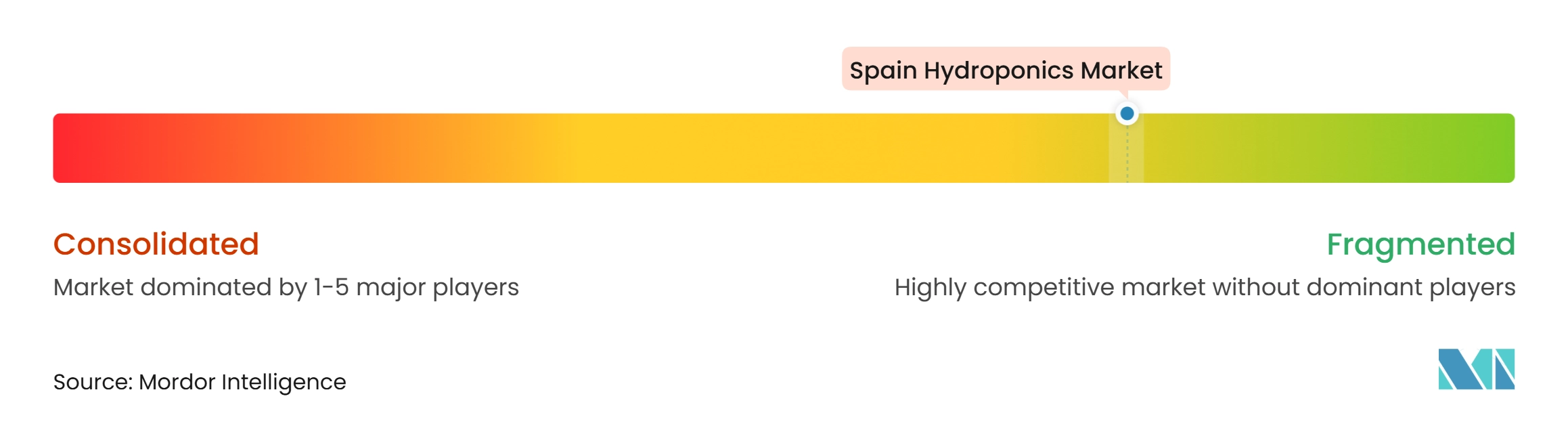
The Spain hydroponics market is moderately fragmented, with participation from established system providers, greenhouse technology companies, irrigation specialists, nutrient management firms, and regional integrators. Key participants include Hydroponic Systems International, SIAP SPAIN SL, NEW GROWING SYSTEMS S.L. (NGS), Novagric, and RITEC. The market also includes several regional integrators, nutrient management providers, irrigation specialists, and greenhouse technology companies serving specific customer requirements across Spain.
Spain-based suppliers compete through local technical support, crop-specific expertise, and close relationships with greenhouse operators. Novagric’s collaboration with Voltiris highlights the growing focus on integrated greenhouse solutions that combine hydroponic production with energy-efficient technologies. Companies are increasingly expanding their digital monitoring, automation, and crop-management capabilities to strengthen their value proposition. Suppliers that combine system installation with ongoing agronomic and remote technical support are better positioned to address the operational challenges growers face in emerging hydroponic production areas.
Technology providers are also focusing on automation, controlled-environment agriculture, and resource-efficiency solutions. Signify N.V. supports commercial greenhouse production through its lighting technologies, while emerging automation developers are introducing robotic solutions for intensive horticulture operations. Companies that help growers improve water-use efficiency, nutrient management, and operational consistency are gaining greater market relevance. Competition is primarily driven by system performance, technical expertise, after-sales service, and the ability to support efficient greenhouse operations. The fragmented structure of the Spain hydroponics market continues to create opportunities for specialist firms offering differentiated technologies and crop-specific solutions.
Spain Hydroponics Industry Leaders
-
Hydroponic Systems International
-
SIAP SPAIN SL
-
NEW GROWING SYSTEM S.L. (NGS)
-
Novagric
-
RITEC
- *Disclaimer: Major Players sorted in no particular order
Spain Hydroponics Market Companies Covered in this Report
- Hydroponic Systems International
- SIAP SPAIN SL
- NEW GROWING SYSTEM S.L. (NGS)
- Novagric
- RITEC
- Auxprotec
- Prosystem Aqua
- Hortalan
- Vertical Green S.L.
- Nutricontrol
- Priva B.V.
- Richel Group
- Netafim Ltd.
- Ridder Group
- Signify N.V.
Recent Industry Developments in Spain Hydroponics Market
- September 2026: Novedades Agrícolas, S.A. and Voltiris SA reported initial results from a spectral-solar pilot at a hydroponic lettuce greenhouse in Mazarrón, Murcia. The project demonstrates the integration of renewable energy generation with hydroponic production, supporting greater energy efficiency and sustainability in Spain's controlled-environment agriculture sector.
- April 2026: J. Huete Greenhouses completed a high-technology greenhouse in Almería equipped with advanced climate-control, energy-efficiency, and CO₂ management systems. The development highlights the increasing adoption of controlled-environment infrastructure capable of supporting hydroponic production and precision greenhouse cultivation in Spain.
- January 2026: NEW GROWING SYSTEM S.L. (NGS) entered a strategic partnership with Ecobloom Technologies to integrate the EcoSense AI-powered crop analytics platform with NGS hydroponic and aeroponic cultivation systems. The collaboration includes pilot projects and phased commercial deployments aimed at improving crop monitoring, resource efficiency, yield stability, and environmental control in controlled-environment agriculture operations.
Spain Hydroponics Market Report Scope
Hydroponics is a soilless cultivation method that grows plants using nutrient-rich water solutions, often supported by inert growing media. It enables efficient use of water and nutrients, supports year-round production, increases crop yields, and is widely used to cultivate vegetables, herbs, and fruits in controlled environments.
The Spain hydroponics market report is segmented by system type (aggregate systems, liquid systems, and drip systems), by farming type (commercial greenhouses, vertical farms, indoor farms, and container farms), and by crop type (leafy vegetables, herbs, tomatoes, cucumbers, strawberries, and other crop types). The market forecasts are provided in terms of value (USD).
Segmentation Overview
| Aggregate Systems |
| Liquid Systems |
| Aeroponics |
| Commercial Greenhouses |
| Vertical Farms |
| Indoor Farms |
| Container Farms |
| Leafy Vegetables |
| Herbs |
| Tomatoes |
| Cucumbers |
| Strawberries |
| Other Crop Types |
| By System Type | Aggregate Systems |
| Liquid Systems | |
| Aeroponics | |
| By Farming Type | Commercial Greenhouses |
| Vertical Farms | |
| Indoor Farms | |
| Container Farms | |
| By Crop Type | Leafy Vegetables |
| Herbs | |
| Tomatoes | |
| Cucumbers | |
| Strawberries | |
| Other Crop Types |
Key Questions Answered in the Report
What is the projected value of hydroponics in Spain by 2031?
The Spain hydroponics market is forecast to reach USD 110.8 million by 2031, growing at a 10.3% CAGR from 2026.
Which production format has the largest revenue position in Spain?
Commercial Greenhouses led farming types with 72.4% revenue share in 2025, supported by established protected cultivation in Andalusia and Murcia.
Which crop is expanding most quickly in hydroponic cultivation?
Herbs are projected to record the highest growth rate, with a projected CAGR of 12.9% through 2031.
Why is water reuse important for Spanish growers?
Almería’s reservoirs were at 7.7% capacity in the 2025/26 season, while the LIFE BIOWET project demonstrated 93% drainage-water recycling.