
Spain Bonsai Market Size and Share
Market Overview
| Study Period | 2021 - 2031 |
|---|---|
| Forecast Data Period | 2026 - 2031 |
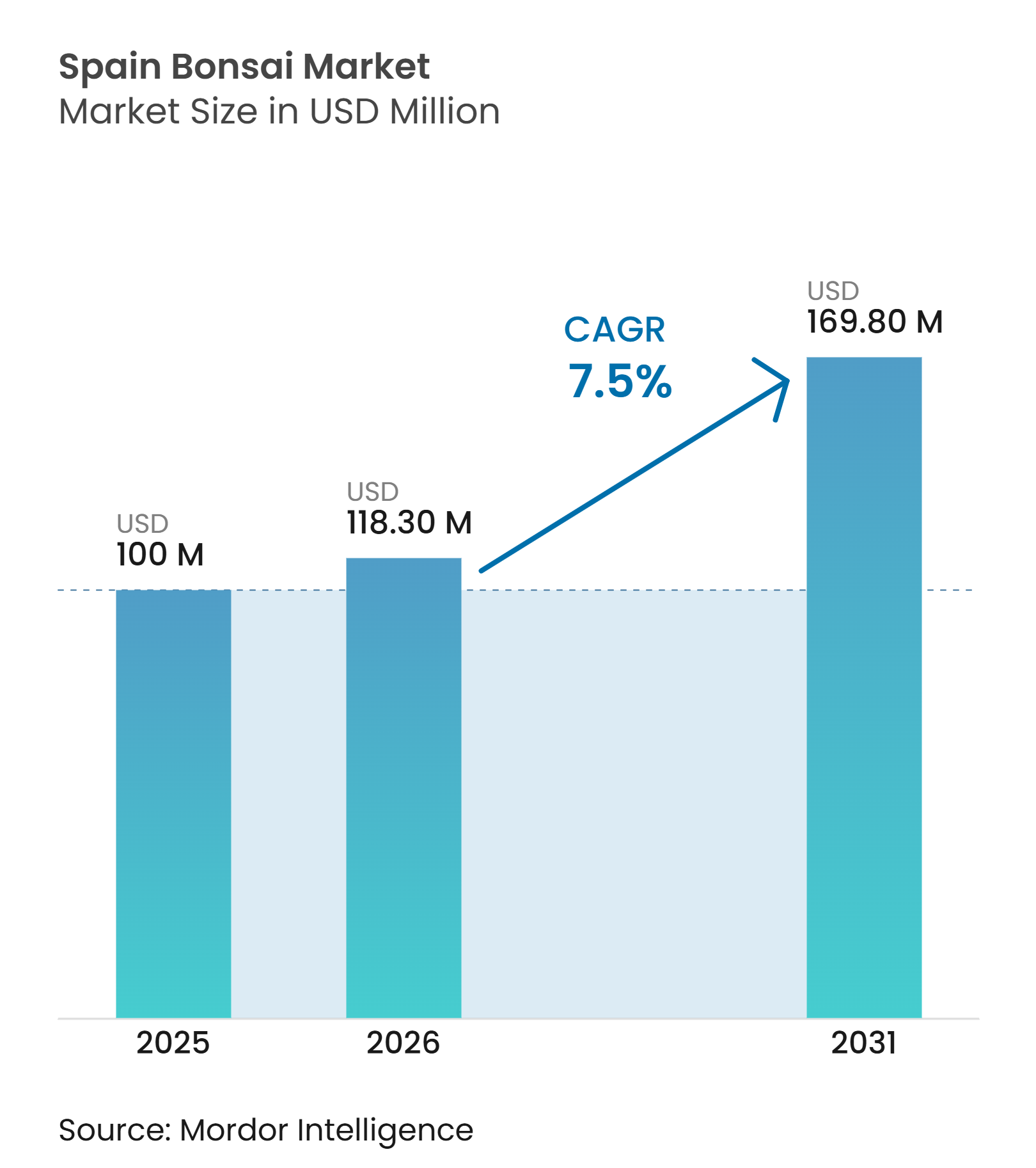
| Base Year Market Size (2025) | USD 100 Million |
| Market Size (2026) | USD 118.30 Million |
| Market Size (2031) | USD 169.80 Million |
| Growth Rate (2026 - 2031) | 7.50 % |
| Market Concentration | Medium |
Major Players *Disclaimer: Major Players sorted in no particular order Image © Mordor Intelligence. Reuse requires attribution under CC BY 4.0. | |
Spain Bonsai Market Analysis by Mordor Intelligence
The Spain bonsai market size was valued at USD 110 million in 2025 and estimated to grow from USD 118.3 million in 2026 to reach USD 169.8 million by 2031, at a CAGR of 7.5% during the forecast period (2026-2031). Urban demand supports sales, as compact homes limit space for larger ornamental plants. Online specialists are expanding access to trees, pots, tools, and care supplies beyond major cities. Spain also has production advantages for olive, juniper, and pine, as Mediterranean conditions support their cultivation. Growth in live plant exports indicates that logistics and production capacity are strengthening, while drought, heat, pests, and import controls remain material operating constraints. Suppliers that pair locally adapted species with dependable care support can reduce customer attrition and improve repeat demand in the Spain bonsai market.
Key Report Takeaways
- By species, indoor species led with 32% of Spain bonsai market share in 2025, and it is also the fastest-growing segment at a 9.40% during the forecast period.
- By distribution channel, offline held 61% in 2025, while online recorded the highest projected CAGR at 11.2% through 2031.
- By application, residential accounted for 55% of the Spain bonsai market size in 2025, while commercial is projected to expand at the fastest rate at an 8.4% CAGR through 2031.
Note: Market size and forecast figures in this report are generated using Mordor Intelligence’s proprietary estimation framework, updated with the latest available data and insights as of January 2026.
Market Trends and Insights
Drivers Impact Analysis of Spain Bonsai Market*
| Driver | (~) % Impact on CAGR Forecast | Geographic Relevance | Impact Timeline |
|---|---|---|---|
| Rising Demand for Compact Urban Ornamentals | +1.40% | National, strongest in Madrid, Catalonia, and Basque Country | Short term (≤ 2 years) |
| Growth of Specialty Online Bonsai Retail | +1.50% | National, with access to EU export buyers | Medium term (2-4 years) |
| Wellness and Mindful Gardening Adoption | +1.10% | National, with strong alignment in urban centers | Medium term (2-4 years) |
| Expansion of Live-Plant Trade and Retail Infrastructure | +1.20% | National, with early gains in Valencia, Andalusia, and Catalonia | Medium term (2-4 years) |
| Mediterranean Species Adaptation to Local Conditions | +0.80% | Spain, with relevance for southern European buyers | Long term (≥ 4 years) |
| Demand for Water-Efficient Living Décor | +0.70% | Spain, especially drought-prone regions | Long term (≥ 4 years) |
| Source: Mordor Intelligence | |||
Rising Demand for Compact Urban Ornamentals
Spain's urbanization rate exceeded 81% in 2025, concentrating demand in cities where apartment layouts limit the use of larger ornamental plants. Bonsai fits on balconies, windows, and small interior spaces without occupying the footprint of conventional garden plants. This positions bonsai as a relevant option for households seeking a visible living element in compact spaces. Madrid, Catalonia, and the Basque Country account for a large share of specialty purchases, combining urban purchasing power with established collector communities. Residential buyers held 55% of demand in 2025, indicating that household use remains the primary revenue base. Buyers with space for only a small number of trees may replace, repot, or add trees more frequently than owners of large gardens. Retailers can respond through starter ranges, repotting services, and care bundles that lower the barrier to ownership for first-time customers. These services can also help convert an initial decorative purchase into repeat spending on tools, substrates, pots, and replacement trees.
Growth of Specialty Online Bonsai Retail
Digital retailers give buyers in smaller cities access to material that local nurseries may not stock, including yamadori, premium pots, and care inputs. The channel also allows retailers to combine a tree purchase with substrate, tools, and practical guidance. Kaizen Bonsai rebuilt its e-commerce architecture in September 2024 after an extended development period, citing requirements related to payments, device security, and product information. This indicates that online selling requires more than a product catalog when live plants, customer expectations, and product details must be managed together. In the Spain bonsai market, educational content can reduce the risk of beginners abandoning the hobby after early tree losses. Live selling and direct care advice can partly replicate the inspection and support benefits traditionally associated with physical specialist stores. Operators that meet e-commerce and consumer protection requirements can build a broader national presence than stores that rely only on local footfall.
Wellness and Mindful Gardening Adoption
Bonsai cultivation aligns with consumer interest in activities that provide structured attention and a regular care routine. Research published in the International Journal of Environmental Research and Public Health links horticultural engagement to reduced anxiety. This association gives some buyers reason to view bonsai as more than a decorative purchase. Mature trees can appeal to consumers who incorporate this practice into their broader personal routines, thereby supporting higher-value specimen sales nationwide. This effect is strongest when buyers receive clear guidance on watering, pruning, light, and seasonal care. Retailers who frame their support around practical maintenance can make the activity less intimidating for newcomers. A dependable care experience can also encourage repeat purchases, reducing reliance on one-time tree sales.
Expansion of Live-Plant Trade and Retail Infrastructure
Spain's live-plant export base supports the production and distribution capabilities available to specialist growers. Live-plant exports totaled EUR 577 million (USD 623 million) in 2025, based on data from Federación Española de Asociaciones de Productores Exportadores de Frutas y Hortalizas (FEPEX). In the first quarter of 2026, flower and live-plant exports rose 10% year over year to EUR 238 million (USD 267 million), according to FEPEX[1]. This trade base gives bonsai producers access to expertise in handling living products, greenhouse cultivation, and export logistics. Catalonia, Valencia, and Andalusia are key production areas within the broader ornamental plant supply chain. Improved logistics can reduce delivery friction for online sellers and extend the reach of specialist inventories. It can also support the supply of domestically grown material, which does not face the same import requirements as non-EU plant stock. For the Spain bonsai market, this infrastructure allows producers to serve both domestic collectors and European wholesale customers.
Restraints Impact Analysis of Spain Bonsai Market*
| Restraint | (~) % Impact on CAGR Forecast | Geographic Relevance | Impact Timeline |
|---|---|---|---|
| Labor-Intensive Bonsai Maintenance | -0.40% | Global, with high impact in Spain’s specialist nurseries | Short term (≤ 2 years) |
| Phytosanitary and Cross-Border Plant-Movement Requirements | -0.30% | Spain and EU perimeter, most acute for Japanese imports | Medium term (2-4 years) |
| Heat, Drought, and Pest-Related Tree Losses | -0.40% | Spain, with highest severity in southern regions | Medium term (2-4 years) |
| Fragmented Specialist Retailer Base and Limited Consumer Care Support | -0.30% | National, most acute outside Madrid and Barcelona | Long term (≥ 4 years) |
| Source: Mordor Intelligence | |||
Labor-Intensive Bonsai Maintenance
Bonsai requires ongoing pruning, watering, repotting, shaping, pest management, and seasonal protection. This maintenance burden affects specialist nurseries, as stock quality depends on skilled care over long cultivation cycles. Mature or collector-grade trees require more precise handling than entry-level indoor plants, which can limit how quickly a nursery expands its valuable inventory. The burden also extends to buyers who underestimate the level of care required after purchase, and customer dissatisfaction can follow if a tree dies shortly after delivery or if its appearance declines. Retailers can reduce this risk by providing care kits, clear instructions, and service commitments such as repotting support. In the Spain bonsai market, operators who manage after-sales care effectively can maintain customer confidence while handling a product category that cannot be treated like a standard decorative item.
Phytosanitary and Cross-Border Plant-Movement Requirements
EU Plant Health Regulation 2016/2031 governs plant health requirements for cross-border movements of regulated plant material[2]. These requirements add process, documentation, inspection, and timing considerations for importers of premium Japanese yamadori and pre-bonsai material. The impact is more significant for small specialist importers, as compliance costs are harder to absorb across limited volumes. Longer lead times can also reduce inventory flexibility when collectors seek specific specimens. The rules are particularly relevant as demand for authentic Japanese material grows. Domestic production of Mediterranean species can lower exposure to this constraint, although it does not replace the appeal of imported collector trees. Importers need dependable sourcing and delivery planning to maintain customer trust. The Spain bonsai market has a structural incentive to balance imported premium stock with locally produced alternatives.
*Our forecasts treat driver/restraint impacts as directional, not additive. The impact forecasts reflect baseline growth, mix effects, and variable interactions.
Spain Bonsai Market Segment Analysis
By Species:
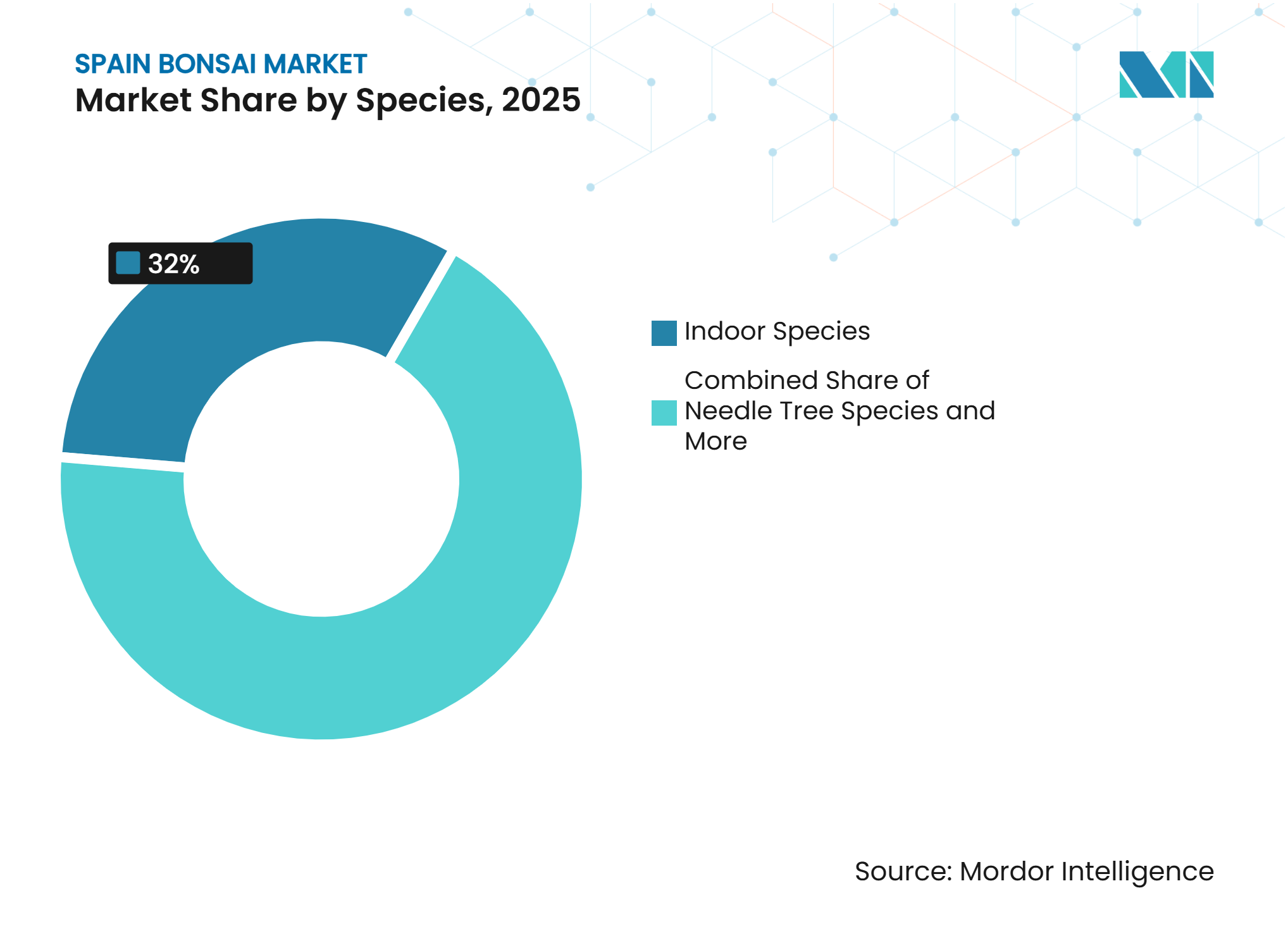
Indoor Species Leads Through Ease of OwnershipIndoor species accounted for 32% of Spain's bonsai market share in 2025, making it the largest species category. Ficus, Carmona, and Schefflera are well-suited to controlled indoor settings and require less seasonal adjustment than most outdoor varieties. Their lower perceived complexity makes them a practical entry point for new buyers, which has helped indoor species become the fastest-growing segment, with a CAGR of 9.4% during the forecast period. Specialist retailers can incorporate indoor trees into beginner bundles that include basic care products and guidance, thereby improving first-year retention and supporting repeat purchases. Outdoor species, needle trees, and deciduous trees serve buyers with varying skill levels and collector interests. Demand for indoor products is supported by apartment living and the need for year-round decorative plants in limited spaces.
Needle trees, primarily juniper and pine, remain significant because mature yamadori specimens can sell for 5 to 10 times the price of an entry-level ficus. Their value reflects the specimen's age, form, rarity, and the level of knowledge required to maintain it. Deciduous species such as maple and pomegranate are gaining traction in Catalonia and the Basque Country, where seasonal gardens and collector culture are more established. These categories appeal to buyers who value seasonal change and horticultural challenge. Domestically sourced material can also help producers highlight provenance and reduce exposure to import certification delays. European Union (EU) plant-health regulations reinforce the value of a local supply base for regulated material. The combination of accessible indoor species and premium collector material gives retailers distinct price points, though the need for strong care support remains consistent across categories.



By Distribution Channel:
Offline Retail Retains Trust While Online Sales AccelerateOffline accounted for 61% of the Spain bonsai market share in 2025, while online is projected to grow at an 11.2% CAGR through 2031. Physical inspection remains important for collector-grade trees, where buyers assess structure, health, provenance, and visual quality before paying a premium. Specialist stores offer direct advice that reduces uncertainty for high-value purchases. Laos Garden in Las Rozas de Madrid is an example of a specialist retailer that imports individually selected Japanese specimens. This model illustrates why physical retail remains relevant even as digital channels expand.
Online sellers are capturing demand from beginners and mid-range buyers through a wider selection, lower geographic barriers, and convenient delivery. Bonsai Direct used TikTok Live events to allow buyers to select individual trees before purchase, creating a more interactive digital sales format. Similar approaches combine live product viewing with direct customer advice and interaction. Digital sellers also use care content and messaging tools to support customers after delivery. Compliance with Spain's electronic commerce regulations and EU consumer protection standards will influence which operators can scale nationally. The growth of online channels does not eliminate the role of specialist stores, as high-value trees still benefit from direct inspection. The two channels serve different buyer needs and can complement each other when retailers combine physical expertise with online reach.
By Application:
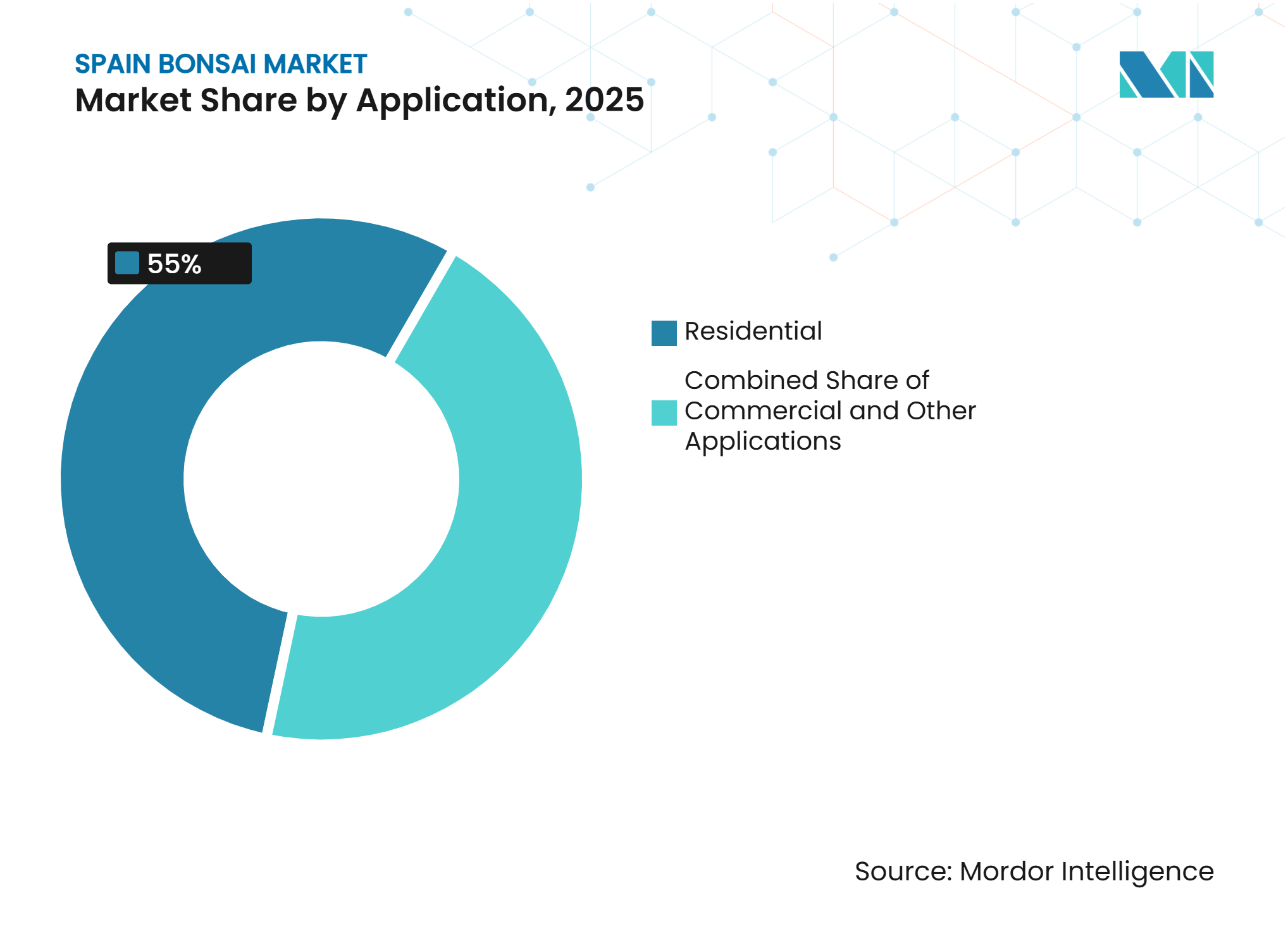
Residential Demand Provides the Base and Commercial Use Expands FasterResidential accounted for 55% of the Spain bonsai market in 2025, making households the largest application segment. Bonsai suits apartments and small homes where a compact living plant has more practical appeal than a full-sized ornamental. This customer base also supports demand for care products, pots, tools, and replacement trees. Commercial is forecast to expand at an 8.4% CAGR from 2026 to 2031. Hotels, restaurants, offices, and wellness centers use premium trees where visual presentation and maintenance quality are important. This gives the Spain bonsai market a second demand source beyond household purchases.
Commercial demand includes corporate gifts, hospitality interiors, and professional installations. Mistral Bonsai introduced a corporate bonsai gift pack range in October 2024, offering a dedicated route into business gifting. Other applications include institutional gifts, art fairs, and cultural events, which are smaller in scale but can increase market visibility. The Ávila International Bonsai and Suiseki Congress is scheduled for November 2026 and is projected to attract exhibitors and buyers from Japan, Italy, and other European markets[3]. Such events can introduce bonsai to new audiences and support the residential buyer pipeline. Commercial growth depends on suppliers that can provide reliable installation, maintenance, and replacement services, creating an opening for organized providers in hospitality and corporate interiors.

Geography Analysis
Catalonia is a major production and consumption center for the Spain bonsai market, supported by Barcelona and the Ebro Delta production corridor. In Q1 2026, flower and live-plant exports from Catalonia increased 20% year over year to EUR 44.5 million (USD 49.8 million), according to FEPEX. Mistral Bonsai's Camarles facilities provide the region with a substantial domestic production base. Madrid remains an important center of demand and distribution, as purchasing power is concentrated in the capital and its metropolitan area. The city also hosts specialist retailers, including Laos Garden. Madrid's position supports in-person sales and specialist e-commerce distribution. Together, these areas connect urban demand with production and supply capability.
Valencia and Andalusia are major regions for ornamental plant exports by volume. In Q1 2026, Valencia generated EUR 69 million (USD 77 million) in live-plant exports, and Andalusia generated EUR 60 million (USD 67 million), according to FEPEX. Valencia's nursery sector includes olive bonsai producers such as P.O.M. Producción Ornamental Mediterránea and has established wholesale links with northern European distributors through Floriday and direct export channels. Andalusia's output growth moderated in late 2025 due to climate-related disruption, exposing a constraint for growers that depend on stable conditions for valuable living stock. Investment in climate-controlled greenhouse space can help limit the impact on the Spain bonsai market.
The Basque Country supports premium collector demand through specialist cultivation, education, and recurring exhibitions. Bonsai Center Bilbao Sopelana and the Bonsai Bizkaia series reflect the region's established enthusiast base. Pesticide-use restrictions under Spain's National Action Plan for the Sustainable Use of Plant Protection Products affect how nurseries select care inputs and substrates. Murcia, Navarre, Extremadura, and other areas in the Rest of Spain remain less developed for specialist bonsai retail, offering opportunities for standardized, beginner-oriented ranges at accessible price points. The geographic pattern indicates that premium collector demand and scalable entry-level demand do not always occur in the same locations. Suppliers therefore require regional product, support, and logistics strategies rather than a single national approach.
Competitive Landscape
Market Concentration
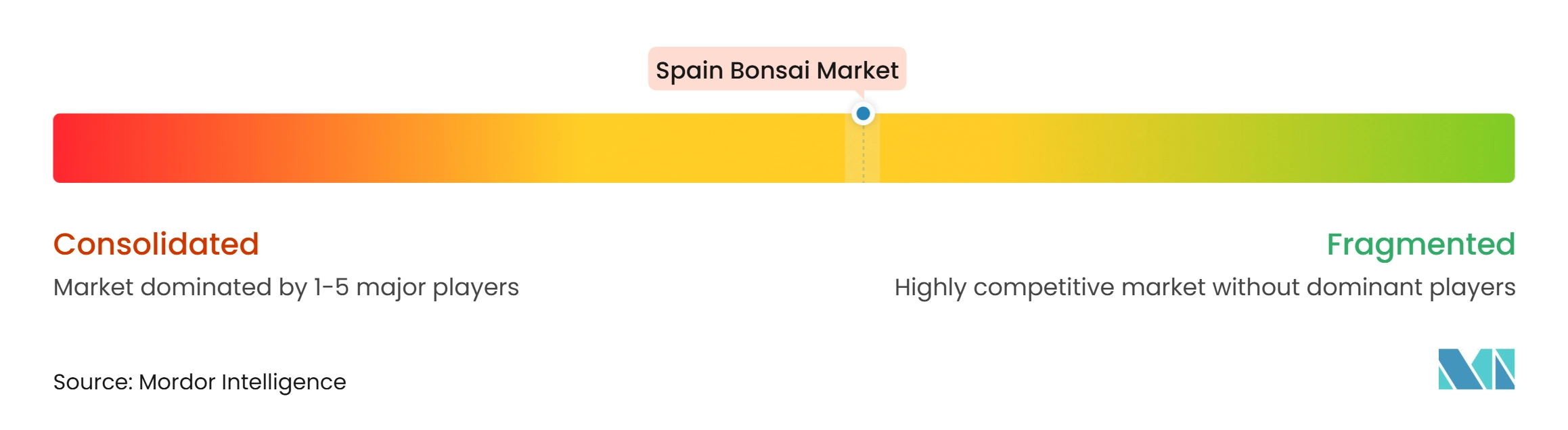
The Spain bonsai market is moderately fragmented in 2025. Key players include Mistral Bonsai S.L., Laos Garden, Ikigai Bonsai, BonsaiNara, and Bonsai Center Bilbao Sopelana. Mistral Bonsai holds a clear scale advantage through 23 hectares of field cultivation, more than 129,000 square meters of greenhouse space, and import, export, wholesale, and direct-to-consumer channels. Its partnership with Green Collect Sales in the Netherlands expanded access to the Floriday marketplace in 2025. Laos Garden, Ikigai Bonsai, and BonsaiNara focus on premium service, imported Japanese specimens, education, and direct collector relationships. This positioning emphasizes margin and specialist knowledge rather than production scale. Competition therefore combines large domestic cultivation with smaller operators serving high-value niche demand.
Digital tools are changing how specialists communicate with potential buyers and present inventory. Bonsai Direct uses live selling to provide real-time tree selection and a stronger sense of community than a static product page. This format allows online sellers to offer more detail before a customer commits to purchasing a living plant. Mistral Bonsai has also used events and corporate gift packs to develop demand beyond traditional retail. Its April 2026 conference included public workshops, demonstrations, yoga sessions, and cultural activities. These activities create opportunities for customer education, community engagement, and new buyer acquisition. Strategic differentiation increasingly relies on after-sales support, content, live presentation, and dependable supply.
Open opportunities remain in subscription-style care services, climate-resilient beginner bundles, and professional programs for hospitality interiors. Providers that can install, maintain, and replace trees may be better positioned for commercial clients than retailers that only sell plants. Customer service is particularly important because beginners may exit the category after early tree losses. Local Mediterranean species give domestic producers a way to reduce some import and climate risks. Imported Japanese material will remain important for collectors, but it carries greater logistical and supply uncertainty. The Spain bonsai market concentration score is 5 out of 10, as the combined share of the top five players is estimated at 50%, indicating a moderately fragmented competitive structure.
Spain Bonsai Industry Leaders
-
Mistral Bonsai S.L.
-
Laos Garden
-
Ikigai Bonsai
-
BonsaiNara
-
Bonsai Center Bilbao Sopelana
- *Disclaimer: Major Players sorted in no particular order
Spain Bonsai Market Companies Covered in this Report
- Mistral Bonsai S.L.
- Laos Garden
- Ikigai Bonsai
- BonsaiNara
- Bonsai Center Bilbao Sopelana
- CentroBonsai.es
- Vitis Bonsai
- Kibo Bonsai
- Minibonsái Shop
- BoheBonsai
- Bonsai.tienda
- P.O.M. Producción Ornamental Mediterránea
- Kaizen Bonsai Ltd.
- Lodder Bonsai BV
- Bonsai Direct Limited
Recent Industry Developments in Spain Bonsai Market
- March 2026: Lodder Bonsai BV held its 25th Annual Lodder Bonsai Open House in Harmelen, Netherlands, attracting 2,000 visitors from across Europe. Spanish master Germán Colmenares delivered a live demonstration, reinforcing Spain’s growing prestige in the European bonsai circuit. The event functions as a strategic retail and trade window for European wholesale buyers.
- August 2025: Bonsai Center Bilbao Sopelana relaunched its annual summer bonsai guardería service for 2025, caring for customers’ trees through watering, pruning, and pinching during vacation periods. The service was supported by a 24-hour WhatsApp advisory line and reflected the center’s move toward recurring customer support
- January 2025: Bonsai Robotics raised USD 15 million Series A to expand AI-based orchard automation, with future applicability to a precision bonsai care network.
Spain Bonsai Market Report Scope
Bonsai is the horticultural art of growing and training ordinary trees or shrubs in shallow containers to create a miniaturized, realistic representation of a mature tree in nature
The Spain bonsai market report is segmented by species (indoor species, outdoor species, needle tree species, and deciduous tree species), by distribution channel (online and offline), and by application (residential, commercial, and others). The market forecasts are provided in terms of value (USD).
Segmentation Overview
| Indoor Species |
| Outdoor Species |
| Needle Tree Species |
| Deciduous Tree Species |
| Online |
| Offline |
| Residential |
| Commercial |
| Other Applications, Institutional Gifts and Art Fairs |
| By Species | Indoor Species |
| Outdoor Species | |
| Needle Tree Species | |
| Deciduous Tree Species | |
| By Distribution Channel | Online |
| Offline | |
| By Application | Residential |
| Commercial | |
| Other Applications, Institutional Gifts and Art Fairs |
Key Questions Answered in the Report
What is the projected value of Spain’s bonsai sector by 2031?
The Spain bonsai market is forecast to reach USD 169.8 million by 2031, from USD 118.3 million in 2026, at a 7.5% CAGR.
Which bonsai category held the largest share in Spain?
Indoor species led the species categories with 32% share in 2025, supported by apartment demand and easier indoor care.
Which sales channel is expanding fastest for bonsai in Spain?
Online retail is forecast to expand at an 11.2% CAGR from 2026 to 2031 because it broadens access to specialist stock and care materials.
Which buyer group accounts for the largest share of bonsai demand in Spain?
Residential buyers accounted for 55% share in 2025, making households the largest application group.
Why are Mediterranean bonsai species important to Spanish growers?
Olive, juniper, and pine suit local conditions and can lower exposure to the import process that affects non-EU plant material.