
Sovereign Customer Managed Encryption Software Market Size and Share
Market Overview
| Study Period | 2020 - 2031 |
|---|---|
| Market Size (2026) | USD 7.88 Billion |
| Market Size (2031) | USD 20.34 Billion |
| Growth Rate (2026 - 2031) | 20.88 % |
| Fastest Growing Market | Asia-Pacific |
| Largest Market | North America |
| Market Concentration | Low |
Major Players *Disclaimer: Major Players sorted in no particular order Image © Mordor Intelligence. Reuse requires attribution under CC BY 4.0. | |
Sovereign Customer Managed Encryption Software Market Analysis by Mordor Intelligence
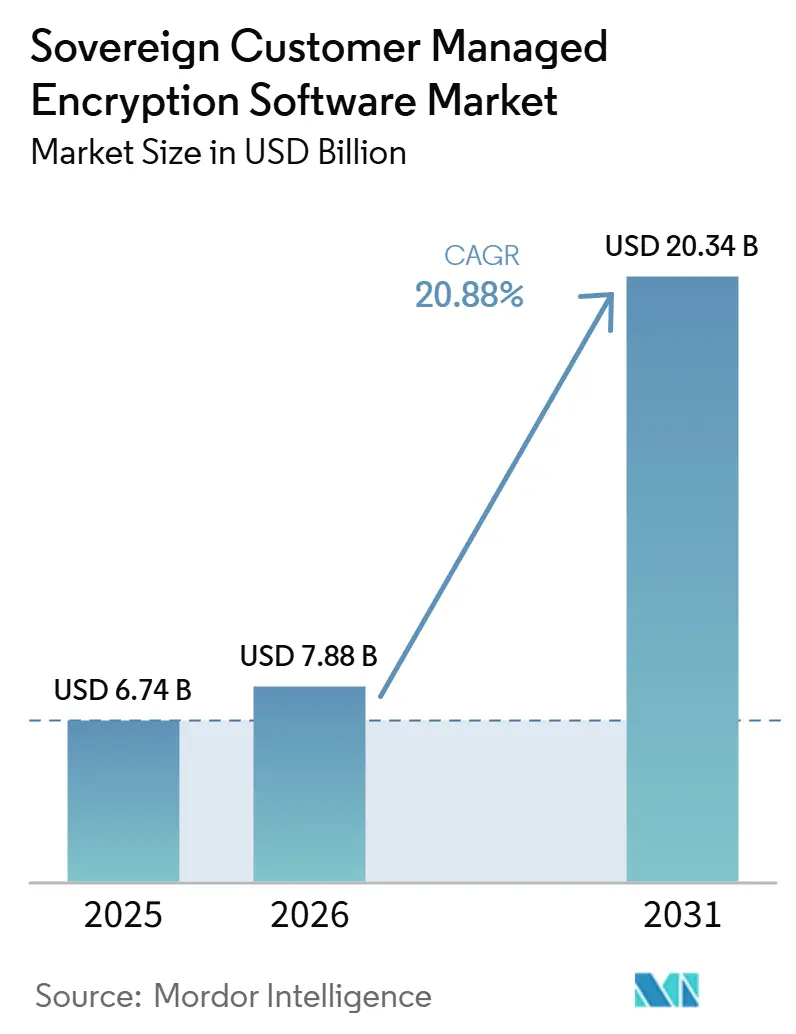
The Sovereign customer managed encryption software market size is projected to expand from USD 6.74 billion in 2025 to USD 20.34 billion by 2031, registering a CAGR of 20.88% between 2026 and 2031. Organizations increasingly treat control of encryption keys as a legal and operational requirement, rather than a routine technical control. GDPR, DORA, NIS2, and national privacy laws have shifted attention from data location to the party that controls access to encrypted information. Cloud adoption also exposes organizations to provider-managed key models that may not meet internal risk policies or contractual requirements. The Sovereign customer managed encryption software market is therefore gaining support from regulated buyers that need independent key custody across cloud, software-as-a-service, and on-premises environments. Demand also reflects preparations for post-quantum cryptography and confidential computing, which require security teams to modernize key management architecture.
Key Report Takeaways
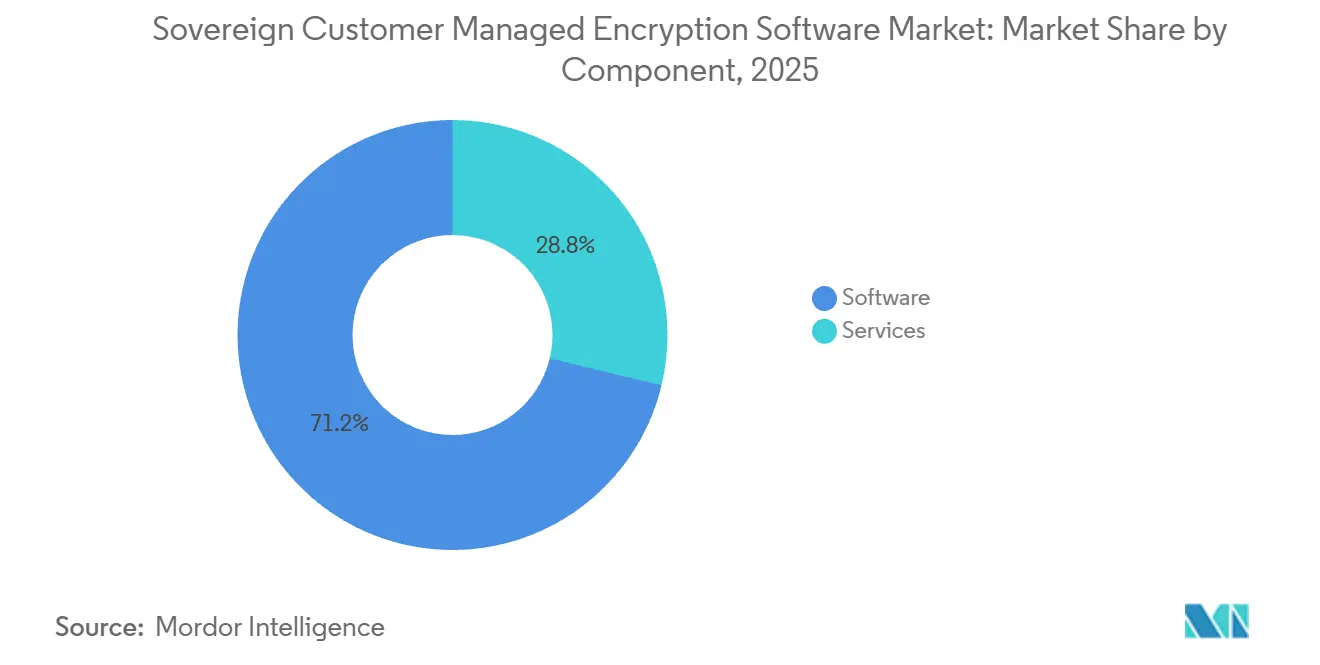
- By component, software led with 71.24% of the Sovereign customer managed encryption software market share in 2025, while services are projected to expand at a 22.74% CAGR through 2031.
- By deployment model, cloud held 68.41% of the Sovereign customer managed encryption software market in 2025, while hybrid deployment is projected to expand at a 21.63% CAGR through 2031.
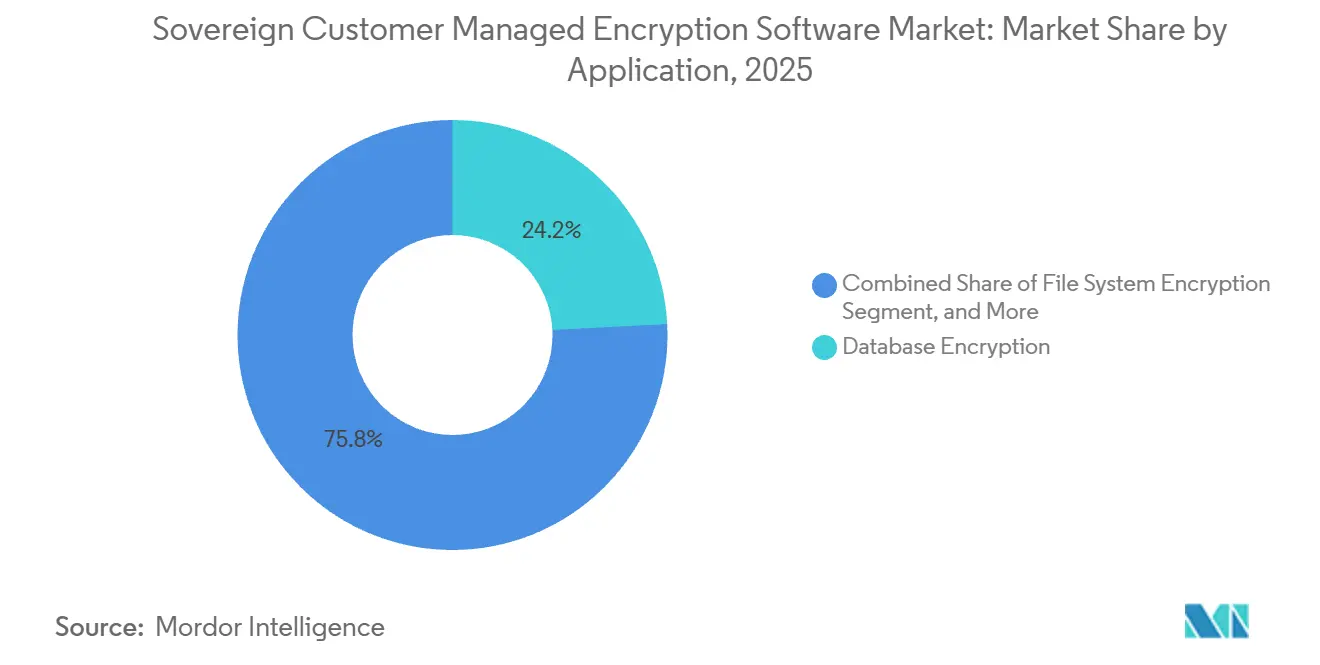
- By application, database encryption accounted for 24.19% of the Sovereign customer managed encryption software market share in 2025, while file system encryption is projected to expand at a 22.91% CAGR through 2031.
- By end user, BFSI held 26.73% share in 2025, while healthcare and life sciences are projected to expand at a 21.48% CAGR through 2031.
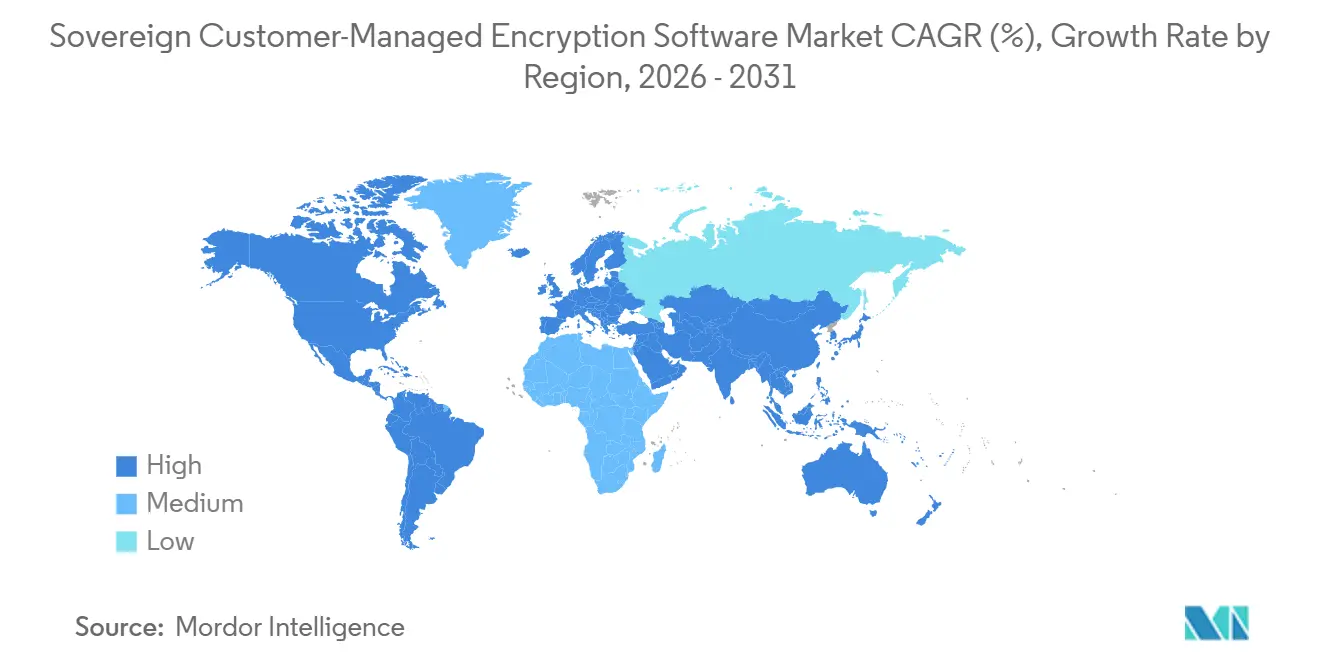
- By geography, North America held 34.62% of the Sovereign customer managed encryption software market share in 2025, while Asia-Pacific is projected to expand at a 22.84% CAGR through 2031.
Note: Market size and forecast figures in this report are generated using Mordor Intelligence’s proprietary estimation framework, updated with the latest available data and insights as of January 2026.
Market Trends and Insights
Drivers Impact Analysis of Sovereign Customer Managed Encryption Software Market*
| Driver | (~) % Impact on CAGR Forecast | Geographic Relevance | Impact Timeline |
|---|---|---|---|
| Tightening Data Sovereignty and Privacy Regulations | +5.2% | Global, with stronger relevance in Europe, Asia-Pacific, and North America | Medium term (2-4 years) |
| Escalating Cloud Data Breaches and Ransomware Exposure | +4.1% | Global, especially North America, Europe, and Asia-Pacific financial centers | Short term (≤ 2 years) |
| Rising Adoption of Bring Your Own Key and Hold Your Own Key Architectures | +3.4% | Global, led by Europe and the U.S. federal sector, with adoption spreading to the Middle East and Africa and Asia-Pacific | Medium term (2-4 years) |
| Expansion of Multi-Cloud and SaaS Workloads | +2.9% | Global, concentrated in North American and European enterprise environments | Short term (≤ 2 years) |
| Customer-Controlled Cryptographic Kill Switches for Regulatory and Exit Risk | +2.2% | Europe, North America, and Gulf Cooperation Council countries | Long term (≥ 4 years) |
| Sovereign Key Management for AI and Confidential Computing Workloads | +1.8% | North America, Europe, and technology-intensive Asia-Pacific economies | Long term (≥ 4 years) |
| Source: Mordor Intelligence | |||
Tightening Data Sovereignty and Privacy Regulations
Privacy rules increasingly focus on who controls encryption keys, not just where data is stored. The CLOUD Act can require U.S.-headquartered providers to disclose data held outside the United States. Customer-held keys can limit a provider's ability to decrypt protected information. In 2026, French public procurement policy gave digital sovereignty a higher priority in technology purchases. The policy specifically placed independent encryption key management near the top of the evaluation criteria. These developments make the Sovereign customer managed encryption software market more relevant to public bodies and regulated enterprises that require demonstrable control over sensitive data. The same rules can influence supplier selection, contract design, and oversight of outsourced processing.
Escalating Cloud Data Breaches and Ransomware Exposure
Ransomware success rates reached 56% in 2026, compared with 50% in 2025. Average recovery costs reached USD 1.7 million per incident, which was 11% higher than the prior year. Sophos reported that 66% of organizations used backups to recover encrypted data in 2026. Attackers increasingly target backup repositories, underscoring the importance of key protection for recovery planning. The Sovereign customer managed encryption software market benefits when organizations place encrypted backup data under customer-controlled keys. This separates the authority to release data from the systems that store backup copies. This approach can reduce the risk that a compromised provider account exposes both production data and recovery copies.[1]Sophos, “State of Ransomware 2026,” Sophos, sophos.com
Rising Adoption of Bring Your Own Key and Hold Your Own Key Architectures
Bring Your Own Key and Hold Your Own Key models provide different levels of control. Under Bring Your Own Key, a customer generally imports key material into the cloud provider's service. Under Hold Your Own Key, the customer keeps cryptographic operations in an independent key management system. This distinction matters for organizations handling payment data, health information, and other sensitive records. Many large organizations are adopting a tiered approach, using Bring Your Own Key for routine workloads and Hold Your Own Key for high-risk data. The Sovereign customer managed encryption software market supports this approach through platforms that operate across both models. It also gives security teams a consistent way to set policy and review privileged access.[2]Cloud Security Alliance, “Choosing the Right Key Responsibility Model,” Cloud Security Alliance, cloudsecurityalliance.org
Expansion of Multi-Cloud and SaaS Workloads
Multi-cloud adoption can leave organizations managing separate key services across several providers. That structure makes it harder to document key ownership, access, and rotation practices. SaaS providers also commonly manage encryption keys by default, which can create a control gap in vendor contracts. Eviden integrated its key management system with Salesforce Hyperforce in June 2026. The integration allows customers to retain externally managed encryption keys for Salesforce information hosted in Europe. Such products broaden the Sovereign customer managed encryption software market beyond infrastructure workloads to business software environments. They also bring key custody into procurement discussions for widely used business applications.[3]Eviden, “Eviden Integrates Sovereign Key Management With Salesforce Hyperforce,” HPCwire, hpcwire.com
Restraints Impact Analysis of Sovereign Customer Managed Encryption Software Market*
| Restraint | (~) % Impact on CAGR Forecast | Geographic Relevance | Impact Timeline |
|---|---|---|---|
| High Total Cost of Ownership for Sovereign Key Infrastructure | -2.3% | Global, with greater pressure on emerging markets and mid-sized enterprises | Long term (≥ 4 years) |
| Key Lifecycle Management Complexity and Skills Shortages | -1.7% | Global, with stronger pressure in Asia-Pacific and the Middle East and Africa | Medium term (2-4 years) |
| Fragmented Cloud and Cryptographic Interoperability Standards | -1.2% | Global, especially multi-cloud enterprise settings | Medium term (2-4 years) |
| Sovereignty-Induced Restrictions on Cross-Border Disaster Recovery | -0.6% | Europe and Asia-Pacific jurisdictions with data localization requirements | Long term (≥ 4 years) |
| Source: Mordor Intelligence | |||
High Total Cost of Ownership for Sovereign Key Infrastructure
Hold Your Own Key deployments can require hardware security modules, redundant key storage, skilled staff, and independent audits. These requirements place the highest cost burden on smaller organizations and emerging market buyers. Costs increase as key environments expand across public cloud, private systems, and edge locations. Tight technology budgets can delay investment in dedicated sovereign key infrastructure. Managed services can shift spending from capital purchases to recurring operating costs, but they do not remove the governance requirement. The Sovereign customer managed encryption software market is responding with consumption-based offerings that can lower the entry barrier for organizations without large security operations. Buyers still need to assess where keys reside, who can access them, and how service continuity is maintained.
Key Lifecycle Management Complexity and Skills Shortages
Key management requires expertise in cryptography, hardware security modules, cloud interfaces, and compliance obligations. Organizations must also prepare for new post-quantum cryptography standards while addressing existing key sprawl. Poorly managed rotation or revocation can make encrypted records permanently inaccessible. This operational risk can lead some buyers to keep provider-managed key arrangements. Automation for rotation, access monitoring, and governance reporting can reduce this burden. Vendors that combine those capabilities with clear administrative tools can compete more effectively with organizations that have limited specialist staff.
*Our forecasts treat driver/restraint impacts as directional, not additive. The impact forecasts reflect baseline growth, mix effects, and variable interactions.
Sovereign Customer Managed Encryption Software Market Segment Analysis
By Component:
Software Leadership Coexists With Services GrowthSoftware held 71.24% of the Sovereign customer managed encryption software market in 2025. Regulated organizations often prefer software that operates within a controlled security environment. This preference reflects established requirements for direct oversight of encryption controls. Financial services, government, and other regulated buyers also need evidence of how keys are created and used. Software platforms can support that level of oversight across their internal systems. The Sovereign customer managed encryption software market also gives buyers a way to standardize those controls across business units. The segment remains important where organizations maintain established cryptographic operations teams.
Services are projected to expand at a 22.74% CAGR through 2031. This growth reflects demand from organizations that lack internal resources for key management operations. Retail, healthcare, and mid-sized financial firms can use managed services to deploy controls without building a full internal infrastructure. Implementation support is also needed when teams connect key systems to clouds, databases, and storage environments. SaaS-delivered platforms can provide consumption-based access while enabling customers to retain control over key materials. The component mix, therefore, reflects both direct software ownership and externally supported operational models. The Sovereign customer managed encryption software market can accommodate both approaches as operational requirements change.


By Deployment Model:
Hybrid Deployment Supports Controlled Cloud UseCloud deployment held 68.41% share in 2025. Cloud leadership does not necessarily mean that organizations have given control of keys to a provider. Sovereign cloud services and independent key systems can combine cloud computing with customer-managed encryption. Microsoft made Azure Integrated HSM generally available in May 2026 for hardware-backed protection of sensitive workloads. The offering reflects provider efforts to meet requirements from regulated cloud users. Cloud deployments remain suitable for organizations that need scalability while maintaining defined key custody practices. The Sovereign customer managed encryption software market supports this balance through independent key control options.
Hybrid deployment is projected to expand at a 21.63% CAGR through 2031. Organizations often keep sensitive key material on-premises or in private environments. They can then run encrypted applications in the public cloud. The customer system authorizes decryption activity through controlled connections. Hybrid environments also support long migration periods from legacy systems to cloud services. This makes the Sovereign customer managed encryption software market relevant to enterprises that need operational continuity while changing their technology estate. It enables staged migration without requiring a sudden replacement of every existing encryption control.[4]Microsoft, “Azure Confidential Computing for Digital Sovereignty and Regulated Workloads,” Microsoft Community Hub, microsoft.com
By Application:
Database Encryption Leads While Container Security ExpandsDatabase encryption held 24.19% share in 2025. Databases contain large volumes of financial, medical, and personal information. Banking, healthcare, and public sector requirements have long supported encryption for stored structured data. Key management remains central because data encryption is only as secure as the systems that protect the keys. The Sovereign customer managed encryption software market addresses this requirement through centralized policy and key lifecycle controls. Cloud storage and object storage encryption, disk and volume encryption, and application and field-level encryption are also part of the application scope. Communication and data-in-transit encryption, along with other applications, complete the covered categories.
File system encryption is projected to expand at a 22.91% CAGR through 2031. It protects data stored in enterprise file environments that can be accessed across applications and infrastructure. Organizations can use customer managed key controls to define who may decrypt protected files. This approach is relevant when regulated information is distributed across systems rather than held in a single database. The Sovereign customer-managed encryption software market also supports encryption for cloud object storage, disks, data in transit, and application fields. These application areas require consistent policy and governance as organizations expand their digital environments.

By End User:
BFSI Remains the Largest User GroupBFSI held 26.73% share in 2025. The sector has invested in encryption infrastructure for many years. Payment security requirements, operational resilience rules, and banking regulations support continued investment in key management. Financial institutions also manage high volumes of customer information and transaction data. Their systems require control that can be audited across internal and external technology providers. The Sovereign customer managed encryption software market provides the relevant controls for these complex operating environments. The Sovereign customer managed encryption software market remains important for banks and insurers as they manage post-quantum readiness alongside existing security obligations.
The healthcare and life sciences industry is projected to expand at a 21.48% CAGR through 2031. Healthcare providers are migrating selected workloads to the cloud while protecting electronic health information. This creates new decisions over encryption, access, and key custody. Government agencies are also building sovereign cloud programs that require domestically controlled security tools. Automotive and transportation, retail and e-commerce, industrial manufacturing, IT and telecommunication, and other end users add demand as operations become more connected. These organizations need encryption that works across data, applications, and distributed infrastructure.
Geography Analysis
North America Sovereign Customer Managed Encryption Software Market
North America held 34.62% of the Sovereign customer managed encryption software market share in 2025. Federal encryption requirements, large enterprise technology budgets, and a mature supplier base supported the region's position. The U.S. executive order issued in June 2026 accelerated federal preparation for a transition to quantum-safe cryptography by 2030. Agencies must identify cryptographic assets and prioritize which systems to migrate. Canada and Mexico also support regional demand through cloud procurement activity and digitization in regulated sectors.
APAC Sovereign Customer Managed Encryption Software Market
Asia-Pacific is projected to expand at a 22.84% CAGR through 2031. India notified its Digital Personal Data Protection Rules in November 2025, with consent manager provisions taking effect in November 2026. Vietnam's Personal Data Protection Law took effect in January 2026. China also completed its cross-border transfer certification framework under PIPL in January 2026. South Korea's Personal Information Protection Act continues to support investment in data security. India, China, Japan, and South Korea account for a large share of demand, while Southeast Asia and Australia offer further growth opportunities.
EMEA and South America Sovereign Customer Managed Encryption Software Market
Europe has a major role because its regulatory framework combines GDPR, NIS2, DORA, and the EU Data Act. European organizations using U.S. cloud infrastructure may need to retain independent control over encryption keys to comply with internal sovereignty policies. France requires SecNumCloud-certified providers for central government administration and sensitive public workloads. The Middle East and Africa are developing through data governance measures in Saudi Arabia, the UAE, and South Africa. South America is supported by Brazil's LGPD enforcement and broader demand for data protection controls. These conditions extend demand across regions with different regulatory structures.

Competitive Landscape
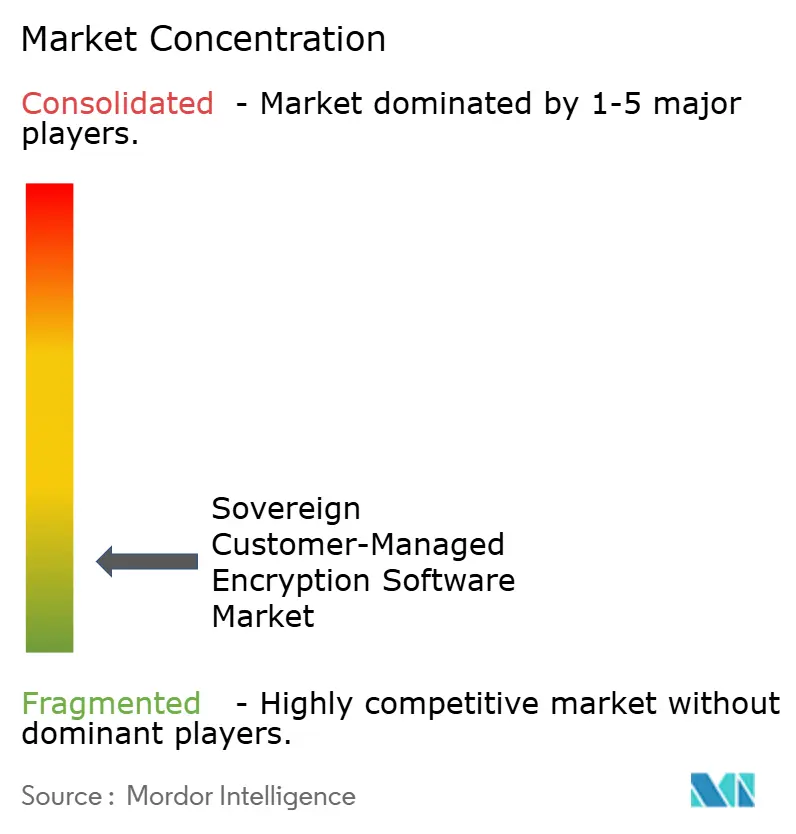
The Sovereign customer managed encryption software market is fragmented. Established platform suppliers compete with specialized key management providers and sovereign-focused vendors. Thales, Entrust, and Fortanix compete through broad product portfolios, support for hardware security modules, and multi-cloud compatibility. Utimaco, Securosys, and DuoKey focus on demanding government, defense, and BFSI requirements. Buyers assess vendors on key areas such as custody, deployment flexibility, and support for different cloud environments. Competition is also shaped by the ability to provide independent controls without creating difficult operational processes. The Sovereign customer managed encryption software market rewards vendors that can make those controls easier to operate.
Entrust launched its Cryptographic Security Platform in April 2025. The platform combined key, secret, and certificate management across on-premises and managed cloud deployments. Fortanix introduced multi-sourced quantum entropy in its Data Security Manager in March 2026. The capability uses independent quantum random number generators from Qrypt and Quantum Dice for enterprise key generation. Thales Trusted Cyber Technologies launched the CipherTrust Manager k160 Mk II in April 2026. Its detachable token HSM can act as a physical control that stops key delivery when removed.
Suppliers are increasingly offering SaaS delivery, post-quantum readiness, and connectors for major cloud platforms. These approaches can reduce the effort required to operate encryption across hybrid technology environments. Keyfactor secured a USD 1 billion-plus strategic growth investment in July 2026 to expand its trust infrastructure platform. WinMagic received FIPS 140-3 validation for SecureDoc and MagicEndpoint cryptographic modules in May 2026. These actions show how product assurance and cryptographic modernization affect procurement. A concentration score cannot be established from the supplied material because it does not provide the combined shareholding of leading vendors.
Sovereign Customer Managed Encryption Software Industry Leaders
Thales SA
Entrust Corporation
Fortanix, Inc.
Utimaco GmbH
Cryptomathic A/S
- *Disclaimer: Major Players sorted in no particular order
Sovereign Customer Managed Encryption Software Market Companies Covered in this Report
- Thales SA
- Entrust Corporation
- Fortanix, Inc.
- Utimaco GmbH
- Cryptomathic A/S
- Securosys SA
- Futurex, L.P.
- Keyfactor, Inc.
- WinMagic Inc.
- Virtru Corporation
- PKWARE, Inc.
- Protegrity USA, Inc.
- Baffle, Inc.
- Skyflow, Inc.
- Echoworx Corporation
- Stormshield SAS
- DuoKey SA
- SSH Communications Security Corporation
- QNu Labs Private Limited
- Eviden SAS
- Kryptus Segurança da Informação S.A.
- OpenKCM

Recent Industry Developments in Sovereign Customer Managed Encryption Software Market
- July 2026: Keyfactor secured a USD 1 billion-plus strategic growth investment led by Summit Partners to accelerate expansion of its Trust Control Plane platform for AI-era and post-quantum enterprise cryptographic security. The investment reflects heightened strategic urgency around quantum-safe key management following the U.S. executive order issued in June 2026 mandating federal transition to quantum-safe cryptography by 2030.
- July 2026: HashiCorp announced the public beta of Vault Kubernetes KMS, a KMS v2-compatible plugin enabling Kubernetes API servers to delegate etcd envelope encryption to Vault Enterprise. The release directly addresses the etcd secret-storage security gap in Kubernetes clusters, enabling customer-managed key operations for containerized workloads at scale.
- June 2026: Eviden, Atos Group, announced the integration of its Key Management System with Salesforce Hyperforce and Shield Platform Encryption, introducing a Bring Your Own Sovereign Encryption model. Enterprises and public sector organizations can now encrypt Salesforce data using externally managed encryption keys hosted in Europe, maintaining full key independence from the SaaS provider.
- June 2026: Keyfactor launched the Trust Control Plane, a unified operating model consolidating machine identity and cryptography management across cloud, hybrid, and on-premises environments. The platform provides continuous visibility, automated operations, and enforced governance over cryptographic assets for standard and AI-agent workloads.


Global Sovereign Customer Managed Encryption Software Market Report Scope
The sovereign customer managed encryption software market refers to the ecosystem of software solutions and associated services that enable organizations to maintain absolute, independent control over their cryptographic operations, encryption keys, and underlying plaintext data. Unlike standard cloud-provider-managed encryption, sovereign customer-managed encryption ensures that the organization exclusively generates, stores, and manages its keys, often utilizing bring-your-own-key (BYOK) or hold-your-own-key (HYOK) frameworks with strict cryptographic isolation. This guarantees that cloud service providers, third-party vendors, or foreign state actors cannot access or decrypt the data. Deployed across cloud, hybrid, or on-premises environments, these solutions secure a wide array of applications, including cloud storage, databases, file systems, and containerized workloads. Driven by an increasingly complex geopolitical landscape, stringent data localization laws, and national security directives, this market primarily serves highly regulated industries such as government and administration, BFSI, healthcare, and defense, empowering them to achieve cryptographic sovereignty, ensure compliance with regional privacy regulations, and mitigate the risk of unauthorized data exposure.
The Sovereign Customer Managed Encryption Software Market Report is Segmented by Component (Software and Services), Deployment Model (Cloud, Hybrid, and On-Premises), Application (Cloud Storage and Object Storage Encryption, Database Encryption, File System Encryption, Disk and Volume Encryption, Application and Field-Level Encryption, Communication and Data-in-Transit Encryption, and Others), End User (IT and Telecommunication, BFSI, Automotive and Transportation, Healthcare and Life Sciences, Retail and E-Commerce, Industrial Manufacturing, and Other End Users), and Geography (North America, South America, Europe, Asia-Pacific, and Middle East and Africa). The Market Forecasts are Provided in Terms of Value (USD).
| Software |
| Services |
| Cloud |
| Hybrid |
| On-Premises |
| Cloud Storage and Object Storage Encryption |
| Database Encryption |
| File System Encryption |
| Disk and Volume Encryption |
| Application and Field-Level Encryption |
| Communication and Data-in-Transit Encryption |
| Other Applications |
| IT and Telecommunication |
| BFSI |
| Automotive and Transportation |
| Healthcare and Life Sciences |
| Retail and E-Commerce |
| Industrial Manufacturing |
| Other End Users |
| North America | United States | |
| Canada | ||
| Mexico | ||
| South America | Brazil | |
| Argentina | ||
| Rest of South America | ||
| Europe | Germany | |
| United Kingdom | ||
| France | ||
| Russia | ||
| Spain | ||
| Rest of Europe | ||
| Asia-Pacific | China | |
| Japan | ||
| India | ||
| South Korea | ||
| Southeast Asia | ||
| Rest of Asia-Pacific | ||
| Middle East and Africa | Middle East | Saudi Arabia |
| United Arab Emirates | ||
| Rest of Middle East | ||
| Africa | South Africa | |
| Nigeria | ||
| Rest of Africa | ||
| By Component | Software | ||
| Services | |||
| By Deployment Model | Cloud | ||
| Hybrid | |||
| On-Premises | |||
| By Application | Cloud Storage and Object Storage Encryption | ||
| Database Encryption | |||
| File System Encryption | |||
| Disk and Volume Encryption | |||
| Application and Field-Level Encryption | |||
| Communication and Data-in-Transit Encryption | |||
| Other Applications | |||
| By End User | IT and Telecommunication | ||
| BFSI | |||
| Automotive and Transportation | |||
| Healthcare and Life Sciences | |||
| Retail and E-Commerce | |||
| Industrial Manufacturing | |||
| Other End Users | |||
| By Geography | North America | United States | |
| Canada | |||
| Mexico | |||
| South America | Brazil | ||
| Argentina | |||
| Rest of South America | |||
| Europe | Germany | ||
| United Kingdom | |||
| France | |||
| Russia | |||
| Spain | |||
| Rest of Europe | |||
| Asia-Pacific | China | ||
| Japan | |||
| India | |||
| South Korea | |||
| Southeast Asia | |||
| Rest of Asia-Pacific | |||
| Middle East and Africa | Middle East | Saudi Arabia | |
| United Arab Emirates | |||
| Rest of Middle East | |||
| Africa | South Africa | ||
| Nigeria | |||
| Rest of Africa | |||


Key Questions Answered in the Report
What is the size of the Sovereign customer managed encryption software market?
The Sovereign customer managed encryption software market was valued at USD 6.74 billion in 2025, is estimated at USD 7.88 billion in 2026, and is projected to reach USD 20.34 billion by 2031, at a 20.88% CAGR.
Which component leads demand for customer-managed encryption software?
Software led the market with 71.24% share in 2025. Services is projected to grow faster at a 22.74% CAGR through 2031.
Why do organizations use Hold Your Own Key models?
Hold Your Own Key models keep cryptographic operations in an independent customer-controlled system, which supports stronger oversight for sensitive information.
Which application is expected to grow fastest through 2031?
File system encryption is projected to grow at a 22.91% CAGR through 2031.
Which end-user group has the largest share?
BFSI held the largest end-user share at 26.73% in 2025, reflecting its established security and compliance requirements.
Which region is expected to grow fastest?
Asia-Pacific is projected to grow at a 22.84% CAGR through 2031, driven by new and evolving privacy and data localization requirements.
Page last updated on:


 Your data is secure and never sold or shared.


