
South Korea Microgreens Market Size and Share
Market Overview
| Study Period | 2021 - 2031 |
|---|---|
| Forecast Data Period | 2026 - 2031 |
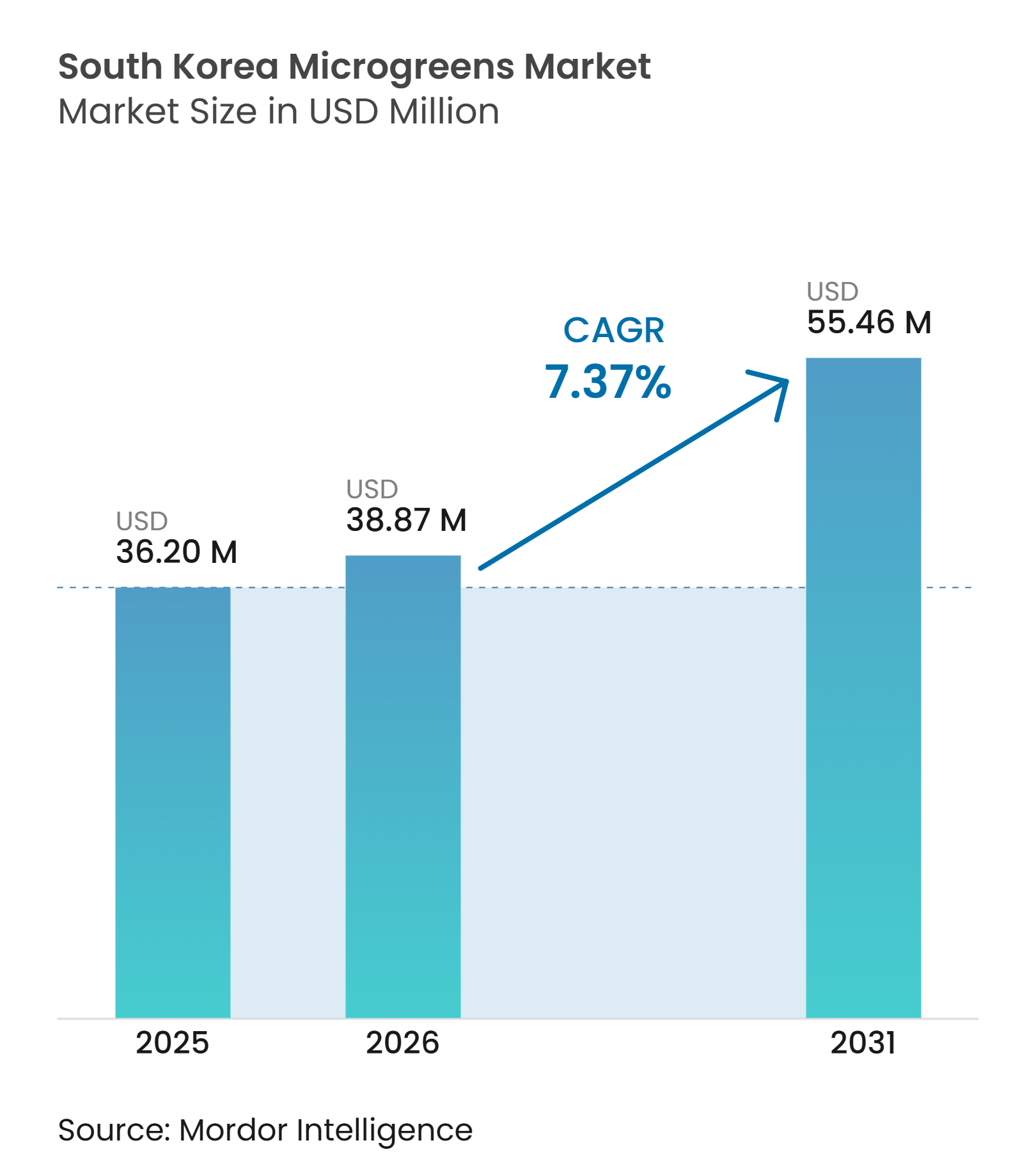
| Base Year Market Size (2025) | USD 36.20 Million |
| Market Size (2026) | USD 38.87 Million |
| Market Size (2031) | USD 55.46 Million |
| Growth Rate (2026 - 2031) | 7.37 % |
| Market Concentration | Low |
Major Players *Disclaimer: Major Players sorted in no particular order Image © Mordor Intelligence. Reuse requires attribution under CC BY 4.0. | |
South Korea Microgreens Market Analysis by Mordor Intelligence
The South Korea microgreens market size was valued at USD 36.20 million in 2025 and estimated to grow from USD 38.87 million in 2026 to reach USD 55.46 million by 2031, at a CAGR of 7.4% during the forecast period from 2026 to 2031. Demand is supported by the need for reliable specialty produce in foodservice and by wider access to controlled cultivation. Dense cities and limited agricultural land make compact production formats commercially viable, although these conditions do not eliminate the costs of lighting, labor, and compliant distribution. Policy support for smart farming can improve the operating environment for growers who produce and sell fresh microgreens within the defined scope. The South Korea microgreens market also has room to broaden sales beyond chefs when producers can maintain freshness, package consistently, and manage delivery costs. Competition remains shaped by production reliability, certification, crop variety, and access to urban customers rather than broad agricultural scale.
Key Report Takeaways
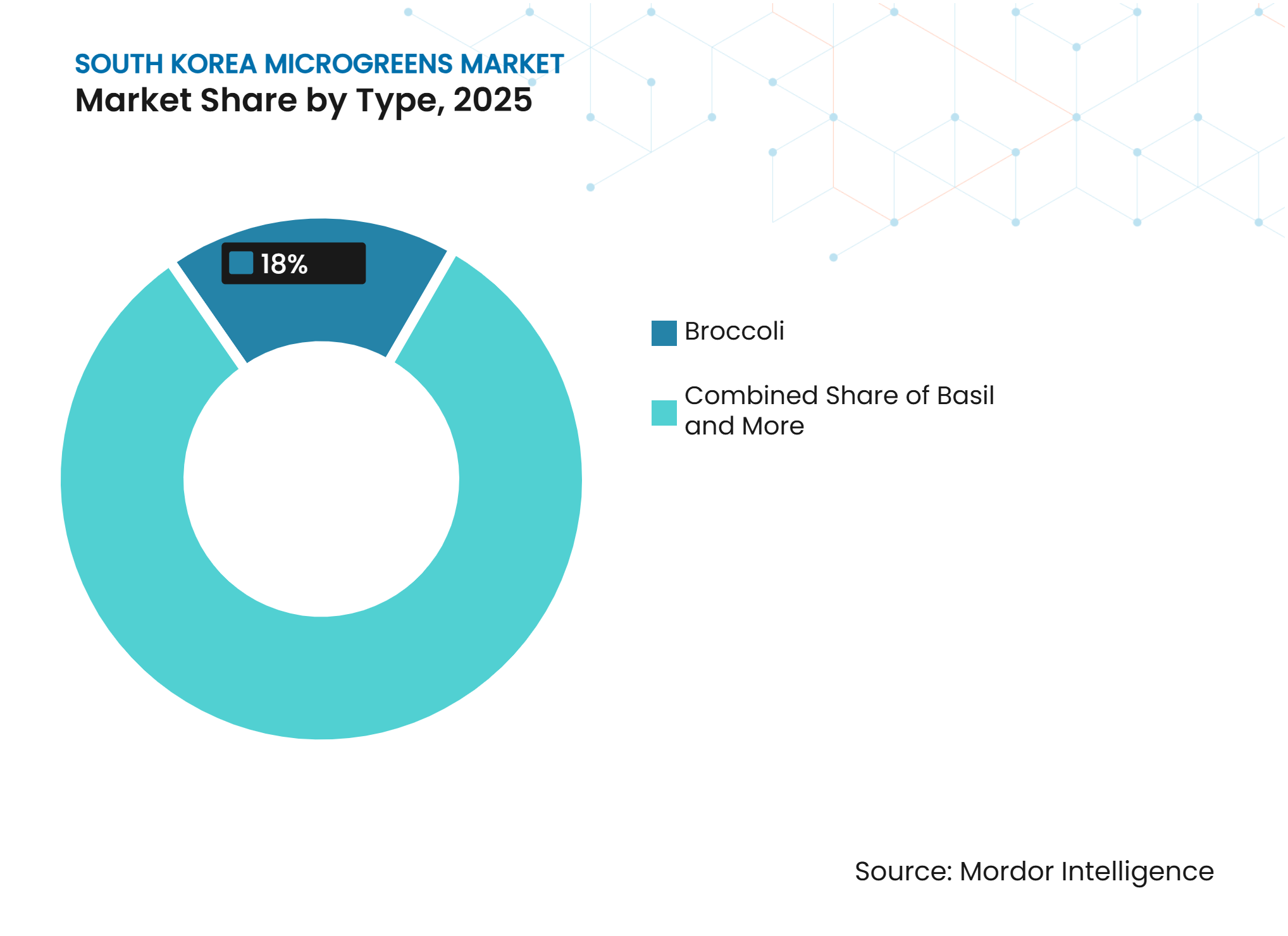
- By type, broccoli was the largest category with 18% of the South Korea microgreens market share in 2025, while basil is forecast to grow at the fastest CAGR of 9.6% from 2026 to 2031.
- By sales channel, restaurants and foodservice were the largest channel with 45% of the South Korea microgreens market size in 2025, while online grocery is forecast to grow at the fastest CAGR of 11% from 2026 to 2031.
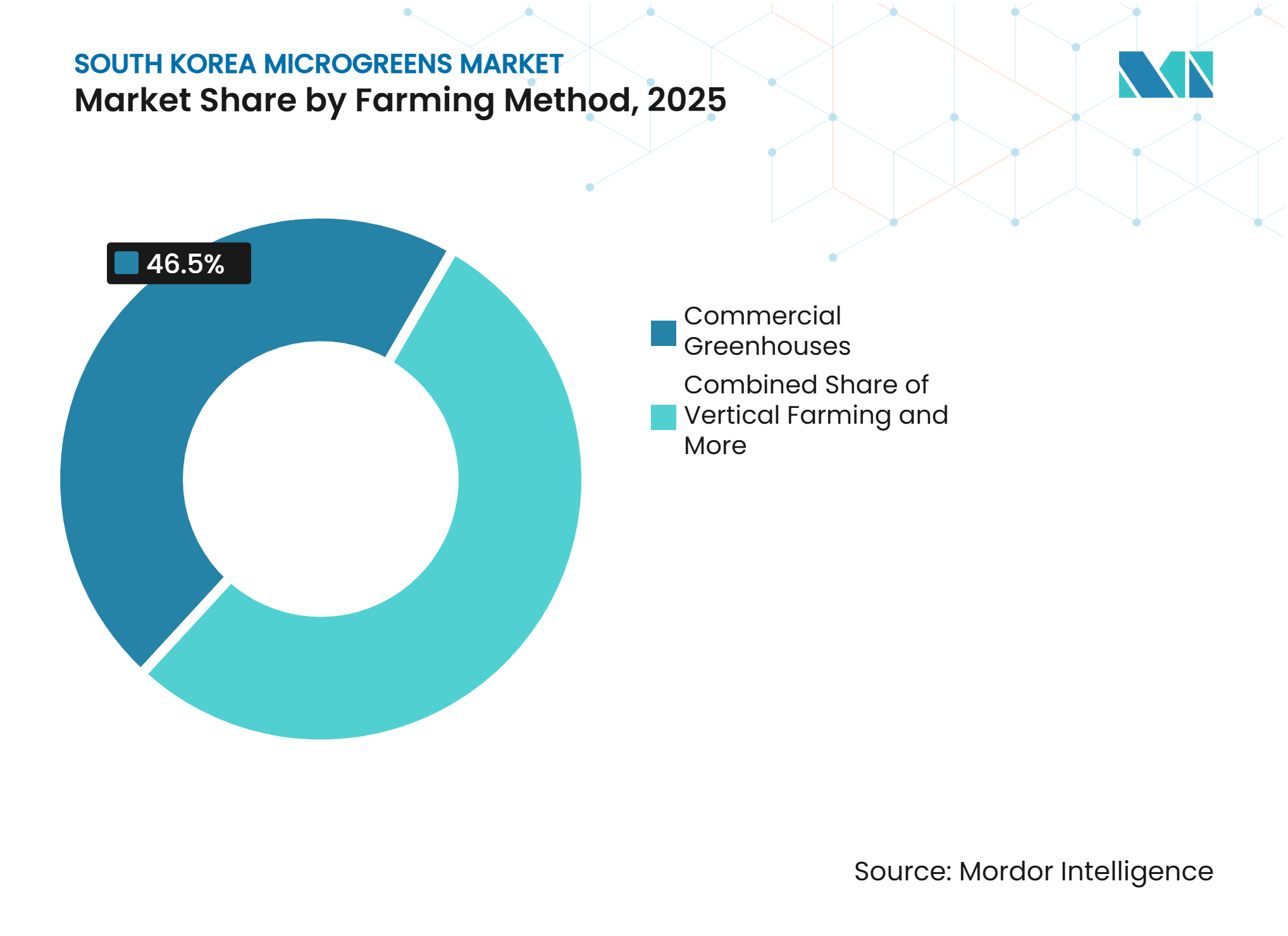
- By farming method, commercial greenhouses were the largest method with 46.5% share in 2025, while vertical farming is forecast to grow at the fastest CAGR of 13.4% from 2026 to 2031.
Note: Market size and forecast figures in this report are generated using Mordor Intelligence’s proprietary estimation framework, updated with the latest available data and insights as of 2026.
Market Trends and Insights
Drivers Impact Analysis of South Korea Microgreens Market*
| Driver | (~) % Impact on CAGR Forecast | Geographic Relevance | Impact Timeline |
|---|---|---|---|
| Expansion of Seoul-based urban microgreens production | +1.8% | National, concentrated in Seoul and satellite cities | Short term (≤ 2 years) |
| Growth of subway-station and public-space smart farms | +0.9% | Seoul Metropolitan Area, with early replication in Gwangju | Medium term (2-4 years) |
| Government-led smart-farming expansion | +1.5% | National, with early fostering districts | Medium term (2-4 years) |
| Restaurant demand for reliable locally produced microgreens | +1.3% | National, anchored in Seoul dining districts | Short term (≤ 2 years) |
| Limited arable land and dense urban development | +0.8% | National | Long term (≥ 4 years) |
| Expansion of year-round controlled-environment supply | +1.0% | National, with early gains in Seoul, Gyeonggi, and Gyeongsangbuk-do | Medium term (2-4 years) |
| Source: Mordor Intelligence | |||
Expansion of Seoul-Based Urban Microgreens Production
Urban production can reduce the time between harvest and delivery for products that lose quality quickly after packing. Koppert Cress identifies proximity to Seoul’s gastronomic customers as a feature of its Korean licensed-partner model. Shorter distribution routes can reduce handling and make it easier for suppliers to offer frequent deliveries to restaurants. This advantage is most relevant in Seoul and nearby satellite cities, where demand density can justify specialized distribution. It does not mean that every city-based indoor farm produces microgreens or that urban farming alone expands national sales. In the South Korea microgreens market, location decisions still depend on electricity costs, rents, certified handling, and the ability to maintain product quality.
Growth of Subway-Station and Public-Space Smart Farms
Publicly visible smart farms can make controlled cultivation more familiar to urban consumers. Seoul Metropolitan Government reported the opening of a smart Metro Farm at Sangdo Station, providing a public example of indoor crop production. Farm8 records the Metro Farm initiative in its company history. Such sites can increase awareness of fresh produce grown near consumers, although they do not provide a national microgreens sales figure. For microgreens producers, greater familiarity with controlled growing can reduce the need for explanation when selling through online grocery and direct subscriptions. The effect is likely strongest in metropolitan areas where people encounter these formats frequently. It can complement, rather than replace, foodservice-led demand in the South Korea microgreens market.
Government-Led Smart-Farming Expansion
The Ministry of Agriculture, Food and Rural Affairs issued the First Five-Year Smart Farming Master Plan for 2025 to 2029 in February 2025[1]. The plan targets the adoption of smart farming technology across 35% of South Korea’s 55,000 hectares of greenhouses and designates 4 Smart Farming Fostering Districts in 2025. The program gives eligible growers a clearer framework for technology verification, financing, and shared infrastructure. These measures matter for the South Korea microgreens market because controlled production must balance crop consistency with high fixed operating costs. The Organization for Economic Co-operation and Development reported in 2025 that South Korea’s Smart Farm Industry Development Plan directed research toward energy-saving and green-bio technologies. Producers who adapt these methods to fresh microgreen cultivation can improve the economics of year-round supply.
Restaurant Demand for Reliable Locally Produced Microgreens
Restaurants and foodservice represented 45% of sales in 2025, making professional buyers the largest channel for fresh microgreens. Regular kitchen orders can support planned harvest cycles and reduce demand uncertainty for commercial growers. Chefs also need consistent color, size, flavor, and delivery timing when microgreens are used as plated ingredients. Koppert Cress Korea states that its Mungyeong operation supplies its products year-round at fixed prices from a controlled LED farm. This model shows why foodservice demand supports growers who can meet specification and scheduling requirements. The South Korea microgreens market benefits when suppliers build consumer channels alongside this established restaurant base.
Restraints Impact Analysis of South Korea Microgreens Market*
| Restraint | (~) % Impact on CAGR Forecast | Geographic Relevance | Impact Timeline |
|---|---|---|---|
| High electricity costs for indoor cultivation | -1.40% | National, most acute in Seoul and Gyeonggi | Short term (≤ 2 years) |
| Short shelf life and concentrated distribution economics | -0.70% | National, most limiting outside Seoul Metropolitan Area | Short term (≤ 2 years) |
| Strict fresh-produce food-safety requirements | -0.50% | National | Medium term (2-4 years) |
| Dependence on premium urban and foodservice demand | -0.40% | National | Long term (≥ 4 years) |
| Source: Mordor Intelligence | |||
High Electricity Costs for Indoor Cultivation
Indoor microgreens production requires lighting and environmental control across short but intensive growing cycles. A 2024 study in the Journal of Bio-Environment Control analyzed energy requirements in agricultural facilities and reported agricultural power tariffs of up to KRW 62.2 per kilowatt-hour in April 2024 [2]. Energy costs can therefore have a material effect on growers using fully controlled facilities. The 2025 smart-farming plan’s emphasis on energy-saving technology is commercially relevant because it addresses this operating pressure. Farms that improve lighting schedules, climate control, or renewable-energy use may have a cost advantage over less efficient peers. The South Korea microgreens market remains exposed where premium pricing cannot fully absorb higher utility costs.
Short Shelf Life and Concentrated Distribution Economics
Fresh microgreens generally have a short usable shelf life, so timely refrigerated delivery is central to product quality. Producers serving distant buyers need reliable cold-chain handling and shorter delivery windows. The Korean Institute of Science and Technology Information published a 2024 report on biological-hazard management in fresh-cut agricultural products that emphasized the importance of temperature control. The need for rapid, compliant delivery can favor growers located near dense customer clusters. It can also reduce the cost advantage of facilities in lower-rent agricultural regions. These conditions limit the speed at which the South Korea microgreens market can spread beyond established production-consumption corridors.
*Our forecasts treat driver/restraint impacts as directional, not additive. The impact forecasts reflect baseline growth, mix effects, and variable interactions.
South Korea Microgreens Market Segment Analysis
By Type:
Broccoli Leads, While Aromatic Varieties Reshape the Premium TierBroccoli held 18% of the South Korea microgreens market size in 2025, making it the largest type segment. Its role is supported by familiarity among professional buyers and its use in premium fresh-produce menus. Lettuce and chicory, radish, arugula, kale, mustard, amaranth, beets, fennel, carrots, cress, and chard add texture, flavor, and visual variety to the category. A broad crop portfolio can help suppliers serve different culinary uses without expanding beyond the definition of microgreens. It can also make production planning more complex because varieties need different seed, harvest, and environmental schedules.
Basil is forecast to grow at the fastest CAGR of 9.6% from 2026 to 2031. Aromatic microgreens are relevant to Italian, contemporary, and fusion cuisine, where a small volume can contribute both flavor and presentation. Demand for these varieties depends on chefs’ menu choices and on suppliers’ ability to provide consistent quality. The National Agricultural Products Quality Management Service reported 13,077 Good Agricultural Practices certified production operations across 322 product types in 2025[3]. Certification can improve access to formal buyers, although the published total is not a microgreens-specific count. Producers that manage a wider range of types need disciplined scheduling to preserve product quality and avoid waste.



By Sales Channel:
Foodservice Anchors Revenue, While Digital Commerce Broadens AccessRestaurants and foodservice held 45% of the South Korea microgreens market share in 2025, making this the largest sales channel. The channel provides recurring orders and direct product feedback from professional buyers. Restaurant customers often pay for consistent product quality, but they also expect reliable delivery and clear product specifications. Hypermarkets and supermarkets can extend reach, though they require packaging, labeling, and quality controls that smaller growers may struggle to maintain. Farmers' markets provide direct contact with shoppers and can help producers demonstrate how fresh microgreens are used.
Online grocery is forecast to grow at the fastest CAGR of 11% from 2026 to 2031. Digital ordering can expand access for metropolitan households that value scheduled fresh-produce delivery. Direct-to-consumer subscriptions can create repeat sales, but growers must align sowing and harvest plans with delivery commitments. The July 2024 Act on Fostering and Supporting Smart Farming enabled the construction of building-type vertical farms in industrial complexes, expanding the potential sites for qualifying producers. This legal change can support additional urban production options, but it does not remove the need for commercially viable microgreens sales. Channel diversification allows foodservice-focused growers to build consumer demand while retaining professional customers.
By Farming Method:
Commercial Greenhouses Remain Largest While Vertical Farming Grows FastestCommercial greenhouses accounted for 46.5% of the South Korea microgreens market size in 2025, making them the largest farming method. Greenhouse production can combine controlled growing conditions with established horticultural practices. The Ministry of Agriculture, Food and Rural Affairs plans to target the adoption of smart farming across 35% of the country’s greenhouse area. Indoor horizontal farms offer another controlled setting for fresh microgreen cultivation. Hydroponic grow cabinets can support small commercial trials, but cabinet sales themselves are outside the measured market.
Vertical farming is forecast to grow at the fastest CAGR of 13.4% from 2026 to 2031. Stacked growing systems can be useful where floor area is costly and where production must be close to urban customers. The 2024 smart-farming law expanded the legal basis for building-type vertical farms inside industrial complexes. Vertical production can increase output per unit of floor space, yet it also increases reliance on lighting and environmental controls. Farm8’s Metro Farm history illustrates urban-controlled cultivation in Seoul. For the South Korea microgreens industry, the relevant measure is the value of fresh microgreens produced and sold, not the value of vertical-farming equipment.

Geography Analysis
The Seoul Metropolitan Area is the main production-consumption corridor within the South Korea microgreens market. Seoul’s concentration of restaurants and premium dining districts creates a dense buyer base for perishable specialty ingredients. Proximity to these customers can improve delivery speed and help suppliers maintain freshness. Koppert Cress Korea identifies near-Seoul service as a feature of its licensed-partner approach. Farm8’s Metro Farm activity also places controlled cultivation in a high-visibility urban setting.
Production is not limited to the capital region. Farm8 states that it completed a smart farm facility in Naju, South Jeolla Province, in 2024. Koppert Cress Korea operates from Mungyeong in North Gyeongsang Province, combining a regional production base with access to national logistics. The Ministry of Agriculture, Food and Rural Affairs designated 4 Smart Farming Fostering Districts in 2025 to support clustered development beyond individual sites. Regional facilities may offer lower property costs, but delivery planning remains critical for fresh microgreens.
National food-safety requirements apply regardless of production location. The Good Agricultural Practices system provides a common framework for traceability and production management across certified operations. The Organisation for Economic Co-operation and Development described South Korea’s smart-farming rollout as government-led and still developing in its 2025 policy review. This suggests that non-metropolitan production infrastructure may develop gradually rather than uniformly. Short shelf life still favors locations with practical access to major consumption centers. Geographic expansion in the South Korea microgreens market will depend on whether lower operating costs can offset the expense and risk of longer delivery routes.
Competitive Landscape
Market Concentration
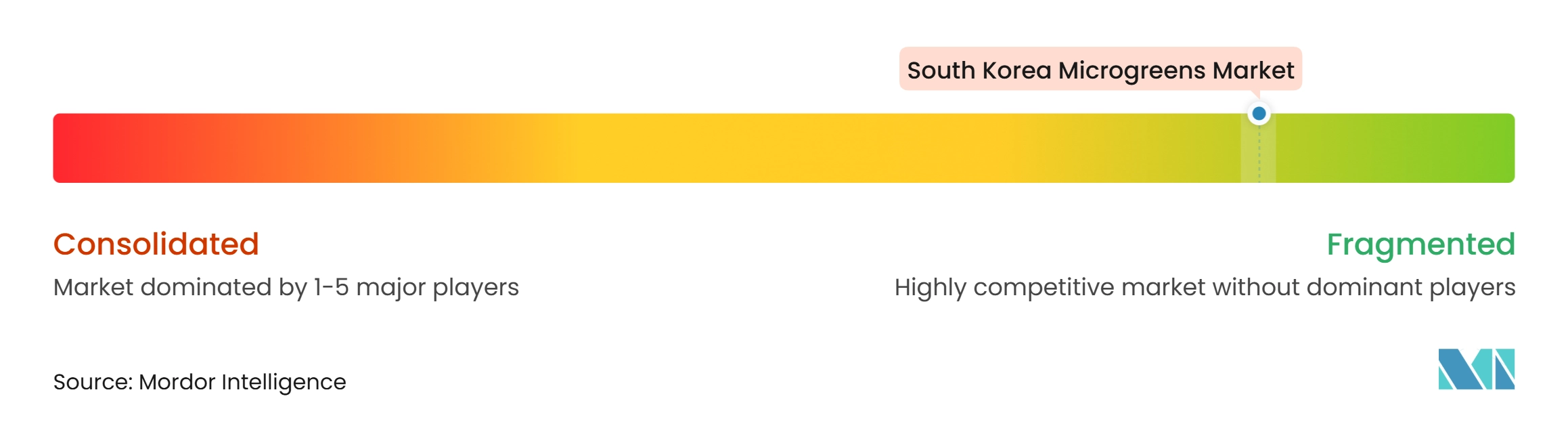
The approved competitive universe comprises Koppert Cress, Farm8, and Korea Microgreen Co., Ltd. No validated individual or combined company market-share figures are available in the source material. The landscape is therefore best assessed through commercial microgreens production, customer access, product differentiation, and operating capability rather than assumed revenue rankings. Koppert Cress is positioned around premium cress and microgreens supplied through its Korean licensed operation. Farm8 operates controlled-environment farms and has recorded activity at Metro Farm in Seoul.
Koppert Cress Korea states that it supplies certified non-genetically modified cress and microgreen varieties from its LED smart farm in Mungyeong. This approach emphasizes crop range, controlled production, and foodservice supply. Farm8’s 2024 Naju facility represents a strategic move to add controlled-production capacity outside the Seoul Capital Area. Farm8’s public-facing Metro Farm format is another strategic move because it combines cultivation with consumer visibility. The 2024 smart-farming law created more potential locations for building-type vertical farms, which can influence how approved producers evaluate future urban facilities. Korea Microgreen Co., Ltd. remains within the approved company universe, but the available sources contain no company-specific operating detail that can be reliably added.
Rivalry is moderated by the operational difficulty of delivering fresh, consistent, and certified products to demanding buyers. Growers compete through crop variety, delivery reliability, food-safety systems, and energy efficiency. The Ministry of Agriculture, Food and Rural Affairs policy support can lower some barriers to technology adoption, but it does not guarantee commercial microgreen production or sales. Smaller operators may face greater pressure from compliance costs and the need to maintain cold-chain quality. The South Korea microgreens market is not a commodity market because customers evaluate freshness and product attributes closely. No claim of a dominant producer is appropriate without validated market-share data.
South Korea Microgreens Industry Leaders
-
Koppert Cress
-
Farm8
-
Korea Microgreen Co., Ltd.
- *Disclaimer: Major Players sorted in no particular order
South Korea Microgreens Market Companies Covered in this Report
- Koppert Cress
- Farm8
- Korea Microgreen Co., Ltd.
Recent Industry Developments in South Korea Microgreens Market
- February 2025: The Ministry of Agriculture, Food and Rural Affairs issued the First Five-Year Smart Farming Master Plan for 2025 to 2029, targeting smart-farming adoption across 35% of 55,000 hectares of greenhouses and designating 4 Smart Farming Fostering Districts.
- January 2025: The National Agricultural Products Quality Management Service recorded 13,077 Good Agricultural Practices certified production operations across 322 product types.
- July 2024: South Korea’s Act on Fostering and Supporting Smart Farming enabled building-type vertical farms in industrial complexes.
South Korea Microgreens Market Report Scope
Microgreens are young, edible vegetable and herb seedlings harvested 7 to 21 days after germination. They are valued for their nutritional content, flavor, vibrant color, and applications in salads, garnishes, sandwiches, and specialty dishes. The South Korea microgreens market report is segmented by Type (Broccoli, Lettuce and Chicory, Basil, Fennel, Carrots, Radish, Amaranth, Arugula, Beets, Mustard, Kale, and Cress and Chard), by Sales Channel (Hypermarket and Supermarkets, Restaurants and Foodservice, Direct-to-Consumer Subscription, Farmers Markets and Online Grocery ), and by Farming Method (Indoor Horizontal Farming, Vertical Farming, Commercial Greenhouses, and Hydroponic Grow Cabinets). The Market Forecasts are Provided in Terms of Value (USD).
Segmentation Overview
| Broccoli |
| Lettuce and Chicory |
| Basil |
| Fennel |
| Carrots |
| Radish |
| Amaranth |
| Arugula |
| Beets |
| Mustard |
| Kale |
| Cress and Chard |
| Hypermarkets and Supermarkets |
| Restaurants and Foodservice |
| Direct-to-Consumer Subscription |
| Farmers Markets |
| Online Grocery |
| Indoor Horizontal Farming |
| Vertical Farming |
| Commercial Greenhouses |
| Hydroponic Grow Cabinets |
| By Type | Broccoli |
| Lettuce and Chicory | |
| Basil | |
| Fennel | |
| Carrots | |
| Radish | |
| Amaranth | |
| Arugula | |
| Beets | |
| Mustard | |
| Kale | |
| Cress and Chard | |
| By Sales Channel | Hypermarkets and Supermarkets |
| Restaurants and Foodservice | |
| Direct-to-Consumer Subscription | |
| Farmers Markets | |
| Online Grocery | |
| By Farming Method | Indoor Horizontal Farming |
| Vertical Farming | |
| Commercial Greenhouses | |
| Hydroponic Grow Cabinets |
Key Questions Answered in the Report
What is driving demand for microgreens in South Korea?
Restaurant demand, controlled cultivation, and smart-farming policy support are key factors.
Which microgreen type is the largest in South Korea?
Broccoli was the largest type, with 18% of sales in 2025.
Which farming method is growing fastest?
Vertical farming is forecast to grow at the fastest CAGR of 13.4% from 2026 to 2031.
What limits expansion for commercial microgreens growers?
What limits expansion for commercial microgreens growers?