
South Korea Fixed Wireless Access Market Size and Share
Market Overview
| Study Period | 2020 - 2031 |
|---|---|
| Forecast Data Period | 2026 - 2031 |
| Base Year Market Size (2025) | USD 1.69 Billion |
| Market Size (2026) | USD 2 Billion |
| Market Size (2031) | USD 4.06 Billion |
| Growth Rate (2026 - 2031) | 15.21 % |
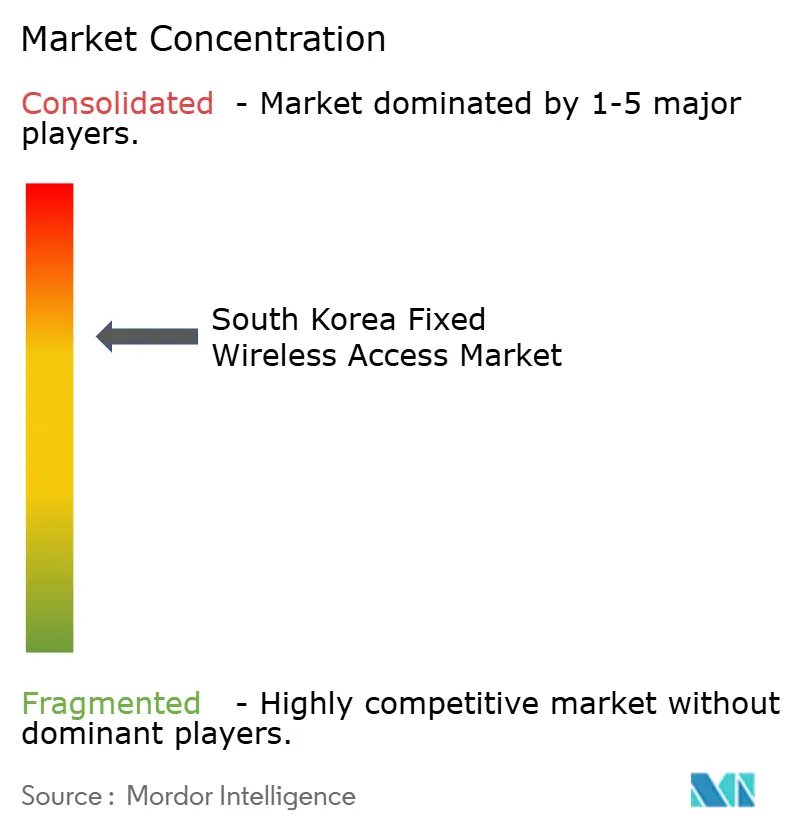
| Market Concentration | Medium |
Major Players *Disclaimer: Major Players sorted in no particular order Image © Mordor Intelligence. Reuse requires attribution under CC BY 4.0. | |
South Korea Fixed Wireless Access Market Analysis by Mordor Intelligence
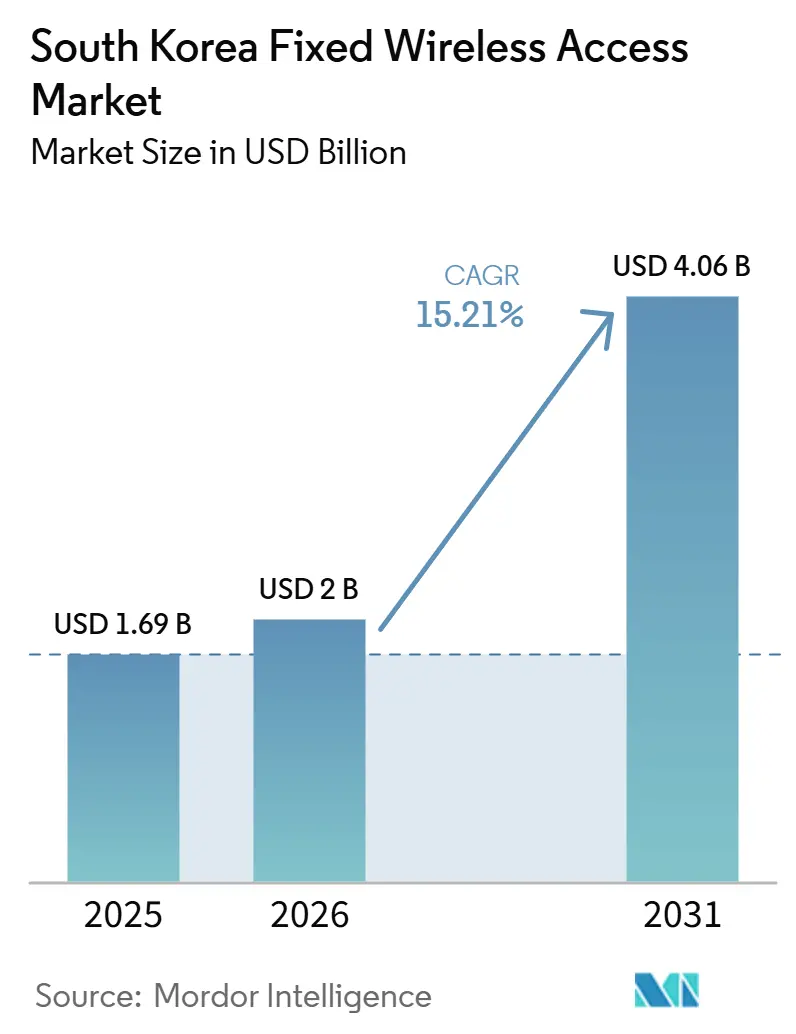
The South Korea fixed wireless access market was valued at USD 1.69 billion in 2025 and estimated to grow from USD 2.00 billion in 2026 to reach USD 4.06 billion by 2031, at a CAGR of 15.21% during the forecast period 2026-2031. The South Korea fixed wireless access market is moving from early deployment to broader commercialization as 5G standalone upgrades improve service quality, lower latency, and create a more reliable platform for residential, enterprise, and public-sector connections. The main growth pool remains outside the strongest fiber pockets, especially in semi-urban districts, outer metro zones, and locations where last-mile fiber work remains costly or delayed by building conditions. Operators are also broadening the South Korea fixed wireless access market beyond simple internet access by linking connectivity with managed services, backup links, security layers, and faster activation models that reduce installation friction. At the same time, the South Korea fixed wireless access market faces a clear structural limit: fiber penetration remains exceptionally high, narrowing the pool of households that would switch on price or coverage alone. Competition, therefore, depends less on pure network reach and more on service packaging, indoor coverage quality, self-install equipment, and the ability to serve secondary use cases that fiber does not address as efficiently.
Key Report Takeaways
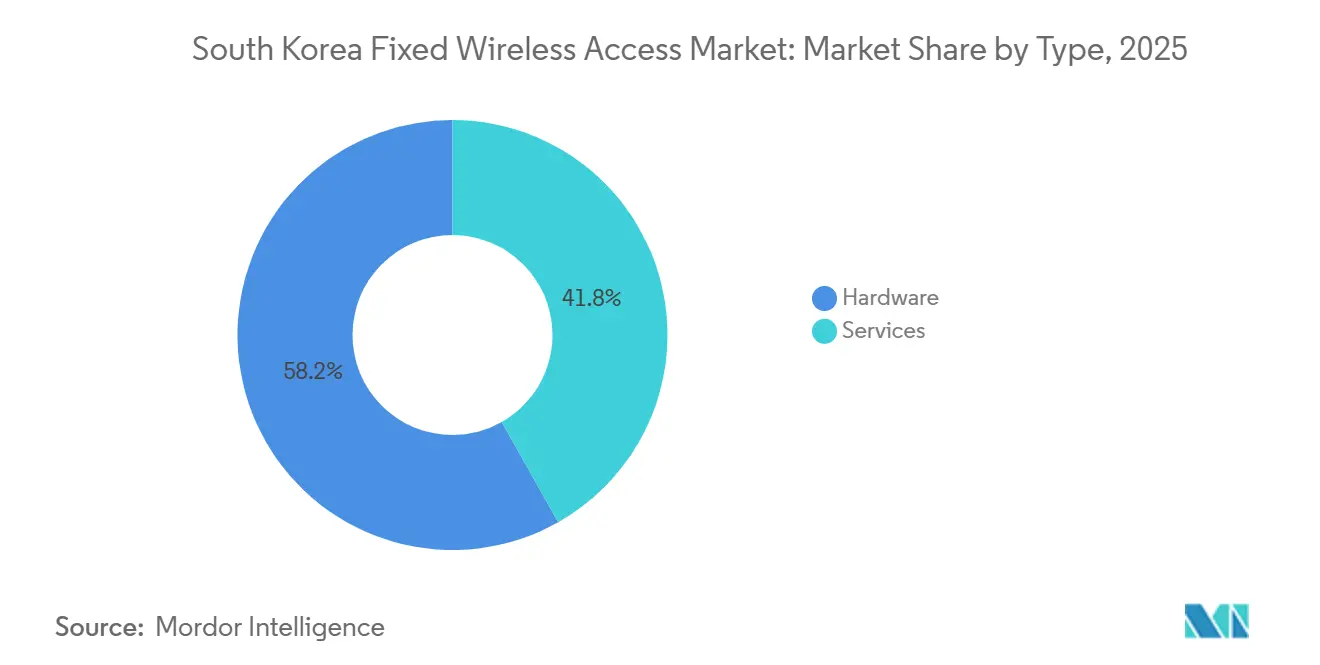
- By type, hardware led with a 58.19% revenue share of the South Korea fixed wireless access market size in 2025, while services is projected to expand at a 16.81% CAGR through 2031.
- By application, residential connections held 63.87% share in 2025, while Government and Public Safety is projected to record the fastest growth at 15.87% through 2031.
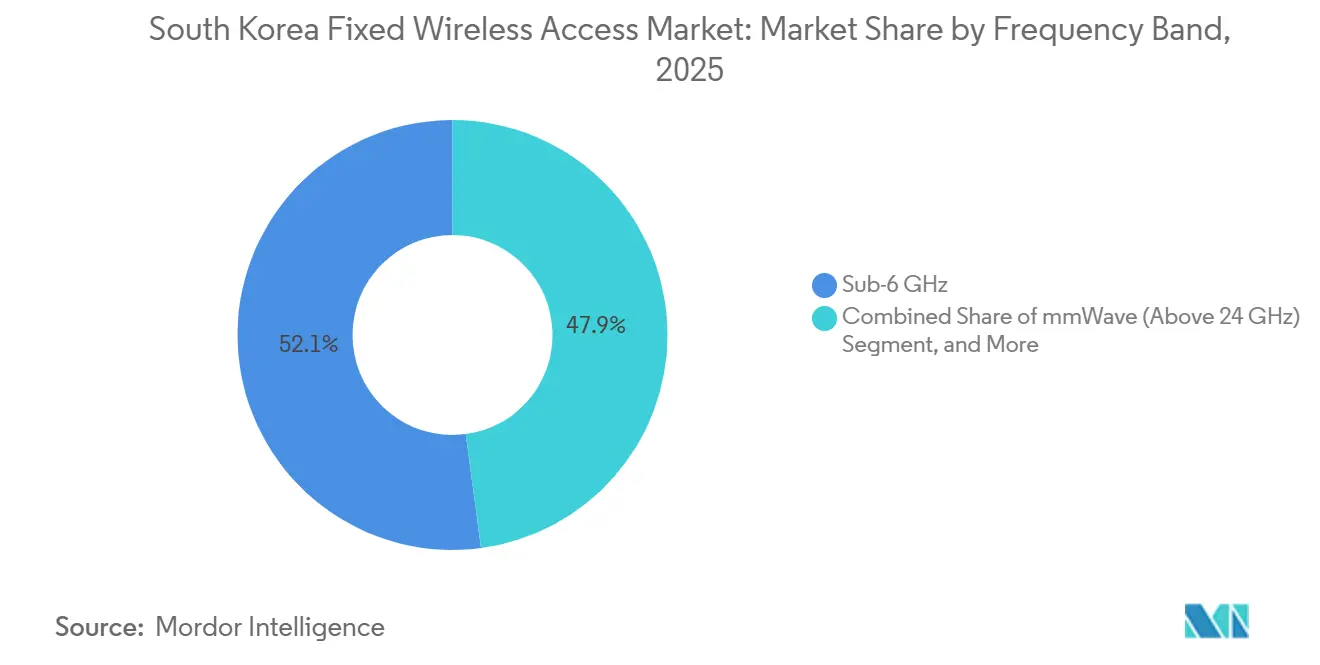
- By frequency band, sub-6 GHz accounted for 52.11% share of the South Korea fixed wireless access market size in 2025, while mmWave above 24 GHz is expected to expand at a 15.97% CAGR through 2031.
- By deployment mode, indoor CPE captured 61.11% share in 2025, while self-install window-mount CPE is projected to grow at a 16.44% CAGR through 2031.
Note: Market size and forecast figures in this report are generated using Mordor Intelligence’s proprietary estimation framework, updated with the latest available data and insights as of January 2026.
South Korea Fixed Wireless Access Market Trends and Insights
Drivers Impact Analysis*
| DRIVER | (~) % IMPACT ON CAGR FORECAST | GEOGRAPHIC RELEVANCE | IMPACT TIMELINE |
|---|---|---|---|
| 5G Network Densification Supporting Broader FWA Coverage | +3.5% | National, with priority gains in Seoul, Incheon, and Busan metropolitan zones | Short term (≤ 2 years) |
| Fixed Broadband Substitution in Price-Sensitive Household Segments | +2.8% | Semi-urban and suburban areas, with spillover to outer Seoul satellite cities | Medium term (2-4 years) |
| Enterprise Demand for Rapid Backup Connectivity and Business Continuity | +2.2% | National, with early concentration in Gyeonggi, Seoul, and port-industrial clusters | Medium term (2-4 years) |
| Self-Install Customer Premises Equipment: Reducing Service Activation Time | +1.8% | National | Short term (≤ 2 years) |
| Mid-Band Spectrum Availability Improving Capacity Economics | +2.1% | National, with densification gains in high-traffic urban corridors | Medium term (2-4 years) |
| AI-Enabled Network Optimization Improving Spectral Efficiency | +1.7% | National, with early gains in Seoul and Gyeonggi commercial districts | Long term (≥ 4 years) |
| Source: Mordor Intelligence | |||
5G Network Densification Supporting Broader FWA Coverage
South Korea achieved nationwide 5G coverage across all 85 city administrative districts and major rural areas by April 2024, providing the South Korean fixed wireless access market with a broad base for subscriber expansion after the initial mobile rollout phase.[1]CMS Expert Guides, “5G Regulation and Law in South Korea,” CMS Expert Guides, cms.law In 2026, operators are shifting from macro-site expansion to denser indoor coverage, small-cell layering, and wider commercialization of standalone networks, which improve service consistency for fixed wireless users in buildings where signal behavior matters more than nominal coverage. KT already operated a nationwide 5G standalone network and extended that capability to the iPhone 17 series in March 2026, while SK Telecom and LG Uplus are completing their broader standalone transitions within 2026. The government also tied the renewal of spectrum rights expiring in 2026 to progress on 5G standalone upgrades, thereby reducing the risk that carriers delay core network investment needed for higher-value FWA services. As standalone capabilities spread, operators can deploy network slicing and more reliable quality tiers, making the South Korean fixed wireless access market more suitable for enterprise users who have been cautious about shared-spectrum performance. This matters because coverage quality inside apartment towers, offices, and public buildings now shapes adoption as much as simple geographic reach.
Fixed Broadband Substitution in Price-Sensitive Household Segments
The South Korea fixed wireless access market is not expanding because fiber is absent, but because some households still face installation friction, delayed approvals, or budget pressure that keeps wired upgrades from happening immediately.[2]FTTH Council Europe, “FTTH/B Global Ranking 2025,” FTTH Council Europe, ftthcouncil.eu In June 2026, the government pushed carriers to simplify a large number of tariff plans and move toward lower-priced bundled 5G offerings, which improves the relative economics of wireless broadband for cost-sensitive users. That pricing reset is important in outer Seoul districts, semi-urban clusters, and older residential stock where subscribers often weigh installation effort and monthly cost together rather than comparing theoretical peak speeds alone. LG Uplus also reported 9.314 million 5G handset subscriptions in 2025, up 17.1% year on year, indicating the broad mobile base operators can target when packaging wireless broadband and mobile services more closely. The South Korea fixed wireless access market, therefore, gains most when wireless reduces total subscriber acquisition friction rather than when it replaces fiber on raw speed alone.
Enterprise Demand for Rapid Backup Connectivity and Business Continuity
Enterprise demand is supporting the South Korea fixed wireless access market mainly as a backup and continuity layer rather than as a full substitute for primary wired broadband. KT deployed its 5G Business Network Hub Model across 7 local governments under the Gyeonggi Provincial Office in June 2026, replacing separate wired communication systems with a centralized wireless architecture managed through a government mobile gateway. That rollout showed that public institutions are willing to adopt wireless-first models when the network can simplify shared infrastructure and improve continuity across subordinate agencies. In April 2026, SK Telecom, KT, and LG Uplus committed to raising spending on next-generation networks and AI by 15% year on year, following government pressure following cyber incidents, to support enterprise-grade resilience and service assurance. Disaster-resilience needs also reinforce demand, as wireless backup links can remain useful when physical cable routes or related infrastructure are disrupted, especially in logistics, municipal, and critical service environments. This keeps enterprise adoption tied to risk management and uptime, broadening the South Korea fixed wireless access market into one where reliability and deployment speed carry more weight than headline price.
Mid-Band Spectrum Availability Improving Capacity Economics
Sub-6 GHz and mid-band assets remain central to the South Korea fixed wireless access market because they offer a better balance of coverage, indoor reach, and usable capacity than very high-frequency alternatives. South Korea’s extensive 3.5 GHz deployment provides operators with a practical foundation for residential and small-business FWA in suburban and semi-urban areas where line-of-sight conditions are less predictable. Mid-band economics are especially important in a country where operators must cover dense apartment environments without pushing installation or densification costs beyond what entry-level broadband pricing can support. The reallocation policy finalized in December 2025 lowered fees by 14.8% across the three operators, which gives carriers more room to direct capital into network upgrades that improve service quality for FWA users. Better mid-band capacity also lowers reliance on mmWave-only strategies that require much heavier site density and are harder to scale across mixed urban and semi-urban geographies. For that reason, the near-term expansion path for the South Korea fixed wireless access market still depends more on practical mid-band performance than on extreme throughput claims.
Restraints Impact Analysis*
| RESTRAINT | (~) % IMPACT ON CAGR FORECAST | GEOGRAPHIC RELEVANCE | IMPACT TIMELINE |
|---|---|---|---|
| Dense Fiber Infrastructure Limiting FWA Addressable Demand | -2.3% | National, most constraining in Seoul, Incheon, and Busan metropolitan corridors | Long term (≥ 4 years) |
| Spectrum Congestion and Capacity Constraints in High Traffic Zones | -1.4% | Urban high-density zones, including central Seoul, Gangnam district, and major transit hubs | Medium term (2-4 years) |
| High Densification and Backhaul Costs for Sustained Urban Coverage | -1.1% | National urban coverage, particularly dense apartment complexes | Medium term (2-4 years) |
| Weather Sensitivity and Line-Of-Sight Limits in Higher Frequency Deployments | -0.5% | Coastal and mountainous regions, and mmWave urban corridors | Short term (≤ 2 years) |
| Source: Mordor Intelligence | |||
Dense Fiber Infrastructure Limiting FWA Addressable Demand
Dense fiber deployment remains the strongest structural cap on the South Korea fixed wireless access market, as household FTTH/B penetration reached 96.6% by September 2024, placing the country second globally. The World Broadband Association also placed South Korea among only 3 countries to achieve 100% FTTH coverage in its 2024 Fiber Development Index, underscoring how limited the white space for broadband replacement really is. In practical terms, this means operators usually sell FWA on convenience, activation speed, backup utility, or building-specific constraints rather than on the basic promise of bringing broadband to uncovered homes. The input also shows that sub-6 GHz FWA chipset demand accounted for only 8% to 10% of South Korea’s 5G chipset demand, underscoring the targeted nature of the addressable use case. As a result, the South Korea fixed wireless access market depends more heavily on secondary roles such as enterprise redundancy, temporary access, and public sector backup than many other national markets do. This keeps long-term demand growth positive, but it also narrows the path to very large mass-market substitution.
Spectrum Congestion and Capacity Constraints in High Traffic Zones
Urban density creates a second clear limit because traffic loads in central Seoul and similar areas can strain the radio layer during busy periods, directly affecting broadband quality perception. The input notes that mmWave cells in dense commercial districts can experience significant non-line-of-sight losses from facades and moving obstacles, limiting the effective range to sub-100-meter cells in some cases. The December 2025 reallocation policy also shortened the use terms for the 1.8 GHz and 2.6 GHz bands to 3 years ending in 2029, adding planning uncertainty for mid-band investment tied to longer FWA capacity strategies. Stage X gained 800 MHz of 28 GHz spectrum as a fourth-operator entry point, but its 6,000 base-station obligation over 3 years is still modest relative to what dense indoor broadband coverage would require. Operators also need to protect core mobile service obligations before allocating spare capacity to FWA tiers, which can leave fixed wireless users at a disadvantage against dedicated fiber in the most congested corridors. This means the South Korea fixed wireless access market expands most smoothly when capacity pressure is manageable and when the service is not competing with peak-hour mobile demand on the same terms.
*Our forecasts treat driver/restraint impacts as directional, not additive. The impact forecasts reflect baseline growth, mix effects, and variable interactions.
Segment Analysis
By Type: Services Revenue Rising as Hardware Matures
Hardware accounted for 58.19% of the South Korea fixed wireless access market in 2025, with consumer premises equipment accounting for the largest share of that revenue base, followed by access units. That position reflects the current shape of the South Korea fixed wireless access market, where subscriber additions still require large volumes of indoor devices, routers, and radio access components before recurring service layers fully deepen. CPE economics improved as global production scale expanded, helping South Korean operators refresh home broadband equipment without relying on heavy, technician-led installation models.[3]Broadcom Inc., “Broadcom Unveils World’s First Integrated 5G and Wi-Fi 8 FWA Platform in Collaboration With Samsung Electronics,” Broadcom Inc., broadcom.com The hardware mix is also improving performance, as South Korean carriers introduced Wi-Fi 7 devices in 2026 and paired those upgrades with faster local networking for dense home use. Access units such as femtocells and picocells are gaining traction because better indoor coverage aligns with the policy push for additional in-building 5G base-station deployment over the next several years.
Services is projected to expand at a 16.81% CAGR from 2026 to 2031, making it the fastest-growing segment in the South Korea fixed wireless access industry. This shift shows that the South Korea fixed wireless access market is moving beyond access provision and toward managed connectivity, performance assurance, and security-linked monetization. KT’s Flexline ZTNA service is a useful example because it combines zero-trust network access with dynamic bandwidth management and direct cloud connectivity for enterprise clients. GSA reported in June 2026 that 5G FWA average marketed peak download speeds across 514 operators in 179 countries reached 774.7 Mbps, supporting the idea that service differentiation increasingly occurs above the connectivity layer. As throughput becomes easier to market, operators in the South Korea fixed wireless access industry have stronger reasons to sell uptime, prioritization, security, and managed performance rather than compete only on device supply.


By Application: Residential Volume Supports Scale While Public Networks Expand Faster
Residential connections held 63.87% of the South Korea fixed wireless access market share in 2025, confirming that household broadband remains the largest volume use case for the category. Residential demand is strongest in older apartment stock and semi-urban settings, where fiber activation can be delayed by internal wiring issues or building approval steps, even though national fiber availability is high. In those cases, fixed wireless gains ground because it can be activated faster and with less resident disruption than a new wired setup. Commercial demand ranks second and benefits from the same plug-and-deploy logic in small offices, leased retail space, and temporary work locations where installation timing matters. Industrial demand remains smaller, but it still fits factory, utility, and logistics locations where wired extensions are harder to justify or slower to complete.
Government and Public Safety is projected to grow at a 15.87% CAGR from 2026 to 2031, making it the fastest-growing application in the South Korea fixed wireless access market. KT’s June 2026 deployment across 7 municipalities in Gyeonggi Province created a practical model that public agencies can replicate when they want a centralized communication architecture rather than separate, redundant systems. The application also gained support from 5G standalone slicing demonstrations that separated resources for emergency staff at a major public gathering in Seoul during June 2026. That example matters because public safety buyers value predictable access and continuity more than headline speed, which aligns well with a standalone-enabled FWA proposition. Regulatory expectations around wireless backup links for public institutions and critical operations give this segment a more durable demand floor than consumer switching behavior alone would provide.
By Frequency Band: Sub-6 GHz Holds The Base While mmWave Gains Relevance
Sub-6 GHz accounted for 52.11% of the South Korea fixed wireless access market share in 2025, reflecting its role as the main commercial band for present-day deployments. Its lead comes from stronger non-line-of-sight performance, wider usable coverage per site, and compatibility with the 3.5 GHz infrastructure that South Korea operators have expanded since 2019. This band is better suited to mixed-density districts where signal travel inside buildings matters as much as nominal spectrum depth. It also supports multi-device household usage more reliably across suburban and semi-urban zones where operators need practical coverage economics rather than very short-range capacity bursts. Shared-spectrum applications remain limited in South Korea compared with the United States, so the commercial weight of FWA still sits overwhelmingly on licensed spectrum pathways.
mmWave above 24 GHz is projected to expand at a 15.97% CAGR through 2031, making it the fastest-growing band segment in the South Korea fixed wireless access market. Stage X’s acquisition of 800 MHz of 28 GHz spectrum adds a new operator-led push for mmWave buildout in dense urban settings. Samsung and Qualcomm also announced Power Class 1 validation for 5G FWA on virtualized RAN in May 2026, with reported gains of up to 10 times higher cell-edge uplink throughput and 40% wider coverage than the earlier standard.[4]Samsung Electronics, “Samsung and Qualcomm Achieve Industry-First Power Class 1 Validation for 5G Fixed Wireless Access on Virtualized RAN,” Samsung Newsroom, news.samsung.com Those improvements matter because mmWave economics have long been limited by reach and cell-edge performance rather than by a lack of raw spectrum. As better uplink behavior, more spectrum, and standalone network control come together, mmWave becomes more practical for residential towers and enterprise campuses that need very high-capacity wireless links

By Deployment Mode: Indoor Leadership Continues While Window-Mount Formats Grow Fastest
Indoor CPE accounted for 61.11% of the South Korea fixed wireless access market in 2025, reflecting the apartment-heavy housing mix in the country’s major urban centers. Indoor devices align with the prevailing installation pattern because building management groups often control exterior mounting, and residents prefer self-setup options that do not require facade work. They also align with sub-6 GHz performance profiles that remain more forgiving in indoor propagation conditions than higher-band alternatives. Outdoor CPE still has an important role in detached housing and small commercial sites, especially in suburban and rural settings where line-of-sight conditions improve throughput. That split shows how the South Korea fixed wireless access industry adapts device choices to actual building conditions rather than a single national deployment model.
Self-install window-mount CPE is projected to grow at a 16.44% CAGR from 2026 to 2031, which makes it the fastest-growing deployment mode. The format is suited to South Korea high-rise living because residents can place the unit on an interior-facing glass wall without altering the exterior of the building. Qualcomm’s FWA Gen 5 Elite Platform includes Dynamic Antenna Steering Gen 2 and an RF Sensing Suite, which helps users find better indoor placement without technician support. That reduces activation time to the same day in many use cases and lowers customer acquisition cost compared with technician-led wired installations. The South Korea fixed wireless access market benefits directly from easier installation, which shortens the gap between customer intent and revenue recognition for both residential and small enterprise accounts.
Geography Analysis
Seoul and Gyeonggi accounted for the largest concentration of addressable demand in the South Korea fixed wireless access market in 2025, though that demand stemmed more from building constraints and activation delays than from a lack of fiber infrastructure. Older apartment complexes across the metro area remain a practical target because internal wiring and management approval issues can still delay full gigabit upgrades for residents. In these districts, self-install and window-mount FWA devices address a timing issue more than a pure access issue. KT’s June 2026 rollout of New 5G-GES switches to deliver 1 Gbps service over existing UTP cable in legacy apartments shows that operators are also defending the same buildings with improved wired alternatives. That means metro competition is shaped by deployment speed, internal building conditions, and bundle design rather than by simple geographic coverage.
The second geographic tier includes cities such as Daejeon, Gwangju, and Changwon, along with their surrounding semi-urban belts, where FWA economics are more straightforward during the 2026 to 2031 period. Fiber availability remains high there by global standards, but it is less uniform than in the capital region, which leaves more room for fast wireless activation in light-industrial sites and multi-story residential pockets. All 3 major operators also built a shared 5G rural network for farming and fishing villages, which improves baseline infrastructure coverage where standalone investment would be difficult to justify. That shared model matters because it extends service readiness into areas where small subscriber pools still need reliable broadband and backup capacity. The South Korea fixed wireless access market therefore gains cleaner commercial traction in these mid-tier zones than in the most fiber-saturated city cores.
Rural, island, and coastal geographies remain important because wireless connectivity often serves resilience needs in addition to ordinary broadband demand. The input highlighted KT’s deployment on Ulleungdo Island, using redundant microwave wireless backup alongside submarine cables, demonstrating how access and continuity can be planned together in harder-to-serve locations. Enterprise adoption is also rising in the Gyeonggi industrial corridor and around Incheon’s port and logistics assets, where single-point wired failures are not acceptable. These use cases give the South Korea fixed wireless access market a more durable regional role even in places where household substitution alone would not justify aggressive expansion.
Competitive Landscape
The South Korea fixed wireless access market is moderately concentrated in service delivery, as KT Corporation, SK Telecom, and LG Uplus control commercial FWA access through their national 5G networks. That structure provides the market with a stable operator core, but the equipment side remains more varied, with Samsung Electronics, Nokia, Ericsson, Qualcomm, ZTE, Huawei, and specialist device suppliers competing for contracts. Samsung holds a strong position because it participates in both network infrastructure and device platform development, which gives it influence across multiple layers of the value chain. In May 2026, Samsung and Broadcom introduced the world’s first integrated 5G and Wi-Fi 8 FWA reference platform built around Samsung’s B1320 modem and Broadcom’s BCM6776 Wi-Fi 8 SoC. That move matters because better device integration can shorten time-to-market for carriers and CPE makers seeking faster, more capable home and enterprise terminals.
Ericsson and SK Telecom also signed an MoU in March 2026 to advance AI-RAN from 5G through 6G, with work focused on AI-driven scheduling, beam management, and traffic prediction. This kind of cooperation can improve spectral efficiency and lower per-bit delivery cost, which becomes valuable when fixed wireless traffic grows on shared radio infrastructure. Another strategic move came from KT, whose hub-model rollout in Gyeonggi municipalities turned a public-sector deployment into a repeatable template for managed enterprise and government connectivity. That gives KT a practical reference case in a part of the South Korea fixed wireless access market where recurring service value can rise faster than basic access revenue. Competitive advantage is therefore shifting toward integrated service design, stronger indoor performance, and faster deployment models rather than simple coverage claims.
White space remains most visible in managed enterprise FWA services and in higher-capacity mmWave offerings that have not yet been deployed at full potential. Stage X’s planned buildout following its acquisition of 28 GHz spectrum provides the market with a fresh catalyst, even if network density requirements will remain demanding. ZTE’s March 2026 introduction of AI Wi-Fi 8 CPE and dual-mode sub-6 GHz plus mmWave CPE shows that the device side is advancing toward more flexible deployment options. Because all operators must align with the national 5G standalone transition timetable, competition in the South Korean fixed wireless access market is likely to increasingly center on service quality, affordability, and device performance rather than on core-network timing alone.
South Korea Fixed Wireless Access Industry Leaders
KT Corporation
LG Uplus Corp.
SK Telecom Co. Ltd.
Samsung Electronics Co. Ltd.
Nokia Corporation
- *Disclaimer: Major Players sorted in no particular order

Recent Industry Developments
- June 2026: KT deployed its 5G Business Network Hub Model in 7 local governments under the Gyeonggi Provincial Office, replacing individual agency infrastructure with a centralized Government Mobile Gateway and creating a scalable public-sector connectivity template.
- May 2026: Samsung Electronics and Broadcom unveiled the world’s first integrated 5G and Wi-Fi 8 FWA reference platform, combining the Samsung B1320 5G modem with Broadcom’s BCM6776 Wi-Fi 8 SoC, with carrier trials and OEM sampling underway.
- May 2026: Samsung and Qualcomm achieved an industry-first Power Class 1 validation for 5G FWA on virtualized RAN, demonstrating up to 10 times higher cell-edge uplink throughput and 40% greater coverage extension versus Power Class 1.5.
- April 2026: SK Telecom, KT, and LG Uplus committed to increasing spending on next-generation networks and AI by 15% year on year after a joint pledging ceremony with the Ministry of Science and ICT.


South Korea Fixed Wireless Access Market Report Scope
The South Korea Fixed Wireless Access Market Report is Segmented by Type (Hardware [Consumer Premise Equipment, and Access Units], and Services), Application (Residential, Commercial, Industrial, and Government and Public Safety), Frequency Band (Sub-6 GHz, mmWave (Above 24 GHz), and Unlicensed/Shared CBRS), and Deployment Mode (Indoor CPE, Outdoor CPE, and Self-Install Window-Mount CPE). The Market Forecasts are Provided in Terms of Value (USD).
| Hardware | Consumer Premise Equipment (CPE) |
| Access Units (Femto and Picocells) | |
| Services |
| Residential |
| Commercial |
| Industrial |
| Government and Public Safety |
| Sub-6 GHz |
| mmWave (Above 24 GHz) |
| Unlicensed / Shared CBRS |
| Indoor CPE |
| Outdoor CPE |
| Self-Install Window-Mount CPE |
| By Type | Hardware | Consumer Premise Equipment (CPE) |
| Access Units (Femto and Picocells) | ||
| Services | ||
| By Application | Residential | |
| Commercial | ||
| Industrial | ||
| Government and Public Safety | ||
| By Frequency Band | Sub-6 GHz | |
| mmWave (Above 24 GHz) | ||
| Unlicensed / Shared CBRS | ||
| By Deployment Mode | Indoor CPE | |
| Outdoor CPE | ||
| Self-Install Window-Mount CPE |


Key Questions Answered in the Report
What is the South Korea fixed wireless access market size in 2026, and where is it expected to reach by 2031?
The South Korea fixed wireless access market is generating USD 2.00 billion in 2026 and is projected to reach USD 4.06 billion by 2031 at a 15.21% CAGR.
What is driving fixed wireless access adoption in South Korea if fiber coverage is already high?
Adoption is supported by faster activation, 5G standalone upgrades, increased demand for backup connectivity, and building-level installation constraints that still affect some homes and institutions.
Which application leads demand for fixed wireless access in South Korea?
Residential connections led with a 63.87% share in 2025, mainly because fixed wireless can be activated more quickly in older apartments and semi-urban areas.
Which application is growing the fastest through 2031?
Government and Public Safety is projected to grow fastest at a 15.87% CAGR as agencies increase wireless backup and continuity capabilities.
Which frequency band is most important today, and which one is growing fastest?
Sub-6 GHz led with a 52.11% share in 2025 because it offers better coverage economics, while mmWave is projected to grow fastest at a 15.97% CAGR.
How concentrated is competition among providers in South Korea?
Service competition is concentrated among KT, SK Telecom, and LG Uplus, while the device and network equipment layers are broader, with companies such as Samsung, Ericsson, Qualcomm, and ZTE.
Page last updated on:





