
South Korea Bonsai Market Size and Share
Market Overview
| Study Period | 2021 - 2031 |
|---|---|
| Forecast Data Period | 2026 - 2031 |
| Base Year Market Size (2025) | USD 37.5 Million |
| Market Size (2026) | USD 41.01 Million |
| Market Size (2031) | USD 65.15 Million |
| Growth Rate (2026 - 2031) | 9.70 % |
| Market Concentration | Low |
Major Players *Disclaimer: Major Players sorted in no particular order Image © Mordor Intelligence. Reuse requires attribution under CC BY 4.0. | |
South Korea Bonsai Market Analysis by Mordor Intelligence
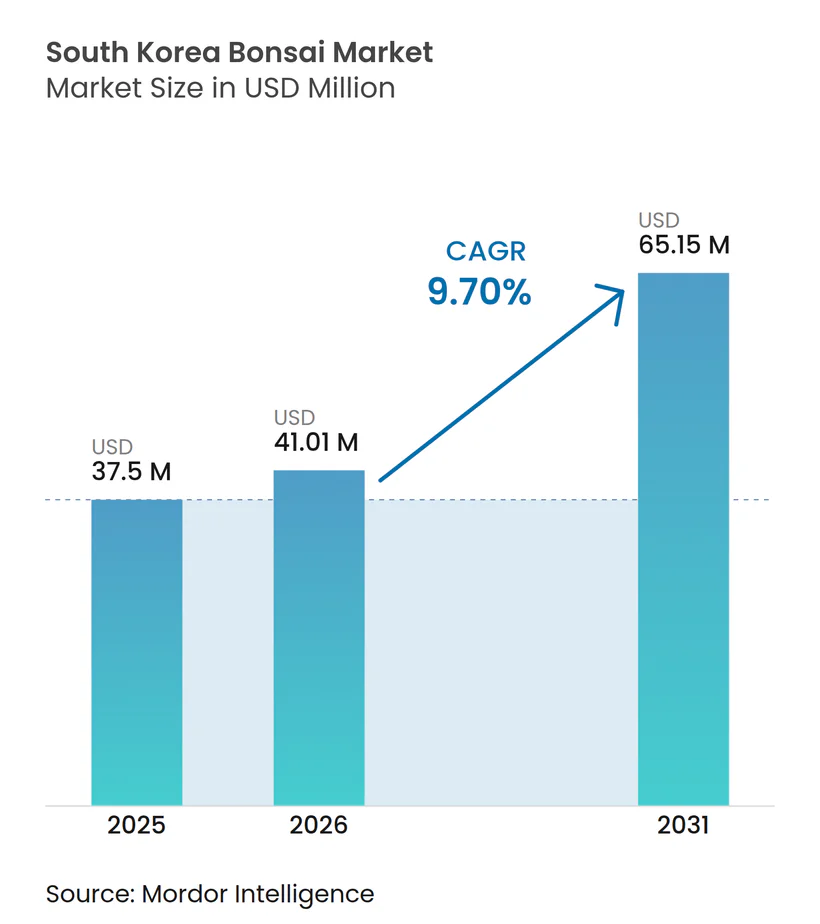
The South Korea bonsai market was valued at USD 37.50 million in 2025 and is projected to grow from USD 41.01 million in 2026 to USD 65.15 million by 2031, at a CAGR of 9.70% during the forecast period from 2026 to 2031. Demand is supported by apartment-based living, ownership of indoor plants, and a broader interest in plants as part of home routines. Bonsai also benefits from Korea's established bunjae tradition, which gives the category cultural relevance beyond its decorative use. Spending covers living trees, soils, pots, pruning inputs, lessons, maintenance, exhibitions, and visitor experiences. This mix gives sellers several ways to serve beginners, collectors, and commercial buyers. Growth will depend on whether providers can make care easier for new owners while maintaining the supply of mature specimens.
Key Report Takeaways
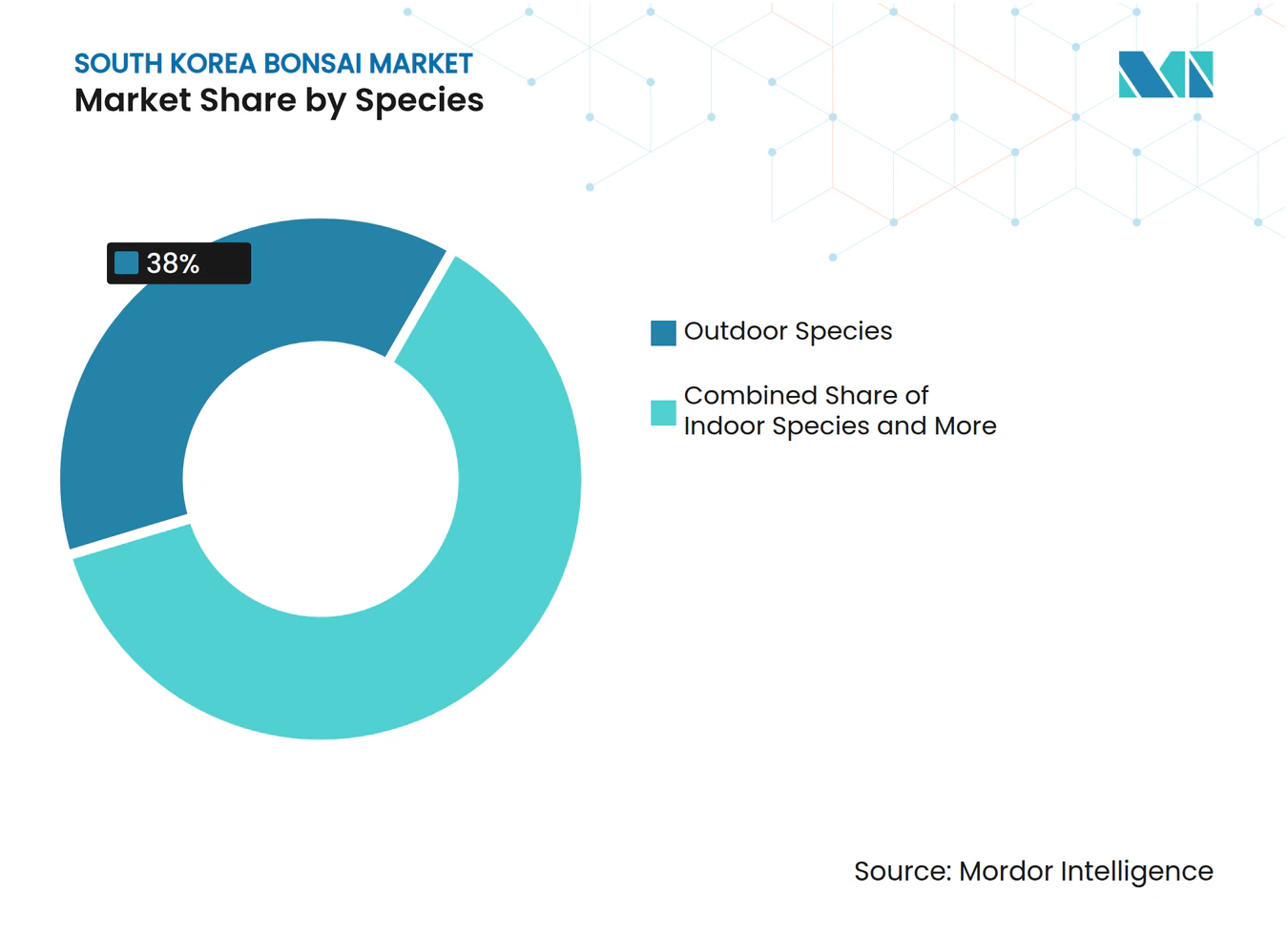
- By species, outdoor species accounted for the largest 38.0% of the South Korea bonsai market share in 2025, while indoor species is projected to grow at the fastest CAGR of 10.3% from 2026 to 2031.
- By distribution channel, offline accounted for the largest share at 58.0% in 2025, while the South Korea bonsai market size for the online segment is projected to grow at the fastest CAGR of 13.6% from 2026 to 2031.
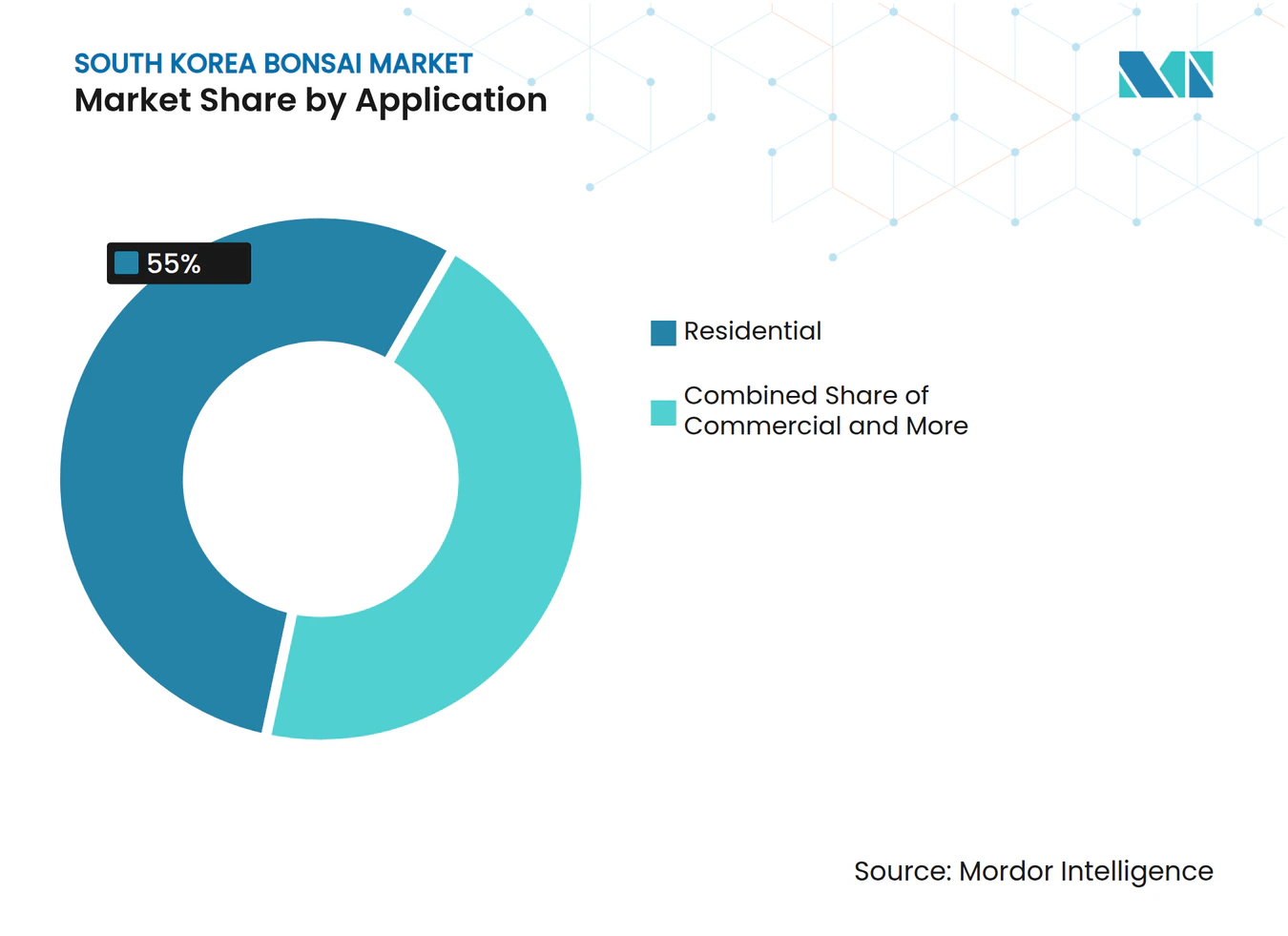
- By application, residential accounted for the largest share at 55.0% in 2025, while commercial applications are projected to grow at the fastest CAGR of 9.6% from 2026 to 2031.
Note: Market size and forecast figures in this report are generated using Mordor Intelligence’s proprietary estimation framework, updated with the latest available data and insights as of January 2026.
Market Trends and Insights
Drivers Impact Analysis of South Korea Bonsai Market*
| Driver | (~) % Impact on CAGR Forecast | Geographic Relevance | Impact Timeline |
|---|---|---|---|
| Apartment-Based Indoor Plant Ownership | 2.4% | National, concentrated in Seoul, Sejong, and Gyeonggi Province | Short term (≤ 2 years) |
| Wellness and Mindfulness Gardening | 1.7% | National, strongest in Seoul, Busan, and Daegu | Medium term (2-4 years) |
| Digital Discovery and Online Bonsai Education | 1.6% | National, concentrated in metropolitan areas | Short term (≤ 2 years) |
| Corporate Gifting and Premium Interior Styling | 1.2% | Seoul, Busan, Incheon, and commercial centers | Medium term (2-4 years) |
| Succession-Oriented Bonsai Certification | 0.7% | National, with activity in South Jeolla, Gyeonggi, and Seoul | Long term (≥ 4 years) |
| Tourism Monetization of Korean Bonsai Heritage | 0.6% | Sinan County, Jeongeup, Jeju Island, and Gyeongju | Medium term (2-4 years) |
| Source: Mordor Intelligence | |||
Apartment-Based Indoor Plant Ownership
Apartment-style living supports demand in the South Korea bonsai market by encouraging interest in compact greenery that can be maintained without a private garden. According to the Ministry of Data and Statistics (MDS), 2026, apartments accounted for 65.8% of South Korea's housing units in 2025. This housing format creates opportunities for bonsai suited to windowsills, balconies, and indoor displays. As residents seek ways to incorporate plants into limited living spaces, bonsai offers an accessible option for owning ornamental plants, supporting demand across residential settings.
Wellness and Mindfulness Gardening
Wellness-oriented routines may support the South Korea bonsai market by encouraging consumers to explore plant care as a mindful home activity. The Cultural Corps of Korean Buddhism (CCKB) reported 349,219 Templestay participants in 2025, indicating engagement in organized cultural experiences that involve reflection and relaxation. Although this figure does not measure participation in bonsai, it provides context for interest in contemplative activities. Activities such as observation, watering, pruning, and seasonal care make bonsai cultivation a structured way to engage with plants, which may help retailers introduce bonsai to wellness-oriented consumers beyond the established collector base.
Digital Discovery and Online Bonsai Education
Digital content can support the South Korea bonsai market by helping consumers discover bonsai and learn cultivation techniques before purchasing. The Ministry of Trade, Industry and Resources (MOTIR) reported that online sales at 26 major retailers increased 11.8% in 2025, indicating growth in digital retail channels. Videos, species guides, care records, and community forums can reduce knowledge barriers for beginners, while online sellers can connect customers with starter trees, tools, and educational resources. This combination of digital content and accessible instruction can broaden participation in bonsai beyond experienced collectors.
Succession-Oriented Bonsai Certification
Bonsai certification supports the South Korea bonsai market by preserving cultivation expertise and developing practitioners for production, retail, and education. The Private Qualification Information Service (PQIS) recorded 158 Bonsai Manager Level 1 qualifications awarded in 2024, indicating an established pathway for developing specialist skills. Structured training covers the knowledge required to manage bonsai and support related commercial activities. As certified practitioners enter the industry, they can improve access to care guidance and skilled services, helping sustain participation and support the market's long-term development.
Restraints Impact Analysis of South Korea Bonsai Market*
| Restraint | (~) % Impact on CAGR Forecast | Geographic Relevance | Impact Timeline |
|---|---|---|---|
| Aging Grower Base and Succession Risk | -1.5% | National, strongest in South Jeolla, North Jeolla, and rural Gyeonggi | Long term (≥ 4 years) |
| High Maintenance Intensity for Beginners | -0.9% | National, particularly apartment settings with limited light and humidity control | Short term (≤ 2 years) |
| Phytosanitary Friction for Imported Mature Trees | -0.5% | National, especially Incheon International Airport and Busan Port | Medium term (2-4 years) |
| Weak Standalone Bonsai Market Statistics | -0.3% | National | Long term (≥ 4 years) |
| Source: Mordor Intelligence | |||
Aging Grower Base and Succession Risk
An aging horticultural workforce poses a challenge for the South Korea bonsai market by creating succession gaps and threatening continuity in specialist cultivation. Statistics Korea reported that 51.0% of South Korea's farming population was aged 65 or older in 2025, indicating limited demographic depth to sustain agricultural production. Bonsai cultivation is particularly vulnerable because developing mature specimens requires years of skilled care, making it difficult to quickly replace production capacity. Without effective recruitment, training, and succession pathways, the industry may face a shrinking pool of experienced growers, restricting the availability of cultivated bonsai over time.
Phytosanitary Friction for Imported Mature Trees
South Korea’s plant quarantine requirements can restrain the bonsai market by increasing the documentation, inspection, and handling involved in importing live trees. The Animal and Plant Quarantine Agency (APQA), in its 2025 guidance, specifies that imported plants for planting require a phytosanitary certificate, subject to applicable exemptions, and must undergo quarantine inspection. These procedures can extend delivery timelines and raise compliance costs, particularly for smaller importers handling mature specimens. Domestic cultivation can reduce exposure to import-related delays, but limited local supply may leave retailers reliant on regulated imports.
*Our forecasts treat driver/restraint impacts as directional, not additive. The impact forecasts reflect baseline growth, mix effects, and variable interactions.
South Korea Bonsai Market Segment Analysis
By Species:
Outdoor Species Holds Ground as Indoor Species AccelerateOutdoor species accounted for the largest 38.0% of the South Korea bonsai market share in 2025. Outdoor bonsai remain associated with traditional Korean bunjae cultivation, established collectors, and practitioners who value tree structure, seasonal development, and long-term styling. Korean hornbeam, Japanese black pine, and zelkova can represent different aesthetic and cultivation interests within this category. Buyers may assess specimens according to form, maturity, and cultivation history. Specialist nurseries and educational organizations can support this interest through practical guidance and demonstrations, helping sustain demand for outdoor bonsai among experienced hobbyists and collectors.
Indoor species is projected to grow at the fastest CAGR of 10.3% from 2026 to 2031. Indoor bonsai can broaden participation by offering plant varieties suited to homes without gardens, including apartments and other small living spaces. Ficus, Carmona, and jade plants offer options for buyers seeking ornamental greenery suitable for indoor display when properly cared for. Accessible species information and guidance on light, watering, and pruning can help beginners make informed selections. These features can support customer acquisition and encourage continued cultivation, positioning indoor bonsai as an important avenue for market development alongside traditional outdoor practice.



By Distribution Channel:
Offline Remains Dominant, Online Redefines Access EconomicsOffline Segment accounted for the largest share at 58.0% in 2025. Physical nurseries, specialist shops, bonsai gardens, and exhibitions allow buyers to examine trees directly before purchase. This is particularly relevant when assessing root spread, bark, branch structure, styling, and plant condition. In-person interaction also gives customers opportunities to discuss care requirements and compare specimens with knowledgeable sellers. Gardens and specialist retailers can complement sales with demonstrations, workshops, and visitor experiences. These services help buyers evaluate bonsai more confidently, supporting offline retail's role in serving collectors and customers seeking personalized assistance.
The South Korea bonsai market size for the online segment is projected to grow at the fastest CAGR of 13.6% from 2026 to 2031. Digital channels can connect bonsai sellers with customers beyond established cultivation centers and make starter trees, pots, tools, soil, and learning resources easier to discover. Videos, species guides, care records, and online communities can help prospective buyers understand cultivation before making a purchase. Online Woori Bonsai illustrates an education-led approach through its digital resources and training activities. Clear product descriptions, suitable packaging, and practical aftercare guidance can address concerns about buying living plants online, supporting both beginners and experienced enthusiasts.
By Application:
Residential Segment is Wide, Commercial Segment is AcceleratingThe residential segment accounted for the largest share at 55.0% in 2025. Growth in this segment is supported by interest in ornamental plants, compact displays, and home-based nature activities. Bonsai can be placed in suitable indoor settings or outdoor areas such as balconies, depending on the species and growing requirements. Starter plants and clear care instructions allow households with varying levels of experience to participate. Retailers can further support residential customers by providing guidance on watering, pruning, lighting, and seasonal care, encouraging successful cultivation and repeat purchases of plants and related supplies.
The commercial segment is projected to grow at the fastest CAGR of 9.6% from 2026 to 2031. Businesses in hospitality, offices, coworking environments, and retail settings use bonsai as living decorative features that enhance interior design and the visitor experience. Corporate gifting and event displays may also create opportunities for curated specimens and accompanying presentation services. Commercial buyers typically have distinct requirements for plant size, appearance, delivery, and ongoing maintenance. Suppliers that offer suitable tree selection, care documentation, and after-sale support are better positioned to address these needs, creating room for bonsai providers to develop services alongside specimen sales.

Geography Analysis
The Seoul metropolitan area is a major population and retail center for bonsai demand. Statistics Korea's 2024 Population and Housing Census, published in 2025, recorded 26.31 million residents in the Capital Area, representing 50.8% of South Korea's population. This concentration provides a substantial base of potential household and commercial customers. Apartment living and urban retail infrastructure support interest in compact bonsai, while specialist shops and educational providers connect consumers with products and cultivation advice. These factors make access, convenient purchasing, and beginner-friendly information relevant to serving customers across the metropolitan market.
South Jeolla and North Jeolla provinces are notable for their heritage and practice of Korean bunjae, though their cultivation activity does not directly translate into a quantified market share. Regional gardens, growers, and cultural destinations introduce visitors to bonsai through displays, education, and direct engagement with trees. Such settings may help maintain cultivation knowledge and provide opportunities for specialist sales. Their contribution also depends on access to skilled growers and the continuity of long-term cultivation. Regional operators can connect heritage-oriented experiences with practical learning and customer relationships, supporting the broader bonsai ecosystem without implying unverified regional sales leadership.
Jeju Island and other secondary urban and tourism centers provide additional settings for bonsai engagement. The Korea Tourism Organization lists Sanbangsan Secret Garden in Geoje, Gyeongsangnam-do, as featuring a bonsai garden among its visitor attractions. This publicly documented attraction illustrates how bonsai can be incorporated into broader garden and tourism experiences rather than being limited to specialist retail. Similar visitor-oriented settings can introduce casual audiences to bonsai aesthetics and cultivation. Regional businesses may build on this interest through guided experiences, plant sales, and care information, although the presence of a garden alone does not establish local market size or commercial growth.
Competitive Landscape
Market Concentration
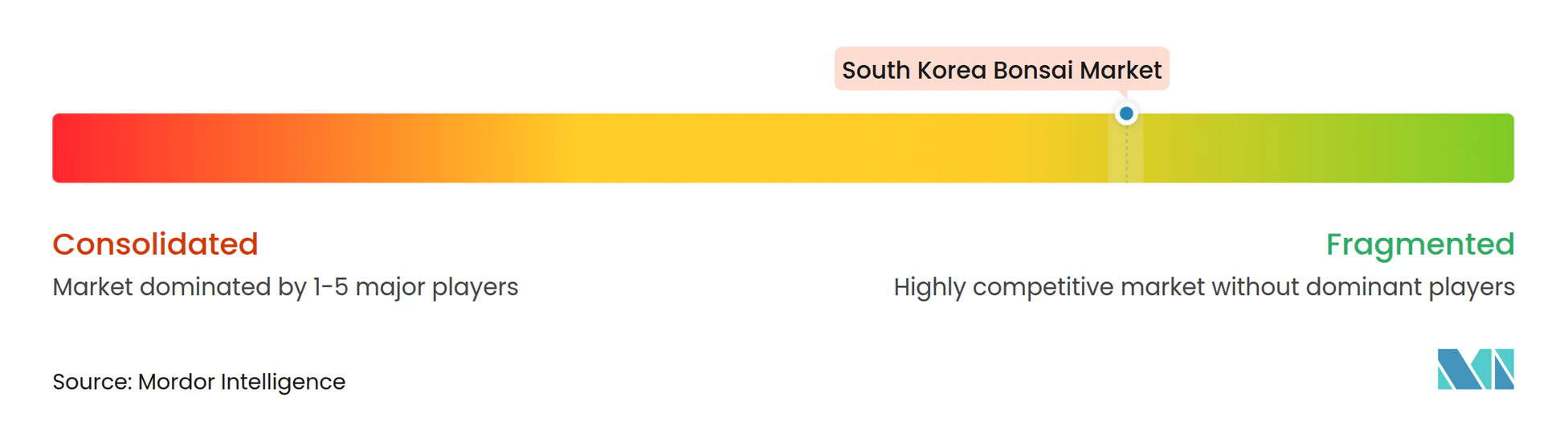
The South Korea Bonsai market is fragmented in 2025, with key players including SIMPOL Co., Ltd., Yesol Bonsai Garden, Wooli Bonsai Garden, Online Woori Bonsai, and Jurong Lake Gardens. Competition is shaped by product quality, cultivated-tree selection, regional identity, and customer relationships. Providers can differentiate through exhibitions, practical instruction, and personalized care advice. Because bonsai requires ongoing maintenance, pre- and post-purchase guidance can influence customer experience. Competitive positioning depends on matching species and presentation to buyer needs, clearly communicating care requirements, and building trust among beginners, collectors, and commercial customers.
Education and cultivation expertise represent another dimension of competition. The Korean Bonsai Association provides a formal organizational context for bonsai learning and certification, while specialist studios and gardens can offer demonstrations and practical instruction. Such activities may help practitioners develop skills in pruning, wiring, soil preparation, and species-specific care. Providers can use workshops and learning resources to maintain customer contact between purchases and support longer-term participation. The value of these services depends on their relevance, accessibility, and quality rather than simply their availability, creating opportunities for operators to distinguish themselves through credible instruction and continued customer support.
Import procedures and plant health management can also influence competitive operations. The Animal and Plant Quarantine Agency publishes requirements for relevant categories of imported plants, making compliance an operational consideration for businesses sourcing trees internationally. Importers must account for applicable documentation, inspection, and handling procedures, while domestic growers may offer alternatives for buyers seeking locally cultivated specimens. Sellers can distinguish their businesses through transparent species information, credible cultivation histories, careful handling, and appropriate aftercare guidance. These practices help customers assess purchases and can support trust across different price points, product types, and specialist service models.
South Korea Bonsai Industry Leaders
-
SIMPOL Co., Ltd.
-
Yesol Bonsai Garden
-
Wooli Bonsai Garden
-
Online Woori Bonsai
-
Jurong Lake Gardens
- *Disclaimer: Major Players sorted in no particular order
South Korea Bonsai Market Companies Covered in this Report
- Online Woori Bonsai
- NOKYA Bonsai
- Yesol Bonsai Garden
- MANDARINSTONE
- Jurong Lake Gardens
- 1004 Islands Bonsai Garden
- Wooli Bonsai Garden
- Gama-Uji Bonsai
- Plant Workshop Shongha
- SIMPOL Co., Ltd.
- Purda Co., Ltd.
Recent Industry Developments in South Korea Bonsai Market
- September 2026: Online Woori Bonsai launched a four-month Level 1 Bonsai Manager program in Seoul, providing structured training in cultivation, including pruning, soil formulation, and wiring. The initiative can strengthen specialist skills, support customer education, and help develop South Korea’s bonsai cultivation and service ecosystem.
- November 2025: 1004 Islands Bonsai Garden hosted the Asia-Pacific Bonsai Friendship Federation Convention alongside the Korea National Bonsai Exhibition, welcoming international delegates. The event promoted bonsai appreciation, strengthened cultural exchange, and created opportunities for garden tourism and cross-border industry engagement in South Korea.
- September 2025: Purda Co., Ltd. launched a limited-edition miniature bonsai collection through Wadiz, featuring Zelkova, juniper, and hinoki trees, including Japanese-imported Zelkova. The launch expanded premium bonsai offerings for collectors and indoor décor consumers in South Korea.
South Korea Bonsai Market Report Scope
Bonsai is the Japanese art of cultivating miniature trees in containers through pruning, wiring, and root management to replicate the form and proportions of mature trees. It is primarily used for ornamental, cultural, residential, commercial, and institutional applications.
The South Korea bonsai market report is segmented by species (indoor species, outdoor species, needle tree species, and deciduous tree species), by distribution channel (online and offline), and by application (residential, commercial, and others (institutional gifts, art fairs). The market forecasts are provided in terms of value (USD).
Segmentation Overview
| Indoor Species |
| Outdoor Species |
| Needle Tree Species |
| Deciduous Tree Species |
| Online |
| Offline |
| Residential |
| Commercial |
| Others (Institutional Gifts, Art Fairs) |
| By Species | Indoor Species |
| Outdoor Species | |
| Needle Tree Species | |
| Deciduous Tree Species | |
| By Distribution Channel | Online |
| Offline | |
| By Application | Residential |
| Commercial | |
| Others (Institutional Gifts, Art Fairs) |
Key Questions Answered in the Report
What is the projected value of the South Korea bonsai market by 2031?
The South Korea bonsai market is forecast to reach USD 65.15 million by 2031.
Which bonsai species category leads sales in South Korea?
Outdoor Species led with the largest 38.0% share in 2025.
Why are indoor bonsai plants gaining popularity in South Korea?
Apartment living and indoor companion-plant ownership support demand for compact bonsai that can be maintained in limited spaces.
Which sales channel is growing fastest for bonsai in South Korea?
Online segment are forecast to grow at the fastest CAGR of 13.6% from 2026 to 2031.