
South America Surveillance IP Cameras Market Size and Share
Market Overview
| Study Period | 2020 - 2031 |
|---|---|
| Forecast Data Period | 2026 - 2031 |
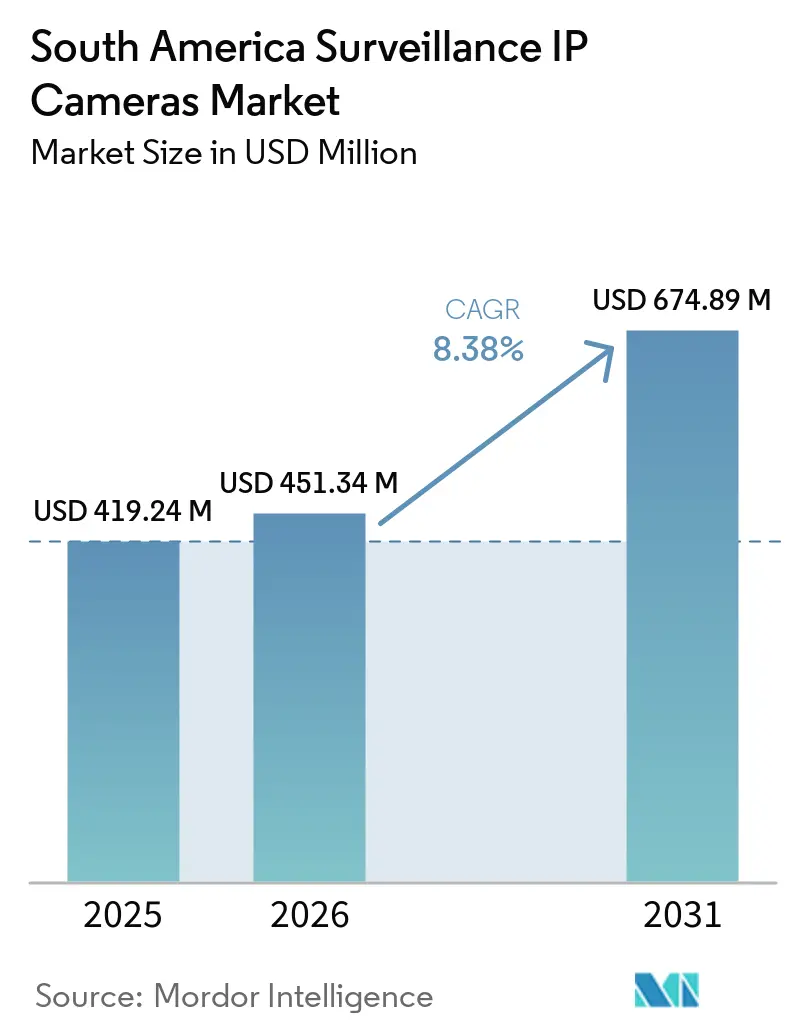
| Base Year Market Size (2025) | USD 419.24 Million |
| Market Size (2026) | USD 451.34 Million |
| Market Size (2031) | USD 674.89 Million |
| Growth Rate (2026 - 2031) | 8.38 % |
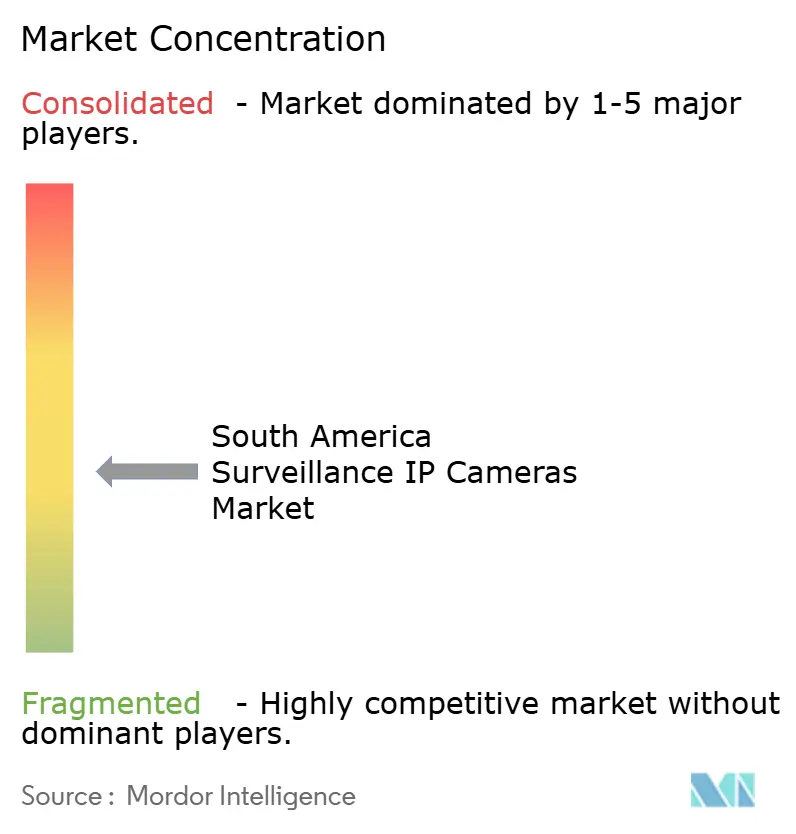
| Market Concentration | Medium |
Major Players *Disclaimer: Major Players sorted in no particular order Image © Mordor Intelligence. Reuse requires attribution under CC BY 4.0. | |
South America Surveillance IP Cameras Market Analysis by Mordor Intelligence
The South America surveillance IP cameras market size was valued at USD 419.24 million in 2025 and USD 451.34 million in 2026, and is projected to reach USD 674.89 million by 2031, at a CAGR of 8.38% during the forecast period (2026-2031). Public safety spending, replacement of analog systems, and edge-based AI functions support demand across the region. Government procurement continues to set technical requirements and price expectations for many large projects. This gives vendors an incentive to offer products that meet institutional security, storage, and compliance needs. Brazil remains the central source of demand, while Colombia, Chile, and Peru add different infrastructure and public safety opportunities. The outlook also depends on whether suppliers can translate large public projects into durable local service relationships, since procurement decisions increasingly cover installation quality, cybersecurity, storage capacity, maintenance obligations, and the ability to integrate new cameras with existing command-center operations. The resulting purchase decision is therefore shaped by the full operating context, including the scope of the location, the available communications and power infrastructure, local compliance requirements, the level of technical support available after installation, and the need to show measurable value from security and operational spending.
Key Report Takeaways
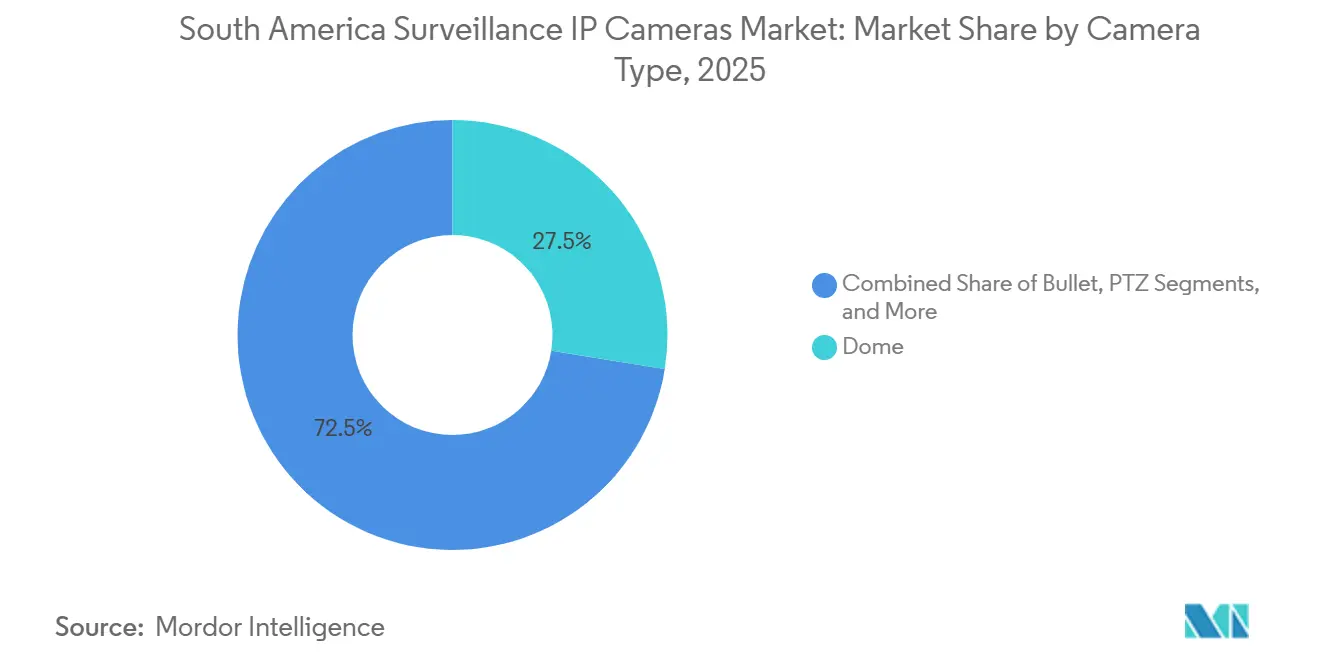
- By camera type, dome cameras held 27.52% of the South America surveillance IP cameras market share in 2025, while PTZ cameras are projected to expand at a 9.32% CAGR through 2031.
- By resolution, the 3-5 MP Full-HD+ segment accounted for 45.23% of the South America surveillance IP cameras market size in 2025, while the ≥12 MP multisensor segment is projected to expand at a 9.24% CAGR through 2031.
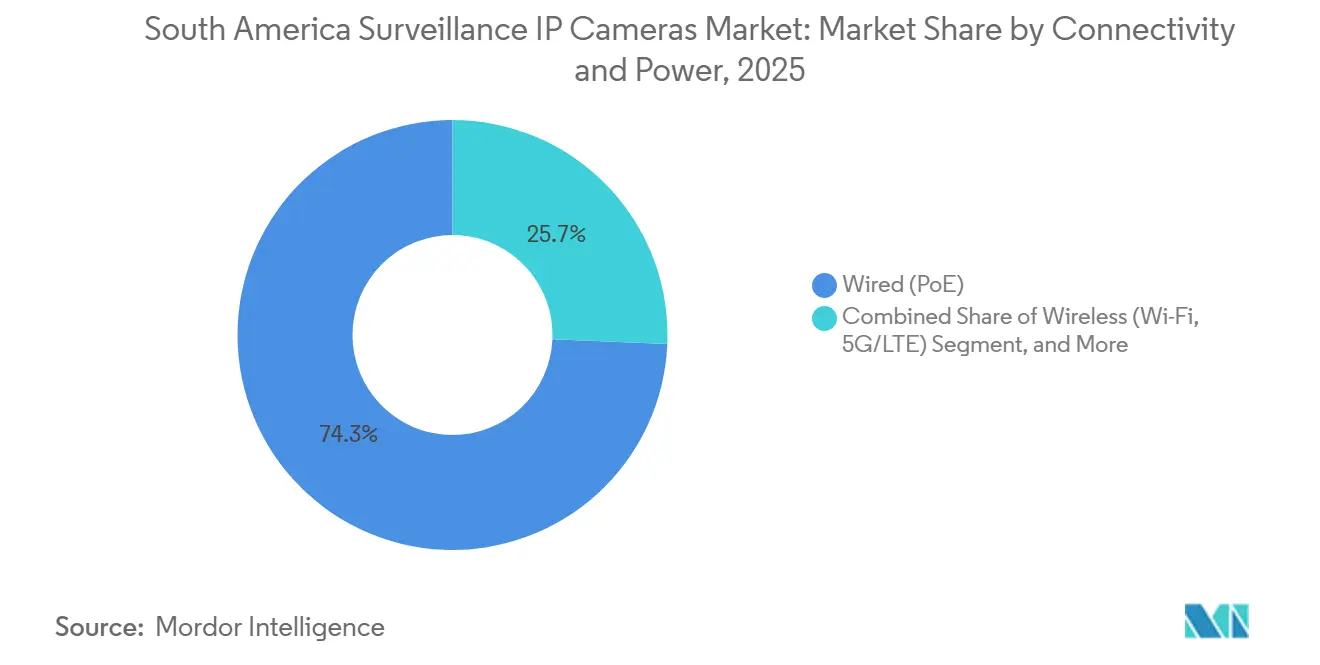
- By connectivity and power, wired PoE installations held 74.34% share in 2025, while battery and solar-powered cameras are projected to expand at a 9.89% CAGR through 2031.
- By deployment architecture, centralized NVR-centric systems held 67.87% share in 2025, while decentralized edge-AI systems are projected to expand at a 9.75% CAGR through 2031.
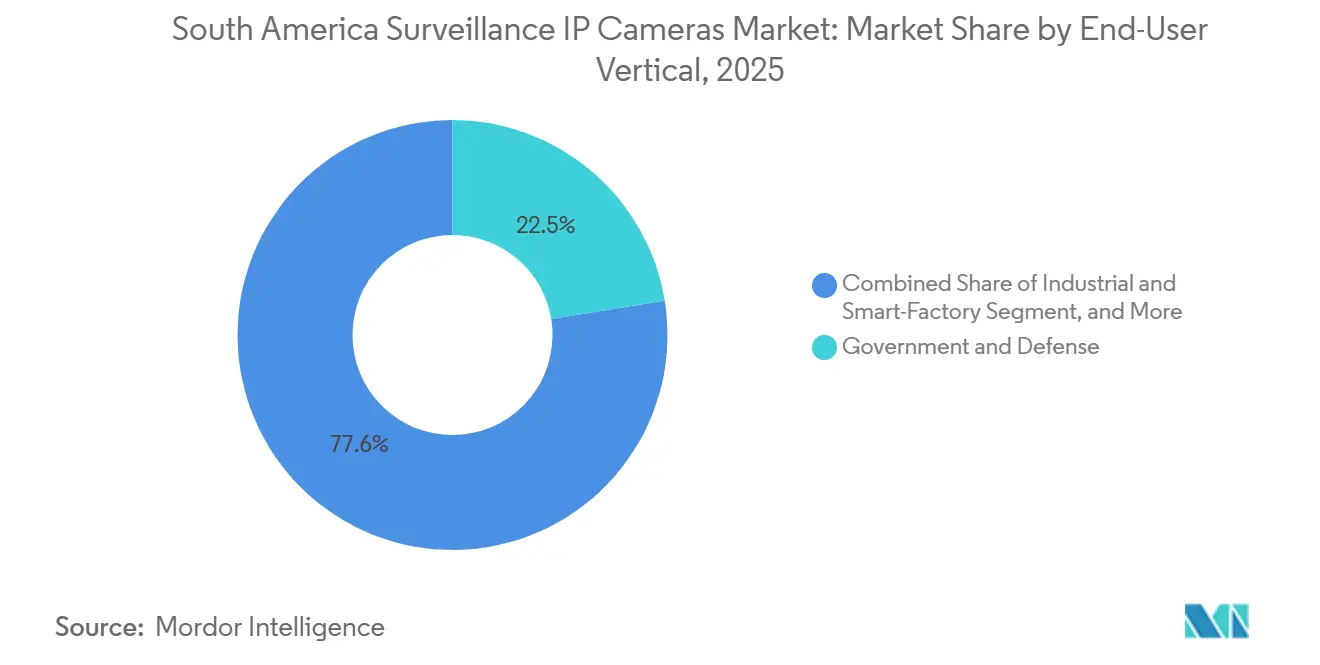
- By end-user vertical, government and defense held 22.45% share in 2025, while transportation and infrastructure is projected to expand at a 9.82% CAGR through 2031.
- By geography, Brazil held 39.46% share in 2025, while Colombia is projected to expand at a 9.21% CAGR through 2031 in the South America surveillance IP cameras market.
Note: Market size and forecast figures in this report are generated using Mordor Intelligence’s proprietary estimation framework, updated with the latest available data and insights as of January 2026.
Market Trends and Insights
Drivers Impact Analysis of South America Surveillance IP Cameras Market*
| Driver | (~) % Impact on CAGR Forecast | Geographic Relevance | Impact Timeline |
|---|---|---|---|
| Government-Funded Safe-City and Public-Safety Programs | +2.8% | Brazil, Colombia, Chile, Peru, Argentina, and Ecuador | Short Term (≤ 2 Years) |
| AI-Enabled Detection and Operational Video Analytics | +1.5% | Brazil, Colombia, Chile, and Peru | Medium Term (2-4 Years) |
| Analog-to-IP Replacement across Commercial Installations | +1.2% | South America, especially Brazil, Colombia, and Argentina | Short Term (≤ 2 Years) |
| Smart-City, Transport, and Critical-Infrastructure Expansion | +0.8% | Brazil, Colombia, Chile, and Ecuador | Medium Term (2-4 Years) |
| Port And Customs Surveillance Compliance Requirements | +0.4% | Coastal and border areas in Brazil, Chile, Colombia, and Argentina | Medium Term (2-4 Years) |
| Edge Processing to Reduce Cross-Border Video-Data Exposure | +0.3% | Brazil, Chile, and the broader region | Long Term (≥ 4 Years) |
| Source: Mordor Intelligence | |||
Government-Funded Safe-City and Public-Safety Programs
Government-funded public safety programs remain the main demand source for the South America surveillance IP cameras market. High levels of homicide and extortion can prompt emergency procurement even when public budgets are constrained. Smart Sampa operated more than 50,000 cameras in São Paulo during 2026, including 20,000 city-owned cameras and 30,000 cameras integrated from private networks. The program allowed businesses and residents to connect qualifying cameras without charge when they met the 2 MP minimum resolution standard.Rio de Janeiro increased the CIVITAS monitoring center budget from BRL 16 million (USD 2.8 million) to BRL 180 million (USD 31.3 million) in January 2026 and set a target of 20,000 smart cameras by 2028.[1] Programs in São Paulo and Niterói provide examples that João Pessoa, Curitiba, and Salvador can adapt for their own deployments. This broadens procurement beyond the first large metropolitan projects and supports continuing equipment demand. The pattern matters because these contracts typically establish technical standards that private buyers later recognize, including minimum image quality, central management compatibility, secure connectivity, and operating procedures that can be applied across retail, transport, banking, and other institutional settings. The resulting purchase decision is therefore shaped by the full operating context, including the scope of the location, the available communications and power infrastructure, local compliance requirements, the level of technical support available after installation, and the need to show measurable value from security and operational spending.
AI-Enabled Detection and Operational Video Analytics
AI functions allow cameras to identify relevant events before a control-room operator reviews the footage. This is important for municipalities that have limited staff for continuous video monitoring. Edge processing can send alerts from the camera or local gateway without transferring every stream through a central connection. Axis Communications introduced panoramic fisheye cameras in 2026 with ARTPEC-9 edge processing, 360-degree coverage, and audio analytics for critical sound detection.[2] The company stated that the products are available in 6 MP and 12 MP versions. The South America surveillance IP cameras market benefits when analytics are embedded in equipment, because buyers can combine monitoring, identification, and response functions within a single installation. The approach also increases the importance of suppliers that can support software, cybersecurity, and maintenance needs. For purchasers, the practical value lies in receiving more usable information from the same video network, while keeping human review focused on events that require action and reducing the burden placed on limited communications links and centralized monitoring equipment. The resulting purchase decision is therefore shaped by the full operating context, including the scope of the location, the available communications and power infrastructure, local compliance requirements, the level of technical support available after installation, and the need to show measurable value from security and operational spending.
Analog-to-IP Replacement across Commercial Installations
Banks, retailers, and logistics operators are replacing analog CCTV systems with IP-based equipment. Remote management and analytics integration give these operators stronger reasons to update older installations. Higher image quality also supports the need for usable forensic footage in security investigations. The regional analog installed base remains larger than in North America and Western Europe. This leaves a longer replacement path for the South America surveillance IP cameras market and creates recurring upgrade opportunities. The transition can shorten hardware replacement cycles because analog encoders do not support many IP-native analytics platforms. Vendors can therefore compete on a complete camera, software, storage, and support package rather than on camera price alone. Commercial buyers also assess the transition as an operational change, because remote access, centralized administration, searchable recordings, and analytics-ready feeds can improve how security teams manage dispersed facilities, investigate incidents, and maintain consistent video coverage across locations. The resulting purchase decision is therefore shaped by the full operating context, including the scope of the location, the available communications and power infrastructure, local compliance requirements, the level of technical support available after installation, and the need to show measurable value from security and operational spending.
Smart-City, Transport, and Critical-Infrastructure Expansion
Transportation projects create a second demand channel for surveillance equipment outside conventional security use. Cameras installed by transport authorities can support traffic monitoring, incident response, fare enforcement, and public safety. Colombia’s fourth-generation road program has supported demand for toll-lane surveillance and license plate recognition equipment on major highway corridors.[3] New concession requirements can make surveillance equipment part of the original project design instead of a later addition. Bus fleets also use onboard cameras for passenger counting, driver monitoring, and centralized fleet oversight. These uses improve the case for the South America surveillance IP cameras market because the same camera network can support operations and security. Infrastructure operators are therefore more likely to select products that integrate with command centers and transport management platforms. This combination of functions can make a project easier to fund because surveillance is linked with service continuity, road and passenger safety, and operational oversight, rather than being treated only as a separate security expense with a narrower benefit for the operator.
Restraints Impact Analysis of South America Surveillance IP Cameras Market*
| Restraint | (~) % Impact on CAGR Forecast | Geographic Relevance | Impact Timeline |
|---|---|---|---|
| High Total Cost of Ownership for Connected IP Deployments | -2.1% | South America, especially Argentina, Venezuela, and smaller Andean countries | Short Term (≤ 2 Years) |
| Privacy, Facial-Recognition, and Data-Governance Concerns | -1.3% | Brazil, Chile, and Argentina | Medium Term (2-4 Years) |
| Certification Delays for Wireless and Imported Equipment | -0.6% | Brazil, Chile, and Colombia | Short Term (≤ 2 Years) |
| Interoperability Gaps across Multibrand Legacy Systems | -0.4% | South America, especially multi-municipality programs | Medium Term (2-4 Years) |
| Source: Mordor Intelligence | |||
High Total Cost of Ownership for Connected IP Deployments
Connected IP camera projects require spending beyond the initial purchase of cameras. Costs include networking, power redundancy, storage, installation, training, and long-term maintenance. Brazil’s network equipment import charges can range from 0% to 35% of CIF value, depending on the tariff classification. Argentina’s currency depreciation has increased local purchasing requirements for hardware priced in USD. Municipalities outside the main urban corridors in Brazil and Colombia may need solar power or battery backup to maintain continuous camera availability. These conditions can delay projects or reduce their technical scope. Shortages of certified integrators in Peru, Bolivia, and Ecuador can also require vendors to include training and multiyear service commitments in public bids. The financial challenge is not limited to the equipment itself, since public buyers must also assess site readiness, available power, resilient communications, qualified installation labor, replacement parts, and the recurring service capacity needed to keep a dispersed network operating as specified.
Privacy, Facial-Recognition, and Data-Governance Concerns
Biometric surveillance rules are changing project requirements across South America. Brazil elevated the ANPD to independent regulatory status under Law No. 15.352/2026 in February 2026. The ANPD identified AI and facial recognition as enforcement priorities for 2026 and 2027, and it ordered Paraná to halt biometric data collection for school attendance in August 2026. Chile’s Law 21.719 takes full effect in December 2026 and introduces transparency and proportionality requirements for personal data processing. Government and banking buyers are consequently requesting local or hybrid processing for biometric data. This favors designs that keep sensitive video data closer to the point of collection, although it can increase processing costs per camera. These requirements make privacy and system design closely connected, because buyers must consider where video is processed, who may access it, how long it is retained, and whether the chosen supplier can document controls for the use of sensitive personal information.
*Our forecasts treat driver/restraint impacts as directional, not additive. The impact forecasts reflect baseline growth, mix effects, and variable interactions.
South America Surveillance IP Cameras Market Segment Analysis
By Camera Type:
PTZ Cameras Support Institutional UpgradesPTZ cameras are projected to expand at a 9.32% CAGR from 2026 to 2031, the highest rate among camera types. Their pan, tilt, and zoom functions help command centers monitor broad areas with fewer devices. Ports, stadiums, and transportation hubs use this capability where operators need active visual control. Dome cameras held 27.52% share in 2025, making them the largest camera type in the South America surveillance IP cameras market. Their vandal-resistant housing and discreet form support use in banks, retail locations, and government buildings. Their role is particularly clear in projects that need operators to follow changing activity across a wide area, where a fixed field of view may not be sufficient and the value of active monitoring can justify higher specifications and operator-oriented control features.
Bullet cameras remain relevant for long-distance perimeter monitoring at industrial sites and highway locations. Box and cube cameras serve controlled indoor settings where buyers need interchangeable lenses. Covert and pinhole products continue to support loss prevention and investigative uses in retail and hospitality. Hanwha Vision presented its BLAZE video management platform at the ESS+ 2026 event in Bogotá, linking camera hardware with behavioral analytics. Fisheye and multisensor cameras can cover more angles from one point, which places pressure on dome camera volumes in some new commercial installations. Together, these formats allow buyers to select equipment based on viewing distance, lighting conditions, site layout, concealment needs, and the degree of flexibility required, rather than applying a single camera design across every security and operational use case.

By Resolution:
Full-HD+ Serves Broad Commercial DemandThe 3-5 MP Full-HD+ tier held 45.23% share in 2025 and remained the leading resolution category. The South America surveillance IP cameras market size for this tier reflects a balance between image quality and installation cost. It serves public safety, retail, and banking deployments that need useful forensic footage without the storage load of higher-resolution systems. The ≥12 MP multisensor segment is projected to expand at a 9.24% CAGR through 2031. A single multisensor unit can replace several fixed cameras in open areas, lowering cabling, labor, and NVR licensing needs. Buyers in this tier can standardize equipment across diverse estates while retaining sufficient image detail for routine investigation, access control support, and incident review, which helps explain its continued role in projects that require many cameras within a controlled budget.
Axis Communications demonstrated the P3740-PLVE multisensor camera at Smart City Expo Curitiba in March 2026. The product provided 360-degree coverage from one installation point and illustrated how a single unit can replace 3-4 fixed cameras at an urban intersection. The ≤2 MP tier continues to lose relevance as the price difference with Full-HD+ equipment narrows. Smart Sampa requires a minimum 2 MP resolution for private cameras connected to its platform. 4K and ≥8 MP products are gaining use in perimeter and traffic applications where digital zoom supports license plate identification. The example shows why resolution choices are increasingly tied to total installation design, since wider coverage can reduce the number of mounting points, cable runs, and individual devices that a site must install, configure, secure, and maintain over time.
By Connectivity and Power:
PoE Remains the Main Installation MethodWired PoE connectivity held 74.34% share in 2025, reflecting its established position in institutional camera systems. The South America surveillance IP cameras market share for PoE systems is supported by structured cabling, predictable power delivery, and manageable network security. Government, banking, and enterprise buyers often prefer this arrangement because it does not depend on wireless spectrum. Battery and solar-powered cameras are projected to expand at a 9.89% CAGR through 2031. Mining sites, oil and gas facilities, and agricultural properties need these products when fiber and reliable cellular coverage are unavailable. The approach also supports predictable commissioning and maintenance practices, which matters for institutional buyers that manage extensive networks and must maintain service continuity, document system performance, and protect camera connections from unauthorized access or inconsistent local conditions.
Wireless cameras are also gaining traction in transport and event locations where trenching costs are high. Hikvision 4G LTE cameras covered more than 630 km of highways in Mato Grosso do Sul during 2025. The installation showed how mobile connectivity can support monitoring before fiber networks are economically practical. Improved solar panels, lower-power edge processors, and H.265 or H.266/VVC compression support longer operating time for off-grid devices. In southern Brazil, solar-powered cameras are also used in flood-monitoring and environmental alert applications. Suppliers that combine cellular connectivity, solar power, and analytics can address remote perimeter and infrastructure projects. These options do not replace structured cabling in every location, but they give project teams another path where site conditions make conventional installation slow or costly, especially when coverage is needed across remote roads, temporary venues, extraction sites, and environmental monitoring locations.
By Deployment Architecture:
Edge AI Changes System DesignCentralized NVR-centric architecture held 67.87% share in 2025, supported by the installed base in government, banking, and enterprise accounts. These buyers have sunk investment in NVR-based video management systems and often prefer additions to existing systems. Decentralized edge-AI architecture is projected to expand at a 9.75% CAGR through 2031. The South America surveillance IP cameras market size for edge systems is supported by the need to limit uplink traffic and respond quickly to local events. Large outdoor sites can benefit when cameras or local gateways process video before it is sent to a central platform. This installed base gives centralized systems continued relevance because many organizations need to protect previous investment, preserve familiar operating procedures, and add camera capacity without interrupting security operations or undertaking a complete redesign of storage, networking, and control-room processes.
Cloud uplink costs remain higher in South America than in North America because international peering capacity is limited and transit costs are higher. This creates a financial reason to process selected video at the edge instead of sending all raw streams to a central location. Edge migration can also create demand for larger local storage and higher-capacity network-attached storage systems. Higher-resolution cameras generate greater data volumes even when analytics processing is localized. Integrators that develop commissioning and maintenance capabilities for edge deployments can secure service work as adoption expands. The shift favors vendors that can provide cameras, storage guidance, cybersecurity support, and lifecycle maintenance. The decision therefore involves more than reducing communications charges, as local processing can shape response time, data movement, storage planning, resilience during network interruptions, and the technical skills that integrators need to support a distributed surveillance environment.
By End-User Vertical:
Government Leads While Transport Expands FastestGovernment and defense held 22.45% share in 2025 and formed the largest end-user vertical. Public safe-city programs shape the technical specifications, qualification standards, and replacement cycles used in the South America surveillance IP cameras market. Transportation and infrastructure is projected to expand at a 9.82% CAGR through 2031, the highest rate across end-user verticals. Demand is supported by Brazilian highway concession requirements, Colombia’s road program, and the expansion of onboard bus monitoring. Banking and financial institutions remain another large institutional demand center because they need fraud deterrence, ATM perimeter monitoring, and loss prevention. Large public projects also influence adjacent verticals because established specifications, trusted installation partners, and familiar analytic functions can carry into banking, retail, transport, and other institutional deployments that follow similar requirements for reliability, evidence quality, and centralized oversight.
Intelbras demonstrated integrated banking fraud-prevention solutions at Febraban Tech 2026. The example reflected the move toward combined camera, analytics, and security management systems in banking. Retail, industrial sites, healthcare facilities, corporate campuses, homes, hospitality locations, and education facilities form the broader demand base. These buyers tend to have smaller projects and greater price sensitivity than government purchasers. Transport operators can justify higher-specification equipment because license plate recognition can support toll collection, traffic management, and vehicle crime enforcement. This shared use improves the value case for camera installations across major urban and highway networks. The wide set of end users means suppliers must balance high-specification institutional opportunities with more price-sensitive deployments, adapting camera configurations, maintenance arrangements, and integration support to the distinct operating needs of each buyer group and installation environment.
Geography Analysis
Brazil Surveillance IP Cameras Market
By geography, Brazil held 39.46% share in 2025, while Colombia is projected to expand at a 9.21% CAGR through 2031 in the South America surveillance IP cameras market. Brazil remained the dominant country market in 2026, and its procurement patterns influenced regional pricing and product specifications. Smart Sampa operated 50,000 cameras across all 5 zones of São Paulo, creating a public-private model that other Brazilian cities are adapting. Rio de Janeiro plans for CIVITAS to reach 20,000 smart cameras by 2028. Programa Sentinela proposed more than 200,000 cameras statewide at an estimated BRL 2 billion (USD 347.8 million). Brazil’s data protection requirements encourage hybrid designs that can demonstrate an appropriate legal basis and governance controls for biometric data. Its scale gives suppliers a reason to establish local channels and compliance capability, while municipal programs create reference deployments that influence how customers elsewhere in the region assess camera quality, integration options, operating models, and the likely value of advanced analytics. The resulting purchase decision is therefore shaped by the full operating context, including the scope of the location, the available communications and power infrastructure, local compliance requirements, the level of technical support available after installation, and the need to show measurable value from security and operational spending.
Colombia and Chile Surveillance IP Cameras Market
Colombia and Chile formed the next group of country opportunities, with different purchasing factors in each country. Bogotá operated more than 1,200 traffic cameras through a central management platform in 2026. Colombia’s road program supported demand for toll-lane surveillance and license plate recognition equipment on new highway corridors. Chile’s Law 21.719 takes full effect in December 2026 and drives audits and upgrades in existing camera estates. The SITIA platform connected 1,500 cameras from 20 municipalities in the Región Metropolitana, showing the value of multibrand interoperability in Chilean public procurement. Their differing conditions require suppliers to adjust their offer, with transport-linked demand in Colombia placing emphasis on infrastructure integration and Chilean procurement giving greater weight to governance, transparency, interoperability, and the ability to support more complex multi-agency operating arrangements.
South America Surveillance IP Cameras Market
Peru, Argentina, and other South American countries present different demand conditions. Peru’s security crisis supported plans for up to 54,000 AI-powered cameras across an 8-city network for the National Police. Argentina’s currency constraints and import restrictions limit spending, although mining, oil and gas, and critical infrastructure projects can support fully specified systems. Ecuador, Bolivia, Paraguay, and Uruguay offer smaller opportunities as municipal programs begin formalizing transport and border surveillance needs. Venezuela’s economic and infrastructure conditions continue to limit addressable demand despite security pressures. These differences require suppliers in the South America surveillance IP cameras market to match their pricing, support model, and deployment design to each country. This varied environment makes a uniform regional strategy less effective, since suppliers must weigh security demand against purchasing power, import conditions, network readiness, technical support availability, and the capacity of local government or commercial buyers to operate more advanced systems over time.
Competitive Landscape
The South America surveillance IP cameras market is fragmented, with no supplier dominating every country and end-user vertical. Hikvision and Dahua have broad regional reach through distributor networks and competitive pricing for government and price-sensitive commercial bids. Their scale supports large-volume tenders where unit cost strongly affects vendor selection. Axis Communications, Hanwha Vision, Teledyne FLIR, and Bosch compete through analytics, compliance documentation, and specialized cameras. These suppliers focus on multisensor, thermal, and body-worn applications where technical requirements can outweigh the lowest acquisition price. Competition therefore changes by project and country, with price, distribution reach, integration capability, local certification, cybersecurity documentation, specialized product performance, and after-sales support all affecting which supplier can meet a purchaser’s stated requirements and practical operating conditions. The resulting purchase decision is therefore shaped by the full operating context, including the scope of the location, the available communications and power infrastructure, local compliance requirements, the level of technical support available after installation, and the need to show measurable value from security and operational spending.
Axis introduced its 2026 panoramic fisheye camera family with ARTPEC-9 edge AI processing and audio analytics. Hanwha Vision used the ESS+ 2026 event to present the BLAZE video management platform and its connection with AI-led video analytics. Intelbras differentiates itself through Brazilian channel coverage, locally certified products, Portuguese-language support, and local payment terms. These capabilities can be important in public tenders with local service requirements. They also make local technical support a competitive factor alongside camera features and price. These moves show that product competition is increasingly connected to the surrounding software and channel model, because buyers evaluate not only image capture but also analytics, management tools, integration, maintenance, and local access to appropriately trained technical support.
Video management suppliers such as Genetec and Milestone Systems support buyers that want cameras from more than 1 manufacturer. This can reduce dependence on a single hardware provider and make multibrand upgrades easier. Managed security services remain an opportunity for small and midsize enterprises that lack IT infrastructure or certified integrators. Subscription-based services can reduce the initial cost barrier for these buyers, although privacy requirements can slow fully cloud-based deployments. This leaves room for hardware and software suppliers that can provide flexible, supportable arrangements, particularly where buyers want to modernize existing systems gradually, retain choice among camera brands, and avoid carrying the full cost and technical responsibility of a new on-premise deployment. The resulting purchase decision is therefore shaped by the full operating context, including the scope of the location, the available communications and power infrastructure, local compliance requirements, the level of technical support available after installation, and the need to show measurable value from security and operational spending.
South America Surveillance IP Cameras Industry Leaders
-
Hangzhou Hikvision Digital Technology Co., Ltd.
-
Intelbras S.A.
-
Zhejiang Dahua Technology Co., Ltd.
-
Axis Communications AB
-
Hanwha Vision Co., Ltd.
- *Disclaimer: Major Players sorted in no particular order
South America Surveillance IP Cameras Market Companies Covered in this Report
- Hangzhou Hikvision Digital Technology Co., Ltd.
- Intelbras S.A.
- Zhejiang Dahua Technology Co., Ltd.
- Axis Communications AB
- Hanwha Vision Co., Ltd.
- Robert Bosch GmbH
- Motorola Solutions, Inc.
- Teledyne FLIR LLC
- Honeywell International Inc.
- Panasonic Connect Co., Ltd.
- Vivotek Inc.
- Zhejiang Uniview Technologies Co., Ltd.
- Johnson Controls International plc
- Verkada Inc.
- Eagle Eye Networks, Inc.
- Pelco, Inc.
- Infinova International, Inc.
- ACTi Corporation
- IDIS Co., Ltd.
- Positivo Tecnologia S.A.
Recent Industry Developments in South America Surveillance IP Cameras Market
- August 2026: Rio de Janeiro and Niterói signed a cooperation agreement for a 144-camera electronic surveillance corridor spanning more than 80 km between the Rio-Niterói Bridge and Avenida Brasil, enabling more than 180,000 license plate reads per day. The cross-municipal data-sharing architecture provides a replicable model for intercity surveillance integration across South American metropolitan regions.
- August 2026: Dahua Technology and Grupo NSO deployed an AI-embedded bus surveillance ecosystem for São Paulo's public transit fleet at LatBus 2026, integrating onboard cameras with passenger counting, fare-evasion control, real-time driver behavior monitoring, and centralized fleet management for Viação Santa Brígida's 650+ bus fleet.
- May 2026: Claro Empresas, in partnership with Qualcomm Technologies, launched Smart View with Edge AI powered by Qualcomm Dragonwing chipsets in Brazil, processing video analytics locally at enterprise security camera nodes for real-time anomaly alerts without cloud uplink dependency.
- March 2026: Axis Communications AB appointed Brako as its authorized distributor in Brazil, expanding integrator access across all 5 Brazilian regions with a dedicated regional sales team, strengthening channel coverage in public security, critical infrastructure, and industrial verticals.
South America Surveillance IP Cameras Market Report Scope
The South America Surveillance IP Cameras Market encompasses the development, manufacturing, distribution, installation, and deployment of internet protocol (IP)-based video surveillance cameras and related monitoring solutions across the region.
The South America Surveillance IP Cameras Market Report is Segmented by Camera Type (Dome, Bullet, PTZ, Box and Cube, and Covert/Pinhole), Resolution (Less than or equal to 2 MP HD, 3-5 MP Full-HD+, 4K / greater than or equal to 8 MP UHD, and Greater than 12 MP Multisensor), Connectivity and Power (Wired (PoE), Wireless (Wi-Fi, 5G/LTE), and Battery/Solar-Powered), Deployment Architecture (Centralized (NVR-Centric) and Decentralized/Edge-AI), and End-User Vertical (Government and Defense, Transportation and Infrastructure, Banking and Financial Institutions, Retail and Malls, Industrial and Smart-Factory, Healthcare and Elder-Care, Corporate Campuses and Enterprises, Residential Smart-Home, and Hospitality and Education) and Geography (Brazil, Argentina, Colombia, and Rest of South America). The Market Forecasts are Provided in Terms of Value (USD).
Segmentation Overview
| Dome |
| Bullet |
| PTZ |
| Box and Cube |
| Covert / Pinhole |
| Less than or equal to 2 MP HD |
| 3-5 MP Full-HD+ |
| 4K / greater than or equal to 8 MP UHD |
| Greater than 12 MP Multisensor |
| Wired (PoE) |
| Wireless (Wi-Fi, 5G/LTE) |
| Battery/Solar-Powered |
| Centralized (NVR-Centric) |
| Decentralized / Edge-AI |
| Government and Defense |
| Transportation and Infrastructure |
| Banking and Financial Institutions |
| Retail and Malls |
| Industrial and Smart-Factory |
| Healthcare and Elder-Care |
| Corporate Campuses and Enterprises |
| Residential Smart-Home |
| Hospitality and Education |
| Brazil |
| Argentina |
| Colombia |
| Rest of South America |
| By Camera Type | Dome |
| Bullet | |
| PTZ | |
| Box and Cube | |
| Covert / Pinhole | |
| By Resolution | Less than or equal to 2 MP HD |
| 3-5 MP Full-HD+ | |
| 4K / greater than or equal to 8 MP UHD | |
| Greater than 12 MP Multisensor | |
| By Connectivity and Power | Wired (PoE) |
| Wireless (Wi-Fi, 5G/LTE) | |
| Battery/Solar-Powered | |
| By Deployment Architecture | Centralized (NVR-Centric) |
| Decentralized / Edge-AI | |
| By End-User Vertical | Government and Defense |
| Transportation and Infrastructure | |
| Banking and Financial Institutions | |
| Retail and Malls | |
| Industrial and Smart-Factory | |
| Healthcare and Elder-Care | |
| Corporate Campuses and Enterprises | |
| Residential Smart-Home | |
| Hospitality and Education | |
| By Geography | Brazil |
| Argentina | |
| Colombia | |
| Rest of South America |
Key Questions Answered in the Report
What is the South America Surveillance IP Cameras Market Size?
The South America surveillance IP cameras market size is estimated at USD 451.34 million in 2026 and is forecast to reach USD 674.89 million by 2031, at an 8.38% CAGR.
Which Camera Type Leads Demand in South America?
Dome cameras led camera type demand with a 27.52% share in 2025. PTZ cameras are projected to record the highest camera-type CAGR at 9.32% through 2031.
Why Are Edge-AI Surveillance Systems Gaining Adoption?
Edge-AI systems reduce bandwidth needs and support faster local responses. Decentralized edge-AI architecture is projected to expand at a 9.75% CAGR through 2031.
Which End Users Are Expanding Camera Procurement Fastest?
Transportation and infrastructure is projected to expand at a 9.82% CAGR through 2031, supported by highway, tolling, and fleet monitoring needs.
What Limits Adoption of Connected IP Cameras in South America?
Network infrastructure costs, import exposure, currency volatility, privacy requirements, and a shortage of certified integrators can delay deployments.
Which Country Is Central to Regional Demand?
Brazil is the dominant country market, supported by Smart Sampa and planned expansion of Rio de Janeiro's CIVITAS system.