
South America Surveillance Camera Market Size and Share
Market Overview
| Study Period | 2020 - 2031 |
|---|---|
| Forecast Data Period | 2026 - 2031 |
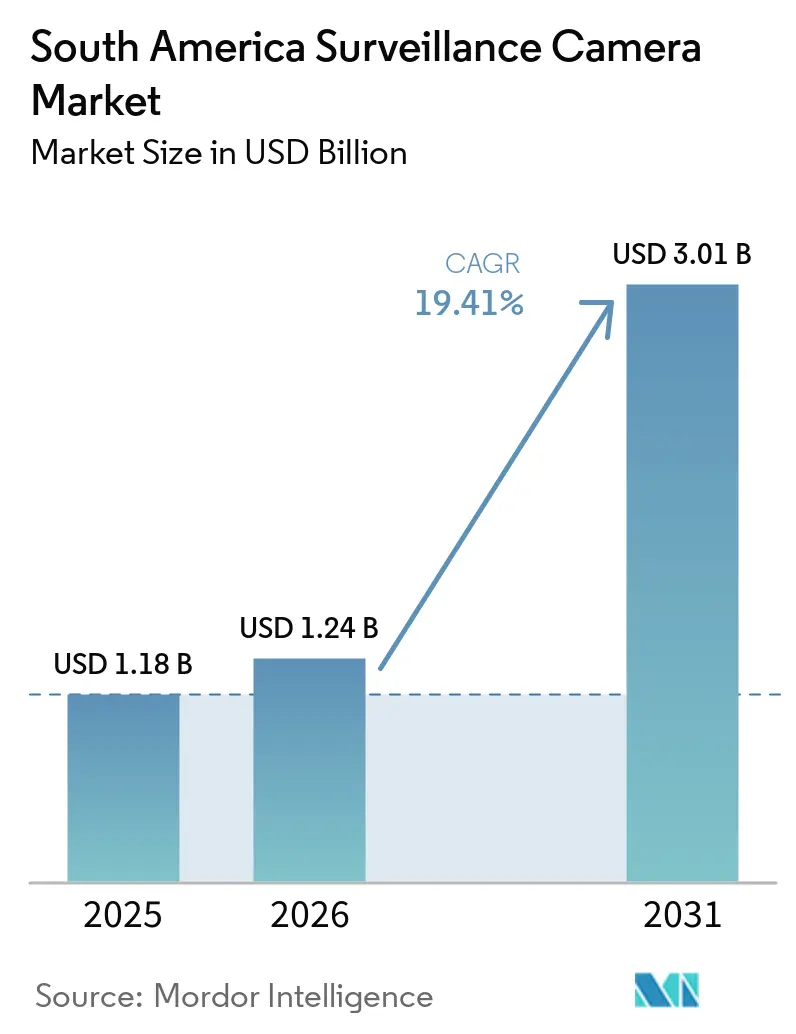
| Base Year Market Size (2025) | USD 1.18 Billion |
| Market Size (2026) | USD 1.24 Billion |
| Market Size (2031) | USD 3.01 Billion |
| Growth Rate (2026 - 2031) | 19.41 % |
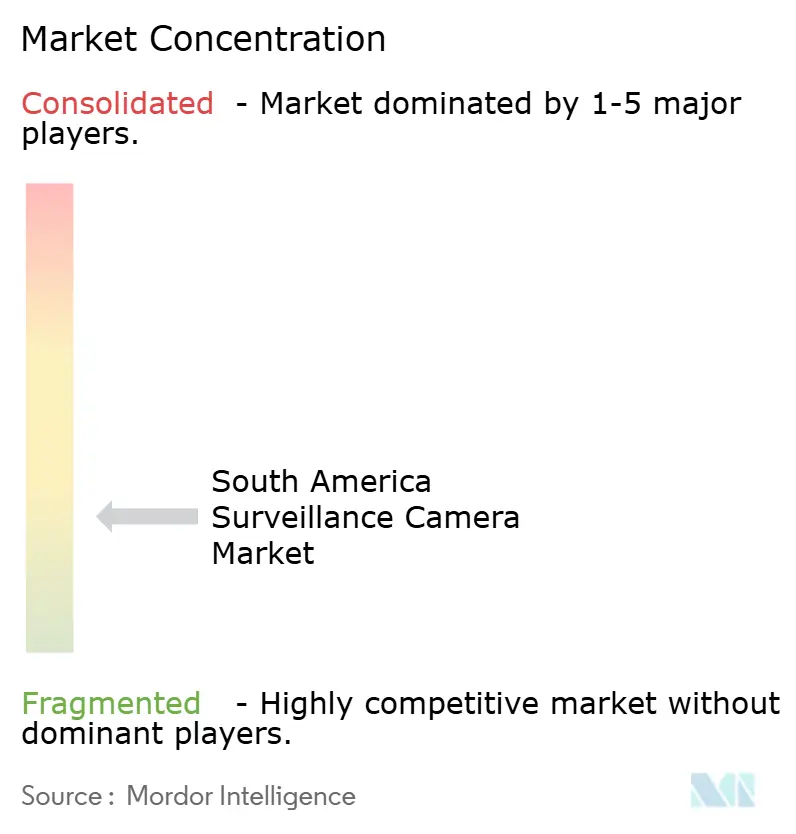
| Market Concentration | Low |
Major Players *Disclaimer: Major Players sorted in no particular order Image © Mordor Intelligence. Reuse requires attribution under CC BY 4.0. | |
South America Surveillance Camera Market Analysis by Mordor Intelligence
The South America Surveillance Camera Market size was valued at USD 1.18 billion in 2025 and estimated to grow from USD 1.24 billion in 2026 to reach USD 3.01 billion by 2031, at a CAGR of 19.41% during the forecast period (2026-2031). Government public-safety programs, AI-enabled video analysis, and replacement of analog equipment with connected systems support demand. Security budgets have become more essential for public agencies and large operators, even where fiscal conditions remain tight. Procurement programs increasingly favor suppliers that can provide analytics, compatible software platforms, and local technical support. Data protection rules and import costs also affect purchase decisions and encourage the adoption of hybrid systems that keep sensitive biometric data on-site. The South America Surveillance Camera Market, therefore, offers an opportunity for vendors that can balance system performance, compliance, and installation cost.
Key Report Takeaways
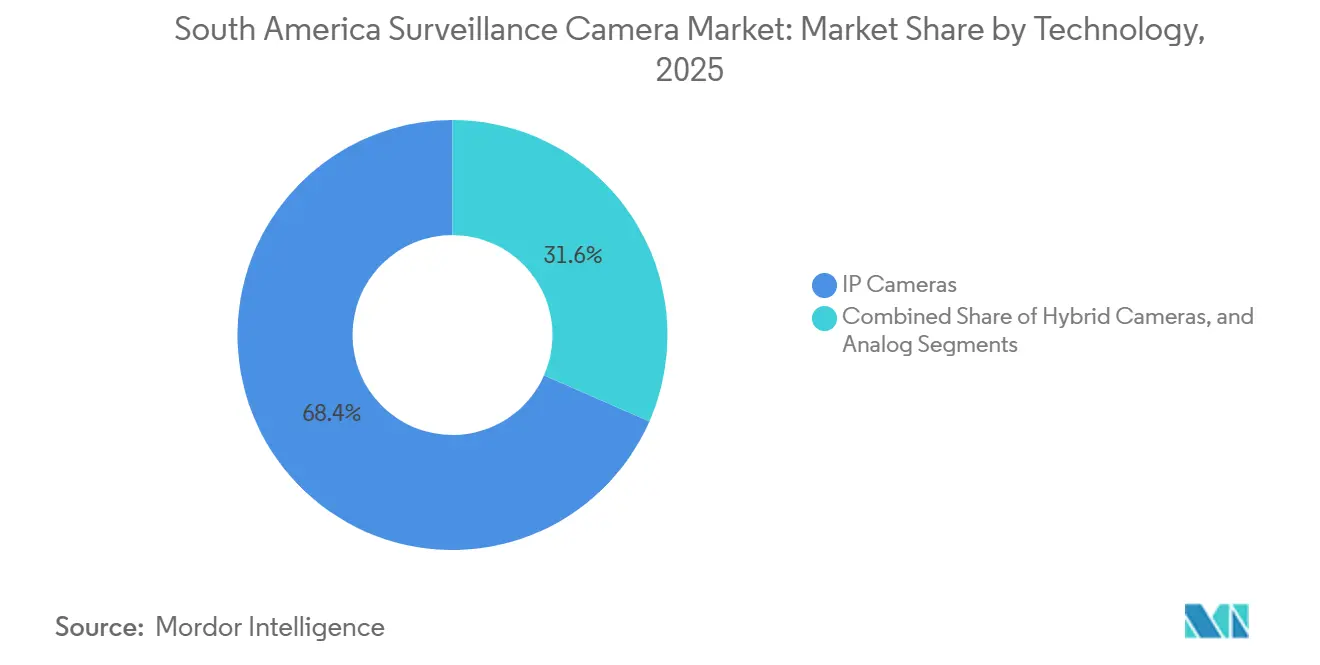
- By technology, IP cameras held 68.42% of the South America Surveillance Camera Market share in 2025, while hybrid cameras are forecast to grow at a 20.83% CAGR through 2031.
- By form factor, dome cameras held 41.28% of the South America Surveillance Camera Market share in 2025, while thermal cameras are forecast to grow at a 21.14% CAGR through 2031.
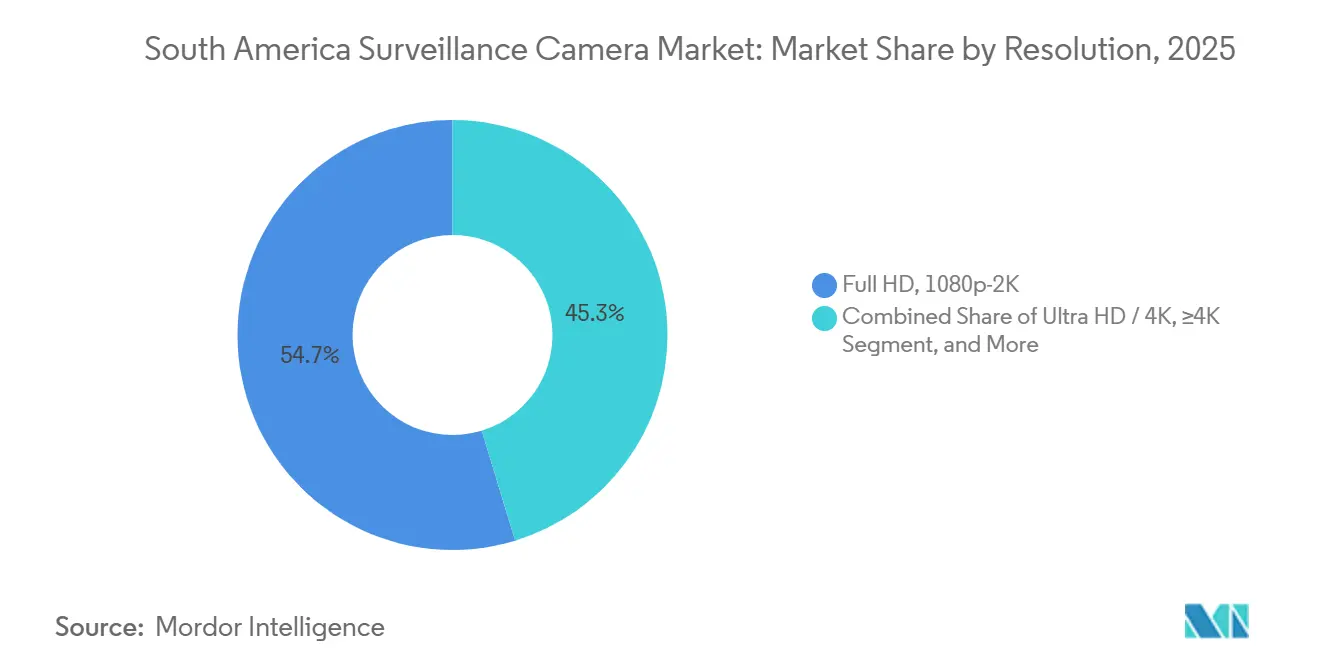
- By resolution, Full HD (1080p) and 2K cameras held a 54.71% share of the South America Surveillance Camera Market in 2025, while Ultra HD/4K and higher cameras are forecast to grow at a 20.69% CAGR through 2031.
- By connectivity, wired cameras held a 62.33% share in 2025, while cellular (4G/5G NB-IoT) cameras are forecast to grow at a 20.92% CAGR through 2031.
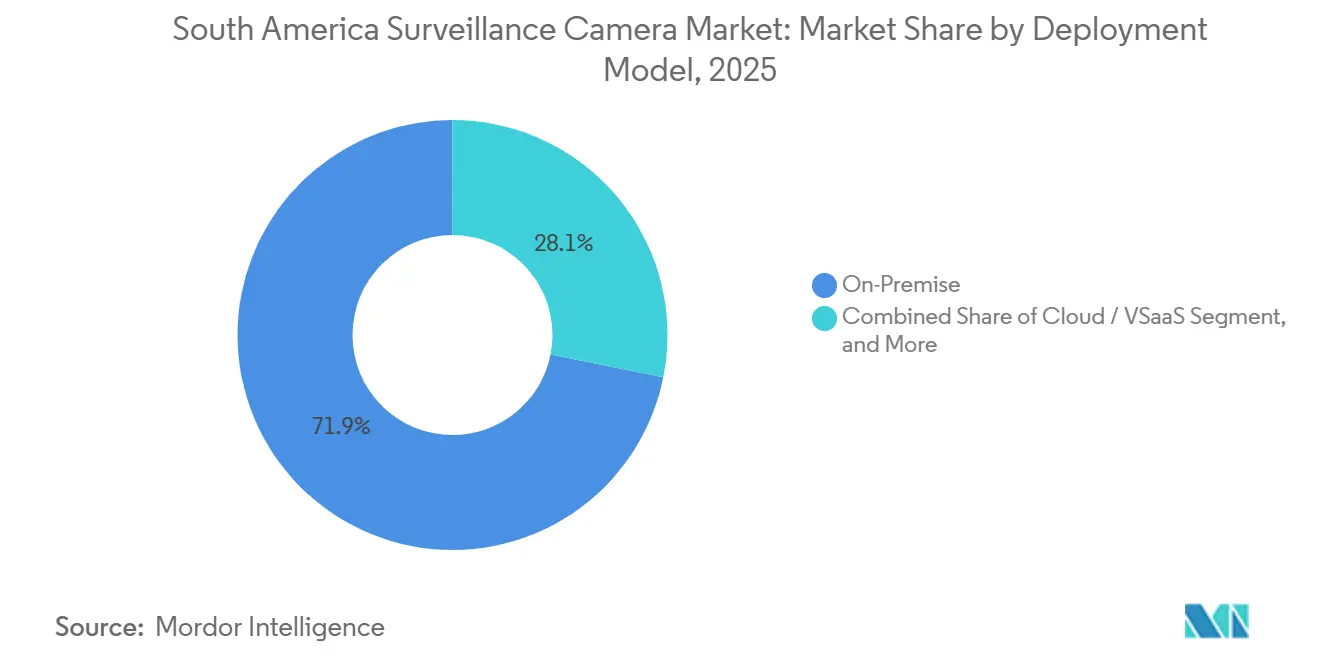
- By deployment model, on-premises systems held 71.86% of the South America Surveillance Camera Market share in 2025, while Cloud/VSaaS is forecast to grow at a 21.37% CAGR through 2031.
- By end-user industry, enterprise and commercial offices held 26.41% share in 2025, while logistics and warehousing are forecast to grow at a 20.78% CAGR through 2031.
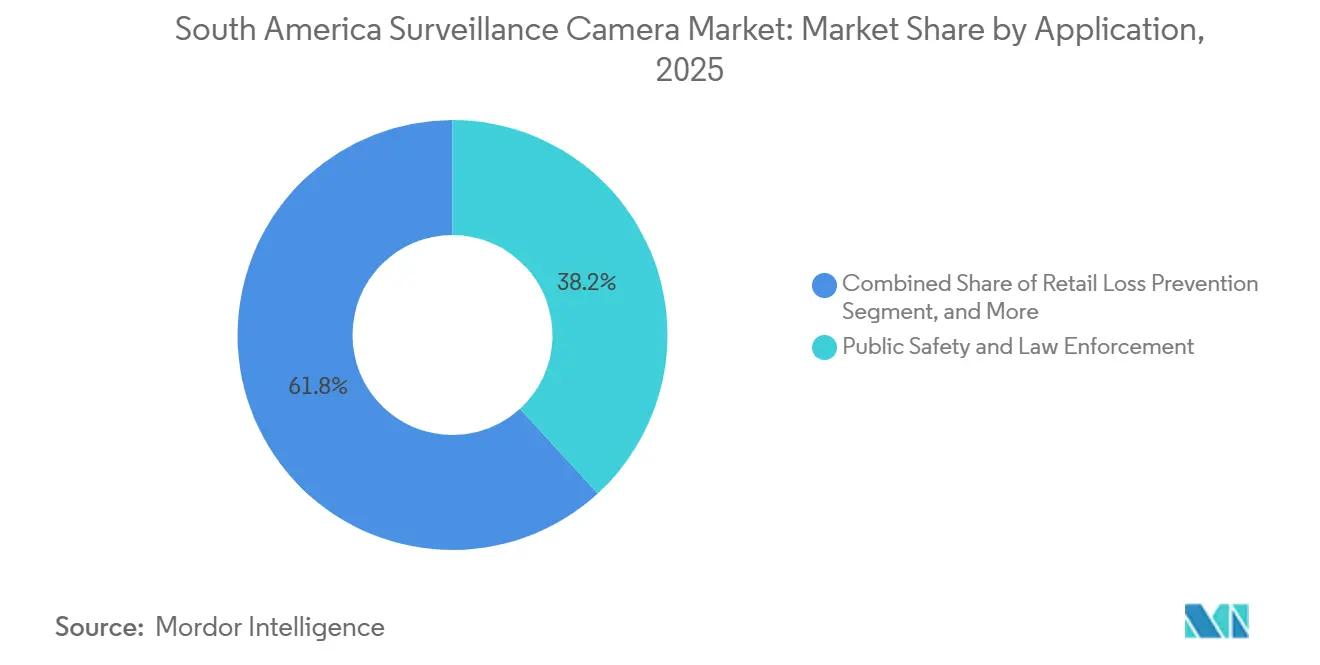
- By application, public safety and law enforcement held 38.19% South America Surveillance Camera Market share in 2025, while remote site and mining surveillance is forecast to grow at a 21.21% CAGR through 2031.
- By geography, Brazil held 44.82% share in 2025, while the Rest of South America is forecast to grow at a 20.56% CAGR through 2031.
Note: Market size and forecast figures in this report are generated using Mordor Intelligence’s proprietary estimation framework, updated with the latest available data and insights as of January 2026.
Market Trends and Insights
Drivers Impact Analysis of South America Surveillance Camera Market*
| Driver | (~) % Impact on CAGR Forecast | Geographic Relevance | Impact Timeline |
|---|---|---|---|
| Smart-City and Public-Safety Network Expansion | +4.2% | Brazil, Colombia, Chile, Argentina | Long term (≥ 4 years) |
| Security Concerns and Urban Crime Exposure | +3.8% | Brazil, Colombia, Venezuela | Short term (≤ 2 years) |
| Shift From Analog to IP and AI-Enabled Cameras | +3.5% | Brazil, Argentina, Colombia | Medium term (2-4 years) |
| Cloud VSaaS Adoption by Multi-Site Businesses | +2.8% | Brazil, Chile | Medium term (2-4 years) |
| Cellular and Edge Surveillance at Connectivity-Constrained Sites | +2.1% | Brazil highways, Venezuela, Rest of South America | Long term (≥ 4 years) |
| Insurance-Linked Connected-Home Security Adoption | +1.4% | Brazil | Short term (≤ 2 years) |
| Source: Mordor Intelligence | |||
Expansion of Smart-City and Public-Safety Camera Networks
Government-funded programs are shifting the South America Surveillance Camera Market from fragmented projects toward longer procurement cycles. Rio de Janeiro expanded the Civitas monitoring center budget from BRL 16 million to BRL 180 million (USD 31 million) in January 2026 and supports analysis of 3,000 data points per second across 10,000 cameras. State programs can establish common specifications for cameras, video management platforms, and analytics tools. That approach narrows opportunities for suppliers that cannot meet public-sector technical or service requirements. São Paulo’s Muralha Paulista integrates 94,000 public and private cameras into one security network.[1] These programs can also provide a foundation for smaller municipalities to adopt established operating models.
Rising Security Concerns and Urban Crime Exposure
Security concerns continue to support camera purchases by public agencies and private operators in the South America Surveillance Camera Market. Brazil had more than 560 facial recognition projects in 2026, more than twice the count reported 2 years earlier.[2] Public demand during major events has reinforced investment in monitoring systems in large cities. Higher expectations for search accuracy encourage the use of higher-resolution cameras and edge analytics. Private demand also extends to warehouse perimeter protection and loss prevention systems. The result is a broader requirement for dependable equipment, rather than basic image capture alone.
Migration From Analog to IP and AI-Enabled Cameras
Camera systems installed between 2008 and 2015 are creating a replacement cycle for networked equipment across the South America Surveillance Camera Market. Large cities are moving from analog equipment to basic IP systems and then to AI-enabled IP platforms. Secondary cities often face a different decision because they are making their first investment in IP. Hybrid technology helps customers retain usable cabling while adding centralized monitoring and selected analytics. Rio de Janeiro’s government discussed new monitoring equipment and facial recognition cameras with Hikvision and Dahua in 2025. This replacement pattern gives integrators a role in designing upgrades that fit local budgets and infrastructure.
Cloud VSaaS Adoption Across Multi-Site Businesses
Cloud video surveillance as a service is gaining relevance among retailers, logistics operators, and financial institutions with dispersed sites. These customers can centralize oversight and reduce the information technology workload associated with separate local systems. Government users often retain on-premises or hybrid designs because biometric information is subject to tighter handling requirements. The South America Surveillance Camera Market benefits where providers can combine local processing with cloud-based management. Eagle Eye Networks and Brivo completed their merger on December 29, 2025, creating a combined cloud-native physical security company. The deal shows how video and access-control platforms are being offered together to commercial customers.
Restraints Impact Analysis of South America Surveillance Camera Market*
| Restraint | (~) % Impact on CAGR Forecast | Geographic Relevance | Impact Timeline |
|---|---|---|---|
| Import Duties, Currency Volatility, and Installation Costs | -1.1% | Brazil, Argentina | Short term (≤ 2 years) |
| Privacy and Facial-Recognition Governance Concerns | -0.8% | Brazil, Chile, Argentina | Medium term (2-4 years) |
| Uneven Broadband, Power Reliability, and Cloud Latency | -0.7% | Venezuela, rural Brazil, Rest of South America | Long term (≥ 4 years) |
| Limited Local AI Video Integration and Maintenance Skills | -0.6% | Regional, smaller economies | Long term (≥ 4 years) |
| Source: Mordor Intelligence | |||
High Import Duties, Currency Volatility, and Total Installation Costs
Import taxes can materially raise the landed cost of cameras and supporting network equipment in Brazil. The country applies several import taxes and charges, and applicable rates can range from 0% to 35% of the cost, insurance, and freight value.[3] These costs make price-sensitive commercial projects harder to close and can delay equipment refresh plans. Exchange-rate volatility adds uncertainty to longer contracts in Argentina. Subscription pricing can reduce the initial outlay for some customers, but it does not eliminate hardware costs from the supply chain. Suppliers with local channels and installation support can reduce procurement friction in the South America Surveillance Camera Market.
Privacy and Facial-Recognition Governance Concerns
Privacy rules are adding review steps for systems that process facial images and other biometric information. Brazil’s National Data Protection Authority identified high risks in mass biometric surveillance in its June 2024 Technology Radar report. Chile’s Personal Data Protection Act, Law 21.719, takes full effect on December 1, 2026, and sets requirements for proportionality and transparency. Multinational retailers and logistics operators must account for different local requirements when deploying shared platforms. This can slow cross-border standardization and favor a flexible hybrid architecture. Suppliers must make privacy controls understandable to customers, system operators, and procurement teams.[4]
*Our forecasts treat driver/restraint impacts as directional, not additive. The impact forecasts reflect baseline growth, mix effects, and variable interactions.
South America Surveillance Camera Market Segment Analysis
By Technology:
IP Systems Set the Standard for ModernizationIP cameras held 68.42% of the South America Surveillance Camera Market share in 2025. Their leading position reflects public specifications for network-compatible equipment in Brazil, Colombia, and Chile. IP systems can support person searches, license plate recognition, and anomaly detection at the device level. Analog systems remain relevant for low-cost retrofits and locations with older cabling. The South America surveillance camera industry continues to use analog equipment where a full replacement cannot be justified.
Hybrid cameras are forecast to grow at a 20.83% CAGR through 2031. They allow integrators to connect existing analog infrastructure to IP-managed systems. This approach can spread the project cost over several upgrade stages for municipal customers. Axis Communications appointed Brako as an authorized distributor in Brazil in March 2026.[5] The South America Surveillance Camera Market rewards vendors that can support both transition projects and complete IP installations.

By Form Factor:
Thermal Cameras Serve Specialized SitesDome cameras held 41.28% share in 2025, supported by use in retail, commercial buildings, transport hubs, and public facilities. Their design suits indoor locations where broad coverage and resistance to tampering are important. Bullet cameras are used for perimeter and highway coverage. PTZ models remain useful when operators need to follow an incident across a large area. Fisheye and turret cameras can reduce blind spots in retail and open office layouts.
Thermal cameras are forecast to grow at a 21.14% CAGR through 2031. Mining and critical infrastructure sites use them where dust, darkness, heat, or long perimeters limit the effectiveness of standard optical devices. Hanwha Vision installed X-series and SolidEDGE cameras at Drummond Colombia’s coal operation to support long-distance monitoring without fiber connectivity.[6] Thermal imaging tools can also detect abnormal heat in electrical equipment before failure. This specialist demand expands the South America Surveillance Camera Market beyond conventional building security.
By Resolution:
4K Supports More Demanding AnalysisFull HD (1080p) and 2 K cameras held a 54.71% share in 2025. This resolution range balances image quality with storage and bandwidth needs across uneven network conditions. Non-HD equipment remains present in highly price-sensitive installations. The HD, 720p-1080p range is losing relevance as specifications move toward clearer images. Full HD equipment remains practical for many commercial and public uses.
Ultra HD/4K and higher cameras are forecast to grow at a 20.69% CAGR through 2031. Their clearer images support forensic review and facial recognition at longer distances. Higher resolution also increases demand for local processing, compressed video, and efficient storage management. Hanwha Vision showed AI cameras with 31x zoom and license plate recognition capabilities in Bogotá in August 2026. The South America Surveillance Camera Market, therefore, drives demand for cameras, software, and video infrastructure.
By Connectivity:
Cellular Links Extend CoverageWired connectivity held 62.33% share in 2025. Commercial buildings, government sites, and established urban facilities commonly use power-over-Ethernet networks for reliable data and power delivery. Wi-Fi and Zigbee options are well-suited to indoor settings where extensive cabling is difficult. Wired designs remain the preferred choice where continuous connection and fixed installation are required. They also provide a practical base for high-resolution systems.
Cellular, 4G/5G NB-IoT cameras are forecast to grow at a 20.92% CAGR through 2031. Way Brasil and TIM Brasil deployed 4G LTE-connected Hikvision cameras across more than 630 kilometers of highways in Mato Grosso do Sul in June 2025. The project planned expansion to 1,070 kilometers in 2026. Cellular systems allow operators to extend surveillance without fiber backhaul. This model supports remote roads, industrial corridors, and temporary installations across the South America Surveillance Camera Market.
By Deployment Model:
Hybrid Designs Address Compliance NeedsOn-premise deployments held 71.86% share in 2025. Government, banking, and industrial facilities often prefer local storage due to network reliability and data-handling requirements. Existing NVR and DVR installations also support this preference. Local systems give operators direct control over recording and retention. These factors keep on-premise equipment central to the South America Surveillance Camera Market.
Cloud/VSaaS is forecast to grow at a 21.37% CAGR through 2031. Multi-site businesses value centralized dashboards and subscription-based management. Edge and hybrid systems combine local AI processing with remote access to selected information. The merger of Eagle Eye Networks and Brivo reinforces investment in integrated subscription platforms. Hybrid designs remain relevant because sensitive biometric information may need to remain in local environments.
By End-User Industry:
Logistics Adds New DemandEnterprise and commercial offices held 26.41% share in 2025. This category includes corporate campuses, financial districts, and multi-tenant properties in major cities. Financial institutions use dense camera coverage in branches and ATM corridors. Healthcare, retail, transport, government, and industrial sites also maintain substantial installed bases. The South America surveillance camera industry serves a varied group of users with different security and compliance needs.
Logistics and warehousing are forecast to grow at a 20.78% CAGR through 2031. E-commerce fulfillment sites require coverage for inventory monitoring, vehicle movement, worker safety, and perimeter protection. Dahua Technology installed an integrated smart retail solution at Carrefour Brazil, featuring AI analytics, video search, people counting, and alarm linkage. Similar analytics can integrate camera systems into broader operational management. This supports continued commercial demand in the South America Surveillance Camera Market.
By Application:
Remote Sites and Mining Lead GrowthPublic safety and law enforcement held 38.19% share in 2025. The category includes municipal CCTV networks, police body cameras, and command-center surveillance. Bogotá had more than 1,200 traffic cameras connected to its central management system in 2026. Industrial, banking, and government sites also use cameras for intrusion detection and perimeter protection. Retail systems use video search to support loss prevention.
Remote site and mining surveillance is forecast to grow at a 21.21% CAGR through 2031. Mining operations require continuous coverage of valuable assets, isolated perimeters, and challenging operating conditions. Hanwha Vision supplied 2,000 AI CCTV cameras to Lima’s Santiago de Surco district in August 2025, with license plate recognition and multi-sensor monitoring. These capabilities show the technical standard available for demanding sites. The South America Surveillance Camera Market can benefit from mining and remote operations that require higher-performing surveillance.
Geography Analysis
Brazil Surveillance Camera Market
Brazil held 44.82% share in 2025 and remained the largest national contributor to the South America Surveillance Camera Market. São Paulo’s Smart Sampa network reached 50,000 AI-enhanced cameras in 2026. Muralha Paulista also links 94,000 public and private cameras in a unified network. Data protection requirements, logistics investment, and local compliance needs widen demand beyond public programs.[7]
Colombia and Argentina Surveillance Camera Market
Colombia and Argentina have distinct demand patterns. Colombia focuses on urban public safety, traffic monitoring, and managed security services. Medellín’s first C5i command center contract was announced in May 2026 and brings together cameras, license plate readers, and IoT sensors. Argentina faces currency and import constraints but continues to prioritize mining, oil and gas, and critical infrastructure. Axis Communications reopened its Buenos Aires operation in 2026 with a focus on those sectors, while local procurement conditions require tailored solutions.
South America Surveillance Camera Market
The rest of South America is forecast to grow at a 20.56% CAGR through 2031. Peru supports this growth through investment in mining surveillance and related logistics requirements. Hanwha Vision’s 2025 Lima deployment illustrates institutional demand for AI-enabled urban security systems. Chile has advanced digital infrastructure but faces new privacy and private security requirements in 2026, while Venezuela remains constrained by infrastructure and macroeconomic conditions. The South America Surveillance Camera Market varies by country, with remote sites and mining creating a common source of demand.
Competitive Landscape
The South America Surveillance Camera Market has fragmentation, with Hikvision and Dahua holding strong positions by unit volume through established distributor networks. Axis Communications, Hanwha Vision, Bosch Security Systems, and Teledyne FLIR compete on AI capabilities, compliance capabilities, and performance in specialized applications. Platform providers such as Genetec, Milestone Systems, Eagle Eye Networks, and Verkada have greater influence than camera brands when buyers choose video management systems. Security controls, local support, and integration capability increasingly shape procurement. This structure allows hardware suppliers and software providers to compete on different parts of the same customer requirement.
Axis Communications launched the AXIS S1228 AI-Optimized Server in June 2025, featuring 28 simultaneous-stream licenses and 12 TB of local storage. The product shows how established camera suppliers are adding local AI processing and storage to their offers. Hanwha Vision opened its Hanwha Innovation and Technology Experience center in São Paulo in August 2026 to demonstrate its AI camera portfolio to enterprise and government customers. Dahua Technology and Grupo NSO also presented AI-enabled onboard monitoring for São Paulo's public transit fleets in August 2026.[8] These actions reflect a shift toward solutions tailored to specific operating environments.
Mid-market opportunities remain in analytics integration for commercial customers and managed video services for multi-site logistics and retail operators. Cybersecurity scrutiny of large government contracts can increase the value of documented firmware security and incident-response processes. Intelbras demonstrates the importance of local language support, regional service, and payment options in Brazil. Smaller suppliers and integrators compete by offering responsive support and pricing tailored to small and medium-sized customers. The South America Surveillance Camera Market remains open to vendors that can combine product availability, compliant deployment, and reliable maintenance.
South America Surveillance Camera Industry Leaders
-
Hangzhou Hikvision Digital Technology Co., Ltd.
-
Zhejiang Dahua Technology Co., Ltd.
-
Axis Communications AB
-
Hanwha Vision Co., Ltd.
-
Uniview Technologies Co., Ltd.
- *Disclaimer: Major Players sorted in no particular order
South America Surveillance Camera Market Companies Covered in this Report
- Hangzhou Hikvision Digital Technology Co., Ltd.
- Zhejiang Dahua Technology Co., Ltd.
- Axis Communications AB
- Hanwha Vision Co., Ltd.
- Uniview Technologies Co., Ltd.
- VIVOTEK Inc.
- i-PRO Co., Ltd.
- MOBOTIX AG
- Bosch Security Systems GmbH
- Teledyne FLIR LLC
- Pelco, Inc.
- Genetec Inc.
- Milestone Systems A/S
- Eagle Eye Networks, Inc.
- Verkada Inc.
- Arlo Technologies, Inc.
- Lorex Technology Inc.
- Arecont Vision Costar, LLC
- March Networks Corporation
- GeoVision Inc.
- ZKTeco Co., Ltd.
- Infinova International, Inc.
Recent Industry Developments in South America Surveillance Camera Market
- August 2026: Hanwha Vision opened its Hanwha Innovation and Technology Experience center in São Paulo, its second in South America, to provide demonstrations of its Wisenet 9 AI camera portfolio and deepen enterprise and government customer engagement.
- June 2026: Hikvision deployed its 4 MP Water-Level Detection Network Speed Dome solution in Muçum, Brazil, combining video imaging and millimeter-wave radar.
- May 2026: Seguritech signed a contract with Medellín to construct and operate Colombia’s first C5i command center, integrating several thousand cameras, license plate readers, and IoT sensors through its SAIMON Tech platform.
- March 2026: Axis Communications appointed Brako as its authorized distributor in Brazil, expanding integrator access across the country.
South America Surveillance Camera Market Report Scope
The South America surveillance camera market refers to the sales and deployment of video monitoring devices ranging from analog to IP and hybrid technologies across the region. These cameras, available in various form factors like dome, bullet, and thermal, are used for public safety, traffic monitoring, intrusion detection, and industrial process observation. Connected via wired, wireless, or cellular networks and managed through on-premise, cloud, or edge storage models, they serve sectors such as banking, government, retail, and residential to enhance security and operational oversight.
The South America Surveillance Camera Market Report is Segmented by Technology (Analog Cameras, IP Cameras, and Hybrid Cameras), Form Factor (Dome Cameras, Bullet Cameras, PTZ Cameras, Box Cameras, Turret Cameras, Fisheye Cameras, and Thermal Cameras), Resolution (Non-HD, ≤720p, HD, 720p-1080p, Full HD, 1080p-2K, and Ultra HD / 4K, ≥4K), Connectivity (Wired, Power-over-Ethernet, Wireless, Wi-Fi/Zigbee, and Cellular, 4G/5G NB-IoT), Deployment Model (On-Premise, Cloud / VSaaS, Edge / On-Device Storage, and Hybrid), End-User Industry (Banking and Financial Institutions, Transportation and Infrastructure, Government and Defense, Healthcare Facilities, Industrial and Manufacturing, Retail and Hospitality, Enterprise and Commercial Offices, Residential / Smart Home, Logistics and Warehousing, Educational Campuses, and Other End-User Industries), Application (Public Safety and Law Enforcement, Traffic Monitoring and Automatic Number-Plate Recognition, Intrusion Detection and Perimeter Protection, Retail Loss Prevention, Industrial Safety and Process Monitoring, Remote Site and Mining Surveillance, and Residential Monitoring), and Geography (Brazil, Argentina, Colombia, Chile, Venezuela, and Rest of South America). The Market Forecasts are Provided in Terms of Value (USD).
Segmentation Overview
| Analog Cameras |
| IP Cameras |
| Hybrid Cameras |
| Dome Cameras |
| Bullet Cameras |
| PTZ Cameras |
| Box Cameras |
| Turret Cameras |
| Fisheye Cameras |
| Thermal Cameras |
| Non-HD, Up to 720p |
| HD, 720p-1080p |
| Full HD, 1080p-2K |
| Ultra HD / 4K, Above 4K |
| Wired |
| Power-over-Ethernet |
| Wireless, Wi-Fi/Zigbee |
| Cellular, 4G/5G NB-IoT |
| On-Premise |
| Cloud / VSaaS |
| Edge / On-Device Storage |
| Hybrid |
| Banking and Financial Institutions |
| Transportation and Infrastructure |
| Government and Defense |
| Healthcare Facilities |
| Industrial and Manufacturing |
| Retail and Hospitality |
| Enterprise and Commercial Offices |
| Residential / Smart Home |
| Logistics and Warehousing |
| Educational Campuses |
| Other End-User Industries |
| Public Safety and Law Enforcement |
| Traffic Monitoring and Automatic Number-Plate Recognition |
| Intrusion Detection and Perimeter Protection |
| Retail Loss Prevention |
| Industrial Safety and Process Monitoring |
| Remote Site and Mining Surveillance |
| Residential Monitoring |
| Brazil |
| Argentina |
| Colombia |
| Chile |
| Rest of South America |
| By Technology | Analog Cameras |
| IP Cameras | |
| Hybrid Cameras | |
| By Form Factor | Dome Cameras |
| Bullet Cameras | |
| PTZ Cameras | |
| Box Cameras | |
| Turret Cameras | |
| Fisheye Cameras | |
| Thermal Cameras | |
| By Resolution | Non-HD, Up to 720p |
| HD, 720p-1080p | |
| Full HD, 1080p-2K | |
| Ultra HD / 4K, Above 4K | |
| By Connectivity | Wired |
| Power-over-Ethernet | |
| Wireless, Wi-Fi/Zigbee | |
| Cellular, 4G/5G NB-IoT | |
| By Deployment Model | On-Premise |
| Cloud / VSaaS | |
| Edge / On-Device Storage | |
| Hybrid | |
| By End-User Industry | Banking and Financial Institutions |
| Transportation and Infrastructure | |
| Government and Defense | |
| Healthcare Facilities | |
| Industrial and Manufacturing | |
| Retail and Hospitality | |
| Enterprise and Commercial Offices | |
| Residential / Smart Home | |
| Logistics and Warehousing | |
| Educational Campuses | |
| Other End-User Industries | |
| By Application | Public Safety and Law Enforcement |
| Traffic Monitoring and Automatic Number-Plate Recognition | |
| Intrusion Detection and Perimeter Protection | |
| Retail Loss Prevention | |
| Industrial Safety and Process Monitoring | |
| Remote Site and Mining Surveillance | |
| Residential Monitoring | |
| By Geography | Brazil |
| Argentina | |
| Colombia | |
| Chile | |
| Rest of South America |
Key Questions Answered in the Report
What is the South America Surveillance Camera Market size?
The South America Surveillance Camera Market was valued at USD 1.18 billion in 2025, is estimated at USD 1.24 billion in 2026, and is forecast to reach USD 3.01 billion by 2031 at a 19.41% CAGR. The forecast period runs from 2026 to 2031.
What is driving demand for surveillance cameras in South America?
Public-safety networks, analog-to-IP replacement, AI analytics, and security requirements at logistics and remote sites support demand. Large municipal programs also increase the need for compatible video platforms and local service support.
Which camera technology leads adoption in South America?
IP cameras led with 68.42% share in 2025 because they support connected video management and AI-based analysis. Hybrid cameras offer a practical route for customers that need to retain portions of existing analog infrastructure.
Which deployment model is expanding fastest?
Cloud/VSaaS is forecast to grow at a 21.37% CAGR through 2031, particularly among multi-site commercial users. Hybrid models remain important when organizations need local processing or storage for sensitive data.
Which application is growing fastest through 2031?
Remote site and mining surveillance is forecast to grow at a 21.21% CAGR through 2031 as operators require resilient monitoring in demanding environments. Thermal cameras and cellular connectivity can be relevant for these isolated locations.
Which country has the largest surveillance camera demand?
Brazil held 44.82% share in 2025, supported by public programs, commercial deployment, and logistics-related requirements. Public networks in São Paulo and Rio de Janeiro contribute to a large installed base.