
South America Surveillance Analog Camera Market Size and Share
Market Overview
| Study Period | 2020 - 2031 |
|---|---|
| Forecast Data Period | 2026 - 2031 |
| Base Year Market Size (2025) | USD 1.21 Billion |
| Market Size (2026) | USD 1.51 Billion |
| Market Size (2031) | USD 2.11 Billion |
| Growth Rate (2026 - 2031) | 6.92 % |
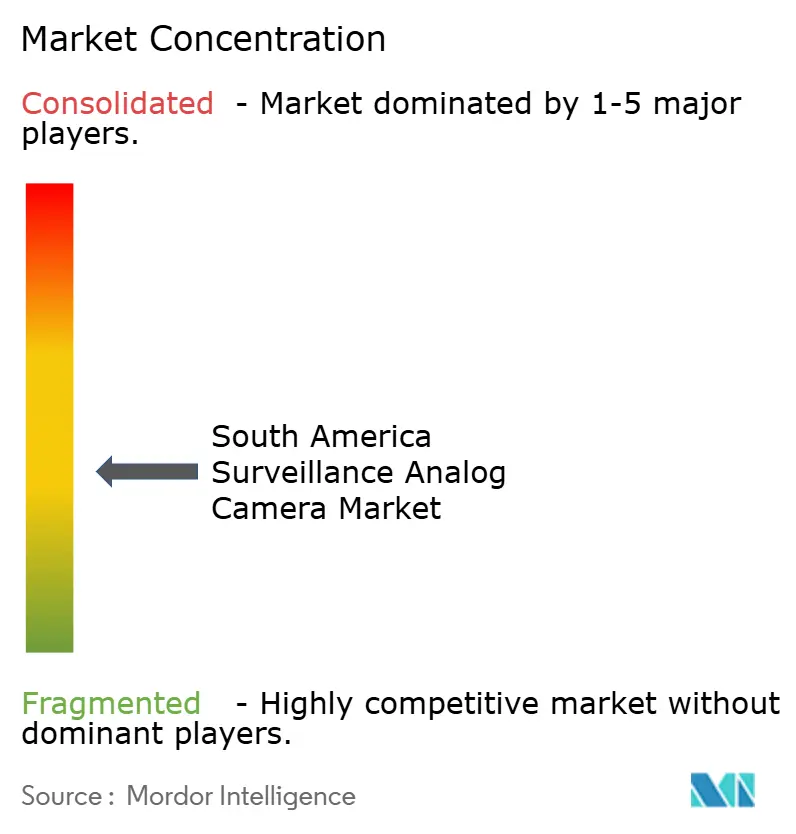
| Market Concentration | Medium |
Major Players *Disclaimer: Major Players sorted in no particular order Image © Mordor Intelligence. Reuse requires attribution under CC BY 4.0. | |
South America Surveillance Analog Camera Market Analysis by Mordor Intelligence
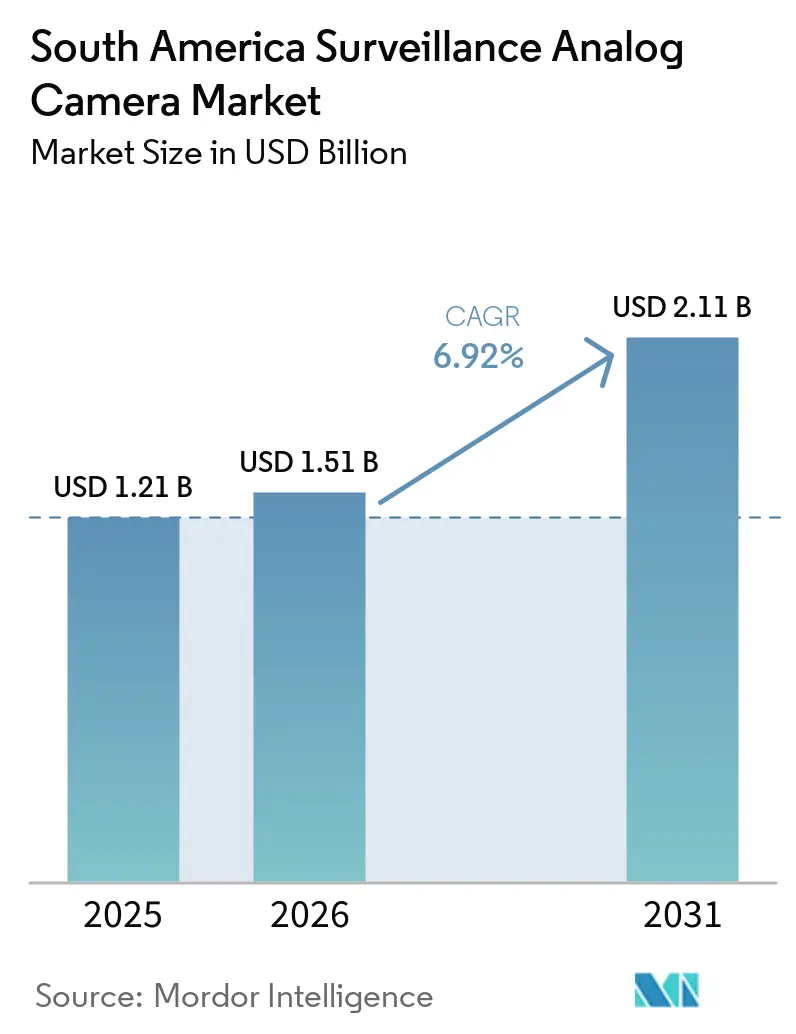
The South America Surveillance Analog Camera Market size is projected to expand from USD 1.21 billion in 2025 to USD 1.51 billion in 2026, and to USD 2.11 billion by 2031, registering a CAGR of 6.92% between 2026 and 2031. The installed base of coaxial cable continues to support upgrades that do not require replacing building cabling. HD-over-coax formats allow buyers to improve image quality while keeping existing runs in service. Government purchasing and city surveillance programs support larger deployments, while small businesses favor packaged DVR systems with lower initial costs. Hybrid recorders extend the useful life of analog installations by accommodating selected IP channels for analytics or encryption. This mix keeps the South America Surveillance Analog Camera Market relevant in cost-sensitive sites, although lower IP hardware prices remain a material constraint.
Key Report Takeaways
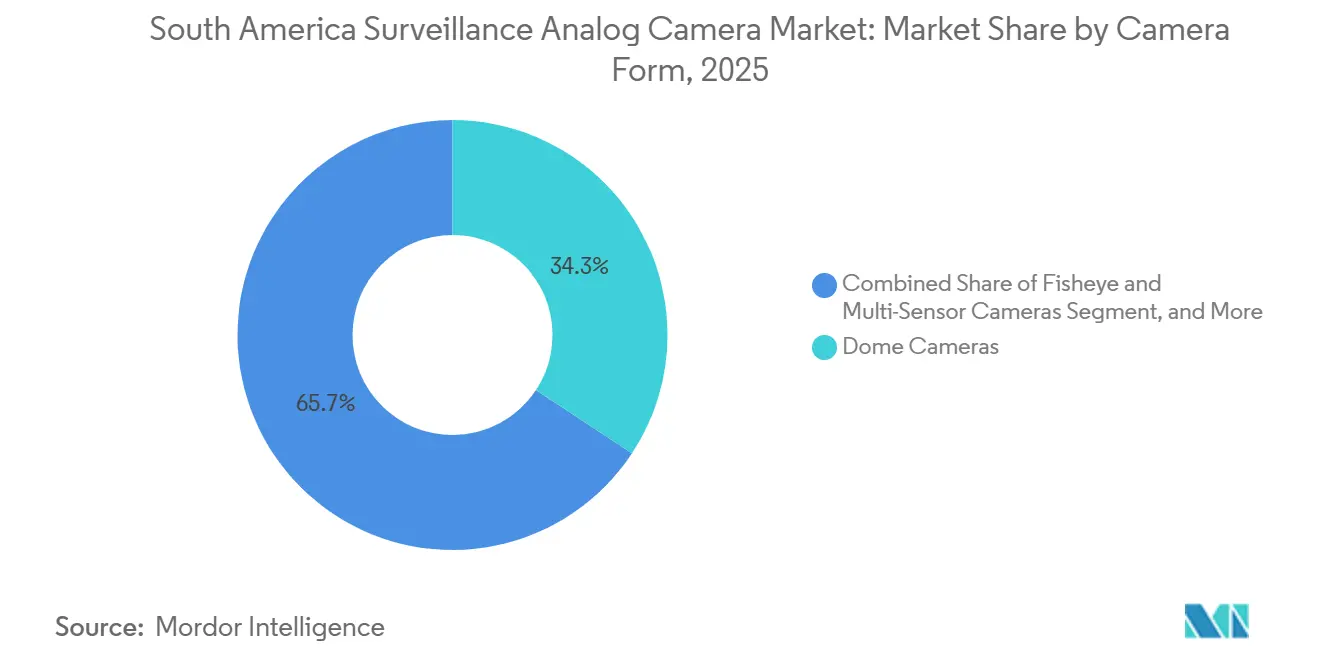
- By camera form, dome cameras held 34.27% of the South America Surveillance Analog Camera Market revenue in 2025, while fisheye and multi-sensor cameras are forecast to grow at a 7.32% CAGR through 2031.
- By technology, HD-TVI held 38.41% of revenue in 2025, while hybrid analog and IP is forecast to grow at a 7.13% CAGR through 2031.
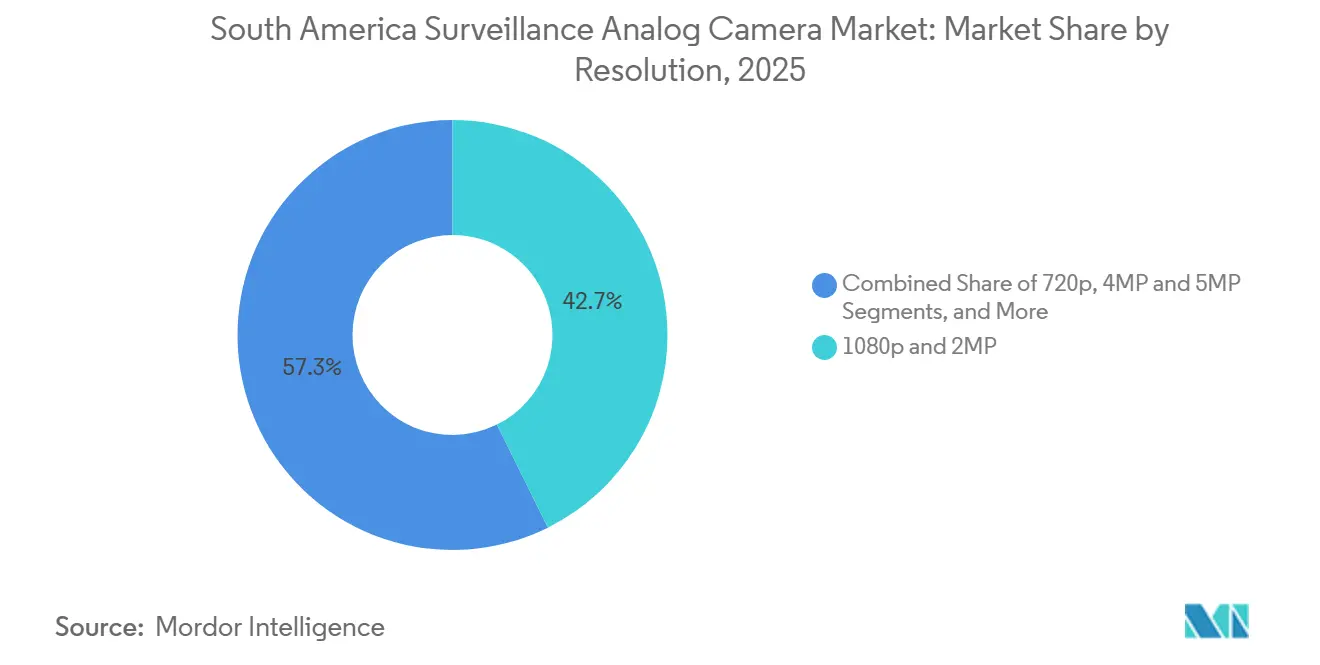
- By resolution, 1080p and 2MP held 42.68% of the South America Surveillance Analog Camera Market revenue in 2025, while 4MP and 5MP are forecast to grow at a 7.24% CAGR through 2031.
- By application, outdoor surveillance held 41.19% of revenue in 2025, while traffic and perimeter monitoring is forecast to grow at a 7.79% CAGR through 2031.
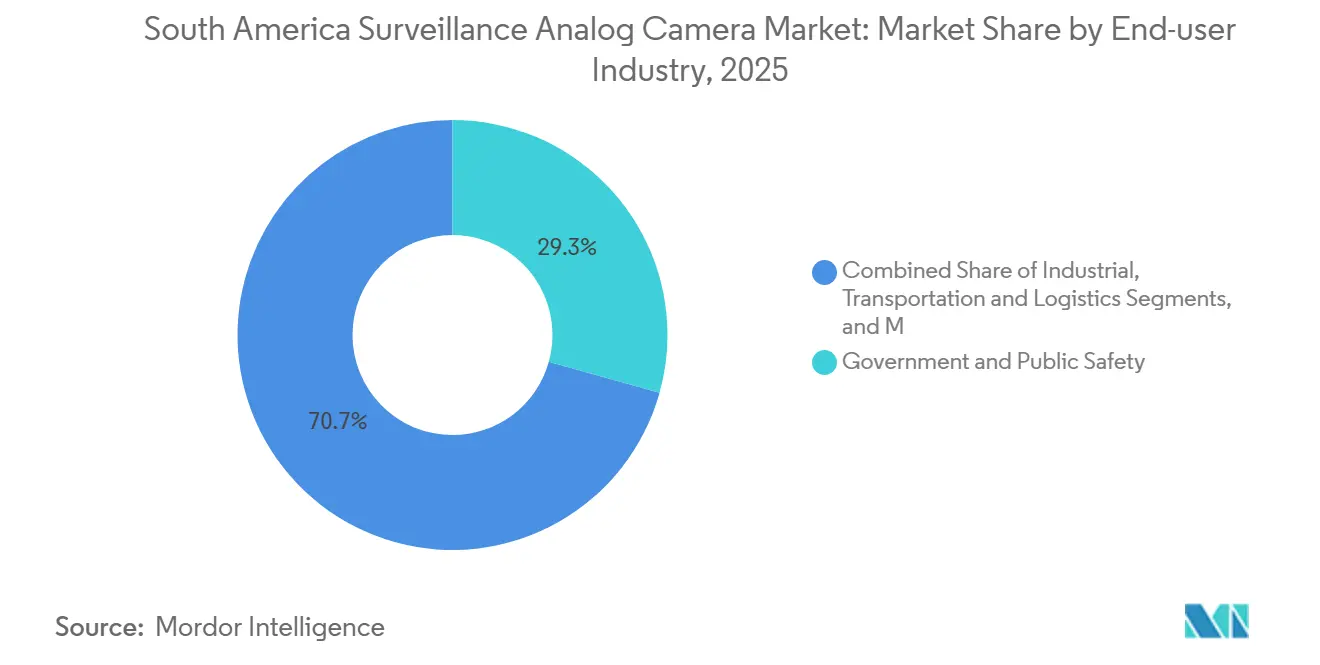
- By end-user industry, government and public safety held 29.33% of the South America Surveillance Analog Camera Market revenue in 2025, while transportation and logistics are forecast to grow at a 7.06% CAGR through 2031.
- By distribution channel, system integrators and installers held 45.72% of revenue in 2025, while specialist retail and e-commerce are forecast to grow at a 7.91% CAGR through 2031.
- By geography, Brazil held 52.84% of revenue in 2025, while Colombia is forecast to grow at a 7.47% CAGR through 2031.
Note: Market size and forecast figures in this report are generated using Mordor Intelligence’s proprietary estimation framework, updated with the latest available data and insights as of January 2026.
Market Trends and Insights
Drivers Impact Analysis of South America Surveillance Analog Camera Market*
| Driver | (~) % Impact on CAGR Forecast | Geographic Relevance | Impact Timeline |
|---|---|---|---|
| Installed Coaxial Infrastructure and Staged Upgrade Economics | +1.9% | South America, strongest in Brazil, Argentina, and Colombia | Long term (≥ 4 years) |
| Cost Effectiveness and Affordability | +1.5% | South America | Medium term (2-4 years) |
| Government Public Safety and Smart City Procurement | +1.3% | Brazil, Colombia, and Argentina | Medium term (2-4 years) |
| Rising Crime and Security Investment | +1.0% | Brazil, Colombia, and Venezuela | Long term (≥ 4 years) |
| HD-Over-Coax Resolution Improvements | +0.7% | South America | Short term (≤ 2 years) |
| Informal Sector and Microenterprise Security Standardization | +0.5% | Brazil and Colombia | Medium term (2-4 years) |
| Source: Mordor Intelligence | |||
Installed Coaxial Infrastructure and Staged Upgrade Economics
Coaxial networks in commercial and institutional buildings remain a durable base for camera replacements. Replacing those networks with Cat6 cabling adds USD 40 to USD 150 in labor cost for each camera. A hybrid HVR system costs USD 700 to USD 950 for 8 cameras, compared with USD 1,400 or more for a comparable IP-NVR system in 2026. Hybrid DVRs allow sites to retain cable assets while improving cameras in phases. Hikvision Turbo HD supports Power over Coaxial, which delivers power and video over a single BNC cable.[1] This approach can keep a site committed to procuring coaxial cameras through subsequent refresh cycles.
Cost Effectiveness and Affordability
Price sensitivity remains important for small and mid-sized buyers across South America. AHD and HD-TVI cameras can provide 1080p quality at lower prices when an existing DVR is retained. Private security spending supports continued demand for lower-cost coverage. Pre-packaged analog kits are reaching smaller formal and informal enterprises through retail channels. Intelbras benefits from local production in Manaus, which supports competitive pricing for DVRs and cameras. The South America Surveillance Analog Camera Market, therefore, retains a role where upfront spending determines buying decisions.
Government Public Safety and Smart City Procurement
Government and public safety accounted for 29.33% of end-user revenue in 2025. City programs create demand for large camera networks and related command-center equipment. Rio de Janeiro state launched Programa Sentinela in January 2026 with a BRL 2 billion (USD 348 million) public tender for 220,000 AI-enabled cameras and 182 control centers. Agencies can retain coaxial contracts for broad coverage and specify IP nodes for locations needing analytics. That procurement approach supports hybrid deployments across the South America Surveillance Analog Camera Market.
Rising Crime and Security Investment
Public-order and safety spending averaged 1.9% of GDP across South American governments in 2024.[2] Brazil, Colombia, and Venezuela represented a substantial share of regional homicide volume. Security needs are particularly persistent in urban and peri-urban areas. Bogotá raised security investment by 43% in 2025 and connected 310 new 360-degree multisensor cameras to its C4 system. Secondary cities can procure analog DVR kits within annual budgets without building full IP networks. Private security spending also supports demand from commercial sites seeking basic camera coverage.
Restraints Impact Analysis of South America Surveillance Analog Camera Market*
| Restraint | (~) % Impact on CAGR Forecast | Geographic Relevance | Impact Timeline |
|---|---|---|---|
| Technological Limitations and IP Camera Substitution | -1.2% | South America | Long term (≥ 4 years) |
| Cybersecurity and Data Privacy Exposure of Legacy DVRs | -0.8% | Brazil and Colombia | Medium term (2-4 years) |
| Import Dependence, Currency Volatility, and Certification Costs | -0.6% | Brazil, Argentina, and Venezuela | Short term (≤ 2 years) |
| Shortage of Skilled Analog to Hybrid Installers Outside Major Cities | -0.4% | Brazil interior, Chile, and other South American countries | Medium term (2-4 years) |
| Source: Mordor Intelligence | |||
Technological Limitations and IP Camera Substitution
IP cameras are gaining ground at premium sites and new construction projects. These systems offer edge analytics, remote administration, and encrypted video transmission. The narrowing cost difference between IP and hybrid systems places pressure on the analog value proposition. Large urban locations in São Paulo, Buenos Aires, and Bogotá are more likely to specify IP deployments. Suppliers need hybrid firmware and video-management compatibility to retain mid-market buyers during this transition.
Cybersecurity and Data Privacy Exposure of Legacy DVRs
Older DVRs can retain outdated firmware and unpatched remote-access weaknesses. Brazil's General Data Protection Law applies administrative fines of up to 2% of annual revenue for violations involving personal data. Banking, financial services, insurance, and healthcare buyers apply stricter encryption and audit requirements. These requirements can remove basic DVR systems from procurement shortlists. Hybrid recorders provide a transition option by supporting encrypted IP streams at higher-risk positions. Vendors with current firmware and documented data-handling practices are better placed in regulated tenders.
*Our forecasts treat driver/restraint impacts as directional, not additive. The impact forecasts reflect baseline growth, mix effects, and variable interactions.
South America Surveillance Analog Camera Market Segment Analysis
By Camera Form:
Dome Cameras Support Broad Commercial CoverageDome cameras held 34.27% of the South America Surveillance Analog Camera Market in 2025. Their vandal-resistant housing and ceiling-mount design suit bank branches, retail outlets, and building lobbies. Wide-angle lenses reduce blind spots in compact commercial areas. Bullet cameras remain common for exterior walls, parking areas, and highway corridors. PTZ cameras are used in sites that require active scene tracking. Box cameras remain relevant for specialized enclosures and ATM surveillance. Fisheye and multi-sensor cameras are forecast to grow at a 7.32% CAGR through 2031. Their wider fields of view can reduce the number of cameras required in warehouses and transit hubs.
A multi-sensor unit can cover a broad retail floor with 1 coaxial run and 1 DVR channel. Separate dome cameras would require 3 to 4 runs and channels for similar coverage. This operating model can lower cabling and installation work in large open spaces. The benefit is important where labor costs affect project selection. Dome cameras continue to meet the general requirements of indoor commercial buyers. Fisheye models are well-suited to locations where wide-area observation is more valuable than discrete camera views. The South America Surveillance Analog Camera Market benefits from both formats because they can be deployed over existing coaxial infrastructure. The format mix also allows installers to tailor systems without changing the recording.

By Technology:
HD-TVI Retains Its Lead as Hybrid Systems ExpandHD-TVI held 38.41% of the South America Surveillance Analog Camera Market in 2025. Hikvision's market presence helped establish a broad TVI camera and DVR ecosystem. Open-license derivatives reduced buyers' concerns about a single supplier. HD-CVI offers comparable coaxial performance through Dahua's installer network. AHD remains available in value-oriented branded and unbranded channels. Standard-definition analog continues to be used in replacement projects with limited image-quality requirements. Hybrid analog and IP is forecast to grow at a 7.13% CAGR through 2031. Hybrid XVRs can ingest older coaxial feeds and selected IP camera channels.
Hybrid systems allow institutional buyers to sequence upgrades according to budget and risk. An existing coaxial camera can remain active while an analytics-capable IP camera is added at a key access point. This model avoids immediate replacement of every camera and cable. It also helps system integrators keep maintenance relationships during modernization. Government programs can use hybrid specifications when they combine new command-center needs with existing perimeter cameras. Pure DVR platforms have less flexibility in these requirements. Pure NVR platforms can require a larger initial infrastructure commitment. The South America Surveillance Analog Camera Market remains linked to this staged technology path.
By Resolution:
1080p and 2MP Remain the Core FormatThe 1080p and 2MP tiers accounted for 42.68% of the South America Surveillance Analog Camera Market in 2025. It balances image clarity with the transmission limits of common DVR configurations. The tier supports facial recognition at 3 to 5 meters and license-plate capture at 5 to 8 meters. These capabilities meet many commercial perimeter and government requirements. Up to 960H systems remain in low-budget replacement projects. They are used where retention periods are short and detailed images are not essential. The 4MP and 5MP tier is forecast to grow at a 7.24% CAGR through 2031. Public transportation and government buyers use higher resolution at intersections and terminal entrances.
Higher-resolution cameras can require recorder upgrades when installed on older multi-channel DVRs. That need allows suppliers to sell cameras and recorders together. Buyers can prioritize 4MP and 5MP coverage at access points where evidence quality matters. Other positions can remain on 1080p cameras to control spending. This configuration supports a phased migration rather than a complete replacement. The 4K and above category remains limited by DVR encoder capability. It is being tested in newer public-safety centers seeking higher image detail. The South America Surveillance Analog Camera Market, therefore, retains a broad middle tier while selectively adding higher-resolution cameras.
By Application:
Outdoor Surveillance Leads While Traffic Monitoring GrowsOutdoor surveillance held 41.19% of the South America Surveillance Analog Camera Market in 2025. Building exteriors, public spaces, and transport corridors require broad perimeter coverage. Climate-rated analog cameras with infrared night vision can meet these needs at a controlled cost. Indoor surveillance remains important in banks, retail stores, healthcare sites, and corporate offices. Low-light and night surveillance has expanded in residential compounds and peri-urban zones. EXIR and starlight technology have improved HD-analog performance in darker conditions. Traffic and perimeter monitoring is forecast to grow at a 7.79% CAGR through 2031. Highway and transit projects are creating demand for dense coverage of roads, terminals, and stations.
Way Brasil and TIM deployed 4G-connected surveillance cameras across 630 km of concession roads in Mato Grosso do Sul in June 2025.[3] The companies planned to extend coverage to 1,070 km in 2026 through the Way-262 concession. Remote road sites can relay DVR-recorded footage through 4G networks without continuous IP video streams. This reduces backhaul requirements where connections are limited. Perimeter monitoring, therefore, remains a practical analog use case outside major urban centers. Infrared cameras also support nighttime observation at unlit road sections. Transit programs add a second source of demand for cameras around passenger flows. These applications support continued deployment of units in the South America Surveillance Analog Camera Market.
By End-User Industry:
Government Leads While Logistics Adds DemandGovernment and public safety held 29.33% of the South America Surveillance Analog Camera Market in 2025. Metropolitan programs in Brazil and Colombia support large deployments that reuse coaxial networks. Brazilian procurements often require ANATEL-certified hardware. This condition favors domestic suppliers and established vendors with local approvals. Banking, financial services, and insurance are major commercial users of DVR systems at branches and ATMs. Healthcare buyers deploy cameras in corridors, pharmacies, and parking areas. Transportation and logistics are forecast to grow at a 7.06% CAGR through 2031. Highway operators, port authorities, and logistics parks are expanding surveillance to meet contractual and security requirements.
Port projects show that certified camera systems are required in hazardous operational areas. Freight-theft risk also supports coverage at logistics facilities. Government procurement remains the primary volume anchor for camera and recorder suppliers. Transportation creates opportunities for ruggedized outdoor units and remote monitoring systems. Healthcare and financial institutions remain steady buyers with established indoor requirements. The South America Surveillance Analog Camera Market serves these industries through different deployment and compliance needs.
By Distribution Channel:
Integrators Lead While E-Commerce ExpandsSystem integrators and installers held 45.72% of the South America Surveillance Analog Camera Market in 2025. Government, healthcare, and commercial real-estate projects require cable termination and DVR configuration. These buyers also require maintenance support after installation. Security distributors serve installers in Brazil's interior and in secondary cities. Direct enterprise and government procurement is increasing among institutions with internal technical teams. Specialist retail and e-commerce is forecast to grow at a 7.91% CAGR through 2031. This channel serves micro-enterprises and residential buyers looking for packaged analog DVR kits. Online purchasing expands access beyond established professional installation networks.
Intelbras identified AI-enabled cameras sold through retail distribution as a strategic growth area in its 2026 earnings materials.[4] Retail channels generally sell smaller systems than project integrators. They can still expand unit demand by reaching first-time camera users. E-commerce also makes product comparison easier for price-sensitive buyers. Integrators remain necessary where sites require long cable runs or ongoing service. Distributor networks remain important for reaching smaller cities. The channel mix creates room for both installed projects and self-install kits. This balance supports demand across the South America Surveillance Analog Camera Market.
Geography Analysis
Brazil Surveillance Analog Camera Market
Brazil held 52.84% of the South America Surveillance Analog Camera Market in 2025. Large urban programs, dense population centers, and domestic manufacturing support this position. Rio de Janeiro state issued a BRL 2 billion (USD 348 million) tender for 220,000 AI-enabled cameras in January 2026. The program includes 182 integrated control centers across the state's municipalities. Intelbras reported BRL 4.46 billion (USD 762 million) in total net revenue in 2025 and planned a BRL 200 million (USD 34.8 million) camera facility in Manaus.
Colombia and Argentina Surveillance Analog Camera Market
Colombia is forecast to grow at a 7.47% CAGR through 2031, the highest geographic rate in the South America Surveillance Analog Camera Market. Bogotá's C4 system will integrate 13,000 cameras in 2026. Colombia has more than 26,000 government-managed surveillance cameras. Medellín contracted Seguritech in May 2026 to build a COP 205 billion (USD 50 million) command center. Argentina maintains demand through municipal and port security programs despite economic constraints.
South America Surveillance Analog Camera Market
Chile supports a measured analog-to-hybrid transition in banking and retail because institutional procurement is relatively stable. Venezuela has more limited formal procurement, but lower-cost analog hardware continues to move through regional channels. Ecuador, Paraguay, Uruguay, Bolivia, and other smaller countries add meaningful unit volumes. Across South America, analog systems remain useful in secondary cities and peri-urban locations where full IP infrastructure has not yet become cost-effective.
Competitive Landscape
The South America Surveillance Analog Camera Market is highly competitive among leading OEMs and regional suppliers. Hikvision and Dahua retain influence through HD-TVI and HD-CVI technology ecosystems. Intelbras is a significant domestic competitor in Brazil due to its local production and channel relationships. Tiandy Technologies, TVT Digital Technology, and CP PLUS International compete in value-oriented hybrid DVR offerings. Smaller cities and peri-urban markets remain open areas for regional integrators and specialist retailers.
Intelbras announced a plan in April 2026 to invest up to BRL 200 million (USD 34.8 million) in a new CCTV manufacturing facility in Manaus. Hikvision's Turbo HD architecture uses Power over Coaxial to reduce installation work on compatible systems. Hanwha Vision has deployed more than 2,000 AI cameras in Lima's Santiago de Surco district. Axis Communications has positioned certified surveillance systems for port projects subject to regulatory requirements. These moves address local capacity, installation efficiency, analytics demand, and compliance requirements.
Competitive strategies increasingly combine hardware compatibility, local support, and compliance readiness. Hybrid recorders help vendors retain analog accounts while providing an entry route to IP upgrades. Installers influence equipment choices on project-based deployments. Public tenders favor vendors that can provide documentation of certifications, data handling, and service capacity.
South America Surveillance Analog Camera Industry Leaders
-
Hangzhou Hikvision Digital Technology Co., Ltd.
-
Zhejiang Dahua Technology Co., Ltd.
-
Hanwha Vision Co., Ltd.
-
Axis Communications AB
-
Zhejiang Uniview Technologies Co., Ltd.
- *Disclaimer: Major Players sorted in no particular order
South America Surveillance Analog Camera Market Companies Covered in this Report
- Hangzhou Hikvision Digital Technology Co., Ltd.
- Zhejiang Dahua Technology Co., Ltd.
- Hanwha Vision Co., Ltd.
- Axis Communications AB
- Zhejiang Uniview Technologies Co., Ltd.
- i-PRO Co., Ltd.
- IDIS Co., Ltd.
- ACTi Corporation
- Tiandy Technologies Co., Ltd.
- TVT Digital Technology Co., Ltd.
- Infinova International, Inc.
- EverFocus Electronics Corp.
- CP PLUS International Pte. Ltd.
- Intelbras S.A. Indústria de Telecomunicação Eletrônica Brasileira
- Teledyne FLIR LLC
- Pelco, Inc.
- VIVOTEK Inc.
- GeoVision Inc.
- D-Link Corporation
- Avigilon Corporation
Recent Industry Developments in South America Surveillance Analog Camera Market
- July 2026: Rio de Janeiro city expanded Civitas Rio's annual budget to BRL 180 million (USD 31.3 million) following a January 2026 upgrade, now operating 10,000 integrated cameras, 3,000 capable of processing 3,000 data points per second, with a target of 20,000 units by 2028.
- April 2026: Intelbras S.A. acquired 670,000 m² of land in the Manaus Free Trade Zone for BRL 19.4 million (USD 3.4 million) and announced plans to invest up to BRL 200 million (USD 34.8 million) in a new CCTV camera manufacturing facility.
- January 2026: Rio de Janeiro state launched Programa Sentinela, issuing a BRL 2 billion (USD 348 million) public tender for 220,000 AI-enabled surveillance cameras and 182 integrated control centers across 92 municipalities.
- June 2025: Way Brasil and TIM launched a 4G LTE-connected highway camera surveillance system across 630 km of concession roads in Mato Grosso do Sul.
South America Surveillance Analog Camera Market Report Scope
The South America surveillance analog camera market refers to traditional closed-circuit television (CCTV) cameras that transmit video signals over coaxial cables via technologies such as AHD, HD-CVI, and HD-TVI. Available in various form factors such as dome, bullet, and box cameras, these systems offer cost-effective video monitoring for indoor, outdoor, and low-light applications. They are primarily deployed across government, banking, retail, and residential sectors in the region, distributed through security integrators, specialists, and direct procurement channels to provide reliable, legacy-compatible security infrastructure.
The South America Surveillance Analog Camera Market Report is Segmented by Camera Form (Box Cameras, Dome Cameras, Bullet Cameras, Pan-Tilt-Zoom Cameras, Fisheye and Multi-Sensor Cameras, and Pinhole and Other Camera Forms), Technology (Standard-Definition Analog, AHD, HD-CVI, HD-TVI, and Hybrid Analog and IP), Resolution (Up to 960H, 720p, 1080p and 2MP, 4MP and 5MP, and 4K and Above), Application (Indoor Surveillance, Outdoor Surveillance, Low-Light and Night Surveillance, and Traffic and Perimeter Monitoring), End-user Industry (Government and Public Safety, Banking, Financial Services, and Insurance, Healthcare, Transportation and Logistics, Industrial, Retail, Hospitality, and Commercial, Residential and Small Businesses, and Education and Other End-user Industries), Distribution Channel (Security Distributors, System Integrators and Installers, Specialist Retail and E-commerce, and Direct Enterprise and Government Procurement), and Geography (Brazil, Argentina, Colombia, Chile, and Rest of South America). The Market Forecasts are Provided in Terms of Value (USD).
Segmentation Overview
| Box Cameras |
| Dome Cameras |
| Bullet Cameras |
| Pan-Tilt-Zoom Cameras |
| Fisheye and Multi-Sensor Cameras |
| Pinhole and Other Camera Forms |
| Standard-Definition Analog |
| AHD |
| HD-CVI |
| HD-TVI |
| Hybrid Analog and IP |
| Up to 960H |
| 720p |
| 1080p and 2MP |
| 4MP and 5MP |
| 4K and Above |
| Indoor Surveillance |
| Outdoor Surveillance |
| Low-Light and Night Surveillance |
| Traffic and Perimeter Monitoring |
| Government and Public Safety |
| Banking, Financial Services, and Insurance |
| Healthcare |
| Transportation and Logistics |
| Industrial |
| Retail, Hospitality, and Commercial |
| Residential and Small Businesses |
| Education and Other End-user Industries |
| Security Distributors |
| System Integrators and Installers |
| Specialist Retail and E-commerce |
| Direct Enterprise and Government Procurement |
| Brazil |
| Argentina |
| Colombia |
| Chile |
| Rest of South America |
| By Camera Form | Box Cameras |
| Dome Cameras | |
| Bullet Cameras | |
| Pan-Tilt-Zoom Cameras | |
| Fisheye and Multi-Sensor Cameras | |
| Pinhole and Other Camera Forms | |
| By Technology | Standard-Definition Analog |
| AHD | |
| HD-CVI | |
| HD-TVI | |
| Hybrid Analog and IP | |
| By Resolution | Up to 960H |
| 720p | |
| 1080p and 2MP | |
| 4MP and 5MP | |
| 4K and Above | |
| By Application | Indoor Surveillance |
| Outdoor Surveillance | |
| Low-Light and Night Surveillance | |
| Traffic and Perimeter Monitoring | |
| By End-user Industry | Government and Public Safety |
| Banking, Financial Services, and Insurance | |
| Healthcare | |
| Transportation and Logistics | |
| Industrial | |
| Retail, Hospitality, and Commercial | |
| Residential and Small Businesses | |
| Education and Other End-user Industries | |
| By Distribution Channel | Security Distributors |
| System Integrators and Installers | |
| Specialist Retail and E-commerce | |
| Direct Enterprise and Government Procurement | |
| By Geography | Brazil |
| Argentina | |
| Colombia | |
| Chile | |
| Rest of South America |
Key Questions Answered in the Report
What is the South America Surveillance Analog Camera Market size?
The South America Surveillance Analog Camera Market was USD 1.51 billion in 2026 and is forecast to reach USD 2.11 billion by 2031, at a 6.92% CAGR.
Why do analog surveillance cameras remain relevant in South America?
Existing coaxial cable networks reduce upgrade costs, while hybrid recorders allow operators to add IP channels gradually.
Which camera form leads demand in South America?
Dome cameras led with 34.27% of revenue in 2025 because they suit commercial interiors and offer wide-angle coverage.
Which application is growing fastest through 2031?
Traffic and perimeter monitoring is forecast to grow at a 7.79% CAGR, supported by highway and transit surveillance needs.
Which country leads surveillance analog camera demand in South America?
Brazil led with 52.84% of revenue in 2025, supported by city programs and domestic camera manufacturing.
What is the main challenge for analog camera suppliers?
Falling IP system costs and stricter security requirements place pressure on basic DVR-based systems, particularly at premium sites.