
South America Seed Processing Machinery Market Size and Share
Market Overview
| Study Period | 2021 - 2031 |
|---|---|
| Forecast Data Period | 2026 - 2031 |
| Base Year Market Size (2025) | USD 430.80 Million |
| Market Size (2026) | USD 462.90 Million |
| Market Size (2031) | USD 661.47 Million |
| Growth Rate (2026 - 2031) | 7.40 % |
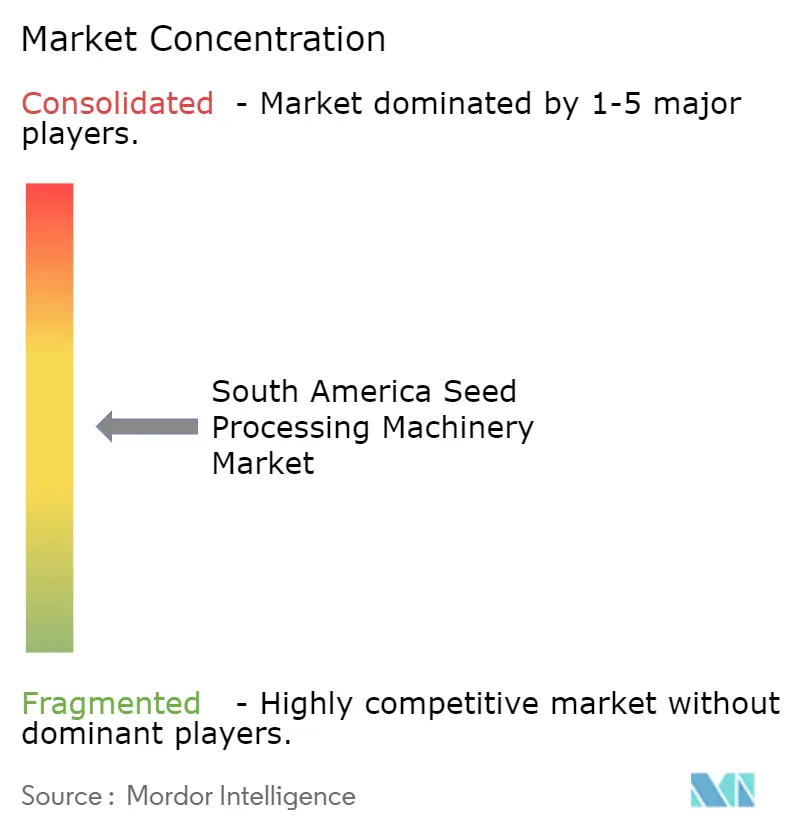
| Market Concentration | Medium |
Major Players *Disclaimer: Major Players sorted in no particular order Image © Mordor Intelligence. Reuse requires attribution under CC BY 4.0. | |
South America Seed Processing Machinery Market Analysis by Mordor Intelligence
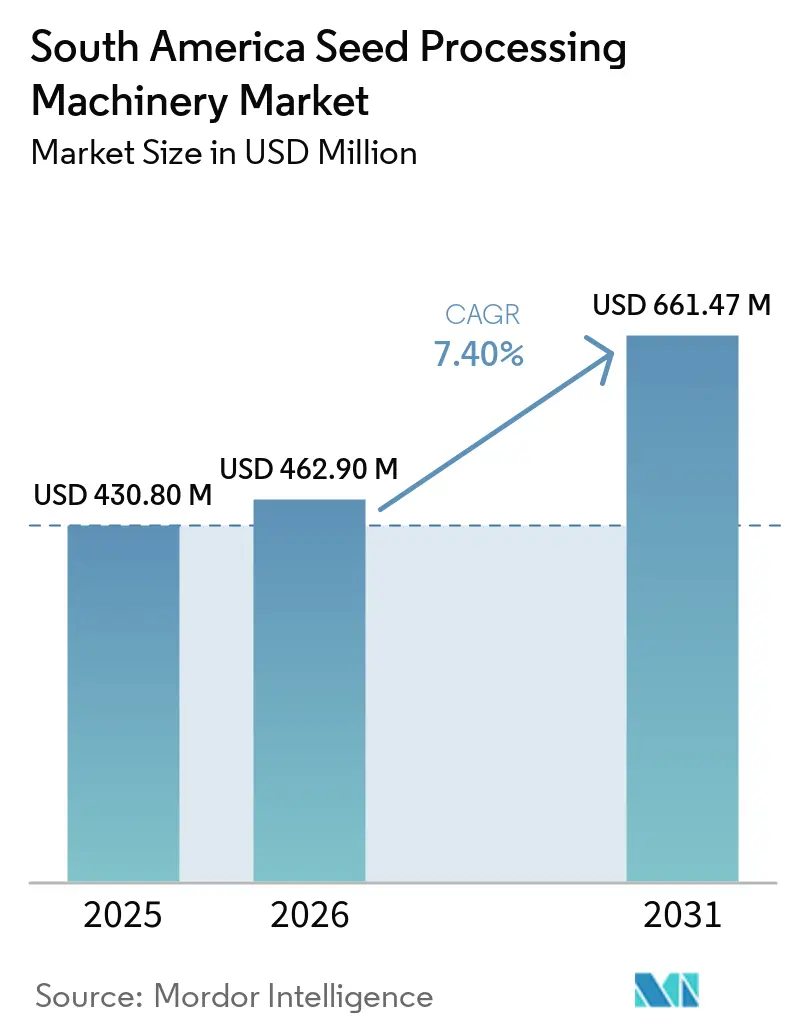
The South America seed processing machinery market was valued at USD 430.80 million in 2025 and is projected to grow from USD 462.90 million in 2026 to USD 661.47 million by 2031, at a CAGR of 7.40% during the forecast period (2026-2031). Capital spending on processing capacity continued even as high benchmark interest rates weakened broader agricultural machinery sales. Brazil and Argentina drive regional demand due to their large soybean and row-crop export positions and certified-seed requirements. These requirements prioritize equipment decisions over short-term commodity price movements, maintaining a baseline level of investment in the South American seed processing machinery market even when farm profitability is under pressure. Suppliers are responding with AI-enabled sorting systems, modular treatment lines, and documentation tools that support certification records.
Key Report Takeaways
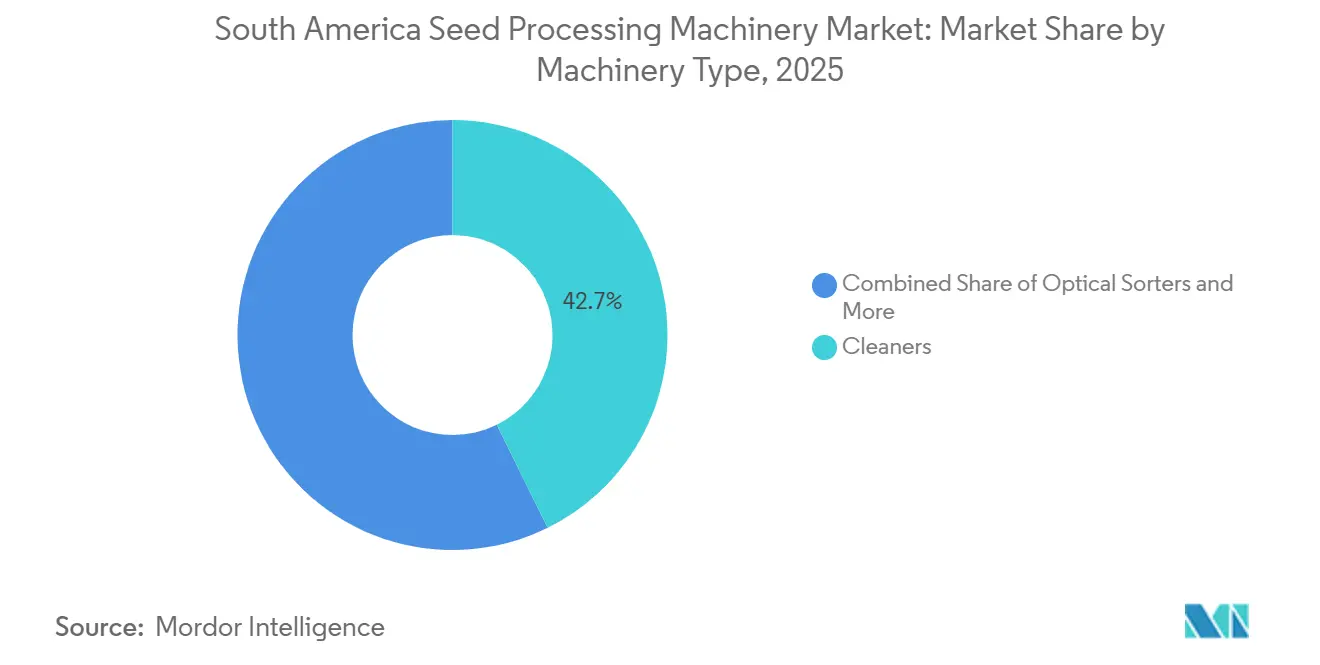
By machinery type, cleaners accounted for the largest share at 42.7% in 2025, while optical sorters are forecast to grow at the fastest CAGR, 9.4%, from 2026 to 2031.
By operation mode, automatic accounted for the largest share at 70.6% in 2025, and the South America seed processing machinery market size for the automatic is forecast to grow at the fastest CAGR of 8.7% from 2026 to 2031.
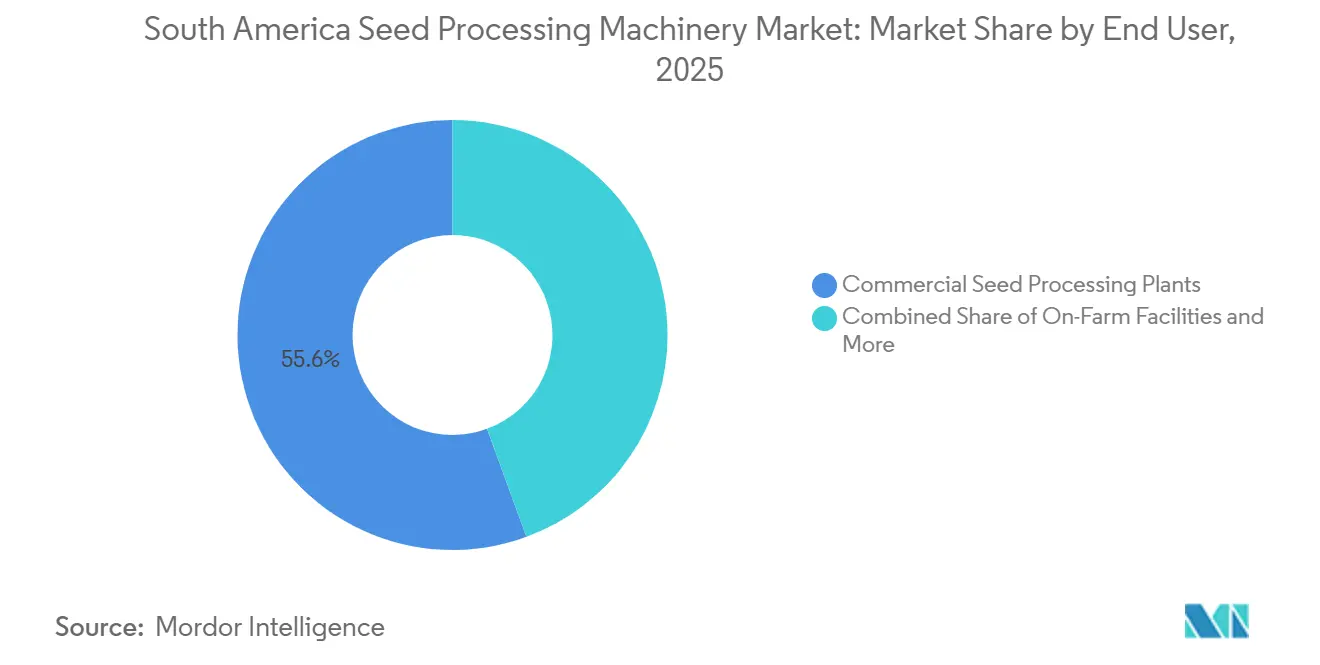
By end user, commercial seed processing plants accounted for the largest share, at 55.6%, of the South American seed processing machinery market in 2025, while on-farm facilities are forecast to grow at the fastest CAGR of 8.0% from 2026 to 2031.
By geography, Brazil held the largest share in 2025 at 45.0%, and it is forecast to grow at the fastest CAGR, at 8.2%, from 2026 to 2031.
Note: Market size and forecast figures in this report are generated using Mordor Intelligence’s proprietary estimation framework, updated with the latest available data and insights as of January 2026.
Market Trends and Insights
Drivers Impact Analysis of South America Seed Processing Machinery Market*
| Driver | (~) % Impact on CAGR Forecast | Geographic Relevance | Impact Timeline |
|---|---|---|---|
| Expansion of commercial seed multiplication in Brazil and Argentina | +2.0% | Brazil and Argentina, with effects in Paraguay and Uruguay | Medium term (2-4 years) |
| Increasing demand for certified and treated seeds | +1.5% | South America, with greatest intensity in Brazil and Argentina | Medium term (2-4 years) |
| Automation of optical sorting and quality inspection | +1.3% | Brazil, Colombia, Chile, and Rest of South America | Long term (≥ 4 years) |
| Government-supported agricultural mechanization | +0.9% | Brazil, Colombia, and Argentina | Short term (≤ 2 years) |
| South American seed export traceability requirements | +0.7% | Brazil and Argentina | Medium term (2-4 years) |
| Retrofit demand for modular seed treatment lines | +0.6% | South America, with early activity in Mato Grosso, Rio Grande do Sul, and Buenos Aires Province | Long term (≥ 4 years) |
| Source: Mordor Intelligence | |||
Expansion of Commercial Seed Multiplication in Brazil and Argentina
Brazil's expanding commercial grain base is increasing demand for planting seed preparation, particularly for major crops such as soybean, corn, and sorghum. According to Brazil's National Supply Company (CONAB), grain production for the 2025/26 season is estimated at 360.8 million metric tons, up 2.4% from the previous cycle, with the cultivated area increasing by 2.1% to 83.5 million hectares[1]. The larger planted area directly increases the volume of seed required for commercial sowing, which must be cleaned, graded, treated, and prepared for distribution, raising throughput requirements for seed-processing facilities. This expansion strengthens demand for machinery across South America.
Increasing Demand for Certified and Treated Seeds
Chile's growing certified-seed activity is increasing demand for controlled selection, treatment, packaging, and quality-inspection equipment. According to Chile's Agricultural and Livestock Service (SAG) in 2025, more than 750,000 kilograms of certified potato seed had been dispatched for the domestic market, while 75,000 kilograms had been approved for export to Brazil[2]. These certified lots must undergo supervised selection, packaging, labeling, official sampling, and laboratory analysis, all of which require dedicated processing infrastructure. As certified-seed volumes move through regulated facilities, processors require reliable equipment to maintain quality and traceability, driving investment in seed-processing machinery across the region.
Automation of Optical Sorting and Quality Inspection
Advances in optical sorting automation are strengthening the case for replacing conventional inspection systems with more advanced equipment. According to Bühler Group in 2025, the SORTEX AI700 achieved a 5-10% improvement in reject concentration compared with earlier algorithmic systems. Higher reject concentration enables processors to separate unwanted material more precisely while reducing the removal of acceptable seed, improving sorting performance, and supporting more consistent output quality. These improvements are encouraging seed processors to upgrade optical sorting capabilities as quality requirements increase, creating opportunities for the replacement and modernization of automated inspection machinery.
Government-Supported Agricultural Mechanization
Government-backed agricultural credit is improving access to capital for mechanization and facility upgrades. According to the Brazilian Development Bank (BNDES), R$ 3.6 billion (USD 0.65 billion) was approved under the Plano Safra 2025/2026 for investments in installations and machinery. This financing supports capital-intensive equipment purchases, enabling agricultural businesses and cooperatives to upgrade their productive infrastructure. For seed processors, access to investment financing can facilitate purchases of cleaning, grading, treatment, and handling equipment, encouraging modernization of processing facilities and supporting machinery demand across the region.
Restraints Impact Analysis of South America Seed Processing Machinery Market*
| Driver | (~) % Impact on CAGR Forecast | Geographic Relevance | Impact Timeline |
|---|---|---|---|
| High upfront cost of automated machinery | -1.2% | South America, with greatest intensity in Colombia, Chile, and Rest of South America | Medium term (2-4 years) |
| Foreign-exchange volatility and imported component costs | -1.0% | Argentina, Brazil, and Colombia | Short term (≤ 2 years) |
| Shortage of skilled operators and regional service technicians | -0.6% | South America, with rural and frontier regions most affected | Long term (≥ 4 years) |
| Limited standardization of data protocols across seed plants | -0.4% | South America, with early compliance gains in São Paulo and Mato Grosso | Long term (≥ 4 years) |
| Source: Mordor Intelligence | |||
High Upfront Cost of Automated Machinery
High financing costs can increase the effective burden of acquiring automated seed-processing equipment, particularly for smaller processors with limited investment capacity. According to Caixa Econômica Federal in 2026, Moderfrota financing carries interest rates of up to 12.5% per year, or 11.5% per year for Pronamp borrowers, for eligible machinery and equipment purchases. These rates apply to equipment financing, meaning borrowing can materially add to the cost of capital-intensive sorting and treatment systems and extend investment payback periods. This may lead processors to postpone automation or continue using existing equipment, limiting the pace of machinery upgrades across the region.
Foreign-Exchange Volatility and Imported Component Costs
Foreign-exchange uncertainty makes it difficult for processors to budget for imported seed-processing machinery and components in local currency, particularly when equipment is priced in US dollars. According to the Central Bank of the Republic of Argentina (BCRA), Argentina introduced an exchange-rate band of ARS 1,000–ARS 1,400 per USD 1 in April 2025, within which the peso is allowed to fluctuate according to market conditions[3]. This wide operating range creates uncertainty over the local-currency cost of imported machinery, sensors, and electronic components, which may cause processors to defer capital purchases and limit equipment modernization across the region.
*Our forecasts treat driver/restraint impacts as directional, not additive. The impact forecasts reflect baseline growth, mix effects, and variable interactions.
South America Seed Processing Machinery Market Segment Analysis
By Machinery Type:
Cleaners Lead While Optical Sorters AdvanceCleaners accounted for the largest share in 2025 at 42.7%, reflecting their essential role in removing chaff, dust, and oversized material before subsequent processing stages. Their position is reinforced by widespread use across soybean, corn, wheat, and other seed-conditioning operations, where consistent pre-cleaning protects downstream equipment and improves separation performance. Demand remains supported by processors seeking reliable throughput and stable feed quality for graders, separators, treaters, and optical systems. As cleaning remains a foundational step in integrated processing lines, manufacturers continue to develop equipment with improved airflow, screening flexibility, and automation to meet varied seed-processing requirements.
Optical sorters are forecast to grow at the fastest CAGR of 9.4% from 2026 to 2031, reflecting increasing adoption of automated quality-inspection technologies. This growth indicates that processors are placing greater emphasis on precise separation, seed purity, and consistent lot quality. Optical sorting can automate the identification and removal of unwanted material, reducing reliance on manual inspection while improving processing consistency. As commercial processors modernize conventional cleaning and grading lines, the faster expansion of optical sorting creates opportunities for equipment upgrades and new installations, strengthening demand for advanced sorting machinery across the region.

By Operation Mode:
Automatic Systems Remain the Core FormatAutomatic equipment accounted for the largest share in 2025, at 70.6%, reflecting the need for consistent throughput, repeatable processing conditions, and reduced manual intervention in commercial seed facilities. Automated systems coordinate cleaning, grading, treating, conveying, and inspection steps, allowing processors to maintain process consistency across larger production volumes. Their integration also supports centralized monitoring and faster adjustment when seed characteristics change. As commercial operators prioritize productivity and standardized quality, automation remains the core operating format, while equipment suppliers increasingly combine mechanical processing with sensors, controls, and digital interfaces to improve plant coordination.
The South America seed processing machinery market size for the automatic segment is forecast to grow at the fastest CAGR of 8.7% from 2026 to 2031, supported by the modernization of commercial processing facilities. Automated systems reduce dependence on manual adjustments across repetitive cleaning, grading, treating, and inspection tasks, while enabling more consistent operating parameters. This is particularly relevant for processors handling multiple seed varieties or batches, where frequent changes can increase operator workload. Greater adoption of automated controls can therefore improve line utilization and process repeatability, encouraging processors to replace manually intensive equipment and expand integrated processing capabilities across the region.
By End User:
Commercial Plants Lead and On-Farm Facilities Grow FasterCommercial seed processing plants accounted for the largest share, at 55.6%, of the South American seed processing machinery market in 2025, reflecting the concentration of professional seed conditioning activities within dedicated facilities. These plants integrate cleaning, grading, treatment, inspection, and packaging to prepare seed for commercial distribution while maintaining consistent lot quality. Their centralized operating structure supports higher equipment utilization than dispersed on-farm handling and makes integrated machinery economically viable. As commercial seed businesses strengthen quality control and processing efficiency, dedicated plants remain the primary users of processing equipment, sustaining demand for complete processing lines and replacement machinery across major seed-producing areas.
On-farm facilities are forecast to grow at the fastest CAGR of 8.0% from 2026 to 2031, as producers seek greater control over seed handling and more flexibility for smaller or specialized lots. In-house conditioning can reduce reliance on external processing schedules and allow producers to manage proprietary seed stocks closer to production areas. This model favors modular cleaners, graders, treaters, and handling equipment that can be scaled according to local requirements. Growth in on-farm processing creates opportunities for compact and adaptable machinery, particularly where integrated commercial facilities are less accessible or economical.
Geography Analysis
Brazil held the largest share in 2025 at 45.0% and is forecast to grow at the fastest CAGR of 8.2% from 2026 to 2031. The country's large grain and seed production base drives demand for cleaning, grading, treatment, and sorting equipment across commercial facilities. The scale of soybean, corn, and other crop production creates recurring requirements for conditioning capacity, while expanding quality standards encourage investment in modern machinery. This combination of production scale and processing needs positions Brazil as the strongest equipment market in the region, supporting continued supplier expansion.
Argentina and Chile offer differentiated equipment opportunities through specialized seed-processing activities and export-oriented production. Argentina has an established commercial seed-processing base serving domestic and international customers, while Chile supports processing across industrial crops, vegetables, and other seed categories. These operations require adaptable capabilities for cleaning, drying, grading, treatment, packaging, and traceability, rather than standardized single-crop systems. Export-oriented processors also place greater emphasis on consistent lot quality and controlled handling. This combination of crop diversity, specialized processing, and international seed supply chains creates opportunities for machinery suppliers offering flexible configurations, quality-control capabilities, and integrated processing solutions.
The rest of South America also offers differentiated equipment opportunities as seed industries become more formalized and quality controls expand. Colombia's Agricultural Institute (ICA) regulates seed production, import, export, storage, and commercialization, with registered activities covering certified-seed production, re-packaging, importing, and exporting. This regulatory structure creates recurring requirements for conditioning, quality inspection, and compliant handling equipment. Argentina, Peru, Chile, Bolivia, and Paraguay similarly provide opportunities across commercial seed production and specialized crop segments, supporting regional demand for cleaners, graders, treaters, optical sorters, and other processing equipment.
Competitive Landscape
The market is moderately consolidated, with key players in 2025 including Cimbria A/S (Grain and Protein Technologies), Bühler AG, PETKUS Technologie GmbH, Westrup ApS, and Oliver Manufacturing Co., Inc. These companies compete by offering broad portfolios of seed-processing equipment, including cleaning, grading, treatment, drying, and optical sorting. Cimbria and Bühler emphasize integrated processing technologies and automation, while PETKUS and Westrup provide specialized conditioning and treatment solutions. Oliver Manufacturing contributes to the competitive landscape through cleaning and separation equipment. Their established technologies, processing expertise, and regional distribution networks create competitive differentiation across equipment categories and customer requirements.
Technology differentiation is becoming increasingly important as suppliers integrate artificial intelligence, advanced sensors, and automated controls into seed-processing equipment. At Agritechnica 2025, PETKUS Technologie GmbH presented the Optical Sorter OS f with artificial intelligence-supported germination analysis, demonstrating how optical systems can address seed-quality characteristics beyond conventional visual sorting. Such capabilities can influence equipment replacement decisions when processors seek greater quality assurance and process automation. Global manufacturers can compete through technological depth, while regional suppliers can differentiate through application knowledge, customization, commissioning, and proximity to service for South American processors.
Service coverage remains a critical competitive factor, as seed processors require commissioning, maintenance, operator support, and spare parts availability following equipment installation. In 2026, Westrup ApS reported that its renewed Oliver Westrup South America partnership had supported more than 20 customers across 7 countries and installed 59 machines over the previous three years. This regional footprint demonstrates the importance of combining equipment portfolios with local market access and service capabilities. Suppliers that maintain reliable technical support can strengthen customer retention and improve their ability to secure replacement, expansion, and modernization projects.
South America Seed Processing Machinery Industry Leaders
-
Cimbria A/S (Grain and Protein Technologies)
-
Bühler AG
-
PETKUS Technologie GmbH
-
Westrup ApS
-
Oliver Manufacturing Co., Inc.
- *Disclaimer: Major Players sorted in no particular order
South America Seed Processing Machinery Market Companies Covered in this Report
- Cimbria A/S (Grain and Protein Technologies)
- Bühler AG
- PETKUS Technologie GmbH
- Westrup ApS
- Oliver Manufacturing Co., Inc.
- Momesso Indústria de Máquinas de Tratamento e Beneficiamento de Sementes Ltda.
- Ag Growth International Inc.
- Satake Corporation (Satake Group)
- Alvan Blanch Development Company Limited
- Lewis M. Carter Manufacturing, LLC
- A.T. Ferrell Company, Inc.
- CIMISA Máquinas Pozzer Ltda.
Recent Industry Developments in South America Seed Processing Machinery Market
- July 2026: Westrup ApS and Oliver Manufacturing Co., Inc. renewed their South America partnership, combining seed-cleaning, gravity-separation, and seed-treatment equipment. The partnership has installed 59 machines for more than 20 customers across 7 countries, strengthening their regional seed-processing presence.
- June 2026: Satake Corporation launched the SLASH β PLUS compact optical sorter for agricultural processing on the global market, including South America. The product features high-efficiency ejectors, automatic sensitivity adjustment, LED technology, and integration with upstream and downstream equipment.
- April 2026: Satake Corporation launched the SLASH VQS modular optical sorter globally, including in South America. The sorter incorporates multi-wavelength infrared detection, automatic calibration, high-efficiency ejectors, and modular configurations that enable capacity expansion.
South America Seed Processing Machinery Market Report Scope
The South America seed processing machinery market is segmented by machinery type (pre-cleaners, cleaners, dryers, graders, coaters and treaters, separators and destoners, polishers, optical sorters, seed packagers, and other specialized equipment), by operation mode (automatic and semi-automatic), and by end-user (commercial seed processing plants, seed producers, research institutions, on-farm facilities, and grain handling facilities), by geography (Brazil, Argentina, Colombia, Chile, and Rest of South America). The market forecasts are provided in terms of value (USD).
Segmentation Overview
| Pre-cleaners |
| Cleaners |
| Dryers |
| Graders |
| Coaters and Treaters |
| Separators and Destoners |
| Polishers |
| Optical Sorters |
| Seed Packagers |
| Other Specialized Equipment |
| Automatic |
| Semi-Automatic |
| Commercial Seed Processing Plants |
| Seed Producers |
| Research Institutions |
| On-Farm Facilities |
| Grain Handling Facilities |
| Brazil |
| Argentina |
| Colombia |
| Chile |
| Rest of South America |
| By Machinery Type | Pre-cleaners |
| Cleaners | |
| Dryers | |
| Graders | |
| Coaters and Treaters | |
| Separators and Destoners | |
| Polishers | |
| Optical Sorters | |
| Seed Packagers | |
| Other Specialized Equipment | |
| By Operation Mode | Automatic |
| Semi-Automatic | |
| By End-User | Commercial Seed Processing Plants |
| Seed Producers | |
| Research Institutions | |
| On-Farm Facilities | |
| Grain Handling Facilities | |
| By Geography | Brazil |
| Argentina | |
| Colombia | |
| Chile | |
| Rest of South America |
Key Questions Answered in the Report
What is the forecast for South America seed processing machinery through 2031?
The South America seed processing machinery market is forecast to rise from USD 462.90 million in 2026 to USD 661.47 million by 2031.
Which machinery type leads demand in South America?
Cleaners led with the largest 42.7% of revenue in 2025 because they support the front end of most processing lines.
Which equipment category is growing fastest in seed processing?
Optical sorters are forecast to grow at the fastest 9.4% CAGR from 2026 to 2031 as processors adopt AI-based quality inspection.
Why is Brazil important for seed processing equipment suppliers?
Brazil held the largest 45.0% of revenue in 2025 and is forecast to grow at the fastest 8.2% CAGR from 2026 to 2031.