
South America Rigid Plastic Packaging Market Size and Share
Market Overview
| Study Period | 2020 - 2031 |
|---|---|
| Forecast Data Period | 2026 - 2031 |
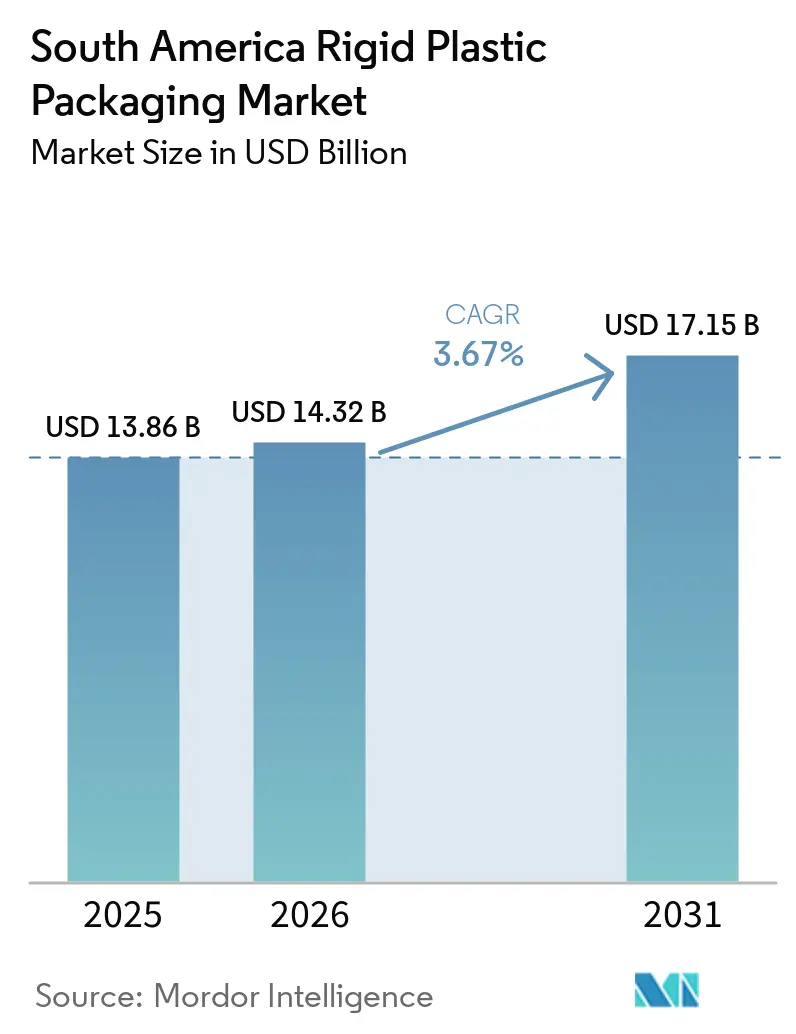
| Base Year Market Size (2025) | USD 13.86 Billion |
| Market Size (2026) | USD 14.32 Billion |
| Market Size (2031) | USD 17.15 Billion |
| Growth Rate (2026 - 2031) | 3.67 % |
| Market Concentration | Medium |
Major Players *Disclaimer: Major Players sorted in no particular order Image © Mordor Intelligence. Reuse requires attribution under CC BY 4.0. | |
South America Rigid Plastic Packaging Market Analysis by Mordor Intelligence
The South America rigid plastic packaging market size was valued at USD 13.86 billion in 2025 and estimated to expand from USD 14.32 billion in 2026 to reach USD 17.15 billion by 2031, at a CAGR of 3.67% during the forecast period (2026-2031). Demand is supported by urban consumption centers, formal grocery retail, and continuing investment in food and beverage processing. Rigid formats remain important where products require carbonation resistance, tamper evidence, reliable stacking, and cold-chain protection. Packaging suppliers are also adapting their resin choices and container designs to recycled-content requirements in Brazil and Colombia. The market offers opportunities for converters that can combine high-output production with certified recycled material and dependable local supply. Competitive activity increasingly centers on recycling capacity, integrated beverage packaging, healthcare-grade formats, and operational scale.
Key Report Takeaways
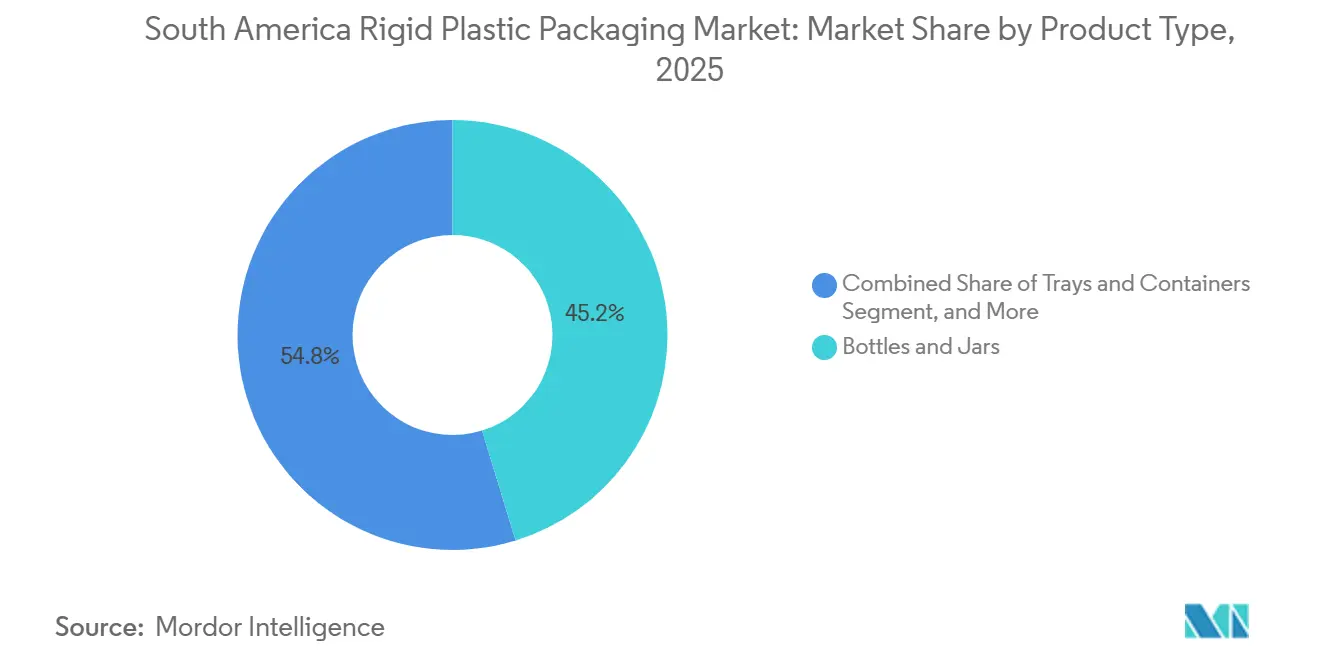
- By product type, bottles and jars held 45.24% of the South America rigid plastic packaging market share in 2025.
- By material, polyethylene held 35.67% of revenue in 2025, while bioplastics are projected to expand at a 3.72% CAGR through 2031.
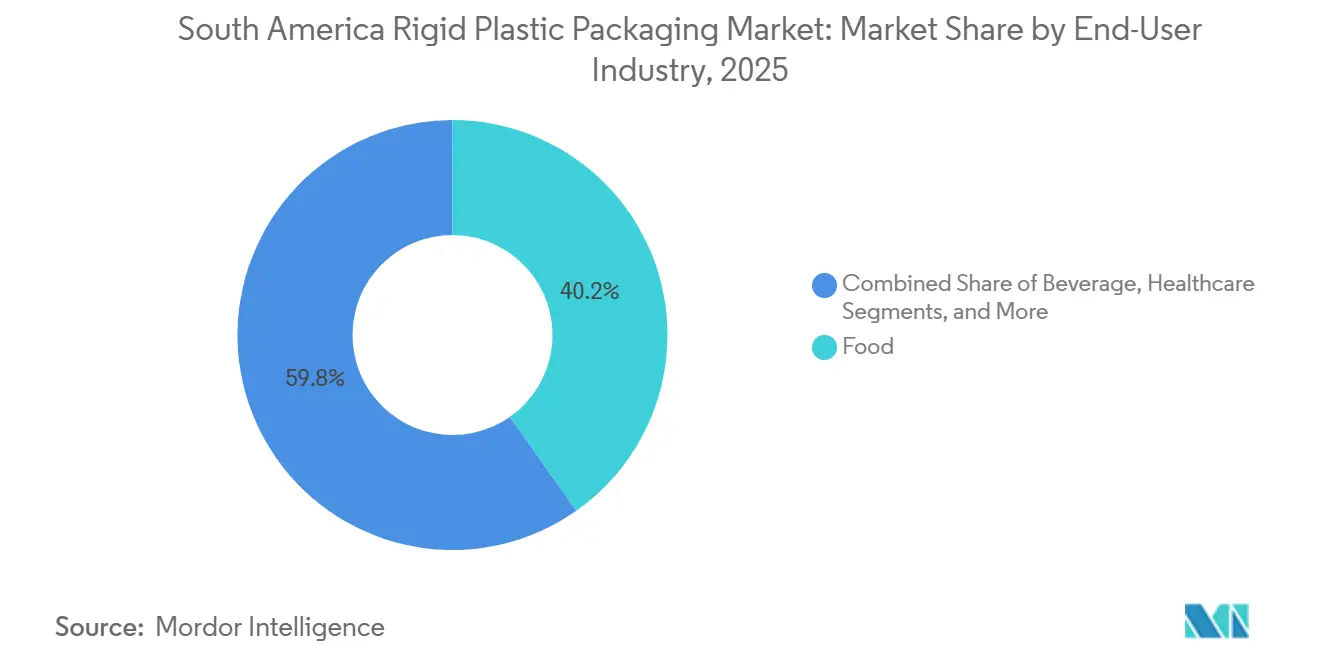
- By end-user industry, food accounted for 40.23% of revenue in 2025, while healthcare is projected to expand at a 3.89% CAGR through 2031 in the South America rigid plastic packaging market.
- By manufacturing process, extrusion blow molding held 32.72% of revenue in 2025, while thermoforming is projected to expand at a 4.12% CAGR through 2031.
- By geography, Brazil held 44.54% of revenue in 2025 and is projected to expand at a 3.78% CAGR through 2031 in the South America rigid plastic packaging market.
Note: Market size and forecast figures in this report are generated using Mordor Intelligence’s proprietary estimation framework, updated with the latest available data and insights as of January 2026.
Market Trends and Insights
Drivers Impact Analysis of South America Rigid Plastic Packaging Market*
| Driver | (~) % Impact on CAGR Forecast | Geographic Relevance | Impact Timeline |
|---|---|---|---|
| Expansion of Food and Beverage Processing | +1.2% | Brazil, Argentina, Colombia | Short term (≤ 2 years) |
| Growth of Organized Retail, Convenience Foods, and Delivery | +0.8% | Brazil, Colombia, Argentina | Short term (≤ 2 years) |
| Expansion of Pharmaceutical, Personal Care, and Healthcare Packaging | +0.6% | Brazil, Argentina, Colombia | Medium term (2–4 years) |
| Lightweighting and Material Efficiency | +0.4% | Brazil leads, with effects in Colombia and Argentina | Medium term (2–4 years) |
| Recycled-Content and Reverse-Logistics Investment | +0.3% | Brazil, with early effects in Colombia | Long term (≥ 4 years) |
| Returnable Bulk Packaging for Agribusiness and Chemicals | +0.2% | Brazil, Argentina, Chile | Long term (≥ 4 years) |
| Source: Mordor Intelligence | |||
Expansion of Food and Beverage Processing
Food and beverage processing remains a major source of demand for the South America rigid plastic packaging market. Processors are investing in automation and manufacturing sites closer to major consumer centers. These projects require containers that perform consistently on fast filling and packing lines. Brazil's organized grocery sector generated BRL 1.1451 trillion (USD 220.78 billion) in 2025 and represented 9.02% of national GDP.[1] High-volume beverage and food operations continue to use PET bottles, jars, and trays across retail channels. Equipment designed around rigid containers can make a shift to other formats less attractive for established product lines.
Growth of Organized Retail, Convenience Foods, and Delivery
Formal retail and delivery channels are increasing the need for standardized packaging across South America. Hypermarkets, cash-and-carry stores, and online grocery services require packs that tolerate handling and repeated stacking. Rigid packs remain suitable for high-density products, carbonated drinks, and higher-value goods. They can offer consistent label adhesion and drop resistance during warehouse storage and courier delivery. The South America rigid plastic packaging market benefits when consumer goods move through formal distribution networks. Flexible pouches retain freight advantages for low-density products, which keeps format selection dependent on the product category.
Expansion of Pharmaceutical, Personal Care, and Healthcare Packaging
Healthcare is projected to expand at a 3.89% CAGR through 2031 within the South America rigid plastic packaging market. Brazil's semaglutide patent expiry in March 2026 supports generic GLP-1 product pipelines that need validated primary plastic bottles. Braskem introduced Medcol V7040, an I'm Green bio-based LDPE grade for blow-fill-seal pharmaceutical processes, in January 2026.[2] The grade meets pharmacopoeia requirements for healthcare and hygiene applications. Certification can help converters use bio-based resin without creating avoidable revalidation requirements. Personal care producers also require dispensing, closure, and tamper-evident systems with reliable performance.
Lightweighting and Material Efficiency
Lightweighting has become a compliance and cost-management priority for rigid packaging converters. Brazil's Decree No. 12,688/2025 requires 22% post-consumer recycled content in plastic packaging from January 2026. The target rises to 40% by 2040 under the same framework. Lower resin use per container reduces the amount of virgin material in each unit. This approach can support recycled-content procurement strategies without changing the core package format. ALPLA acquired a majority stake in Clean Bottle, a Brazilian HDPE recycler with 15,000 tonnes of annual rHDPE output.[3]
Restraints Impact Analysis of South America Rigid Plastic Packaging Market*
| Restraint | (~) % Impact on CAGR Forecast | Geographic Relevance | Impact Timeline |
|---|---|---|---|
| Flexible Packaging Substitution | -0.8% | Brazil, Argentina, Colombia | Short term (≤ 2 years) |
| Virgin Resin Price and Foreign-Exchange Volatility | -0.5% | Brazil, Argentina | Short term (≤ 2 years) |
| Uneven Collection and Food-Grade PCR Availability | -0.3% | South America | Medium term (2–4 years) |
| Fragmented Compliance and Recovery Infrastructure | -0.2% | Rest of South America and secondary cities | Long term (≥ 4 years) |
| Source: Mordor Intelligence | |||
Flexible Packaging Substitution
Flexible packaging presents the clearest substitution risk for the South America rigid plastic packaging market. Stand-up pouches and films are increasingly used for sauces, spreads, dairy products, and detergents. Their lower weight can reduce volumetric freight costs in third-party logistics networks. Rigid packs retain advantages for carbonation containment, resealable tamper-evident closures, and automated warehouse stacking. These requirements remain important in beverages, pharmaceutical products, and nutraceutical products. As a result, substitution pressure is concentrated in ambient and non-pressurized food and household categories.
Virgin Resin Price and Foreign-Exchange Volatility
Resin costs remain a continuing challenge for converters across the South America rigid plastic packaging market. Feedstock is often priced in USD, while converter revenue is earned in local currencies. Exchange-rate movements can weaken margins and delay planned capital spending. Brazil's higher duties on polyethylene, polypropylene, and PVC raised input-cost pressure for domestic converters. Braskem's August 2026 out-of-court debt restructuring created added uncertainty around domestic resin supply. Smaller converters without purchasing scale may face greater exposure to price movements and supply disruption.
*Our forecasts treat driver/restraint impacts as directional, not additive. The impact forecasts reflect baseline growth, mix effects, and variable interactions.
South America Rigid Plastic Packaging Market Segment Analysis
By Product Type:
Bottles and Jars Retain Volume and Value LeadershipBottles and jars held 45.24% of regional rigid plastic packaging revenue share in 2025, supported by PET beverage bottles and HDPE household and personal care containers. These formats are used across convenience outlets, supermarkets, and cash-and-carry stores because they support reclosable closures, product presentation, and dependable handling. Brand owners have invested in filling lines and molds designed for round containers, which makes changes to other formats difficult outside major product relaunches. Trays and containers support ready-meal demand in urban Brazil and Colombia, while pallets support export logistics and returnable transport. IBCs are used for agricultural chemicals, industrial liquids, and food-grade products, and Mauser Packaging Solutions offers composite and stainless steel options across MERCOSUR.
Healthcare-grade bottles and containers are an important source of product development activity. Pharmaceutical producers require formats that accept machine-readable codes across different distribution environments without compromising container performance. Child-resistant and tamper-evident closures can carry higher unit values than standard beverage containers. Injection blow molding and stretch blow molding complement extrusion blow molding in this premium bottle category. These process capabilities position converters to serve healthcare and cosmetics customers during 2026-2031.

By Material:
Polyethylene Holds the Largest Position While Bioplastics AdvancePolyethylene held 35.67% of regional rigid plastic packaging revenue share in 2025, anchored by HDPE bottles, drums, IBCs, and other containers. LDPE serves selected rigid and flexible-adjacent applications, while virgin and recycled PET form the core of beverage bottle supply. Polyethylene supports household, personal care, and industrial products where chemical resistance and impact performance are required. Its established processing base allows converters to serve large-volume customers across several end-use categories. PP remains widely used for heat-resistant food containers and closures, particularly where chemical compatibility is required.
Bioplastics are projected to expand at a 3.72% CAGR through 2031, with Braskem advancing commercial bio-based and circular polyolefin options for food-contact and healthcare uses. Braskem's bio-based ethylene capacity reached 275,000 tonnes per year at its Triunfo complex, giving bio-PE greater volume relevance. PS and EPS face pressure from PP and molded-fiber trays as foodservice operators shift toward durable alternatives. Food-grade recycled-content shortages and limited industrial composting infrastructure restrict broader use of PLA and PHA.
By End-User Industry:
Food Leads While Healthcare Advances FasterFood accounted for 40.23% of the South America rigid plastic packaging market size in 2025, including dairy containers, confectionery and bakery trays, and ready-meal packaging. Formal grocery distribution supports demand for standardized containers that can move through high-throughput retail networks. Dairy brands use HDPE and PP for opacity, UV protection, and tamper-evident closures at competitive prices. Beverage products remain a major application, including carbonated soft drinks, bottled water, and alcoholic beverages. PET bottles continue to lead in these uses despite lightweighting and refillable glass use in selected urban niches.
Healthcare is projected to expand at a 3.89% CAGR through 2031 as generic drug production increases demand for validated primary packaging. Cosmetics and personal care producers also need reliable containers, closures, and dispensing systems. IFC invested up to EUR 65 million (USD 71 million) in America Embalagens during October 2025 to expand plastic-tube production. The project adds 2 production lines with 200 million units of annual capacity and lines capable of incorporating up to 80% recycled content. Industrial, building and construction, and automotive customers provide steady demand for HDPE drums and PP containers.
By Manufacturing Process:
Thermoforming Gains from Changing DemandExtrusion blow molding held 32.72% of regional rigid plastic packaging revenue share in 2025 because it produces high volumes of HDPE and PP bottles and containers. Its low tooling costs support food, beverage, and household chemical applications. The process also accommodates large containers and co-extrusion for multilayer barrier structures. Injection molding serves caps, closures, and wide-mouth containers, while stretch blow molding supports clear PET bottles with barrier requirements. Rotational molding and compression molding serve specialized industrial-container and bulk-storage applications.
Thermoforming is projected to expand at a 4.12% CAGR through 2031, supported by ready-meal trays, healthcare blister packs, and retail-ready packaging. Organized retail in Brazil and Colombia values the visibility and stacking performance of thermoformed formats. Converters are upgrading to servo-driven lines with in-line trimming and inspection for faster cycle times. These systems can lower conversion costs and improve competitiveness against injection-molded alternatives at medium production runs. Generic pharmaceutical pipelines also increase blister-pack volumes across South America.
Geography Analysis
Brazil Rigid Plastic Packaging Market
Brazil held 44.54% of the South America rigid plastic packaging market share in 2025 and is projected to expand at a 3.78% CAGR through 2031. Its large converter base supports food, beverage, consumer goods, and healthcare packaging demand. Brazil's plastic transformation sector generated BRL 164.8 billion (USD 31.78 billion) in 2025. It is projected to reach BRL 168 billion (USD 32.39 billion) in 2026 across 14,600 companies and 404,600 formal jobs. Federal Decree No. 12,688/2025 established recycled-content targets of 22% in 2026 and 40% by 2040. The decree also set national recovery targets of 32% from 2026 and 50% by 2040.
Argentina and Colombia Rigid Plastic Packaging Market
Argentina is the second-largest regional revenue contributor in the South America rigid plastic packaging market. Foreign-exchange controls and peso instability have raised resin import costs and limited converter investment. These conditions have encouraged some brands to consider smaller and lighter formats. Economic measures introduced in 2024 could support packaged-goods investment during the forecast period. IDB Invest committed USD 60 million to Interpack S.A., part of Grupo HZ, in 2026 for a corrugated packaging plant in Buenos Aires Province. Colombia offers an important opportunity for local beverage packaging production. Its EPR framework requires 20% recycled content in PET beverage bottles from 2025.
South America Rigid Plastic Packaging Market
Chile, Peru, Ecuador, and other South American economies form a fragmented group of converter markets. Agribusiness, wine, and marine-product exports support demand for specialized packaging. Chile's single-use plastic restrictions support interest in bioplastics and rPET. Peru's Pamolsa committed USD 8.5 million in 2025 to modernize food packaging capacity for export markets. Waste collection outside major cities remains limited in several countries. Smaller converters may depend on Brazilian or Colombian rPET bales to meet recycled-content commitments. That dependence can expose local packaging supply chains to recycled-resin price movements.
Competitive Landscape
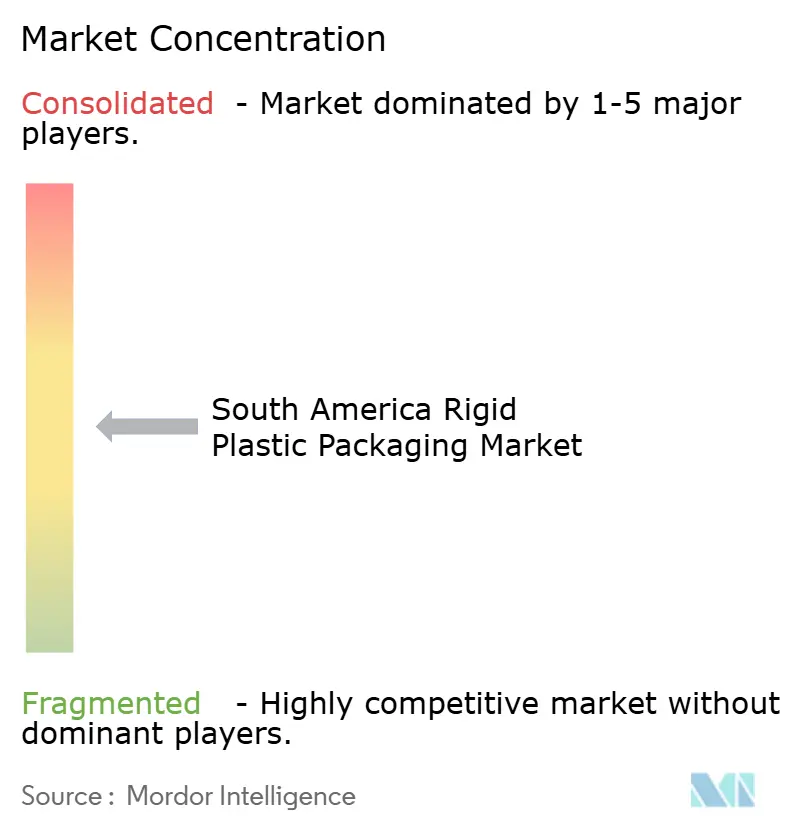
The South America rigid plastic packaging market has moderate concentration among the largest suppliers. Amcor, Plastipak, Valgroup, and ALPLA serve significant beverage, food, and healthcare packaging volumes. Amcor completed its combination with Berry Global in April 2025. The combined company reported USD 23 billion in annualized revenue across 400 facilities. The transaction increased the value of scale, broad technical capabilities, and customer coverage. It also leaves room for domestic suppliers with strong pharmaceutical certification and local development support.
Industrial packaging follows a different competitive model from consumer packaging. Mauser Packaging Solutions and Greif compete in IBCs, drums, and pallets through reconditioning and life-cycle services. Greif reopened its Esteio facility in Rio Grande do Sul during 2026 after rebuilding the site following the 2024 floods. The rebuilt plant includes real-time process monitoring and modern industrial equipment. Braskem provides an important bio-based resin platform through its I'm Green portfolio. Its 275,000-tonne annual bio-PE capacity supports domestic food-contact applications.
Recycled-content rules are becoming a stronger supplier qualification factor in Brazil and Colombia. Suppliers need reliable access to certified recycled resin to support customer compliance requirements. ALPLA's Clean Bottle investment strengthened its rHDPE supply position in Brazil. Valgroup acquired Innova's plastic caps segment in Manaus during August 2026. This move added compression-molded cap production for PET water, soft drink, and juice packaging. The company expanded its integrated beverage packaging offer across 47 plants in 6 countries. Braskem's August 2026 restructuring process may create near-term uncertainty for converters that depend on domestic PE and PP supply.
South America Rigid Plastic Packaging Industry Leaders
-
Amcor plc
-
ALPLA Werke Alwin Lehner GmbH & Co KG
-
Plastipak Holdings, Inc.
-
Indorama Ventures Public Company Limited
-
Braskem S.A
- *Disclaimer: Major Players sorted in no particular order
South America Rigid Plastic Packaging Market Companies Covered in this Report
- Amcor plc
- ALPLA Werke Alwin Lehner GmbH & Co KG
- Braskem S.A.
- Plastipak Holdings, Inc.
- Gerresheimer AG
- Graham Packaging Company, L.P.
- Indorama Ventures Public Company Limited
- Valgroup
- Logoplaste Group
- Carvajal Empaques S.A.
- Mauser Packaging Solutions
- Greif, Inc.
- Schütz GmbH & Co. KGaA
- Schoeller Allibert Services B.V.
- Resilux NV
- Unipac Embalagens Ltda.
- Plaszom Zomer Indústria de Plásticos Ltda.
- Rose Plastic Brasil Embalagens Plásticas Ltda.
- Weener Plastics Group B.V.
Recent Industry Developments in South America Rigid Plastic Packaging Market
- August 2026: Valgroup acquired the plastic caps segment of Innova petrochemical in Manaus, Amazonas state, Brazil, incorporating compression-molded cap production for PET water, soft drink, and juice packaging. The acquisition expands Valgroup's integrated beverage-packaging portfolio across 47 plants in 6 countries and strengthens industrial presence in Brazil's North region.
- August 2026: Braskem filed for out-of-court restructuring of USD 10.9 billion (BRL 56.5 billion) in financial debt, seeking creditor approval within 90 days. The proceeding covers the largest polyolefins producer in the Americas, raising uncertainty over resin supply continuity and downstream investment plans for packaging converters dependent on domestic PE and PP.
- August 2026: Amcor reported fiscal year 2026 results, delivering USD 285 million in synergies from the Berry Global acquisition, 10% ahead of initial projections and nearly half of the USD 650 million 3-year target. Global rigid packaging net sales rose on volume growth in protein and dairy categories.
- June 2026: Amcor introduced the first Moda rotary vacuum chamber sealing system in Brazil, implemented at Barra Mansa Alimentos' meat processing facility. 3 Moda Vac systems replaced up to 9 belt-chamber machines, raising line throughput and sealing consistency for the Brazilian protein sector.
South America Rigid Plastic Packaging Market Report Scope
The South America Rigid Plastic Packaging Market refers to the industry involved in the production, distribution, and utilization of durable plastic packaging solutions that retain their shape and structure during handling, storage, transportation, and end use.
The South America Rigid Plastic Packaging Market Report is Segmented by Product Type (Bottles and Jars, Trays and Containers, Intermediate Bulk Containers (IBCs), Pallets, and Other Product Types), Material (Polyethylene (PE) [High-Density Polyethylene (HDPE) and Low-Density Polyethylene (LDPE)], Polyethylene Terephthalate (PET) [Virgin PET and Recycled PET (rPET)], Polypropylene (PP), Polystyrene (PS) and Expanded Polystyrene (EPS), Bioplastics [Polylactic Acid (PLA) and Polyhydroxyalkanoates (PHA)], and Other Materials), End-User Industry (Food [Dairy, Confectionery and Bakery, and Ready Meals], Beverage [Carbonated Soft Drinks, Bottled Water, and Alcoholic Beverages], Healthcare [Pharmaceuticals and Medical Devices], Cosmetics and Personal Care, Industrial, Building and Construction, Automotive, and Other End-User Industries), Manufacturing Process (Injection Molding, Extrusion Blow Molding, Injection Blow Molding, Stretch Blow Molding, Thermoforming, Rotational Molding, and Compression Molding), and Geography (Brazil, Argentina, Colombia, and Rest of South America). The Market Forecasts are Provided in Terms of Value (USD).
Segmentation Overview
| Bottles and Jars |
| Trays and Containers |
| Intermediate Bulk Containers (IBCs) |
| Pallets |
| Other Product Types |
| Polyethylene (PE) | High-Density Polyethylene (HDPE) |
| Low-Density Polyethylene (LDPE) | |
| Polyethylene Terephthalate (PET) | Virgin PET |
| Recycled PET (rPET) | |
| Polypropylene (PP) | |
| Polystyrene (PS) and Expanded Polystyrene (EPS) | |
| Bioplastics | Polylactic Acid (PLA) |
| Polyhydroxyalkanoates (PHA) | |
| Other Materials |
| Food | Dairy |
| Confectionery and Bakery | |
| Ready Meals | |
| Beverage | Carbonated Soft Drinks |
| Bottled Water | |
| Alcoholic Beverages | |
| Healthcare | Pharmaceuticals |
| Medical Devices | |
| Cosmetics and Personal Care | |
| Industrial | |
| Building and Construction | |
| Automotive | |
| Other End-User Industries |
| Injection Molding |
| Extrusion Blow Molding |
| Injection Blow Molding |
| Stretch Blow Molding |
| Thermoforming |
| Rotational Molding |
| Compression Molding |
| Brazil |
| Argentina |
| Colombia |
| Rest of South America |
| By Product Type | Bottles and Jars | |
| Trays and Containers | ||
| Intermediate Bulk Containers (IBCs) | ||
| Pallets | ||
| Other Product Types | ||
| By Material | Polyethylene (PE) | High-Density Polyethylene (HDPE) |
| Low-Density Polyethylene (LDPE) | ||
| Polyethylene Terephthalate (PET) | Virgin PET | |
| Recycled PET (rPET) | ||
| Polypropylene (PP) | ||
| Polystyrene (PS) and Expanded Polystyrene (EPS) | ||
| Bioplastics | Polylactic Acid (PLA) | |
| Polyhydroxyalkanoates (PHA) | ||
| Other Materials | ||
| By End User Industry | Food | Dairy |
| Confectionery and Bakery | ||
| Ready Meals | ||
| Beverage | Carbonated Soft Drinks | |
| Bottled Water | ||
| Alcoholic Beverages | ||
| Healthcare | Pharmaceuticals | |
| Medical Devices | ||
| Cosmetics and Personal Care | ||
| Industrial | ||
| Building and Construction | ||
| Automotive | ||
| Other End-User Industries | ||
| By Manufacturing Process | Injection Molding | |
| Extrusion Blow Molding | ||
| Injection Blow Molding | ||
| Stretch Blow Molding | ||
| Thermoforming | ||
| Rotational Molding | ||
| Compression Molding | ||
| By Geography | Brazil | |
| Argentina | ||
| Colombia | ||
| Rest of South America | ||
Key Questions Answered in the Report
What is the South America rigid plastic packaging market size?
The South America rigid plastic packaging market was estimated at USD 14.32 billion in 2026. It is forecast to reach USD 17.15 billion by 2031, representing a CAGR of 3.67% during 2026-2031.
Which product category leads rigid plastic packaging demand in South America?
Bottles and jars led product demand, accounting for 45.24% of revenue in 2025. PET beverage bottles and HDPE household and personal care containers remain the primary applications supporting this dominance.
Which material is most widely used for rigid plastic packaging in South America?
Polyethylene accounted for 35.67% of revenue in 2025. HDPE is extensively used in bottles, drums, and IBCs, while LDPE is utilized in selected rigid and flexible-adjacent packaging applications.
Which end-user category has the largest demand for rigid plastic packaging?
Food represented 40.23% of revenue in 2025, driven by demand for dairy containers, bakery trays, and ready-meal packaging. Healthcare is expected to grow at a faster pace, registering a CAGR of 3.89% through 2031.
Why is Brazil important to rigid plastic packaging suppliers?
Brazil accounted for 44.54% of regional revenue in 2025 and is projected to grow at a CAGR of 3.78% through 2031. The country's recycling and recovery targets significantly influence converter investments and material sourcing strategies.
What are the principal challenges for rigid plastic packaging suppliers in South America?
Key challenges include flexible packaging substitution, resin price fluctuations, foreign-exchange volatility, uneven collection systems, and limited availability of food-grade recycled resin. These factors can constrain margins, supply reliability, and compliance progress.