
South America Proximity Access Control Market Size and Share
Market Overview
| Study Period | 2020 - 2031 |
|---|---|
| Forecast Data Period | 2026 - 2031 |
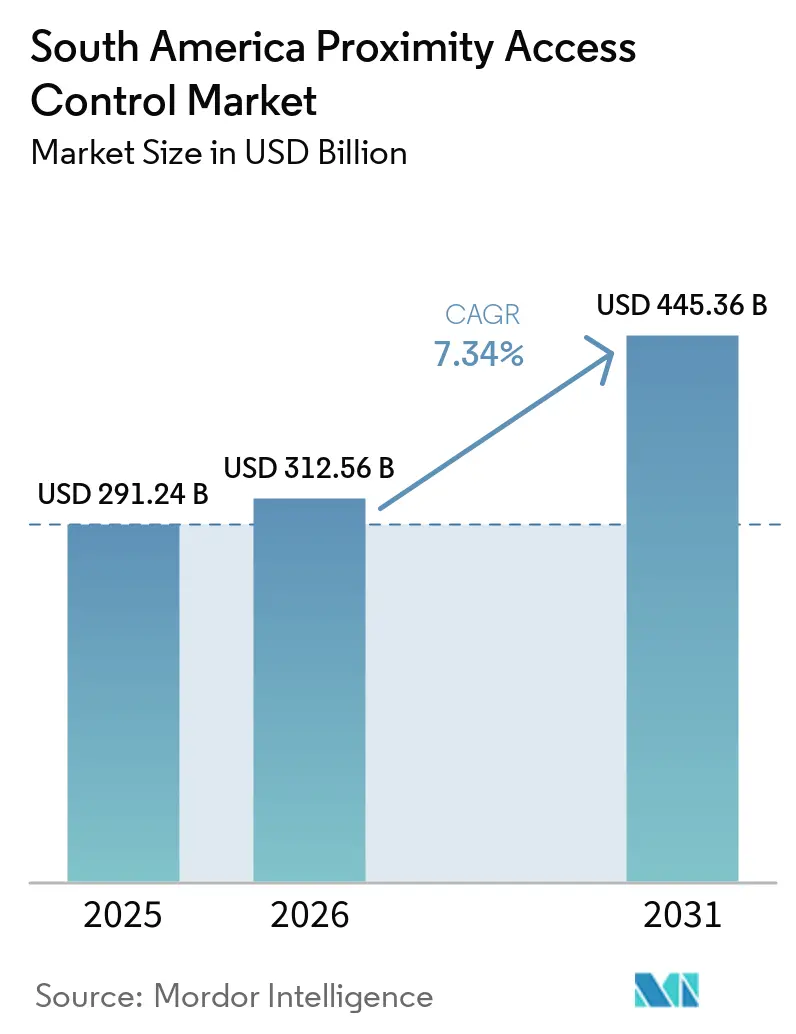
| Base Year Market Size (2025) | USD 291.24 Billion |
| Market Size (2026) | USD 312.62 Billion |
| Market Size (2031) | USD 445.47 Billion |
| Growth Rate (2026 - 2031) | 7.34 % |
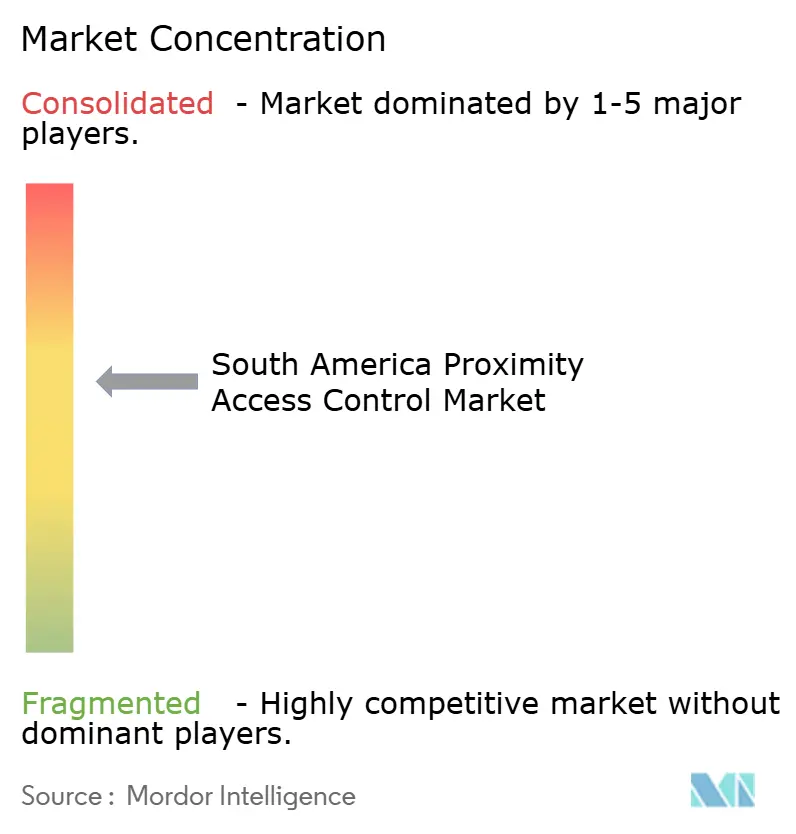
| Market Concentration | Medium |
Major Players *Disclaimer: Major Players sorted in no particular order Image © Mordor Intelligence. Reuse requires attribution under CC BY 4.0. | |
South America Proximity Access Control Market Analysis by Mordor Intelligence
The South America Proximity Access Control Market size is projected to expand from USD 291.24 billion in 2025 and USD 312.62 billion in 2026 to USD 445.47 billion by 2031, registering a CAGR of 7.34% between 2026 and 2031.
Lower controller prices and subscription options have widened adoption beyond large enterprises and government buyers. Security requirements and regulatory obligations have made electronic access control more important for commercial facilities. Brazil's construction pipeline supports new installations, while older systems in Argentina and Chile support retrofit demand. Providers are balancing hardware sales with cloud services, although deployment conditions vary across the region.
Key Report Takeaways
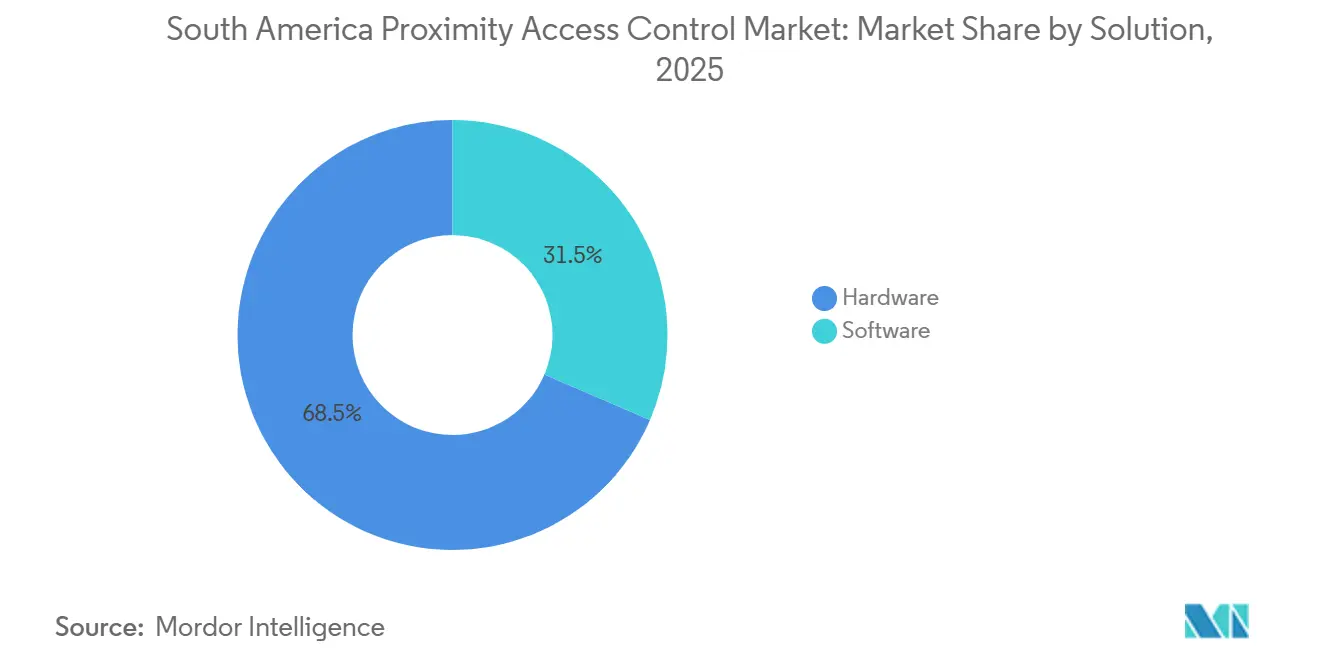
- By solution, hardware held 68.54% of the South America proximity access control market share in 2025, while software is projected to expand at an 8.24% CAGR through 2031.
- By technology, RFID accounted for 52.36% of the South America proximity access control market share in 2025 and is projected to expand at an 8.76% CAGR through 2031.
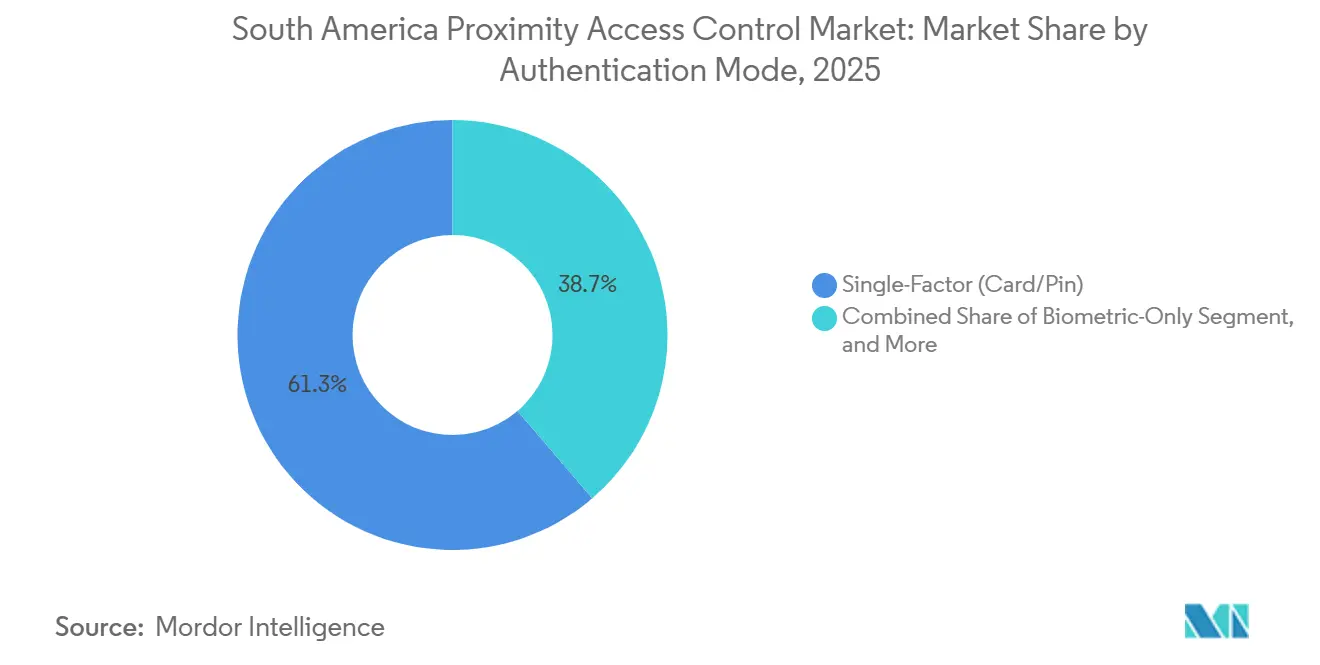
- By authentication mode, single-factor authentication held 61.27% of revenue in 2025, while multi-factor authentication is projected to expand at an 8.79% CAGR through 2031.
- By access control type, proximity readers accounted for 42.59% of revenue in 2025, while wireless locks are projected to expand at an 8.46% CAGR through 2031.
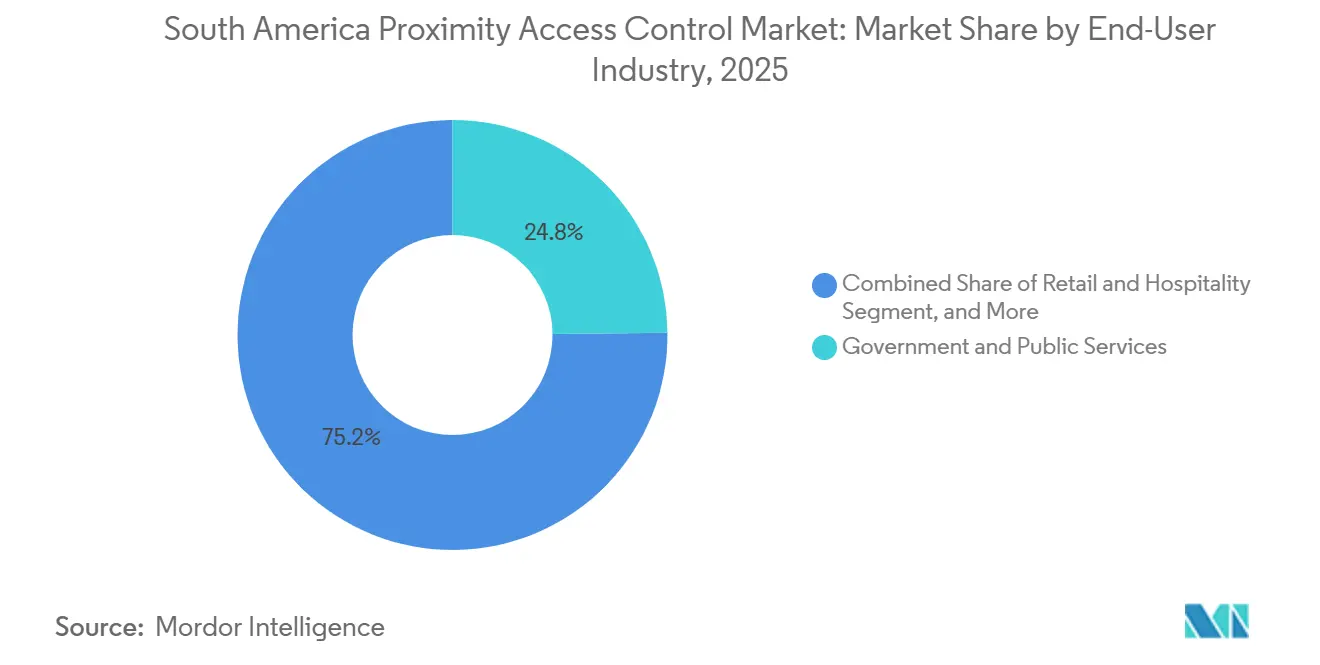
- By end-user industry, government and public services held 24.83% of revenue in 2025, while transportation and logistics is projected to expand at an 8.34% CAGR through 2031.
- By geography, Brazil accounted for 47.31% of revenue in 2025, while Colombia is projected to expand at an 8.23% CAGR through 2031.
Note: Market size and forecast figures in this report are generated using Mordor Intelligence’s proprietary estimation framework, updated with the latest available data and insights as of January 2026.
Market Trends and Insights
Drivers Impact Analysis of South America Proximity Access Control Market*
| Driver | (~) % Impact on CAGR Forecast | Geographic Relevance | Impact Timeline |
|---|---|---|---|
| Expansion of Cloud-Managed Access Control | +2.1% | Brazil, Colombia, Argentina, with secondary uptake in Chile and Peru | Medium term (2-4 years) |
| Brazil-Led Commercial and Logistics Construction | +1.8% | Brazil primarily, with secondary relevance in Colombia and Chile | Short term (≤ 2 years) |
| Rising Demand for Multi-Technology Credentials | +1.4% | Brazil, Colombia, and Argentina | Medium term (2-4 years) |
| Integration of Physical Access With Identity and Security Platforms | +1.2% | Brazil and Colombia, with spillover to Argentina | Long term (≥ 4 years) |
| Government and Public Infrastructure Security Modernization | +0.9% | Brazil, Colombia, and Argentina | Medium term (2-4 years) |
| Replacement of Legacy Low-Frequency Proximity Installations | +0.7% | Brazil, Chile, and Argentina | Long term (≥ 4 years) |
| Source: Mordor Intelligence | |||
Expansion of Cloud-Managed Access Control
Cloud-managed systems are changing how sites buy and administer physical access control. Facility operators can manage policies across multiple locations without installing servers at every property. Hybrid cloud and on-premise configurations are expected to represent 70% of new installations in Brazil in 2026.[1] This mix shows that customers still need local control alongside remote management. Data center capacity in São Paulo, Bogotá, and Buenos Aires supports wider adoption beyond the largest cities. The South America proximity access control market therefore gives service providers an opening to combine cloud administration with local support.
Brazil-Led Commercial and Logistics Construction
Commercial and logistics construction in Brazil creates demand for access systems at warehouses, ports, offices, and technical areas. These locations require controlled entry at loading bays, administration blocks, and restricted zones. Intelbras identified advanced biometrics and digital locks among its 2026 development priorities. Brazil's NR-18 labor safety standards also support controlled site entry for worker identification. These conditions keep construction-related demand important to the South America proximity access control market.
Rising Demand for Multi-Technology Credentials
Multi-technology readers can process 125 kHz proximity cards, 13.56 MHz smart cards, and Bluetooth LE mobile credentials from one module. This design lets buyers continue using existing cards while adding newer credentials for new users. It also avoids making one credential format permanent at the time of installation. In December 2025, HID Global collaborated with Invenzi to add OSDP communication, encryption, and cloning protection to the W-Access platform.[2] The partnership supports larger corporate and critical infrastructure installations in Brazil. Local platform partnerships can help the South America proximity access control market reach customers without disrupting established integrator relationships.
Integration of Physical Access with Identity and Security Platforms
Organizations are connecting physical access systems with identity, security, and human resources platforms. A change in an employee's contract status can then update building access and server-room permissions. This capability requires controllers and software that communicate with enterprise directories in real time. Brazil's General Data Protection Law, known as LGPD, requires access to systems processing personal data to be restricted to authorized users. The National Data Protection Authority opened a consultation on biometric data processing on June 2, 2025, under its 2025-2026 agenda. The South America proximity access control market benefits when compliance needs turn integrated identity management into a procurement priority.
Restraints Impact Analysis of South America Proximity Access Control Market*
| Restraint | (~) % Impact on CAGR Forecast | Geographic Relevance | Impact Timeline |
|---|---|---|---|
| Import Duties and Currency Volatility | -0.8% | Brazil and Argentina, with secondary effects in Colombia and Chile | Short term (≤ 2 years) |
| Fragmented Installer and Integrator Capability | -0.6% | South America, with the greatest effect in secondary cities | Medium term (2-4 years) |
| Data-Protection Exposure from Biometric and Mobile Credentials | -0.3% | Brazil, Argentina, and Colombia | Long term (≥ 4 years) |
| Interoperability Constraints Across Installed Card Systems | -0.2% | Brazil and Argentina, with regional spillover | Long term (≥ 4 years) |
| Source: Mordor Intelligence | |||
Import Duties and Currency Volatility
Imported reader modules, controller boards, and encrypted credentials face tariffs in several South American countries. Brazil's Imposto de Importação and Imposto sobre Produtos Industrializados add to the landed cost of electronic security hardware. Currency weakness raises local costs when premium components are priced in USD. Budget constraints can delay upgrades even when a site needs better security. Local manufacturing can reduce exposure for domestic suppliers, including Intelbras in Brazil. This pressure limits volume for premium imported products in the South America proximity access control market outside high-value projects.
Fragmented Installer and Integrator Capability
Many locations lack integrators with the skills needed for cloud-managed or biometric-enabled deployments. The gap is more visible in secondary Brazilian cities and outside capital-city business centers. Customers may accept weaker designs or pay to bring technical teams from other locations. Both outcomes extend project schedules and reduce procurement speed. Certification programs and deployment training can help vendors improve local capability. Such programs can broaden the reach of the South America proximity access control market without requiring large internal service teams.
*Our forecasts treat driver/restraint impacts as directional, not additive. The impact forecasts reflect baseline growth, mix effects, and variable interactions.
South America Proximity Access Control Market Segment Analysis
By Solution:
Hardware Anchors Revenue While Software Changes Operating EconomicsHardware held 68.54% of the South America proximity access control market size in 2025. This position reflected the region's continued need for physical devices at new and existing sites. Door controllers provided the local connection between credentials, doors, and wider management systems. Card and proximity readers formed the largest part of equipment demand at offices, government facilities, and commercial properties. Biometric readers served financial services and public sites that required higher assurance at selected doors. Keypads and wireless locks extended coverage to smaller openings and locations where conventional wiring was difficult. First-generation projects therefore continued to require substantial upfront equipment spending. Replacement projects also required readers and controllers when sites moved to stronger encrypted formats. Hardware suppliers needed dependable local stock because a missing component could delay an entire installation. The category remained essential even where customers adopted a subscription-based management platform.
Software is projected to expand at an 8.24% CAGR through 2031. Cloud-hosted platforms allow authorized staff to administer policies across several offices, warehouses, or retail locations. Managed services can reduce the need for every site to maintain dedicated server equipment and specialist personnel. Hybrid systems retain local functions while allowing regional teams to oversee users and door events remotely. On-premise software still serves public and health care settings that keep credential information within local infrastructure. Mobile credential management supports Bluetooth LE readers and connects physical entry with digital identity programs. It also lets organizations introduce phone-based entry alongside existing RFID cards. Hybrid cloud and on-premise configurations are expected to account for 70% of new Brazilian installations in 2026. This practical preference shows that cloud adoption does not remove the need for local resilience. The South America proximity access control market consequently includes both recurring software revenue and lasting equipment demand.
By Technology:
RFID Retains Scale Through Encrypted Credential UpgradesRFID held 52.36% of South America proximity access control market share in 2025. The category covers the established 125 kHz format and the newer 13.56 MHz format. It remains common because readers provide quick entry and work across many physical access settings. Corporate offices use RFID for regular employee traffic at entrances and internal doors. Government facilities use the technology where credentials must be issued and administered at scale. Financial facilities value the ability to combine cards with additional verification at sensitive areas. Many deployments are now replacing outdated readers instead of building completely new door infrastructure. That approach reduces disruption because existing cabling and door hardware can often remain in place. Reader replacement also gives customers a way to improve protection without changing every part of the system. The installed base therefore keeps RFID central to spending in the South America proximity access control market.
RFID is also projected to expand at an 8.76% CAGR through 2031. The projection reflects the ongoing move from 125 kHz Wiegand readers to encrypted 13.56 MHz credentials. Legacy Wiegand systems transmit credential data in cleartext and are more exposed to cloning. MIFARE DESFire EV3 and HID iCLASS SE offer encrypted alternatives for these upgrade projects. The resulting demand is RFID revenue, but it represents security hardening within the same technology family. HID Global's 2025 collaboration with Invenzi added OSDP communication and credential-cloning protection to Brazilian deployments. NFC supports digital credential programs that work with devices and wallet services. Bluetooth LE supports mobile entry at campuses, shared workspaces, and commercial buildings. These technologies work alongside RFID rather than simply replacing it. Technology selection also needs to consider developing rules for biometric and electronic credential information.
By Authentication Mode:
Multi-Factor Systems Support Stronger Identity ControlsSingle-factor authentication held 61.27% of revenue in 2025. Card and PIN methods remain widespread because many buildings already use basic credential systems. Government offices, corporate sites, and financial facilities use these methods for routine access. Their familiarity makes administration straightforward for large groups of employees, visitors, and contractors. Biometric-only access serves a smaller set of locations with high security requirements. Data center cages, pharmaceutical vaults, and government command centers can accept slower verification for stronger assurance. These sites often control access to valuable information, equipment, or restricted materials. The sizeable installed base of single-factor systems provides a continuing upgrade opportunity. Buyers can retain cards at general doors while adding stronger methods at limited sensitive areas. This balance keeps basic authentication relevant within the South America proximity access control market.
Multi-factor authentication is projected to expand at an 8.79% CAGR through 2031. It can combine a card with biometric verification or mobile access with a PIN. This approach reduces reliance on a single credential at entrances that require more careful identity checks. Organizations are adopting it when physical access governance is connected to enterprise identity management. The approach can also support audit requirements for server rooms, laboratories, vaults, and operational control areas. Biometric deployments require attention to consent, storage, and alternative methods of entry under the LGPD. Facilities may face later adjustment costs if these processes are absent when requirements are applied. Intelbras identified facial recognition and Palm Vein authentication as 2026 development priorities. These tools broaden the available options for organizations that need stronger identity verification. Multi-factor adoption links access system procurement more closely with wider identity and privacy controls.

By Access Control Type:
Proximity Readers Lead While Wireless Locks Gain UseProximity readers accounted for 42.59% of revenue in 2025. They are widely used at government buildings, financial institutions, and corporate office complexes. Their position reflects predictable read ranges, efficient throughput, and compatibility with RFID credentials. These characteristics make them suitable for entrances that process regular employee and visitor traffic. Card readers remain important in older multi-tenant properties that have not completed contactless upgrades. Biometric scanners are used in manufacturing and warehouse facilities to strengthen attendance and zone access processes. Sites can deploy different reader types at separate doors according to security and operational requirements. Proximity readers remain a familiar option for high-security projects that need controlled entry at scale. Their installed base also supports replacement demand as customers upgrade credential encryption. This leads the South America proximity access control market to retain a large reader hardware requirement.
Wireless locks are projected to expand at an 8.46% CAGR through 2031. They are useful for commercial retrofits, residential high-rises, and small premises where new cabling would add cost. These devices can bring controlled access to doors that were not part of an original centralized system. They can also support phased upgrades within occupied buildings. IP-connected door controllers are replacing earlier panel-based designs in sites that need centralized policy management. Such controllers can communicate with cloud-hosted management applications across multiple doors. Metal detectors, alarms, and intrusion sensors remain supporting elements at transport hubs and government perimeters. They contribute to layered security but are not primary proximity access components. Buyers often combine these elements where regulations or site risks require several verification steps. This broader equipment mix lets providers address both large campuses and smaller retrofit opportunities.
By End-User Industry:
Government Leads While Logistics Adds New DemandGovernment and public services held 24.83% of revenue in 2025. Security modernization programs support system demand at public facilities across Brazil, Argentina, and Colombia. Government campuses need access records that show who entered multiple buildings and restricted rooms. These requirements favor centrally administered systems with dependable credential control. Public procurement often proceeds under multiyear framework contracts rather than single isolated purchases. Vendors already listed under public purchasing arrangements can have renewal advantages. Local-content requirements can add to this advantage where domestic production supports eligibility. The public sector therefore provides a stable revenue base even when private investment conditions change. Government projects also often require installed systems to meet specific security and audit standards. This role makes public services important within the South America proximity access control market.
Transportation and logistics is projected to expand at an 8.34% CAGR through 2031. Brazil's bonded warehouse expansion supports demand for controlled and documented entry at logistics locations. Colombia's fourth-generation road program also creates access needs around new transport-related facilities. Cross-border e-commerce requires reliable records at customs-bonded sites and restricted operating areas. Warehouses need different permission levels for drivers, warehouse workers, visitors, and administrative personnel. Banking and financial services remain a high-value purchaser of layered authentication at vaults and server rooms. Health care and life sciences facilities need controlled access around patient records, medicines, and sensitive work areas. Retail, hospitality, IT and telecom, manufacturing, and smart homes further diversify demand. Brazilian condominium developments are increasingly treating digital access as a basic feature rather than an optional upgrade. This spread of use cases broadens the South America proximity access control industry beyond its traditional public and corporate base.
Geography Analysis
Brazil Proximity Access Control Market
Brazil held 47.31% of the South America proximity access control market share in 2025. It has the largest corporate and government installed base in the region. Its construction pipeline also adds new sites for access system deployment. Brazil's electronic security sector reached BRL 16 billion, or USD 2.74 billion, in 2025. The sector is projected to expand at an 18.8% rate in 2026, according to ABESE research presented at EXPOSEC 2026.
Colombia Proximity Access Control Market
Brazil's LGPD shapes system design where biometric and personal data are involved. The ANPD's 2025-2026 agenda placed biometric data processing among its first priorities. Its June 2025 consultation may lead to rules on data storage, consent, processing, and sharing. Organizations with biometric systems may need to review consent arrangements and data handling practices. Colombia is projected to expand at an 8.23% CAGR through 2031, supported by public-safety, transport, and logistics projects.
South America Proximity Access Control Market
Bogotá's C4 network added 1,200 monitoring points in 2026, creating controlled-entry needs at related facilities. Colombia's newer projects can adopt encrypted readers and cloud-managed controllers without replacing as much legacy infrastructure. Argentina is recovering as improved macroeconomic conditions support commercial investment, although import exposure and currency constraints remain. Chile has demand from remote mining sites where access verification supports safety operations. Peru and Ecuador have port, logistics, and urban-security projects, while Paraguay and Uruguay offer smaller opportunities in financial services and commercial real estate.
Competitive Landscape
The South America proximity access control market is moderately concentrated in credentials and platform technology. HID Global, Allegion, and dormakaba are active in encrypted cards and reader technology. Installation and service activities remain fragmented among regional integrators. Platform suppliers can earn recurring income from credential licensing and cloud subscriptions. Integrators rely more heavily on projects unless they secure managed service contracts.
Intelbras has an advantage from its local Brazilian manufacturing base. Domestic production can reduce the effect of import duties and currency movements on mid-market buyers. The company identified facial recognition adapted to Brazil's ethnic diversity as a 2026 development priority. In December 2025, HID Global partnered with Invenzi to incorporate encryption and OSDP communication into the W-Access platform. This approach lets global technology reach customers through local integrator relationships.
Cloud access control for multi-site logistics operators outside the São Paulo-Rio de Janeiro corridor remains an opening. Health care and life sciences sites may seek systems that provide access records while meeting privacy obligations. Brazilian condominium projects are also treating digital access as base infrastructure more often. Vendors with privacy-focused credential management can be better positioned as biometric rules develop. ASSA ABLOY's Global Technologies division, which includes HID Global, reported 8% organic growth in the first half of the period under review.[3]
South America Proximity Access Control Industry Leaders
-
ASSA ABLOY AB
-
HID Global Corporation
-
Johnson Controls International plc
-
Honeywell International Inc.
-
Intelbras S/A Indústria de Telecomunicação Eletrônica Brasileira
- *Disclaimer: Major Players sorted in no particular order
South America Proximity Access Control Market Companies Covered in this Report
- ASSA ABLOY AB
- Allegion plc
- HID Global Corporation
- dormakaba Holding AG
- Johnson Controls International plc
- Honeywell International Inc.
- Intelbras S/A Indústria de Telecomunicação Eletrônica Brasileira
- Gallagher Group Limited
- SALTO Systems, S.L.
- Genetec Inc.
- Suprema Inc.
- IDEMIA Group S.A.S.
- Thales S.A.
- Bosch Sicherheitssysteme GmbH
- Axis Communications AB
- Nedap N.V.
- Identiv, Inc.
- Vanderbilt Industries, Inc.
- Paxton Access Ltd.
- Hangzhou Hikvision Digital Technology Co., Ltd.
- Zhejiang Dahua Technology Co., Ltd.
- Schneider Electric SE
Recent Industry Developments in South America Proximity Access Control Market
- June 2026: Associação Brasileira das Empresas de Sistemas Eletrônicos de Segurança released its Panorama 2025 and Outlook 2026 research at EXPOSEC 2026 in São Paulo. The research stated that Brazil's electronic security industry had exceeded BRL 16 billion, or USD 2.74 billion, in revenue during 2025 and projected 18.8% sector expansion in 2026. It also reported that AI was embedded in 85.7% of products manufactured in Brazil. The reported use of AI indicated a shift toward domestic readers and controllers with local analytical capability. This development was relevant to buyers that need processing at the device when cloud connectivity is not dependable at remote sites.
- June 2026: Brazil's National Data Protection Authority celebrated one year since the opening of a public consultation on draft biometric data processing rules under the LGPD. The consultation addressed fingerprints, facial recognition, and voice-pattern authentication in settings that include access control. It was listed as a Phase 1 priority within the ANPD's 2025-2026 regulatory agenda. The expected standards could influence reader specifications, consent-management processes, and data retention practices. Organizations using biometric access systems may need to account for these obligations in future procurement decisions.
- January 2026: HID Global and Sharry announced the first implementation of HID Mobile Access with Apple Wallet and Google Wallet credential integration for corporate buildings in South America. The deployment enabled more than 5,500 active users at commercial complexes to authenticate through digital wallets. It provided a regional example of wallet-compatible access management for office buildings. The implementation may support wider reader specifications that accommodate mobile credentials at enterprise campuses.
- January 2026: HID Global announced an OEM technology collaboration with Invenzi in Brazil. The collaboration added OSDP communication, encryption, and credential-cloning protection to Invenzi's W-Access platform for critical operations and multi-building corporate deployments. The platform can serve deployments with tens of buildings, hundreds of control points, and thousands of active users. The arrangement allowed HID-standard encryption to be used without requiring complete replacement of existing infrastructure. It also showed how international technology can be delivered through local access management platforms.
South America Proximity Access Control Market Report Scope
The South America Proximity Access Control Market refers to the industry focused on the development, manufacturing, integration, and deployment of contactless access management solutions that use technologies such as RFID cards, key fobs, smart credentials, mobile-based authentication, and biometric-enabled proximity systems to regulate and monitor entry to physical locations.
The South America Proximity Access Control Market Report is Segmented by Solution (Hardware [Door Controllers, Card and Proximity Readers, Biometric Readers, and Keypads and Wireless Locks] and Software [On-Premise Platforms, Cloud (Hosted, Managed, Hybrid ACaaS), and Mobile Credential Management]), Technology (RFID (125 kHz, 13.56 MHz), NFC, Bluetooth LE, and Wi-Fi/Zigbee/Z-Wave), Authentication Mode (Single-Factor (Card/Pin), Biometric-Only, and Multi-Factor (Card + Biometric/Mobile + Pin)), Access Control Type (Card Readers, Biometric Scanners, Proximity Readers, Alarms and Intrusion Sensors, Metal Detectors, Door Controllers, and Wireless Locks), End-user Industry (Government and Public Services, Banking and Financial Services, IT and Telecom, Transportation and Logistics, Retail and Hospitality, Healthcare and Life Sciences, Residential and Smart Homes, and Manufacturing and Warehousing), and Geography (Brazil, Argentina, Colombia, and Rest of South America). The Market Forecasts are Provided in Terms of Value (USD).
Segmentation Overview
| Hardware | Door Controllers |
| Card and Proximity Readers | |
| Biometric Readers | |
| Keypads and Wireless Locks | |
| Software | On-Premise Platforms |
| Cloud (Hosted, Managed, Hybrid ACaaS) | |
| Mobile Credential Management |
| RFID (125 kHz, 13.56 MHz) |
| NFC |
| Bluetooth LE |
| Wi-Fi / Zigbee / Z-Wave |
| Single-Factor (Card/Pin) |
| Biometric-Only |
| Multi-Factor (Card + Biometric / Mobile + Pin) |
| Card Readers |
| Biometric Scanners |
| Proximity Readers |
| Alarms and Intrusion Sensors |
| Metal Detectors |
| Door Controllers |
| Wireless Locks |
| Government and Public Services |
| Banking and Financial Services |
| IT and Telecom |
| Transportation and Logistics |
| Retail and Hospitality |
| Healthcare and Life Sciences |
| Residential and Smart Homes |
| Manufacturing and Warehousing |
| Brazil |
| Argentina |
| Colombia |
| Rest of South America |
| By Solution | Hardware | Door Controllers |
| Card and Proximity Readers | ||
| Biometric Readers | ||
| Keypads and Wireless Locks | ||
| Software | On-Premise Platforms | |
| Cloud (Hosted, Managed, Hybrid ACaaS) | ||
| Mobile Credential Management | ||
| By Technology | RFID (125 kHz, 13.56 MHz) | |
| NFC | ||
| Bluetooth LE | ||
| Wi-Fi / Zigbee / Z-Wave | ||
| By Authentication Mode | Single-Factor (Card/Pin) | |
| Biometric-Only | ||
| Multi-Factor (Card + Biometric / Mobile + Pin) | ||
| By Access Control Type | Card Readers | |
| Biometric Scanners | ||
| Proximity Readers | ||
| Alarms and Intrusion Sensors | ||
| Metal Detectors | ||
| Door Controllers | ||
| Wireless Locks | ||
| By End-user Industry | Government and Public Services | |
| Banking and Financial Services | ||
| IT and Telecom | ||
| Transportation and Logistics | ||
| Retail and Hospitality | ||
| Healthcare and Life Sciences | ||
| Residential and Smart Homes | ||
| Manufacturing and Warehousing | ||
| By Geography | Brazil | |
| Argentina | ||
| Colombia | ||
| Rest of South America | ||
Key Questions Answered in the Report
What is the South America proximity access control market size?
The South America proximity access control market size is estimated at USD 312.62 million in 2026 and is projected to reach USD 445.47 million by 2031, registering a CAGR of 7.34%. The forecast reflects demand for installations, retrofits, readers, controllers, credentials, software, and related access management services. The outlook also reflects the need to replace older readers and improve management across multiple facilities.
Which solution category leads regional access control spending?
Hardware led with 68.54% of revenue in 2025. Door controllers, card and proximity readers, biometric readers, keypads, and wireless locks remain necessary at new sites and when existing buildings replace outdated devices. Software is projected to expand faster as multi-site management needs increase. Buyers commonly need both equipment at the door and management software that governs user permissions.
Which technology is expanding fastest in proximity access systems?
RFID is projected to expand at an 8.76% CAGR through 2031. The rate is supported by upgrades from 125 kHz Wiegand readers to encrypted 13.56 MHz credentials and readers, rather than simple replacement of RFID with another technology. This upgrade path allows sites to improve credential protection while retaining other parts of their physical access infrastructure.
Why is multi-factor authentication gaining adoption?
Multi-factor authentication is projected to expand at an 8.79% CAGR because organizations are linking physical access with enterprise identity controls. It can combine card, mobile, biometric, and PIN verification for sensitive areas such as vaults, server rooms, laboratories, and operational control points. It is especially relevant where one credential alone does not provide the required level of assurance.
Which country has the largest regional revenue base?
Brazil accounted for 47.31% of 2025 revenue. Its corporate and government installed base, construction activity, local manufacturing capability, and security modernization programs support new installations and upgrades to older systems. Brazil also has a broad set of commercial, industrial, and public facilities that require access credentials and auditable entry controls.
Which end-user area has the highest projected expansion?
Transportation and logistics is projected to expand at an 8.34% CAGR through 2031. Bonded warehouses, road programs, e-commerce logistics, and customs-controlled facilities need documented access for drivers, workers, visitors, and administrative personnel. These operations also require separate permissions for restricted zones, loading areas, offices, and technical rooms.