
South America Prefabricated Bathroom Modules Market Size and Share
Market Overview
| Study Period | 2020 - 2031 |
|---|---|
| Forecast Data Period | 2026 - 2031 |
| Base Year Market Size (2025) | USD 0.13 Billion |
| Market Size (2026) | USD 0.14 Billion |
| Market Size (2031) | USD 0.21 Billion |
| Growth Rate (2026 - 2031) | 8.45 % |
| Market Concentration | Low |
Major Players *Disclaimer: Major Players sorted in no particular order Image © Mordor Intelligence. Reuse requires attribution under CC BY 4.0. | |
South America Prefabricated Bathroom Modules Market Analysis by Mordor Intelligence
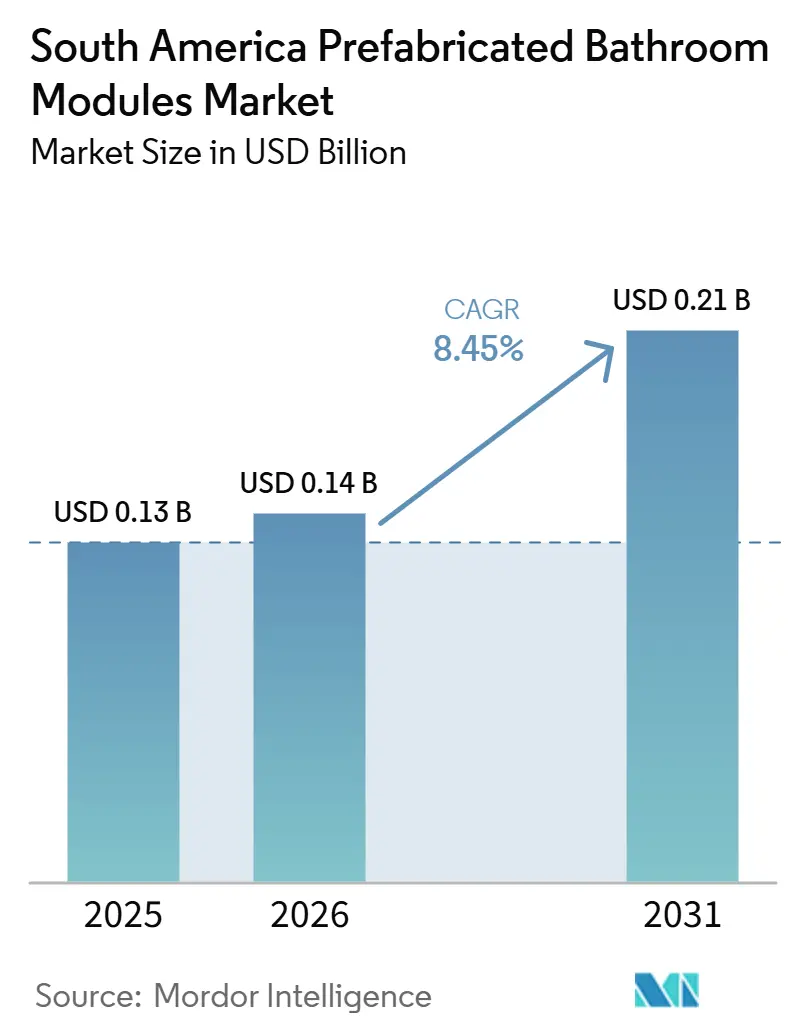
The South America Prefabricated Bathroom Modules Market size is expected to grow from USD 0.13 billion in 2025 to USD 0.14 billion in 2026 and is forecast to reach USD 0.21 billion by 2031 at 8.45% CAGR over 2026-2031.
The South America prefabricated bathroom modules market is supported by hotel development, public housing programs, and health infrastructure investment. These projects favor repeatable layouts and shorter installation schedules, because procurement teams can align room plans, bathroom specifications, and delivery dates before repetitive finishing work begins. Labor shortages also make factory production more relevant for contractors that need predictable finishing work, especially when several specialist trades would otherwise need to work in sequence within the same small room. Supply remains limited because regional production capacity is still developing, and suppliers must meet separate national requirements, leaving many buyers to assess imported units against local installation practices and approval procedures. This creates an opening for manufacturers that combine local service, verified waterproofing, and adaptable designs. The South America prefabricated bathroom modules market also rewards suppliers that can manage delivery and compliance as part of one project offer.
Key Report Takeaways
- By product type, steel framed modules held 38.40% of the South America prefabricated bathroom modules market share in 2025, while hybrid modules are forecast to expand at a 9.40% CAGR through 2031.
- By installation type, new build held 67.80% of the South America prefabricated bathroom modules market size in 2025, while retrofit and renovation are forecast to expand at a 9.00% CAGR through 2031.
- By end user, residential held 34.60% of the market in 2025, while healthcare is forecast to expand at a 9.60% CAGR through 2031.
- By geography, Brazil held 46.80% of the market in 2025, while Chile is forecast to expand at a 9.80% CAGR through 2031 in the South America prefabricated bathroom modules market.
Note: Market size and forecast figures in this report are generated using Mordor Intelligence’s proprietary estimation framework, updated with the latest available data and insights as of January 2026.
South America Prefabricated Bathroom Modules Market Trends and Insights
Drivers Impact Analysis*
| Drivers | (~) % Impact on CAGR Forecast | Geographic Relevance | Impact Timeline |
|---|---|---|---|
| Hotel and Mixed-Use Development | +2.2% | Brazil, Chile, and Colombia | Short term (≤ 2 years) |
| Construction Labor Constraints | +1.8% | Brazil, Argentina, and Colombia | Short term (≤ 2 years) |
| Standardized Social Housing Design | +1.5% | Brazil, Chile, and Argentina | Medium term (2-4 years) |
| Quality and Performance Standards | +1.2% | Brazil, with regional relevance | Medium term (2-4 years) |
| Factory-Controlled Waterproofing | +0.8% | Brazil and Chile | Medium term (2-4 years) |
| Reusable Workforce and Event Units | +0.6% | Argentina and Chile | Short term (≤ 2 years) |
| Source: Mordor Intelligence | |||
Hotel and Mixed-Use Development
Latin America had 759 active hotel projects with 111,340 rooms in the second quarter of 2026[1]. Brazil accounted for 140 of those projects and 20,181 rooms. This volume supports the South America prefabricated bathroom modules market because hotels often use repeated room layouts, allowing developers to specify the same bathroom configuration across many guestrooms without redesigning it for every floor. Brazil's hotel investment pipeline reached BRL 13.6 billion (USD 2.3 billion) across 178 new projects in 2026. The pipeline increased 28.3% from 2025 and was concentrated in midscale and upscale formats. Repeated bathroom installations allow developers to coordinate services and finishes before work begins on site, making the handover between structural work and final room completion easier to plan.
Construction Labor Constraints
Construction labor shortages are increasing interest in controlled offsite work in Brazil. Fundação Getúlio Vargas reported that 82% of construction firms faced recruitment difficulties, while 21% had delayed projects and 18% had revised pricing. Bathroom completion requires work from plumbing, electrical, tiling, and sealing teams. A prefabricated unit brings those activities into one coordinated manufacturing sequence. The South America prefabricated bathroom modules market, therefore, addresses both a practical scheduling issue and a product requirement, since the bathroom is one of the final spaces to be completed before a room can be handed over. A smaller site team can focus on connections and checks after delivery, rather than managing each individual finishing activity in an occupied or crowded construction area. This approach is especially relevant where project schedules are tight and skilled finishing crews are difficult to secure in the South America prefabricated bathroom modules market.
Standardized Social Housing Design
Government social housing programs across South America are creating the standardized procurement conditions needed to scale the adoption of prefabricated bathroom modules. Brazil's Minha Casa, Minha Vida (MCMV) program introduced a dedicated industrialized construction modality in 2025, while Portaria MCID 335 established standardized bathroom specifications for subsidized housing, including a minimum width of 1.50 meters, one washbasin, one toilet with cistern, and a 0.90 m × 0.95 m shower area with accessibility provisions. These requirements apply across projects funded under the program's BRL 208 billion (USD 35.5 billion) 2026 budget allocation, creating a consistent bathroom design suitable for large-scale prefabrication. In Chile, the Ministerio de Vivienda y Urbanismo (Minvu) formalized the Vivienda Industrializada Tipo (VIT) framework, promoting standardized industrialized housing designs on SERVIU-owned land. The framework is already supporting developments such as the 600-unit La Chacra de Castro social housing project in Chiloé and Lomas del Valle I in the Coquimbo region. The use of a limited number of standardized floor plan layouts across multiple municipalities enables developers to procure identical bathroom modules in higher volumes, reducing design coordination requirements and improving manufacturing efficiency. In 2026, São Paulo's Companhia de Desenvolvimento Habitacional e Urbano (CDHU) also launched its Industrialized Modular Offsite Construction program, making Inmetro-accredited inspection a mandatory requirement for modular systems. Together, these initiatives are strengthening quality assurance, standardization, and repeatable procurement practices, supporting broader adoption of prefabricated bathroom modules across the South America prefabricated bathroom modules market.
Quality and Performance Standards
Brazil's regulatory framework is increasingly emphasizing performance-based compliance, creating a favorable environment for prefabricated bathroom modules that can demonstrate verified quality before installation. ABNT NBR 15575 Part 6, which governs hydrosanitary systems in residential buildings, establishes performance requirements for waterproofing, durability, and plumbing systems. At the same time, the Programa Brasileiro da Qualidade e Produtividade do Habitat (PBQP-H) provides a nationally recognized quality certification framework that construction financiers and public procurement authorities use to evaluate contractor eligibility. Manufacturers operating ISO 9001-certified production facilities can provide documented evidence of waterproofing performance, acoustic insulation, and plumbing integrity for every bathroom module, supporting inspection, certification, and warranty requirements more consistently than conventional site-built construction. In addition, CGIEE Resolution No. 4/2025, approved in September 2025 and effective from January 2027, introduces minimum building energy-efficiency requirements, enforced by Inmetro as part of the permitting process. These evolving regulatory requirements further strengthen the position of factory-manufactured bathroom modules, which have pre-tested thermal, sealing, and performance characteristics. Industry evidence also indicates that prefabricated bathroom modules can reduce construction defects, shorten project schedules, and improve quality consistency, reinforcing their suitability for projects operating under Brazil's increasingly performance-oriented regulatory environment. As compliance requirements continue to tighten, certified manufacturers are expected to strengthen their position in the South America prefabricated bathroom modules market.
Restraints Impact Analysis*
| Restraints | (~) % Impact on CAGR Forecast | Geographic Relevance | Impact Timeline |
|---|---|---|---|
| Limited Regional Manufacturing Capacity | -1.8% | South America, with activity in São Paulo and Curitiba | Short term (≤ 2 years) |
| Diverse Building and Plumbing Requirements | -1.2% | Brazil, Chile, Argentina, and Colombia | Medium term (2-4 years) |
| High Upfront Manufacturing Investment | -1.0% | Brazil and Argentina | Long term (≥ 4 years) |
| Preference for Traditional Trade Packages | -0.8% | Brazil and Colombia | Short term (≤ 2 years) |
| Source: Mordor Intelligence | |||
Limited Regional Manufacturing Capacity
Regional manufacturing capacity remains limited for the South America prefabricated bathroom modules market. A peer-reviewed study in Ambiente Construído reported few active Brazilian producers and low production volumes for prefabricated bathrooms. Imported modules can incur shipping costs, currency exposure, and longer delivery coordination times, which can complicate final pricing even when a supplier has a well-established product and technical reference base. The Vicuña copper project in Argentina sourced a modular mining settlement through a Chinese consortium for delivery to the Andes. That sourcing pattern shows why location and transport planning matter for remote projects in the South America prefabricated bathroom modules market. Local plants could shorten delivery routes, but investment decisions are affected by Brazil's financing conditions and Argentina's macroeconomic volatility, so new capacity may take time to match the demand indicated by larger housing, hotel, and mining projects.
Diverse Building and Plumbing Requirements
Regulatory differences across South America's major markets increase compliance costs and limit the regional standardization of prefabricated bathroom modules. Brazil applies ABNT NBR 5626 and ABNT NBR 8160 for water supply and sanitary drainage, while Chile follows the Reglamento de Instalaciones Domiciliarias (RIDDA) and NCh433:2026 seismic requirements. Argentina enforces IRAM standards alongside AySA and provincial utility regulations, whereas Colombia applies MinVivienda Resolution 0501, the RAS framework, ICONTEC NTC 1341, and RETIE requirements. As a result, bathroom modules designed for Brazil's Minha Casa, Minha Vida (MCMV) program often require structural and plumbing modifications before they comply with regulations in neighboring countries. These country-specific requirements increase engineering costs, extend certification timelines, and reduce the economies of scale needed for regional manufacturing expansion in the South America prefabricated bathroom modules market.
*Our forecasts treat driver/restraint impacts as directional, not additive. The impact forecasts reflect baseline growth, mix effects, and variable interactions.
Segment Analysis
By Product Type: Steel Framed Modules Lead Volume While Hybrid Modules Gain Ground
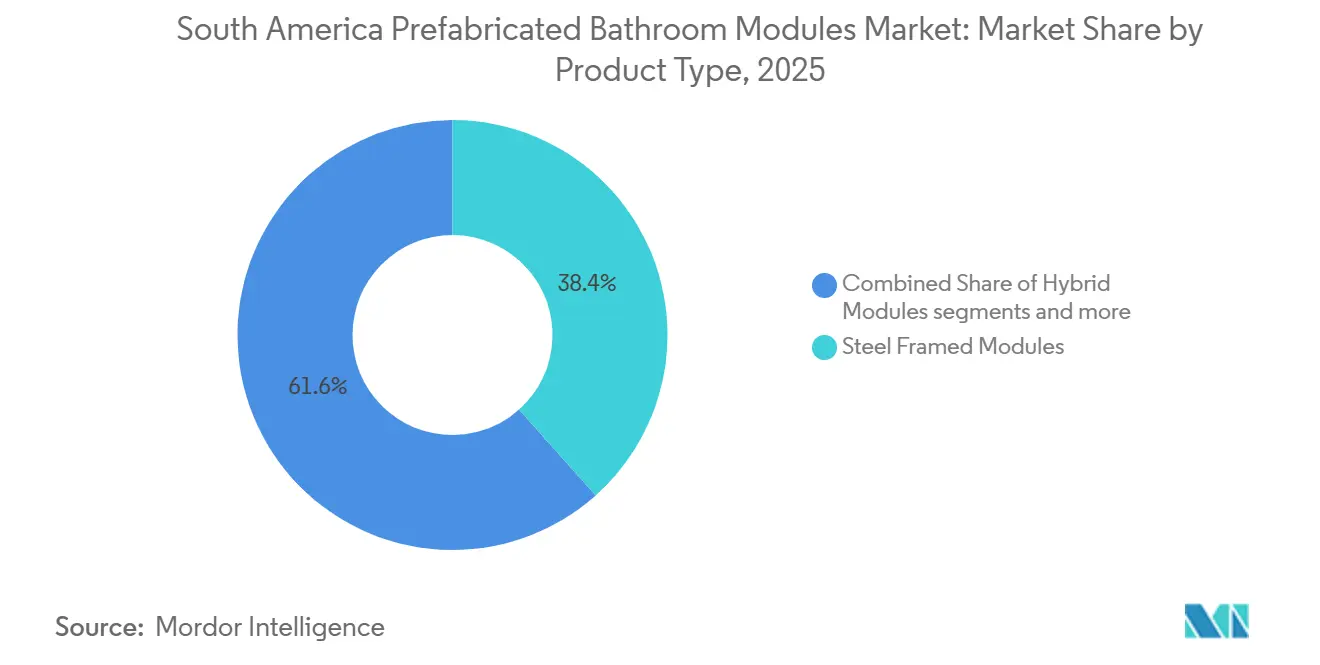
Steel-framed modules held 38.40% of the South America prefabricated bathroom modules market share in 2025. Their galvanized cold-formed steel chassis fits reinforced concrete frames and light steel structures used in hotel and residential construction, allowing design teams to use a familiar load-bearing interface while keeping the bathroom package separate from several on-site finishing activities. Steel also supports recycling considerations in projects pursuing building certification, although this benefit must be assessed alongside transport, lifting, and project-specific material requirements. The material provides manufacturers with a familiar structural base for repeated bathroom layouts and helps maintain a standard production approach across hotel rooms and similar apartment plans. Concrete modules continue to play a role in institutional and correctional settings, where durability and a more robust construction approach can take priority over lighter transport requirements. Their weight can make transport and placement more difficult at high-altitude Andean sites, where road access, crane capacity, and delivery timing must be planned carefully.
Hybrid modules are projected to grow at a 9.40% CAGR from 2026 to 2031. The South America prefabricated bathroom modules market size for hybrid configurations is driven by developers who need a steel chassis with composite, fiber-cement, or tiled wall finishes, particularly when the required finish is more detailed than that of a standard molded unit. These units can combine structural support, acoustic separation, and finished interiors, allowing teams to select materials that suit the expected use of a hotel room, hospital room, or apartment. Glass reinforced plastic (GRP) modules remain relevant for healthcare and student accommodation because they resist moisture and are easier to clean, two characteristics that are important in settings where cleaning routines and visible surface conditions receive close attention. Brasil ao Cubo, backed by Gerdau and Dexco, is developing off-site, multistory modular buildings and targets 4,032 units per year by 2028. Its work shows where hybrid specifications may become more common in larger building programs, especially when a developer seeks factory coordination without giving up a more tailored interior finish.

By Installation Type: New Build Leads While Retrofit and Renovation Accelerate
New build held 67.80% of the South America prefabricated bathroom modules market share in 2025. Modules are easiest to coordinate when they are included in the structural design from the start, because the team can resolve room dimensions, slab interfaces, utility penetrations, and delivery access before construction is advanced. Project teams can plan slab openings, service routes, lifting access, and delivery sequences around the unit dimensions. Hotel, social housing, and mixed-use projects can contain many similar bathroom layouts. Production economies are stronger when a development uses repeated room or apartment designs, as the manufacturer can repeat internal layouts, material orders, and quality-control steps across a defined production run. Temporary and relocatable units also serve mining and energy workforces that need sanitary infrastructure quickly.
Retrofit and renovation are forecast to grow at a 9.00% CAGR from 2026 to 2031. The South America prefabricated bathroom modules market serves older hotels that are replacing bathrooms to improve room quality, particularly where a property faces newer competing rooms and needs to limit disruption to operating floors. Demountable pod systems can be placed floor by floor through room openings where crane access is not practical. This method can reduce the need for wider structural demolition during renovation, helping owners focus work within guestroom boundaries rather than extending it across larger areas of an existing building. Brazil's revised residential performance requirements also raise the importance of waterproofing documentation in qualifying renovation work. Owners can use factory-built units to bring a defined product and recorded testing into a refurbishment plan.
By End User: Residential Demand Leads While Healthcare Raises Quality Requirements
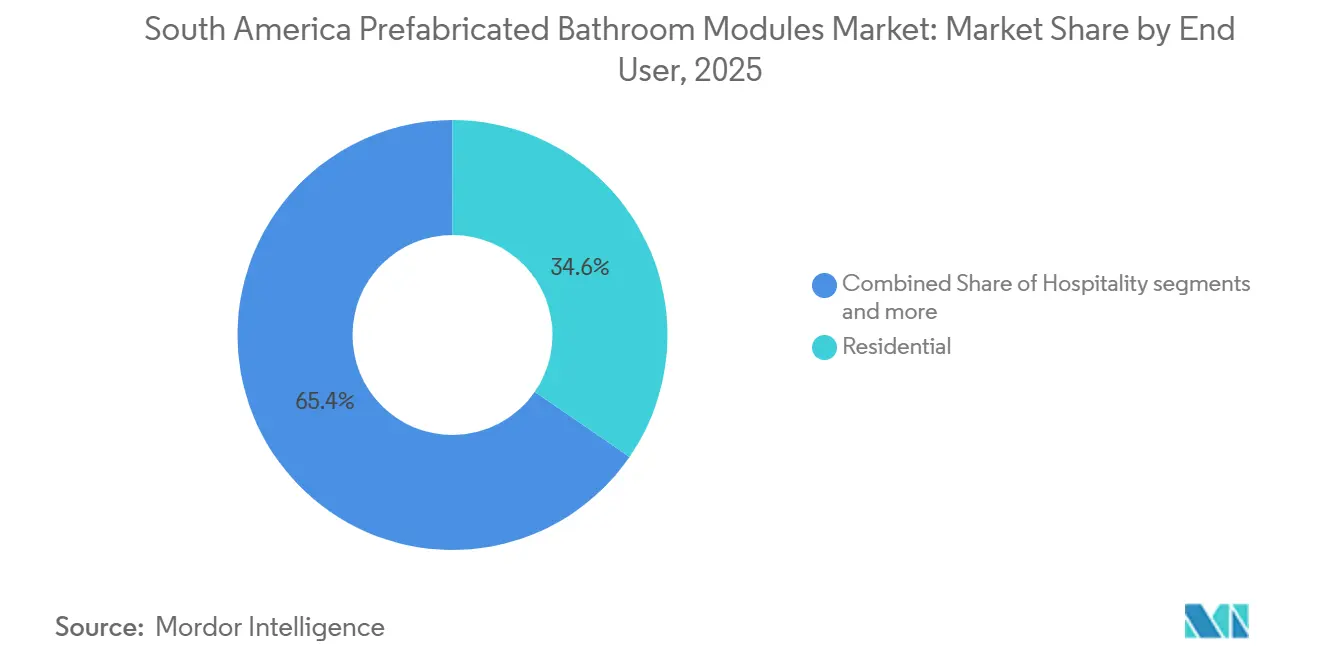
Residential end users held 34.60% of the South America prefabricated bathroom modules market share in 2025. Demand is linked to social housing programs and greater use of modular methods in medium-density housing, where repeated plans create a clearer case for factory coordination than one-off residential designs. Brazil's MCMV program provides a large base for standardized construction. Brasil ao Cubo has stated that modular methods can deliver 8- to 10-story buildings in 6 months at a lower cost than conventional alternatives[2]. Hospitality is the next major user, driven by the regional hotel pipeline.
Healthcare is projected to grow at a 9.60% CAGR from 2026 to 2031. New public hospital activity supports the South America prefabricated bathroom modules market, including hospital construction in Río Negro that is funded through Vaca Muerta oil royalties. Hospital projects place importance on hygiene, waterproofing, and documented inspection records, because room finishes must support regular cleaning and provide evidence of consistent installation practices. Factory-built bathrooms can provide repeatable material and process records to meet those requirements. Commercial office projects form a smaller but steady demand base, with buyers often valuing predictable delivery for washrooms that follow common floorplate arrangements. Their shorter procurement periods can suit standardized bathroom configurations.
Geography Analysis
Brazil held a 46.80% share of the South America prefabricated bathroom modules market in 2025. The country combines hotel construction, social housing activity, healthcare investment, and labor constraints, so its demand base does not depend on a single building category or on a single type of public or private buyer. Its hotel pipeline reached 140 projects and 20,181 rooms in the second quarter of 2026, indicating a visible stream of developments in which bathroom specifications may be set well before building completion. The 15,000-unit CDHU offsite initiative provides a clear example of public procurement for industrialized housing. It shows how the South America prefabricated bathroom modules market can draw support when public buyers consider off-site methods for programs requiring scale and a structured delivery process. Updated ABNT requirements increase the value of documented waterproofing and performance compliance, so suppliers need technical records that are clear enough for designers, contractors, and inspectors to review.
Chile is forecast to expand at a 9.80% CAGR through 2031 in the South America prefabricated bathroom modules market. The country brings together housing policy, mining activity, and a construction environment that supports industrialized methods, allowing suppliers to serve both permanent housing and remote workforce accommodation. Chile's housing brief identified plans for 20,000 modular homes and a dedicated local production line, providing a direct link between housing objectives and the need for industrial capacity to support repeated residential designs. The Cámara Chilena de la Construcción identified 13 major copper projects advancing in 2026[3]. Remote mining sites need accommodation and sanitary facilities for rotating workforces, and the pressure to mobilize them rapidly can favor units that arrive with internal services and finishes already coordinated. This gives the South America prefabricated bathroom modules market a demand channel beyond urban housing and hotels, while also connecting module demand to the operating schedules of remote infrastructure projects.
Argentina and Colombia remain smaller markets with different demand patterns, so suppliers cannot treat the two countries as a single commercial or technical operating environment. Argentina's mining and energy corridor needs sanitary infrastructure for large, remote workforces, where the distance from major cities can increase the value of units that arrive with bathrooms and basic services already incorporated. The Vicuña project planned a modular settlement for 2,500 to 5,000 workers in San Juan. Colombia's adoption is earlier, but hospital construction in Bogotá and Medellín can drive demand for certified products. Peru, Ecuador, and Bolivia remain at a demonstration-project stage in the supplied evidence. These markets may depend on project-specific logistics and locally accepted technical designs, which makes early coordination with project owners and local contractors important before a specification is finalized.
Competitive Landscape
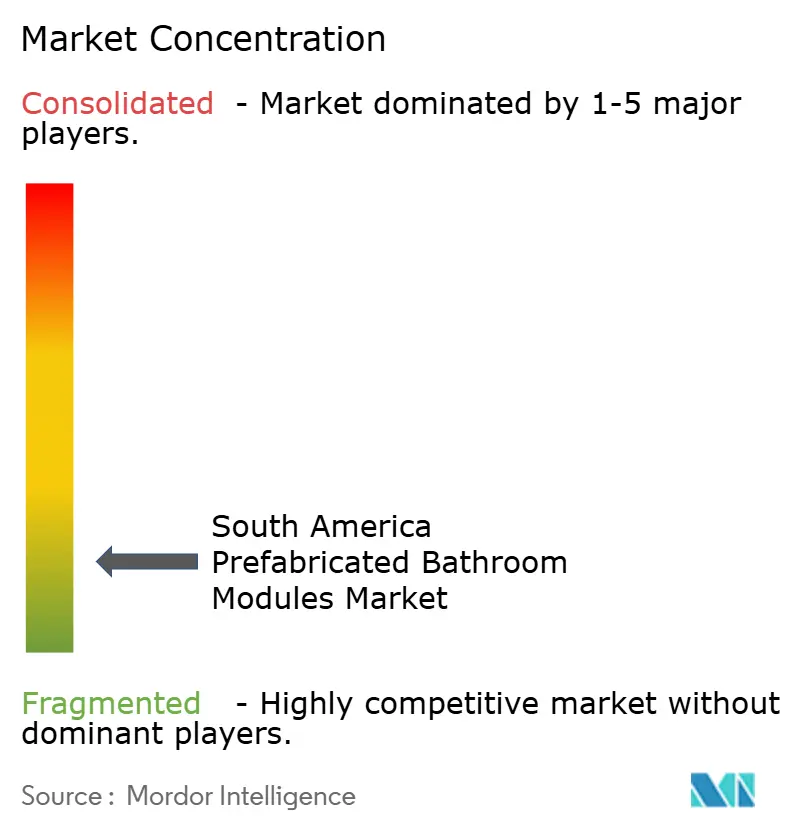
The South America prefabricated bathroom modules market is fragmented, and no supplier holds a dominant regional position. Many active suppliers are European or North American manufacturers that serve projects through exports, which means their regional position can depend as much on freight coordination and after-sales support as on the unit itself. This model leaves competitiveness exposed to shipping cost and currency movement, because a product designed and priced outside the region can become less attractive before it reaches a customer site. Bathsystem Group, StercheleGroup S.A., Sanika GmbH, Eurocomponents Italia S.p.A., and Deba Group serve different technical requirements, reflecting the need to match a pod format to the intended building type, finish level, service layout, and installation constraints. Their offerings include steel-frame, GRP, concrete, and lightweight demountable products, allowing buyers to compare structural weight, intended use, internal finish, and installation method, rather than relying on a single standard format. Walker Modular Limited and Offsite Solutions Limited also bring hospitality and refurbishment experience from European projects, and those references may be relevant where South American buyers require evidence of delivery on comparable hotel renovation or new-build programs.
Local technical support is a key competitive requirement in the South America prefabricated bathroom modules market, since pod placement, connections, and handover still require coordination with the building team at the project site. Established manufacturers can provide certified products and ISO 9001 quality systems, but project teams also need local coordination. BIM-integrated manufacturing is becoming increasingly important on large hospitality and healthcare projects, where late changes to dimensions or services can affect multiple linked design disciplines simultaneously. Brazil has adopted BIM in public contracts, while Chile requires BIM for public works under its national approach, thereby increasing the need for suppliers to make product information usable within the broader project model rather than as a separate drawing package. Manufacturers that provide compatible digital geometry can reduce coordination issues across structural, mechanical, electrical, and architectural work. This capability also helps teams confirm dimensional requirements before factory production starts, reducing the risk that a completed unit conflicts with an opening, a service route, or a finished floor level.
Chinese manufacturers are becoming more visible in the temporary mining accommodation sector. The Vicuña project demonstrates the role of Asian supply in remote workforce facilities. Their position is stronger in standardized temporary units than in premium healthcare or hospitality bathrooms, where product documentation, finish expectations, and compliance requirements are generally more demanding. Brasil ao Cubo is expanding its multistory modular building capabilities in Brazil with support from Gerdau and Dexco, providing a regional example of a manufacturer-and-construction platform that connects industrialized production with larger building formats. Resia Manufacturing opened its prefabricated bathroom and kitchen component capacity to third-party multifamily, hospitality, and student housing developers in October 2025, a move that broadens the potential supply base for developers outside its original affiliated project pipeline. NFI Modular also presents a Brazilian operating model for the rapid installation of bathroom modules, highlighting the importance of local manufacturing and on-site support alongside the capabilities of imported suppliers.
South America Prefabricated Bathroom Modules Industry Leaders
-
Walker Modular Limited
-
Offsite Solutions Limited
-
Bathsystem Group
-
Interpod Australia Pty Ltd
-
Deba Group
- *Disclaimer: Major Players sorted in no particular order
Recent Industry Developments
- April 2026: Ecosan, whose main plant in Loma Verde covers 10,800 m² with a production capacity of up to 120,000 m² annually, was awarded a contract by the UTE Techint–Sacde joint venture to design, manufacture, and install over 1,000 habitational modules, each fitted with fully equipped bathrooms, showers, and sanitary infrastructure, to house 1,600 workers across two camps at the Vaca Muerta Oil Sur (VMOS) project in Añelo, Neuquén.
- April 2026: Chile's Ministry of Housing and Urbanism (Minvu) reported the delivery of 229,262 industrialized homes under the Plan de Emergencia Habitacional, reaching 88% of the national program target, with modular construction cutting project timelines by over 30% compared to traditional methods, according to data published by Moduloria in April 2026.
- January 2026: BAC Modular, an Argentine startup, commercially launched a prefabricated wet-core system that integrates the bathroom and kitchen into a single factory-built module, designed for rapid on-site installation in approximately one week, targeting the residential segment, where skilled wet-trade labor shortages and rising construction costs are acute. The modules feature water-resistant floors, custom cabinetry, aluminum-framed openings with laminated glass, and a detachable roof to allow future home expansion, representing an entry-level bathroom pod format tailored to Argentina's cost-sensitive single-family housing market.
South America Prefabricated Bathroom Modules Market Report Scope
The South America Prefabricated Bathroom Modules Report is Segmented by Product Type (Steel Framed Modules, Concrete Modules, Hybrid Modules, and More), Installation Type (New Build, and More), End User (Hospitality, Healthcare, Residential, Commercial Offices, and others), and Geography (Brazil, Argentina, Colombia, Chile, and Rest of South America). The Market Forecasts are Provided in Terms of Value (USD).
| Steel Framed Modules |
| Concrete Modules |
| Hybrid Modules |
| Glass Reinforced Plastic Modules |
| Timber-Based Modules |
| New Build |
| Retrofit and Renovation |
| Temporary and Relocatable Units |
| Hospitality |
| Healthcare |
| Residential |
| Commercial Offices |
| Others |
| Brazil |
| Argentina |
| Colombia |
| Chile |
| Rest of South America |
| By Product Type | Steel Framed Modules |
| Concrete Modules | |
| Hybrid Modules | |
| Glass Reinforced Plastic Modules | |
| Timber-Based Modules | |
| By Installation Type | New Build |
| Retrofit and Renovation | |
| Temporary and Relocatable Units | |
| By End User | Hospitality |
| Healthcare | |
| Residential | |
| Commercial Offices | |
| Others | |
| By Country | Brazil |
| Argentina | |
| Colombia | |
| Chile | |
| Rest of South America |
Key Questions Answered in the Report
What is the projected value of South America prefabricated bathroom modules by 2031?
The sector is projected to reach USD 0.21 billion by 2031, growing at an 8.45% CAGR from 2026. The estimate reflects demand from standardized building programs, hotel construction, and institutional projects that require repeatable bathroom layouts.
Which product type leads demand for prefabricated bathroom modules in South America?
Steel framed modules led with 38.40% share in 2025 because they fit common hotel and residential structural systems. Their chassis is compatible with widely used concrete-frame and light steel building approaches, while allowing a defined bathroom package to be manufactured offsite.
Why is healthcare the fastest-growing end user for bathroom modules?
Healthcare is forecast to grow at a 9.60% CAGR through 2031 because projects value hygiene, waterproofing, and documented factory checks. These requirements align with units that provide repeatable materials, controlled assembly, and records for the completed bathroom.
Which country is expected to grow fastest through 2031?
Chile is forecast to grow at a 9.80% CAGR, supported by housing plans, mining activity, and modular production initiatives. Housing delivery goals and remote workforce needs create demand across both permanent urban projects and temporary mining-related facilities.