
Market Overview
| Study Period | 2020 - 2031 |
|---|---|
| Forecast Data Period | 2026 - 2031 |
| Base Year Market Size (2025) | USD 0.74 Billion |
| Market Size (2026) | USD 0.79 Billion |
| Market Size (2031) | USD 1.08 Billion |
| Growth Rate (2026 - 2031) | 6.54 % |
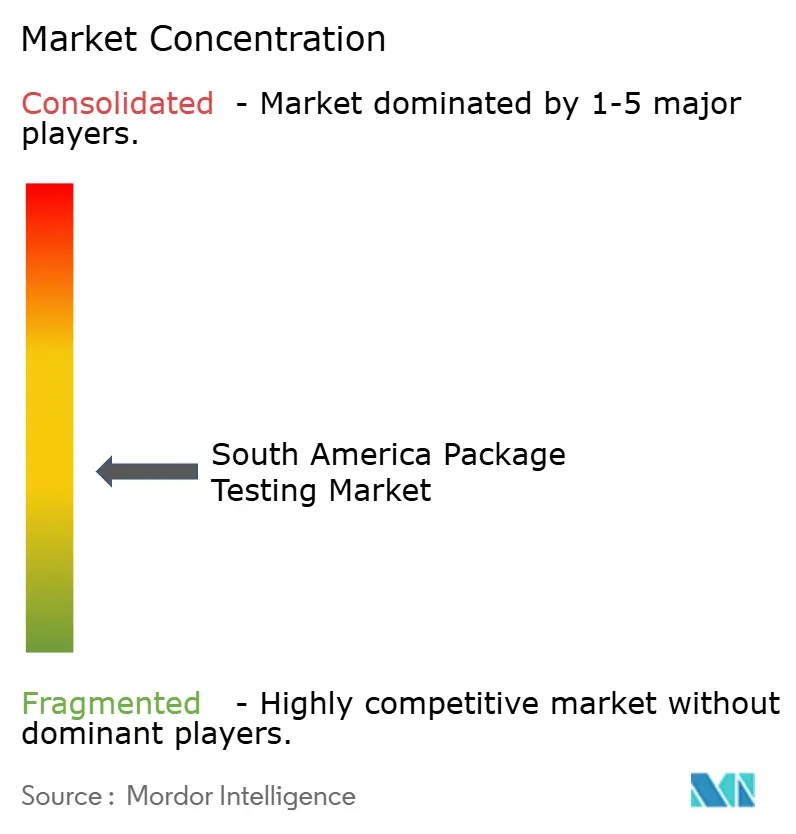
| Market Concentration | Medium |
Major Players *Disclaimer: Major Players sorted in no particular order Image © Mordor Intelligence. Reuse requires attribution under CC BY 4.0. | |
South America Package Testing Market Analysis by Mordor Intelligence
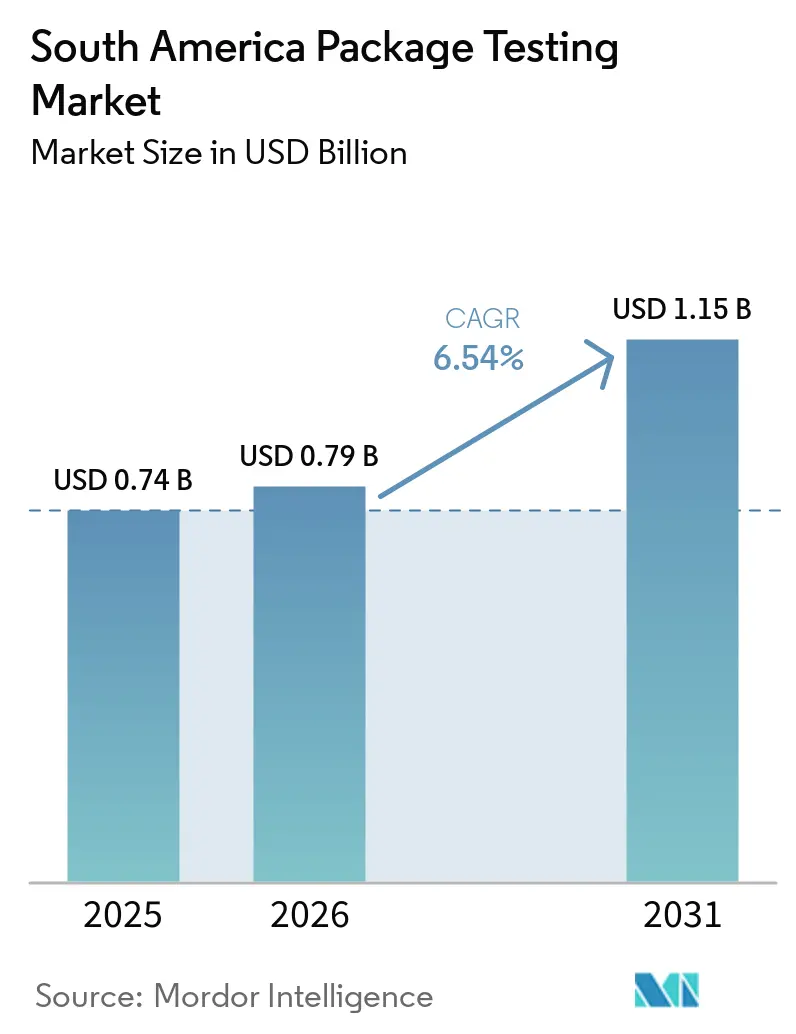
The South America Package Testing Market size is expected to increase from USD 0.74 billion in 2025 to USD 0.79 billion in 2026 and reach USD 1.08 billion by 2031, growing at a CAGR of 6.54% over 2026-2031.
In South America Package Testing Market regulatory changes are widening the evidence that packaging suppliers must provide before products enter food, pharmaceutical, and consumer goods supply chains. This need extends beyond basic package performance because companies must validate safety, material composition, and recyclability. The South America packaging testing market also depends on accredited laboratory capacity, which remains concentrated in major Brazilian industrial areas. This concentration supports established providers but raises turnaround and transport costs for companies in secondary manufacturing centers. Providers with chemical, physical, and environmental capabilities can address a broader set of compliance needs within one engagement.
Key Report Takeaways
- By primary material, plastic held 38.00% of the South America packaging testing market share in 2025 and is projected to expand at a 6.80% CAGR through 2031.
- By testing type, physical performance testing held 32.00% of testing demand in 2025, while chemical testing is projected to expand at an 8.20% CAGR through 2031.
- By packaging function, primary packaging held the largest share at 6.30% in 2025, while tertiary and transit packaging is projected to expand at a 7.20% CAGR through 2031.
- By end-user vertical, food and beverage held 35.00% of testing demand in 2025, while healthcare and pharmaceuticals is projected to expand at a 7.50% CAGR through 2031.
- By geography, Brazil accounted for 58.00% of regional testing revenue in 2025, while Chile is projected to expand at a 7.00% CAGR through 2031.
Note: Market size and forecast figures in this report are generated using Mordor Intelligence’s proprietary estimation framework, updated with the latest available data and insights as of January 2026.
Market Trends and Insights
Drivers Impact Analysis of South America Package Testing Market*
| Driver | (~) % Impact on CAGR Forecast | Geographic Relevance | Impact Timeline |
|---|---|---|---|
| Stricter Food-Contact Migration and Safety Requirements | 1.80% | Brazil, Argentina, MERCOSUR-wide | Short term (≤ 2 years) |
| Growth of Pharmaceutical, Biopharmaceutical and Medical-Device Packaging | 1.40% | Brazil, Argentina, Chile | Medium term (2-4 years) |
| Expansion of E-Commerce and Cross-Border Distribution | 1.10% | Brazil, Colombia, Chile | Medium term (2-4 years) |
| Recycled-Content, Recyclability and Circular-Packaging Validation | 0.80% | Brazil, Chile, Colombia | Long term (≥ 4 years) |
| South America-Specific Logistics Stress and Climate Variability | 0.60% | Brazil, Colombia, Chile | Medium term (2-4 years) |
| Source: Mordor Intelligence | |||
Stricter Food-Contact Migration and Safety Requirements
ANVISA issued RDC No. 843/2024 for food-contact materials and is expected to introduce RDC No. 961/2025, RDC No. 963/2025, RDC No. 979/2025, and RDC No. 1020/2026. These measures update requirements for plastic, cellulosic, and silicone materials. Packaging businesses must review migration evidence when regulated material lists or acceptance criteria change. As a result, the South America packaging testing market generates recurring demand from documentation updates, rather than relying solely on new packaging launches. MERCOSUR-adopted changes can simultaneously affect several material groups used in Brazil. RDC No. 1020/2026 is expected to introduce sanitary requirements for food-contact silicone materials and specify methods for regulated substances[1].
Growth of Pharmaceutical, Biopharmaceutical, and Medical-Device Packaging
Pharmaceutical packaging requires rigorous assessment of container integrity, material compatibility, and thermal performance. Brazil’s expected semaglutide patent expiry in 2026 is likely to increase interest in validated packaging for generic GLP-1 products. Glass vials, prefilled syringes, and sterile plastic containers require supporting evidence before product registration. ANVISA serialization requirements also add printed-code and package-performance testing requirements for commercial units. Cold-chain biologics require thermal-cycling and container-closure validation under tropical and high-altitude conditions. The South America packaging testing market benefits when providers combine chemical, physical, and environmental testing under accredited scopes.
Expansion of E-Commerce and Cross-Border Distribution
E-commerce is increasing the number of packages exposed to automated sorting and repeated handling. Mercado Libre projected that 94% of shipments would move through its proprietary logistics network in 2025. This operating model increases the importance of documented drop, compression, and vibration performance. Exporters also face labeling and material-documentation requirements when supplying multiple South American destinations[2]. The South America packaging testing market has an opportunity in distribution simulation, as many laboratories have stronger food-contact testing capabilities than transit-testing capacity. Providers that combine logistics testing with material verification can reduce the need for multiple laboratory engagements.
Recycled-Content, Recyclability, and Circular-Packaging Validation
Packaging companies increasingly require evidence to support recycled-content and recyclability claims. Brazil’s plastic packaging framework has increased scrutiny of material recovery, recycled content, and annual documentation. Suppliers must distinguish recycled and virgin material streams through credible testing records. This requirement drives demand for composition analysis, recyclability classification, biodegradability evaluation, and compostability evaluation. SGS Chile plans to launch a sustainable packaging laboratory in May 2026, with capabilities for food-contact safety and circular packaging assessments. The South America packaging testing market can support these requirements where laboratories maintain the necessary analytical methods and recognized accreditations.
Restraints Impact Analysis of South America Package Testing Market*
| Restraint | (~) % Impact on CAGR Forecast | Geographic Relevance | Impact Timeline |
|---|---|---|---|
| High Cost of Advanced Package Testing and Laboratory Equipment | -1.80% | Argentina, Rest of South America, secondary Brazilian markets | Short term (≤ 2 years) |
| Uneven Accreditation and Testing Capacity Outside Major Industrial Centers | -1.30% | Argentina, Colombia, Chile secondary cities, Paraguay | Medium term (2-4 years) |
| Fragmented National Regulations and Cross-Border Compliance Complexity | -0.90% | MERCOSUR-wide, Argentina-Brazil and Andean cross-border lanes | Long term (≥ 4 years) |
| Source: Mordor Intelligence | |||
High Cost of Advanced Package Testing and Laboratory Equipment
A full-service packaging testing facility requires advanced analytical instruments, mechanical testing frames, and calibrated climate chambers. This equipment creates significant capital requirements for laboratories seeking to offer a broad range of services. The cost burden increases when imported instruments and calibration services are subject to local currency pressures. Companies outside São Paulo may need to ship samples to specialized facilities, extending compliance timelines. Although centralized infrastructure can provide access to advanced testing capabilities, it can also maintain a higher price floor for customers in distant locations. Consequently, the South America packaging testing market may experience slower service adoption in smaller national markets, despite increasing compliance requirements.
Uneven Accreditation and Testing Capacity Outside Major Industrial Centers
Accredited laboratories and testing capacity are concentrated in Brazil’s Southeast industrial corridor. INMETRO guidance outlines the requirements for packaging testing laboratories operating within the applicable accreditation framework. In Colombia, ICIPC published a catalog of packaging and packaging-material testing services in September 2024 that identifies relevant laboratory capabilities[3]. Manufacturers located outside major cities and established industrial centers have more limited access to accredited testing services. Longer sample transportation times can delay product release decisions, export shipments, and regulatory documentation. Mobile and on-site testing services offer a practical alternative when portable equipment and accredited testing methods can meet client requirements.
*Our forecasts treat driver/restraint impacts as directional, not additive. The impact forecasts reflect baseline growth, mix effects, and variable interactions.
South America Package Testing Market Segment Analysis
By Primary Material:
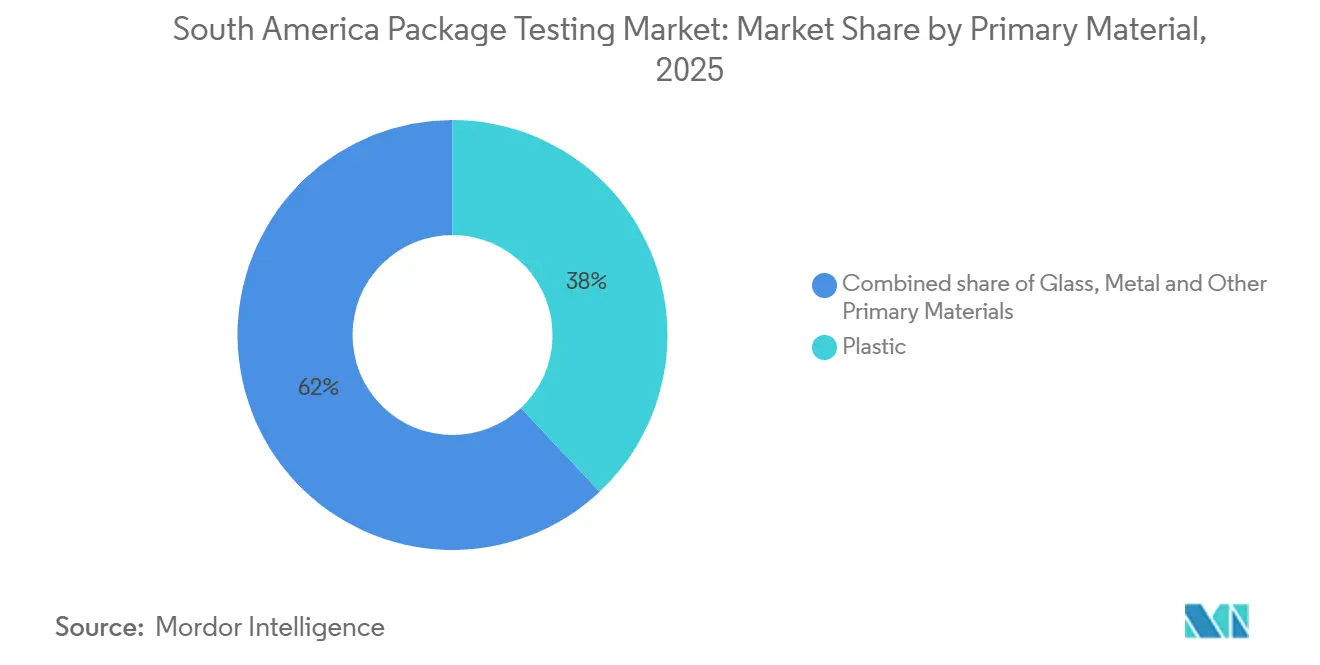
Plastic Leads Testing Demand Across Material CategoriesPlastic accounted for 38.00% of the South America packaging testing market share in 2025 and is projected to grow at a CAGR of 6.80% through 2031. Plastic packaging requires physical performance, migration, environmental, and composition testing across a range of formats. Food-grade films, pharmaceutical blister webs, rigid containers, and recycled-content packaging each present distinct testing requirements. These diverse requirements make plastic a high-value substrate for contract laboratories. The South America packaging testing market is supported by the need to evaluate both established polymers and emerging material combinations. Testing requirements may increase when packaging specifications change, including changes in resin type, recycled content, closures, or intended food-contact applications. Paper and paperboard testing is expanding alongside growth in corrugated e-commerce volumes and recycled-fiber applications. Food-contact paperboard requires targeted documentation when regulations govern materials and additives. Glass testing remains important for pharmaceutical and premium beverage applications, as primary containers require validated conformity. Metal packaging testing supports canned food and aerosol formats that depend on seal integrity and internal coating performance. While mono-material designs can reduce certain composite-material checks, they also create testing requirements for replacement polymers and bio-based materials. The South America packaging testing market continues to generate demand across these materials, as safety and performance requirements remain distinct for each format.

By Testing Type:
Chemical Testing Records the Fastest Forecast GrowthPhysical performance testing accounted for 32.00% of the South America packaging testing market share in 2025. It includes compression, drop, vibration, tensile, and related tests that establish baseline performance across packaged goods. These procedures remain relevant for food, consumer products, pharmaceuticals, industrial products, and retail shipments. Demand is closely linked to packaging production and distribution activity. Physical testing also provides the evidence that retailers and logistics operators require before packaging enters organized fulfillment networks. The large installed base of packages requiring these assessments keeps this service category central to laboratory throughput. Chemical testing is projected to grow at a CAGR of 8.20% through 2031, the highest rate among testing types. It addresses migration analysis and supports composition verification for packaging containing recycled content. Environmental testing covers humidity, temperature, ultraviolet exposure, and altitude conditions. Microbiological testing remains necessary when sterility assurance and barrier performance are critical for food and pharmaceutical packaging. Mechanical testing evaluates material properties, including elongation, tensile modulus, and peel strength. Sensory and organoleptic testing represents a smaller segment but remains relevant when brands need to confirm that recycled or bio-based packaging does not affect food flavor or odor.
By Packaging Function:
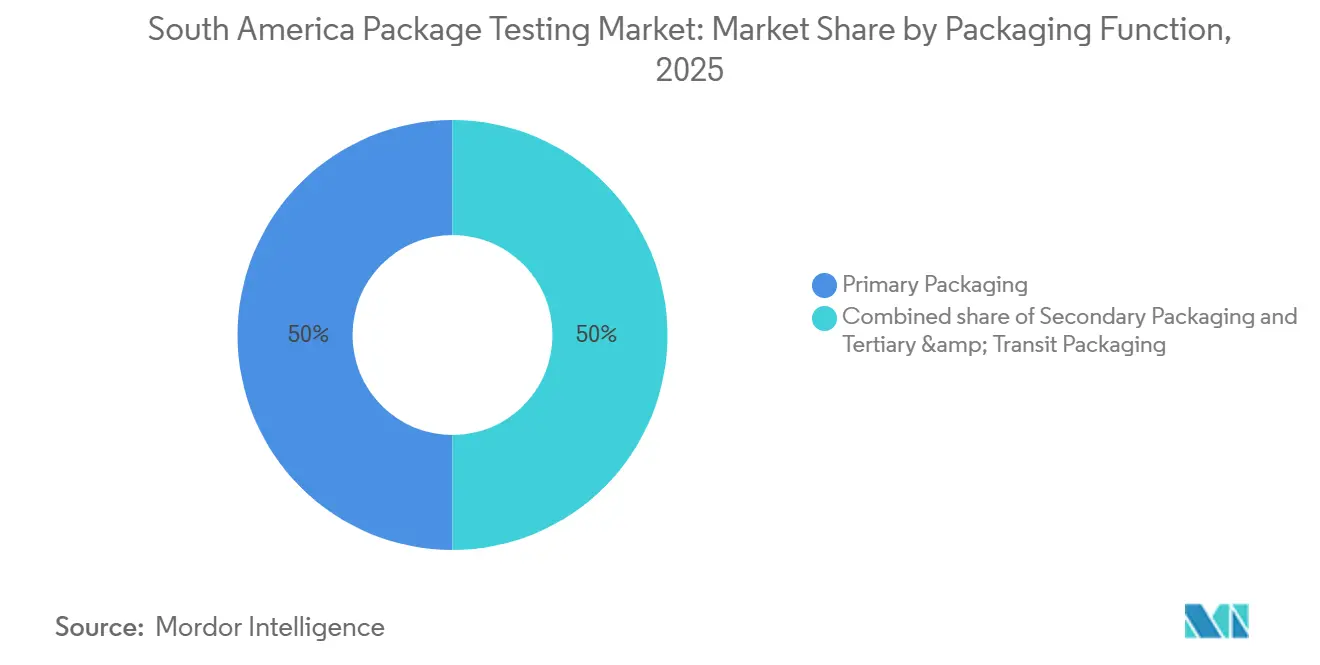
Tertiary and Transit Packaging Lead Forecast GrowthPrimary packaging held the largest share within the packaging function segment at 50.00% in 2025. It requires migration analysis, barrier assessment, and sterility validation before regulated products enter the Brazilian market. This function generates recurring demand because product registrations and packaging changes require updated supporting evidence. Pharmaceutical containers also require extractables and leachables testing, which can increase the scope of an individual submission. Primary packaging therefore provides a stable revenue base for accredited laboratories in the South America packaging testing market. Its testing requirements are closely linked to product safety because the package directly contacts the product. Tertiary and transit packaging is projected to grow at a CAGR of 7.20% through 2031. E-commerce fulfillment subjects packaging to repeated mechanical stress from handling, sorting, storage, and transportation. Mercado Libre's proprietary logistics network handled 94% of its shipments in 2025[4]. This trend reinforces the value of documented distribution simulation results for suppliers that use organized fulfillment channels. Secondary packaging also requires performance testing for multipacks, retail displays, and store-ready formats. Pharmaceutical transit formats must meet mechanical performance requirements while maintaining appropriate thermal conditions during shipment.
By End-User Vertical:
Food and Beverage Anchors Demand While Healthcare AcceleratesFood and beverage accounted for 35.00% of the South America packaging testing market share in 2025. The sector depends on food-contact compliance across a broad range of products and packaging formats. Its testing requirements include migration chemistry, transport performance, microbiological barrier assessment, and sensory evaluation. Updated ANVISA measures continue to increase the importance of packaging documentation for affected food-contact materials. GOV.BR Food and beverage demand provides a dependable testing base because brands frequently manage extensive product portfolios. It also supports laboratories that can conduct both routine performance testing and specialized analytical methods. Healthcare and pharmaceuticals is projected to grow at a CAGR of 7.50% through 2031. Generic and biosimilar product activity increases demand for extractables, leachables, and container-closure integrity testing. Serialization also combines printed-surface requirements with the need to protect products throughout distribution. Cosmetics and personal care products require migration and allergen-related packaging assessments for plastic and metal formats. Electronics and electrical products require drop and vibration testing as online retail activity expands. Industrial chemicals, agri-food products, automotive parts, and protective equipment continue to generate demand for transit and environmental simulation services.
Geography Analysis
Brazil Package Testing Market
Brazil is projected to account for 58.00% of the South America packaging testing market share in 2025. This position reflects the scale of its food and pharmaceutical manufacturing industries, ANVISA requirements, and laboratory infrastructure in São Paulo State. The country has a dense base of organizations that require packaging testing for domestic supply and exports. Regulatory scrutiny of food-contact materials supports demand for chemical and physical testing. Brazil also has a strong need for recycled-content and recyclability documentation as packaging obligations evolve. The concentration of advanced laboratories provides broad testing capabilities but can limit local access for companies outside the Southeast.
Chile and Argentina Package Testing Market
Chile is projected to expand at a 7.00% CAGR through 2031, representing the fastest national growth rate in the regional forecast. Its regulatory focus on packaging recovery, chemical classification, and consumer product documentation supports demand for specialized testing services. SGS Chile is expected to expand its sustainable packaging testing capabilities in May 2026. This expansion will cover biodegradability, compostability, recyclability, and biomaterial characterization. Argentina also presents compliance-related opportunities, as its producers serve Brazilian supply chains. However, currency volatility and slower regulatory implementation may delay testing expenditure.
Andean and Southern Cone Package Testing Market
Colombia is projected to grow above the regional average, supported by pharmaceutical manufacturing and packaging documentation requirements. The ICIPC catalog highlights the need to develop laboratory capacity for packaging and packaging materials. This capacity gap creates an opportunity for domestic and international providers to pursue targeted expansion. Paraguay, Uruguay, Ecuador, Bolivia, and Peru contribute a smaller revenue base to the South America packaging testing market. Food export compliance represents the primary source of demand across these countries. Their future opportunity will depend on regulatory implementation and access to recognized testing services.
Competitive Landscape
Editorial note: Several developments cited in the content are dated 2025 and 2026, which are future periods relative to the current year, 2024. These items should be verified before publication and presented as forward-looking developments unless supported by updated documentation. The South America packaging testing market comprises global testing, inspection, and certification providers, as well as specialized Brazilian laboratories. SGS SA, Bureau Veritas SA, and Intertek Group plc benefit from extensive laboratory networks and broad service portfolios. Eurofins Scientific and TÜV SÜD AG also compete for food-contact, pharmaceutical, and packaging testing assignments. Brazilian laboratories compete through their familiarity with local regulations and faster turnaround times.
This market structure gives large providers an advantage in complex programs requiring physical, chemical, microbiological, and environmental testing. However, it also creates opportunities for specialists with focused capabilities, such as distribution simulation and local compliance services. Eurofins Scientific agreed in July 2026 to acquire Element Materials Technology's Life Sciences Testing Services business in North America for USD 400 million. The transaction includes 27 laboratories and approximately 750 employees and is expected to generate more than USD 150 million in revenue in 2026. The acquisition strengthens Eurofins' life sciences testing capabilities, which are relevant to pharmaceutical and food-contact packaging services. SGS Chile opened a sustainable packaging laboratory in May 2026. In 2025, Intertek acquired TESIS, expanding its testing presence in Brazil.
The South America packaging testing market remains competitive because no single provider fully addresses all specialized testing requirements across the region. Mobile testing and circular packaging validation represent opportunities for providers to expand their service offerings. Companies that combine ISTA-style transit simulation with composition analysis can address related customer requirements through an integrated service model. TÜV Rheinland reported EUR 87.2 million in spending on laboratory expansion and digitalization in 2025. This level of investment supports competitive capabilities across laboratory networks and service delivery. The market is moderately consolidated among major international providers, while national specialists continue to play an important role in local execution and targeted testing methods.
South America Package Testing Industry Leaders
-
SGS SA
-
Intertek Group plc
-
Bureau Veritas SA
-
Eurofins Scientific
-
Instituto de Pesquisas Tecnológicas do Estado de São Paulo
- *Disclaimer: Major Players sorted in no particular order
South America Package Testing Market Companies Covered in this Report
- SGS SA
- Intertek Group plc
- Bureau Veritas SA
- Eurofins Scientific
- TÜV SÜD AG
- Bureau Veritas Consumer Products Services Brazil
- QIMA
- ALS Limited
- Mérieux NutriSciences
- Applus+ Laboratories
- Element Materials Technology
- TÜV Rheinland AG
- UL LLC
- DDL, Inc.
- Cryopak
- Instituto de Pesquisas Tecnológicas do Estado de São Paulo
- SCiTec Laboratório de Ensaios
- Multittech
- NTD Laboratório
Recent Industry Developments in South America Package Testing Market
- July 2026: Eurofins Scientific is expected to acquire Element Materials Technology’s Life Sciences Testing Services business in North America for USD 400 million. The acquisition will encompass 27 laboratories and approximately 750 employees and is expected to generate more than USD 150 million in revenue in 2026. The transaction will remain subject to regulatory approvals and is expected to close in Q4 2026.
- April 2026: ANVISA is expected to issue RDC No. 1020/2026, establishing sanitary requirements for food-contact silicone materials. The resolution will transpose MERCOSUR GMC Resolution No. 34/25 and mandate chemical testing methods for regulated substances in silicone-based packaging.
- October 2025: Brazil is expected to publish Federal Decree No. 12,688/2025, establishing a national reverse logistics system for plastic packaging. The measure will establish a 32% recovery rate target and a 22% recycled content target for large companies, effective January 2026.
South America Package Testing Market Report Scope
The South America Packaging Testing Market is Segmented by Primary Material (Glass, Paper and Paperboard, Plastic, Metal), Testing Type (Physical, Chemical, Environmental, Microbiological, Others), Packaging Function (Primary, Secondary, Tertiary and Transit), End-User Vertical (Food and Beverage, Healthcare, Cosmetics, E-Commerce, Others), and Geography (Brazil, Argentina, Chile, Colombia, Others). Forecasts in Value (USD).
Segmentation Overview
By Primary Material
| Glass |
| Paper and Paperboard |
| Plastic |
| Metal |
By Testing Type
| Physical Performance Testing |
| Chemical Testing |
| Environmental Testing |
| Microbiological Testing |
| Mechanical Testing |
| Sensory and Organoleptic Testing |
By Packaging Function
| Primary Packaging |
| Secondary Packaging |
| Tertiary and Transit Packaging |
By End-User Vertical
| Food and Beverage |
| Healthcare and Pharmaceuticals |
| Cosmetics and Personal Care |
| Industrial and Chemicals |
| Electronics and Electrical Products |
| E-Commerce and Retail Goods |
| Other End-User Verticals |
By Service Mode
| Independent Contract Laboratories |
| In-House Testing Facilities |
| Certification and Inspection Bodies |
| Mobile and On-Site Testing |
| Packaging Engineering and Advisory Services |
| Other Service Modes |
By Country
| Brazil |
| Argentina |
| Chile |
| Colombia |
| Rest of South America |
| By Primary Material | Glass |
| Paper and Paperboard | |
| Plastic | |
| Metal | |
| By Testing Type | Physical Performance Testing |
| Chemical Testing | |
| Environmental Testing | |
| Microbiological Testing | |
| Mechanical Testing | |
| Sensory and Organoleptic Testing | |
| By Packaging Function | Primary Packaging |
| Secondary Packaging | |
| Tertiary and Transit Packaging | |
| By End-User Vertical | Food and Beverage |
| Healthcare and Pharmaceuticals | |
| Cosmetics and Personal Care | |
| Industrial and Chemicals | |
| Electronics and Electrical Products | |
| E-Commerce and Retail Goods | |
| Other End-User Verticals | |
| By Service Mode | Independent Contract Laboratories |
| In-House Testing Facilities | |
| Certification and Inspection Bodies | |
| Mobile and On-Site Testing | |
| Packaging Engineering and Advisory Services | |
| Other Service Modes | |
| By Country | Brazil |
| Argentina | |
| Chile | |
| Colombia | |
| Rest of South America |
Key Questions Answered in the Report
What is the size of the South America packaging testing market?
The South America packaging testing market size is USD 0.74 billion in 2026 and is forecast to reach USD 1.08 billion by 2031 at a 6.54% CAGR.
Which material has the highest packaging testing demand in South America?
Plastic held 38.00% of testing demand in 2025 and is projected to expand at a 6.80% CAGR through 2031.
Which testing service is expanding fastest in South America?
Chemical testing is projected to expand at an 8.20% CAGR through 2031, supported by migration and composition verification requirements.
Why is food and beverage important for packaging testing demand?
Food and beverage held 35.00% of testing demand in 2025 because suppliers require food-contact, transport, microbiological, and sensory assessments.
Which country leads regional packaging testing revenue?
Brazil accounted for 58.00% of regional revenue in 2025 because of its manufacturing scale, regulatory requirements, and laboratory base.
What is driving Chile's packaging testing demand?
Chile is projected to expand at a 7.00% CAGR through 2031, supported by recovery, chemical documentation, and sustainable-packaging testing requirements.