
South America Metal Caps and Closures Market Size and Share
Market Overview
| Study Period | 2020 - 2031 |
|---|---|
| Forecast Data Period | 2026 - 2031 |
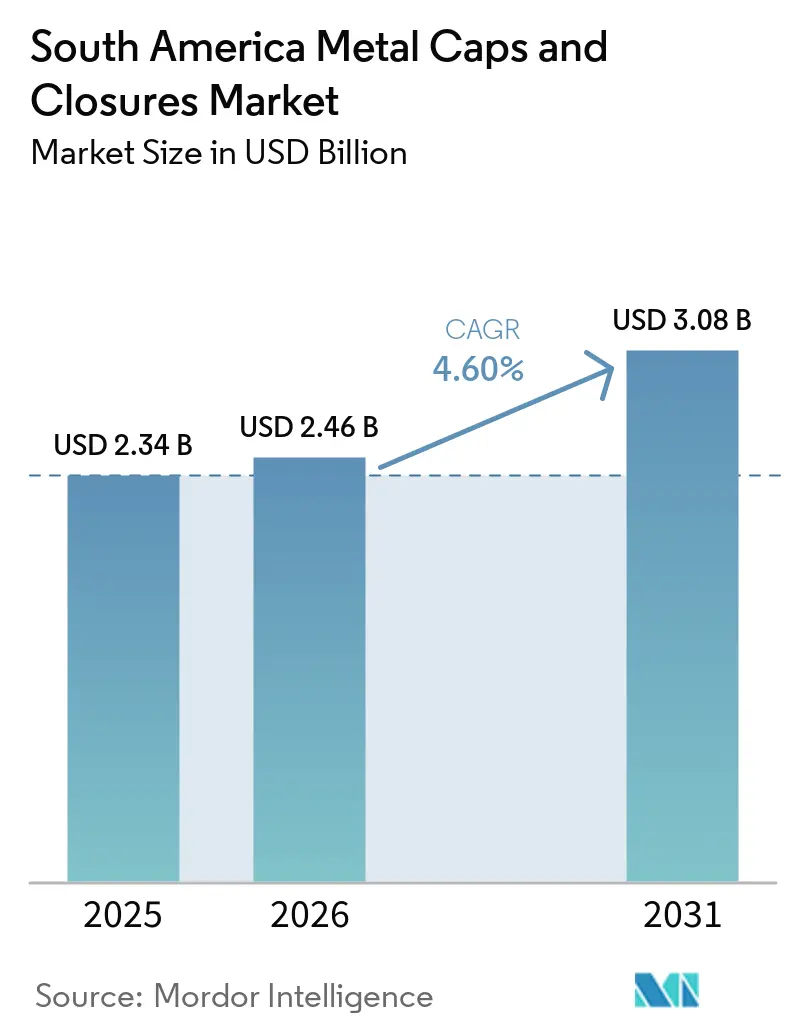
| Base Year Market Size (2025) | USD 2.34 Billion |
| Market Size (2026) | USD 2.46 Billion |
| Market Size (2031) | USD 3.08 Billion |
| Growth Rate (2026 - 2031) | 4.60 % |
| Market Concentration | Medium |
Major Players *Disclaimer: Major Players sorted in no particular order Image © Mordor Intelligence. Reuse requires attribution under CC BY 4.0. | |
South America Metal Caps and Closures Market Analysis by Mordor Intelligence
The South America Metal Caps and Closures Market size was valued at USD 2.34 billion in 2025 and is estimated to grow from USD 2.46 billion in 2026 to reach USD 3.08 billion by 2031, at a CAGR of 4.60% during the forecast period (2026-2031). The South America Metal Caps and Closures Market is supported by demand for beverage, food, pharmaceutical, and personal care packaging. Beverage producers set high-volume closure standards, while premium brands need more decoration and product-security features. Brazil’s aluminum recycling system supports local material availability and the procurement of recycled content. Pharmaceutical traceability and wine export requirements are shifting purchases toward higher-value formats. Metal price exposure and plastic substitution remain important limits in standard applications.
Key Report Takeaways
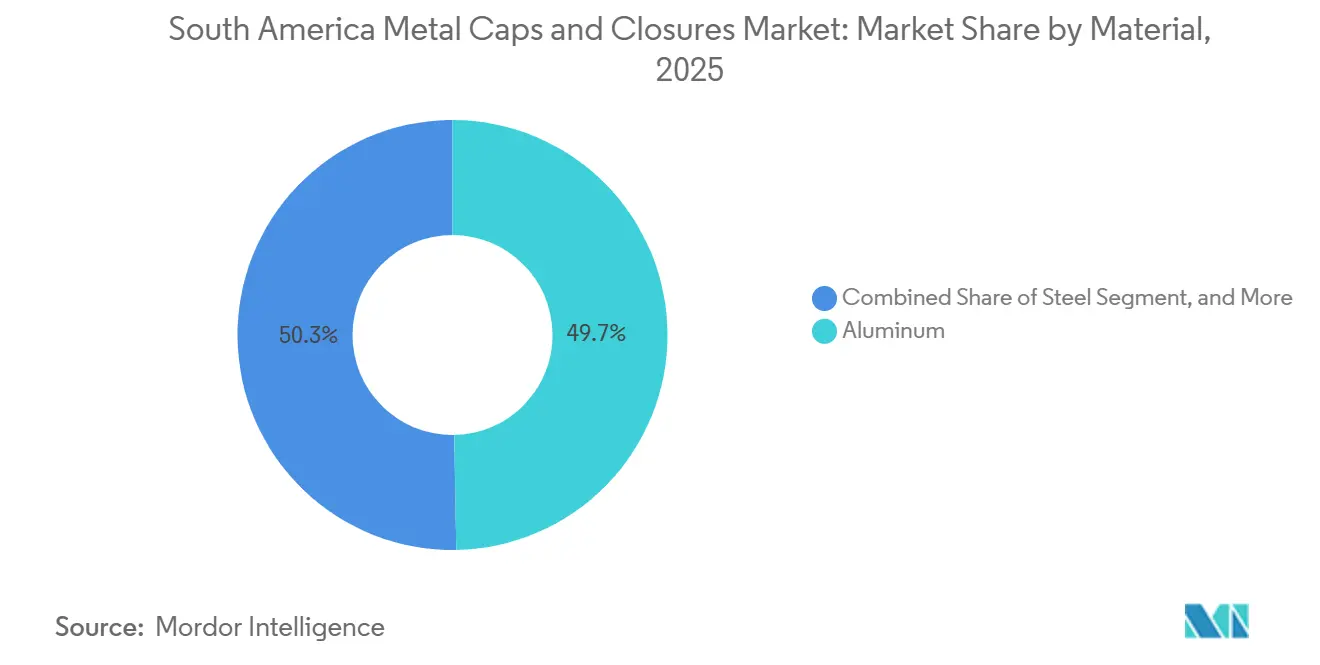
- By material, aluminum held 49.73% South America Metal Caps And Closures Market revenue share in 2025, while steel is forecast to grow at a 5.53% CAGR through 2031.
- By closure type, Roll-On Pilfer-Proof caps held 15.62% share in 2025, while screw caps are forecast to grow at a 5.59% CAGR through 2031.
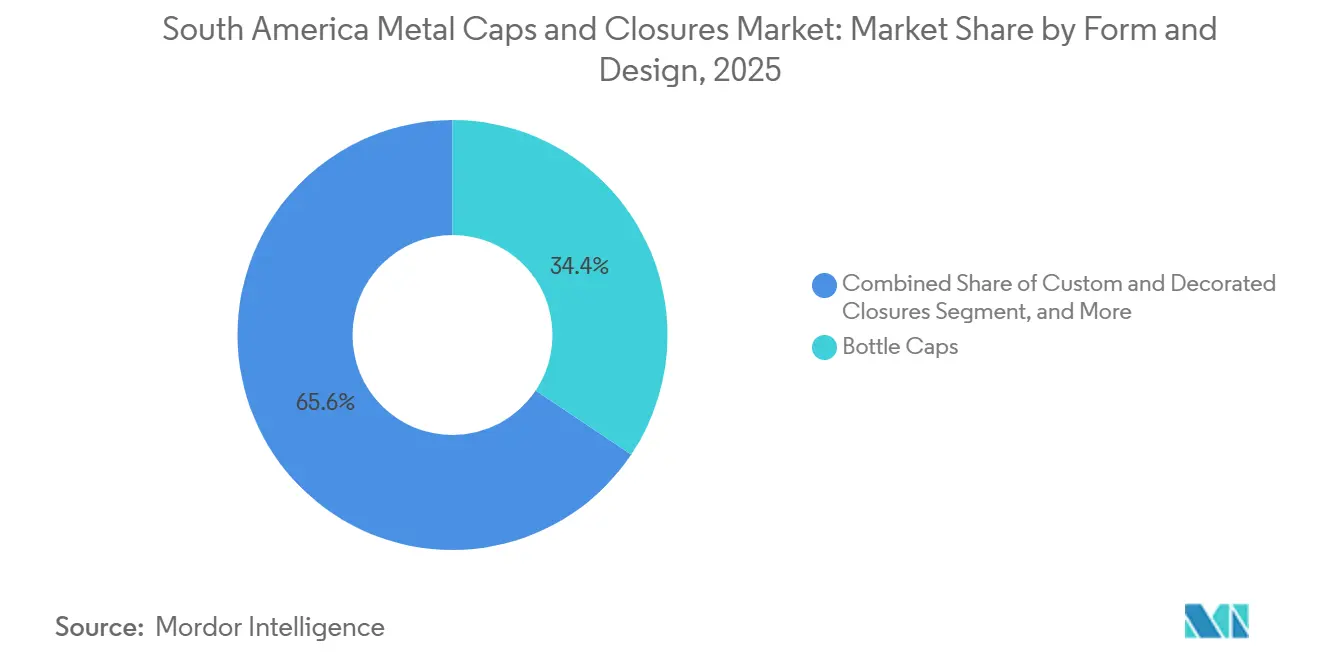
- By form and design, bottle caps accounted for 34.37% of the South America Metal Caps and Closures Market revenue in 2025, while custom and decorated closures are forecast to grow at a 5.72% CAGR through 2031.
- By application, beer and cider held 24.26% share in 2025, while pharmaceutical products are forecast to grow at a 5.82% CAGR through 2031.
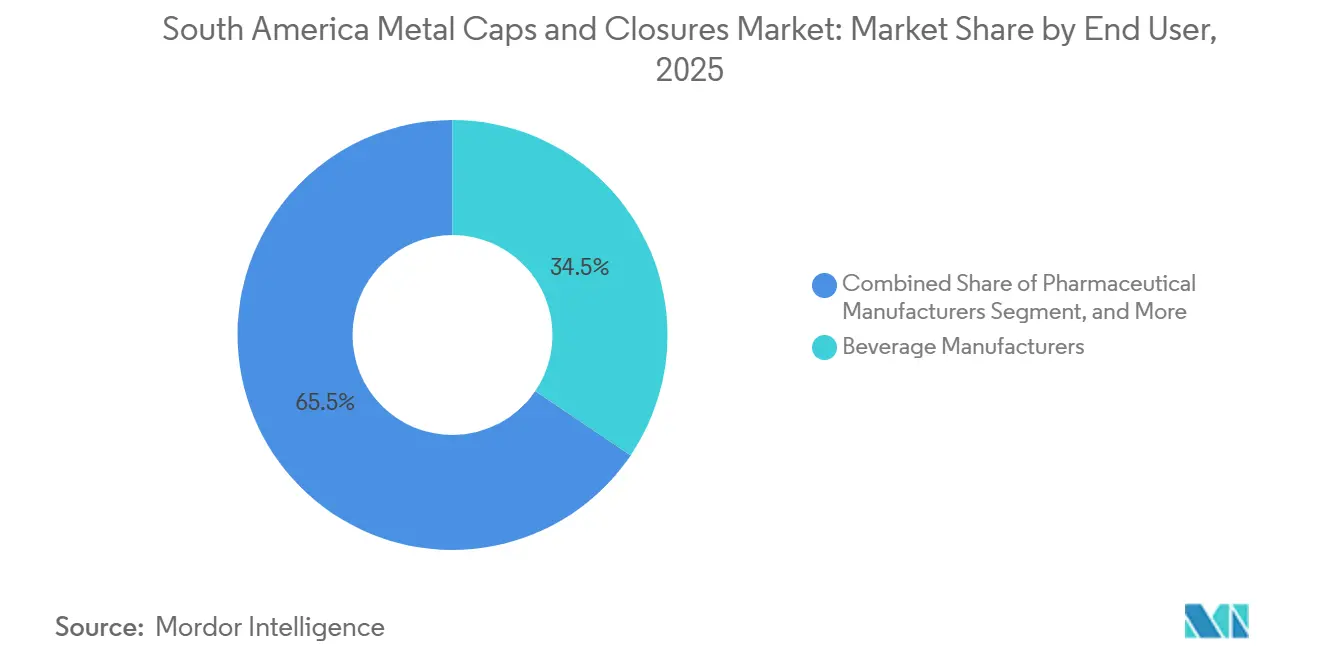
- By end user, beverage manufacturers held 34.46% South America Metal Caps and Closures Market revenue share in 2025, while pharmaceutical manufacturers are forecast to grow at a 5.39% CAGR through 2031.
- By technology and function, tamper-evident closures held 28.47% share in 2025, while non-refillable and anti-counterfeit closures are forecast to grow at a 5.48% CAGR through 2031.
- By geography, Brazil accounted for 30.12% of revenue in the South America Metal Caps and Closures Market in 2025, while Chile is forecast to grow at a 5.49% CAGR through 2031.
Note: Market size and forecast figures in this report are generated using Mordor Intelligence’s proprietary estimation framework, updated with the latest available data and insights as of January 2026.
South America Metal Caps and Closures Market Trends and Insights
Drivers Impact Analysis*
| Driver | (~) % Impact on CAGR Forecast | Geographic Relevance | Impact Timeline |
|---|---|---|---|
| Premium Beer, Spirits, and Wine Packaging | +1.2% | South America, with Brazil and Chile as core markets and spillover to Argentina | Medium term (2-4 years) |
| Preserved Food and Glass-Jar Packaging | +0.9% | South America, with food-processing corridors in Brazil and Argentina | Medium term (2-4 years) |
| Recyclable Aluminum and Steel Closures | +0.8% | South America, with Brazil as the core market and growing relevance in Chile and Colombia | Long term (≥ 4 years) |
| Pharmaceutical and Healthcare Packaging | +0.7% | Brazil, with secondary gains in Argentina and Chile | Medium term (2-4 years) |
| Tamper-Evident and Anti-Counterfeit Closures | +0.5% | Brazil and Argentina, with increasing relevance across the rest of South America | Short term (≤ 2 years) |
| Local Closure Supply Chains and Manufacturing | +0.4% | Brazil, with earlier supply-chain changes in Chile and Colombia | Long term (≥ 4 years) |
| Source: Mordor Intelligence | |||
Premium Beer, Spirits, and Wine Packaging
Premium packaging is changing requirements in the South America Metal Caps and Closures Market. Craft beer, premium spirits, and export wine producers use decorative and tamper-evident formats more often than standard brands. These formats can carry unit prices that are 2 to 3 times higher than those of standard crown caps. Producers in São Paulo and Paraná are adapting filling lines for embossed, lithographed, and laser-marked aluminum closures. Brazilian cachaça brands are using Roll-On Pilfer-Proof and serialized formats for stronger shelf positioning. Chilean wine exporters are moving toward aluminum screw caps for buyers who require resealable, leak-resistant bottles.
Preserved Food and Glass-Jar Packaging
Preserved foods support steady demand for lug caps and twist-off closures in the South America Metal Caps and Closures Market. Sauces, condiments, pickles, olives, and artisanal preserves are commonly sold in glass jars. These products need food-safe liners, precise dimensions, vacuum seals, and thermal-processing resistance. Processors in Buenos Aires Province, Mendoza, and Entre Ríos serve domestic and export channels. Urban consumers are buying more shelf-stable foods that can move through longer distribution routes. Small producers in Mendoza and Córdoba also need short-run cap supply for specialty sauces and pickles.
Recyclable Aluminum and Steel Closures
Recycled metal content is becoming an important procurement requirement for beverage and spirits brands. Brazil sourced 57% of its aluminum consumption from recycled sources, compared with a global average of 28%. Its aluminum can recycling rate reached 97.3% in 2024 and had remained above 96% for 16 consecutive years. This infrastructure supports scrap availability for local packaging manufacturers. It also strengthens recycled-content claims for the South America Metal Caps and Closures Market.[1]Abralatas, “ESG Report 2025, Partnerships for the Circular Economy,” Abralatas, abralatas.org.br.
Pharmaceutical and Healthcare Packaging
Pharmaceutical packaging is expanding faster than the overall closure category. Brazil’s serialization system requires unit-level tracking for prescription medicines through the supply chain. That requirement supports closures with breakaway bands, lot codes, and non-refillable features. The March 2026 expiry of Brazil’s semaglutide patent is adding demand for generic liquid medicine packaging. Chile is applying container-closure integrity requirements to over-the-counter liquid medicines. Qualified suppliers can use stricter dimensions, liners, and validation to support higher-value sales.
Restraints Impact Analysis*
| Restraint | (~) % Impact on CAGR Forecast | Geographic Relevance | Impact Timeline |
|---|---|---|---|
| Aluminum, Steel, and Tinplate Price Volatility | -0.9% | Global commodity exposure, with the greatest converter impact in Brazil and Argentina | Short term (≤ 2 years) |
| Plastic, Flexible, and Composite Substitution | -0.7% | South America, strongest in non-premium beverage and food applications | Medium term (2-4 years) |
| Capital Intensity of High-Speed Closure Lines | -0.5% | South America, particularly mid-sized regional converters | Long term (≥ 4 years) |
| Fragmented Recycling Collection Systems | -0.3% | Argentina and the rest of South America, with lower impact in Brazil | Medium term (2-4 years) |
| Source: Mordor Intelligence | |||
Aluminum, Steel, and Tinplate Price Volatility
Metal input costs are the most immediate risk for regional converters. Aluminum prices remained elevated in 2026 after global supply disruptions threatened smelting capacity. Smaller manufacturers often lack the scale to enter into long-term supply agreements. They are more exposed to spot prices and changing premiums than larger competitors. Argentine currency depreciation through 2024 and 2025 also raised aluminum coil and tinplate import costs. These pressures favor specialty products where pricing is less tied to commodity metal costs.
Plastic, Flexible, and Composite Substitution
Plastic technologies are improving in food-contact and recycled-content applications. Standard water, juice, and non-carbonated drinks face the greatest substitution risk because resealability and low weight guide format choice. Spouted pouches are also taking volume from some shelf-stable foods formerly packed in glass jars. Metal retains important advantages in pharmaceutical, spirits, and hermetically sealed food packaging. These uses require barrier performance, tamper evidence, or thermal-processing resistance. The South America Metal Caps and Closures Market is therefore most exposed in standard commodity formats.
*Our forecasts treat driver/restraint impacts as directional, not additive. The impact forecasts reflect baseline growth, mix effects, and variable interactions.
Segment Analysis
By Material: Aluminum Leads Value While Steel Builds Specialty Demand
Aluminum accounted for 49.73% of the South America Metal Caps and Closures Market share in 2025. Its position reflects recyclability, malleability, and Brazil’s recycling infrastructure. Crown caps, Roll-On Pilfer-Proof closures, and easy-open designs use aluminum across major applications. Beverage producers also use it for lightweight, embossed, and decorative formats. These attributes connect aluminum to the region’s largest pools of closure demand.
Steel and tinplate are important for packaging preserved foods, sauces, and condiments. Their thermal resistance and barrier performance suit retort-processed products. Bimetallic and multi-material closures serve selected pharmaceutical and luxury spirits uses. Established lug-cap and twist-off lines in Brazil and Argentina support continued demand for tinplate. The South America Metal Caps and Closures Market size for steel is forecast to grow at a 5.53% CAGR through 2031.



By Closure Type: Screw Caps Support Resealable Packaging
Roll-On Pilfer-Proof caps held 15.62% share in 2025. They are established in wine, spirits, and high-value pharmaceutical liquid packaging. Chilean exporters use the format for wine bottles needing resealability and tamper evidence. Cachaça and premium rum producers use it to address refilling concerns. Crown caps remain important for mass-market beer in Brazil and Argentina.
Screw caps are forecast to grow at a 5.59% CAGR through 2031. Wine producers are replacing natural cork in selected bottle formats. Pharmaceutical liquids need precisely torqued closures that consumers can reclose. In 2026, Pelliconi presented lightweight, resealable aluminum cap solutions that reduced weight by 10% to 15% without compromising torque retention. This supports the South America Metal Caps and Closures Market through convenience and material efficiency.[2]Pelliconi and C. S.p.A., “Lightweight Closures, Combining Consumer Experience, Personalization and Packaging Innovation,” Pelliconi, pelliconi.com.
By Form and Design: Custom Closures Add Brand Value
Bottle caps held 34.37% share in 2025. Beer, carbonated soft drinks, and water bottles drive demand for crown and screw formats. Jar lids preserve foods that require vacuum integrity and hermetic sealing. Can ends require exact manufacturing tolerances for beverage applications. Brazil sold more than 33.9 billion aluminum beverage cans in 2024.
Custom and decorated closures are forecast to grow at a 5.72% CAGR through 2031. Brand owners use digitally printed closures for promotional codes, seasonal designs, and authenticity features. Pelliconi partnered with Sagres in July 2026 on a connected crown cap project. Standard-diameter closures remain the volume base for mass-market products. Short-run digital lithography supports limited editions and promotional packaging.
By Application: Pharmaceutical Products Have the Fastest Growth Rate
Beer and cider held 24.26% share in 2025. This application supports crown caps, easy-open can ends, and Roll-On Pilfer-Proof closures. Brazil’s annual beer consumption of 14 billion liters supports a large closure demand base. Wine, spirits, and cachaça form the next important beverage group. Preserved food and personal care applications diversify demand in the South America Metal Caps and Closures Market.
Pharmaceutical products are forecast to grow at a 5.82% CAGR through 2031. Serialization supports investment in tamper-evident closures with unique identifiers. Generic and biosimilar activity in Brazil increases demand for liquid medicine packaging. Chile and Argentina add pharmaceutical manufacturing and packaging demand. Household and industrial products provide a stable demand for chemical-resistant steel and tin closures in the South America Metal Caps and Closures Market.
By End User: Contract Packers Gain Purchasing Influence
Beverage manufacturers held 34.46% share in 2025. Large breweries shape closure specifications through their scale and filling-line requirements. Food manufacturers remain major buyers of jar closures and can ends. Cosmetics and personal care producers buy smaller volumes of premium aluminum tubes and specialty screw closures. Retail and private-label producers need cost-competitive standard closures from the South America Metal Caps and Closures Market.
Pharmaceutical manufacturers are forecast to grow at a 5.39% CAGR through 2031. Contract packers and co-packers are becoming more important buyers as companies outsource filling and packaging. Their combined orders can support premium specifications and qualified suppliers. Household and industrial manufacturers continue to use chemical-resistant metal closures. A broader customer base supports the South America Metal Caps and Closures Market beyond a single beverage cycle.
By Technology and Function: Security Features Support Product Protection
Tamper-evident closures held 28.47% share in 2025. Tear bands and breakaway rings are used in beer, spirits, medicines, and food products. Vacuum-sealed closures are important for preserved foods with ambient shelf-life needs. Child-resistant packaging commands a premium in medicines and household chemicals. Printed and embossed closures serve as a brand identifier in the South America Metal Caps and Closures Market.
Non-refillable and anti-counterfeit closures are forecast to grow at a 5.48% CAGR through 2031. Spirits producers use them to reduce illicit bottle refilling in retail and informal channels. Guala Closures developed systems in 2026 that combined electromagnetic-formed aluminum shells, anti-refilling valves, and tamper-evident features.[3]Guala Closures S.p.A., “1Q26 Investor Presentation,” Guala Closures, gualaclosures.com. Lightweight and recycled-metal closures are a related technology area for the South America Metal Caps and Closures Market. Connected caps with NFC or QR-linked features can add authentication functions.
Geography Analysis
Brazil accounted for 30.12% of the South America Metal Caps and Closures Market share in 2025. Its beverage manufacturing base, recycling system, and pharmaceutical packaging demand make it the largest country market. The country had 25 aluminum can manufacturing plants and a 97.3% recycling rate for aluminum beverage cans in 2024. This gives converters in the South America Metal Caps and Closures Market access to a stronger recycled-aluminum base.
Crown Holdings announced USD 550 million in capital expenditures in 2026, including work at Brazilian operations. The third Ponta Grossa line is expected to begin commercial production in Q3 2026, increasing annual capacity to 3.6 billion cans. Craft beer producers also need embossed crown caps and specialty Roll-On Pilfer-Proof formats. Pharmaceutical requirements sustain demand for secure liquid-medicine closures in the South America Metal Caps and Closures Market.
Chile is forecast to grow at a 5.49% CAGR through 2031. Its wine export sector is moving toward screw caps and Roll-On Pilfer-Proof formats for resealable bottles. Guala Closures pursued industrial integration between Argentina and Chile in 2025 to improve the supply of wine and spirits closures. Argentina provides the South America Metal Caps and Closures Market demand from preserved foods, sauces, condiments, and olive products. Colombia, Peru, and Ecuador offer secondary demand for packaged food, while less-developed recycling systems increase competition for plastic in standard applications.
Competitive Landscape
The South America Metal Caps and Closures Market is moderately fragmented. Crown Holdings, Guala Closures, and Pelliconi have technology, scale, and relationships with multinational beverage customers. Metalgráfica Rojek Ltda. And Aro Metalúrgica S.A. has local advantages in Brazil. These include shorter lead times, technical support, and local-currency cost structures. Their positions are strongest in standard beverage and preserved food formats.
Competition is most intense where large breweries buy high volumes through centralized procurement. Pharmaceuticals, luxury spirits, and decorated closures have different competitive conditions. Qualification requirements and product differentiation can support stronger pricing in these areas. Guala Closures developed safety-focused systems for the South American spirits market in Q1 2026. The systems combined electromagnetic forming, anti-refilling valves, and authentication features.
Pelliconi’s July 2026 connected packaging partnership with Sagres used the closure as a consumer communication surface. Crown Holdings expanded capacity at its Ponta Grossa facility to meet demand for Brazilian beverage packaging.[4]Crown Holdings, Inc., “Crown Holdings Reports Fourth Quarter and Full Year 2025 Results,” Crown Holdings, crowncork.com. Guala Closures completed the acquisition of KWK in January 2026, thereby entering the pharmaceutical packaging market. Suppliers with automation, multi-format tooling, and regulatory capabilities are better positioned for premium applications in the South America Metal Caps and Closures Market.
South America Metal Caps and Closures Industry Leaders
Crown Holdings, Inc.
Guala Closures S.p.A.
Silgan Holdings Inc.
Pelliconi & C. S.p.A.
Tecnocap S.p.A.
- *Disclaimer: Major Players sorted in no particular order


Recent Industry Developments
- June 2026: Pelliconi and C. S.p.A. partnered with the beer brand Sagres on a connected packaging project that transforms the crown cap into a digital communication channel between brand and consumer.
- February 2026: Crown Holdings announced USD 550 million in capital expenditures for 2026, including capacity expansions and facility upgrades at plants in Brazil. Commercial production on the new Ponta Grossa third line is expected to begin in Q3 2026.
- February 2026: Guala Closures completed the acquisition of KWK, a specialist pharmaceutical closure manufacturer, and entered the pharmaceutical packaging segment.
- October 2025: Guala Closures signed an agreement to acquire Metal Crowns Group, a crown cork and plastic closures manufacturer with revenue of EUR 32 million (USD 34.6 million at the 2025 average exchange rate).


South America Metal Caps and Closures Market Report Scope
The South America Metal Caps and Closures Market refers to the manufacturing and supply of metallic sealing solutions used to package and protect various consumer and industrial goods. This includes crown caps, screw caps, and easy-open lids made from aluminum, steel, or tin, featuring designs and technologies such as tamper-evident, child-resistant, and vacuum-sealed options. These closures are primarily utilized by the beverage, food, pharmaceutical, and personal care industries across the region to ensure product freshness, prevent leakage, and provide brand differentiation.
The South America Metal Caps and Closures Market Report is Segmented by Material (Aluminum, Steel, Tin and Tinplate, Bimetallic and Multi-Material Closures, and Other Materials), Closure Type (Crown Caps, Screw Caps, Twist Metal Caps, Roll-On Pilfer-Proof Caps, Easy-Open Ends and Lids, Lug Caps, Non-Refillable Closures, and Other Closure Types), Form and Design (Bottle Caps, Jar Lids, Can Ends, Tube and Specialty Closures, Standard-Diameter Closures, Wide-Mouth Closures, Custom and Decorated Closures, and Other Forms and Designs), Application (Beer and Cider, Wine, Spirits and Cachaça, Carbonated Soft Drinks, Juice, Water and Non-Carbonated Beverages, Preserved Food, Sauces and Condiments, Pharmaceutical Products, Cosmetics and Personal Care, Household and Industrial Products, and Other Applications), End User (Beverage Manufacturers, Food Manufacturers, Pharmaceutical Manufacturers, Cosmetics and Personal-Care Manufacturers, Contract Packers and Co-Packers, Retail and Private-Label Producers, Household and Industrial Product Manufacturers, and Other End Users), Technology and Function (Vacuum-Sealed Closures, Tamper-Evident Closures, Child-Resistant Closures, Non-Refillable and Anti-Counterfeit Closures, Easy-Open and Senior-Friendly Closures, PVC-Free and Low-Migration Closures, Printed, Embossed and Digitally Decorated Closures, Lightweight and Recycled-Metal Closures, and Other Technologies and Functions), and Geography (Brazil, Chile, Argentina, and Rest of South America). The Market Forecasts are Provided in Terms of Value (USD).
| Aluminum |
| Steel |
| Tin and Tinplate |
| Bimetallic and Multi-Material Closures |
| Other Materials |
| Crown Caps |
| Screw Caps |
| Twist Metal Caps |
| Roll-On Pilfer-Proof Caps |
| Easy-Open Ends and Lids |
| Lug Caps |
| Non-Refillable Closures |
| Other Closure Types |
| Bottle Caps |
| Jar Lids |
| Can Ends |
| Tube and Specialty Closures |
| Standard-Diameter Closures |
| Wide-Mouth Closures |
| Custom and Decorated Closures |
| Other Forms and Designs |
| Beer and Cider |
| Wine |
| Spirits and Cachaça |
| Carbonated Soft Drinks |
| Juice, Water and Non-Carbonated Beverages |
| Preserved Food, Sauces and Condiments |
| Pharmaceutical Products |
| Cosmetics and Personal Care |
| Household and Industrial Products |
| Other Applications |
| Beverage Manufacturers |
| Food Manufacturers |
| Pharmaceutical Manufacturers |
| Cosmetics and Personal-Care Manufacturers |
| Contract Packers and Co-Packers |
| Retail and Private-Label Producers |
| Household and Industrial Product Manufacturers |
| Other End Users |
| Vacuum-Sealed Closures |
| Tamper-Evident Closures |
| Child-Resistant Closures |
| Non-Refillable and Anti-Counterfeit Closures |
| Easy-Open and Senior-Friendly Closures |
| PVC-Free and Low-Migration Closures |
| Printed, Embossed and Digitally Decorated Closures |
| Lightweight and Recycled-Metal Closures |
| Other Technologies and Functions |
| Brazil |
| Chile |
| Argentina |
| Rest of South America |
| By Material | Aluminum |
| Steel | |
| Tin and Tinplate | |
| Bimetallic and Multi-Material Closures | |
| Other Materials | |
| By Closure Type | Crown Caps |
| Screw Caps | |
| Twist Metal Caps | |
| Roll-On Pilfer-Proof Caps | |
| Easy-Open Ends and Lids | |
| Lug Caps | |
| Non-Refillable Closures | |
| Other Closure Types | |
| By Form and Design | Bottle Caps |
| Jar Lids | |
| Can Ends | |
| Tube and Specialty Closures | |
| Standard-Diameter Closures | |
| Wide-Mouth Closures | |
| Custom and Decorated Closures | |
| Other Forms and Designs | |
| By Application | Beer and Cider |
| Wine | |
| Spirits and Cachaça | |
| Carbonated Soft Drinks | |
| Juice, Water and Non-Carbonated Beverages | |
| Preserved Food, Sauces and Condiments | |
| Pharmaceutical Products | |
| Cosmetics and Personal Care | |
| Household and Industrial Products | |
| Other Applications | |
| By End User | Beverage Manufacturers |
| Food Manufacturers | |
| Pharmaceutical Manufacturers | |
| Cosmetics and Personal-Care Manufacturers | |
| Contract Packers and Co-Packers | |
| Retail and Private-Label Producers | |
| Household and Industrial Product Manufacturers | |
| Other End Users | |
| By Technology and Function | Vacuum-Sealed Closures |
| Tamper-Evident Closures | |
| Child-Resistant Closures | |
| Non-Refillable and Anti-Counterfeit Closures | |
| Easy-Open and Senior-Friendly Closures | |
| PVC-Free and Low-Migration Closures | |
| Printed, Embossed and Digitally Decorated Closures | |
| Lightweight and Recycled-Metal Closures | |
| Other Technologies and Functions | |
| By Geography | Brazil |
| Chile | |
| Argentina | |
| Rest of South America |


Key Questions Answered in the Report
What is the size of the South America Metal Caps and Closures Market?
The South America Metal Caps and Closures Market is estimated at USD 2.46 billion in 2026 and is forecast to reach USD 3.08 billion by 2031 at a 4.60% CAGR.
Which material leads demand for metal caps and closures in South America?
Aluminum led with 49.73% share in 2025, supported by recycling, lightweight properties, and Brazil’s established recycling system.
What closure type is growing fastest in South America?
Screw caps are forecast to grow at a 5.59% CAGR through 2031, supported by resealable wine, spirits, and pharmaceutical packaging.
Which application is expected to grow fastest through 2031?
Pharmaceutical products are forecast to grow at a 5.82% CAGR because of traceability, tamper evidence, and liquid medicine packaging needs.
Which country has the largest demand for metal closures in South America?
Brazil held 30.12% share in 2025, supported by beverage production, aluminum recycling, and pharmaceutical packaging demand.
What is limiting demand for metal caps and closures in South America?
Metal price volatility and plastic substitution affect standard beverage and food applications where price and lightweighting influence packaging choice.
What is limiting demand for metal caps and closures in South America?
Metal price volatility and plastic substitution affect the South America Metal Caps and Closures Market in standard beverage and food applications where price and lightweighting influence packaging choice.
Page last updated on:





