
South America Gaming Headsets Market Size and Share
Market Overview
| Study Period | 2020 - 2031 |
|---|---|
| Forecast Data Period | 2026 - 2031 |
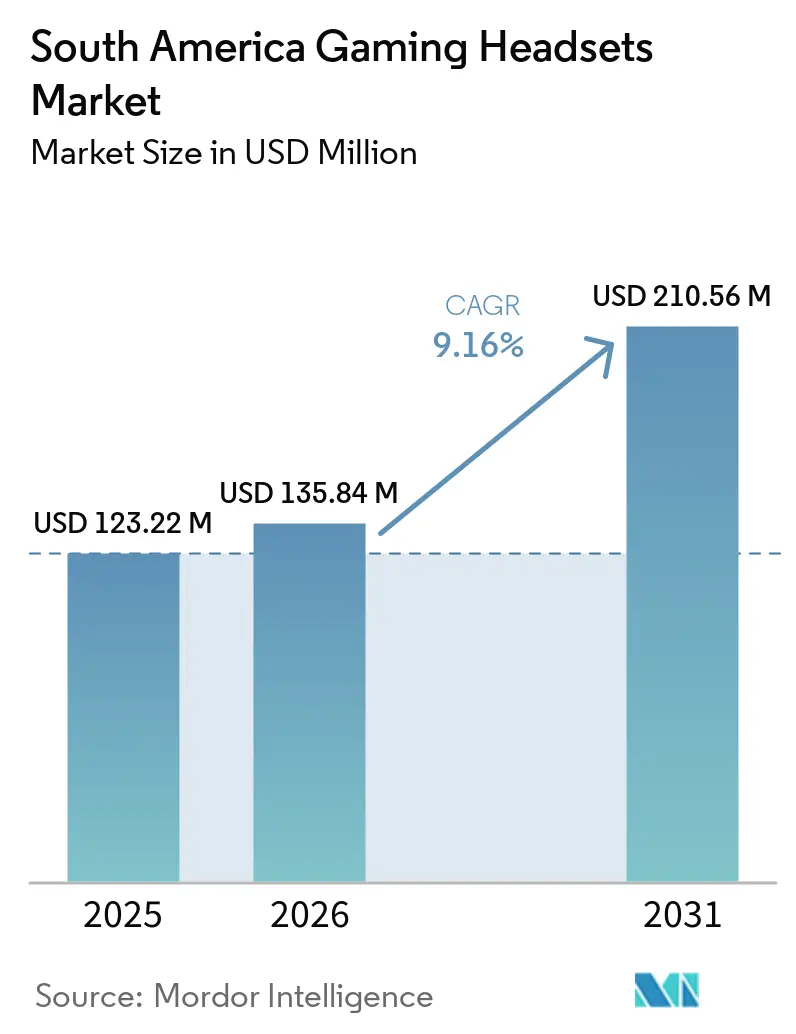
| Base Year Market Size (2025) | USD 123.22 Million |
| Market Size (2026) | USD 135.84 Million |
| Market Size (2031) | USD 210.56 Million |
| Growth Rate (2026 - 2031) | 9.16 % |
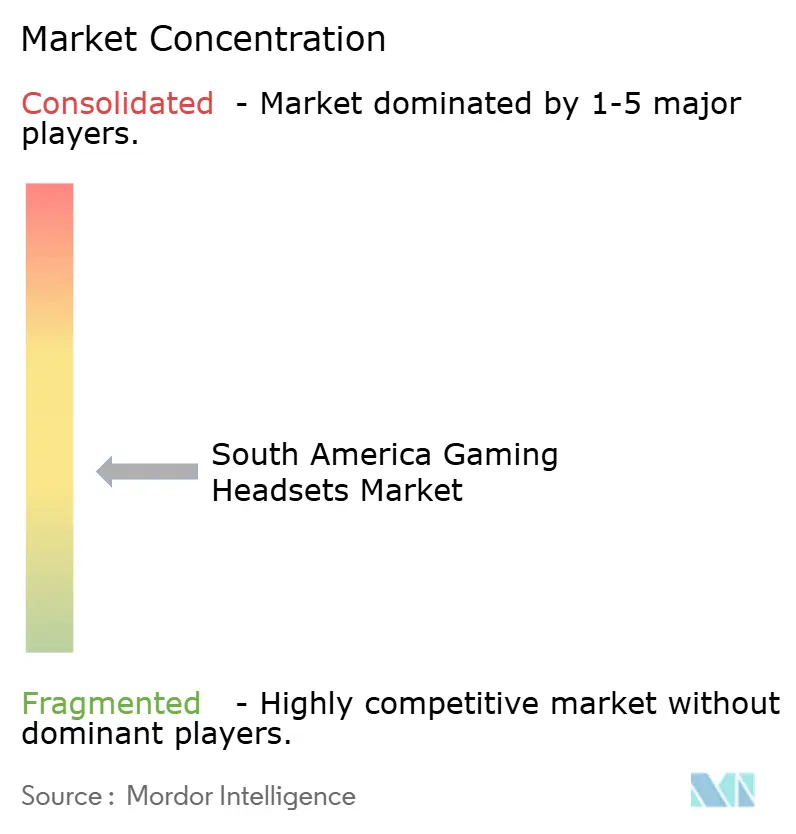
| Market Concentration | Medium |
Major Players *Disclaimer: Major Players sorted in no particular order Image © Mordor Intelligence. Reuse requires attribution under CC BY 4.0. | |
South America Gaming Headsets Market Analysis by Mordor Intelligence
The South America gaming headsets market size was valued at USD 123.22 million in 2025 and is estimated to expand from USD 135.84 million in 2026 to reach USD 210.56 million by 2031, at a CAGR of 9.16% during the forecast period (2026-2031). Gaming participation and broader spending on consoles, PCs, and mobile devices are supporting demand for dedicated audio products. Brazil remains the central demand base because its gaming population, retail infrastructure, telecom offers, and local assembly ecosystem support several price tiers. Wireless products are gaining ground as dual-mode designs make it easier for users to switch among consoles, PCs, and phones. Price sensitivity still shapes most purchases, while installment payments and formal retail channels help more consumers consider higher-value devices. Brands that combine certified wireless products, local distribution, and clear price steps can address the South America gaming headsets market more effectively.
Key Report Takeaways
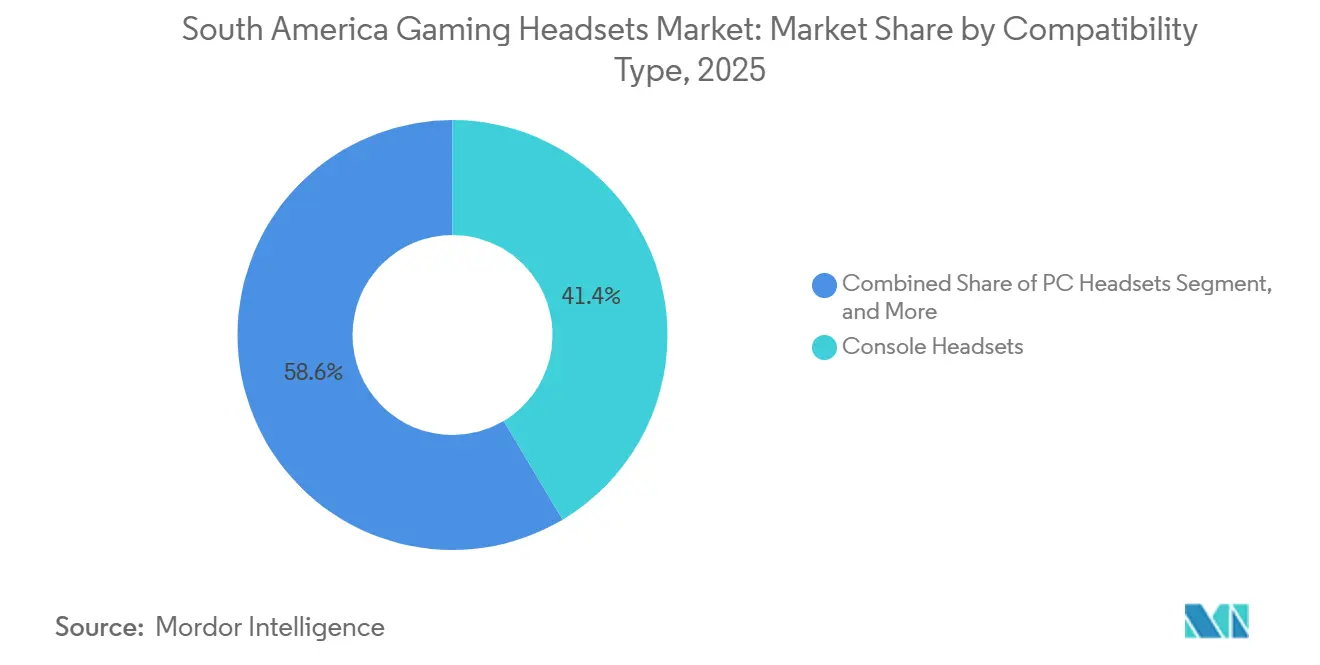
- By compatibility type, console headsets held 41.44% of the South America gaming headsets market in 2025, while mobile and tablet headsets are projected to expand at a 10.50% CAGR through 2031.
- By connectivity type, wired headsets held 65.34% of revenue in 2025, while wireless headsets are projected to expand at a 10.81% CAGR through 2031 in the South America gaming headsets market.
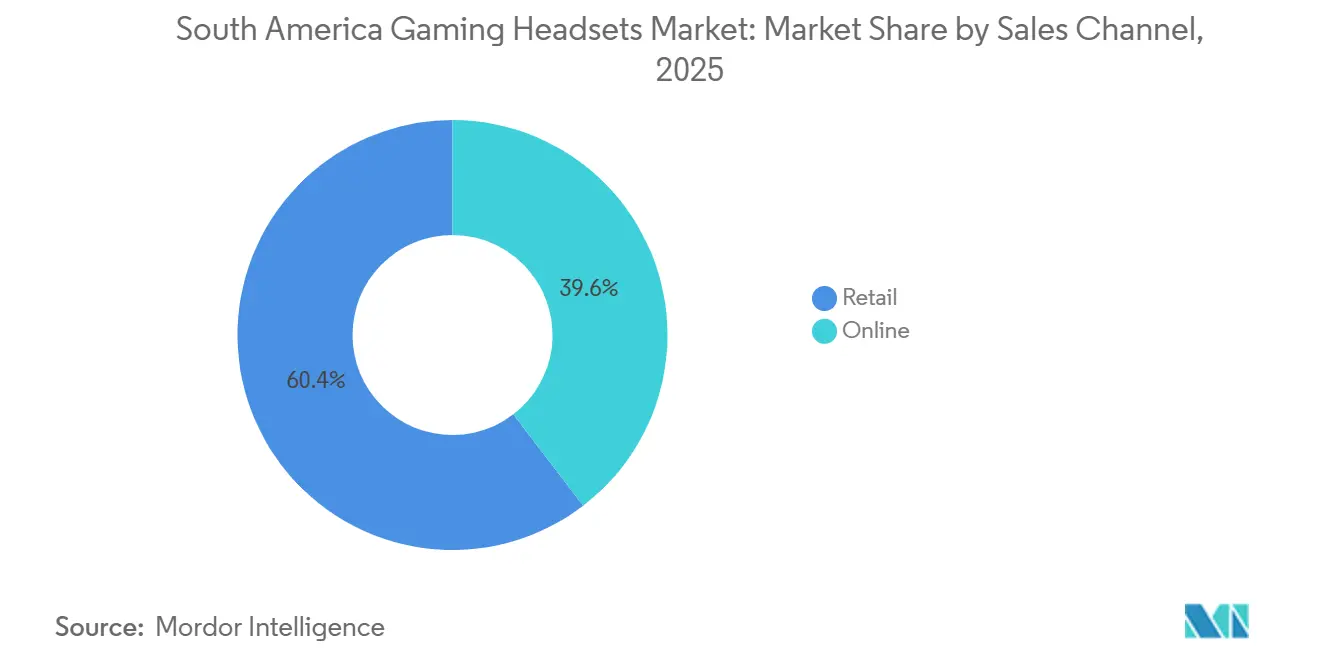
- By sales channel, retail held 60.41% of revenue in 2025, while online sales are projected to expand at a 10.58% CAGR through 2031 in the South America gaming headsets market.
- By price band, entry and budget headsets below USD 50 held 45.72% of revenue in 2025, while high-end and esports headsets above USD 200 are projected to expand at a 10.67% CAGR through 2031 in the South America gaming headsets market.
- By geography, Brazil held 38.48% share in 2025, while Argentina is projected to expand at a 9.24% CAGR through 2031 in the South America gaming headsets market.
Note: Market size and forecast figures in this report are generated using Mordor Intelligence’s proprietary estimation framework, updated with the latest available data and insights as of January 2026.
South America Gaming Headsets Market Trends and Insights
Drivers Impact Analysis*
| Driver | (~) % Impact on CAGR Forecast | Geographic Relevance | Impact Timeline |
|---|---|---|---|
| Rising Esports Participation | +2.3% | Brazil, Argentina, Colombia | Medium term (2-4 years) |
| Expansion of PC and Console Gaming | +2.0% | Brazil, with spillover to Argentina and Chile | Medium term (2-4 years) |
| Wireless Low-Latency Innovation | +1.5% | Brazil, Chile, Argentina | Short term (≤ 2 years) |
| Growth of Online Retail and Installment Payments | +1.0% | Brazil, Argentina, Colombia | Short term (≤ 2 years) |
| Brazil Gaming-Cafe Replacement Cycles | +0.6% | Brazil, including São Paulo, Rio de Janeiro, and interior cities | Medium term (2-4 years) |
| Localized Cross-Platform Bundling Through Telecom and Marketplace Ecosystems | +0.5% | Brazil and Colombia | Short term (≤ 2 years) |
| Source: Mordor Intelligence | |||
Rising Esports Participation
South America’s esports audience exceeded 60 million fans in 2025, expanding the base of consumers exposed to competitive gaming equipment. Regional esports revenue reached USD 103.6 million in 2024, following a 13.6% CAGR from 2019 to 2024 and a 16.4% increase during 2024. Competitive players need low audio latency and accurate positional cues, which increases demand for purpose-built headsets. Tournament broadcasts also make audio quality and product features more visible to casual players. Those viewing habits can lead consumers to use competitive specifications as a reference point when replacing basic audio devices. This setting supports demand in the South America gaming headsets market for products that provide reliable microphone performance and directional sound.
Expansion of PC and Console Gaming
PC and console gaming revenue in South America exceeded USD 2 billion in 2025.[1]“The Games Market in South America: Who the Players Are and How to Connect Brands to This Audience,” Gamescom LATAM, latam.gamescom.global Console gaming held the largest product-type share in Brazil during 2025, which supported purchases of headset models designed for PlayStation and Xbox systems. Gaming venues are also replacing older LAN house formats with more professional gaming arenas. These venues procure headsets in larger volumes as they upgrade equipment for frequent use. Steam and Epic Games Store gaming in South America recorded CAGRs of 10.6% and 13.7%, respectively, from 2022 to 2025. This combination of console ownership, PC platform adoption, and venue investment supports recurring peripheral purchases in the South America gaming headsets market.
Wireless Low-Latency Innovation
Low-latency 2.4 GHz wireless designs are reducing a long-standing concern among competitive players. Logitech’s LIGHTSPEED and Razer’s HyperSpeed product lines show how wireless technology is being positioned for gaming use. Logitech launched the G321 LIGHTSPEED and G325 LIGHTSPEED in Brazil in March 2026 at BRL 449.90 (USD 75) and BRL 699.90 (USD 117), respectively, with 2.4 GHz and Bluetooth 5.0 connectivity.[2]“Logitech G Anuncia no Brasil os Novos Headsets Sem Fio G321 e G325 LIGHTSPEED,” Logitech International S.A., logitechstore.com.br Dual-mode headsets allow users to connect across consoles, PCs, and smartphones without buying separate products. This is relevant in Brazil, where users often move among multiple gaming devices. Consumers who bought wired products from 2020 to 2023 are therefore more likely to consider a wireless replacement within a shorter cycle.
Growth of Online Retail and Installment Payments
Brazil’s e-commerce sector was expected to reach USD 36.3 billion in revenue during 2025, with 94 million people projected to shop online. The domestic online market was projected to expand by 20% in 2025, while cross-border activity was projected to increase by 32%. PIX payments and installment options reduce the immediate cost of a USD 100 to USD 200 headset purchase. Mercado Livre, Shopee, and KaBuM! use these payment structures to make higher-priced hardware more accessible. Vivo also introduced Fibra Gamer with ExitLag and 700 Mbps fiber at BRL 170 (USD 28) per month in August 2025. Telecom offers and online platforms can increase product discovery for the South America gaming headsets market, including through bundles and carrier storefronts.
Restraints Impact Analysis*
| Restraint | (~) % Impact on CAGR Forecast | Geographic Relevance | Impact Timeline |
|---|---|---|---|
| Import Taxes and Currency Volatility | -1.8% | Brazil, Argentina, Chile | Short term (≤ 2 years) |
| Counterfeit and Gray-Market Competition | -1.3% | Brazil and Paraguay border regions | Medium term (2-4 years) |
| ANATEL Certification Friction for Wireless SKUs | -0.9% | Brazil | Short term (≤ 2 years) |
| Battery and E-Waste Compliance Costs | -0.5% | Brazil and Colombia | Medium term (2-4 years) |
| Source: Mordor Intelligence | |||
Import Taxes and Currency Volatility
Brazil increased the IOF rate on international card purchases from 0.38% to 3.50% in May 2025, raising the landed cost of imported products sold through cross-border channels. Proposed trade measures also created potential exposure for US-origin products. Currency movement creates additional pricing pressure because global headset brands commonly set their costs in USD. Argentina’s macroeconomic conditions can create substantial differences between formal and informal prices. Brazil’s GECEX ex-tarifário program can reduce duties on IT and telecommunications goods with no domestic equivalent, but the application process favors importers with established compliance resources. These conditions raise the price floor for certified imported wireless devices and can make unauthorized alternatives more appealing.
Counterfeit and Gray-Market Competition
Counterfeit and gray-market peripherals remain a persistent pressure, particularly for products priced below USD 30. Brazil’s Receita Federal seized 140,000 counterfeit gaming electronics at the Port of Rio de Janeiro in June 2025, with a stated value of BRL 10 million (USD 1.67 million) and falsified ANATEL seals.[3]“Operação da Receita Federal Apreende no Porto do Rio 140 Mil Eletrônicos Falsificados Entre Videogames e Outros Produtos,” Receita Federal do Brasil, g1.globo.com. A joint Receita Federal, Polícia Federal, and Polícia Civil operation executed 21 search and seizure warrants in April 2025 against electronics retailers in Mato Grosso. Unauthorized products avoid ANATEL approval, INMETRO safety testing, and IBAMA registration costs. That cost gap can place certified brands at a price disadvantage in entry-level channels. It can also weaken the brand distinction that budget suppliers seek to build through authorized retail.
*Our forecasts treat driver/restraint impacts as directional, not additive. The impact forecasts reflect baseline growth, mix effects, and variable interactions.
Segment Analysis
By Compatibility Type: Console Products Lead While Mobile Use Expands
Console headsets held 41.44% of the South America gaming headsets market share in 2025, supported by established PlayStation and Xbox use across Brazil and Argentina. The PlayStation PULSE Elite and Xbox Wireless Headset define the more visible console-certified range, while cross-compatible Redragon and Fortrek wired products provide lower-cost alternatives through Brazilian specialty retailers. PC headsets formed the next-largest category because of the installed gaming PC base, continuing Steam and Epic adoption, and LAN house equipment procurement. Venue operators replace headsets in bulk, often within 2 to 3 years when they shift from wired equipment to wireless products. Console and PC buyers remain important because system compatibility and dependable voice communication matter for home and institutional use.
Mobile and tablet headsets are projected to expand at a 10.50% CAGR through 2031, as smartphones were the primary gaming device for the largest share of Brazilian players in 2025. Many mobile-first users are buying a dedicated gaming audio product for the first time, creating a path from phone speakers toward entry peripherals. USB-C and Bluetooth 5.3 make higher-value audio products usable with current phones and tablets, supporting movement toward products priced from USD 50 to USD 99. Brands can retain these buyers through multi-platform products when they later adopt a console or PC. Razer’s August 2025 Hammerhead V3 HyperSpeed announcement illustrated this crossover with wireless compatibility for consoles, PCs, and mobile devices.



By Connectivity Type: Wired Products Retain Volume While Wireless Gains Value
Wired headsets accounted for 65.34% of the South America gaming headsets market share in 2025 because they have lower purchase prices, require no battery, and work across a broad range of devices. The format remains important for esports events where interference rules can restrict wireless use, and for LAN house operators that prioritize durable equipment with predictable replacement costs. It is particularly relevant below USD 20, where removing battery components improves the value proposition. Retailers can use a wired product as an accessible entry point before customers move to a more feature-rich device. This wired base continues to anchor unit demand among price-sensitive and institutional buyers.
Wireless headsets are projected to expand at a 10.81% CAGR through 2031, the highest reported rate among the subsegments. Flexible connections and lower latency in 2.4 GHz and Bluetooth products support this demand, while ANATEL requirements cover Bluetooth, 2.4 GHz dongle, and hybrid wireless products sold in Brazil. Act No. 18086 took effect in May 2026 and requires updated import documentation, while per-SKU certification costs of BRL 7,000 to BRL 20,000 can favor larger importers. Wireless suppliers can combine low-latency audio, Bluetooth support, and multi-device pairing, and future Bluetooth 6.0 specifications should further reduce perceived latency concerns. The South America gaming headsets market therefore has a two-track structure, with wired products retaining value-oriented volume and wireless formats attracting more replacement spending.
By Sales Channel: Retail Holds the Base While Online Sales Accelerate
Retail held 60.41% of the South America gaming headsets market in 2025, with Brazilian chains such as Casas Bahia, Magazine Luiza, and KaBuM! offering product trials and installment options. Physical stores let consumers compare fit, microphone quality, and build quality before purchase, which is valuable when informal channels carry counterfeit goods. Shelf placement consequently acts as a practical authenticity signal and supports sales of mid-tier products that need clearer demonstrations. PIX installment financing also lowers the immediate cost of a higher-priced headset. These factors keep retail central despite rapid marketplace expansion.
Online sales are projected to expand at a 10.58% CAGR through 2031 as Mercado Livre, Shopee, and direct brand stores widen regional choice. Online channels give companies more control over product descriptions, bundles, and official-store verification, while reaching consumers outside major urban shopping areas. Telefônica Vivo launched Cloud Gaming by Blacknut in February 2025 at BRL 20 (USD 3.39) per month for eligible mobile and fiber customers. Carrier applications can introduce gaming users to headset products while customers already consider gaming services. Payment systems, delivery coverage, and telecom links are making online channels more important to the South America gaming headsets market.
By Price Band: Entry-Level Volume Contrasts With High-End Demand
Entry and budget headsets priced below USD 50 accounted for 45.72% of the South America gaming headset market in 2025, underscoring the importance of affordable equipment across the region. Redragon, Fortrek, and Multilaser compete through local distribution, domestic assembly benefits, and products designed for BRL 200 to BRL 300 price points. These products matter to consumers moving from phone speakers to a first dedicated headset, while Fortrek’s April 2026 launch included wired Win and wireless Win Air models. The release shows that domestic suppliers are adding wireless choice without leaving their value-oriented position. Mid-range products priced from USD 50 to USD 99 and premium products priced from USD 100 to USD 199 offer global brands greater margin potential through wireless and spatial-audio features.
High-end and esports headsets priced above USD 200 are projected to grow at a 10.67% CAGR through 2031, even though unit demand remains narrower than in the entry tier. Razer introduced the Kraken Kitty V3 Pro in Brazil at BRL 1,999.90 (USD 339) in December 2025. These products target buyers seeking multi-platform wireless operation and premium audio features. PIX installment structures can split the purchase price into monthly payments, which broadens the potential buyer pool. The gaming headset industry can therefore gain meaningful revenue from high-value products while affordable products continue to lead volume.
Geography Analysis
By geography, Brazil held 38.48% share in 2025, while Argentina is projected to expand at a 9.24% CAGR through 2031 in the South America Gaming Headsets Market. Brazil accounted for the largest share of the South America gaming headsets market. Vivo launched Fibra Gamer with ExitLag and 700 Mbps fiber in August 2025, while Claro offered Nvidia GeForce Now through mobile and home internet plans. Brazil’s LAN house ecosystem is shifting toward professionally managed gaming arenas, and ClansBR cited initial franchise investment needs from BRL 648,000 (USD 108,000) to BRL 1.78 million (USD 297,000) in 2026. These venues can become institutional buyers of better-performing audio equipment. Brazil also faces the highest counterfeit exposure and has robust enforcement through ANATEL marketplace inspections and Receita Federal seizures.
Argentina is the second-largest national market, with gamers concentrated in Greater Buenos Aires, Córdoba, and Rosario, where esports organizations are increasing procurement budgets for certified premium equipment. Strict consumer-electronics import documentation creates a gap between formal and informal prices that can sustain gray-market audio products. Colombia and Chile are smaller but strategically important demand pools, and Colombia’s headset imports increased sharply from 2023 to 2024 as connectivity improved in Bogotá and Medellín. Chile is projected to outpace the South America gaming headsets market in CAGR terms because of stronger internet penetration, more esports venues, and comparatively lower import friction for certified hardware. These conditions make differentiated geographic pricing and formal channel coverage important for suppliers.
Peru, Venezuela, Ecuador, Bolivia, and Paraguay together represent a smaller revenue base, with longer-term demand linked to smartphone penetration and mobile-first gaming. Peru’s import category showed slower CAGR in 2024 amid macroeconomic pressure and sourcing concentration from China and Vietnam. Affordable wired products and low-cost wireless earbuds can introduce first-time buyers to dedicated gaming audio. Paraguay’s Ciudad del Este remains an informal distribution hub, requiring brands to manage authorized pricing carefully where products enter Brazil and Argentina through border retail.
Competitive Landscape
The South America gaming headsets market is fragmented, with no company holding a dominant position across both budget and premium tiers. Logitech, Razer, and Corsair compete strongly in products priced at USD 80 and above, using proprietary LIGHTSPEED, HyperSpeed, and SLIPSTREAM technologies to support higher prices. Logitech identified gaming peripherals as its largest global revenue contributor in its fiscal year 2025 annual report. Its 2025 and 2026 Brazil launches covered entry wireless and flagship multi-platform models, while Sony’s PULSE series and PlayStation Link connectivity support its console-certified position. The USD 50 to USD 80 wireless range remains open for a brand with a clear step-up offer from basic wired products.
Multilaser, Fortrek, Dazz, and Redragon compete mainly through accessible pricing and local distribution, while Redragon’s USB-certified 7.1 surround models have strong visibility in Brazilian retail at BRL 100 to BRL 250. Fortrek’s April 2026 release of 33 peripherals included its first material wireless headset offering. The release brings local competition into entry wireless products, where global brands historically retained more pricing power. Domestic suppliers benefit from local assembly and retailer relationships, but also need stable connections, credible battery performance, multi-platform operation, and formal product verification. Price matters, but authorized availability and confidence in product authenticity also shape brand choice.
Emerging Chinese mid-tier brands can increase pressure on established suppliers if they obtain certification and stable distribution. Comparable features at lower prices could narrow the gap against multinational products in the BRL 200 to BRL 400 range. Established suppliers are using broader price coverage, local launches, and proprietary wireless features to protect their positions. The South America gaming headsets market remains competitive across price tiers rather than concentrated around a small group of dominant firms.
South America Gaming Headsets Industry Leaders
Logitech International S.A.
Razer Inc.
HP Inc.
Corsair Gaming, Inc.
Sony Interactive Entertainment LLC
- *Disclaimer: Major Players sorted in no particular order

Recent Industry Developments
- June 2026: Microsoft announced the Xbox Wireless Headset Forza Horizon 6 Limited Edition for Brazil at BRL 1,199 (USD 200), available from June 2026. The headset includes Dolby Atmos, DTS Headphone:X, Windows Sonic spatial audio, Bluetooth LE Audio for stereo and wideband voice chat, and startup sounds modeled on a Japanese V8 engine.
- April 2026: Fortrek launched 33 gaming products in Brazil, including the Win wired headset and Win Air wireless headset with a 50mm driver, alongside mechanical keyboards, wireless mice, and gaming soundbars. The launch marked Fortrek’s first material push into wireless headsets.
- March 2026: Logitech G launched the G321 LIGHTSPEED at BRL 449.90 (USD 75) and the G325 LIGHTSPEED at BRL 699.90 (USD 117) in Brazil. Both wireless headsets feature 2.4 GHz and Bluetooth connectivity. The G321 uses 28% post-consumer recycled materials and FSC-certified packaging.
- December 2025: Razer launched the Kraken Kitty V3 Pro at BRL 1,999.90 (USD 339) and Kraken Kitty V3 X at BRL 699.90 (USD 119) in Brazil. Both products feature Razer HyperSpeed Wireless 2.4 GHz, Bluetooth 5.3, 40mm TriForce Titanium drivers, and THX Spatial Audio 7.1 surround.


South America Gaming Headsets Market Report Scope
The South America Gaming Headsets Market refers to the industry focused on the design, manufacturing, distribution, and sale of audio headsets specifically developed for gaming applications across countries in the region.
The South America Gaming Headsets Market Report is Segmented by Compatibility Type (Console Headsets, PC Headsets, and Mobile/Tablet Headsets), Connectivity Type (Wired, and Wireless), Sales Channel (Retail, and Online), Price Band (Entry/Budget, Mid-Range, Premium, and High-End/Esports), and Geography (Brazil, Argentina, Colombia, and Rest of South America). The Market Forecasts are Provided in Terms of Value (USD).
| Console Headsets |
| PC Headsets |
| Mobile/Tablet Headsets |
| Wired |
| Wireless |
| Retail |
| Online |
| Entry/Budget (Less than USD 50) |
| Mid-range (USD 50-99) |
| Premium (USD 100-199) |
| High-end/Esports (Greater than USD 200) |
| Brazil |
| Argentina |
| Colombia |
| Rest of South America |
| By Compatibility Type | Console Headsets |
| PC Headsets | |
| Mobile/Tablet Headsets | |
| By Connectivity Type | Wired |
| Wireless | |
| By Sales Channel | Retail |
| Online | |
| By Price Band | Entry/Budget (Less than USD 50) |
| Mid-range (USD 50-99) | |
| Premium (USD 100-199) | |
| High-end/Esports (Greater than USD 200) | |
| By geography | Brazil |
| Argentina | |
| Colombia | |
| Rest of South America |


Key Questions Answered in the Report
What is the size of the South America gaming headsets market?
The South America gaming headsets market size is USD 135.84 million in 2026 and is forecast to reach USD 210.56 million by 2031 at a 9.16% CAGR. This reflects rising gaming participation and replacement demand for dedicated audio equipment.
Which compatibility category leads demand in South America?
Console headsets led compatibility demand with 41.44% of revenue in 2025, supported by PlayStation and Xbox use. Console certification and lower-cost cross-compatible alternatives both support this position.
What is driving wireless gaming headset adoption in South America?
Wireless formats are projected to expand at a 10.81% CAGR through 2031 as 2.4 GHz and Bluetooth models improve flexibility and reduce latency concerns. Dual-mode connectivity also supports switching between consoles, PCs, and phones.
Which sales channel is expected to expand fastest for gaming headsets?
Online sales are projected to expand at a 10.58% CAGR through 2031, supported by marketplaces, official stores, PIX, and installment payments. These channels also extend formal product availability outside large cities.
Why are entry-level products important for headset suppliers?
Products below USD 50 held 45.72% of revenue in 2025, reflecting strong demand for affordable gaming accessories. This tier is especially important for first-time buyers moving beyond phone speakers.
Which country has the largest demand base for gaming headsets in South America?
Brazil is the largest demand base, supported by high gaming participation, local retail, telecom gaming offers, and gaming venue investment. It also combines domestic assembly advantages with a more developed formal-channel ecosystem.
Page last updated on:





