
South America Data Center Energy Storage and Microgrids Market Size and Share
Market Overview
| Study Period | 2021 - 2032 |
|---|---|
| Forecast Data Period | 2027 - 2032 |
| Base Year Market Size (2026) | USD 286.49 Million |
| Market Size (2027) | USD 343.23 Million |
| Market Size (2032) | USD 815.28 Million |
| Growth Rate (2027 - 2032) | 18.89 % |
| Market Concentration | Medium |
Major Players *Disclaimer: Major Players sorted in no particular order Image © Mordor Intelligence. Reuse requires attribution under CC BY 4.0. | |
South America Data Center Energy Storage and Microgrids Market Analysis by Mordor Intelligence
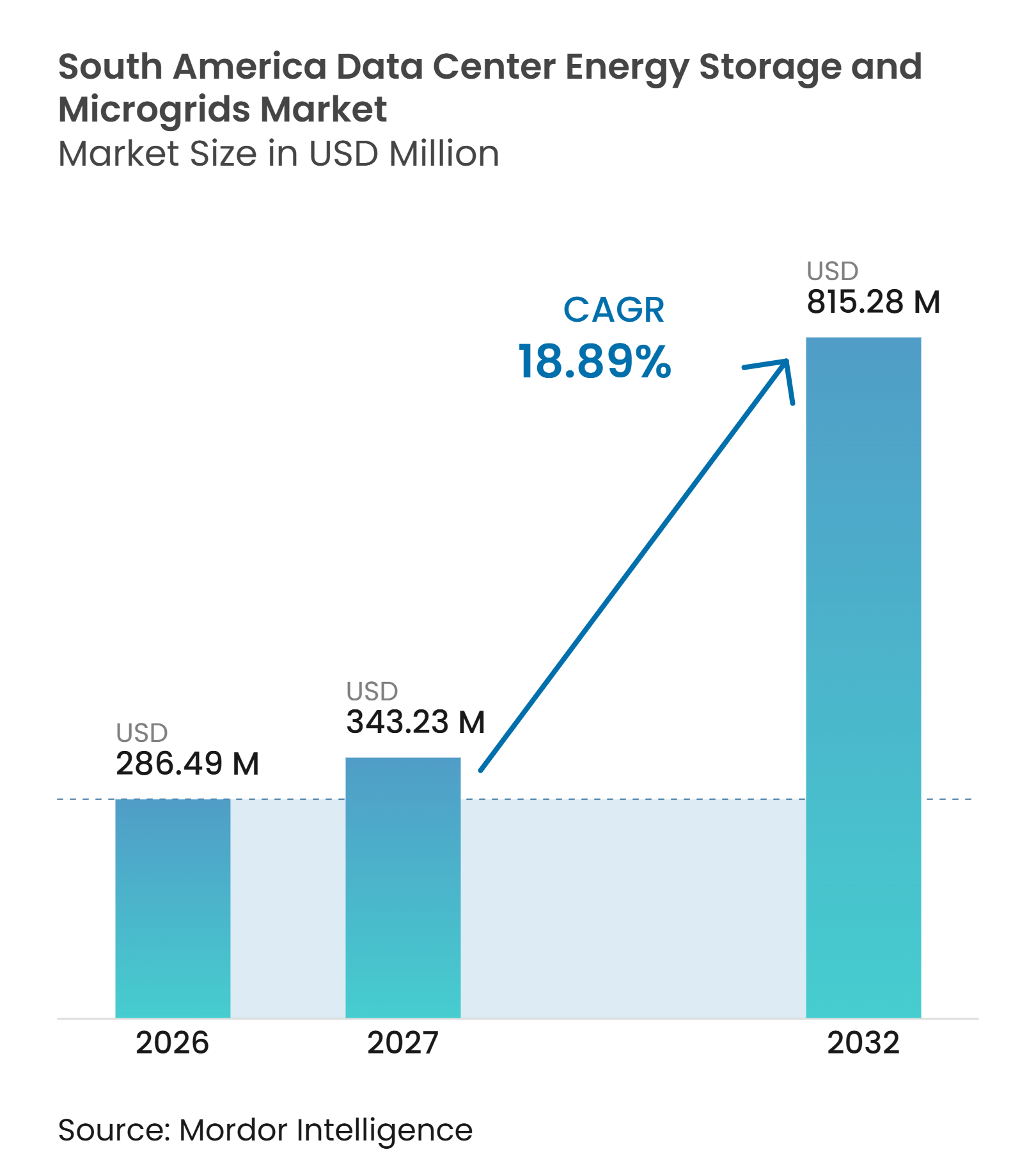
The South America data center energy storage and microgrids market size is projected to expand from USD 286.49 million in 2026 to USD 343.23 million in 2027, and to USD 815.28 million by 2032, registering a CAGR of 18.89% between 2027 and 2032. Artificial intelligence workloads are increasing the need for dependable, responsive power at data center sites. Grid limitations outside the largest metropolitan areas are making on-site storage and microgrids more central to project design. The South America data center energy storage and microgrids market is also being shaped by demand for round-the-clock renewable electricity, particularly where solar and wind output exceeds available transmission capacity. Operators are combining power contracts, storage, and local generation to reduce exposure to outages, connection delays, and fuel costs. These conditions favor integrated suppliers that can provide equipment, controls, and long-term power arrangements rather than a single hardware component.
Key Report Takeaways
- By solution type, energy storage systems held 34.81% of the South America data center energy storage and microgrids market share in 2026 and are projected to expand at a 19.88% CAGR through 2032.
- By storage technology, lithium-ion batteries held 49.12% share in 2026, while flow batteries are expected to expand at a 19.84% CAGR through 2032.
- By microgrid configuration, grid-connected microgrids accounted for 54.02% share in 2026, while hybrid grid-connected and islandable systems are projected to expand at a 19.48% CAGR through 2032.
- By primary energy source, grid electricity held a 38.17% share in 2026 of South America's data center energy storage and microgrids, while solar power is expected to expand at a 20.07% CAGR through 2032.
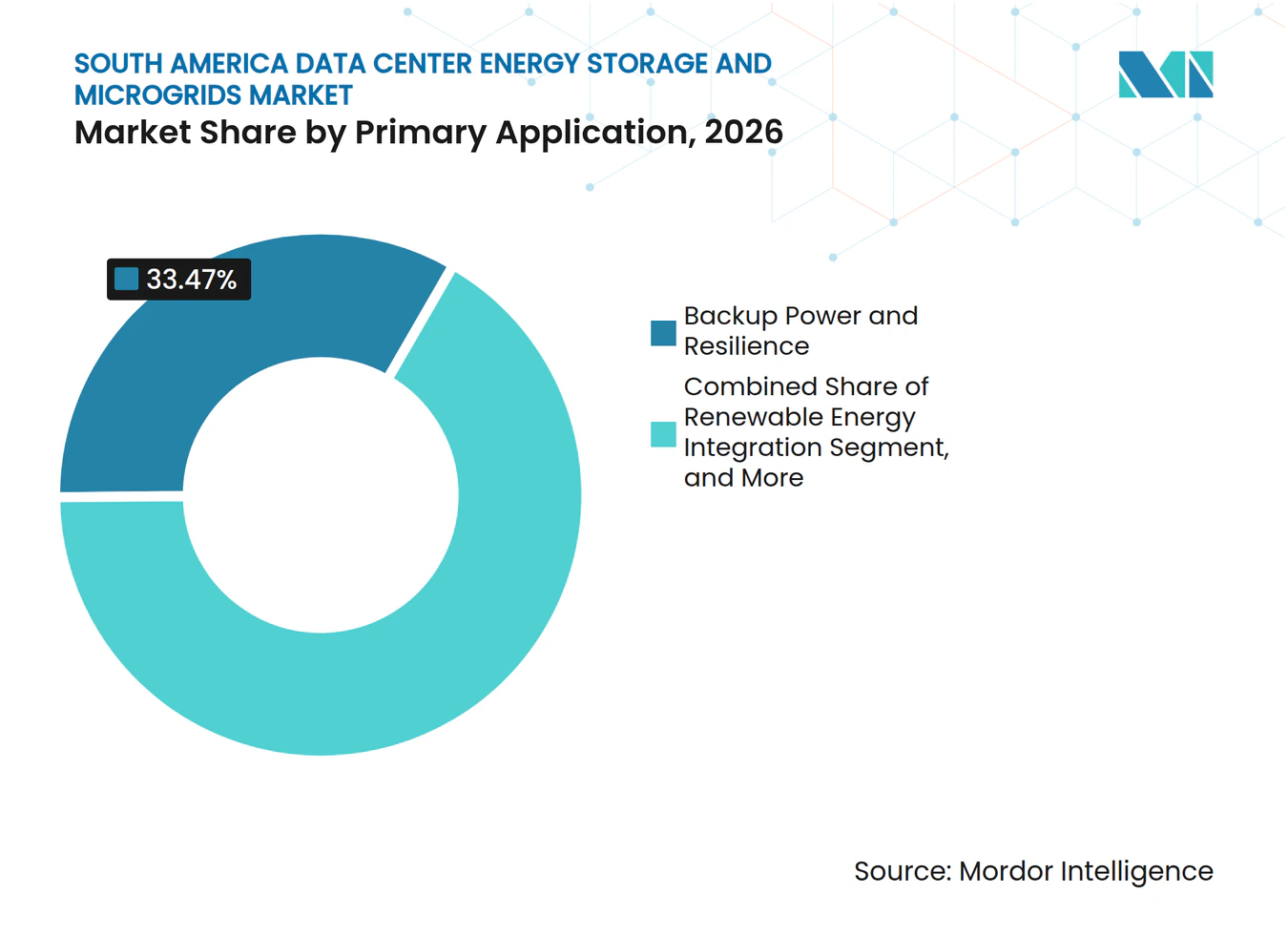
- By primary application, backup power and resilience accounted for 33.47% share in 2026, while renewable energy integration is projected to expand at a 19.79% CAGR through 2032.
- By data center size, large facilities held 36.19% share in 2026, while hyperscale facilities are expected to expand at a 19.64% CAGR through 2032.
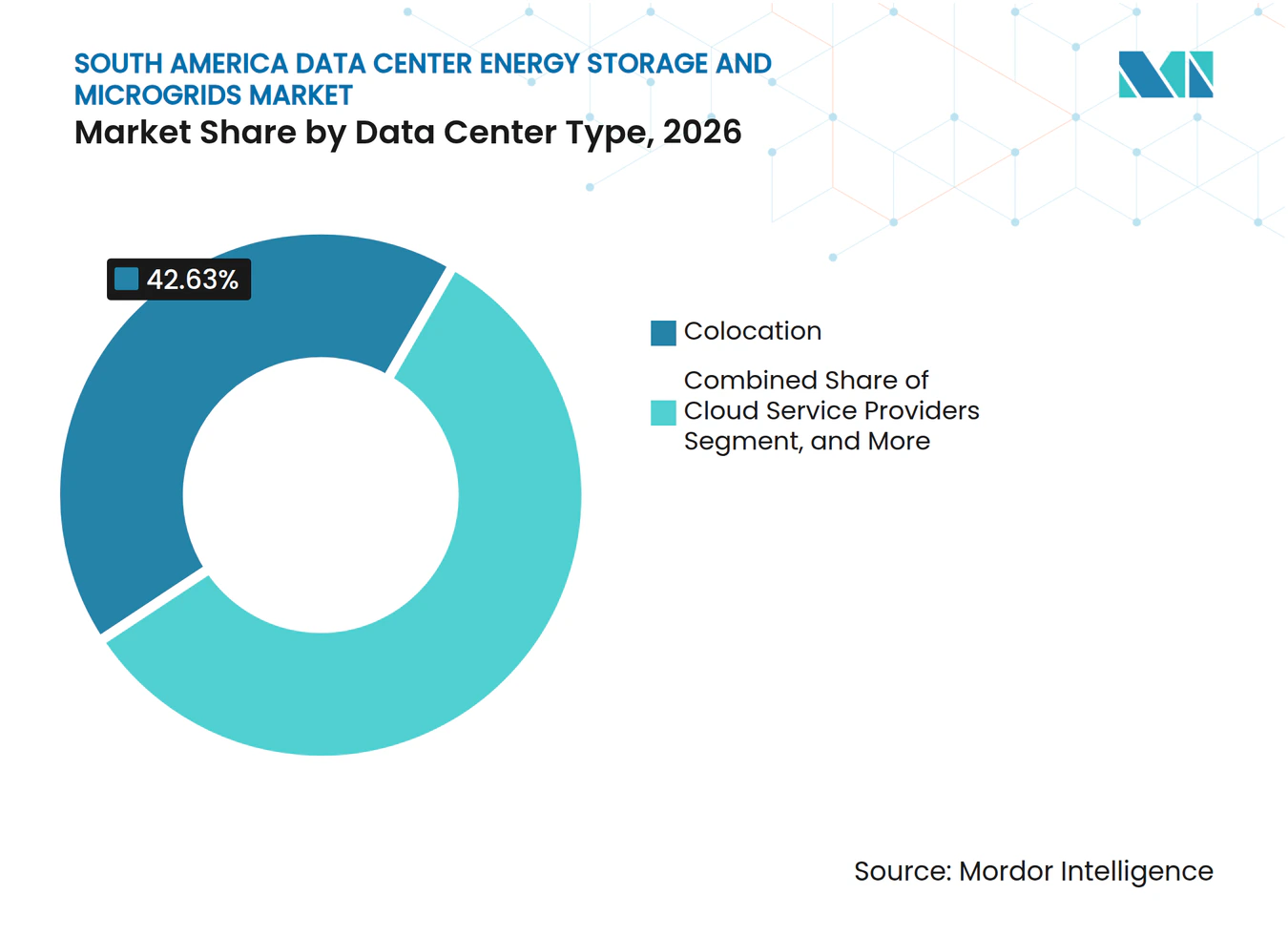
- By data center type, colocation accounted for 42.63% share in 2026, while cloud service providers are projected to expand at a 19.38% CAGR through 2032.
- By geography, Brazil held 52.34% share in 2026, while Chile is expected to expand at a 20.13% CAGR through 2032.
Note: Market numbers in this report are based on Mordor Intelligence's proprietary estimation framework, which combines nine months of actuals with Q4 projections for base year 2026.
Market Trends and Insights
Drivers Impact Analysis of South America Data Center Energy Storage and Microgrids Market*
| Driver | (~) % Impact on CAGR Forecast | Geographic Relevance | Impact Timeline |
|---|---|---|---|
| AI and High-Performance Computing Workload Expansion | +3.5% | Brazil core, spillover to Chile and Colombia | Short term (≤ 2 years) |
| Grid Reliability Requirements Outside Tier-1 Metros | +2.0% | Brazil, Colombia, Peru, and Argentina | Medium term (2-4 years) |
| Renewable Energy Curtailment and 24/7 Clean Power Demand | +2.5% | Chile, Brazil Northeast, and Argentina | Medium term (2-4 years) |
| Falling Lithium-Ion Storage Costs | +3.0% | Global, with strongest adoption in Brazil and Chile | Short term (≤ 2 years) |
| Data Sovereignty and Local Hosting Requirements | +1.5% | Brazil, Colombia, and Argentina | Medium term (2-4 years) |
| Mining and Remote-Operations Microgrid Demand | +1.0% | Chile, Peru, and Argentina | Long term (≥ 4 years) |
| Source: Mordor Intelligence | |||
AI and High-Performance Computing Workload Expansion
Artificial intelligence training and inference workloads are raising power density requirements across the South America data center energy storage and microgrids market. AI-capable racks can require 100-150 kW per rack, which is more than 10 times the load of legacy cloud equipment. The regional energy requirement is therefore not limited to a higher volume of electricity. It also requires a fast power response that can protect computing equipment during disturbances. The US International Trade Administration reported that Brazil’s data center power demand could reach 13.2 GW by 2035, up from 707 MW in 2023, adding pressure on site-level power planning. Storage systems can provide the rapid response that conventional grids may not consistently deliver to high-density sites.
Grid Reliability Requirements Outside Tier-1 Metros
Transmission capacity beyond São Paulo, Santiago, and Bogotá can fall short of the reliability requirement for large data center facilities. This situation makes the South America data center energy storage and microgrids market more dependent on local reliability assets. Delays in network access can force developers to secure capacity long before construction begins. The US International Trade Administration identified power availability as a central issue for Brazil’s expanding data center pipeline. Developers are consequently considering sites closer to generation assets, including wind and solar projects, rather than only near urban demand centers. This approach can convert unused renewable output into usable power when paired with storage.
Renewable Energy Curtailment and 24/7 Clean Power Demand
Brazil’s Northeast and Chile’s Atacama region have substantial renewable resources, but transmission constraints can limit delivery to major consumption centers. Battery systems can store renewable output that would otherwise be curtailed and release it when data center demand is highest. Atlas Renewable Energy received BRL 1 billion in financing during July 2025 for its 505 MWac Draco Solar Complex in Minas Gerais, which is positioned to serve data centers. Atlas also signed an agreement to supply ODATA Chile with I-REC-certified renewable electricity during January 2025. These arrangements make storage-backed power purchase agreements more important for operators with renewable electricity commitments. They also provide a path to more predictable energy procurement.
Falling Lithium-Ion Storage Costs
Falling battery costs have improved the economic case for storage compared with diesel backup systems. The International Renewable Energy Agency reported that battery energy storage can help address the timing gap between renewable generation and electricity demand.[1] Lithium iron phosphate chemistry is becoming more relevant because it reduces dependence on cobalt and supports frequent cycling. This chemistry suits facilities that use batteries for both backup power and renewable integration. Lower equipment costs can reduce the difference between a basic standby system and a four-hour storage configuration. The effect is strongest where imported fuel, interruptions, and peak tariffs make diesel-heavy designs expensive to operate.
Restraints Impact Analysis of South America Data Center Energy Storage and Microgrids Market*
| Restraint | (~) % Impact on CAGR Forecast | Geographic Relevance | Impact Timeline |
|---|---|---|---|
| High Upfront Capex and Limited Project-Finance Depth | -2.0% | Argentina, Peru, Colombia, and rest of South America | Medium term (2-4 years) |
| Grid Interconnection and Permitting Delays | -1.5% | Brazil Southeast and Chile Metropolitan Region | Short term (≤ 2 years) |
| Supply-Chain Dependence and Mineral Price Volatility | -1.0% | Global, amplified in South America by logistics | Medium term (2-4 years) |
| Energy, Water, and Land-Use Constraints | -0.8% | Santiago, coastal Brazil, and Lima | Long term (≥ 4 years) |
| Source: Mordor Intelligence | |||
High Upfront Capex and Limited Project-Finance Depth
Storage and microgrid projects require substantial upfront investment in batteries, power conversion equipment, control systems, and grid connections. Import duties, local insurance limits, and U.S. dollar equipment procurement can increase this burden. Scala Data Centers closed a USD 328 million financing package for three Chilean hyperscale facilities and a power substation in July 2025. The transaction showed that bank funding is available for developers with established contracts and strong counterparties. Smaller operators in Colombia, Peru, and Argentina often face less favorable lending terms and higher equity requirements. This condition can concentrate major projects among hyperscalers and well-funded regional developers.
Grid Interconnection and Permitting Delays
Grid access approvals can delay storage and microgrid deployment even when a project has secured land and financing. Brazil’s power system requires coordination among several public bodies for large high-voltage connections. Chile faces localized congestion around Santiago as more data center capacity is planned in the Metropolitan Region. Chile’s National Data Center Plan recognizes the infrastructure requirements associated with this expansion. Long delivery times for transformers and switchgear can add equipment risk to regulatory delay. Developers are responding by considering industrial sites with established connections, even where the location is less ideal for network design.
*Our forecasts treat driver/restraint impacts as directional, not additive. The impact forecasts reflect baseline growth, mix effects, and variable interactions.
South America Data Center Energy Storage and Microgrids Market Segment Analysis
By Solution Type:
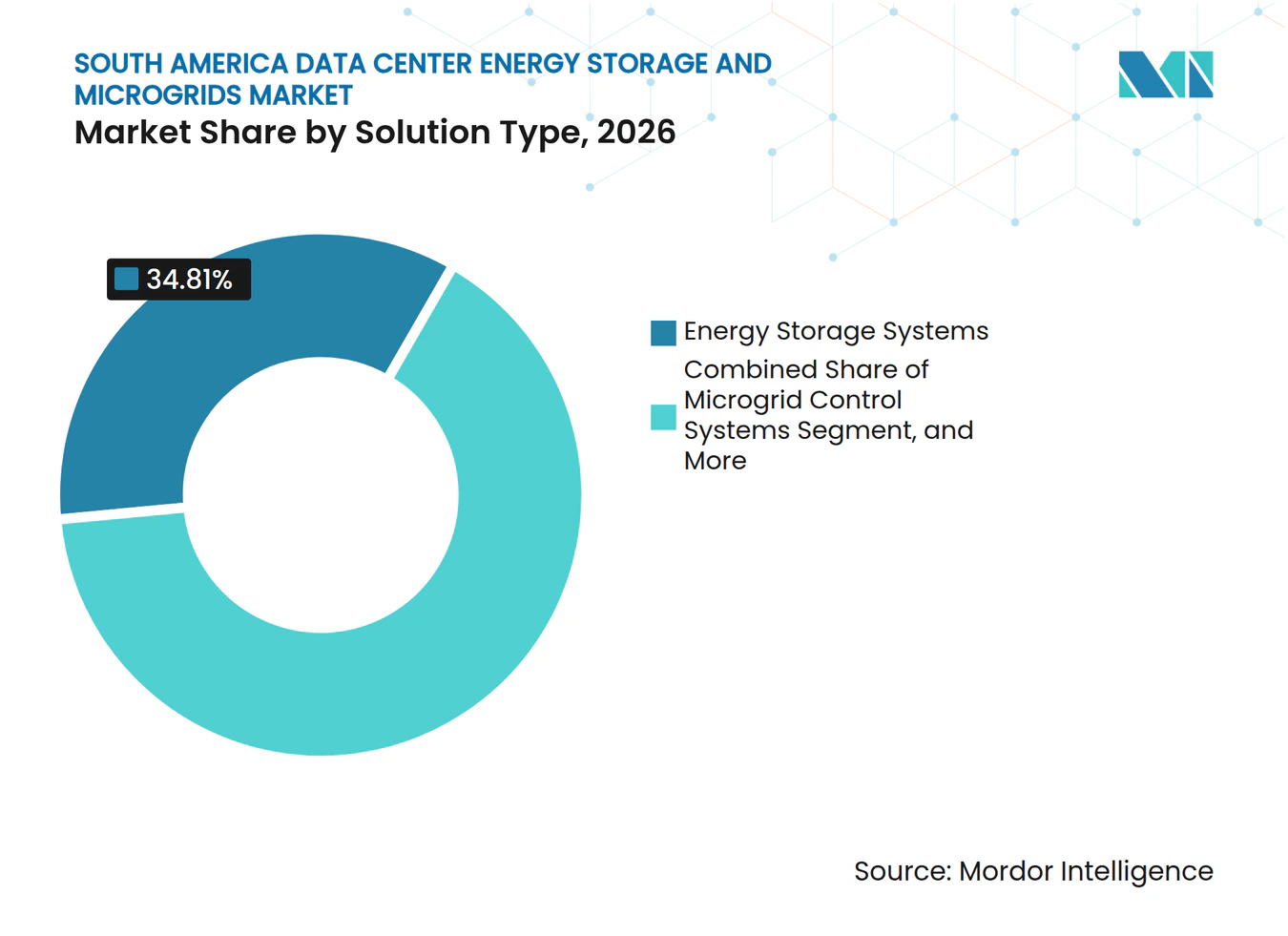
Energy Storage Systems Support Scale and ExpansionEnergy storage systems held 34.81% of the South America data center energy storage and microgrids market share in 2026 and are projected to expand at a 19.88% CAGR through 2032. Their position reflects the role of batteries as both a resilience asset and an operating asset. Operators use them for uninterruptible power, peak management, and renewable electricity balancing. Integrated microgrid solutions are also adopted on larger campuses that require generation, storage, and controls in a single design. Microgrid control systems and power conversion systems support more precise power management as rack densities increase.
The South America data center energy storage and microgrids market size for integrated equipment packages is supported by buyers seeking a single accountable supplier. Such packages combine batteries, inverters, software, and service agreements. This procurement model can reduce coordination risk during construction and commissioning. It can also limit the role of component-only vendors in larger projects. The US Department of Energy has documented how battery-equipped data centers can support grid events while protecting facility operations.[2] This ability adds value beyond a conventional backup system.



By Storage Technology:
Lithium-Ion Leads While Flow Batteries AdvanceLithium-ion batteries held 49.12% of the storage technology segment in 2026. Their installed base benefits from falling costs, widespread availability, and familiarity among data center designers. Fluence, Tesla, BYD, and LG Energy Solution are among the suppliers associated with this technology. Lithium-ion systems can support short-duration UPS requirements and longer-duration buffer applications. Their use is increasingly centered on lithium iron phosphate chemistry.
Flow batteries are projected to expand at a 19.84% CAGR through 2032. They can serve applications that require frequent cycling and longer discharge periods. XL Batteries and Prometheus Hyperscale announced a partnership in May 2025 to deploy organic flow batteries at data centers, including a 333 kW demonstration planned for 2027. Lead-acid batteries remain present in legacy UPS systems and smaller edge facilities. Flywheel systems continue to serve specific applications needing immediate frequency response. The South America data center energy storage and microgrids industry is therefore retaining several technologies even as lithium-ion remains the dominant choice.
By Microgrid Configuration:
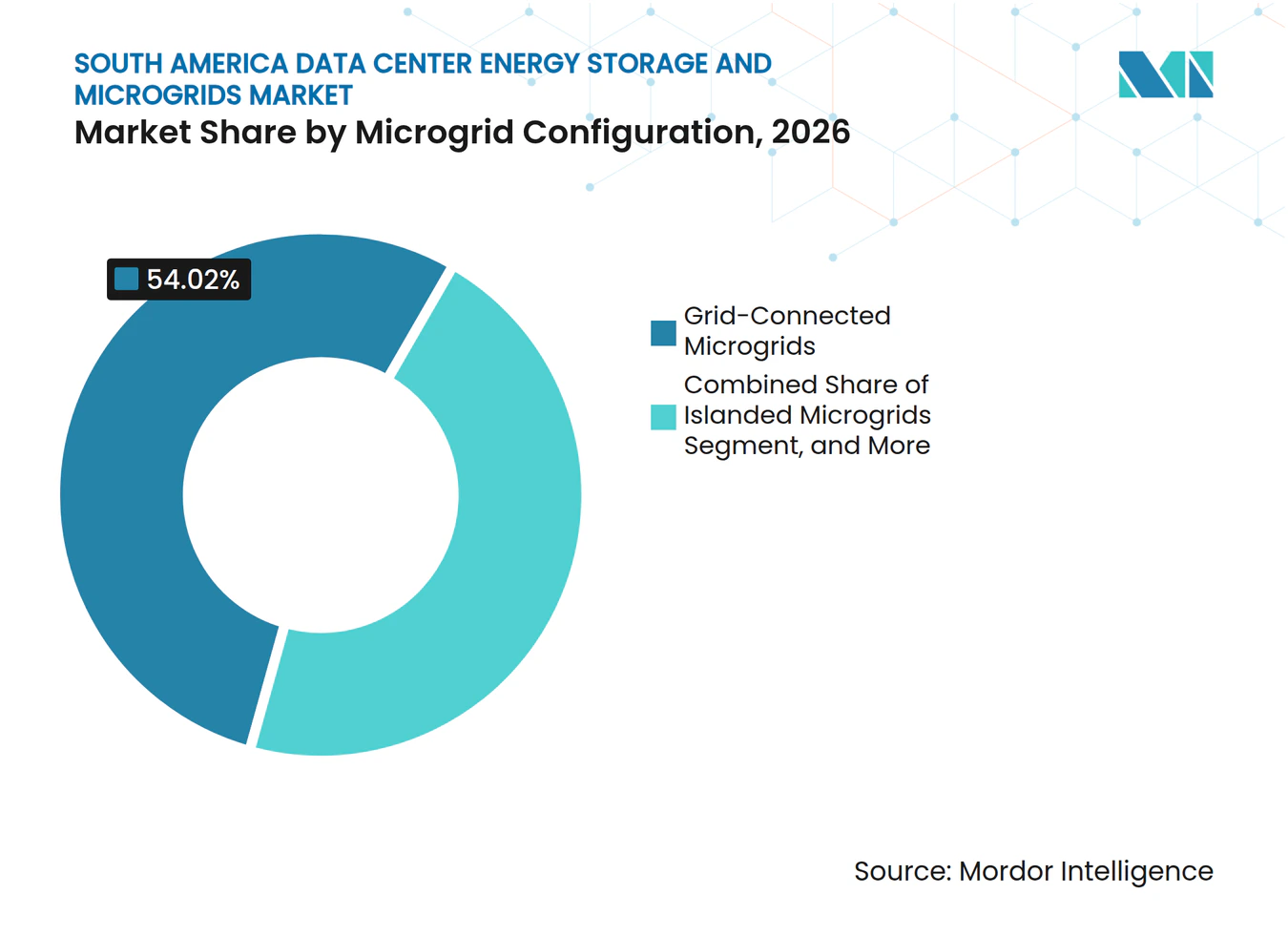
Grid-Connected Systems Remain the Primary DesignGrid-connected microgrids accounted for 54.02% of the configuration segment in 2026. This structure allows facilities to draw grid power while using storage to manage outages, peaks, and demand response opportunities. It also avoids the cost of building sufficient local generation for permanent islanded operation. The configuration is suited to large urban data center campuses with an established grid connection. It supports an incremental transition toward more flexible power operations.
Hybrid grid-connected and islandable microgrids are projected to expand at a 19.48% CAGR through 2032. These systems provide a contingency operating mode during extended outages without requiring routine full isolation from the grid. Islanded systems are more relevant for remote mining operations in Chile and Peru. Research from the Universidad de Chile modeled hybrid solar-wind-battery designs for off-grid copper processing in northern Chile. Such designs can reduce diesel use where extending the network is uneconomic. The South America data center energy storage and microgrids market, therefore, has a clear distinction between urban grid support and remote autonomous operation.

By Primary Energy Source:
Grid Electricity Leads While Solar Power Gains GroundGrid electricity held 38.17% of the primary energy source segment in 2026. Most operating data centers continue to depend on the grid for their core electricity supply. On-site batteries commonly provide bridging capacity, peak shaving, and reliability support. Diesel and natural gas remain important backup sources in remote locations and areas with limited grid quality. Fuel cells and wind power are smaller but relevant alternatives in selected locations.
Solar power is projected to expand at a 20.07% CAGR through 2032. Direct power purchase agreements can help operators secure electricity prices and meet renewable electricity targets. Atlas Renewable Energy’s Draco Solar Complex includes 11 photovoltaic plants and 505 MWac of capacity for Brazil’s industrial demand segment. IEEE research published in 2025 found that wind-solar-storage scheduling can reduce operating costs and emissions in data center microgrids. Storage is crucial because solar generation alone cannot meet a continuous data center load.
By Primary Application:
Resilience Remains Central While Renewable Integration AcceleratesBackup power and resilience accounted for 33.47% of primary application demand in 2026. The share reflects the need to protect continuous operations from transmission disturbances and grid outages. Data center owners still treat uninterrupted service as the first requirement for energy infrastructure. Storage provides a rapid response before generators begin operating. This application remains especially important outside major metropolitan grid centers.
Renewable energy integration is projected to expand at a 19.79% CAGR through 2032. It reflects a change from storage used only as insurance to storage used to firm clean electricity. Peak shaving and load shifting can also help operators manage commercial electricity charges. Grid services, including frequency response and demand response, are emerging applications for larger facilities. The International Renewable Energy Agency has emphasized storage’s role in balancing renewable supply and demand. These uses increase the operational value of batteries after they are installed.
By Data Center Size:
Large Facilities Lead and Hyperscale Development IncreasesLarge data centers held 36.19% of the size segment in 2026. Their share was supported by established 10-30 MW colocation campuses in São Paulo and Santiago. These facilities require reliable power but can often scale in phases. They also provide a practical model for enterprises and cloud providers entering a new location. Their energy systems generally combine grid supply, UPS assets, and standby generation.
Hyperscale facilities are projected to expand at a 19.64% CAGR through 2032. Microsoft announced USD 2.7 billion for Brazil, while AWS and ByteDance have also pursued larger regional capacity plans. Patria Investimentos launched the Omnia hyperscale platform in May 2025 with an initial USD 1 billion commitment for a project in Brazil. Higher-density AI clusters increase the need for liquid cooling and dedicated power architecture. This makes microgrids and storage more integral to campus planning.
By Data Center Type:
Colocation Has an Established Base While Cloud Providers ExpandColocation accounted for 42.63% of the data center type segment in 2026. This model has supported global cloud platforms that first enter a country through shared facilities. It places customers near telecommunications carriers and internet exchange points. Colocation operators also aggregate demand across enterprises that cannot build dedicated power infrastructure. Brazil’s established metro markets remain the core location for this model.
Cloud service providers are projected to expand at a 19.38% CAGR through 2032. AWS, Microsoft, and Google have developed or announced South American cloud capacity that requires dependable local power. Equinix invested in Brazil and Chile during 2025 and 2026, including the SP6 facility in São Paulo and Phase 2 of the Santiago ST2 campus. Enterprise and edge facilities are gaining relevance in Colombia, Peru, and Argentina because of local service requirements. The South America data center energy storage and microgrids industry benefits, as each facility type requires a tailored reliability design.
Geography Analysis
Brazil
Brazil held 52.34% of the South America data center energy storage and microgrids market share in 2026. São Paulo and Rio de Janeiro have an established hyperscale and colocation base, while the Northeast offers substantial wind and solar output. Brazil’s Ministry of Mines and Energy estimated that data center electricity demand could reach 13.2 GW by 2035, compared with 707 MW in 2023. The Redata program reduced certain federal taxes on eligible data center equipment during 2025. This improves the economics of equipment investment, although grid access remains a major constraint. ODATA secured USD 1.02 billion in green financing in September 2025 for facilities that meet energy-efficiency and renewable-energy criteria. The need to manage renewable curtailment in the Northeast is encouraging projects that combine local generation, batteries, and data center load.
Chile
Chile is projected to expand at a 20.13% CAGR through 2032, the highest rate among the countries reviewed. Its National Data Center Plan, launched in December 2024, targets a major expansion of national capacity by 2030. The country benefits from abundant solar resources in the north and a grid with a significant share of renewables. At the same time, Santiago’s concentration of data center activity creates local transmission and water-management considerations. Scala Data Centers closed USD 328 million in project financing during July 2025 for three hyperscale facilities and the Nova Lampa power substation. Atlas Renewable Energy’s supply agreement with ODATA Chile links the procurement of renewable electricity to I-REC certification. Chile’s Energy Transition Law supports faster transmission development, which can reduce connection risk for projects that plan early.
Colombia, Argentina, Peru, and the Rest of South America
Colombia, Argentina, and Peru are emerging markets for South America data center energy storage and microgrids. Bogotá had 47 MW of operational capacity during 2026, with additional projects under construction in the Tenjo area. Argentina is pursuing an AI strategy and has a developing battery storage tender pipeline. Peru’s Lima and Lurín districts are building their role as edge infrastructure locations. Vertiv entered distribution agreements with Grupo Datco for Argentina and Chile in October 2025 and with DACAS Peru in November 2025.[3] These channels can improve access to UPS, distribution equipment, liquid cooling, and battery systems. Ecuador, Uruguay, and Paraguay serve smaller enterprise demand and may benefit from capacity spillover from larger neighboring markets.
Competitive Landscape
Market Concentration
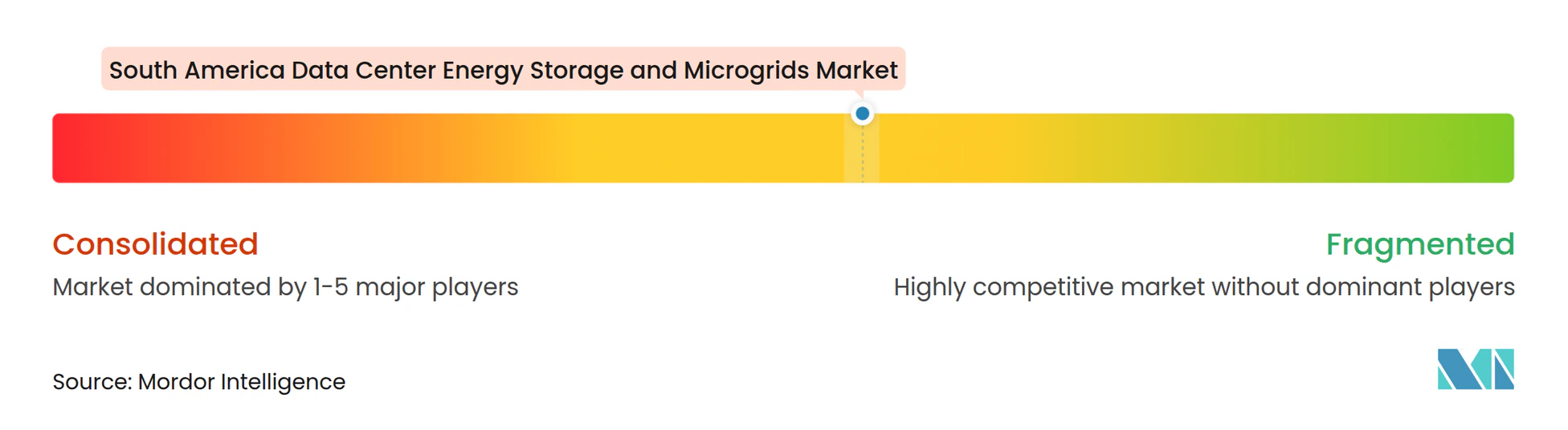
The South America data center energy storage and microgrids market is moderately fragmented. ABB, Schneider Electric, Vertiv, Eaton, and Siemens compete in the power infrastructure tier. Fluence, Tesla, BYD, and CATL participate in battery integration and storage supply. Regional developers and data center operators add another layer of competition by controlling sites, grid relationships, and customer contracts. This mix means a single project can involve several suppliers with overlapping roles.
Companies are differentiating through integrated designs and local delivery capability. Schneider Electric’s operations in Brazil include the production of prefabricated data center modules in Blumenau. WEG partnered with Elea Data Centers in January 2025 to supply transformers for a 50 MW high-voltage AI data center in São Paulo. BYD signed an agreement in May 2025 to supply 3.5 GWh of MC Cube-T battery systems for Grenergy’s Atacama Oasis project. Renewable developers are also bundling solar, storage, and renewable certificates in long-term power agreements. This can reduce the room for standalone battery suppliers that do not provide a broader operating solution.
Remote industrial microgrids in Chile, Peru, and Argentina remain a less developed opportunity. These projects need designs that displace diesel over long operating periods and can cope with limited grid availability. Flow battery suppliers are seeking a role where more than four hours of discharge and high cycling are required. IEEE microgrid standards and IEC 62898 guidance can influence technical design, lender review, and insurance requirements. Smaller suppliers, including EnerSys, Acumuladores Moura, and Nidec ASI, retain roles in UPS, lead-acid backup, and power conversion. Market concentration score: 4 out of 10, because the available evidence shows several global and regional suppliers across distinct layers, with no disclosed top-player concentration that would indicate control by a small group.
South America Data Center Energy Storage and Microgrids Industry Leaders
-
Schneider Electric SE
-
Vertiv Holdings Co
-
ABB Ltd.
-
Eaton Corporation plc
-
Fluence Energy, Inc.
- *Disclaimer: Major Players sorted in no particular order
South America Data Center Energy Storage and Microgrids Market Companies Covered in this Report
- ABB Ltd.
- Schneider Electric SE
- Vertiv Holdings Co
- Eaton Corporation plc
- Siemens AG
- Mitsubishi Electric Corporation
- WEG S.A.
- Fluence Energy, Inc.
- Tesla, Inc.
- BYD Company Limited
- Enel S.p.A.
- AES Andes S.A.
- Engie S.A.
- LG Energy Solution Ltd.
- Contemporary Amperex Technology Co., Limited
- Panasonic Holdings Corporation
- Samsung SDI Co., Ltd.
- Saft Groupe S.A.
- EnerSys
- Acumuladores Moura S.A.
- Nidec ASI S.p.A.
- Hitachi Energy Ltd.
- Atlas Renewable Energy
- ODATA Brazil S.A.
- Scala Data Centers S.A.
- Ascenty Data Centers e Telecomunicações Ltda.
- Equinix, Inc.
- Tecto Data Centers S.A.
- EdgeConneX, Inc.
- Grupo Datco
Recent Industry Developments in South America Data Center Energy Storage and Microgrids Market
- May 2026: Equinix reported that its RJ3 data center in Rio de Janeiro was operational, following an initial USD 45 million investment. The first phase supports more than 550 cabinets. Equinix reported more than USD 419 million in announced and executed investments across Mexico, Brazil, Chile, and Colombia during 2025 and 2026, including USD 270 million in Brazil.
- November 2025: Vertiv signed a distribution agreement with DACAS Peru in Lima, extending its UPS, PDU, and precision cooling portfolio into Peru and reinforcing distribution channel coverage across Chile, Argentina, Paraguay, Uruguay, Bolivia, and Ecuador.
- October 2025: Vertiv established an official distribution partnership with Grupo Datco for Argentina and Chile, providing access to Vertiv's UPS systems, PDUs, liquid cooling, and BESS for microgrid applications through Grupo Datco's Southern Cone fiber network, accelerating deployment of high-density infrastructure for AI applications.
- October 2025: TikTok's parent ByteDance confirmed initial construction on its Ceará data center campus in Brazil was expected to begin within 6 months, representing a potential BRL 50 billion (USD 9.11 billion) investment co-developed with wind farm operator Casa dos Ventos.
South America Data Center Energy Storage and Microgrids Market Report Scope
The South America Data Center Energy Storage and Microgrids Market includes energy storage systems, microgrid control systems, distributed generation systems, power conversion systems, and integrated microgrid solutions that support a reliable power supply, improve energy efficiency, optimize electricity costs, and facilitate the integration of renewable energy in data center operations.
The South America Data Center Energy Storage and Microgrids Market Report is Segmented by Solution Type (Energy Storage Systems, Microgrid Control Systems, Distributed Generation Systems, Integrated Microgrid Solutions, and Power Conversion Systems), Storage Technology (Lithium-Ion Batteries, Flow Batteries, Lead-Acid Batteries, Flywheel Energy Storage, and Other Storage Technologies), Microgrid Configuration (Grid-Connected Microgrids, Islanded Microgrids, and Hybrid Grid-Connected and Islandable Microgrids), Primary Energy Source (Grid Electricity, Solar Power, Wind Power, Fuel Cells, and Other Energy Sources), Primary Application (Backup Power and Resilience, Peak Shaving and Loaf Shifting, Renewable Energy Integration, Energy Cost Optimization, and Grid Services), Data Center Size (Hyperscale, Large, Medium, and Small), Data Center Type (Cloud Service Providers, Colocation, and Enterprise and Edge Data Centers), and Geography (Brazil, Chile, Colombia, Argentina, Peru, and Rest of South America). The Market Forecasts are Provided in Terms of Value (USD).
Segmentation Overview
| Integrated Microgrid Solutions |
| Energy Storage Systems |
| Microgrid Control Systems |
| Distributed Generation Systems |
| Power Conversion Systems |
| Lithium-Ion Batteries |
| Lead-Acid Batteries |
| Flow Batteries |
| Flywheel Storage |
| Other Storage Technologies |
| Grid-Connected Microgrids |
| Islanded Microgrids |
| Hybrid Grid-Connected and Islandable Microgrids |
| Grid Electricity |
| Diesel and Natural Gas |
| Solar Power |
| Wind Power |
| Fuel Cells |
| Other Energy Sources |
| Backup Power and Resilience |
| Peak Shaving and Load Shifting |
| Renewable Energy Integration |
| Grid Services |
| Energy Cost Optimization |
| Small |
| Medium |
| Large |
| Hyperscale |
| Colocation |
| Cloud Service Providers (CSPs) |
| Enterprise and Edge |
| Brazil |
| Chile |
| Colombia |
| Argentina |
| Peru |
| Rest of South America |
| By Solution Type | Integrated Microgrid Solutions |
| Energy Storage Systems | |
| Microgrid Control Systems | |
| Distributed Generation Systems | |
| Power Conversion Systems | |
| By Storage Technology | Lithium-Ion Batteries |
| Lead-Acid Batteries | |
| Flow Batteries | |
| Flywheel Storage | |
| Other Storage Technologies | |
| By Microgrid Configuration | Grid-Connected Microgrids |
| Islanded Microgrids | |
| Hybrid Grid-Connected and Islandable Microgrids | |
| By Primary Energy Source | Grid Electricity |
| Diesel and Natural Gas | |
| Solar Power | |
| Wind Power | |
| Fuel Cells | |
| Other Energy Sources | |
| By Primary Application | Backup Power and Resilience |
| Peak Shaving and Load Shifting | |
| Renewable Energy Integration | |
| Grid Services | |
| Energy Cost Optimization | |
| By Data Center Size | Small |
| Medium | |
| Large | |
| Hyperscale | |
| By Data Center Type | Colocation |
| Cloud Service Providers (CSPs) | |
| Enterprise and Edge | |
| By Geography | Brazil |
| Chile | |
| Colombia | |
| Argentina | |
| Peru | |
| Rest of South America |
Key Questions Answered in the Report
What is the South America data center energy storage and microgrids market size?
The market is projected to increase from USD 286.49 million in 2026 and USD 343.23 million in 2027 to USD 815.28 million by 2032, at an 18.89% CAGR.
What is driving data center storage demand in South America?
AI workloads, grid constraints, renewable curtailment, and demand for dependable clean power are increasing demand for on-site storage and microgrids.
Which solution type leads the regional data center energy storage sector?
Energy storage systems held 34.81% share in 2026 and are projected to expand at a 19.88% CAGR through 2032.
Why are lithium-ion batteries widely used at data centers?
Lithium-ion batteries held 49.12% share in 2026 because they support UPS duties, rapid response, and longer-duration power buffering.
Which country has the largest regional share?
Brazil held 52.34% share in 2026, supported by established data center clusters and large renewable power resources.
Which country is expected to expand fastest through 2032?
Chile is projected to expand at a 20.13% CAGR through 2032, supported by data center policy, renewable resources, and new capacity investment.