
South America Data Center Cyber-Physical Security Market Size and Share
Market Overview
| Study Period | 2021 - 2032 |
|---|---|
| Forecast Data Period | 2027 - 2032 |
| Base Year Market Size (2026) | USD 91.23 Million |
| Market Size (2027) | USD 102.31 Million |
| Market Size (2032) | USD 204.78 Million |
| Growth Rate (2027 - 2032) | 14.89 % |
| Market Concentration | Medium |
Major Players *Disclaimer: Major Players sorted in no particular order Image © Mordor Intelligence. Reuse requires attribution under CC BY 4.0. | |
South America Data Center Cyber-Physical Security Market Analysis by Mordor Intelligence
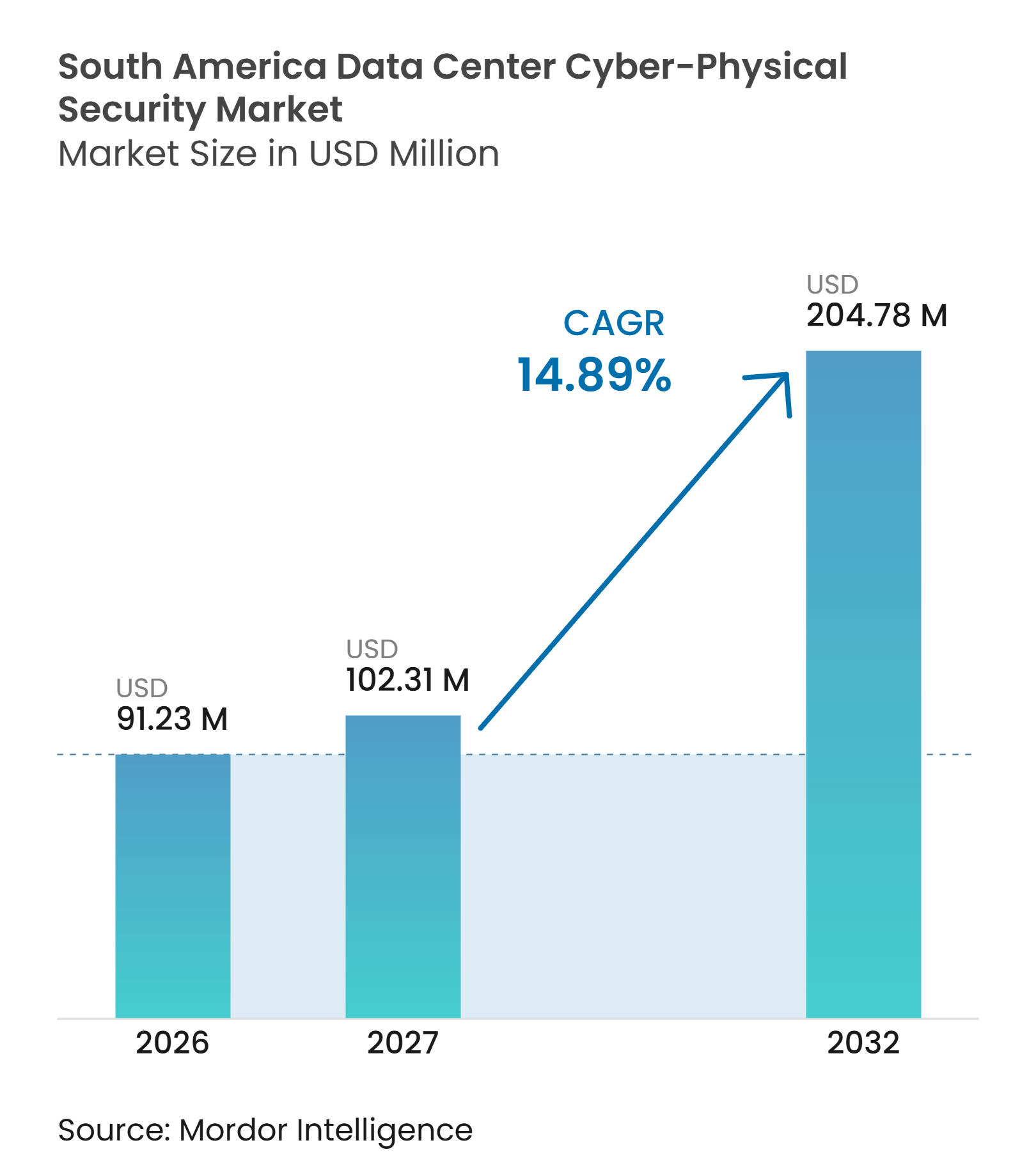
The South America data center cyber-physical security market size is expected to increase from USD 91.23 million in 2026 to USD 102.31 million in 2027 and reach USD 204.78 million by 2032, growing at a CAGR of 14.89% over 2027-2032. New colocation capacity, larger cloud campuses, and new edge sites are widening the number of facilities that require controlled entry, video coverage, environmental monitoring, and protection for operational technology. The South America Data Center Cyber-Physical Security Market is also being shaped by systems that integrate facility, network, and access events into a single operating view. Brazil remains the main source of demand because it has the region's largest construction pipeline and expanding requirements for auditable access controls. Argentina offers a faster path to expansion, although import dependence, currency conditions, and differing compliance obligations can delay projects. Vendors that can connect existing building systems with newer security platforms are better placed to address the South America Data Center Cyber-Physical Security Market.
Key Report Takeaways
- By solution type, Network and OT Security Solutions accounted for 29.72% of the South America data center cyber-physical security market share in 2026, while Unified Cyber-Physical Security Platforms are projected to expand at a 16.26% CAGR through 2032.
- By security layer, Integrated Security Operations Platforms accounted for 32.38% of revenue in 2026 and are projected to grow at a 15.92% CAGR through 2032.
- By deployment model, Cloud-Based Solutions commanded 64.78% of revenue in 2026 and are expected to expand at a 15.39% CAGR through 2032.
- By service type, System Integration and Implementation captured 26.54% of revenue in 2026, while Security Auditing and Compliance Services are projected to advance at a 16.59% CAGR through 2032.
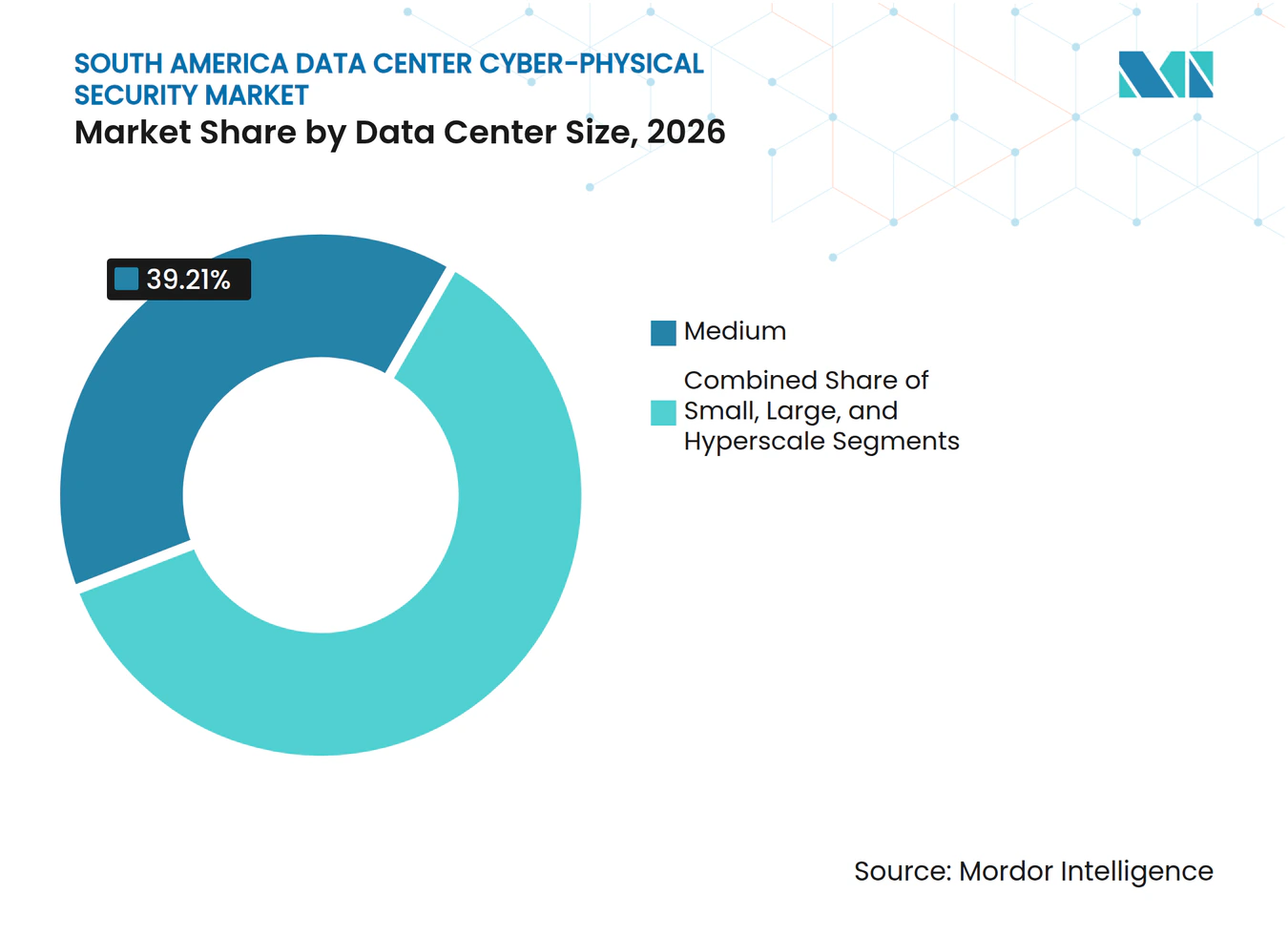
- By data center size, medium data centers accounted for 39.21% of revenue in 2026, while large data centers are projected to accelerate at a 17.27% CAGR through 2032.
- By data center type, Cloud Service Providers accounted for 41.64% of the South America data center cyber-physical security market revenue in 2026, while Enterprise and Edge data centers are expected to expand at a 17.38% CAGR through 2032.
- By geography, Brazil accounted for 42.53% of the South America data center cyber-physical security market by revenue in 2026, while Argentina is projected to record a 16.93% CAGR through 2032.
Note: Market numbers in this report are based on Mordor Intelligence's proprietary estimation framework, which combines nine months of actuals with Q4 projections for base year 2026.
Market Trends and Insights
Drivers Impact Analysis of South America Data Center Cyber-Physical Security Market*
| Driver | (~) % Impact on CAGR Forecast | Geographic Relevance | Impact Timeline |
|---|---|---|---|
| Hyperscale and Colocation Capacity Expansion | +3.5% | Brazil, Argentina, and Rest of South America | Short term (≤ 2 years) |
| Cyber-Physical Convergence of BMS, DCIM, and Security Systems | +2.8% | Brazil, Argentina, and Rest of South America | Medium term (2-4 years) |
| AI Workloads Increase Facility Criticality and Security Density | +2.6% | Brazil and Argentina | Medium term (2-4 years) |
| LGPD-Driven Auditability of Physical Access | +1.8% | Brazil and Argentina | Short term (≤ 2 years) |
| Submarine-Cable and Edge-Facility Expansion | +1.5% | Brazil and Argentina | Medium term (2-4 years) |
| Construction-Phase Theft and Unmanned-Site Exposure | +0.9% | Brazil and Argentina | Short term (≤ 2 years) |
| Source: Mordor Intelligence | |||
Hyperscale and Colocation Capacity Expansion
South America’s data center buildout is creating a larger base of sites that need security systems before operations begin. The regional construction pipeline was 42% precommitted at the end of 2025, which brings security design decisions forward in the construction cycle. Ascenty approved USD 1 billion of capital investment for 2026, including its SPO05 campus in Greater São Paulo, which targets 47 MW. Precommitted hyperscale campuses specify access control, video coverage, and facility monitoring during design rather than during fit-out. This narrows the time available for suppliers to qualify their systems and strengthens the value of established integration partners. Unified cyber-physical platforms used by hyperscalers also provide a reference point for colocation and enterprise operators selecting their own systems.
Cyber-Physical Convergence of BMS, DCIM, and Security Systems
Building management systems and data center infrastructure management systems connect operational technology and information technology through protocols such as BACnet, Modbus, and OPC UA. These protocols support interoperability, but they were not designed as complete security controls. Jacobs noted that AI workloads have made facilities more dependent on linked programmable controllers, power systems, and building automation tools. A weakness in remote monitoring or building controls can simultaneously affect cooling, fire suppression, and site access. Integrated Security Operations Platforms led the security-layer segment, accounting for 32.38% of revenue in 2026, and are projected to expand at a 15.92% CAGR through 2032. The South America Data Center Cyber-Physical Security Market, therefore, favors systems that integrate access, video, DCIM, and network monitoring rather than isolated products.
AI Workloads Increase Facility Criticality and Security Density
AI training and inference clusters are raising rack power density and increasing the operational consequences of facility failure. Some newer facilities are deploying GPU clusters exceeding 30 kW per rack, increasing the need to protect computing rows, cooling systems, and electrical infrastructure. IBM reported that the average cost of a data breach in Brazil was BRL 7.44 million (USD 1.46 million) in 2026.[1] The report also found that supply-chain compromise represented 16% of initial-access incidents. This environment supports demand for biometric access controls, thermal cameras, and staffed security operations centers. Medium-sized data centers, which accounted for 39.21% of revenue in 2026, still have room to add these capabilities as their operating requirements change.
LGPD-Driven Auditability of Physical Access
Brazil’s LGPD requires controllers to use technical and administrative measures that protect personal data. Article 46 makes this requirement relevant to data center operators that collect access records and biometric credentials. Operators need time-stamped logs for people entering controlled areas and suitable safeguards for biometric data. Anatel opened a consultation in January 2026 on conformity requirements for data centers integrated with telecommunications networks. The proposal includes a one-year adaptation period and references physical resilience, ISO/IEC 27000-aligned cybersecurity, and electromagnetic compatibility. This period creates a near-term requirement for improved visitor management, access control, and audit-trail systems.
Restraints Impact Analysis of South America Data Center Cyber-Physical Security Market*
| Restraint | (~) % Impact on CAGR Forecast | Geographic Relevance | Impact Timeline |
|---|---|---|---|
| High Imported-System and Integration Costs | -2.3% | Brazil and Argentina | Medium term (2-4 years) |
| Fragmented Country-Level Compliance Requirements | -1.4% | Brazil, Argentina, and Rest of South America | Medium term (2-4 years) |
| Shortage of Certified Cyber-Physical Integration Specialists | -1.0% | All South American markets | Long term (≥ 4 years) |
| Legacy OT Protocols and Vendor-Lock-In Risk | -1.0% | All South American markets | Long term (≥ 4 years) |
| Source: Mordor Intelligence | |||
High Imported-System and Integration Costs
Many advanced video analytics devices, biometric readers, and integrated DCIM modules are manufactured outside South America. This makes procurement sensitive to exchange rates, import tariffs, and delivery costs. Argentina’s foreign-exchange controls can add uncertainty to multi-year capital planning and make budgeting harder for operators. Cloud-Based Solutions held 64.78% of the deployment-model segment in 2026, partly because subscription licensing reduces immediate exposure to hardware costs. The cost of connecting older BMS controllers to newer platforms can also exceed the initial equipment budget when proprietary gateways and specialized services are required. These conditions can delay projects at medium-sized facilities that lack dedicated integration teams.
Fragmented Country-Level Compliance Requirements
Brazil’s LGPD and Argentina’s data protection framework do not operate as a single regional physical security standard. A system approved for one country can require new testing, configuration, audits, and legal review in another country. This adds cost for hyperscalers seeking to apply a common security architecture across several locations. The burden is higher when local financial-sector or telecommunications rules apply alongside data protection requirements. The South America Data Center Cyber-Physical Security Market can face slower project completion when country-specific evidence must be prepared for each deployment. A future mutual-recognition arrangement between Brazil and Argentina could reduce some of this friction, but no such arrangement is assumed in current planning.
*Our forecasts treat driver/restraint impacts as directional, not additive. The impact forecasts reflect baseline growth, mix effects, and variable interactions.
South America Data Center Cyber-Physical Security Market Segment Analysis
By Solution Type:
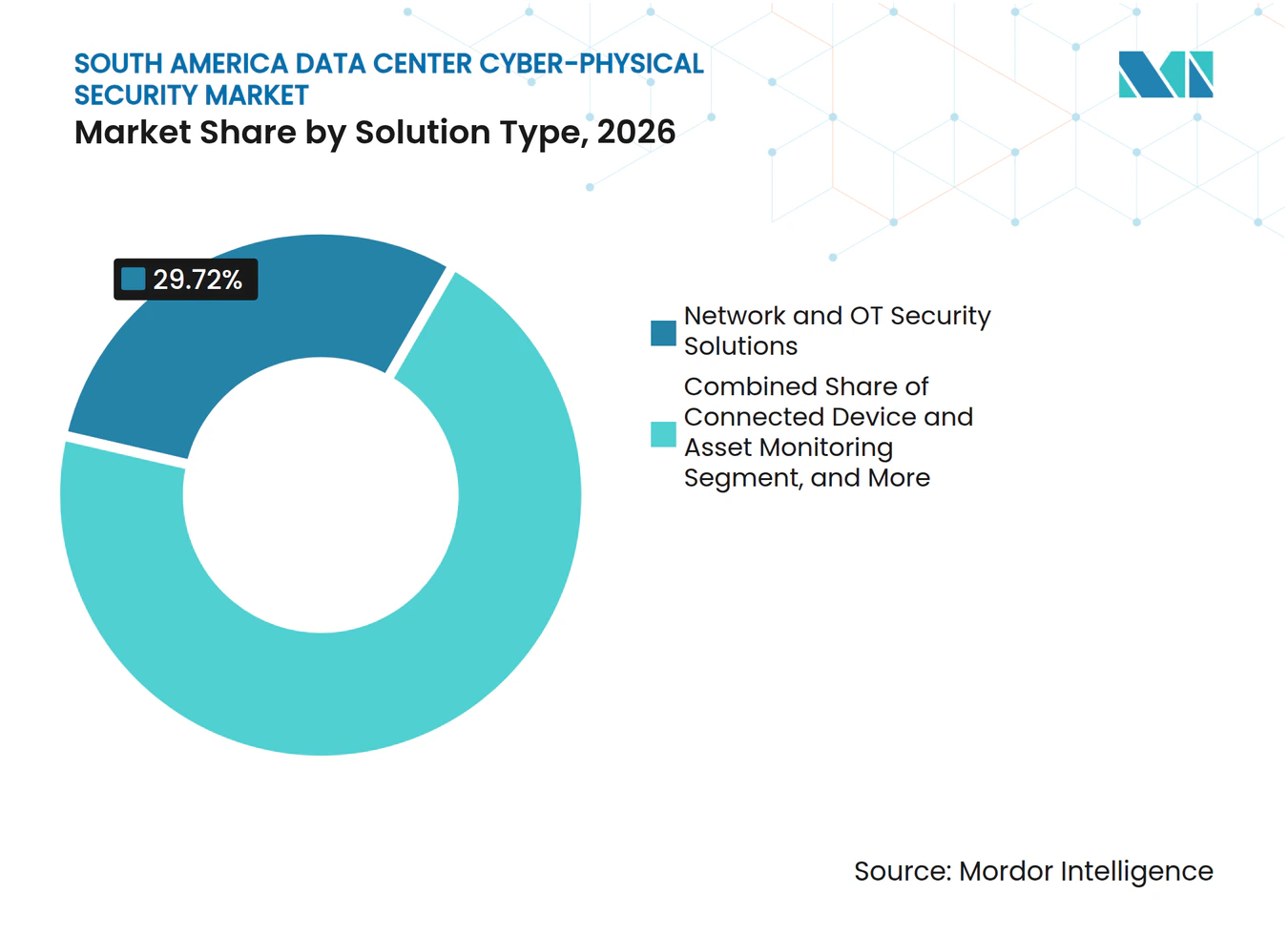
Network and OT Security Leads Revenue While Unified Platforms Set the Growth PaceNetwork and OT Security Solutions held 29.72% of the South America Data Center Cyber-Physical Security Market size in 2026, the largest share within the solution type. The position reflects the need to protect industrial and IP networks that support power management, environmental monitoring, and remote facility operations. Operators that expanded cloud and colocation capacity earlier are now addressing security gaps in older network architectures. This work includes protecting communication paths between building controllers, facility equipment, and operational teams. Connected Device and Asset Monitoring Solutions address the equipment visibility layer, while Security Information and Event Correlation Solutions bring alerts together for review. Identity and Access Management Solutions are also gaining relevance as biometric credentials and cloud-managed access replace older card systems.
Unified Cyber-Physical Security Platforms are projected to record a 16.26% CAGR from 2027 to 2032, the fastest rate in this segmentation. These platforms bring physical, OT, and cybersecurity telemetry into a single interface, which helps teams review linked events. The approach can shorten response time when an access event occurs beside a cooling, power, or network alert. Integration and Incident Response Services are increasingly supplied with platform licenses rather than purchased as entirely separate projects. That model reduces standalone service revenue, but it increases the importance of vendors that can deliver a continuing operating outcome. The South America Data Center Cyber-Physical Security Market is moving toward platform designs where interoperability and consistent audit records matter more than isolated device features.



By Security Layer:
Integrated Platforms Lead and Extend Their AdvantageIntegrated Security Operations Platforms accounted for 32.38% of the South America Data Center Cyber-Physical Security Market share in 2026. They are also expected to expand at a 15.92% CAGR through 2032, making them both the largest and fastest-moving security layer. Centralized visibility helps operators connect access events, video feeds, fire alerts, and environmental data. Physical Access Control Systems remain essential because legal and customer requirements still require clear control over entry to critical rooms. Video Surveillance Systems are also shifting toward AI-enabled analysis that can detect objects and unusual movement. Environmental and Infrastructure Monitoring Systems are becoming more closely tied to DCIM investments that manage the power and cooling demands of GPU deployments.
Genetec presented its Security Center platform at Futurecom 2025 in Brazil as an open system connecting video, access, fire, and environmental information.[2] The company noted that IP cameras and access controllers receive a disproportionate share of attack attempts compared with their share of connected devices. Axis Communications demonstrated compression technology that can reduce storage needs by 50% on average while supporting thermal and object detection coverage. These capabilities matter when operators need evidence from cameras without sharply increasing storage requirements. Platform adoption does not remove the need for independent devices, but it changes how they are selected and managed. Suppliers that support open integration can work more easily with facilities that have equipment from several vendors.
By Deployment Model:
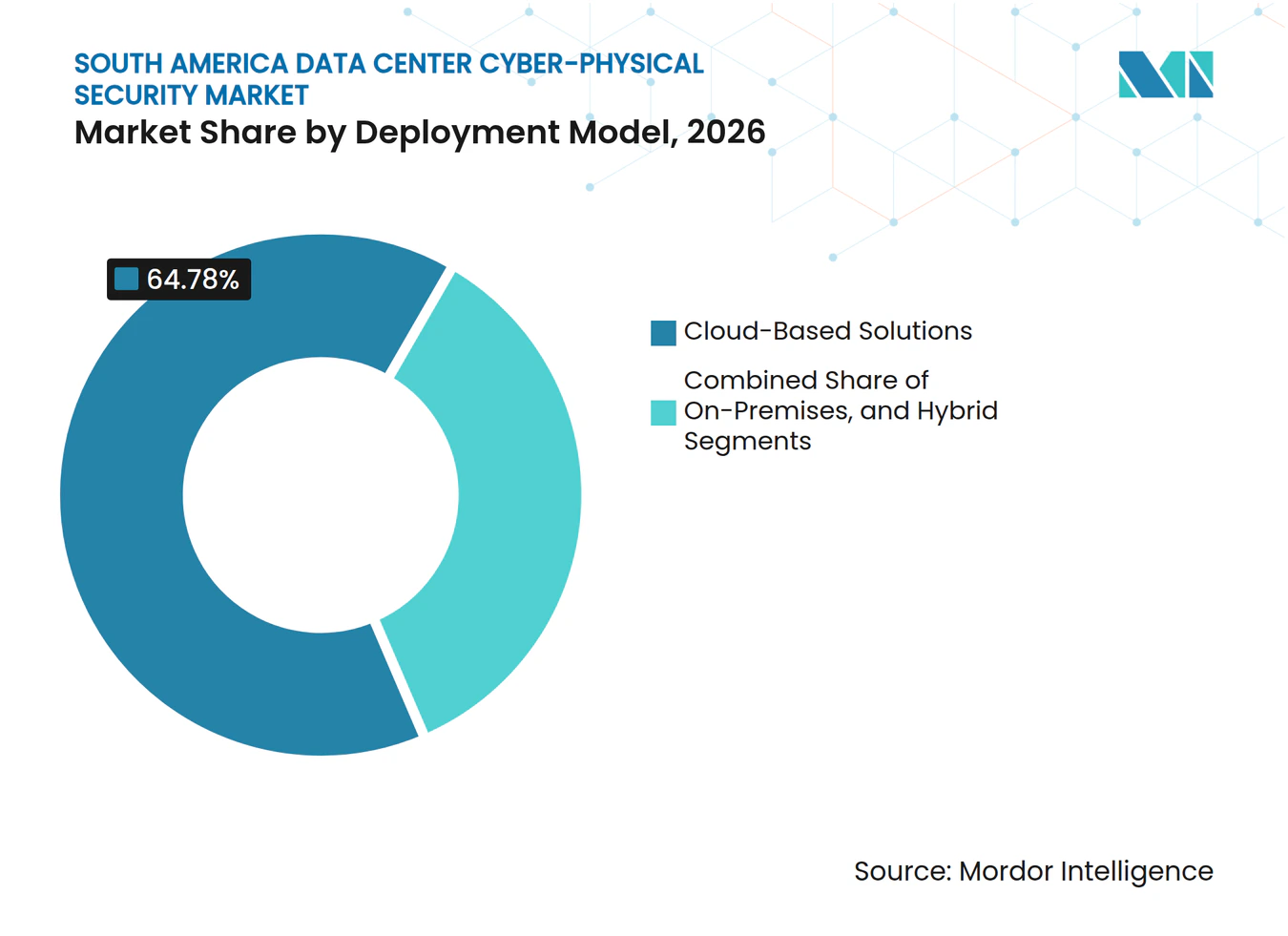
Cloud Dominates While On-Premise Remains Important for SovereigntyCloud-Based Solutions captured 64.78% of revenue in 2026 and are expected to expand at a 15.39% CAGR through 2032. This leadership reflects subscription pricing, centralized management, and automatic firmware updates across multi-site colocation portfolios. Operators use these platforms to oversee facilities beyond São Paulo, including Campinas, Rio de Janeiro, and Porto Alegre. Cloud management can also provide a consistent operating model across sites with varying local staffing levels. The dominant cloud position gives vendors recurring subscription and analytics revenue. It also makes service continuity and cybersecurity controls central to the supplier relationship.
On-Premise Solutions remain necessary when data sovereignty rules or sector requirements limit the use of cloud-hosted access logs or video feeds. Financial services and public-sector operators can apply more restrictive controls to facility records. Hybrid Solutions combine cloud management with local processing of sensor data, accommodating these needs. A hybrid architecture can keep time-sensitive or sensitive information on-site while supporting centralized administration. The South America data center physical security industry, therefore, has room for each deployment model, even though cloud systems lead current revenue. The choice depends on customer obligations, operating scale, connectivity, and the ability to maintain local infrastructure.

By Service Type:
System Integration Leads Revenue While Compliance Auditing Expands FastestSystem Integration and Implementation held 26.54% of service-type revenue in 2026, the largest share in this category. Data center campuses often combine legacy BMS infrastructure with newer security platforms from several providers. This creates a material need for work that connects devices, software, controls, and operating procedures. Integration partners must also consider how systems exchange logs and alerts without disrupting critical operations. The work is particularly important for facilities that are adding new halls while keeping existing capacity live. Large, multi-vendor deployments can require phased implementation and testing before a platform is placed into normal operation.
Security Auditing and Compliance Services are projected to advance at a 16.59% CAGR through 2032. The demand is supported by LGPD access-record requirements and the proposed Anatel conformity framework. IBM found that supply-chain compromise represented 16% of initial-access incidents in Brazil in 2026, adding weight to vendor assessment programs. Managed Monitoring and Detection services can support operators that need continuous oversight but do not maintain a fully staffed in-house security center. Cyber-Physical Risk Assessment services are being brought into projects earlier, especially where AI infrastructure adds new OT exposure. Incident Response and Recovery services complete the offering because operators need a defined process if a physical or cyber event affects site availability.
By Data Center Size:
Medium Facilities Anchor Revenue While Large Sites Accelerate FastestMedium data centers commanded 39.21% of revenue in 2026, the largest share among the 4 size groups. These facilities are large enough to justify layered security but are common enough to create a broad base of recurring purchases. Many serve secondary Brazilian cities, enterprise customers, and regional service providers. Their requirements often include managed video, access control, alarm response, and monitoring that can be expanded over time. Medium sites may not always have dedicated integration teams, which makes ease of deployment and remote management important. They can also favor cloud-managed systems because they lower the immediate capital commitment for individual locations.
Large data centers are projected to record a 17.27% CAGR from 2027 to 2032, the fastest rate by facility size. Campinas alone was expected to add 60 MW of hyperscale capacity in 2026, and each large campus needs security from the perimeter to individual compute rows. AI-era rack densities above 30 kW increase the need for thermal imaging, row-level entry controls, and hardened OT segmentation. These requirements lead to higher security spending per site than at conventional facilities. Small data centers continue to serve enterprises and regional internet service providers. Their preference for cloud-managed security platforms creates a continuing transaction-based business despite their lower per-site capital spending.
By Data Center Type:
Cloud Service Providers Lead Revenue While Enterprise and Edge Sites Accelerate FastestCloud Service Providers accounted for 41.64% of the South America Data Center Cyber-Physical Security Market in 2026. Hyperscalers operating proprietary campuses in the São Paulo metropolitan area run some of the region’s most security-mature facilities. Their security designs include perimeter protection, multi-factor biometric controls, video analytics, and linked DCIM-security dashboards. This model has become a reference point for colocation and enterprise facilities seeking to meet similar customer expectations. Colocation operators also need to separate customer cages, manage visitors, and retain detailed audit trails. These requirements become more important as contracts include formal physical security service levels.
Enterprise and Edge data centers are projected to expand at a 17.38% CAGR through 2032. Edge-node deployment is supported by cable landings and efforts to distribute AI computing beyond major metropolitan areas. Tecto Data Centers connected its Porto Alegre TPOA1 facility to V.tal’s Malbec cable, which links Brazil and Argentina. Remote edge sites require protection that works with limited on-site staff. Autonomous access management and AI-enabled video analytics are relevant because these locations may be unmanned for extended periods. The South America Data Center Cyber-Physical Security Market is therefore extending beyond large campuses to smaller but operationally critical sites.
Geography Analysis
Brazil accounted for 42.53% of revenue in 2026. São Paulo supports this lead through its concentrated cloud, fintech, and carrier-neutral ecosystem. Brazil accounted for 71% of the region’s capacity under construction in 2026, supporting a continued stream of security procurement. Campinas was expected to add 60 MW of hyperscale capacity during 2026. Deliveries in Greater São Paulo were also expected to exceed the 56 MW added in 2025. Rio de Janeiro, Porto Alegre, and Fortaleza are broadening the geographic base as land and power costs rise in São Paulo.
Brazil’s LGPD and evolving Anatel requirements make auditable physical access controls more important for facility operators. CrowdStrike identified Brazil as South America’s most targeted country for ransomware in 2025. IBM reported a record average breach cost of BRL 7.44 million (USD 1.46 million) in Brazil in 2026. Argentina is projected to register a 16.93% CAGR through 2032, the fastest rate among the geographic segments. CABASE reported 43 data centers and an installed capacity of 20 MW in Argentina during 2026. The World Bank committed USD 200 million for Argentina’s digital infrastructure, with part of the program supporting ARSAT’s expansion plans.
ARSAT opened a procurement in August 2025 for a new Benavidez data room with 620 kW of IT capacity and a 50% expansion of its high-security safe room. Cirion expanded its BUE1 facility in Buenos Aires in August 2025, adding more than 2 MW and 160 racks. The rest of South America has markets at different stages of development, but submarine cables are improving the role of coastal cities as connectivity hubs. EllaLink expanded capacity at Telxius’ Fortaleza data center in November 2025.[3] Chile, Colombia, Ecuador, and Peru are attracting edge facilities near cable landing stations. These sites need perimeter protection, remote access control, and video analytics because they may operate with limited staff.
Competitive Landscape
Market Concentration
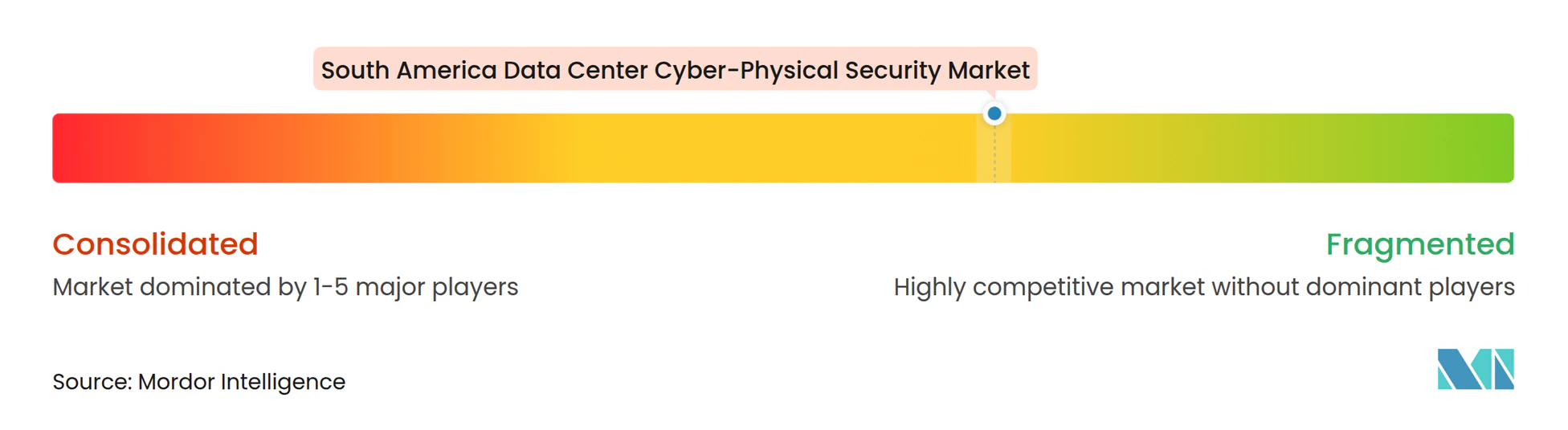
The South America Data Center Cyber-Physical Security Market is moderately fragmented. Global vendors, including Johnson Controls International, Honeywell International, Axis Communications, and Schneider Electric, have platform advantages through integrated software and service offerings. Regional specialists compete through local compliance knowledge, implementation support, and total cost of ownership. Competition increasingly centers on offerings that combine physical access, video surveillance, and BMS integration. This approach can reduce the number of supplier relationships an operator must manage. It also places greater value on systems that can connect with existing equipment.
Johnson Controls launched CCURE IQ 3.2 at ISC West 2026 in March 2026. The company also presented Software House CCURE IQ v3.10 at GSX 2025 in September 2025, with OSDP-verified controllers and zero-trust-aligned functions. Axis Communications brought together more than 90 South American companies through its Partner Summit in March 2026 to deepen the regional channel. These actions show that product development and local channels are both part of the competitive response.
Argentina’s early-stage hyperscale segment offers room for international vendors that establish local delivery capability. Edge security is another opening because cable landing sites and remote facilities may not have on-site personnel. AI-enabled video analytics and autonomous remote access management address this operating gap. Genetec’s open Security Center platform can support upgrades where a colocation campus has hardware from several incumbent vendors. Cloud-native credential management and edge inference are also being used to compete for enterprise and colocation accounts. The South America Data Center Cyber-Physical Security Market is fragmented across global platforms, regional integrators, and specialized component providers.
South America Data Center Cyber-Physical Security Industry Leaders
-
Axis Communications AB
-
Hangzhou Hikvision Digital Technology Co., Ltd.
-
Bosch Sicherheitssysteme GmbH
-
Genetec Inc.
-
Johnson Controls International plc
- *Disclaimer: Major Players sorted in no particular order
South America Data Center Cyber-Physical Security Market Companies Covered in this Report
- Axis Communications AB
- Hangzhou Hikvision Digital Technology Co., Ltd.
- Bosch Sicherheitssysteme GmbH
- Genetec Inc.
- Johnson Controls International plc
- Honeywell International Inc.
- Schneider Electric SE
- Siemens AG
- ABB Ltd
- Securitas Technology AB
- Prosegur Compañía de Seguridad, S.A.
- ASSA ABLOY AB
- Cisco Systems, Inc.
- Motorola Solutions, Inc.
- Senstar Corporation
- Brivo Systems, LLC
- Axis Communications local integration partners
- Aeon Security
- Interconnect S.R.L.
- VS Tecnologia Ltda.
Recent Industry Developments in South America Data Center Cyber-Physical Security Market
- October 2026: IBM's Cost of Data Breach 2026 reported a record average breach cost of BRL 7.44 million (USD 1.46 million) in Brazil, up 3.5% year on year, with supply-chain compromise at 16% of initial-access incidents, elevating physical access auditing and third-party vetting as board-level data center priorities.
- May 2026: Johnson Controls launched C•CURE IQ 3.2, C•CURE IQ VMS, and C•CURE IQ Incident Management at ISC West 2026, unifying video surveillance, access control, and incident workflows on a single browser-based platform for data centers and other mission-critical facilities.
- March 2026: Axis Communications hosted its Partner Summit 2026 with more than 90 security-industry companies and 300+ attendees across South America, announcing technology integration partnerships with Genetec, HID, Panduit, and Stulz for data center security deployments.
- January 2026: Anatel opened Public Consultation No. 48/2025, implementing Resolution No. 780/2025, proposing mandatory conformity requirements for data centers integrated into Brazil's telecommunications networks, covering physical resilience, ISO/IEC 27000-aligned cybersecurity, and electromagnetic compatibility for GPU facilities, with a proposed one-year adaptation period.
South America Data Center Cyber-Physical Security Market Report Scope
The South America Data Center Cyber-Physical Security Market includes revenue from security solutions and services deployed in data centers across Brazil, Argentina, Chile, and other South American countries. Growth is supported by colocation expansion, digital transformation, rising awareness of cyber-physical threats, and increasing adoption of remote monitoring and managed security services.
The South America Data Center Cyber-Physical Security Market Report is Segmented by Solution Type (Unified Cyber-Physical Security Platforms, Connected Device and Asset Monitoring Solutions, Security Information and Event Correlation Solutions, Network and Operational Technology Security Solutions, Identity and Access Management Solutions, and Integration and Incident Response Services), Security Layer (Physical Access Control Systems, Video Surveillance Systems, Building Management and Facility Control Systems, Environmental and Infrastructure Monitoring Systems, and Integrated Security Operations Platforms), Deployment Model (On-Premise Solutions, Cloud-Based Solutions, and Hybrid Solutions), Service Type (Cyber-Physical Risk Assessment, System Integration and Implementation, Managed Monitoring and Detection, Incident Response and Recovery, and Security Auditing and Compliance Services), Data Center Size (Small, Medium, Large, and Hyperscale), Data Center Type (Colocation, Cloud Service Providers (CSPs), and Enterprise / Edge), and Country (Brazil, Argentina, and Rest of South America). The Market Forecasts are Provided in Terms of Value (USD).
Segmentation Overview
| Unified Cyber-Physical Security Platforms |
| Connected Device and Asset Monitoring Solutions |
| Security Information and Event Correlation Solutions |
| Network and Operational Technology Security Solutions |
| Identity and Access Management Solutions |
| Integration and Incident Response Services |
| Physical Access Control Systems |
| Video Surveillance Systems |
| Building Management and Facility Control Systems |
| Environmental and Infrastructure Monitoring Systems |
| Integrated Security Operations Platforms |
| On-Premise Solutions |
| Cloud-Based Solutions |
| Hybrid Solutions |
| Cyber-Physical Risk Assessment |
| System Integration and Implementation |
| Managed Monitoring and Detection |
| Incident Response and Recovery |
| Security Auditing and Compliance Services |
| Small |
| Medium |
| Large |
| Hyperscale |
| Colocation |
| Cloud Service Providers (CSPs) |
| Enterprise / Edge |
| Brazil |
| Argentina |
| Rest of South America |
| By Solution Type | Unified Cyber-Physical Security Platforms |
| Connected Device and Asset Monitoring Solutions | |
| Security Information and Event Correlation Solutions | |
| Network and Operational Technology Security Solutions | |
| Identity and Access Management Solutions | |
| Integration and Incident Response Services | |
| By Security Layer | Physical Access Control Systems |
| Video Surveillance Systems | |
| Building Management and Facility Control Systems | |
| Environmental and Infrastructure Monitoring Systems | |
| Integrated Security Operations Platforms | |
| By Deployment Model | On-Premise Solutions |
| Cloud-Based Solutions | |
| Hybrid Solutions | |
| By Service Type | Cyber-Physical Risk Assessment |
| System Integration and Implementation | |
| Managed Monitoring and Detection | |
| Incident Response and Recovery | |
| Security Auditing and Compliance Services | |
| By Data Center Size | Small |
| Medium | |
| Large | |
| Hyperscale | |
| By Data Center Type | Colocation |
| Cloud Service Providers (CSPs) | |
| Enterprise / Edge | |
| By Country | Brazil |
| Argentina | |
| Rest of South America |
Key Questions Answered in the Report
What is the size of the South America data center cyber-physical security market?
The South America data center cyber-physical security market size is expected to increase from USD 91.23 million in 2026 to USD 102.31 million in 2027 and reach USD 204.78 million by 2032, growing at a CAGR of 14.89% over 2027-2032.
Which deployment model leads data center physical security demand in South America?
Cloud-Based Solutions led with 64.78% of revenue in 2026 and are expected to expand at a 15.39% CAGR through 2032. Their subscription model also helps operators manage multiple locations with centralized updates and administration.
Why are integrated security platforms becoming more important for data centers?
They combine access, video, facility, and network information, which helps operators investigate linked events and maintain audit records. This design is increasingly important across the South America data center physical security market where cooling, electrical systems, and entry controls are interconnected.
Which country leads regional spending on data center physical security?
Brazil accounted for 42.53% of revenue in 2026, supported by its large construction pipeline and compliance requirements. Its concentration of cloud and colocation facilities supports continuing demand for integrated systems and implementation services.
Which geography is expected to expand fastest through 2032?
Argentina is projected to record a 16.93% CAGR through 2032, supported by digital infrastructure programs and data center projects. Import dependence and foreign-exchange conditions can still affect equipment procurement timing.
What services are expanding fastest in the sector?
Security Auditing and Compliance Services are projected to advance at a 16.59% CAGR through 2032 as access logging and third-party review needs increase. These services help operators address audit trails, supplier checks, and documented procedures.