
South America Container Homes Market Size and Share
Market Overview
| Study Period | 2021 - 2032 |
|---|---|
| Forecast Data Period | 2027 - 2032 |
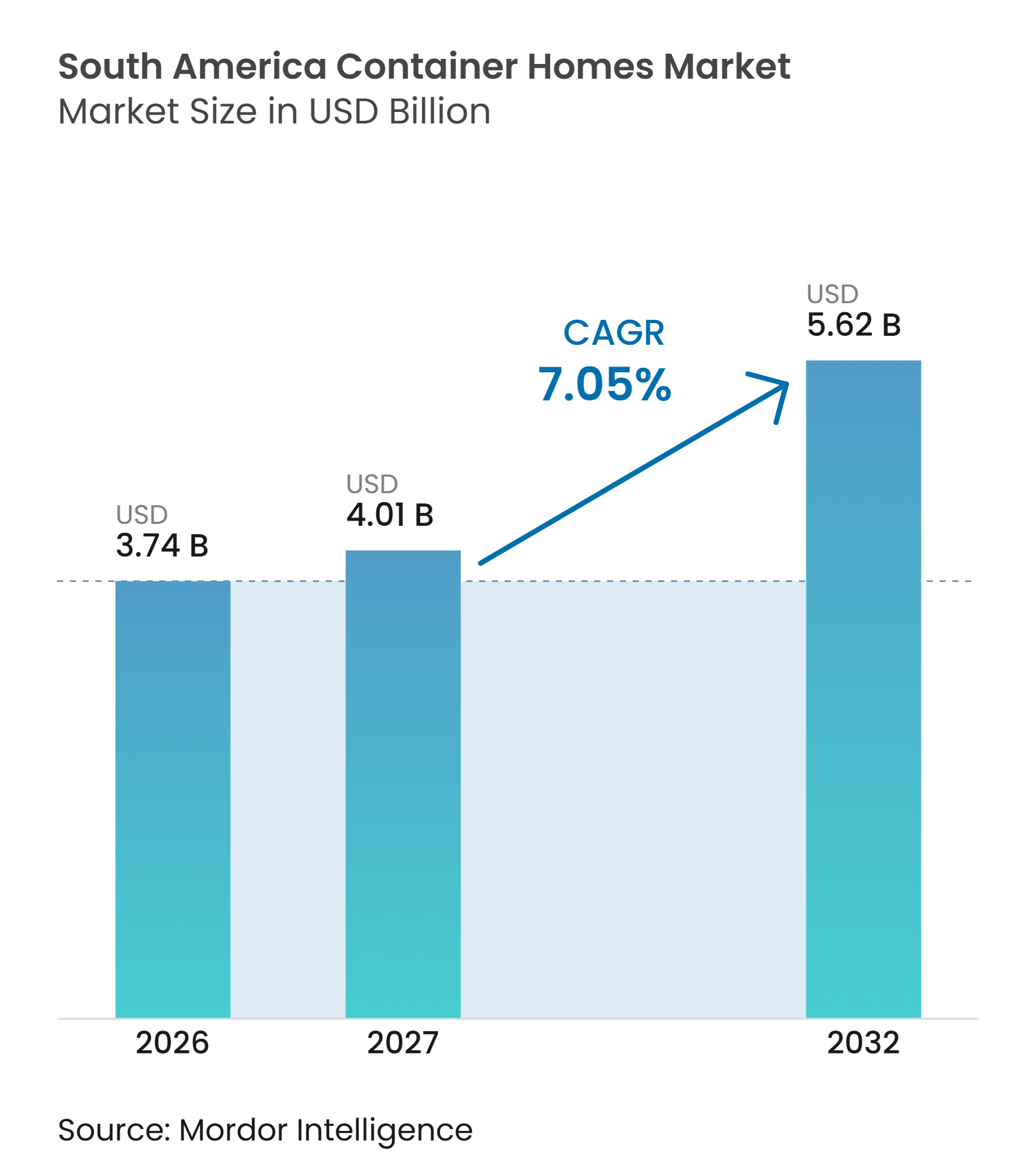
| Base Year Market Size (2026) | USD 3.74 Billion |
| Market Size (2027) | USD 4.01 Billion |
| Market Size (2032) | USD 5.62 Billion |
| Growth Rate (2027 - 2032) | 7.05 % |
| Market Concentration | Medium |
Major Players *Disclaimer: Major Players sorted in no particular order Image © Mordor Intelligence. Reuse requires attribution under CC BY 4.0. | |
South America Container Homes Market Analysis by Mordor Intelligence
The South America Container Homes Market size is projected to be USD 3.74 billion in 2026, USD 4.01 billion in 2027, and reach USD 5.62 billion by 2032, growing at a CAGR of 7.05% from 2027 to 2032.
Housing deficits, public procurement, remote industrial projects, and recurring disaster-response needs support demand across the region. Brazil is widening access to public housing programs for industrialized construction, while Chile has established a more formal approval structure for industrialized homes. Mining and energy projects also create a steadier source of demand for temporary and relocatable accommodation. These conditions favor suppliers that can meet public-sector technical requirements, manufacture at scale, and adapt units to local climate and site conditions. Retail demand remains more constrained because mortgage, insurance, and property valuation practices still favor conventional construction.
Key Report Takeaways
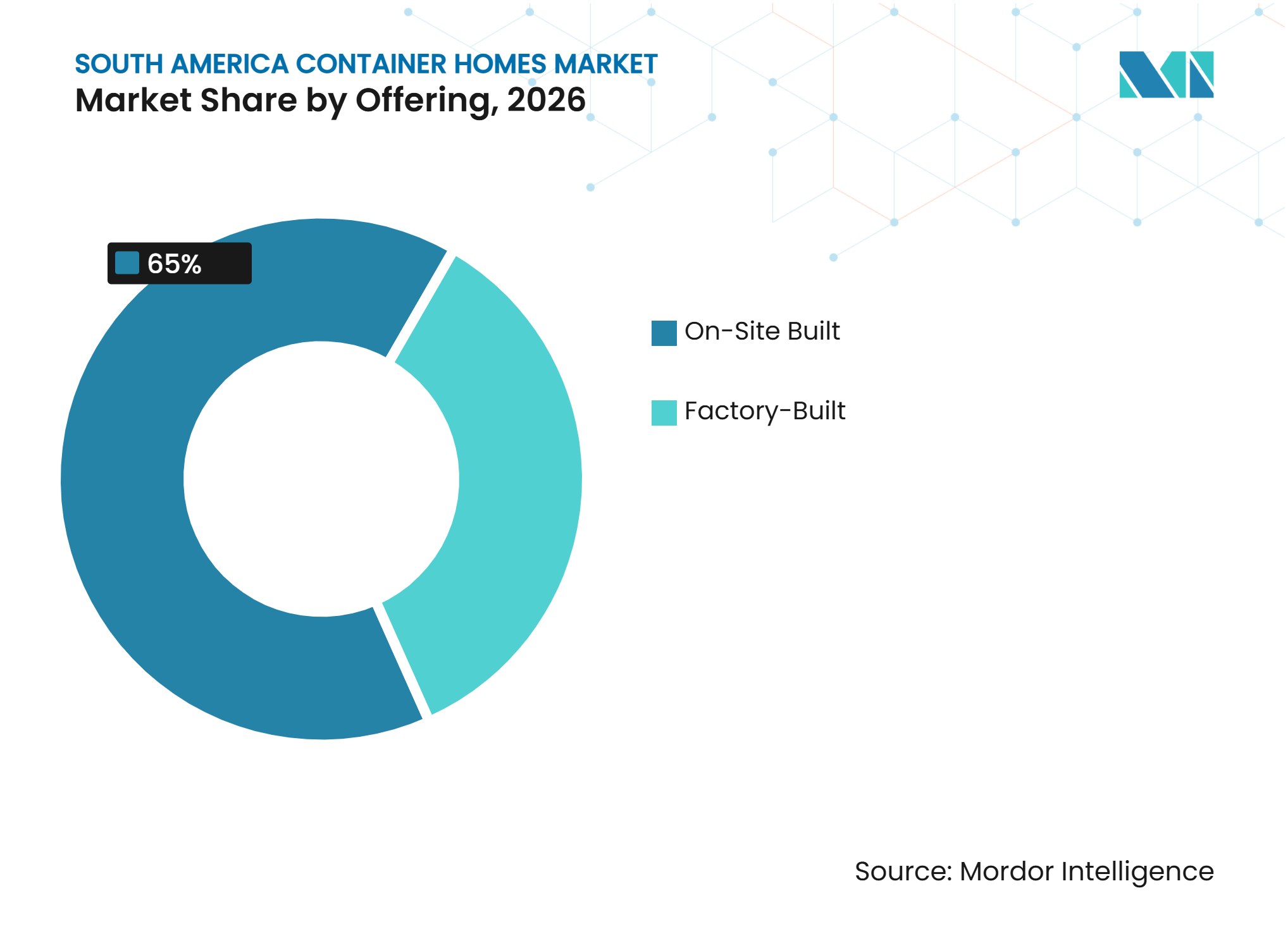
• By offering, on-site built homes held 65% of the South America container homes market share in 2026, while factory-built units are forecast to grow at a 7.8% CAGR through 2032.
• By construction type, fixed structures held 53% of the South America container homes market share in 2026, while movable configurations are forecast to grow at an 8.2% CAGR through 2032.
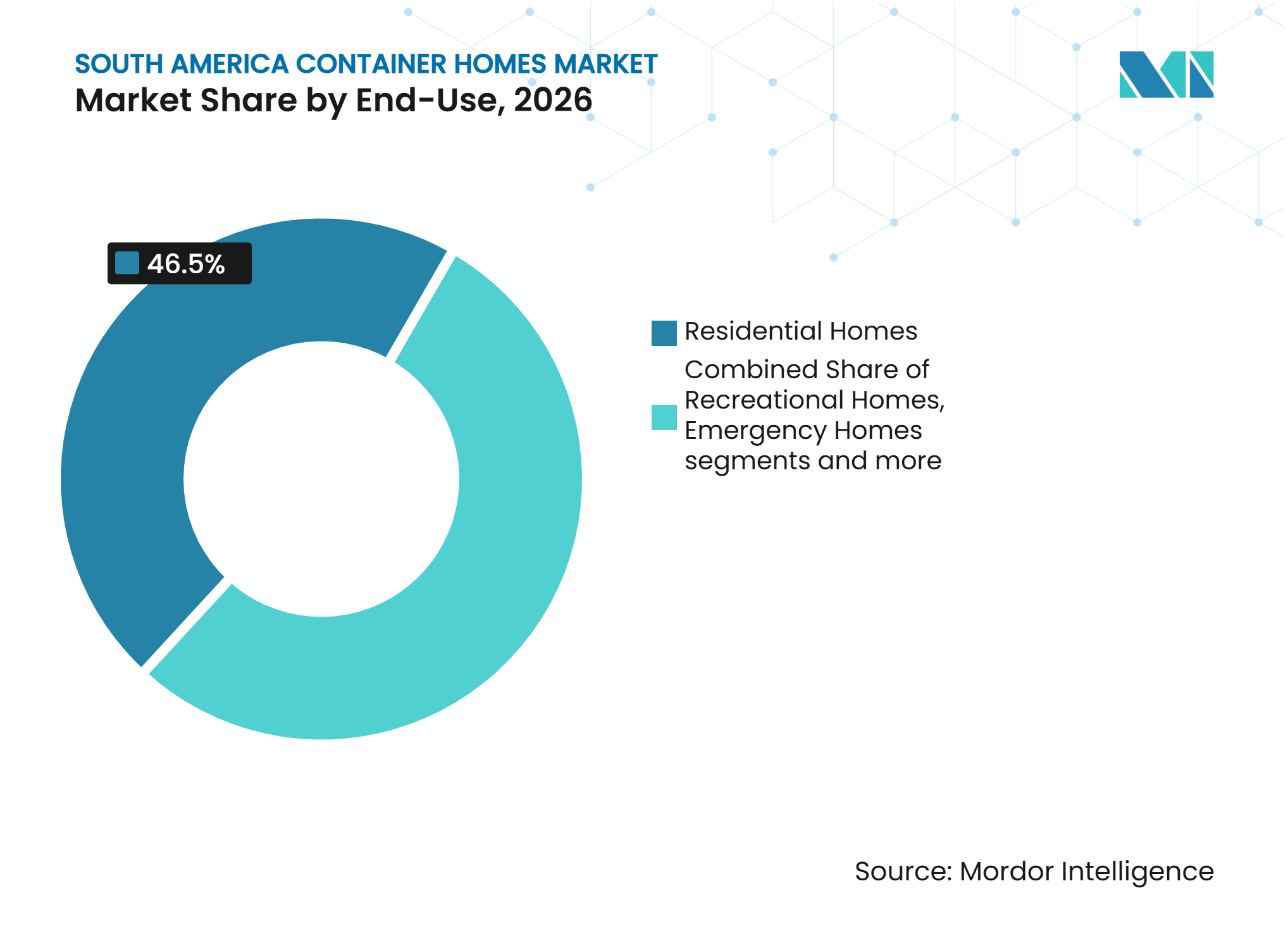
• By end use, residential homes accounted for 46.5% of the South America container homes market size in 2026, while emergency homes are forecast to grow at an 8.55% CAGR through 2032.
• By country, Brazil held 47% of the South America container homes market share in 2026, and Argentina is forecast to grow at a 7.55% CAGR through 2032.
Note: Market numbers in this report are based on Mordor Intelligence's proprietary estimation framework, which combines nine months of actuals with Q4 projections for base year 2026.
Market Trends and Insights
Drivers Impact Analysis of South America Container Homes Market*
| Drivers | (~) % Impact on CAGR Forecast | Geographic Relevance | Impact Timeline |
|---|---|---|---|
| Lower-Income Housing Deficits and Public Procurement | +2.1% | Brazil, Chile, Argentina, with spillover to Peru and Colombia | Medium term (2-4 years) |
| Emergency and Disaster-Relief Housing Demand | +1.5% | Peru, Colombia, Venezuela, and Ecuador | Short term (≤ 2 years) |
| Mining, Energy, and Tourism Accommodation Demand | +1.2% | Chile, Peru, Argentina, and Brazil | Long term (≥ 4 years) |
| Modular and Prefabricated Construction Expansion | +1.0% | Brazil and Chile, with spillover to Argentina | Medium term (2-4 years) |
| Sustainability and Circular Use Of Steel Containers | +0.6% | Chile, Brazil, Uruguay, and other South American markets | Long term (≥ 4 years) |
| Source: Mordor Intelligence | |||
Lower-Income Housing Deficits and Public Procurement
Brazil has made social housing a central policy priority in 2026, and the Minha Casa, Minha Vida program is planned to reach 3 million housing contracts. The program represented 53% of residential launches and sales nationally, which gives public procurement considerable influence over housing delivery. The Novo Programa de Aceleração do Crescimento allocated USD 1.9 billion for 85,000 rural and association-led housing units across 884 municipalities[1]. A January 2026 rule change made industrialized off-site production eligible for program disbursements, which broadens the addressable pipeline for certified manufacturers. Chile has also delivered 229,262 industrialized homes through its housing emergency plan and lists 43 approved models from 22 certified industrializers, giving qualified suppliers a clearer route into public projects. These programs turn existing housing needs into visible multi-year procurement activity, which gives the South America container homes market a more predictable demand base than retail channels can provide.
Emergency and Disaster-Relief Housing Demand
Emergency shelter demand is rising because earthquakes and floods repeatedly displace households across several South American countries. Peru’s Ministry of Housing, Construction and Sanitation deployed 323 temporary modules to Junín after the July 2026 earthquake and began procurement for 700 additional units for 1,203 displaced families. Colombia’s August 2026 earthquake affected Chocó and Valle del Cauca, and the International Organization for Migration mapped 71 temporary collective accommodation sites serving nearly 4,700 displaced people[2]. The source material also reports that more than 14,000 homes were destroyed in the affected Colombian areas, which created a need for prefabricated housing responses. These events place value on units that can be transported, assembled quickly, and relocated when local recovery plans change. Suppliers that obtain civil-defense and humanitarian procurement approvals are better placed to respond when an emergency occurs. This makes the South America container homes market less dependent on a single residential demand cycle.
Mining, Energy, and Tourism-Linked Accommodation Demand
Chile’s mining investment pipeline supports demand for workforce accommodation in locations where conventional building is difficult. The source material identifies 13 major copper projects advancing in 2026, which supports requirements for rapid and durable housing near remote project sites. Grupo Cintac inaugurated its 80,000 m² Promet Chacabuco plant in May 2026 and stated that the facility can produce more than 150,000 m² of modular infrastructure annually. The company linked the added capacity to mining, energy, and housing work, with a project pipeline of more than USD 1 billion over 4 years. In Argentina, Ecosan was selected to fabricate and install more than 1,000 modular units for 2 construction camps connected to the Vaca Muerta Oil Sur project. This type of project can sustain demand even when household purchasing power is weak, because industrial accommodation is tied to construction schedules rather than consumer mortgage availability. The South America container homes market therefore benefits from a mix of residential and project-based demand.
Expansion of Modular and Prefabricated Construction
The 2026 financing change in Brazil removes a major barrier for factory-made units seeking access to subsidized housing programs. It aligns public financing more closely with industrialized construction, where production can take place while foundation and site work proceed in parallel. Chile’s industrialized housing registry and certification process provide a related example of how structured approvals can make public buyers more willing to use manufactured housing[3]. Tecno Fast opened a USD 15 million plant in Puerto Varas with capacity for more than 400 housing solutions per year, and the company is delivering units for the 600-home La Chacra social housing project in Castro. These investments show that the South America container homes market is gaining local production capacity near demand centers rather than treating modular construction as a limited niche. As procurement standards become clearer, factory production can gain share in projects where schedule certainty and repeatable specifications matter.
Restraints Impact Analysis of South America Container Homes Market*
| Restraints | (~) % Impact on CAGR Forecast | Geographic Relevance | Impact Timeline |
|---|---|---|---|
| Limited Mortgage, Insurance, and Valuation Infrastructure | -0.6% | Brazil, Argentina, and Chile | Medium term (2-4 years) |
| Macroeconomic Volatility, High Interest Rates, and Currency Risk | -0.5% | Argentina, Brazil, and Colombia | Short term (≤ 2 years) |
| Fragmented Permitting and Building-Code Requirements | -0.4% | All South American countries, particularly Peru and Colombia | Long term (≥ 4 years) |
| Thermal and Corrosion Performance In Humid and Coastal Zones | -0.3% | Coastal Brazil, Colombia, Ecuador, and other South American markets | Long-term (≥ 4 years) |
| Source: Mordor Intelligence | |||
Limited Mortgage, Insurance, and Valuation Infrastructure
The South America container homes market faces weaker retail financing access because mortgage and insurance systems were designed mainly for masonry and reinforced-concrete buildings. The draft indicates that valuation is difficult when local appraisers lack comparable sales for nontraditional structures. This can lead lenders to value a project below its full construction cost and reduce the share that a borrower can finance. The same draft notes that insurers often require proof of permanent foundations and local building permits before offering standard property coverage. Buyers may then rely on specialty products that can cost more and offer narrower coverage. Until property and financial institutions set clearer standards for industrialized homes, retail sales will remain more dependent on buyer equity and supplier financing.
Macroeconomic Volatility, High Interest Rates, and Currency Risk
High inflation and restrictive interest rates in Argentina reduce household purchasing power and limit credit availability for retail container home purchases. Brazil’s Selic rate remains a relevant affordability constraint for buyers outside subsidized Minha Casa, Minha Vida credit lines. Currency movements also affect suppliers because imported components and finished modular units can be priced in USD or Chinese renminbi. A weaker local currency can raise landed costs, pressure manufacturer margins, and delay buyer decisions. In Colombia, currency depreciation can make imported modular units less competitive against locally manufactured alternatives. Government-backed housing and industrial procurement can be more insulated from these pressures than consumer-facing sales, which reinforces the difference between institutional and retail demand in the South America container homes market.
*Our forecasts treat driver/restraint impacts as directional, not additive. The impact forecasts reflect baseline growth, mix effects, and variable interactions.
South America Container Homes Market Segment Analysis
By Offering:
On-Site Customization Retains Volume While Factory Capacity ExpandsOn-site built homes held 65% of the South America container homes market in 2026. Their position reflects how the South America container homes market still serves retail demand for designs that can be adjusted to individual sites and customer preferences. This model also requires less capital investment than a dedicated manufacturing plant, which helps smaller fabricators participate in secondary cities. On-site work remains practical where buyers want nonstandard layouts or where local contractors are already available. The same model can be slower to scale because design and construction depend more heavily on local labor and site conditions. That limitation becomes more visible in government projects that require repeatable specifications and strict delivery dates.
Factory-built units are forecast to grow at a 7.8% CAGR through 2032, faster than the overall South America container homes industry. Brazil’s off-site financing eligibility and Chile’s approved industrialized housing models improve access to public procurement for certified producers. Tecno Fast’s Puerto Varas investment and its La Chacra project demonstrate how factory capacity can be used for large residential programs. Factory production can also reduce weather-related disruption and provide more consistent quality checks before a unit reaches the site. As public buyers favor delivery certainty, suppliers with factories, certifications, and transport capability can win a larger portion of new awards. On-site builders are likely to remain relevant where customization and local service are more important than standardized volume.


By Construction Type:
Fixed Structures Lead While Movable Units Serve Projects and EmergenciesFixed structures held 53% of the regional market in 2026. These units suit permanent residential and social housing projects that need utility connections, foundations, and occupancy approvals. Their use is closely linked to the requirements of subsidized housing programs, where long-term placement is central to the project purpose. Permanent units can also offer a clearer path to formal property registration where local rules recognize the construction method. This supports their continuing role in urban, peri-urban, and planned social housing developments. Fixed structures are therefore likely to remain the volume base for the South America container homes market.
Movable configurations are forecast to grow at an 8.2% CAGR through 2032, the highest rate across the segmentation categories. Their value is strongest in mining, energy, construction, and disaster response, where a building may need to move with the project or serve a temporary site. The Vaca Muerta Oil Sur project illustrates this need, with more than 1,000 modular units planned for 2 construction camps. Peru’s high-elevation mining locations also favor transportable solutions because logistics can be harder for conventional building methods. Movable units can be deployed quickly, taken down, and used again, which helps project owners manage changing workforce needs. Their growing role shows how the South America container homes industry is serving both permanent housing and time-sensitive infrastructure work.
By End Use:
Residential Homes Form the Base While Emergency Housing AcceleratesResidential homes accounted for 46.5% of the South America container homes market size in 2026. Affordability pressures in large cities and demand for smaller homes support this segment. The segment includes permanent houses for owner-occupiers as well as projects built under public housing schemes. Brazil’s housing program and Chile’s industrialized housing approvals provide a clearer route for qualified suppliers to deliver formal residential units. Residential demand still depends on accessible financing, insurance, and local approvals. These limits keep the South America container homes market dependent on both public support and buyers who can fund a substantial portion of the purchase themselves.
Emergency homes are forecast to grow at an 8.55% CAGR through 2032. Peru’s use of 323 temporary modules in Junín and procurement for a further 700 units shows how public agencies use modular structures after major disasters. Colombia’s temporary accommodation response after the August 2026 earthquake also shows the scale of displacement that can activate emergency procurement. Suppliers in this segment need readily available inventory, dependable transport, and the ability to work with government and humanitarian procurement procedures. Their success depends less on consumer marketing than on prequalification and operational readiness. Emergency demand can be irregular at a local level, but recurring seismic and flood exposure makes it a durable part of regional demand.


Geography Analysis
Brazil
Brazil held 47% of the regional market in 2026. The country’s scale comes from the interaction of national housing policy, a developing factory-built supply base, and remote industrial accommodation needs. The federal housing program is planned to reach 3 million contracts, and it accounted for 53% of residential launches and sales nationally in the source material. The Novo Programa de Aceleração do Crescimento committed USD 1.9 billion to 85,000 units in 884 municipalities. The January 2026 policy change makes off-site industrialized production eligible for program disbursements. This gives certified manufacturers a more direct path into public housing procurement. Industrial demand from mining areas also broadens the customer base beyond urban housing. Capsul’s announced plan to establish a Latin American hub in Brazil with up to USD 5 million of investment points to outside interest in the country’s long-term opportunity. Brazil’s regulatory influence within the South America container homes market is strongest where federal financing requirements shape which forms of construction can enter subsidized projects.
Argentina
Argentina is forecast to grow at a 7.55% CAGR through 2032. The country has two demand streams: project accommodation for energy and infrastructure work and retail housing that can appeal when conventional construction is costly. The Vaca Muerta Oil Sur project required more than 1,000 modular units for 2 construction camps, showing the need for large-scale temporary accommodation. The Santa Cruz provincial housing institute also launched a public tender for factory-built homes in 40 m² and 51 m² formats. These actions show that modular housing demand extends beyond the main energy corridor. High inflation, restrictive interest rates, and currency movements remain material constraints for households and suppliers. The Central Bank of the Argentine Republic has a central role in the credit conditions that affect consumer housing demand. Suppliers that can serve energy clients while maintaining local procurement relationships may be better insulated from the retail cycle. This makes industrial contracts an important stabilizing factor in Argentina’s place within the South America container homes market.
Chile, Peru, Colombia, and Other South American Markets
Chile has the region’s most established industrialized housing approval structure, with 22 certified industrializers and 43 approved models in the national registry. Grupo Cintac’s 80,000 m² Chacabuco plant expanded the company’s modular capacity to more than 150,000 m² a year and is positioned to serve mining, energy, and housing work. Tecno Fast’s work on housing, mining accommodation, redeployable offices, and modular hotels shows how Chilean suppliers are using broad product portfolios. Peru’s Ministry of Housing used temporary modules after the July 2026 earthquake, which demonstrates the role of public emergency procurement. Colombia’s 2026 earthquake response created demand for temporary accommodation, with the International Organization for Migration identifying 71 collective sites. Peru and Colombia also face permitting and site challenges that make local compliance capability important. Uruguay represents an earlier-stage municipal opportunity, with a 2026 pilot agreement for 25 container homes for vulnerable families. Smaller markets may not match Brazil’s scale or Chile’s supply maturity. Still, emergency response, municipal housing needs, and remote project locations support gradual adoption across the South America container homes market.
Competitive Landscape
Market Concentration
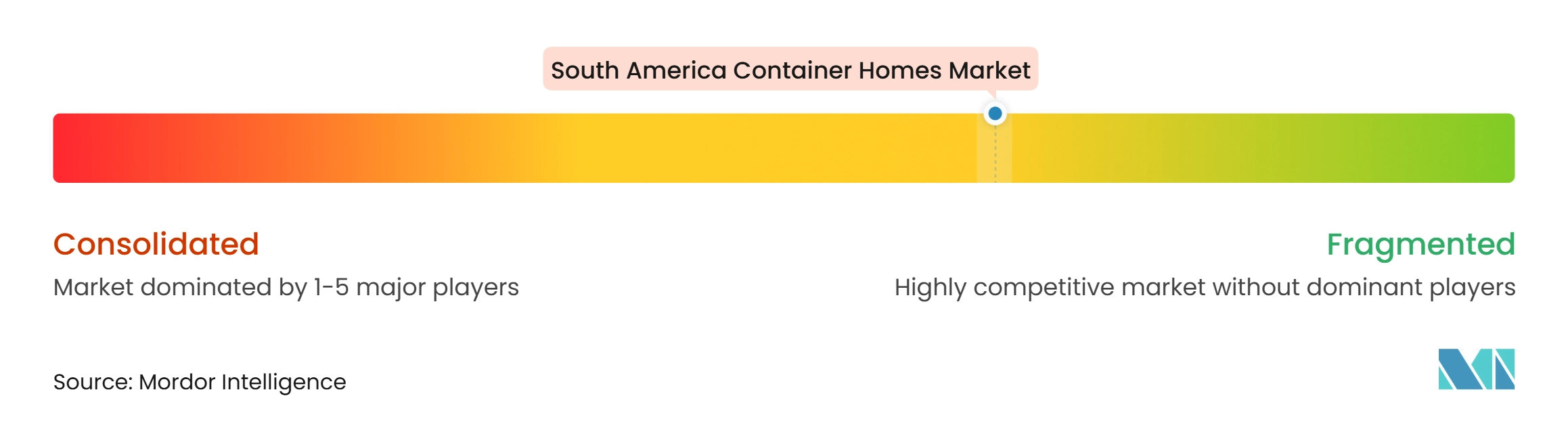
The South America container homes market is fragmented in retail and smaller project work, while larger social housing, mining, energy, and emergency contracts favor suppliers with proven capacity. Regional companies compete with international manufacturers that seek larger industrial and disaster-response projects. Tecno Fast is one of the better-established Chilean suppliers, with projects across mining camps, redeployable offices, hotels, and housing. The company’s strategy combines product range with manufacturing capability and project delivery experience. Grupo Cintac follows a similarly integrated approach through its Promet business, which combines design, manufacturing, and project execution. This type of integration can reduce handoffs and improve control over schedule and quality for complex projects.
Competition is especially strong in industrial accommodation because project owners compare price, speed, logistics, technical performance, and local compliance. GS Housing used EXPONOR Chile 2026 to present expandable and flat-pack container homes to mining customers, showing how overseas suppliers can market directly to regional project buyers. Local companies in the South America container homes market retain an advantage when projects require thermal adaptation, seismic engineering, local permits, and on-site service. ISO 668 and ISO 1496 offer widely recognized container standards for dimensions and structural specifications. However, these standards do not replace the local design and approval work needed for a residential or industrial installation. Suppliers that can translate standard container platforms into locally compliant buildings are better positioned for formal procurement.
Strategic investment is moving toward factory capacity, repeatable designs, and financing or distribution tools that can widen buyer access. Tecno Fast’s USD 15 million Puerto Varas plant supports the 600-home La Chacra project, while its retail financing arrangement with Getnet allows buyers to use up to 36 interest-free credit-card installments. Grupo Cintac’s Chacabuco expansion gives it capacity to address large mining and energy orders. Capsul’s plan to invest up to USD 5 million in Brazil reflects interest in digital distribution and corporate accommodation channels. Suppliers also continue to differentiate through insulated designs for difficult environments and modular emergency products. Competitive success in the South America container homes market depends on matching those product features with certifications, reliable delivery, and local relationships rather than on unit price alone.
South America Container Homes Industry Leaders
-
Solução Home Containers
-
Box House SRL
-
Inside Box
-
Dice Containers
-
Mi Casa Containers
- *Disclaimer: Major Players sorted in no particular order
South America Container Homes Market Companies Covered in this Report
- Solução Home Containers
- Box House SRL
- Inside Box
- Dice Containers
- Mi Casa Containers
- Casas Containers
- GNT Construcciones
- ArqContainer
- Moducontainer
- Modiner
- E Econtainers
- Tecno Fast
- CGCH (China Green Container House)
- GS Housing
- Guangdong C.BOX Co., Ltd
- HiG Housing Tech Co., Ltd
- Max Prefab House Co., Ltd
- Casa Box
- Heshi (Hebei) Integrated Housing Co., Ltd
- Konbuild
Recent Industry Developments in South America Container Homes Market
- October 2026: The IDUV (Instituto de Desarrollo Urbano y Vivienda) of Santa Cruz province, Argentina, is preparing to launch a public tender under Licitación Pública for factory-built modular housing units in 40 m² and 51 m² configurations, targeting families on provincial housing waiting lists. The tender opened competition to both local and national manufacturers meeting technical requirements.
- May 2026: Grupo Cintac officially inaugurated the 80,000 m² Promet Chacabuco modular plant in Colina, Chile, tripling production capacity to more than 150,000 m² of annual modular infrastructure output for mining, energy, and housing, with a USD 1 billion project pipeline projected over 4 years and 1,000 new direct jobs created.
- April 2026: Tecno Fast Home launched the Modular Light line in April 2026, five housing models from 48 m² to 96 m² designed for greater cost efficiency, to broaden its residential product range beyond its traditional industrial client base.
South America Container Homes Market Report Scope
Segmentation Overview
| Factory-Built |
| On-Site Built |
| Fixed |
| Movable |
| Residential Homes |
| Recreational Homes |
| Emergency Homes |
| Nursing Homes |
| Brazil |
| Argentina |
| Chile |
| Peru |
| Colombia |
| Rest of South America |
| By Offering | Factory-Built |
| On-Site Built | |
| By Construction Type | Fixed |
| Movable | |
| By End-Use | Residential Homes |
| Recreational Homes | |
| Emergency Homes | |
| Nursing Homes | |
| By Country | Brazil |
| Argentina | |
| Chile | |
| Peru | |
| Colombia | |
| Rest of South America |
Key Questions Answered in the Report
What is the expected growth rate for container homes in South America?
The South America container homes market is forecast to grow at a 7.05% CAGR from 2027 to 2032, reaching USD 5.62 billion by 2032.
Which country has the greatest demand for container homes in South America?
Brazil held 47% of regional demand in 2026, supported by federal housing programs, industrialized construction policy, and remote industrial accommodation needs.
Which type of container home is growing fastest in South America?
Movable configurations are forecast to grow at an 8.2% CAGR through 2032 because mining, energy, construction, and emergency users need relocatable accommodation.
Why are emergency container homes gaining traction in the region?
Emergency homes are forecast to grow at an 8.55% CAGR through 2032, supported by disaster-response needs in countries such as Peru and Colombia.
How do public housing programs affect container home demand in Brazil?
The 2026 financing change allows eligible off-site industrialized production to access Minha Casa, Minha Vida disbursements, and open public procurement opportunities for certified suppliers.
What limits wider consumer adoption of container homes?
Mortgage, insurance, and valuation processes often favor conventional buildings, which can reduce financing availability and raise costs for buyers of non-traditional homes.