
Market Overview
| Study Period | 2021 - 2031 |
|---|---|
| Forecast Data Period | 2026 - 2031 |
| Base Year Market Size (2025) | USD 651.23 Million |
| Market Size (2026) | USD 684.44 Million |
| Market Size (2031) | USD 893.32 Million |
| Growth Rate (2026 - 2031) | 5.47 % |
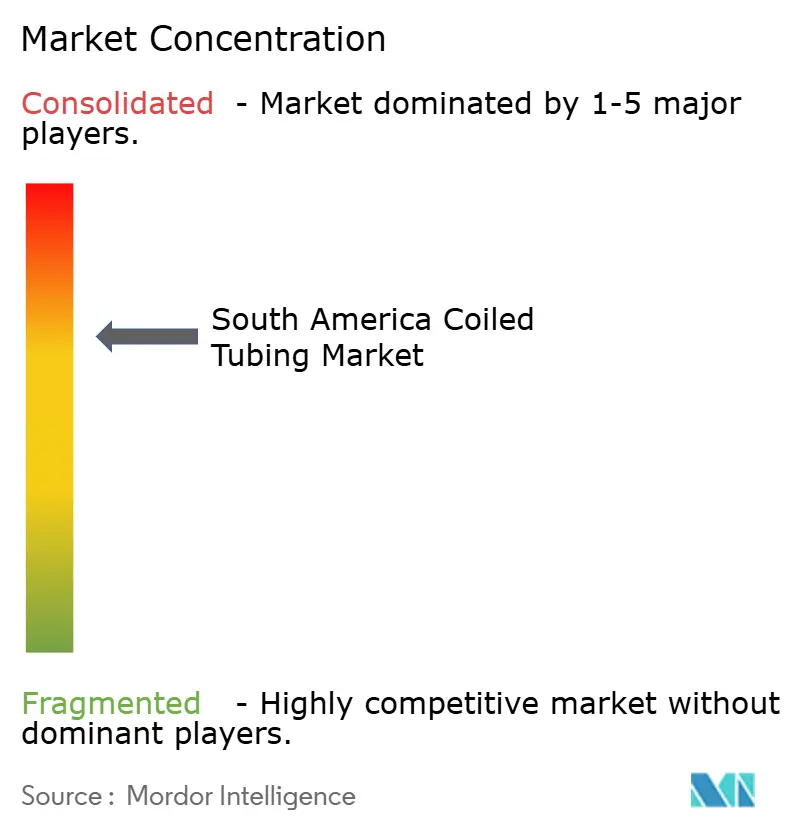
| Market Concentration | Medium |
Major Players *Disclaimer: Major Players sorted in no particular order Image © Mordor Intelligence. Reuse requires attribution under CC BY 4.0. | |
South America Coiled Tubing Market Analysis by Mordor Intelligence
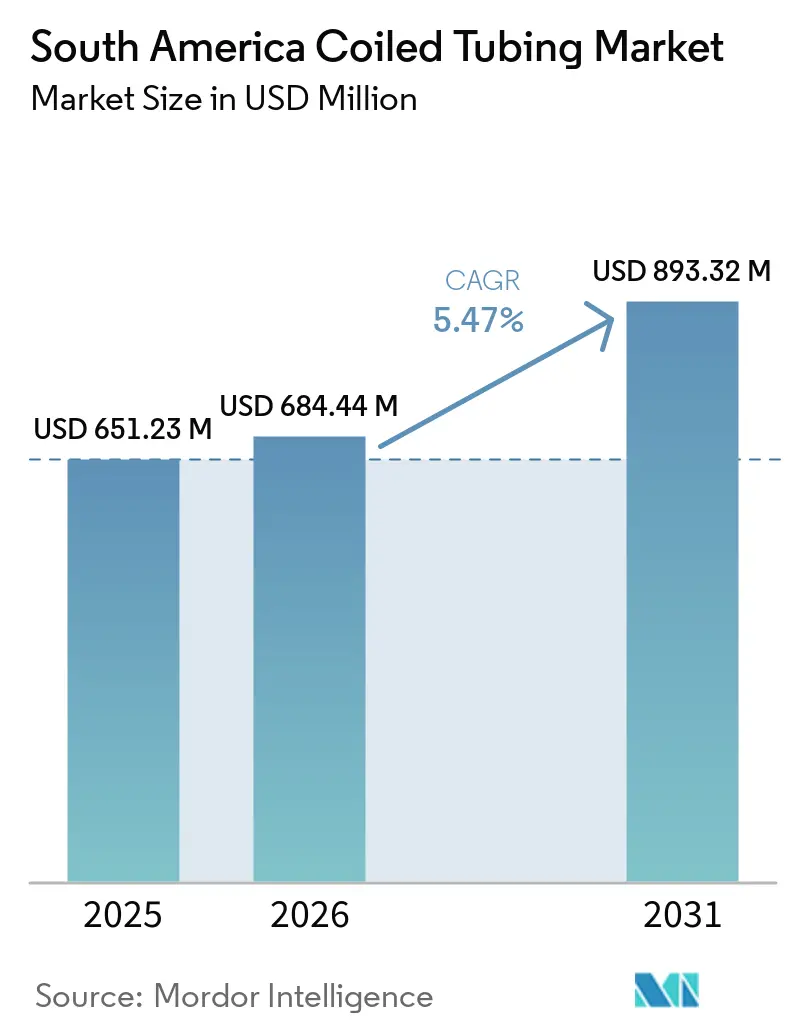
The South America Coiled Tubing Market size is expected to increase from USD 651.23 million in 2025 to USD 684.44 million in 2026 and reach USD 893.32 million by 2031, at a CAGR of 5.47% over 2026-2031. Higher output from Brazil’s pre-salt fields and Guyana’s offshore developments supports demand for completion, intervention, and well maintenance services. Brazil’s oil and gas production rose 13.3% in 2025 to 4.9 million boe/d, and pre-salt fields contributed 79.6% of national production, which keeps offshore service activity central to the regional demand base[1]. Petrobras’s planned upstream investment and Guyana’s continuing FPSO program create a multi-year pipeline for specialized well work. The South America coiled tubing market also faces high mobilization expenses, local-content requirements, and competition from wireline and hydraulic workover units in simpler jobs. Providers with offshore equipment, trained crews, and integrated service capability are better placed to serve Brazil’s deepwater fields and establish an early position in Guyana.
Key Report Takeaways
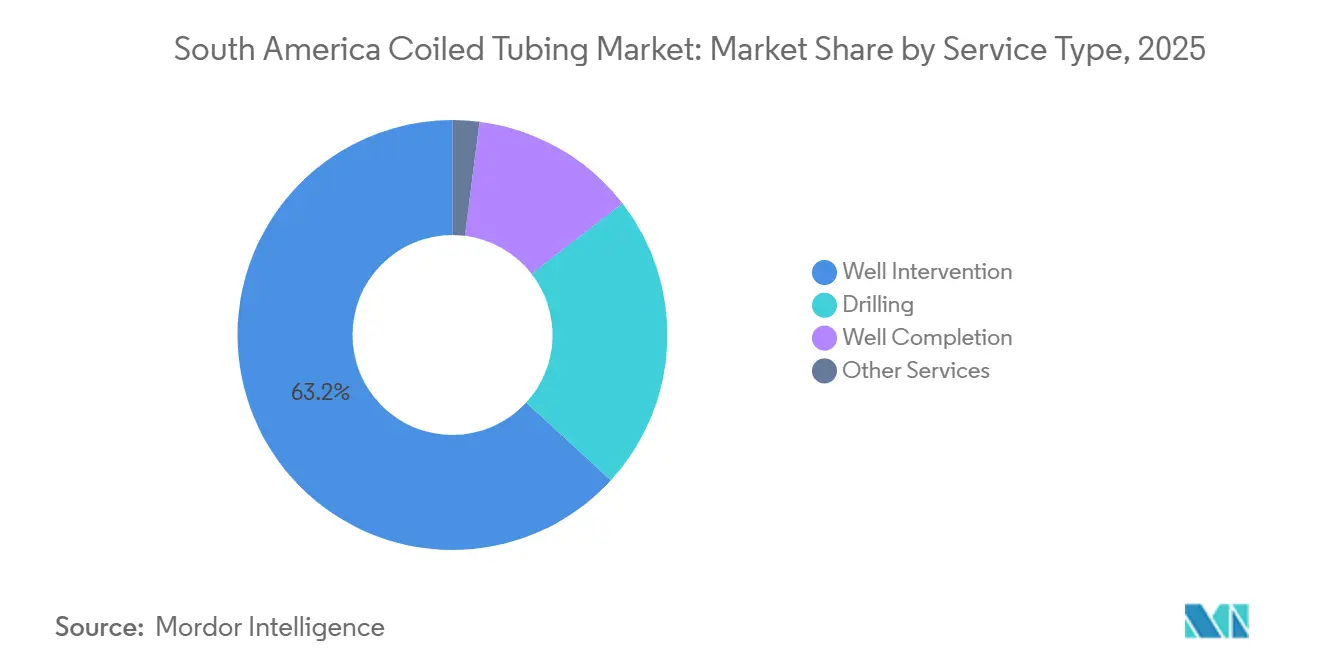
- By service type, well intervention held 63.2% of the South America coiled tubing market share in 2025, while drilling is forecast to grow at a 6.7% CAGR through 2031.
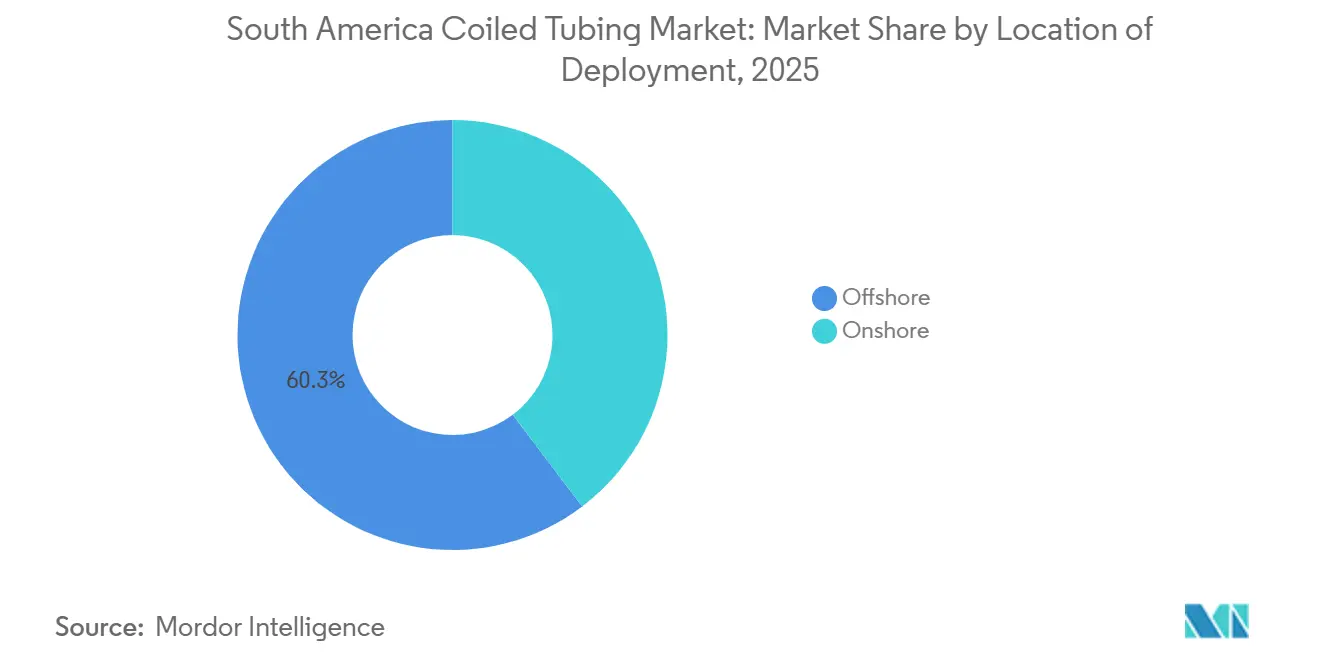
- By location of deployment, offshore accounted for 60.3% of the South America coiled tubing market share in 2025 and is expected to advance at a 7.1% CAGR through 2031.
- By geography, Brazil accounted for 57.3% of regional revenue in 2025, while Guyana is forecast to grow at an 8.2% CAGR through 2031.
Note: Market size and forecast figures in this report are generated using Mordor Intelligence’s proprietary estimation framework, updated with the latest available data and insights as of January 2026.
Market Trends and Insights
Drivers Impact Analysis of South America Coiled Tubing Market*
| Driver | % Impact on CAGR Forecast | Geographic Relevance | Impact Timeline |
|---|---|---|---|
| Expansion of Brazil Pre-Salt and Guyana Deepwater Production | +1.80% | Brazil (Santos & Campos Basins), Guyana (Stabroek Block) | Long term (≥ 4 years) |
| Vaca Muerta Well Development and Recompletion Activity | +1.20% | Argentina (Neuquén Basin) | Medium term (2-4 years) |
| Aging-Well Production Optimization and Life Extension | +1.00% | Brazil (Campos & Santos), Colombia | Long term (≥ 4 years) |
| Rigless Intervention Demand to Reduce Offshore Nonproductive Time | +0.80% | Brazil offshore, Guyana frontier | Medium term (2-4 years) |
| Real-Time Downhole Diagnostics and Automated Coiled Tubing | +0.50% | Brazil (pre-salt), Guyana (Stabroek) | Medium term (2-4 years) |
| Integrated Workover and Plug-and-Abandonment Campaigns | +0.40% | Brazil (Campos Basin), Colombia | Short term (≤ 2 years) |
| Source: Mordor Intelligence | |||
Expansion of Brazil Pre-Salt and Guyana Deepwater Production
Brazil’s pre-salt output expansion increases the number of wells that need completion, cleanout, and production support. Brazil recorded 4.9 million boe/d of oil and gas output in 2025, while pre-salt production represented 79.6% of the country total. Petrobras plans USD 120 billion of upstream investment for 2026 through 2030, with pre-salt production expected to represent up to 82% of its output by 2030. Each new subsea well requires work during completion and may require later intervention as production conditions change. In Guyana, ExxonMobil made a final investment decision in September 2025 on the USD 6.8 billion Hammerhead project, its seventh Stabroek development, with a 150,000 bopd facility expected in 2029. The growing number of FPSO projects creates an opportunity for service providers that can mobilize equipment and personnel locally.
Vaca Muerta Well Development and Recompletion Activity
Vaca Muerta is widening the onshore demand base for the South America coiled tubing market through multi-well pad development and recompletion work. Coiled tubing is used for plug drill-outs between fracturing stages and can support lateral re-entries and sidetracks. These activities become more frequent when operators move from early appraisal work to repeatable pad development. The demand pattern differs from Brazil because it centers on high-volume campaigns rather than deepwater vessel-based work. Halliburton’s exclusive multi-year Zeus completions contract with YPF covers unconventional completions, but the broader expansion of pad activity also supports intervention and recompletion work outside the contract scope. This leaves room for providers that can supply reliable strings, downhole tools, and field crews for repeated operations in the Neuquén Basin.
Aging-Well Production Optimization and Life Extension
Mature fields in Brazil, Colombia, and Chile require frequent work to sustain production and manage well conditions. Coiled tubing can support cleanouts, nitrogen lifting, stimulation, and diagnostic work without the full cost of a workover rig. This makes it relevant for post-salt fields in the Campos Basin and conventional onshore assets. Digital services can improve the value of these jobs by providing pressure, temperature, and flow information during the same downhole trip. SLB’s ACTive service combines fiber-optic measurements with coiled tubing operations and can monitor these well conditions in real time[2]. The South America coiled tubing market can therefore gain not only from a higher number of interventions, but also from the increased use of diagnostic tools in mature-well programs.
Rigless Intervention Demand to Reduce Offshore Nonproductive Time
Deepwater operators seek to reduce time spent waiting for a rig, vessel, crew, or favorable weather window. Rigless coiled tubing work can address certain intervention and plug-and-abandonment jobs without using a drilling rig. Halliburton’s Petrobras contract for offshore intervention and plug-and-abandonment work includes coiled tubing among its core services. Baker Hughes also expanded its Macaé facilities to provide coiled tubing and tubular running capacity for its Petrobras offshore program. These service commitments make rigless operations a planned part of offshore work programs rather than an occasional option. The approach is especially relevant for Brazil and Guyana, where offshore logistics and vessel availability can affect intervention schedules.
Restraints Impact Analysis of South America Coiled Tubing Market*
| Restraint | % Impact on CAGR Forecast | Geographic Relevance | Impact Timeline |
|---|---|---|---|
| High Mobilization and Specialized Personnel Costs | -0.70% | Brazil offshore (deepwater), Guyana (frontier) | Long term (≥ 4 years) |
| Wireline, Hydraulic Workover, and Other Substitute Competition | -0.50% | Brazil (post-salt Campos), Colombia, Chile | Medium term (2-4 years) |
| Fatigue, Corrosion, and Sour-Service Qualification Limits | -0.30% | Brazil deepwater (pre-salt H₂S), Guyana | Medium term (2-4 years) |
| Local-Content, Permitting, and Cross-Border Logistics Friction | -0.40% | Brazil (ANP local-content), Argentina (cross-border) | Short term (≤ 2 years) |
| Source: Mordor Intelligence | |||
High Mobilization and Specialized Personnel Costs
Deepwater coiled tubing work requires pressure-control equipment, specialized vessels, and personnel qualified for high-pressure operations. These requirements raise the cost of sending equipment to Brazil’s pre-salt fields or importing it into Guyana. The cost barrier is particularly relevant where local service bases are limited. ANP safety requirements require operators to document pressure-barrier integrity for offshore well work, which adds compliance work to intervention planning. Established providers have an advantage because they can spread equipment, training, and compliance costs across several contracts. This can slow entry by smaller providers even when offshore demand is expanding.
Wireline, Hydraulic Workover, and Other Substitute Competition
Wireline and hydraulic workover units can address some intervention and cleanout jobs at lower cost than coiled tubing. Their appeal is strongest in simpler wellbores and conventional onshore fields. This affects the South America coiled tubing market most clearly in mature assets in Colombia, Chile, and parts of Argentina. Coiled tubing providers must show that their tools offer a practical advantage in diagnostics, well access, or job completion time. SLB’s autonomous well intervention platform combines digital workflows across wireline and coiled tubing services, which gives operators more flexibility in selecting the service method. Providers without differentiated tools may face lower pricing power in less complex intervention work.
*Our forecasts treat driver/restraint impacts as directional, not additive. The impact forecasts reflect baseline growth, mix effects, and variable interactions.
South America Coiled Tubing Market Segment Analysis
By Service Type:
Well Intervention Anchors Revenue While Drilling AcceleratesWell intervention accounted for 63.2% of the South America coiled tubing market share in 2025. The segment benefits from Brazil’s mature offshore assets and the continuing intervention workload in the Campos Basin. Operators use coiled tubing for cleanouts, pressure-management work, stimulation, and other production support tasks. Halliburton’s Petrobras contract covers offshore intervention and plug-and-abandonment activity, including coiled tubing services[3]. Baker Hughes has also committed dedicated capacity at Macaé for its offshore workover and plug-and-abandonment program[4]. These contracts provide a stable base for well intervention revenue through the active terms of the programs.
Drilling is the fastest-growing service type and the South America coiled tubing market size for this segment is forecast to grow at a 6.7% CAGR from 2026 to 2031. Coiled tubing drilling supports lateral re-entries and sidetrack operations, particularly in Vaca Muerta. The segment is linked to a growing need to extend the productive life of pad wells and access remaining reservoir sections. Well completion activity also rises as Brazil and Guyana add subsea development wells connected to FPSOs. Other services, including nitrogen lifting and matrix stimulation, remain smaller but support production improvement in mature wells. A 2025 study from Universidade do Estado de Santa Catarina examined nitrogen use through coiled tubing for production induction, illustrating the technical relevance of this approach for Brazilian wells.

By Location of Deployment:
Offshore Drives Both Scale and SpeedOffshore held 60.3% of the South America coiled tubing market share in 2025 and is forecast to expand at a 7.1% CAGR through 2031. The segment leads because Brazil’s pre-salt fields rely on subsea wells, vessels, and specialized intervention services. Offshore work includes commissioning support, completion optimization, intervention, and plug-and-abandonment activity. Petrobras expects the pre-salt to contribute up to 82% of company production by 2030, which extends the need for offshore well services. SLB received a September 2025 Petrobras contract for services and technology for up to 35 ultra-deepwater wells in the Santos Basin. These conditions favor providers that can combine vessel access, downhole services, and local operating capability.
Onshore deployment is smaller, but it has a different and important role in regional demand. Vaca Muerta requires repeated plug drill-outs between fracturing stages on multi-well pads. This gives the onshore coiled tubing market a high-frequency service pattern that differs from the larger offshore jobs. Conventional fields in Colombia and Chile also require cleanout and maintenance work, although their scale is more limited. Argentina’s investment framework supports longer-cycle project planning and can improve visibility for equipment deployment. The segment therefore offers providers a way to balance offshore exposure with recurring onshore campaigns. The South America coiled tubing industry is shaped by both service models, although offshore work remains the larger revenue source.
Geography Analysis
Brazil Coiled Tubing Market
Brazil held 57.3% of South America coiled tubing market revenue in 2025. The country’s position results from the scale and technical depth of its offshore production system. Pre-salt fields produced 3 million barrels of oil per day in 2025 and represented close to 80% of Brazilian output. Petrobras has allocated USD 120 billion to upstream investment for 2026 through 2030. This program supports new-well completion, intervention, and decommissioning work. Offshore operators also need equipment suitable for high-pressure, deepwater conditions. These requirements reinforce the role of technically capable providers in Brazil.
Guyana Coiled Tubing Market
Guyana is projected to record the fastest regional growth at an 8.2% CAGR from 2026 to 2031. The country’s coiled tubing demand is tied to successive Stabroek FPSO developments. ExxonMobil approved the USD 6.8 billion Hammerhead project in September 2025, with startup expected in 2029. Each project brings development wells that need completion support and later intervention services. The small domestic supply base raises logistics needs for tools and trained personnel. A permanent local service presence could therefore become a competitive advantage as offshore activity grows.
South America Coiled Tubing Market
Argentina’s onshore coiled tubing activity is led by Vaca Muerta. The basin supports regular plug drill-out campaigns and recompletion requirements across multi-well pads. This creates a recurring demand pattern for crews and equipment. Colombia and Chile remain focused on conventional maintenance and mature-well work. Bolivia and Peru add smaller volumes within the regional total. The South America coiled tubing market combines large deepwater projects with operationally intensive onshore campaigns. That combination limits the usefulness of a single delivery model across all countries.
Competitive Landscape
The South America coiled tubing market is moderately consolidated because a small group of global service companies holds key offshore contracts in Brazil. SLB, Halliburton, and Baker Hughes have established positions in intervention, completion, and plug-and-abandonment programs. SLB received a Petrobras award in September 2025 for services and technology for up to 35 ultra-deepwater wells in the Santos Basin. Halliburton’s Petrobras offshore intervention and plug-and-abandonment contract includes coiled tubing services. Baker Hughes expanded its Macaé facility to provide added coiled tubing capacity for Petrobras work. These positions give the large providers strong access to the largest regional offshore workload.
Competition increasingly depends on integrating equipment, vessel access, digital services, and local operations. SLB’s ACTive service provides real-time downhole data during coiled tubing operations. Its autonomous intervention platform also supports automation across coiled tubing and wireline workflows. Weatherford secured 2 contracts with Constellation Oil Services in May 2026 for managed pressure drilling and subsea well intervention offshore Brazil. This move strengthens its presence in the Campos and Espírito Santo Basins. These strategic moves show that providers are competing on operational scope and technical capability, not only on individual service lines.
Argentina offers a different competitive setting because pad campaigns need repeated onshore execution and local equipment availability. Tenaris can use its Argentine manufacturing position to support coiled tubing string supply in Vaca Muerta. Smaller specialized providers can compete where they offer dependable crews and tailored plug drill-out service. Guyana remains an important opening because local coiled tubing infrastructure is still limited. Brazil’s established contract base remains difficult to enter without equipment, compliance capability, and offshore experience. No combined market-share figure for the leading companies was provided, so a precise market concentration score cannot be calculated from the available evidence. The available contract evidence supports a moderately consolidated description rather than a fragmented one.
South America Coiled Tubing Industry Leaders
-
Halliburton Company
-
Baker Hughes Company
-
SLB (Schlumberger Limited)
-
Weatherford International plc
-
Tenaris S.A.
- *Disclaimer: Major Players sorted in no particular order
South America Coiled Tubing Market Companies Covered in this Report
- Aker Solutions ASA
- Altus Intervention
- Archer Limited
- Baker Hughes Company
- C&J Well Services
- Calfrac Well Services Ltd.
- Halliburton Company
- Helix Energy Solutions Group, Inc.
- Jereh Group
- Key Energy Services, LLC
- Nabors Industries Ltd.
- National Oilwell Varco (NOV) Inc.
- Oceaneering International, Inc.
- Royal IHC
- SLB (Schlumberger Limited)
- STEP Energy Services Ltd.
- Superior Energy Services, Inc.
- Tenaris S.A.
- Trican Well Service Ltd.
- Weatherford International plc
Recent Industry Developments in South America Coiled Tubing Market
- May 2026: Weatherford International secured two contracts with Constellation Oil Services for managed pressure drilling and subsea well intervention on the ultra-deepwater Gold Star semisubmersible offshore Brazil, focused on the Campos and Espírito Santo Basins. The scope expands Weatherford's P&A and workover presence and strengthens its local operational teams in Brazil.
- May 2026: Saipem and Petrobras signed a Memorandum of Understanding to develop integrated decommissioning solutions for Brazilian offshore oil and gas fields, covering well P&A and subsea decommissioning. The partnership could materially expand Brazil's coiled tubing P&A market by bringing a major EPCI contractor into the well-plug value chain.
- September 2025: SLB was awarded a major contract by Petrobras to provide services and technology for up to 35 ultra-deepwater wells in the Santos Basin, deploying advanced electric completions technologies including Electris™ high-flow-rate interval control valves. Work was scheduled to begin in mid-2026, structurally anchoring SLB's deepwater CT and completions position in Brazil through 2027 and beyond.
- September 2025: ExxonMobil took a final investment decision on the Hammerhead development, seventh Stabroek project offshore Guyana, committing USD 6.8 billion for a 150,000 bopd facility expected online in 2029. This extends Guyana's CT service demand horizon to 2030 and beyond, confirming the block's capacity will approach 1.5 million bopd across seven projects.
South America Coiled Tubing Market Report Scope
Coiled tubing (CT) is a continuous, flexible steel pipe spooled onto a large reel and used in oil and gas wells for drilling, well completion, well intervention, and workover operations. Unlike conventional jointed tubing, coiled tubing can be run into and retrieved from a well continuously without repeatedly connecting or disconnecting pipe sections. Common applications include well cleanouts, stimulation, nitrogen lifting, logging, fishing, pressure control, and production enhancement. Its ability to operate while the well remains under pressure makes it particularly valuable for well intervention activities.
The South America Coiled Tubing Market is segmented by service type, location of deployment, and geography. By service type, the market is segmented into well intervention, drilling, well completion, and other services. By location of deployment, the market is segmented into onshore and offshore. The report also covers the market size and forecasts for the South America coiled tubing market across the 5 countries in the region. For each segment, the market sizing and forecasts have been provided on the basis of value (USD).
Segmentation Overview
By Service Type
| Well Intervention |
| Drilling |
| Well Completion |
| Other Services |
By Location of Deployment
| Onshore |
| Offshore |
By Geography
| Brazil |
| Argentina |
| Guyana |
| Colombia |
| Chile |
| Rest of South America |
| By Service Type | Well Intervention |
| Drilling | |
| Well Completion | |
| Other Services | |
| By Location of Deployment | Onshore |
| Offshore | |
| By Geography | Brazil |
| Argentina | |
| Guyana | |
| Colombia | |
| Chile | |
| Rest of South America |
Key Questions Answered in the Report
What is the projected growth rate for coiled tubing services in South America?
The South America coiled tubing market is projected to grow at a 5.47% CAGR from 2026 to 2031, reaching USD 893.32 million. The outlook is supported by deepwater development in Brazil and Guyana, along with continuing maintenance and intervention requirements in established producing fields.
Which service type leads regional coiled tubing revenue?
Well intervention led with 63.2% of revenue in 2025, supported by offshore maintenance and intervention activity in Brazil. This work includes cleanouts, production support, stimulation, and pressure-management tasks across mature and newer wells.
Why is offshore work important for regional coiled tubing demand?
Offshore deployment held 60.3% of revenue in 2025 and is projected to expand at a 7.1% CAGR as deepwater projects require completion and intervention services. Offshore jobs also require specialized equipment, qualified crews, and vessel-supported operations, which increase the role of experienced service providers.
Which country is the largest source of coiled tubing demand in South America?
Brazil accounted for 57.3% of regional revenue in 2025 because of its large pre-salt and mature offshore field base. Petrobras’s investment program supports both new subsea developments and the continuing intervention and plug-and-abandonment needs of older assets.
Why is Guyana growing quickly for coiled tubing providers?
Guyana is forecast to grow at an 8.2% CAGR through 2031 as Stabroek FPSO developments create new completion and intervention requirements. Its limited local supply base also gives value to providers that can establish equipment, crews, and operating capability within the country.
What limits adoption of coiled tubing services in the region?
High offshore mobilization costs and competition from wireline and hydraulic workover units can limit adoption in lower-complexity jobs. Local-content rules, cross-border logistics, and the need for specialized personnel can also make service delivery more difficult in Brazil and Guyana.