
South America Bottling Line Cleaning Machinery Market Size and Share
Market Overview
| Study Period | 2021 - 2032 |
|---|---|
| Forecast Data Period | 2027 - 2032 |
| Base Year Market Size (2026) | USD 2.61 Million |
| Market Size (2027) | USD 2.76 Million |
| Market Size (2032) | USD 3.67 Million |
| Growth Rate (2027 - 2032) | 5.86 % |
| Market Concentration | Medium |
Major Players *Disclaimer: Major Players sorted in no particular order Image © Mordor Intelligence. Reuse requires attribution under CC BY 4.0. | |
South America Bottling Line Cleaning Machinery Market Analysis by Mordor Intelligence
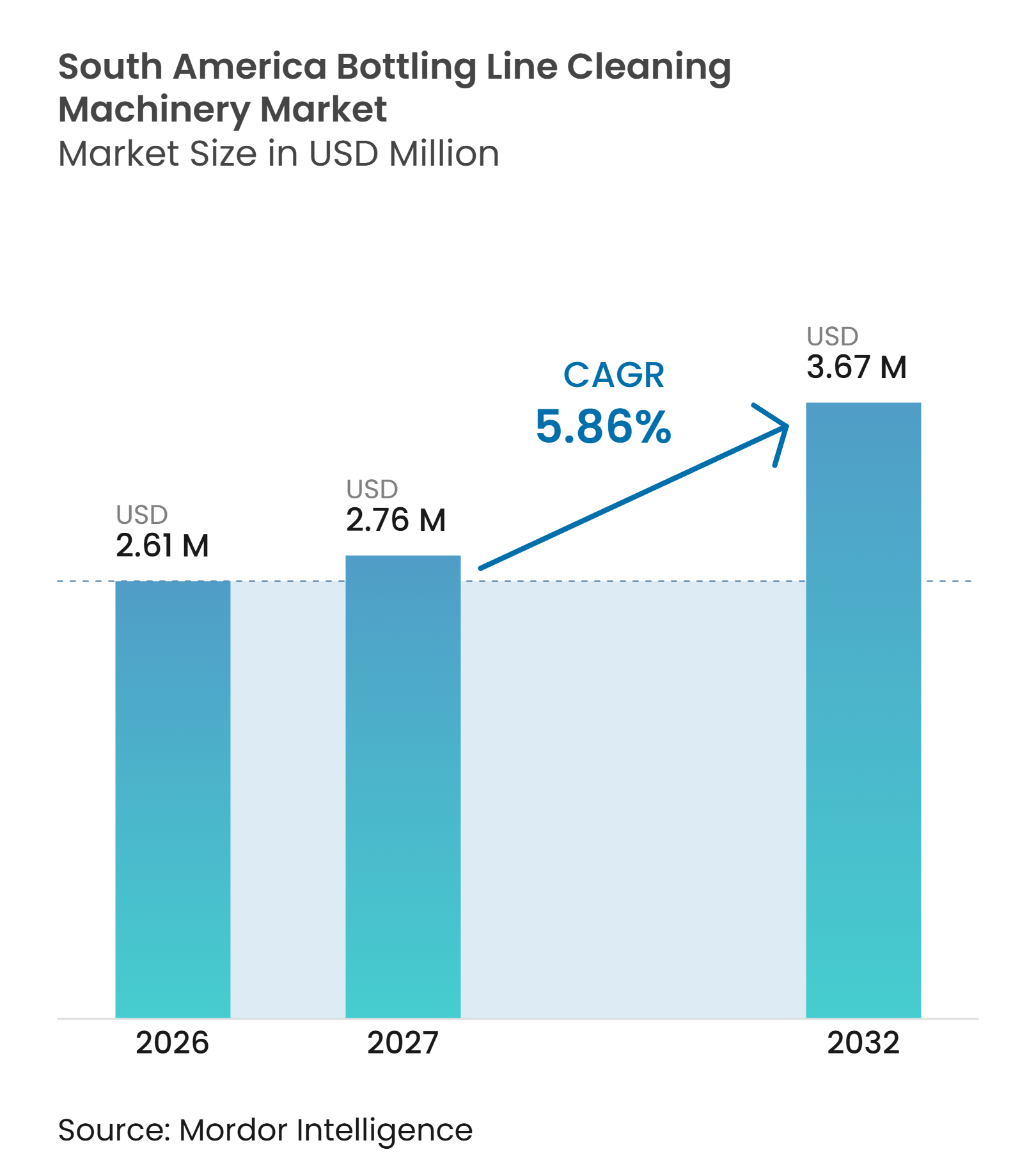
The South America Bottling Line Cleaning Machinery Market size was valued at USD 2.61 million in 2026 and is estimated to grow from USD 2.76 million in 2027 to reach USD 3.67 million by 2032, at a CAGR of 5.86% during the forecast period (2027-2032).
Beverage producers are adding capacity and replacing older equipment, which is driving demand for matched cleaning systems for new glass, PET, and mixed-format lines. Coca-Cola and its bottling partners confirmed USD 1.4 billion of investment in Argentina through 2028 for production, logistics, and returnable-packaging capacity. Returnable formats also create repeat cleaning requirements because every bottle must be washed before refilling. Food safety requirements and documented cleaning validation are making fully automated systems increasingly relevant for large bottlers. Suppliers are differentiating their offerings through lower water use, lower energy consumption, digital records, and retrofit services for installed equipment.
Key Report Takeaways
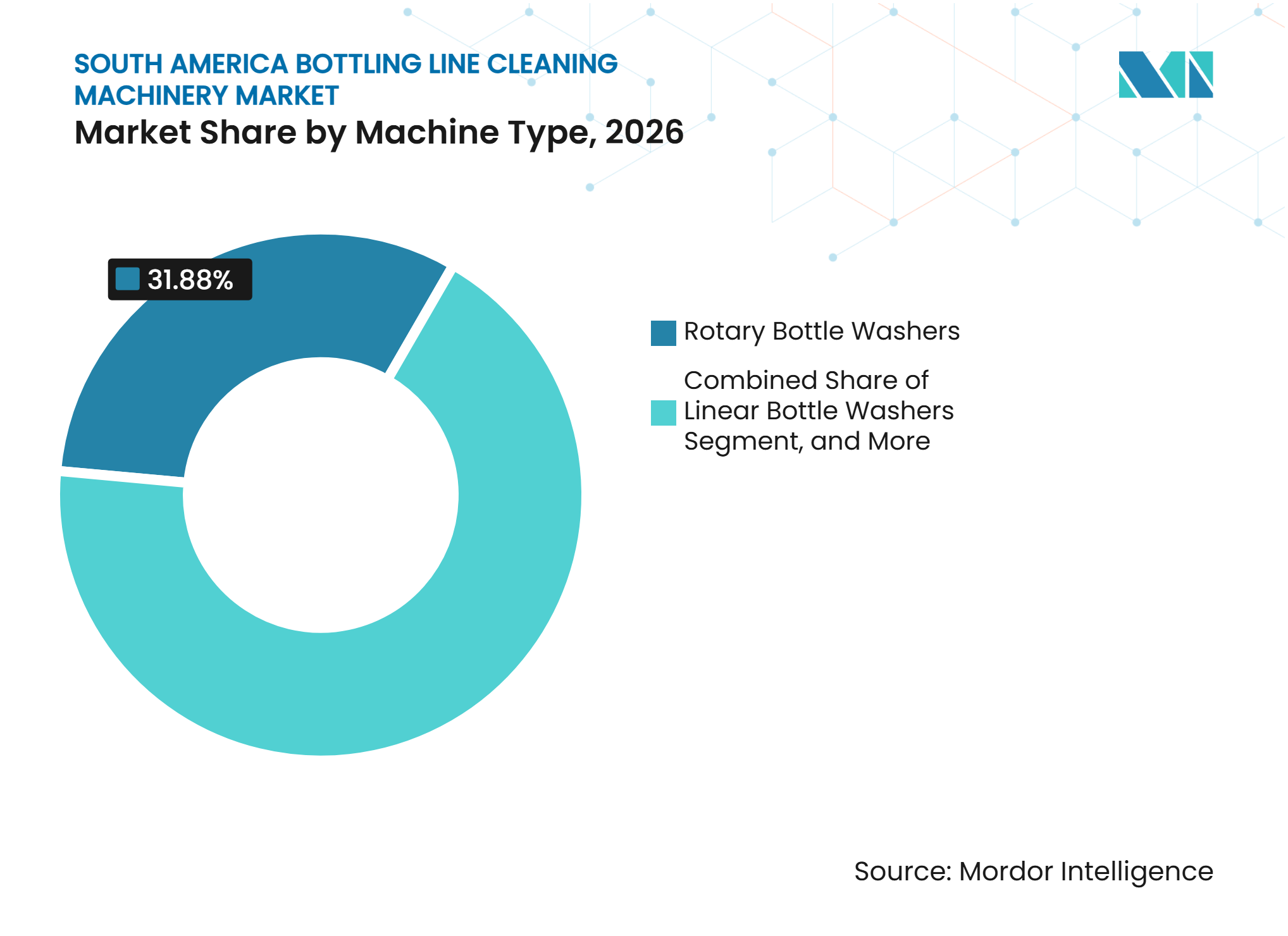
- By machine type, rotary bottle washers held 31.88% of the South America bottling line cleaning machinery market share in 2026, while combined washer-dryer systems are projected to expand at a 7.24% CAGR through 2032.
- By automation level, fully automatic systems accounted for 47.01% of the South America bottling line cleaning machinery market size in 2026 and are projected to advance at a 6.44% CAGR through 2032.
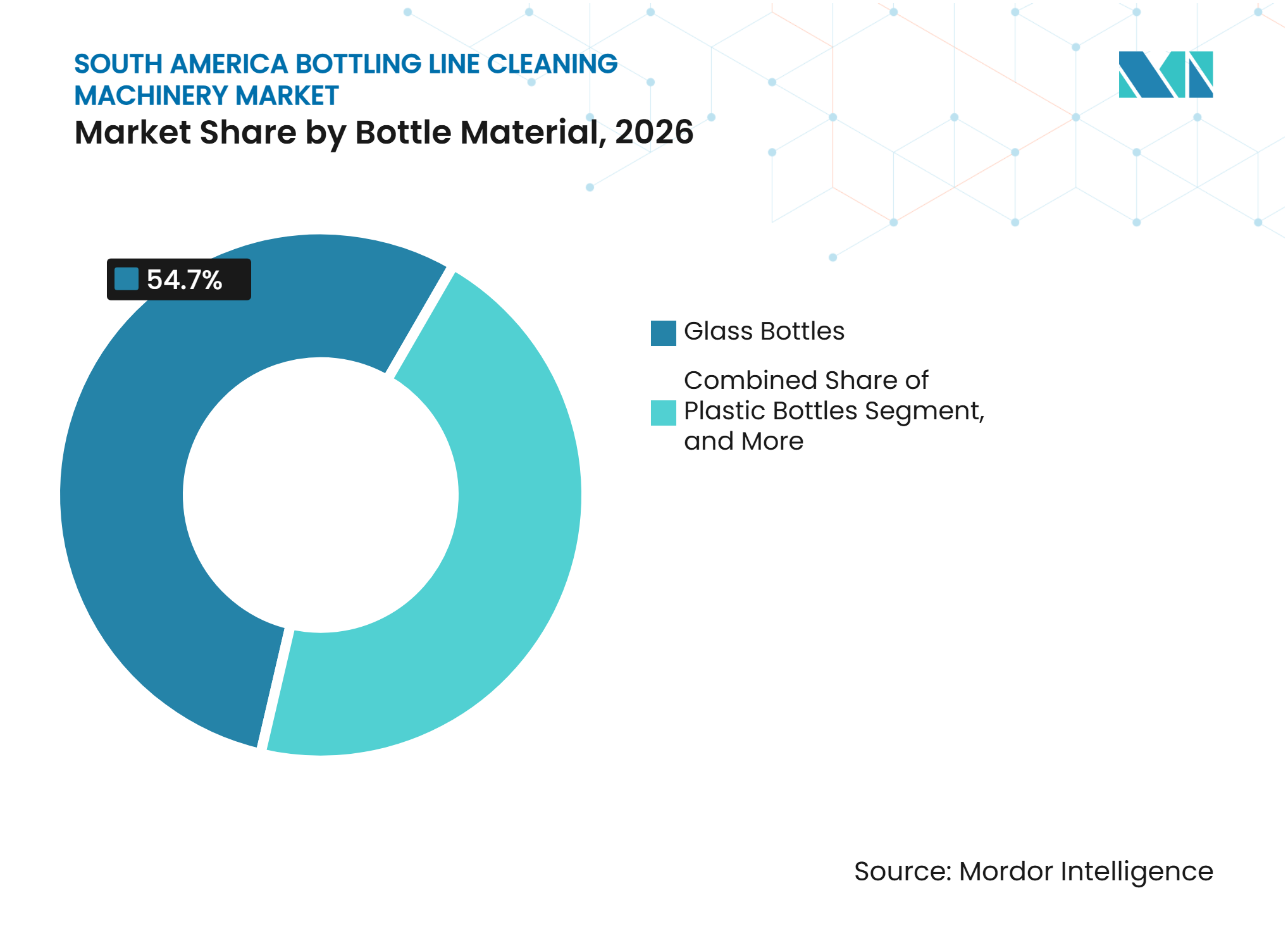
- By bottle material, glass accounted for 54.70% of the South America bottling line cleaning machinery market share in 2026, while plastic is projected to expand at a 6.43% CAGR through 2032.
- By end user, breweries and soft-drink producers held 45.62% of the South America bottling line cleaning machinery market size in 2026, while contract packaging and bottling companies are projected to accelerate at a 7.01% CAGR through 2032.
- By geography, Brazil held 53.85% of regional value in 2026, while Argentina is projected to expand at a 6.83% CAGR through 2032.
Note: Market numbers in this report are based on Mordor Intelligence's proprietary estimation framework, which combines nine months of actuals with Q4 projections for base year 2026.
Market Trends and Insights
Drivers Impact Analysis of South America Bottling Line Cleaning Machinery Market*
| Driver | (~) % Impact on CAGR Forecast | Geographic Relevance | Impact Timeline |
|---|---|---|---|
| Expansion of High-Speed Beverage Bottling Capacity | +1.0% | Brazil, Argentina, Chile | Short term (≤ 2 years) |
| Stricter Hygienic Design and Food-Safety Compliance | +0.8% | Brazil, Argentina, Rest of South America | Medium term (2-4 years) |
| Growth of Returnable and Reusable Bottle Loops | +0.7% | Argentina, Brazil, Chile, Paraguay | Medium term (2-4 years) |
| Demand for Water, Chemical, and Energy Efficiency | +0.5% | Brazil and Argentina | Long term (≥ 4 years) |
| Closed-Loop Nanobubble and Ozone Cleaning Adoption | +0.3% | Winery and brewery sectors in South America | Long term (≥ 4 years) |
| Rising Need for Predictive Cleaning and Changeover Optimization | +0.2% | Large breweries in Brazil | Long term (≥ 4 years) |
| Source: Mordor Intelligence | |||
Expansion of High-Speed Beverage Bottling Capacity
Beverage investment is supporting demand for cleaning equipment because every new high-speed bottling line requires a matching washing, rinsing, or clean-in-place system. Coca-Cola announced plans for 14 new production lines in Brazil during 2025, indicating continued investment in regional production capacity. In Argentina, the Coca-Cola system committed USD 1.4 billion through 2028 for production expansion, logistics, and returnable packaging. These projects increase demand for equipment capable of high throughput and meeting the cleaning needs of returnable containers. Facilities using glass, PET, and can formats also require different cleaning processes for each format. This makes mixed-format plants more likely to install separate washers, rinsers, or clean-in-place configurations. The South America bottling line cleaning machinery market benefits when producers invest in several formats rather than a single package type.
Stricter Hygienic Design and Food-Safety Compliance
Brazil is strengthening the regulatory focus on hygiene and production controls for food and beverage facilities. ANVISA included a revision of Good Manufacturing Practice requirements under RDC 275/2002 in its 2026-2027 regulatory agenda. The agenda keeps equipment hygiene, process documentation, and facility controls relevant to procurement decisions. Bottlers need cleaning systems that can deliver repeatable programs and preserve electronic records for internal and external review. This requirement favors fully automated equipment with controlled operating parameters over manual systems. It also encourages mid-sized producers to upgrade equipment when their existing systems cannot provide the required validation documentation. The South America bottling line cleaning machinery market therefore gains support from compliance spending as well as from new capacity investment.
Growth of Returnable and Reusable Bottle Loops
Returnable packaging supports recurring cleaning activity because bottles need industrial washing before each refill. Uruguay formalized a deposit-return system under Plan Vale in February 2025, establishing a policy framework for container recovery. Larger return volumes can require more washing capacity and stronger inspection procedures at refill sites. Reusable bottle formats also require cleaning equipment that can manage variable bottle condition, label residue, and high return volumes. The Coca-Cola system's Universal Bottle design can be reused up to 25 times across multiple brands, illustrating the operational importance of reusable formats. The South America bottling line cleaning machinery market is supported by this recurring operating requirement rather than only by one-time line additions.
Demand for Water, Chemical, and Energy Efficiency
Water, chemical, and energy use are becoming more important buying criteria for bottling equipment. Krones stated that its Lavasonic HI washer can reduce freshwater use by up to 20% and thermal energy use by up to 30% compared with the preceding machine generation. The system uses ultrasound-assisted cleaning at lower temperatures, which can lower resource use while maintaining cleaning performance. Lower operating consumption is particularly relevant for breweries and soft-drink bottlers operating returnable lines at high volume. Suppliers can use these operating benefits to support replacement sales where older washers have high utility requirements. Resource performance can also strengthen reporting for multinational beverage groups that track water and energy use across their plants. The South America bottling line cleaning machinery market is likely to reward suppliers that can show resource savings through validated equipment performance.
Restraints Impact Analysis of South America Bottling Line Cleaning Machinery Market*
| Restraint | (~) % Impact on CAGR Forecast | Geographic Relevance | Impact Timeline |
|---|---|---|---|
| High Capital Cost and Long Payback for Advanced Systems | -0.7% | South America, especially Argentina and Rest of South America | Short term (≤ 2 years) |
| Import Dependence and Currency Volatility | -0.5% | Argentina, Brazil, and smaller South America markets | Short term (≤ 2 years) |
| Limited Local Service and Skilled Maintenance Capacity | -0.2% | Rest of South America and Argentina outside Buenos Aires | Medium term (2-4 years) |
| Complexity of Validating Cleaning Performance Across Mixed Bottle Formats | -0.1% | Multi-format facilities in Brazil and Argentina | Long term (≥ 4 years) |
| Source: Mordor Intelligence | |||
High Capital Cost and Long Payback for Advanced Systems
Fully automatic and connected cleaning systems require substantial initial investment. The financial return from lower labor, water, chemical, and energy consumption can take 4-8 years, which can deter buyers in volatile economic conditions. Smaller bottlers often have limited access to the capital available to multinational beverage groups. They may choose semi-automatic, refurbished, or lower-capacity equipment instead of advanced systems. Compliance deadlines can make the decision harder because some upgrades cannot be postponed without operational risk. Contract packagers and pharmaceutical bottlers can also incur additional validation costs when installing a new system. These costs can slow adoption even where a new system offers better throughput and documented cleaning performance.
Import Dependence and Currency Volatility
South American buyers depend heavily on imported bottle washing and clean-in-place equipment from Europe and East Asia. This dependence exposes capital projects to currency fluctuations, shipping requirements, import procedures, and longer payment cycles. Argentina reported a year-on-year decline in capital-goods import volumes, indicating continued caution regarding imported machinery purchases.[1] The country introduced a managed exchange-rate band, improving planning visibility for some importers. However, extended payment schedules for imported capital equipment can still increase working-capital requirements. This situation can delay projects and favor suppliers that offer accessible local service, inventory, or financing options.
*Our forecasts treat driver/restraint impacts as directional, not additive. The impact forecasts reflect baseline growth, mix effects, and variable interactions.
South America Bottling Line Cleaning Machinery Market Segment Analysis
By Machine Type - Rotary Washers Serve High-Throughput Returnable Lines
Rotary bottle washers held 31.88% of the South America bottling line cleaning machinery market share in 2026. They are used on high-throughput returnable glass lines because they combine a compact layout with reliable performance across common bottle sizes. Brewery and carbonated soft-drink operations use these machines where steady line speed is important. Their role is especially clear in facilities that handle returnable bottles requiring intensive interior and exterior cleaning. Rotary designs are also well-suited to plants that handle multiple glass formats on the same production line. This operational flexibility helps producers maintain throughput while shifting among package sizes.
Combined washer-dryer systems are projected to record a 7.24% CAGR through 2032, the highest rate within machine types. Contract packagers value these systems because they combine functions in a smaller footprint. The compact format can reduce the space needed for separate washing and drying operations while supporting multi-format production. Linear washers remain relevant for water and dairy producers that need process flexibility. Tunnel washers continue to serve wineries that need consistent, gentle handling of premium glass. Immersion washers are used for heavily soiled returnables, while rinsers and blowers are common on PET water lines. The machine-type mix enables the South America bottling line cleaning machinery market to serve both large returnable operations and lower-capital bottle-preparation needs.



By Automation Level - Fully Automatic Systems Support Documentation and Output
Fully automatic systems accounted for 47.01% of the South America bottling line cleaning machinery market size in 2026 and are projected to expand at a 6.44% CAGR through 2032. Their leading position reflects investment by large beverage producers in repeatable cleaning, high throughput, and standardized operating controls. These systems can support automatic chemical dosing, cycle monitoring, and production records. Such capabilities align with the need to document hygiene processes for internal quality systems and regulatory review. Automation also reduces reliance on manual intervention during repeatable cleaning sequences. These benefits matter most where bottlers operate at high speed or manage a large volume of returnable packages.
Semi-automatic systems continue to serve small and medium-sized bottled-water producers, food processors, dairies, and regional breweries. These buyers may have available operators but face limits on capital expenditure. Schneider Electric reported that AI-enabled clean-in-place interfaces can reduce cycle time by an average of 15% and water use by 17% compared with fixed-parameter manual programs. The potential savings strengthen the case for automation where utility costs are material. Manual equipment remains concentrated in artisanal wineries and distilleries with low throughput and specialized cycles. Equipment suppliers need to offer a clear upgrade path from manual and semi-automatic systems. This will help the South America bottling line cleaning machinery industry reach buyers with different capital and production requirements.
By Bottle Material - Glass Retains Its Lead as Returnable PET Expands
Glass represented 54.70% of the South America bottling line cleaning machinery market share in 2026. The segment benefits from the established use of returnable glass for beer, soft drinks, and wine. Every returned glass bottle must be washed before it can be refilled, making glass the most intensive material category for cleaning equipment. Bottlers need machines that can remove labels, residue, and soil without damaging the container. This explains the continued importance of washers on glass-focused brewery and soft-drink lines. Glass also supports the need for inspection and handling systems that protect bottle quality across repeated cycles.
Plastic is projected to register a 6.43% CAGR through 2032, the highest rate among bottle materials. The rate reflects increased use of returnable PET formats that require cleaning before reuse. The Coca-Cola system's Universal Bottle design can be reused up to 25 times across multiple brands. PET is lighter than glass and can be easier for consumers and retailers to handle in return systems. Metal and aluminum remain a smaller but steady equipment category. Canning lines usually require rinsing rather than the full washing cycle used for returnable glass and PET. The shift toward reusable plastic broadens the material requirements addressed by the South America bottling line cleaning machinery market.

By End User - Breweries Lead While Contract Packagers Add Flexibility Needs
Breweries and soft-drink producers accounted for 45.62% of the South America bottling line-cleaning machinery market in 2026. Their leading position is linked to the large returnable glass and PET lines operated by multinational groups and their regional partners. Brazil's largest brewers have invested more than BRL 17.5 billion (USD 3.3 billion) since 2020 in production facilities and related capacity. Heineken launched a premium returnable-glass line in Goiás in 2025 with a capacity of 60,000 bottles per hour. Bottled-water producers form a second tier because PET lines need rinsing and blowing at container intake. Wineries, distilleries, food producers, dairy processors, and pharmaceutical manufacturers need systems that meet different container and hygienic requirements.
Contract packaging and bottling companies are projected to expand at a 7.01% CAGR through 2032, the fastest rate among end-user groups. Brand owners use these providers to access filling and packaging capacity without having to fund their own plants. Contract operators often need to change among client package formats and product requirements. This increases demand for cleaning equipment capable of supporting flexible changeovers. Multi-format washer and clean-in-place designs can help these facilities move among different bottle types while maintaining hygiene controls. The related South America contract packaging market was valued at USD 4.15 billion in 2026 and is expected to expand at a 7.14% annual rate. This connection positions contract packaging as a meaningful demand channel for the South America bottling line cleaning machinery market.
Geography Analysis
Brazil
Brazil accounted for 53.85% of the South America bottling line cleaning machinery market share in 2026. Its large beverage production base supports demand across breweries, soft drinks, water, and returnable packaging operations. Coca-Cola, Ambev, Heineken, and regional producers operate a high concentration of bottling facilities that require washing and rinsing capacity. ANVISA's regulatory agenda also keeps hygienic equipment design and Good Manufacturing Practice requirements central to production planning. Brazil therefore combines capacity investment with compliance requirements that encourage the adoption of validated cleaning systems. Suppliers can gain from providing service coverage outside traditional southeastern industrial centers. This is important as producers add capacity in agricultural and inland areas. Local maintenance and parts availability will remain important as the South America bottling line cleaning machinery market expands across Brazil.
Argentina
Argentina is projected to register a 6.83% CAGR through 2032, the fastest geographic rate in the South America bottling line cleaning machinery market. Its mature returnable-bottle culture drives steady demand for washing across soft-drink, beer, and related beverage lines. Coca-Cola and its bottling partners committed USD 1.4 billion through 2028 for production, logistics, and returnable packaging. Reginald Lee inaugurated a USD 18.5 million returnable packaging line in Ranelagh during 2025. The line can produce 18,000 RefPET and glass bottles per hour.[2] Capital-goods import volumes declined 13.7% year on year during January-May 2026, showing that import-related caution remains a constraint. Equipment suppliers need to account for exchange-rate conditions, payment timing, and availability of local technical support. These factors make retrofit and service offerings relevant alongside sales of new machinery.
Rest of South America
Chile, Uruguay, Peru, Colombia, Ecuador, and Paraguay form a more diverse demand base for the South America bottling line cleaning machinery market. Coca-Cola Embonor announced an USD 80 million plan for Chile and Bolivia in 2026 focused on production capacity, returnable containers, and refrigeration equipment. Uruguay formalized its deposit return system in February 2025 under Plan Vale. The system establishes a framework for collecting containers that may later require sorting, washing, and refill infrastructure at scale. Peru updated technical standards for beverage containers in December 2025 through INACAL. These compliance factors raise the importance of hygiene validation for beverage-contact equipment. Paraguay also received a new multi-category returnable line from Coca-Cola Andina during the second half of 2025. The region offers suppliers several smaller opportunities rather than one uniform market. Flexible configurations, training, and local service partnerships can help suppliers address these mixed requirements.
Competitive Landscape
Market Concentration
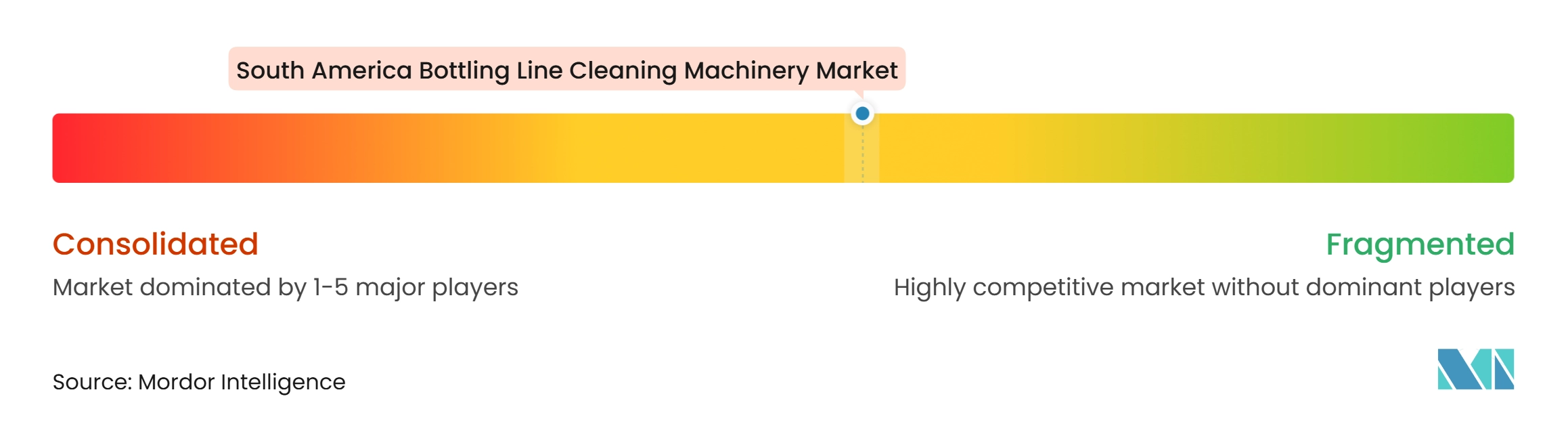
The South America bottling line cleaning machinery market has a moderately fragmented supply structure. Krones, KHS, and Sidel serve the premium end through turnkey line offerings and established relationships with global beverage producers. GEA and Alfa Laval are important suppliers for clean-in-place and tank-cleaning applications. Southern European suppliers, including CFT, Della Toffola, SIPA, SMI, and INOXPA, offer configurations used by wineries, distilleries, juice producers, dairy plants, and other beverage operations. INOXPA supports its hygienic equipment offer with ISO 9001 certification and EHEDG alignment. Asian suppliers compete primarily in price-sensitive semi-automatic applications. The competitive opportunity extends beyond new equipment, as machines installed from 2010-2020 are reaching an age at which upgrades to drives, spray systems, and controls become increasingly relevant. Strong local service capacity can therefore be as important as equipment specifications.
Technology is an important source of differentiation for premium suppliers. Krones introduced the Lavasonic HI double-end bottle washer in September 2025 with ultrasound cavitation and high-intensity cleaning. The company stated that the system can reduce treatment time by up to 40%, thermal energy use by up to 30%, fresh-water use by up to 20%, and carbon footprint by up to 35% compared with the existing generation. Sidel completed the first commercial installation of its Hydra Ultrasonic bottle washer in June 2026. Sidel stated that the technology can provide 20% heat savings and 15% water savings. These developments indicate that equipment makers are competing on operating consumption as well as cleaning effectiveness. Digital monitoring, predictive maintenance, and electronic cleaning records are also becoming expected features in large-account tenders.
GEA introduced AdaptAx at BrauBeviale in November 2026 as a modular orbital cleaner for clean-in-place operations on brewery and beverage tanks. The company stated that the product can deliver up to 30% higher cleaning performance than the preceding generation. Alfa Laval launched Controlled Rotating Retractors in June 2026 to clean hard-to-reach areas on beverage, dairy, and food processing lines.[3] Alfa Laval stated that the retractors can deliver up to twice the cleaning efficiency of static spray balls while reducing cleaning-media use by up to 55%. These product moves show why suppliers need to show measurable savings, reliable cleaning, and practical retrofits. Smaller bottlers may still prioritize cost, ease of maintenance, and operator support over advanced digital functions. The market remains open to specialized suppliers that can combine competitive pricing with credible local support.
South America Bottling Line Cleaning Machinery Industry Leaders
-
Krones AG
-
KHS GmbH
-
Sidel (Tetra Laval International SA)
-
Sanmartin
-
Alfa Laval AB
- *Disclaimer: Major Players sorted in no particular order
South America Bottling Line Cleaning Machinery Market Companies Covered in this Report
- Krones AG
- KHS GmbH
- Sidel (Tetra Laval International SA)
- Sanmartin
- Alfa Laval AB
- GEA Group Aktiengesellschaft
- Tetra Pak International SA
- SPX FLOW, Inc.
- IC Filling Systems S.r.l.
- Della Toffola S.p.A.
- SIPA S.p.A.
- SMI S.p.A.
- Melegari Manghi S.r.l.
- INOXPA, S.A.U.
- CFT S.p.A.
- Tetralon
- Kran SpA
- CarbonaTech
- FILLEX
- Sunswell Machinery
Recent Industry Developments in South America Bottling Line Cleaning Machinery Market
- November 2026: GEA Group AG launched AdaptAx at BrauBeviale 2026 in Nuremberg, a next-generation modular orbital cleaner for brewery and beverage tank CIP operations, delivering up to 30% higher cleaning performance than the previous generation and reducing cleaning time per cycle from 60 to 45 minutes in GEA's internal brewery model, with market launch planned for early 2027.
- June 2026: Alfa Laval AB launched its Controlled Rotating Retractors for hygienic CIP cleaning of hard-to-reach areas in beverage, dairy, and food processing lines, achieving up to twice the cleaning efficiency of static spray balls and reducing water and cleaning-media usage by up to 55%.
- June 2026: Sidel confirmed the first commercial installation of its Hydra Ultrasonic bottle washer at ThaiNamthip Corporation, marking the first global deployment of this ultrasonic bottle washing technology and signaling readiness for full commercial rollout.
- December 2025: Reginald Lee inaugurated a new USD 18.5 million returnable packaging production line at its Ranelagh facility, increasing output of RefPET 2-liter and glass 1-liter bottles to 18,000 bottles per hour, with integrated bottle inspection and energy-efficiency technology.
South America Bottling Line Cleaning Machinery Market Report Scope
The South America Bottling Line Cleaning Machinery Market refers to the market for industrial equipment and systems used to clean, wash, rinse, and prepare bottles and other containers before they are filled, sealed, and packaged across the beverage, food, dairy, pharmaceutical, and other manufacturing industries. These machines remove residual liquids, dust, dirt, contaminants, and other impurities from the internal and external surfaces of containers to ensure hygiene, product safety, and compliance with applicable quality and sanitation standards.
The South America Bottling Line Cleaning Machinery Market Report is Segmented by Machine Type (Rotary Bottle Washers, Linear Bottle Washers, Tunnel Bottle Washers, Immersion Bottle Washers, Bottle Rinsers and Blowers, Combined Washer-Dryer Systems, ad Other Machine Types), Automation Level (Manual, Semi-Automatic, and Fully-Automatic), Bottle Material (Glass Bottles, Plastic Bottles, and Metal and Aluminum Containers), End User (Breweries and Soft-Drink Producers, Bottled Water Producers, Wineries and Distilleries, Food and Dairy Producers, Pharmaceutical Manufacturers, and Contract Packaging and Bottling Companies), and Geography (Brazil, Argentina, and Rest of South America). The Market Forecasts are Provided in Terms of Value (USD).
Segmentation Overview
| Rotary Bottle Washers |
| Linear Bottle Washers |
| Tunnel Bottle Washers |
| Immersion Bottle Washers |
| Bottle Rinsers and Blowers |
| Combined Washer-Dryer Systems |
| Other Machine Types |
| Manual |
| Semi-automatic |
| Fully-automatic |
| Glass Bottles |
| Plastic Bottles |
| Metal and Aluminum Containers |
| Breweries and Soft-Drink Producers |
| Bottled-Water Producers |
| Wineries and Distilleries |
| Food and Dairy Producers |
| Pharmaceutical Manufacturers |
| Contract Packaging and Bottling Companies |
| Brazil |
| Argentina |
| Rest of South America |
| By Machine Type | Rotary Bottle Washers |
| Linear Bottle Washers | |
| Tunnel Bottle Washers | |
| Immersion Bottle Washers | |
| Bottle Rinsers and Blowers | |
| Combined Washer-Dryer Systems | |
| Other Machine Types | |
| By Automation Level | Manual |
| Semi-automatic | |
| Fully-automatic | |
| By Bottle Material | Glass Bottles |
| Plastic Bottles | |
| Metal and Aluminum Containers | |
| By End User | Breweries and Soft-Drink Producers |
| Bottled-Water Producers | |
| Wineries and Distilleries | |
| Food and Dairy Producers | |
| Pharmaceutical Manufacturers | |
| Contract Packaging and Bottling Companies | |
| By Geography | Brazil |
| Argentina | |
| Rest of South America |
Key Questions Answered in the Report
What is the South America bottling line cleaning machinery market size?
The market size is estimated at USD 2.76 million in 2027 and is projected to reach USD 3.67 million by 2032, at a 5.86% CAGR.
What is driving demand for bottle cleaning machinery in South America?
New beverage production lines, returnable packaging, food-safety controls, and resource-efficient equipment are supporting demand.
Which machine type leads the South America bottling line cleaning machinery market?
Rotary bottle washers lead with 31.88% share in 2026 because they suit high-throughput returnable glass lines.
Which automation level is expanding fastest in South America?
Fully automatic systems lead with 47.01% share in 2026 and are projected to expand at a 6.44% CAGR through 2032.
Why are returnable bottles important for cleaning equipment suppliers?
Each returned bottle must be cleaned before refilling, which creates repeat demand for washers, rinsers, inspection, and clean-in-place systems.
Which country offers the fastest outlook for bottling line cleaning machinery?
Argentina is projected to expand at a 6.83% CAGR through 2032, supported by returnable packaging and capacity investment.