
South America Bonsai Market Size and Share
Market Overview
| Study Period | 2021 - 2031 |
|---|---|
| Forecast Data Period | 2026 - 2031 |
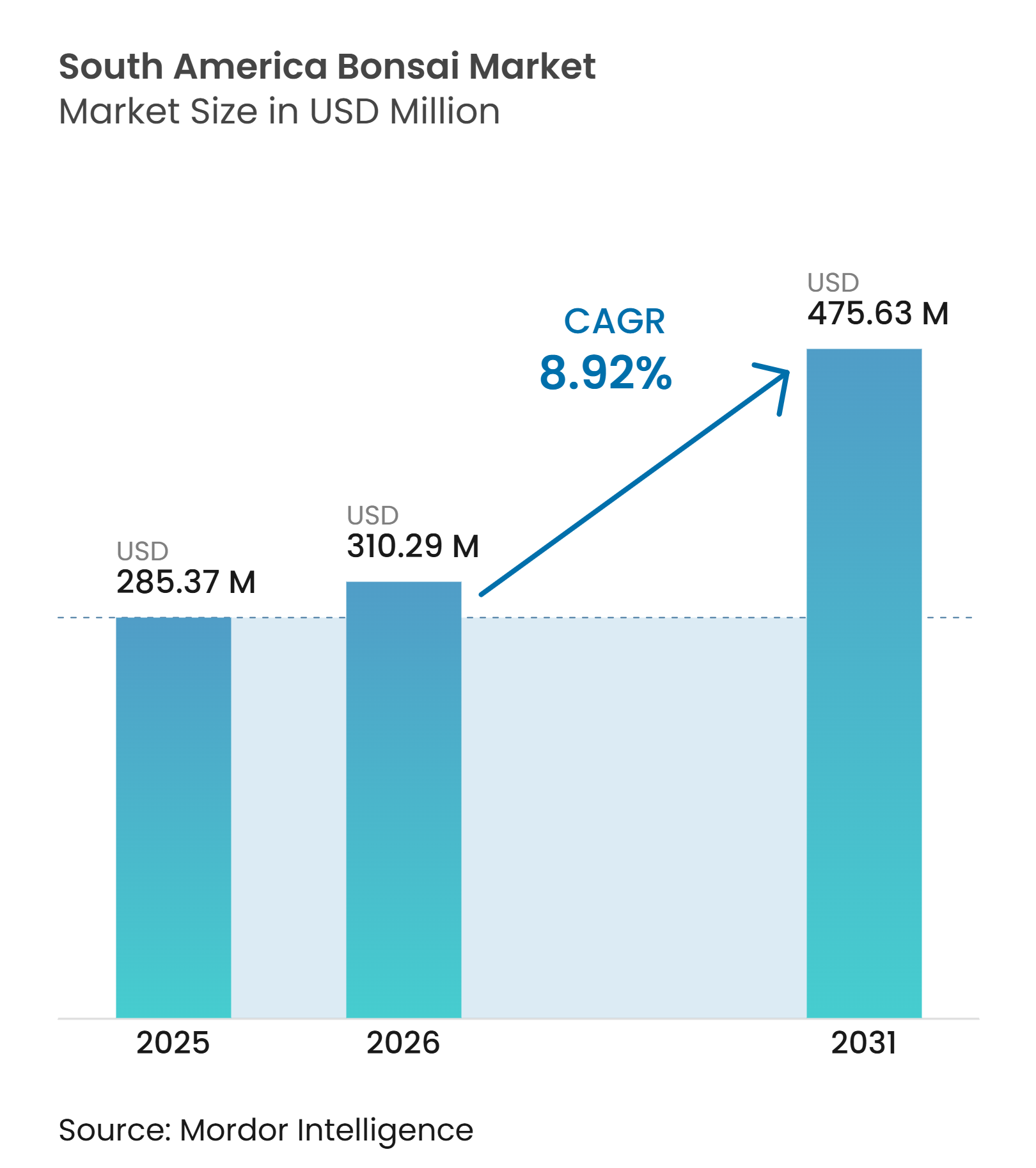
| Base Year Market Size (2025) | USD 285.37 Million |
| Market Size (2026) | USD 310.29 Million |
| Market Size (2031) | USD 475.63 Million |
| Growth Rate (2026 - 2031) | 8.92 % |
| Market Concentration | Low |
Major Players *Disclaimer: Major Players sorted in no particular order Image © Mordor Intelligence. Reuse requires attribution under CC BY 4.0. | |
South America Bonsai Market Analysis by Mordor Intelligence
The South America bonsai market was valued at USD 285.37 million in 2025 and is projected to grow from USD 310.29 million in 2026 to USD 475.63 million by 2031, at a CAGR of 8.92% during the forecast period (2026–2031). Urban households using compact plants as part of interior décor, particularly where conventional gardening space is limited, support market growth. Brazil accounts for the largest share of buyers, growers, specialist retail outlets, and established horticultural knowledge in the region. Colombia offers a growing production and logistics base, supported by its established floriculture capabilities, which can support domestic ornamental tree activity. Online retail is widening access to entry-level specimens and pre-bonsai material, while physical nurseries remain important for mature trees that buyers prefer to inspect before purchase. Climate risk, long cultivation cycles, and cross-border plant health requirements favor nurseries with disciplined inventory management, careful plant handling, and professional customer support.
Key Report Takeaways
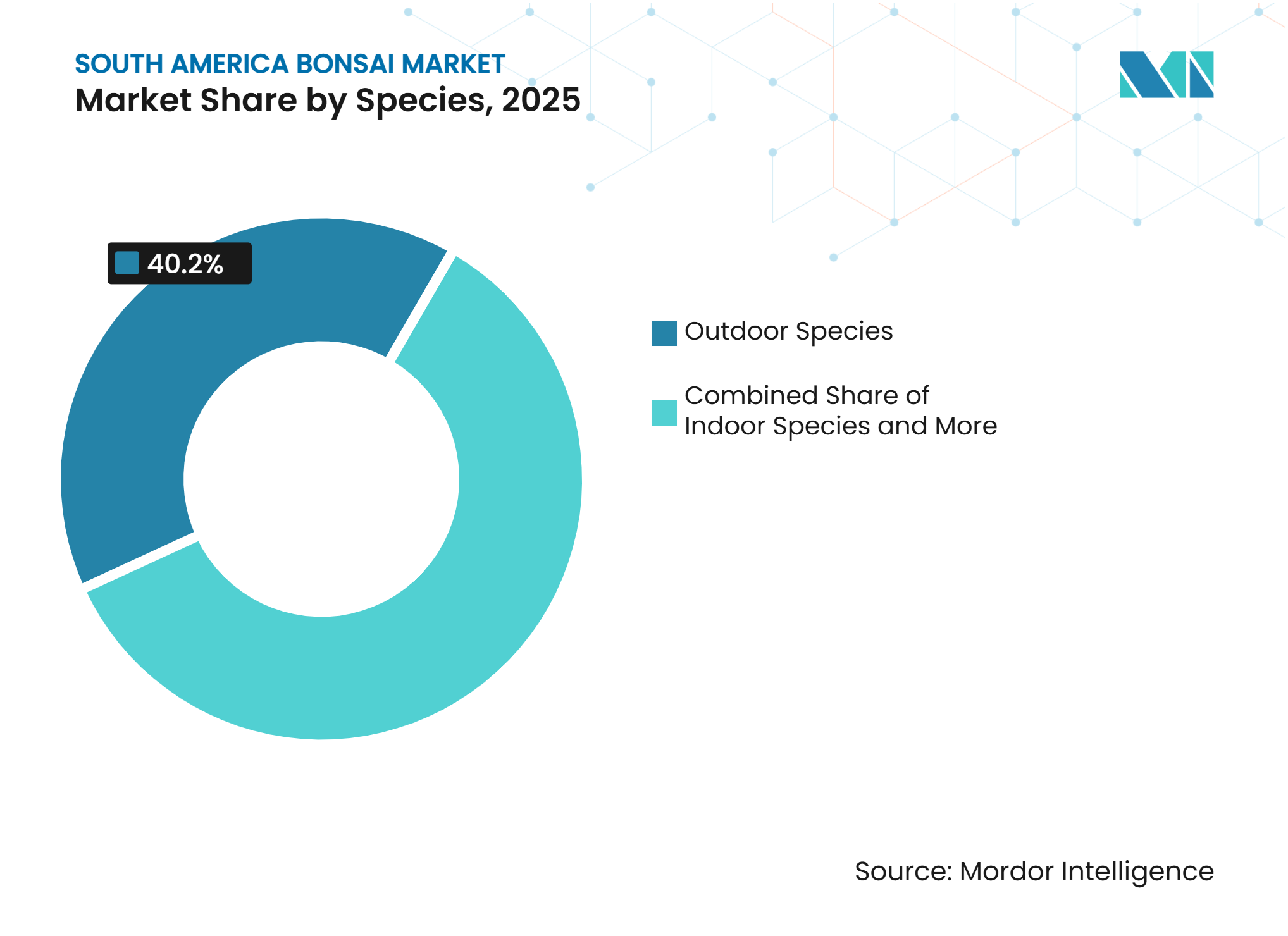
- By species, outdoor species accounted for the largest 40.2% of the South America bonsai market share in 2025, while indoor species is projected to grow at the fastest CAGR of 10.3% from 2026 to 2031.
- By distribution channel, offline accounted for the largest share at 65.1% in 2025, while the South America bonsai market size for the online segment is projected to grow at the fastest CAGR of 13.6% from 2026 to 2031.
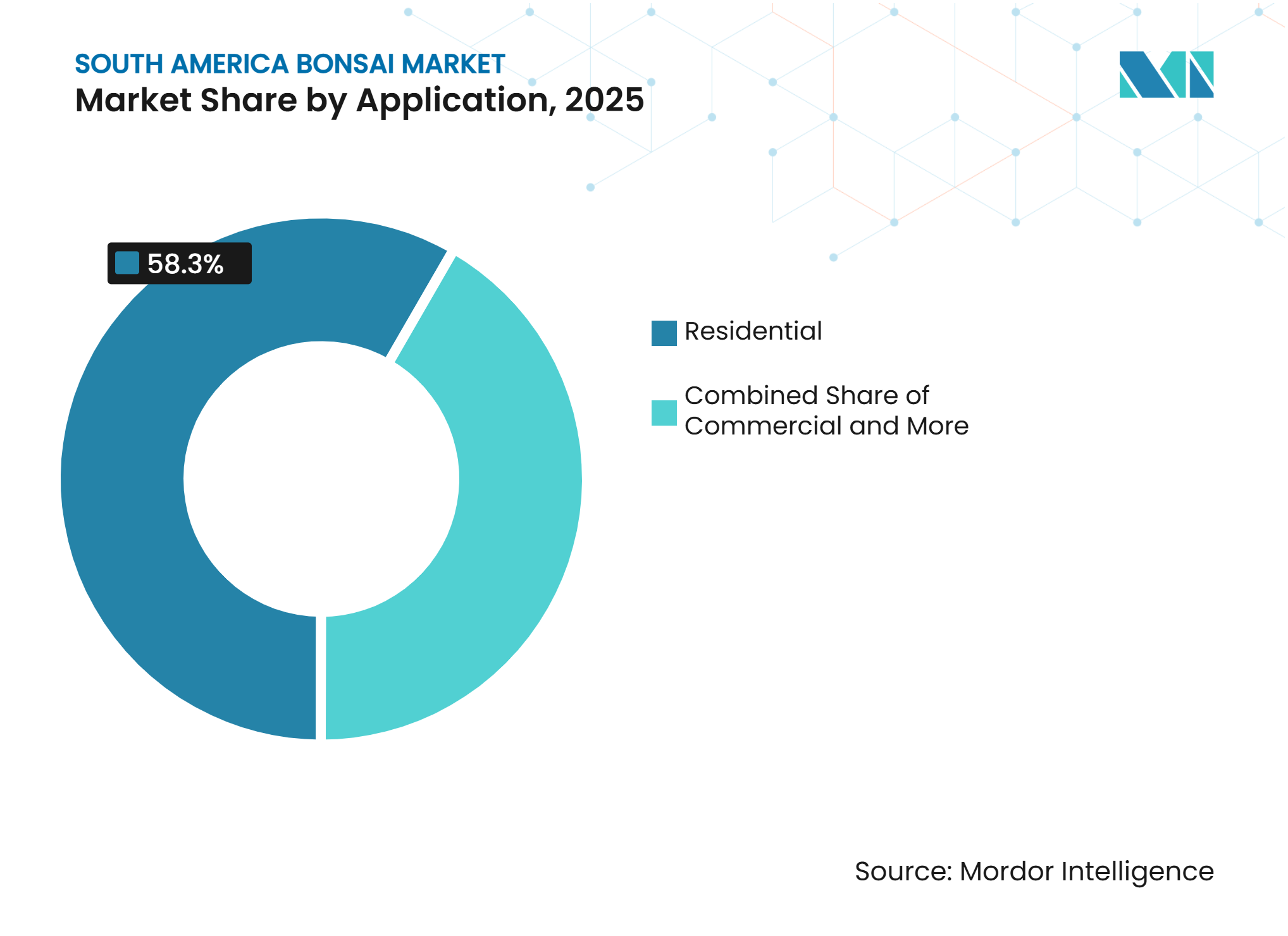
- By application, residential accounted for the largest share at 58.3% in 2025, while commercial is projected to grow at the fastest CAGR of 9.6% from 2026 to 2031.
- By geography, Brazil accounted for the largest share at 63.4% in 2025, while Colombia is projected to grow at the fastest CAGR of 11.0% from 2026 to 2031.
Note: Market size and forecast figures in this report are generated using Mordor Intelligence’s proprietary estimation framework, updated with the latest available data and insights as of January 2026.
Market Trends and Insights
Drivers Impact Analysis of South America Bonsai Market*
| Driver | (~) % Impact on CAGR Forecast | Geographic Relevance | Impact Timeline |
|---|---|---|---|
| Growth of Urban Indoor Gardening and Compact Decor | 2.3% | Brazil, Argentina, and Chile, especially dense metropolitan areas | Short term (≤ 2 years) |
| Expansion of Specialty E-Commerce and Social Commerce | 2.1% | Brazil, Colombia, and Argentina | Short term (≤ 2 years) |
| Rising Demand for Locally Adapted Native Species | 1.6% | Brazil, Colombia, and Peru | Medium term (2-4 years) |
| Growth of Bonsai Courses, Clubs and Experiential Services | 1.3% | Brazil, Argentina, and Colombia | Medium term (2-4 years) |
| Premiumization of Mature and Exhibition-Grade Trees | 1.8% | Brazil and Argentina | Long term (≥ 4 years) |
| Commercial Use in Hospitality, Offices and Premium Events | 1.4% | Brazil, Colombia, Chile, and Peru | Medium term (2-4 years) |
| Source: Mordor Intelligence | |||
Growth of Urban Indoor Gardening and Compact Decor
South America's high urban population supports demand for compact ornamental plants suited to apartments and smaller living spaces. According to the United Nations Department of Economic and Social Affairs (UN DESA), 85.5% of South America's population lived in urban areas in 2025[1]. This urban lifestyle supports interest in bonsai, which can be displayed on windowsills, furniture, and balconies without requiring extensive garden space. As consumers seek decorative greenery that fits limited indoor spaces, bonsai serves as a practical option for residential settings, supporting market demand for compact indoor tree varieties.
Expansion of Specialty E-Commerce and Social Commerce
Specialty e-commerce and social commerce are expanding opportunities for bonsai sellers to reach customers beyond local storefronts. The International Trade Administration (ITA), in its 2025 Brazil eCommerce guide, reported that 94 million Brazilians were estimated to make online purchases in 2025[2]. Digital platforms enable nurseries to showcase bonsai shapes, sizes, conditions, and care requirements, helping buyers compare trees and make informed purchasing decisions remotely. This broader digital reach can support online bonsai sales while complementing physical retailers, where customers can inspect specimens and receive specialist advice before purchasing.
Rising Demand for Locally Adapted Native Species
Growing interest in locally adapted native species is creating opportunities for South America's bonsai market by encouraging the cultivation of regionally distinctive trees. In 2025, the Municipality of Villa María, Argentina, reported that its 31st Expo Bonsai featured more than 90 bonsai specimens, with a focus on native trees trained as bonsai. The exhibition linked bonsai appreciation to native flora conservation and education, demonstrating the relevance of native species to bonsai culture. Such initiatives can encourage collector interest and broaden species selection, supporting demand for native-species bonsai across the region.
Growth of Bonsai Courses, Clubs and Experiential Services
Growth in bonsai courses, clubs, and experiential services can attract beginners by making cultivation techniques more accessible and encouraging continued participation. The XV International South American and Caribbean Bonsai Federation (FELAB) Congress 2026, scheduled in Brazil, is estimated to bring together more than 500 bonsai artists and professionals, according to FELAB Brasil. Its demonstrations, lectures, exhibitions, and workshops provide opportunities for knowledge exchange and practical skill development. These educational experiences can build buyer confidence, encourage bonsai ownership, and support demand for trees, tools, supplies, and related services across South America.
Restraints Impact Analysis of South America Bonsai Market*
| Restraint | (~) % Impact on CAGR Forecast | Geographic Relevance | Impact Timeline |
|---|---|---|---|
| Long Cultivation Cycles and Slow Inventory Turnover | -1.9% | All South American geographies | Long term (≥ 4 years) |
| Phytosanitary Barriers to Cross-Border Plant Movement | -1.3% | Brazil and Argentina corridor, and Colombia | Medium term (2-4 years) |
| Limited Skilled-Care Infrastructure Outside Major Cities | -0.9% | Interior Brazil, Andean countries, and Ecuador | Medium term (2-4 years) |
| Climate Volatility and Species-Specific Mortality Risk | -0.7% | Brazil, Colombia, Peru, and Ecuador | Short term (≤ 2 years) |
| Source: Mordor Intelligence | |||
Long Cultivation Cycles and Slow Inventory Turnover
Long cultivation cycles and slow inventory turnover restrain the South America bonsai market by delaying the availability of commercially presentable trees. Brazilian producer Bonsai do Campo reports that its growth-stage plants require 12 to 36 months before they can enter bonsai production or be sold as pre-bonsai[3]. This production period ties up nursery space, labor, and resources before any sales can occur. Additional shaping and maintenance extend the cultivation process further, requiring careful inventory planning and sustained investment. These requirements limit growers' ability to expand sale-ready supply quickly and respond to changing demand.
Phytosanitary Barriers to Cross-Border Plant Movement
Phytosanitary barriers constrain the South American bonsai market by imposing regulatory and administrative requirements on cross-border plant shipments. The National Service for Agrifood Health and Quality (SENASA), in its 2025 guidance, states that imported plant products must meet Argentina's phytosanitary requirements, which are verified upon entry. Depending on the product and its origin, importers may also need authorization or post-entry quarantine. These procedures increase compliance workloads and complicate shipment planning, particularly for live bonsai that require careful handling, thereby limiting the efficiency and scalability of regional distribution.
*Our forecasts treat driver/restraint impacts as directional, not additive. The impact forecasts reflect baseline growth, mix effects, and variable interactions.
South America Bonsai Market Segment Analysis
By Species:
Outdoor Species Supports the Base as Indoor Species GrowOutdoor species accounted for the largest share of the South America bonsai market at 40.2% in 2025. This segment is associated with collectors who value established outdoor-growing practices, seasonal development, and the gradual refinement of tree structure. Japanese pine, juniper, and azalea are examples of traditional bonsai material, though suitability depends on local climate and growing conditions. Specialist nurseries and bonsai communities support interest in these trees through cultivation advice, styling demonstrations, and exhibitions. Demand is therefore linked to both plant characteristics and the knowledge required to maintain outdoor specimens.
The indoor species is projected to grow at the fastest CAGR of 10.3% from 2026 to 2031. Indoor bonsai appeals to urban residents seeking compact botanical décor and an accessible introduction to the practice. Ficus and other tropical species are commonly considered for indoor use when temperatures, light, and humidity meet their requirements. Retailers can support this segment by offering clear care instructions and helping buyers select plants suited to their environment. Online catalogs and social media provide additional channels for discovering suitable specimens before purchase. Successful indoor cultivation depends on adequate light, watering, airflow, and species-specific care.



By Distribution Channel:
Offline Segment Leads as Online Segment Broadens AccessOffline accounted for the largest share at 65.1% in 2025. Physical nurseries, garden centers, and specialist sellers allow buyers to inspect trunk movement, root development, branch placement, foliage condition, and the relationship between a tree and its pot. These visible characteristics are particularly important when purchasing established specimens or selecting material for further styling. In-person advice also helps less experienced customers understand species suitability and maintenance requirements. Local exhibitions and bonsai communities provide additional opportunities to learn about cultivation and engage with sellers. This combination of inspection, guidance, and direct engagement supports the continued role of offline retail.
The online segment is projected to grow at the fastest CAGR of 13.6% from 2026 to 2031. Digital marketplaces, nursery websites, and social platforms extend product discovery beyond established bonsai retail locations. Buyers can compare photographs, descriptions, species information, and seller-provided care guidance before making a purchase decision. Online channels are particularly useful for starter trees, pre-bonsai material, tools, and accessories that customers can evaluate through listings. Sellers can strengthen buyer confidence by providing up-to-date photographs, accurate descriptions, packaging information, and responsive after-sales support. Live video and remote consultations may further help customers assess plants, while delivery quality remains important for live specimens.
By Application:
Residential Use Provides Volume While Commercial Demand Builds ValueResidential accounted for the largest share at 58.3% in 2025. Home hobbyists, decorators, and gift buyers drive demand for bonsai as living ornaments and personal interests. Compact trees can suit homes with limited garden space, provided buyers can meet the selected species' light and environmental requirements. Residential ownership also supports purchases of pots, soil, pruning tools, and care services over time. Beginner-friendly plants and practical guidance can help new owners maintain their trees and develop their interest. The segment therefore includes both decorative purchases and longer-term engagement with bonsai cultivation.
The commercial segment is projected to grow at the fastest CAGR of 9.6% from 2026 to 2031. Hotels, offices, restaurants, and event venues may use bonsai as distinctive botanical features in reception areas, lounges, and designed interiors. Their suitability depends on lighting, temperature, maintenance access, and the ability to protect living specimens from unsuitable conditions. Commercial customers may seek established trees, coordinated pots, placement advice, and ongoing maintenance rather than a plant alone. Nurseries and designers can serve this demand through selection, installation, care instructions, and replacement services. These service elements create opportunities for commercial sales beyond one-time plant transactions.

Geography Analysis
Brazil accounted for the largest share at 63.4% in 2025. Its market position is supported by established ornamental plant production, specialist nurseries, and bonsai communities that facilitate the exchange of cultivation knowledge and customer access. São Paulo state, including areas such as Atibaia, Mogi das Cruzes, and Holambra, is central to the country's horticultural and bonsai activity. Domestic producers serve buyers through nursery visits, specialist retail, and online channels. Brazil's varied climates require species selection and cultivation practices to be matched to local conditions. These factors contribute to the breadth of its bonsai ecosystem.
Colombia is projected to grow at the fastest CAGR of 11.0% from 2026 to 2031. Bogotá and Medellín serve as urban customer centers where bonsai can be sold as decorative plants, gifts, and hobby specimens. Local sellers may differentiate through cultivation advice, styling services, and maintenance support, particularly for customers new to the practice. Colombia's established ornamental horticulture capabilities provide relevant experience in plant handling and commercial distribution, although cut-flower production alone does not indicate demand for bonsai. Market development will also depend on species adapted to local growing conditions, consumer awareness, specialist availability, and the ability to maintain plants through retail and delivery.
Chile's bonsai market includes specialist organizations, retailers, and public-facing events that connect enthusiasts with growers and products. The Asociación Chilena de Bonsái (AChiBo) promotes bonsai activities and provides a platform for nurseries, stores, artisans, and suppliers. The 2026 exhibition includes a bonsai market, with participation open to bonsai producers and sellers of tools, pots, substrates, and related goods. This planned event illustrates how specialist gatherings can support product discovery and connections between businesses and customers, although it does not quantify national demand or sales (AChiBo, 2026).
Competitive Landscape
Market Concentration
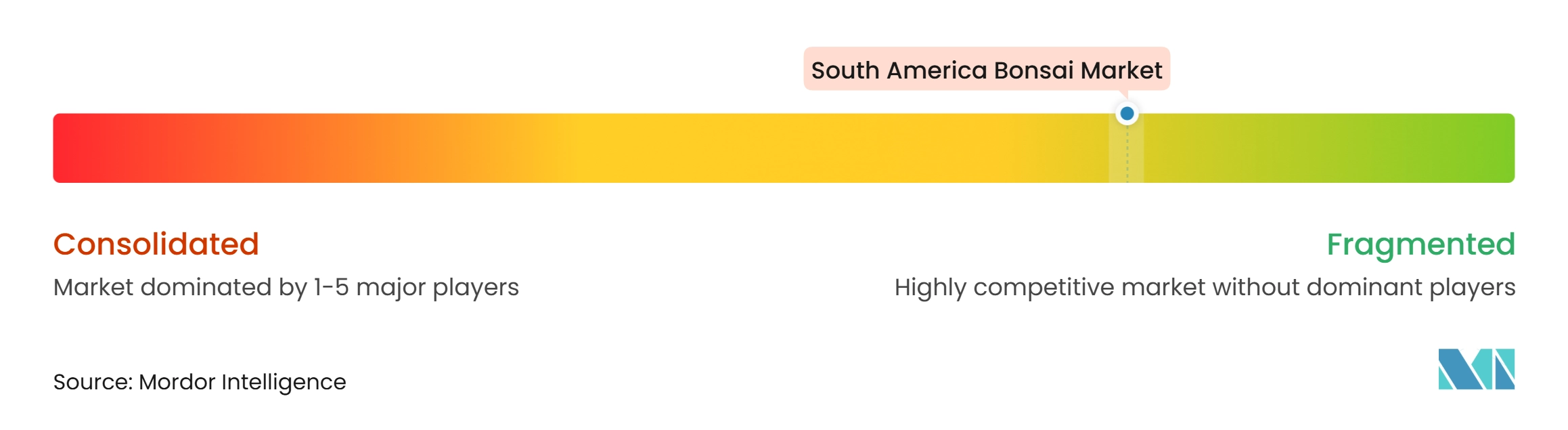
The South America bonsai market is fragmented in 2025, with specialist nurseries, independent growers, online retailers, and bonsai educators serving customers across individual countries and cities. Major players identified in this landscape include Bonsai do Campo Producao e Comercio de Plantas Ornamentais LTDA, O Bonsai, Bonsai Kai Plantas e Complementos Ltda., A Casa Bonsai, and Bonsai Argento. These businesses represent a mix of nursery production, specialist retail, and bonsai-focused services. Their competitive positioning varies according to species selection, tree maturity, styling, customer guidance, and access to local buyers.
Competition centers on tree species, maturity, styling, presentation, provenance, and the services accompanying a sale. Starter material may appeal to beginners, while experienced collectors may seek established trees with particular trunk forms, root structures, or styling potential. Nurseries can supplement plant sales with courses, workshops, health assessments, and ongoing care advice. Digital sellers may use detailed photographs, video, and online consultations to help customers evaluate specimens remotely. These approaches address different buyer needs rather than defining a single competitive model. Reliable plant descriptions, appropriate packaging, and responsive support can also influence customer confidence and repeat business.
Industry events provide a sales and networking channel for specialist bonsai businesses seeking to connect with collectors and hobbyists. For FELAB Brasil 2026, the organizer made 40 booth modules available in its initial commercial release for retailers selling bonsai, tools, pots, substrates, and related products (FELAB Brasil, 2026). The dedicated retail area gives participating businesses an opportunity to showcase their offerings alongside exhibitions and demonstrations, while enabling visitors to discover specialist suppliers. This event format adds a direct retail component to the bonsai community and supports interaction between sellers, practitioners, and potential customers.
South America Bonsai Industry Leaders
-
Bonsai do Campo Producao e Comercio de Plantas Ornamentais LTDA
-
O Bonsai
-
Bonsai Kai Plantas e Complementos Ltda.
-
A Casa Bonsai
-
Bonsai Argento
- *Disclaimer: Major Players sorted in no particular order
South America Bonsai Market Companies Covered in this Report
- Bonsai do Campo Producao e Comercio de Plantas Ornamentais LTDA
- O Bonsai
- Bonsai Kai Plantas e Complementos Ltda.
- Nipon Bonsai
- A Casa Bonsai
- BonsaiFox
- Bonsai Ise
- Bonsai Argento
- Kuyen Bonsai
- Chilebonsai
- Hanasu Bonsai
- Bonsai-Ya
Recent Industry Developments in South America Bonsai Market
- September 2026: Kuyen Bonsai showcased its diverse species portfolio in a La Nación profile, featuring native Patagonian trees such as ñire, coihue, and arrayán, as well as more than 20 Japanese maple varieties. This range reflects the nursery's focus on cultivating both regionally native species and Japanese maple varieties for bonsai enthusiasts.
- August 2026: Bonsai do Campo Producao e Comercio de Plantas Ornamentais LTDA partnered with the XV International FELAB Congress in Curitiba, Brazil. The event featured bonsai exhibitions, demonstrations, and commercial activities. The announcement confirms event support, but does not establish a new commercial partnership or facility expansion.
- July 2026: Brazil's Chamber of Deputies received Bill PL 3478/2026, which proposes recognizing Arabutã, Santa Catarina, as the National Capital of Bonsai. The proposal seeks formal legislative recognition for a municipality associated with bonsai cultivation, which could raise the profile of local bonsai activities. The proposal remains a bill and has not been enacted into law or established as a funding program.
South America Bonsai Market Report Scope
Bonsai is the Japanese art of cultivating miniature trees in containers through pruning, wiring, and root management to replicate the form and proportions of mature trees. It is primarily used for ornamental, cultural, residential, commercial, and institutional applications.
The South America bonsai market report is segmented by species (indoor species, outdoor species, needle tree species, and deciduous tree species), by distribution channel (online and offline), by application (residential, commercial, and others (institutional gifts and art fairs)), and by geography (Brazil, Argentina, Colombia, Chile, Peru, Ecuador, and rest of South America). The market forecasts are provided in terms of value (USD).
Segmentation Overview
| Indoor Species |
| Outdoor Species |
| Needle Tree Species |
| Deciduous Tree Species |
| Online |
| Offline |
| Residential |
| Commercial |
| Others (Institutional Gifts, Art Fairs) |
| Brazil |
| Argentina |
| Colombia |
| Chile |
| Peru |
| Ecuador |
| Rest of South America |
| By Species | Indoor Species |
| Outdoor Species | |
| Needle Tree Species | |
| Deciduous Tree Species | |
| By Distribution Channel | Online |
| Offline | |
| By Application | Residential |
| Commercial | |
| Others (Institutional Gifts, Art Fairs) | |
| By Geography | Brazil |
| Argentina | |
| Colombia | |
| Chile | |
| Peru | |
| Ecuador | |
| Rest of South America |
Key Questions Answered in the Report
What is the projected value of the South America bonsai market by 2031?
The South America bonsai market is forecast to reach USD 475.63 million by 2031.
Which bonsai species category is growing fastest in South America?
Indoor Species is projected to grow at the fastest CAGR of 10.3% from 2026 to 2031.
Why do physical nurseries remain important for bonsai purchases?
Offline segment accounted for the largest at 65.1% in 2025 for South America Bonsai market.
Which country leads bonsai sales in South America?
Brazil accounted for the largest share at 63.4% share in 2025.