
South America 3D Construction Market Size and Share
Market Overview
| Study Period | 2020 - 2031 |
|---|---|
| Forecast Data Period | 2026 - 2031 |
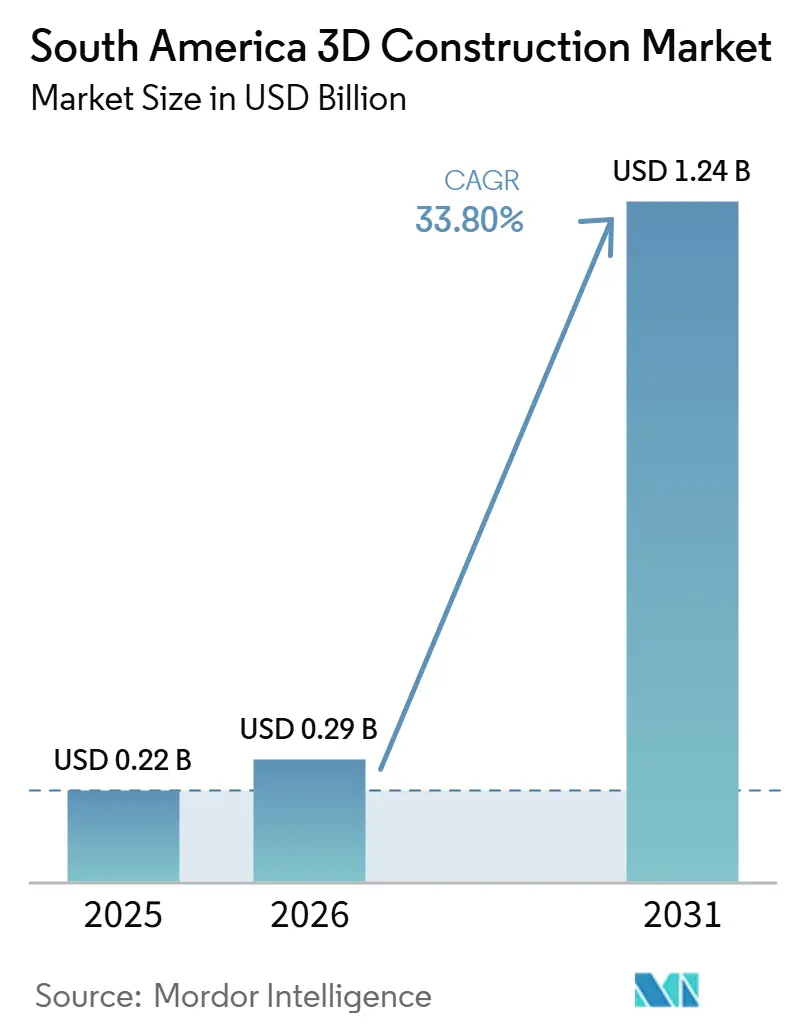
| Base Year Market Size (2025) | USD 0.22 Billion |
| Market Size (2026) | USD 0.29 Billion |
| Market Size (2031) | USD 1.24 Billion |
| Growth Rate (2026 - 2031) | 33.80 % |
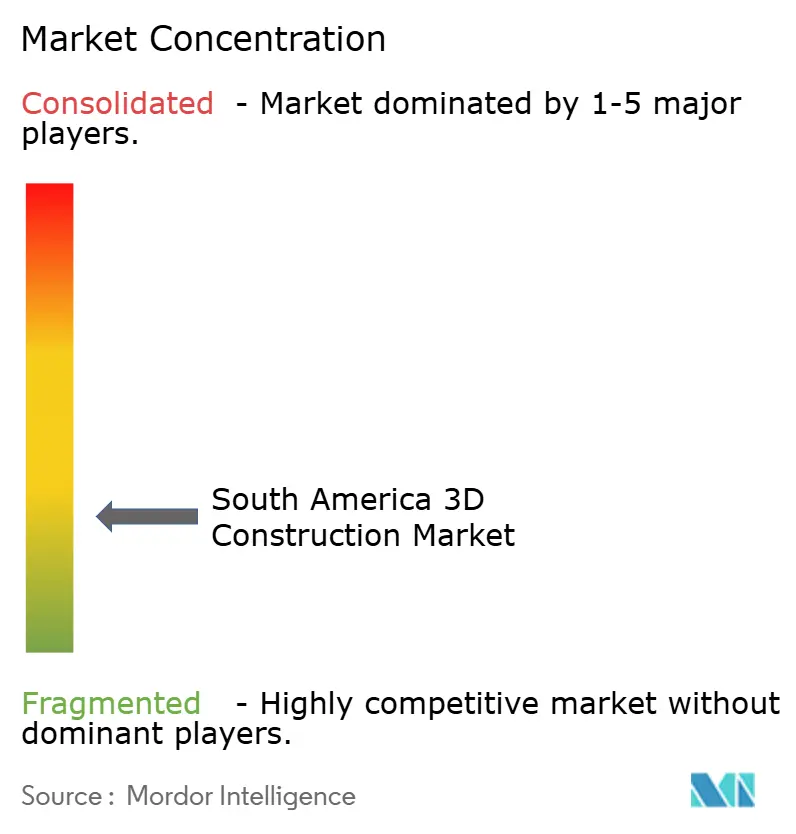
| Market Concentration | Medium |
Major Players *Disclaimer: Major Players sorted in no particular order Image © Mordor Intelligence. Reuse requires attribution under CC BY 4.0. | |
South America 3D Construction Market Analysis by Mordor Intelligence
South America 3D Construction Market size is projected to be USD 0.22 billion in 2025, USD 0.29 billion in 2026, and reach USD 1.24 billion by 2031, growing at a CAGR of 33.80% from 2026 to 2031. The South America 3D construction market is supported by housing shortages, dense urban development, and public programs that aim to accelerate the delivery of low-income homes. Additive construction can shorten wall construction, reduce material use, and reduce dependence on skilled masonry labor. Its value is also becoming clearer in areas exposed to flooding and seismic events, where rapid, repeatable construction methods are important. Suppliers are responding through local material formulations, equipment partnerships, and projects that demonstrate compliance with construction requirements. The main constraints are imported equipment costs, uneven code approval, and limited insurance acceptance, although public procurement and field projects are beginning to address these barriers.
Key Report Takeaways
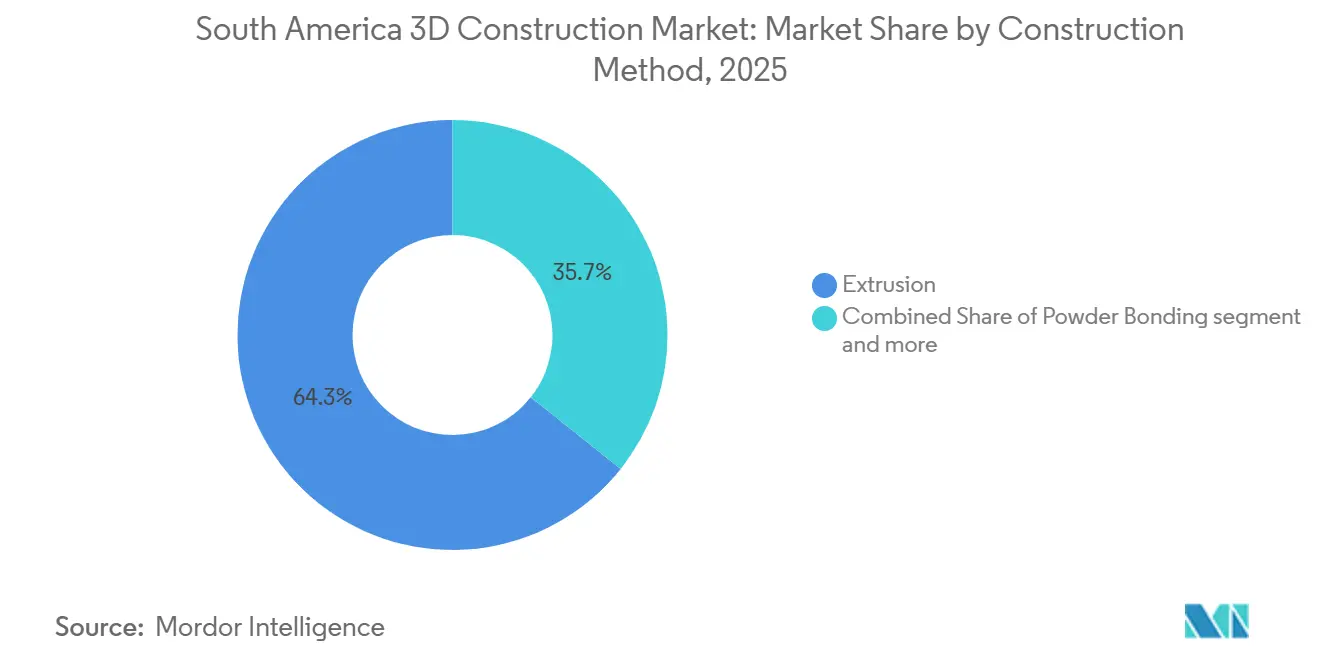
- By construction method, extrusion accounted for 64.3% of the South America 3D construction market size in 2025, while powder bonding is forecast to grow at a 44.1% CAGR through 2031.
- By material type, concrete accounted for 56.9% of the South America 3D construction market share in 2025, while composite materials are forecast to expand at a 48.6% CAGR through 2031.
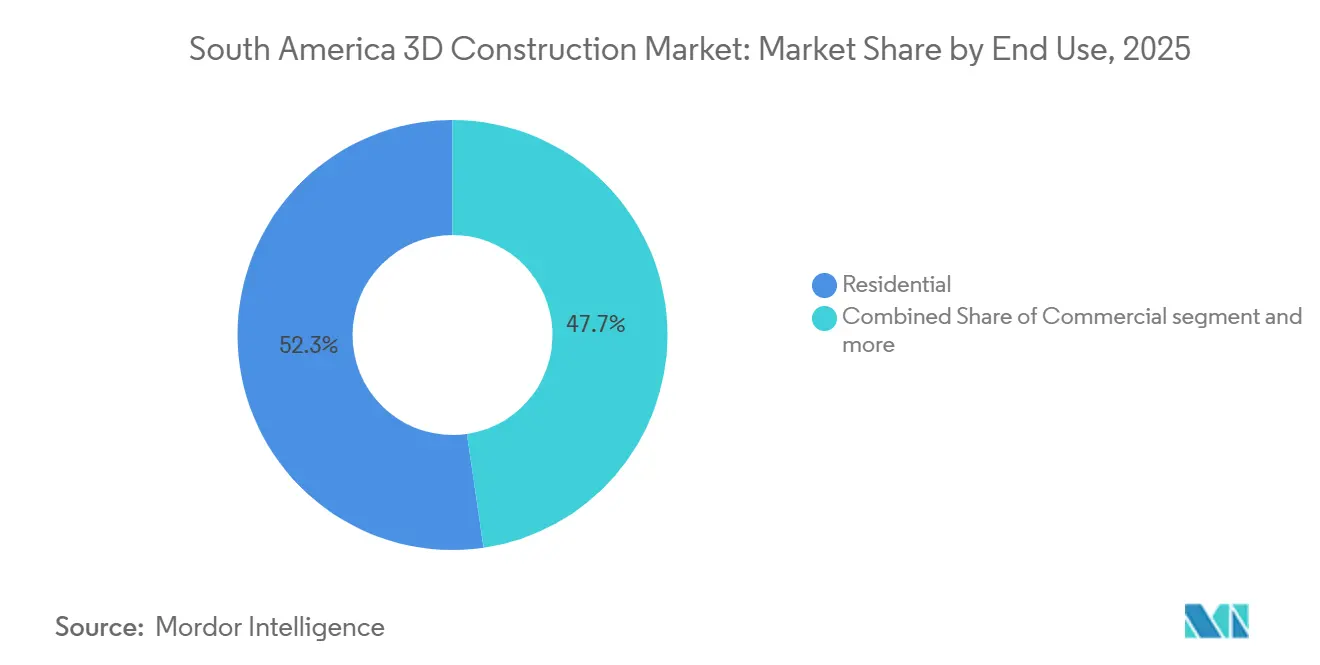
- By end use, residential applications held 52.3% of demand in 2025, while infrastructure is forecast to record a 39.8% CAGR through 2031.
- By construction setting, on-site printing held 69.4% of demand in 2025, while off-site and prefabrication printing is forecast to grow at a 38.7% CAGR through 2031.
- By geography, Brazil accounted for 47.2% of revenue in 2025, while Chile is forecast to grow at a 36.9% CAGR through 2031.
Note: Market size and forecast figures in this report are generated using Mordor Intelligence’s proprietary estimation framework, updated with the latest available data and insights as of January 2026.
South America 3D Construction Market Trends and Insights
Drivers Impact Analysis*
| Drivers | (~) % Impact on CAGR Forecast | Geographic Relevance | Impact Timeline |
|---|---|---|---|
| Government Housing Programs for Affordable Printed Construction | +7.5% | Brazil, Colombia, Chile, Argentina, and Peru | Short term (≤ 2 years) |
| Shorter Build Cycles and Lower Labor Intensity in Urban Corridors | +6.5% | Brazil, Chile, and Colombia | Short term (≤ 2 years) |
| Reliable Mix Designs for Seismic and Flood-Prone Areas | +5.5% | Chile, Colombia, Peru, Ecuador, and coastal Brazil | Medium term (2-4 years) |
| Post-Disaster Reconstruction Demand | +4% | Brazil, Chile, Colombia, and Ecuador | Short term (≤ 2 years) |
| Lower-Carbon Binders and Reduced Waste | +4% | Chile, Brazil, and Colombia | Medium term (2-4 years) |
| Digital Quality Control and Lower Rework | +3.5% | Brazil, Chile, Colombia, and Argentina | Medium term (2-4 years) |
| Source: Mordor Intelligence | |||
Government Housing Programs for Affordable Printed Construction
Government housing programs provide a practical route into the South America 3D construction market because they can group enough units to support printer transport, setup, and material planning. Brazil authorized 4,063 new Minha Casa, Minha Vida units across 12 states in January 2025, supported by BRL 646.1 million (USD 118 million) at the stated 2025 average exchange rate. São Paulo state’s CDHU tender covered 15,000 off-site modular units and identified 3D printing as an eligible construction method.
These programs often serve peri-urban and rural areas where labor availability and material transport add cost to conventional masonry work. In Colombia, Cementos Argos and COBOD completed social housing projects under Casa Para Mí, reporting printing rates of 6 m² per hour, 30% faster construction, and 20% lower material costs than traditional methods. As more agencies accept printed construction in tenders, contractors can plan equipment use across a clearer project pipeline.
Shorter Build Cycles and Lower Labor Intensity in Urban Corridors
The South America 3D construction market benefits when contractors can reduce the time needed to create walls for standard housing designs. A masonry team can require 30 to 45 days to complete the wall structure for a 60 m² home, while concrete printing systems can complete comparable wall work in less than 48 hours. Sika Brasil completed a printed concrete house in Rio Grande do Sul in 60 hours using SikaCrete-732 3D and reported a cost 30% lower than comparable masonry construction. Faster shell construction can reduce the period during which capital remains tied up in an unfinished project. It can also reduce the effect of skilled-trade shortages in high-density corridors, where project schedules often depend on specialist availability. The South America 3D construction market benefits from this approach in social housing and repetitive infrastructure work, where firms can reuse designs and coordinate pumps, crews, and materials across multiple sites.
Reliable Mix Designs for Seismic and Flood-Prone Areas
The South America 3D construction market requires material systems that address the seismic conditions of Chile, Peru, Ecuador, and Colombia, as well as flooding risk in coastal Brazil. Cementos Argos developed a mortar formulation for Colombian conditions with compressive strength above 35 MPa and flexural strength of 8 MPa, incorporating calcined clay as a supplementary cementitious material. Chile’s university and industry projects have also focused on concrete systems that meet local seismic requirements.
The Favela 3D project delivered 12 homes to flood-affected families in Eldorado do Sul in December 2024, providing a local example of post-disaster deployment. Such projects give municipalities, insurers, and lenders evidence from real conditions rather than from laboratory testing alone. The South America 3D construction market can therefore benefit when locally adapted materials support regulatory review and repeat orders from public buyers.
Post-Disaster Reconstruction Demand
Post-disaster reconstruction is driving demand for 3D-printed construction in South America because affected communities need housing delivered within short timeframes. The 2024 floods in Rio Grande do Sul displaced many households and increased attention on methods that can accelerate rebuilding. The Favela 3D project delivered 12 printed concrete homes to flood-affected families in Eldorado do Sul in December 2024. Emergency procurement can shorten approval processes that usually delay the use of newer construction methods. Similar needs may arise in Andean and coastal areas that are earthquake-prone, flood-prone, and subject to severe weather. These projects also give municipal authorities, insurers, and lenders direct evidence of how printed housing performs under urgent field conditions.
Restraints Impact Analysis*
| Restraints | (~) % Impact on CAGR Forecast | Geographic Relevance | Impact Timeline |
|---|---|---|---|
| High Printer Capital Cost, Currency Exposure, and Import Costs | -5.5% | Brazil, Argentina, Colombia, and Chile | Short term (≤ 2 years) |
| Fragmented Building Codes and Uneven Approval Cycles | -4.5% | South America, especially Brazil, Peru, and Bolivia | Medium term (2-4 years) |
| Insurance and Warranty Acceptance Gaps | -2.5% | South America, especially Brazil and Argentina | Medium term (2-4 years) |
| Feedstock Quality and Additive Supply Constraints | -2% | Inland Brazil, Bolivia, Paraguay, and Peru | Medium term (2-4 years) |
| Source: Mordor Intelligence | |||
High Printer Capital Cost, Currency Exposure, and Import Costs
Large-format equipment remains difficult for mid-sized contractors to purchase because printers are generally priced in USD while construction revenue is earned in local currencies. The COBOD BOD2 used in regional projects must be transported in modular units and assembled on site, which adds cost in remote or mountainous locations. The La Unión project in Antioquia required five truckloads for equipment transport. Techint E&C installed a COBOD BOD2 unit in Argentina with a 12 m by 12 m working area and a 6 m print height, demonstrating the scale of equipment required for industrial applications. Capital recovery depends on a stable flow of repetitive projects, rather than a single housing demonstration. Leasing and distributor arrangements can shift part of the upfront cost to specialized intermediaries, although import classifications, tariffs, taxes, and foreign exchange movements still make budgets less predictable.
Fragmented Building Codes and Uneven Approval Cycles
Fragmented building codes create uncertainty for developers and contractors considering 3D printed concrete projects across South America. The region’s countries use separate standards bodies and approval systems, with limited alignment on construction-specific requirements for printed structures. In Brazil, the absence of a dedicated national standard can require project-by-project reviews by local engineering authorities. A 2025 study of Latin American AEC practitioners identified the lack of standards and regulations as a leading barrier to the adoption of 3D-printed construction. The issue is particularly important in seismic markets such as Chile and Peru, where structural performance requirements are strict. Longer, less predictable approval cycles can raise certification costs, delay project starts, and erode the cost advantage of additive construction.
*Our forecasts treat driver/restraint impacts as directional, not additive. The impact forecasts reflect baseline growth, mix effects, and variable interactions.
Segment Analysis
By Construction Method: Extrusion Holds the Leading Position While Powder Bonding Expands
Extrusion held 64.3% of the South America 3D construction market share in 2025 because it fits established ready-mix supply and pumping equipment. Current housing projects use continuous-layer wall printing with gantry-based systems and locally calibrated printable mortars. Public programs also favor repeatable wall layouts, which reduce the transition burden for procurement teams familiar with concrete. Digital monitoring of adhesion and flow can improve confidence in layer quality during printing. These factors make extrusion practical where project scale and straightforward logistics matter most.
Powder bonding is forecast to grow at a 44.1% CAGR through 2031 from a smaller base. It can serve complex components, urban furniture, and specialized infrastructure shapes where custom formwork is expensive. It is less suited to large social housing programs that prioritize the rapid production of standard walls. Other methods include contour-crafting variants and hybrid systems, while research in Peru continues to examine the seismic resistance of printed social housing[1]Pontificia Universidad Católica del Perú, “Diseño y análisis sismorresistente de una vivienda social de dos niveles impresa en 3D de concreto,” PUCP Academic Repository, pucp.edu.pe. The South America 3D construction industry is likely to retain extrusion for core projects while powder bonding serves specialized applications.


By Material Type: Concrete Provides the Base While Composites Gain Ground
Concrete accounted for 56.9% of the South America 3D construction market share in 2025 because regional producers, contractors, and public buyers already use it widely. Cement, aggregates, pumps, and ready-mix facilities support printed wall systems and familiar procurement practices. Suppliers can tailor mortars for humidity, aggregate quality, and structural needs. Cementos Argos has used a calcined-clay formulation for conditions in Antioquia, Colombia. Concrete will remain central because it connects additive methods with established construction practice.
Composite materials are forecast to record the highest material CAGR at 48.6% through 2031. They include fiber-reinforced geopolymers, calcined-clay binders, and systems intended to improve performance or reduce cement content. A 2025 study found that geopolymer systems using recycled construction and demolition waste can support the construction of low-rise printed buildings. Research in Peru also tested PET waste and coconut fibers in printable concrete. Metal remains limited to specialist components, while composite adoption will depend on printability, curing, structural evidence, and cost.
By End Use: Residential Demand Leads While Infrastructure Applications Accelerate
Residential applications accounted for 52.3% of demand in 2025 and form the main base of the South America 3D construction market. Affordable housing programs in Brazil and Colombia favor construction speed, material efficiency, and repeatable layouts. Cementos Argos and COBOD reported 30% faster construction, 20% lower material costs, and 15% to 30% less waste in La Unión, Antioquia. The companies identified a 20-unit phase after the initial homes. Commercial projects remain more constrained by approvals and insurance questions.
Infrastructure is forecast to be the fastest-growing end-use segment at a 39.8% CAGR through 2031. Potential uses include drainage culverts, retaining walls, bridge parapets, utility chambers, and smaller public structures. Printing can lower the cost and delay associated with custom formwork, while urban furniture can provide an earlier application. Chilean work has paired public-facing printed construction with seismic-focused material development. The South America 3D construction industry can use infrastructure to build standardized product catalogs between housing projects.
By Construction Setting: On-Site Printing Leads While Off-Site Capacity Develops
On-site printing held 69.4% of demand in 2025, making it the leading regional setting. Mobile gantry systems print walls directly on prepared foundations and reduce the need to move heavy precast elements over constrained roads. This supports social housing developments with grouped units and locally supplied concrete. The Sika Brasil house in Rio Grande do Sul demonstrated a foundation-to-wall printed approach using a dedicated microconcrete product. On-site printing remains important where transport and installation are difficult.
Off-site and prefabrication printing is forecast to grow at a 38.7% CAGR through 2031. Factory conditions can improve dimensional control, curing management, and inspection records. Techint E&C incorporated Argentina’s first industrial 3D concrete printer in December 2025 for perimeter walls, drainage chambers, and permanent formwork. The project shows how off-site printing can complement precast operations. Expansion will depend on transport economics, factory utilization, and demonstrated quality.
Geography Analysis
Brazil held 47.2% revenue share in 2025 and leads the South America 3D construction market through large housing programs and broad construction activity. The federal government authorized 4,063 Minha Casa, Minha Vida units across 12 states in January 2025 with BRL 646.1 million (USD 118 million) at the stated 2025 average exchange rate. São Paulo’s CDHU included 3D printing among eligible methods in a tender for 15,000 off-site modular housing units. The Favela 3D project delivered 12 printed homes in Eldorado do Sul in December 2024, which added a local example of flood-recovery deployment.
Chile is forecast to grow at a 36.9% CAGR through 2031, the fastest country rate in the regional outlook. The Universidad del Bío-Bío completed Casa Semilla in Concepción in October 2024, printing structural walls in 29 hours with the Atenea-UBB gantry and a KUKA KR120 industrial robot. The project was built to seismic-resistant specifications and reflects the country’s focus on performance in a high-seismic-risk environment. Chile’s universities and private sector help suppliers test local mixes and support the transition from demonstration projects to commercial programs. The South America 3D construction market can use this work to support broader regional adoption.
Colombia is a significant proof-of-concept location in the South America 3D construction market through the work of Cementos Argos and COBOD. The companies delivered the first 3D printed social housing units in South America in La Unión, Antioquia, during 2025[2]Cementos Argos, “In La Unión, Antioquia, the Printing of the First 3D Printed Homes in South America Has Begun,” Argos Corporate, argos.co. Argentina gained an industrial reference point when Techint E&C installed a COBOD BOD2 printer in December 2025. Peru’s research on seismic-resistant printed social housing and sustainable materials provides a basis for future projects, while other markets remain primarily in the pilot stage.
Competitive Landscape
The South America 3D construction market is moderately fragmented, with no supplied data showing that a single company dominates equipment and materials. Cement and construction-chemicals suppliers, including Holcim, CEMEX, Sika AG, and Cementos Argos, compete through material systems and regional supply chains. Equipment providers, including COBOD International, ICON Technology, Apis Cor, and CyBe Construction, compete through printer capability, software, and local partners. Cementos Argos developed a local printable mortar and used it in Colombian social housing work, while Sika demonstrated SikaCrete-732 3D in Brazil.
The South America 3D construction market has opportunities in mid-scale infrastructure components and remote housing, where complex formwork or transport raises conventional costs. Local university-linked firms and distributors can compete through country knowledge, material adaptation, and familiarity with approval processes. Techint E&C installed a printer for standard precast parts, while Cementos Argos and COBOD used an initial project to support a planned 20-unit development. Sika used a completed Brazilian house to demonstrate its material platform in full construction[3]Sika Brasil, “Sika Brasil constrói casa de concreto impressa em 3D no Rio Grande do Sul,” Sika AG, sika.com.
Materials specialists retain an advantage where local aggregate quality, humidity, seismic requirements, and concrete supply require customized formulations. Printer suppliers remain essential, but their equipment must work with local materials and project practices. Distribution partnerships can reduce entry barriers for contractors that do not want to own equipment alone. No combined market-share figure for leading players was supplied, so a concentration score cannot be calculated under the stated method. The field is therefore moderately fragmented rather than concentrated.
South America 3D Construction Industry Leaders
CEMEX S.A.B. de C.V.
Holcim Ltd.
Sika AG
Acciona S.A.
Heidelberg Materials AG
- *Disclaimer: Major Players sorted in no particular order

Recent Industry Developments
- April 2026: Cementos Argos and COBOD International completed and handed over South America's first 3D-printed social housing project in La Unión, Antioquia, Colombia. Two 63 m² homes were printed on-site in 16 hours over three days, reducing construction time by 30%, material consumption by 20%, and waste by up to 30% compared with conventional methods. The companies also announced plans to expand the technology to larger rural housing developments.
- December 2025: Techint Engineering & Construction incorporated Argentina’s first 3D concrete printer, a COBOD BOD2 unit, at its General Pacheco logistics center for perimeter walls, drainage chambers, and permanent formwork elements.


South America 3D Construction Market Report Scope
| Extrusion |
| Powder Bonding |
| Others |
| Concrete |
| Metal |
| Composite |
| Other Material Types |
| Residential |
| Commercial |
| Infrastructure |
| On-site (In-situ) Printing |
| Off-site (Factory / Precast) Printing |
| Brazil |
| Chile |
| Colombia |
| Argentina |
| Peru |
| Rest of South America |
| By Construction Method | Extrusion |
| Powder Bonding | |
| Others | |
| By Material Type | Concrete |
| Metal | |
| Composite | |
| Other Material Types | |
| By End Use | Residential |
| Commercial | |
| Infrastructure | |
| By Construction Setting | On-site (In-situ) Printing |
| Off-site (Factory / Precast) Printing | |
| By Country | Brazil |
| Chile | |
| Colombia | |
| Argentina | |
| Peru | |
| Rest of South America |


Key Questions Answered in the Report
What is the forecast growth rate for 3D construction in South America?
The sector is forecast to grow at a 33.8% CAGR from 2026 to 2031, reaching USD 1.24 billion by 2031.
Which construction method has the largest regional share?
Extrusion led with 64.3% share in 2025 because it works with established concrete supply and pumping systems.
Why is residential construction the largest application?
Residential use held 52.3% of demand in 2025, supported by public affordable housing programs and repeatable home designs.
Which material is growing fastest in 3D construction?
Composite materials are forecast to grow at a 48.6% CAGR through 2031, supported by fiber-reinforced, geopolymer, and lower-cement formulations.
Which country leads adoption in South America?
Brazil held 47.2% share in 2025, supported by federal housing programs and state procurement that accepts 3D printing.
Page last updated on:





