
South Africa Turf Protection Market Size and Share
Market Overview
| Study Period | 2021 - 2031 |
|---|---|
| Forecast Data Period | 2026 - 2031 |
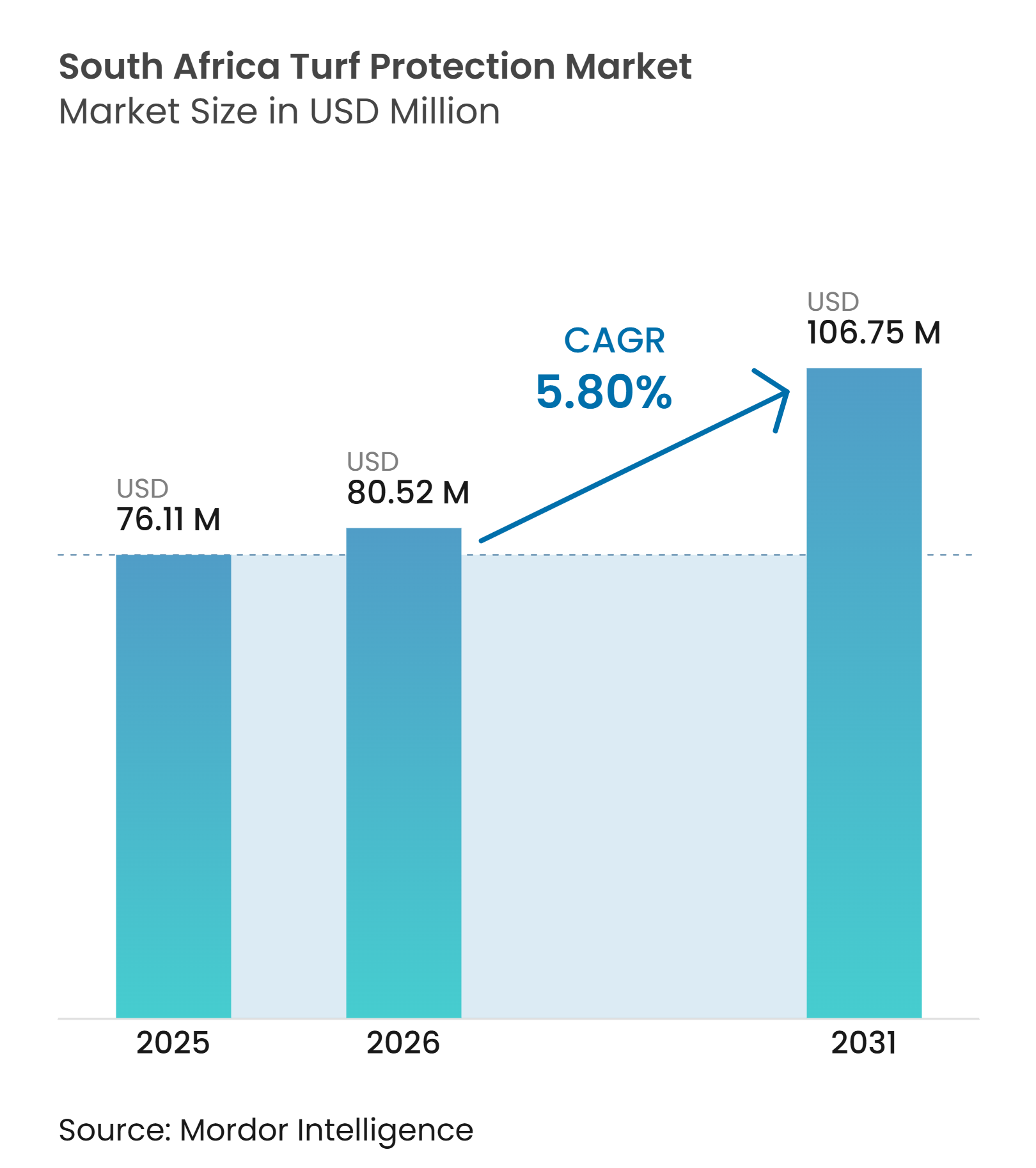
| Base Year Market Size (2025) | USD 76.11 Million |
| Market Size (2026) | USD 80.52 Million |
| Market Size (2031) | USD 106.75 Million |
| Growth Rate (2026 - 2031) | 5.80 % |
| Market Concentration | Medium |
Major Players *Disclaimer: Major Players sorted in no particular order Image © Mordor Intelligence. Reuse requires attribution under CC BY 4.0. | |
South Africa Turf Protection Market Analysis by Mordor Intelligence
The South Africa turf management market size was valued at USD 76.11 million in 2025 and is projected to grow from USD 80.52 million in 2026 to reach USD 106.75 million by 2031, at a CAGR of 5.80% during the forecast period from 2026 to 2031. Golf facilities, professional sports venues, and formal landscaping contracts drive recurring demand for turf management inputs. South Africa’s growing prominence as a golf tourism destination is increasing the focus on golf course conditioning. In addition, preparations for major cricket and football events are elevating maintenance standards at leading venues. These factors are driving demand for fungicides, herbicides, plant growth regulators, and biological products. However, water scarcity remains a key constraint, increasing the complexity of turf management programs and prompting some public facilities to adopt artificial surfaces.
Key Report Takeaways
- By product type, fungicides accounted for the largest 34.0% of the South Africa turf protection market share in 2025, while biostimulants and bio-fertilizers are projected to grow at the fastest CAGR of 9.5% from 2026 to 2031.
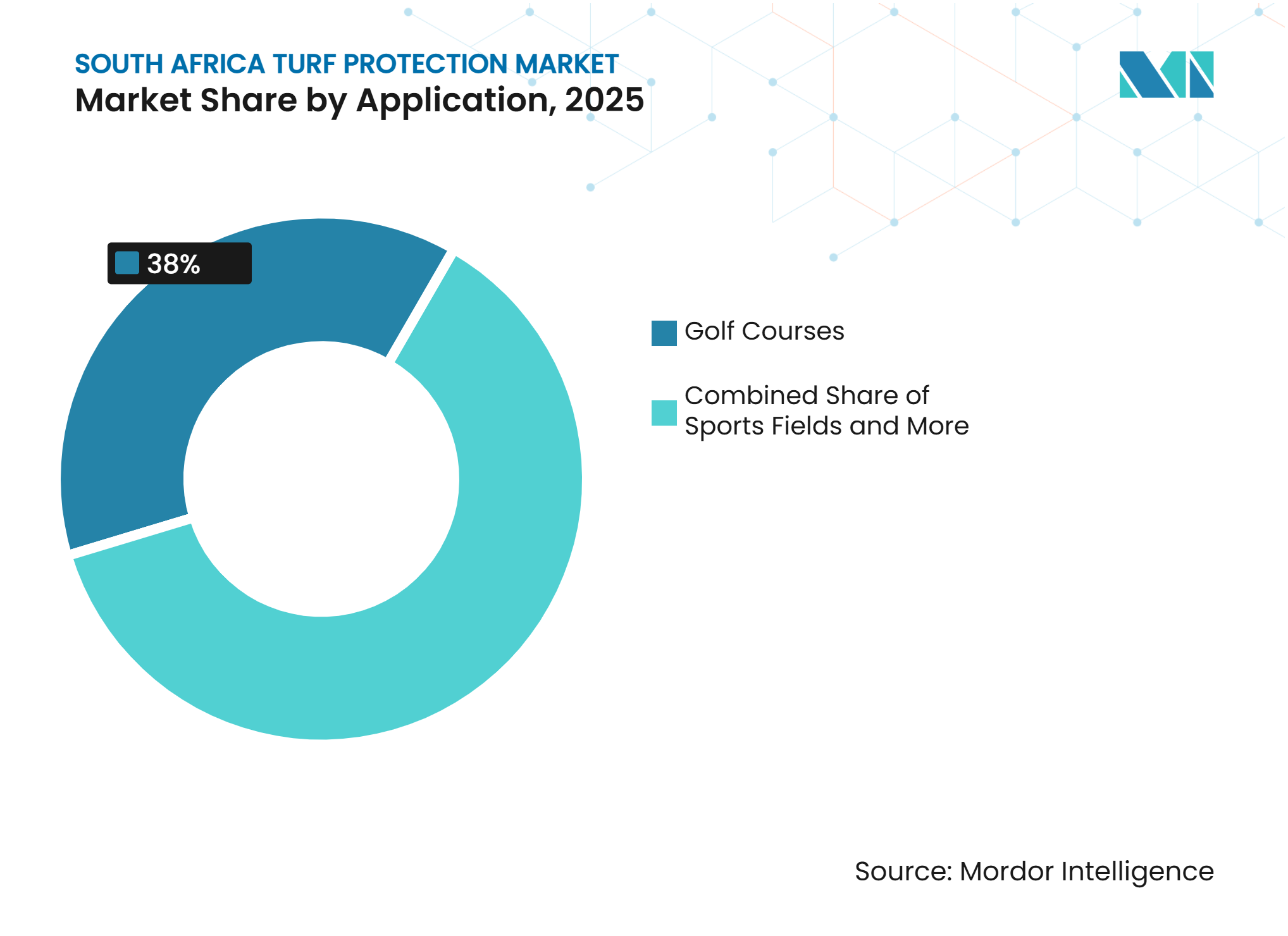
- By application, golf courses accounted for the largest share at 38.0% in 2025, while the South Africa turf protection market size for sports fields is projected to grow at the fastest CAGR of 7.1% from 2026 to 2031.
- By end user, commercial landscape contractors accounted for the largest share at 36.0% in 2025, while municipalities and schools are projected to grow at the fastest CAGR of 6.8% from 2026 to 2031.
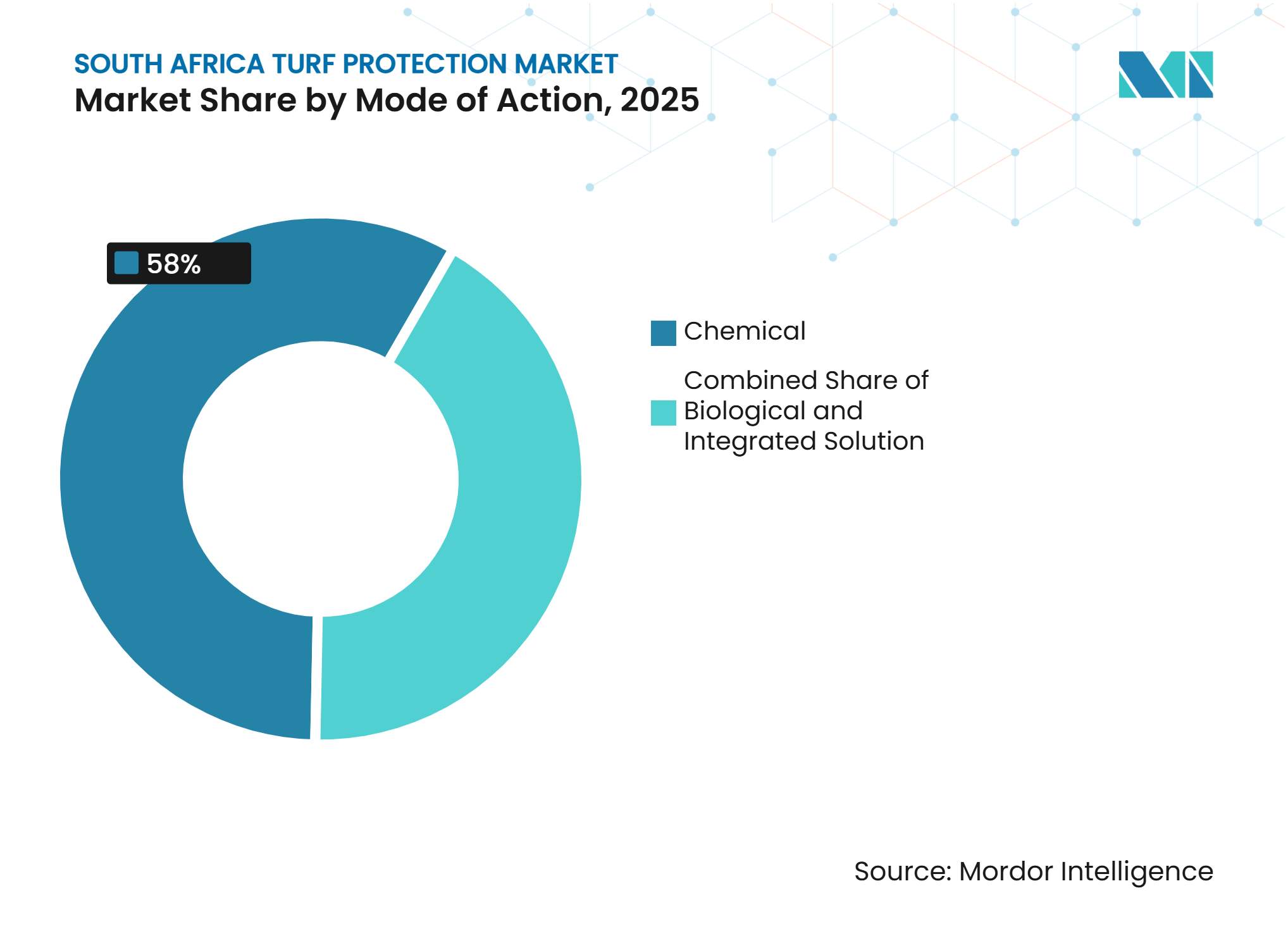
- By mode of action, chemical inputs accounted for the largest share at 58.0% in 2025, while biological inputs are projected to grow at the fastest CAGR of 9.5% from 2026 to 2031.
- By formulation, liquid concentrates accounted for the largest share at 64.0% in 2025, while granules are projected to grow at the fastest CAGR of 6.6% from 2026 to 2031.
Note: Market size and forecast figures in this report are generated using Mordor Intelligence’s proprietary estimation framework, updated with the latest available data and insights as of January 2026.
Market Trends and Insights
Drivers Impact Analysis of South Africa Turf Protection Market*
| Driver | (~) % Impact on CAGR Forecast | Geographic Relevance | Impact Timeline |
|---|---|---|---|
| Expansion of Golf and Sports Turf Maintenance | 1.30% | Western Cape, Gauteng, and KwaZulu-Natal | Medium term (2-4 years) |
| Water-Efficient Turf Programs Increasing Input Intensity | 0.90% | Western Cape, Gauteng, and national spillover | Short term (≤ 2 years) |
| Rising Disease and Pest Pressure Under Climate Volatility | 0.80% | KwaZulu-Natal, Eastern Cape, and nationwide | Short term (≤ 2 years) |
| Growth of Biological and Biostimulant Turf Programs | 1.10% | National, with early gains in Gauteng and Western Cape | Medium term (2-4 years) |
| Professionalization of Municipal and Commercial Landscaping | 0.70% | Gauteng, Western Cape, and Eastern Cape | Medium term (2-4 years) |
| Localized Product Development for South African Turf Cultivars | 0.60% | National | Long term (≥ 4 years) |
| Source: Mordor Intelligence | |||
Expansion of Golf and Sports Turf Maintenance
The expansion and maintenance of golf and sports facilities are driving demand for turf protection products in South Africa. The Ernie Els-designed Zimbali Lakes golf course opened in April 2025, adding a professionally managed turf area that requires ongoing agronomic care[1]. The Lions Cricket and Servest partnership, announced in 2025, further highlights recurring maintenance needs across sports facilities. These developments are supporting sustained demand for fungicides, herbicides, and biostimulants, as turf managers seek to maintain playing quality, prevent diseases and weed growth, and preserve surface performance. The expansion of professionally managed turf areas is thus driving the South African turf protection market.
Water-Efficient Turf Programs Increasing Input Intensity
Growing adoption of water-efficient irrigation practices is increasing the technical requirements for maintaining managed turf under South Africa's water constraints. A 2026 review in Water found that treated wastewater can provide a viable alternative irrigation source in South Africa when assessed against soil conditions, irrigation methods, water quality, and plant requirements[2]. These additional management considerations require turf operators to coordinate irrigation, soil moisture, nutrient availability, and product application with greater precision. Such integrated programs may increase the demand for wetting agents, surfactants, biostimulants, and complementary turf-protection treatments.
Rising Disease and Pest Pressure Under Climate Volatility
Rising temperature stress and irregular rainfall are increasing the need for more responsive turf maintenance programs across South Africa's golf and sports facilities. Royal Johannesburg (2026) reported that exceptionally high temperatures and limited rainfall increased turf stress and disease vulnerability, prompting the facility to adjust its wetting-agent program to maintain moisture levels on the greens. Weather-related stress can weaken turf resilience, increasing the need for preventive disease management, moisture optimization, and timely protective treatments. As turf managers adapt maintenance practices to variable climatic conditions, recurring demand for fungicides, biostimulants, and related protective inputs is supporting growth in the South African turf protection market.
Growth of Biological and Biostimulant Turf Programs
South Africa's water scarcity, recurrent droughts, nutrient limitations, and variable climatic conditions are increasing the need for turf managers to adopt inputs that enhance plant resilience and resource-use efficiency. Biological and biostimulant solutions can complement conventional turf protection programs by supporting root development, soil microbial activity, nutrient availability, and recovery from environmental stress. These solutions are particularly relevant where maintaining turf quality requires efficient use of water and nutrients without relying exclusively on synthetic inputs. As turf management programs increasingly prioritize soil health and plant resilience alongside disease and pest control, broader adoption of biological and biostimulant solutions is projected to drive market growth.
Restraints Impact Analysis of South Africa Turf Protection Market*
| Restraint | (~) % Impact on CAGR Forecast | Geographic Relevance | Impact Timeline |
|---|---|---|---|
| Act 36 Registration and Compliance Lead Times | -0.80% | National | Long term (≥ 4 years) |
| Water Scarcity and Irrigation-Linked Application Constraints | -0.70% | Western Cape, Northern Cape, and Gauteng | Medium term (2-4 years) |
| Artificial Turf Substitution in Water-Stressed Facilities | -0.50% | Gauteng and Western Cape | Medium term (2-4 years) |
| Resistance, Phytotoxicity, and Skilled-Application Risk | -0.40% | National | Long term (≥ 4 years) |
| Source: Mordor Intelligence | |||
Act 36 Registration and Compliance Lead Times
Registration and compliance requirements under South Africa's agricultural remedy framework can increase the administrative burden and the time required to commercialize turf protection products. The South African Department of Agriculture (DA) (2026) confirms that agricultural remedies require registration and that the registration is valid for 3 years, with periodic renewal[3]. Product applicants must satisfy regulatory requirements covering efficacy and safety for humans, animals, crops, and the environment. These requirements can increase documentation, testing, and compliance costs for suppliers introducing new formulations, particularly for biological products that require regulatory assessment. Consequently, regulatory obligations can delay product commercialization, increase market-entry costs, and constrain the pace at which new turf protection solutions reach South African customers.
Water Scarcity and Irrigation-Linked Application Constraints
Water scarcity is limiting turf facilities' ability to irrigate and maintain playing surfaces, increasing operational complexity for turf managers. The South African Department of Water and Sanitation (DWS) (2025) identifies South Africa as one of the thirty most water-scarce countries in the world, and rising demand continues to pressure available supplies. Water restrictions can reduce irrigation flexibility and require managers to coordinate watering with soil moisture levels and treatment timing. These constraints can complicate turf protection programs and necessitate additional water management measures, increasing the operational requirements for maintaining turf quality. As a result, persistent water scarcity can hinder the efficient use and expansion of turf protection products at affected facilities.
*Our forecasts treat driver/restraint impacts as directional, not additive. The impact forecasts reflect baseline growth, mix effects, and variable interactions.
South Africa Turf Protection Market Segment Analysis
By Product Type:
Fungicides Lead While Biostimulants and Bio-Fertilizers Grow FastestFungicides accounted for the largest share of the South Africa turf protection market at 34.0% in 2025, reflecting their established role in disease management across professionally maintained turf. Golf courses, sports fields, landscaped areas, and sod farms require consistent disease management programs to preserve turf health, surface quality, and recovery. Fungicides are used alongside herbicides, insecticides, plant growth regulators, and biological inputs, depending on site conditions and maintenance objectives. Their established role in professional turf programs supports recurring product demand, particularly where disease prevention is important for maintaining functional and visually consistent playing and landscaped surfaces.
Biostimulants and bio-fertilizers are projected to grow at the fastest CAGR of 9.5% from 2026 to 2031, supported by increasing integration of plant-health and soil-management practices into turf maintenance programs. These products can complement conventional protection treatments by supporting root development, nutrient availability, microbial activity, and tolerance to environmental stress. Their use provides turf managers with additional tools for maintaining plant vigor alongside disease, weed, and pest management. Integrated programs can broaden the role of biological inputs within professional turf maintenance and create opportunities for suppliers offering complementary solutions for managed turf environments.
By Application:
Golf Courses Lead and Sports Fields Grow FastestGolf courses accounted for the largest share at 38.0% in 2025, supported by recurring maintenance requirements across greens, tees, fairways, and surrounding landscaped areas. Maintaining consistent turf quality requires coordinated disease, weed, insect, growth, and soil-management programs. Golf facilities also require treatments that preserve playing conditions and support recovery from environmental stress. Sports fields require comparable protection to maintain usable surfaces for training and competition, while landscaping serves estates, hospitality properties, institutions, and public spaces. Sod farms require protection during turf production and establishment. This diverse base of applications supports continued demand for specialized turf-protection products across South Africa.
The South Africa turf protection market for sports fields is projected to grow at the fastest CAGR of 7.1% from 2026 to 2031, driven by the need for reliable playing surfaces and regular maintenance. Sports facilities require coordinated programs covering disease prevention, weed management, pest control, plant growth, and turf recovery. These requirements generate recurring product use as fields are maintained for scheduled activities and competition. Golf courses continue to require comprehensive programs across multiple turf zones, while landscaping and sod production address distinct maintenance and establishment needs. This diversity of applications creates opportunities for suppliers offering products suited to different turf environments.



By End User:
Commercial Landscape Contractors Lead While Municipalities and Schools AccelerateCommercial landscape contractors accounted for the largest share, at 36.0% in 2025, reflecting their role in managing diverse properties that require regular turf and landscape maintenance. Contractors serve residential developments, golf estates, corporate campuses, hospitality properties, parks, and institutional grounds. Their service responsibilities include weed control, disease management, pest management, plant growth regulation, soil improvement, and turf establishment. This broad customer coverage supports consolidated procurement and recurring product requirements. Contractors also provide application expertise for properties requiring coordinated maintenance programs. Their role creates an important distribution and service channel through which multinational and local suppliers can reach diverse managed-turf customers across South Africa.
Municipalities and schools are projected to grow at the fastest CAGR of 6.8% from 2026 to 2031, driven by ongoing requirements to maintain public parks, school grounds, recreational areas, and civic landscapes. These users require structured maintenance programs that address turf health, weed control, disease prevention, pest management, and surface appearance. Procurement processes can encourage the use of registered products and documented application practices. Commercial landscape contractors remain important as they manage multiple properties and consolidate purchasing requirements. Sports facility owners also require specialized surface-care programs, while residential customers contribute to lawn-maintenance demand across privately managed properties and communities.
By Mode of Action:
Chemical Lead While Biological Close The GapChemical inputs accounted for the largest share at 58.0% in 2025, reflecting their established role in professional turf-protection programs. Chemical fungicides, herbicides, and insecticides provide targeted management of diseases, weeds, and pests across golf courses, sports fields, landscaping areas, and sod farms. Their established application practices support predictable treatment programs and integration with existing turf-maintenance equipment. Biological products provide complementary approaches focused on plant health, soil function, and environmental stress management. Integrated solutions combine different approaches based on site conditions and maintenance objectives. This range allows turf managers to select protection strategies suited to specific operational requirements and turf conditions.
Biological inputs are projected to grow at the fastest CAGR of 9.5% from 2026 to 2031, driven by growing interest in solutions that complement conventional turf-protection programs. Biological products can support root development, soil microbial activity, nutrient availability, and plant resilience, providing additional tools for managing turf health. Their use can be integrated with chemical treatments tailored to disease, pests, soil, and environmental conditions. This approach enables turf managers to address multiple aspects of turf performance within coordinated maintenance programs. As biological solutions become more integrated into professional practices, suppliers can expand their offerings across golf, sports, landscaping, and other managed-turf applications.

By Formulation:
Liquid Concentrates Lead While Granules Grow FastestLiquid concentrates accounted for the largest share at 64.0% in 2025, owing to their suitability for spray-based turf maintenance programs. Professional turf managers can apply liquid products using existing spraying equipment, adjusting application rates and targeting specific areas based on maintenance requirements. Uniform application is particularly important across golf greens, sports fields, and landscaped surfaces, where inconsistent treatment can affect turf condition and appearance. Wettable powders remain suitable for applications where formulation characteristics and active ingredients support their use. Granules provide an alternative delivery format for soil-based programs. Together, these formulations give suppliers flexibility in serving varied turf management practices and application requirements.
Granules are projected to grow at the fastest CAGR of 6.6% from 2026 to 2031, supported by their suitability for soil-applied turf programs. Granular formulations can deliver nutrients, biostimulants, herbicides, and other inputs directly to the soil or root zone based on product requirements. Their use can complement spray applications where soil placement supports the intended treatment approach. Liquid concentrates continue to support precise spray-based applications at professional turf facilities, while wettable powders offer an additional formulation option for selected products. The availability of multiple delivery formats allows turf managers to align application methods with product characteristics, equipment, turf conditions, and maintenance objectives.
Geography Analysis
Gauteng, Western Cape, and KwaZulu-Natal are key regional markets for turf-protection products, driven by their concentration of golf courses, sports facilities, commercial landscapes, residential developments, hospitality properties, and municipal recreational areas. Gauteng benefits from extensive urban and sporting infrastructure, while the Western Cape has a strong golf, tourism, landscaping, and municipal sports ecosystem. KwaZulu-Natal benefits from coastal tourism, golf, residential estates, and hospitality infrastructure. These regional characteristics create recurring demand for turf maintenance products, including fungicides, herbicides, insecticides, plant growth regulators, biostimulants, and other turf-management products.
Demand across these regions is influenced by the scale of professionally maintained turf and the diversity of end-use environments. In Gauteng, landscape contractors, golf-course operators, sports facilities, and residential communities regularly maintain urban and sporting infrastructure. The Western Cape benefits from established golf, tourism, municipal, and commercial landscaping activities, while KwaZulu-Natal's coastal recreational environment supports demand from golf courses, resorts, residential estates, and sports facilities. Professional maintenance requirements and diverse turf applications support recurring use of protective products and create opportunities for conventional, biological, and integrated turf-management solutions.
Gauteng's professionally maintained sports infrastructure reinforces its position as a major regional demand center for turf-protection products. The Lions Cricket and Servest collaboration covers 21 cricket fields, including maintenance of pitches, nets, and outfields, as well as mowing, edging, winter treatment, and fertilization. These organized maintenance requirements indicate recurring professional turf-care activities across the province, creating demand for products that manage diseases, weeds, insects, and plant health. Dedicated maintenance programs across cricket facilities support continued demand for turf-protection solutions in Gauteng and reinforce the province's importance within the national market.
Competitive Landscape
Market Concentration
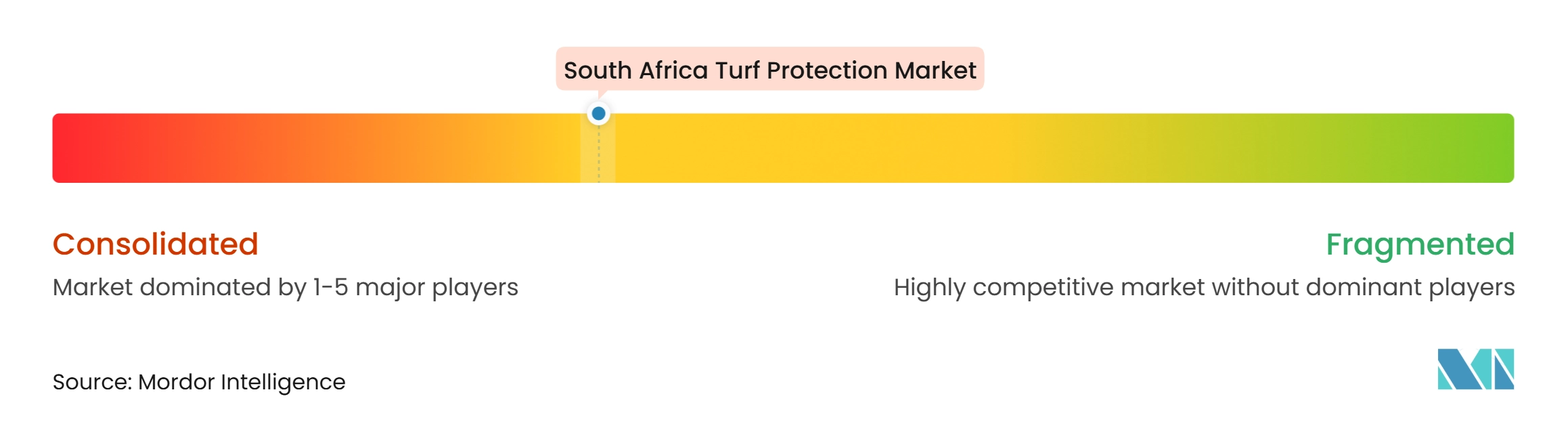
The market is moderately consolidated in 2025, with major players including Syngenta AG, BASF SE, Bayer AG, Corteva, Inc., and Nufarm Limited. These companies compete through established crop and turf-protection portfolios, technical capabilities, distribution networks, and relationships with professional turf managers. Their broad product offerings enable participation across fungicides, herbicides, insecticides, plant growth regulators, and other turf-management solutions. The presence of these multinational suppliers drives competition around product performance, formulation capabilities, application support, and access to professional golf, sports, landscaping, and other managed-turf customers.
Competition is further shaped by differences in product specialization, technical support, distribution reach, regulatory capabilities, and customer relationships. Multinational suppliers benefit from established research and development capabilities and broad product portfolios, while specialized suppliers can compete through local market knowledge, focused turf solutions, responsive technical services, and customer support. Suppliers also differentiate through formulation technology and integrated approaches that combine disease, weed, insect, growth, and plant-health management. This competitive environment encourages companies to strengthen their turf-specific offerings and provide solutions tailored to the requirements of golf courses, sports fields, landscape contractors, and other professional turf users.
Syngenta AG has strengthened its turf-focused positioning by developing a dedicated portfolio that addresses multiple professional turf-management requirements. Its Primo Maxx plant growth regulator, registered for use in South Africa, contains 120.9 g/L of trinexapac-ethyl and is specifically positioned for turf-care and golf-course managers. The product controls foliar growth and can reduce mowing frequency and clipping volume, allowing Syngenta to address operational efficiency alongside turf quality. This specialized positioning broadens the company's relevance beyond conventional crop protection and strengthens its competitiveness in professional turf-management applications across South Africa.
South Africa Turf Protection Industry Leaders
-
Syngenta AG
-
BASF SE
-
Bayer AG
-
Corteva, Inc.
-
Nufarm Limited
- *Disclaimer: Major Players sorted in no particular order
South Africa Turf Protection Market Companies Covered in this Report
- Syngenta AG
- BASF SE
- Bayer AG
- Corteva, Inc.
- Nufarm Limited
- UPL Limited
- Philagro South Africa (Pty) Ltd (Sumitomo Chemical Co., Ltd.)
- ADAMA Ltd
- Makhro Home and Garden (Pty) Ltd
- Agro-Serve (Pty) Ltd
- Henchem (Pty) Ltd
- IVM Chemicals (Pty) Limited
Recent Industry Developments in South Africa Turf Protection Market
- February 2025: UPL Limited launched Winger 850 WG in Cape Town, a residual pre-emergent herbicide containing 850 g/kg pyroxasulfone. The launch expanded UPL's herbicide portfolio in South Africa and strengthened its weed management product offering.
- June 2024: Syngenta AG promoted Ryder turf pigment technology for South African golf courses, with applications demonstrated at Omeya Golf Club and Maritzburg Golf Club. The solution is designed to improve turf resilience, color consistency, density, and plant protection performance under environmental stress.
- March 2024: Makhro Home and Garden (Pty) Ltd introduced Turbo-K, a granular fertilizer for lawns, landscaping, and sports fields. Its formulation provides balanced plant nutrition to support turf growth, root development, and resilience, adding a turf-focused plant nutrition solution to Makhro's South African portfolio.
South Africa Turf Protection Market Report Scope
Turf protection refers to the products and practices used to maintain healthy and attractive turf by controlling weeds, insects, diseases, and stress. It includes fungicides, herbicides, insecticides, growth regulators, biostimulants, and bio-fertilizers.
The South Africa turf protection market report is segmented by product type (fungicides, herbicides, insecticides, plant growth regulators, and biostimulants and bio-fertilizers), by application (landscaping, golf courses, sports fields, and sod farms), by end user (residential customers, commercial landscape contractors, sports facility owners, and municipalities and schools), by mode of action (chemical, biological, and integrated solution), and by formulation (granules, liquid concentrate, and wettable powder). The market forecasts are provided in terms of value (USD).
Segmentation Overview
| Fungicides |
| Herbicides |
| Insecticides |
| Plant Growth Regulators |
| Biostimulants and Bio-Fertilizers |
| Landscaping |
| Golf Courses |
| Sports Fields |
| Sod Farms |
| Residential Customers |
| Commercial Landscape Contractors |
| Sports Facility Owners |
| Municipalities and Schools |
| Chemical |
| Biological |
| Integrated Solution |
| Granules |
| Liquid Concentrate |
| Wettable Powder |
| By Product Type | Fungicides |
| Herbicides | |
| Insecticides | |
| Plant Growth Regulators | |
| Biostimulants and Bio-Fertilizers | |
| By Application | Landscaping |
| Golf Courses | |
| Sports Fields | |
| Sod Farms | |
| By End User | Residential Customers |
| Commercial Landscape Contractors | |
| Sports Facility Owners | |
| Municipalities and Schools | |
| By Mode of Action | Chemical |
| Biological | |
| Integrated Solution | |
| By Formulation | Granules |
| Liquid Concentrate | |
| Wettable Powder |
Key Questions Answered in the Report
What is the market size for the South Africa turf management market in 2026?
The South Africa turf management market is valued at USD 80.52 million in 2026.
Which product category leads turf management demand in South Africa?
Fungicides led product demand with the largest 34.0% share in 2025 because golf courses and sports fields need regular disease control under warm and humid conditions.
Why are biological turf products growing in South Africa?
Biological inputs are forecast to grow at the fastest CAGR of 9.5% from 2026 to 2031.
Which end users create the most demand for turf inputs?
Commercial landscape contractors led end-user demand with the largest 36.0% share in 2025.