
South Africa Seed Processing Machinery Market Size and Share
Market Overview
| Study Period | 2021 - 2031 |
|---|---|
| Base Year Market Size (2025) | USD 107.92 Million |
| Historical Data Period | 2021 - 2024 |
| Market Size (2026) | USD 114.79 Million |
| Market Size (2031) | USD 156.32 Million |
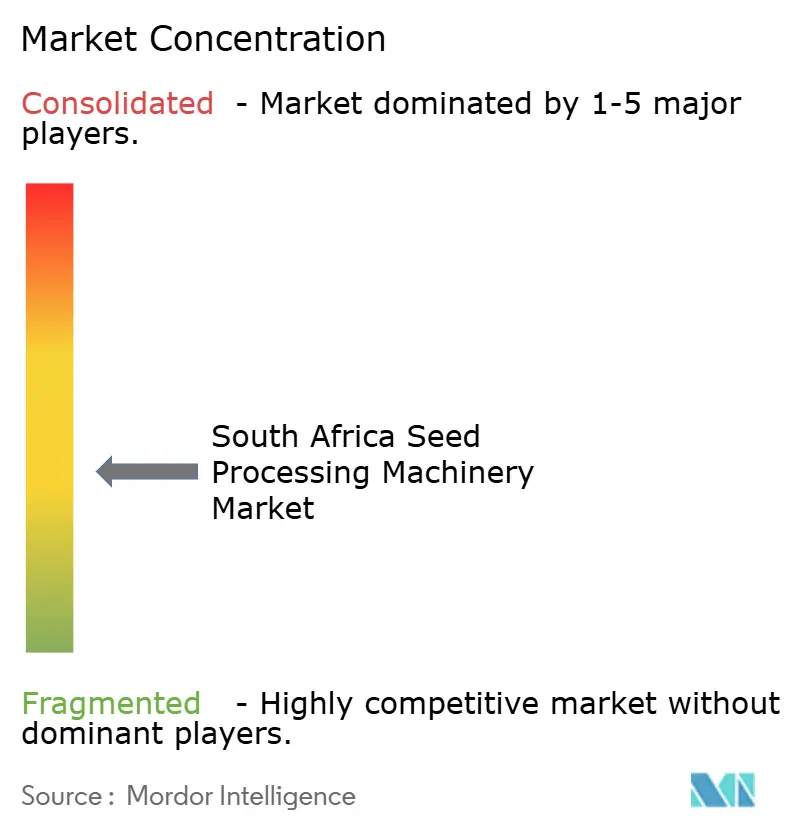
| Market Concentration | Medium |
Major Players *Disclaimer: Major Players sorted in no particular order Image © Mordor Intelligence. Reuse requires attribution under CC BY 4.0. | |
South Africa Seed Processing Machinery Market Analysis by Mordor Intelligence
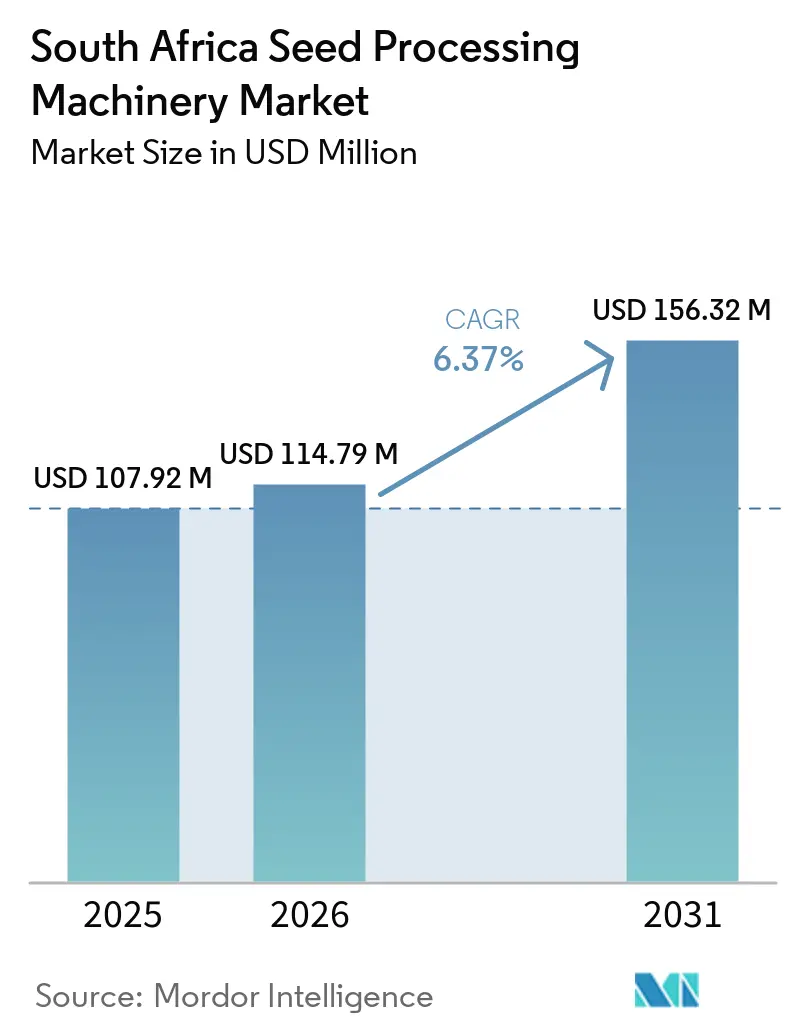
The South Africa seed processing machinery market size was valued at USD 107.92 million in 2025 and is forecast to increase from USD 114.79 million in 2026 to USD 156.32 million by 2031. The market is forecast to grow at a CAGR of 6.37% from 2026 to 2031. The market is driven by increasing adoption of certified seed production, expanding mechanized farming practices, and the growing need for high-quality seed cleaning, grading, treatment, sorting, and packaging solutions. Rising investments in agricultural modernization and post-harvest infrastructure are encouraging seed processors to replace conventional equipment with automated, precision-processing systems that improve operational efficiency and seed quality. Demand is further supported by the expansion of commercial seed-processing facilities, the growing production of major field crops such as maize and soybeans, and the increasing emphasis on compliance with national seed quality standards. Although imported precision components and power reliability remain challenges, the presence of local equipment suppliers, engineering service providers, and retrofit solutions continues to support market adoption. Overall, the ongoing modernization of South Africa's seed value chain and increasing focus on productivity, traceability, and certified seed quality are projected to sustain steady market growth throughout the forecast period.
Key Report Takeaways
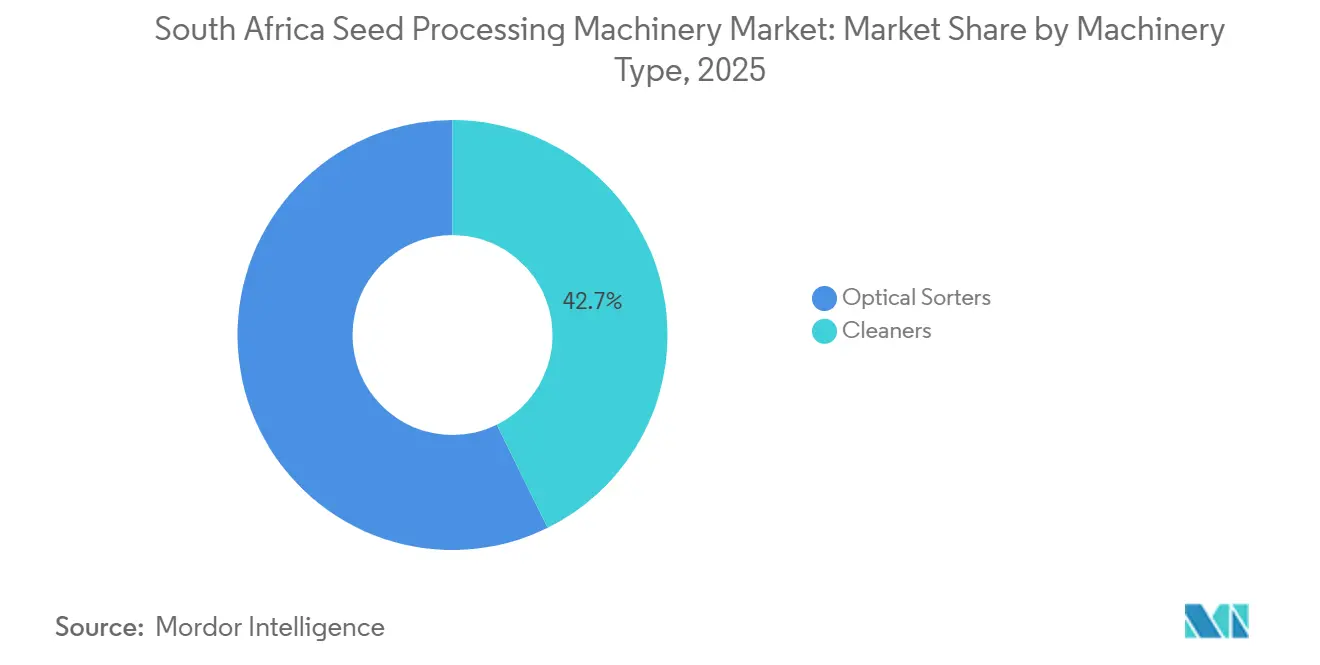
- By machinery type, cleaners accounted for the largest share of the South Africa seed processing machinery market, at 42.7% in 2025, whereas optical sorters are forecast to register the fastest growth, at a CAGR of 7.6% from 2026 to 2031.
- By operation mode, automatic equipment accounted for 70.6% of the South Africa seed processing machinery market share in 2025 and is forecast to grow at the fastest CAGR of 8.0% from 2026 to 2031.
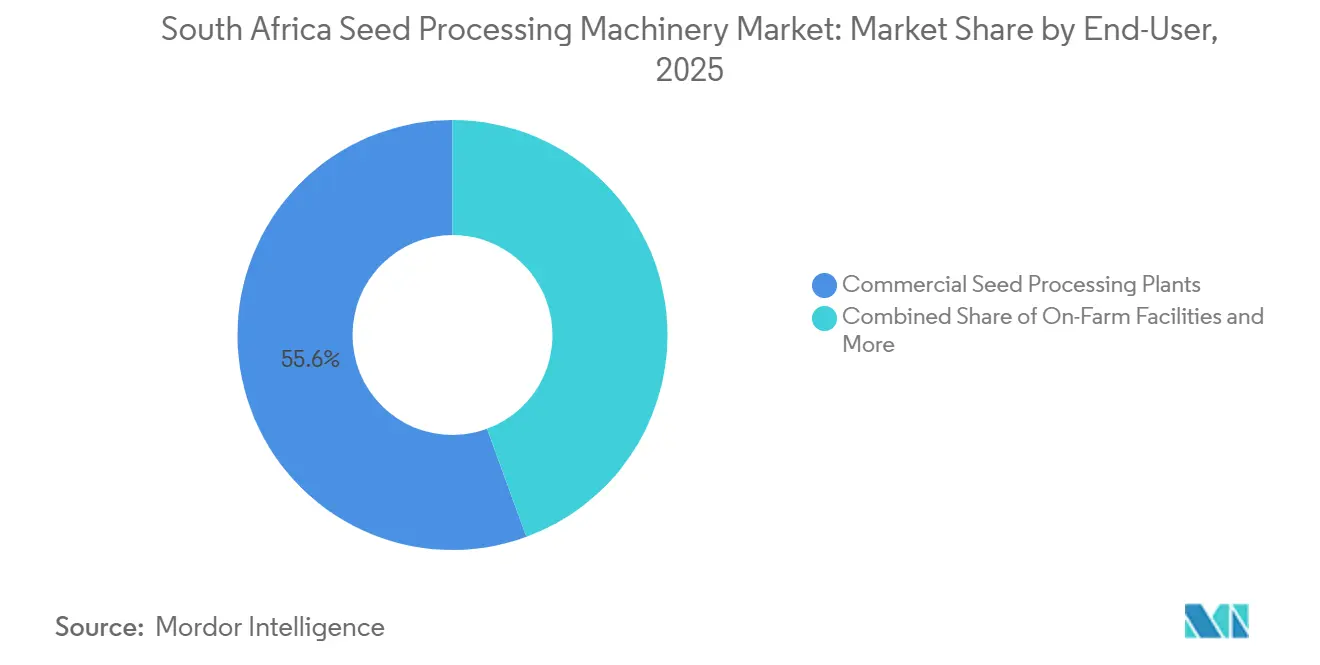
- By end user, commercial seed processing plants accounted for 55.6% of the South Africa seed processing machinery market size in 2025, whereas the on-farm facilities segment is forecast to grow at the fastest CAGR of 6.4% from 2026 to 2031.
Note: Market size and forecast figures in this report are generated using Mordor Intelligence’s proprietary estimation framework, updated with the latest available data and insights as of January 2026.
Market Trends and Insights
Drivers Impact Analysis of South Africa Seed Processing Machinery Market*
| Driver | (~) % Impact on CAGR Forecast | Geographic Relevance | Impact Timeline |
|---|---|---|---|
| Growth in certified seed multiplication and commercial seed plants | +1.4% | National, with concentration in Free State, North West, and Mpumalanga | Short term (≤ 2 years) |
| Replacement of labor-intensive cleaning and grading operations | +1.1% | National, strongest in high-volume grain provinces and commercial seed plant clusters | Medium term (2-4 years) |
| Rising demand for uniform seed lots in mechanized planting | +0.9% | National, strongest in the soybean and maize production belt | Medium term (2-4 years) |
| Increasing adoption of optical sorting for export-grade quality | +0.8% | National, with early momentum in Western Cape and Northern Cape specialty crops | Long term (≥ 4 years) |
| Public and private investment in agricultural mechanization | +0.7% | National, with provincial concentration in KwaZulu-Natal, Free State, and Limpopo | Short term (≤ 2 years) |
| Localized retrofit demand created by grid instability and mobile processing | +0.5% | National, strongest at rural on-farm and cooperative processing sites | Medium term (2-4 years) |
| Source: Mordor Intelligence | |||
Growth in Certified Seed Multiplication and Commercial Seed Plants
The expansion of certified seed production and tightening regulatory requirements are driving demand for seed processing machinery across South Africa. The Plant Improvement Act, 2018, effective from 1 December 2025, strengthened requirements for seed business registration, varietal listing, and seed quality compliance, prompting processors to modernize cleaning, grading, treatment, and sorting operations. According to the South African National Seed Organization (SANSOR), certified seed crops are produced on more than 60,000 hectares, reflecting the growing scale of certified seed production and supporting sustained investment in seed processing equipment.
Replacement of Labor-Intensive Cleaning and Grading Operations
Seed processors are increasingly replacing manual cleaning, separation, and grading with mechanized and automated equipment to improve operational consistency, processing capacity, and seed quality. Manual operations require considerable labor to remove impurities, separate seeds by size, and maintain uniform grading standards across different crop varieties. Modern pre-cleaners, cleaners, graders, and optical sorters enable commercial seed processing plants to perform these activities with greater precision and reduced manual intervention. This transition supports higher processing efficiency, consistent seed quality, and improved productivity across South Africa's commercial seed processing industry.
Rising Demand for Uniform Seed Lots in Mechanized Planting
Rising demand for commercial seed is encouraging investment in advanced seed-processing equipment to ensure uniformity and consistency in planting. According to the United States Department of Agriculture Foreign Agricultural Service (USDA FAS) (2025), South Africa's corn planted area is projected at 3 million hectares for the 2025/26 marketing year[1], indicating substantial demand for commercial seed supplies. Meeting this demand requires processors to produce uniform seed lots through cleaning, grading, and sorting operations that remove impurities and separate seeds by size. Consistent seed characteristics improve compatibility with mechanized metering systems, supporting accurate seed placement, uniform crop establishment, and increased demand for advanced seed-processing machinery.
Increasing Adoption of Optical Sorting for Export-Grade Quality
The increasing adoption of optical sorting is enabling seed processors to achieve higher purity, uniformity, and export-grade quality while reducing the need for manual inspection. According to QualiBasic Seed Company (QBS), the company commissioned a QualySense QSorter at its South African facility in October 2025 to separate white maize kernels from red kernels using fluorescent genetic trait detection at the foundation seed stage[2]. The technology improves sorting accuracy and supports efficient hybrid seed production with consistent quality standards. As export requirements become more stringent, investment in advanced optical sorting systems is projected to strengthen demand for seed processing machinery across South Africa.
Restraints Impact Analysis of South Africa Seed Processing Machinery Market*
| Restraint | (~) % Impact on CAGR Forecast | Geographic Relevance | Impact Timeline |
|---|---|---|---|
| High upfront cost of automated processing lines | -1.5% | National, most acute for mid-tier commercial plants and cooperative facilities | Long term (≥ 4 years) |
| Foreign-exchange exposure and imported component dependence | -1.0% | National, affecting operators that procure imported original equipment manufacturer (OEM) equipment and precision components | Medium term (2-4 years) |
| Shortage of specialized operators and maintenance technicians | -0.7% | National, concentrated at rural processing sites distant from training institutions | Long term (≥ 4 years) |
| Power reliability and dust-control constraints at processing sites | -0.6% | National, with rural sites in Free State, North West, and KwaZulu-Natal most affected | Medium term (2-4 years) |
| Source: Mordor Intelligence | |||
High Upfront Cost of Automated Processing Lines
High upfront investment requirements remain a significant barrier to adopting automated seed processing lines, particularly for small- and medium-sized seed processors. Establishing automated facilities requires substantial capital expenditure on pre-cleaners, cleaners, graders, separators, seed treaters, optical sorters, and packaging systems. Additional expenses for equipment integration, electrical infrastructure, installation, and commissioning further increase initial investment requirements. These costs can restrict smaller processors' ability to modernize existing facilities. As a result, many operators prioritize essential machinery and upgrade equipment in phases, which influences the adoption of advanced seed processing technologies across South Africa.
Foreign-Exchange Exposure and Imported Component Dependence
Foreign-exchange exposure and reliance on imported precision components continue to restrain investment in advanced seed-processing machinery across South Africa. Many high-performance optical sorting, grading, and separation systems rely on imported technologies, making equipment costs vulnerable to currency fluctuations and rising operating expenses. According to the National Agricultural Marketing Council (NAMC) (2025), a proposed 12.7% increase in electricity tariffs added further cost pressure on agricultural operations[3]. Higher operating and import-related expenses reduce the capital available for machinery upgrades, extending equipment replacement cycles and limiting the adoption of fully automated seed-processing systems.
*Our forecasts treat driver/restraint impacts as directional, not additive. The impact forecasts reflect baseline growth, mix effects, and variable interactions.
South Africa Seed Processing Machinery Market Segment Analysis
By Machinery Type:
Cleaners Lead While Optical Sorters Reshape Quality StandardsCleaners accounted for 42.7% of the South Africa seed processing machinery market size in 2025. Cleaners form the foundation of nearly every seed processing line by removing dust, chaff, broken seeds, and other foreign materials before grading, treatment, and packaging. Their broad applicability across maize, soybean, wheat, sunflower, and vegetable seeds supports widespread adoption among commercial processors, seed producers, research institutions, and on-farm facilities. Their ability to improve seed purity, operational efficiency, and certification readiness makes them an essential component of both new installations and equipment replacement projects.
Optical sorters are forecast to grow at the fastest CAGR of 7.6% from 2026 to 2031. Growing demand for export-grade seed quality, higher processing accuracy, and reduced manual inspection is driving the adoption of optical sorting technology. Modern systems identify subtle color, size, and surface defects that conventional equipment cannot consistently detect, improving seed uniformity and genetic purity. Increasing availability of artificial intelligence-enabled sorting technologies and local technical support is encouraging adoption beyond large commercial processors. Continued investment in precision seed processing is projected to strengthen demand for optical sorting equipment throughout the forecast period.

By Operation Mode:
Automation Leads as Semi-Automatic Lines Face Structural PressureAutomatic equipment accounted for 70.6% of the South Africa seed processing machinery market share in 2025 and is forecast to grow at the fastest CAGR of 8.0% from 2026 to 2031. Automatic systems are preferred for their ability to deliver consistent processing quality, higher throughput, and lower labor dependence while supporting certified seed production. Integrated automation enables continuous control of cleaning, grading, treatment, sorting, and packaging processes with minimal operator intervention. Large commercial seed processors continue to prioritize automated equipment to improve operational efficiency, processing consistency, and overall productivity across multiple crop varieties.
Semi-automatic equipment continues to serve small and medium-sized seed producers, research institutions, and on-farm processing facilities where production volumes do not justify fully automated lines. These systems require lower initial investment while providing flexibility in handling multiple seed types and processing batches. They remain suitable for operators transitioning from manual processing or expanding capacity in stages. Although semi-automatic equipment maintains an important role in decentralized seed processing, increasing emphasis on labor efficiency, precision processing, and scalable automation is gradually shifting demand toward fully automatic processing systems.
By End-User:
Commercial Plants Dominate, On-Farm Facilities Drive Future GrowthCommercial seed processing plants held the largest share at 55.6% in 2025. These facilities process high volumes of certified seed across multiple crop types using integrated systems that combine cleaning, grading, treatment, sorting, drying, and packaging operations. Their purchasing decisions emphasize processing capacity, product consistency, operational efficiency, and compliance with seed certification standards. Continuous replacement of aging equipment and investment in higher-capacity processing lines support sustained demand from commercial processing facilities serving domestic and export-oriented seed markets.
The on-farm facilities segment of the South Africa seed processing machinery market is to grow at the fastest CAGR of 6.4% from 2026 to 2031. Farmers are increasingly adopting compact, modular seed-processing equipment to improve seed quality before storage or planting and reduce dependence on centralized processing facilities. Growing interest in flexible, energy-efficient, and mobile processing systems supports this transition. On-farm processing also enables quicker handling of harvested seed, greater operational independence, and improved seed quality management, contributing to steady adoption throughout the forecast period.
Geography Analysis
The Free State, North West, and Mpumalanga are the primary demand centers for seed processing machinery, accounting for a significant share of South Africa's commercial grain and oilseed production. The concentration of certified seed multiplication, commercial farming enterprises, and integrated seed processing facilities drives demand for high-capacity cleaners, graders, dryers, gravity separators, and optical sorting equipment. These provinces also benefit from established agricultural infrastructure, experienced service providers, and proximity to major seed companies, supporting continuous investment in processing technologies that improve seed quality, operational efficiency, and certification compliance.
KwaZulu-Natal and Limpopo are emerging growth regions due to expanding hybrid seed production, diversified cropping systems, and increasing agricultural mechanization. Public support for farm modernization, along with growing investment in commercial agriculture, is driving the adoption of modular, energy-efficient seed-processing equipment. Seed producers in these provinces increasingly require flexible processing lines capable of handling maize, soybean, vegetable, and other field crop seeds with varying physical characteristics. Growing interest in decentralized processing is also supporting demand for compact cleaning, grading, and treatment equipment suitable for medium-sized operations.
The Western Cape, Eastern Cape, and Northern Cape generate demand for high-value vegetable seed, horticultural, and specialty crop production, creating requirements for specialized seed-processing operations. Commercial seed producers handling diverse crop varieties require precision cleaning, grading, separation, and optical sorting equipment to remove impurities, maintain seed uniformity, and preserve varietal quality. These requirements drive investment in machinery capable of handling different seed sizes, shapes, and physical characteristics. The need to maintain consistent processing standards and meet commercial quality requirements supports demand for advanced seed processing solutions across these provinces.
Competitive Landscape
The South Africa seed processing machinery market is moderately fragmented, with global manufacturers such as Bühler AG, Cimbria A/S (Grain & Protein Technologies), PETKUS Technologie GmbH, Satake Corporation, and Ag Growth International Inc. competing alongside local engineering companies and equipment suppliers. International companies focus on advanced optical sorting, automated processing, and integrated seed handling technologies, while domestic manufacturers emphasize customized equipment, shorter lead times, and responsive after-sales service. Competition is primarily based on processing performance, equipment reliability, automation capabilities, energy efficiency, technical support, and the ability to deliver complete processing solutions for commercial seed producers, research institutions, and on-farm processing facilities across diverse agricultural applications.
Global manufacturers continue strengthening their market presence through local distributors, engineering partnerships, and expanded service capabilities to improve customer support and equipment availability. Companies are increasingly investing in intelligent automation, AI-enabled optical sorting, digital monitoring, and modular processing systems that improve seed quality and operational efficiency. Local manufacturers compete by offering cost-effective equipment tailored to regional operating conditions, including compact processing lines, retrofit solutions, and energy-efficient machinery suitable for medium-sized processors. This competitive environment encourages continuous product innovation and technology adoption throughout the industry.
Competition is also supported by continuous product innovation and technology expansion among leading manufacturers. In 2025, Cimbria A/S (Grain & Protein Technologies) continued expanding the deployment of its SEA.IQ PLUS optical sorting platform featuring BRAIN AI technology through its South African partner, Techmach Engineering (Pty) Ltd, strengthening local access to advanced optical sorting, installation, and after-sales support. This combination of global technology and local engineering capabilities improves processing efficiency and supports broader adoption of automated seed processing systems across commercial facilities.
South Africa Seed Processing Machinery Industry Leaders
-
Bühler AG
-
Cimbria A/S (Grain & Protein Technologies)
-
PETKUS Technologie GmbH
-
Satake Corporation
-
Ag Growth International Inc.
- *Disclaimer: Major Players sorted in no particular order
South Africa Seed Processing Machinery Market Companies Covered in this Report
- Bühler AG
- Cimbria A/S (Grain & Protein Technologies)
- PETKUS Technologie GmbH
- Satake Corporation
- Ag Growth International Inc.
- Westrup ApS
- Alvan Blanch Development Company Limited
- Oliver Manufacturing Co., Inc.
- Techmach Engineering (Pty) Ltd
- ALMAZ AGRO SA
- Perry Africa Pty Ltd
- Facet Engineering (Pty) Ltd
Recent Industry Developments in South Africa Seed Processing Machinery Market
- November 2025: Bühler AG continued investing in local manufacturing capabilities in 2025, including engineering services and digital processing technologies, to strengthen grain and seed processing support across Southern Africa.
- March 2025: Westrup ApS partnered with 3U Vision to integrate color-sorting technology into its seed-cleaning portfolio, strengthening its optical sorting solutions for commercial seed processors and supporting the need for improved seed purity and grading efficiency in South Africa's seed processing industry.
- March 2024: Cimbria A/S (Grain & Protein Technologies) launched BRAIN AI for its SEA.IQ PLUS optical sorter, enabling AI-powered recipe generation and increasing sorting efficiency by up to 18% for grain and seed processing applications in South Africa.
South Africa Seed Processing Machinery Market Report Scope
Seed processing machinery encompasses equipment used in agriculture to clean, sort, grade, dry, treat, and package seeds, improving their quality and viability for planting. These machines play a critical role in removing impurities, ensuring uniformity, and safeguarding seeds from pests and diseases.
The South Africa seed processing machinery market is segmented by machinery type (pre-cleaners, cleaners, dryers, graders, coaters and treaters, separators and destoners, polishers, optical sorters, seed packagers, and other specialized equipment), by operation mode (automatic and semi-automatic), and by end-user (commercial seed processing plants, seed producers, research institutions, on-farm facilities, and grain handling facilities). The market sizes and forecasts are provided in terms of value (USD) for all the above segments.
Segmentation Overview
| Pre-cleaners |
| Cleaners |
| Dryers |
| Graders |
| Coaters and Treaters |
| Separators and Destoners |
| Polishers |
| Optical Sorters |
| Seed Packagers |
| Other Specialized Equipment |
| Automatic |
| Semi-Automatic |
| Commercial Seed Processing Plants |
| Seed Producers |
| Research Institutions |
| On-Farm Facilities |
| Grain Handling Facilities |
| By Machinery Type | Pre-cleaners |
| Cleaners | |
| Dryers | |
| Graders | |
| Coaters and Treaters | |
| Separators and Destoners | |
| Polishers | |
| Optical Sorters | |
| Seed Packagers | |
| Other Specialized Equipment | |
| By Operation Mode | Automatic |
| Semi-Automatic | |
| By End-User | Commercial Seed Processing Plants |
| Seed Producers | |
| Research Institutions | |
| On-Farm Facilities | |
| Grain Handling Facilities |
Key Questions Answered in the Report
What is the forecast growth rate for seed processing machinery in South Africa?
The South Africa seed processing machinery market is forecast to grow at a 6.37% CAGR from 2026 to 2031.
Which equipment category leads demand in South Africa?
Cleaners led demand with the largest 42.7% share in 2025 because they remove impurities before grading, treatment, and packaging.
Why are automatic seed processing systems gaining adoption?
Automatic equipment accounted for 70.6% of the South Africa seed processing machinery market share in 2025 and is forecast to grow at the fastest CAGR of 8.0% from 2026 to 2031, supported by its ability to improve process repeatability for seed certification.
What is driving optical sorter adoption in South Africa?
Optical sorters are forecast to grow at the fastest 7.6% CAGR from 2026 to 2031, supported by export-grade quality requirements and wider use of AI-assisted detection.