
South Africa Microgreens Market Size and Share
Market Overview
| Study Period | 2021 - 2031 |
|---|---|
| Forecast Data Period | 2026 - 2031 |
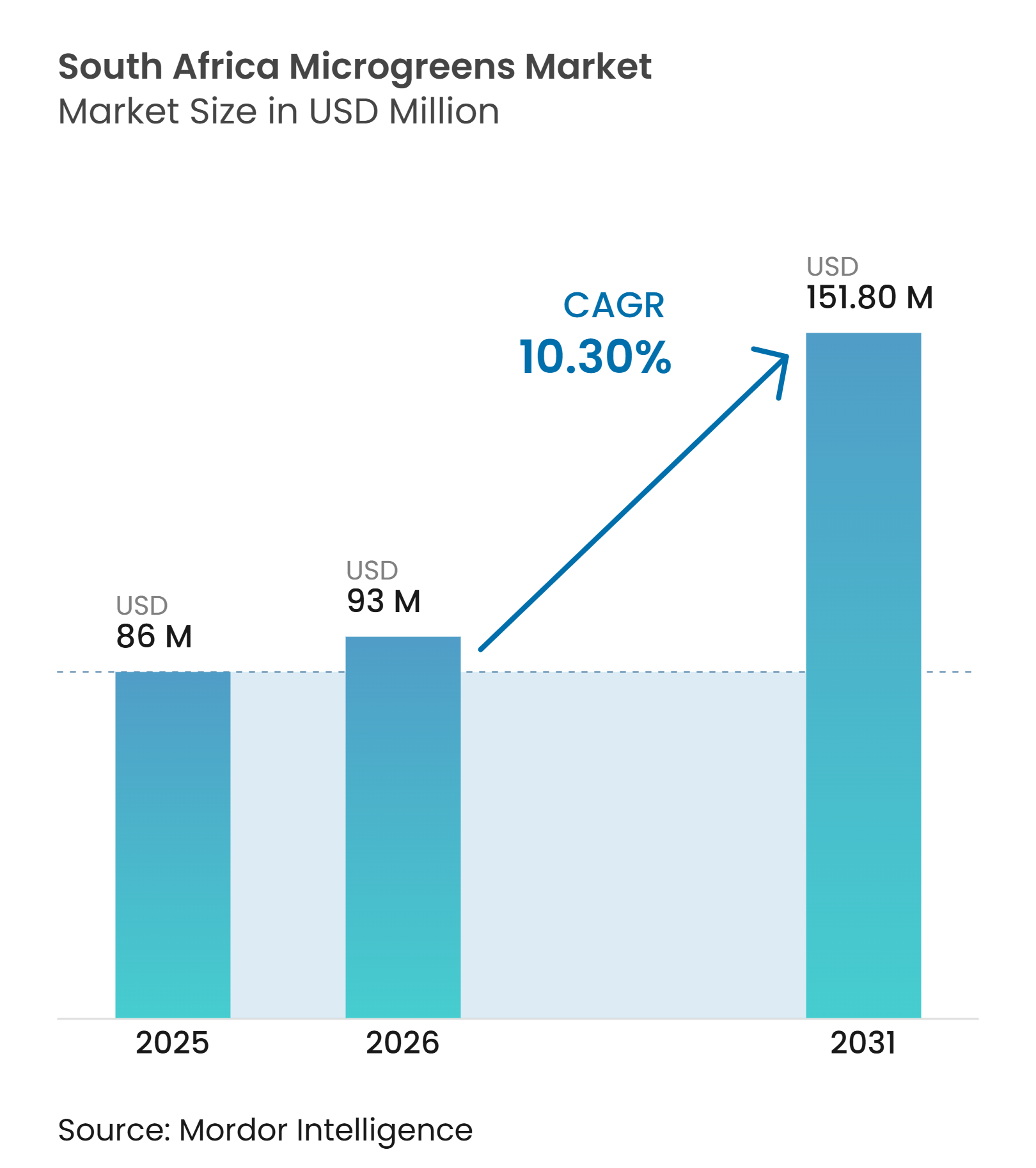
| Base Year Market Size (2025) | USD 86 Million |
| Market Size (2026) | USD 93 Million |
| Market Size (2031) | USD 151.80 Million |
| Growth Rate (2026 - 2031) | 10.30 % |
| Market Concentration | Low |
Major Players *Disclaimer: Major Players sorted in no particular order Image © Mordor Intelligence. Reuse requires attribution under CC BY 4.0. | |
South Africa Microgreens Market Analysis by Mordor Intelligence
The South Africa microgreens market size was valued at USD 86 million in 2025 and is estimated to grow from USD 93 million in 2026 to reach USD 151.8 million by 2031, at a CAGR of 10.3% during the forecast period (2026-2031). Demand is supported by urban consumers seeking nutrient-dense, minimally processed foods and by restaurants using specialty greens for flavor, texture, and presentation. Indoor production enables growers to supply fresh produce throughout the year, while hydroponic systems can reduce water demand compared with conventional field production. Retail listings and direct delivery models are widening access beyond specialist buyers, although each route requires reliable handling and clear product standards. Power interruptions, cooling requirements, and the premium cost of controlled-environment production remain key operating constraints. The market, therefore, favors growers that can deliver consistent quality close to the point of consumption.
Key Report Takeaways
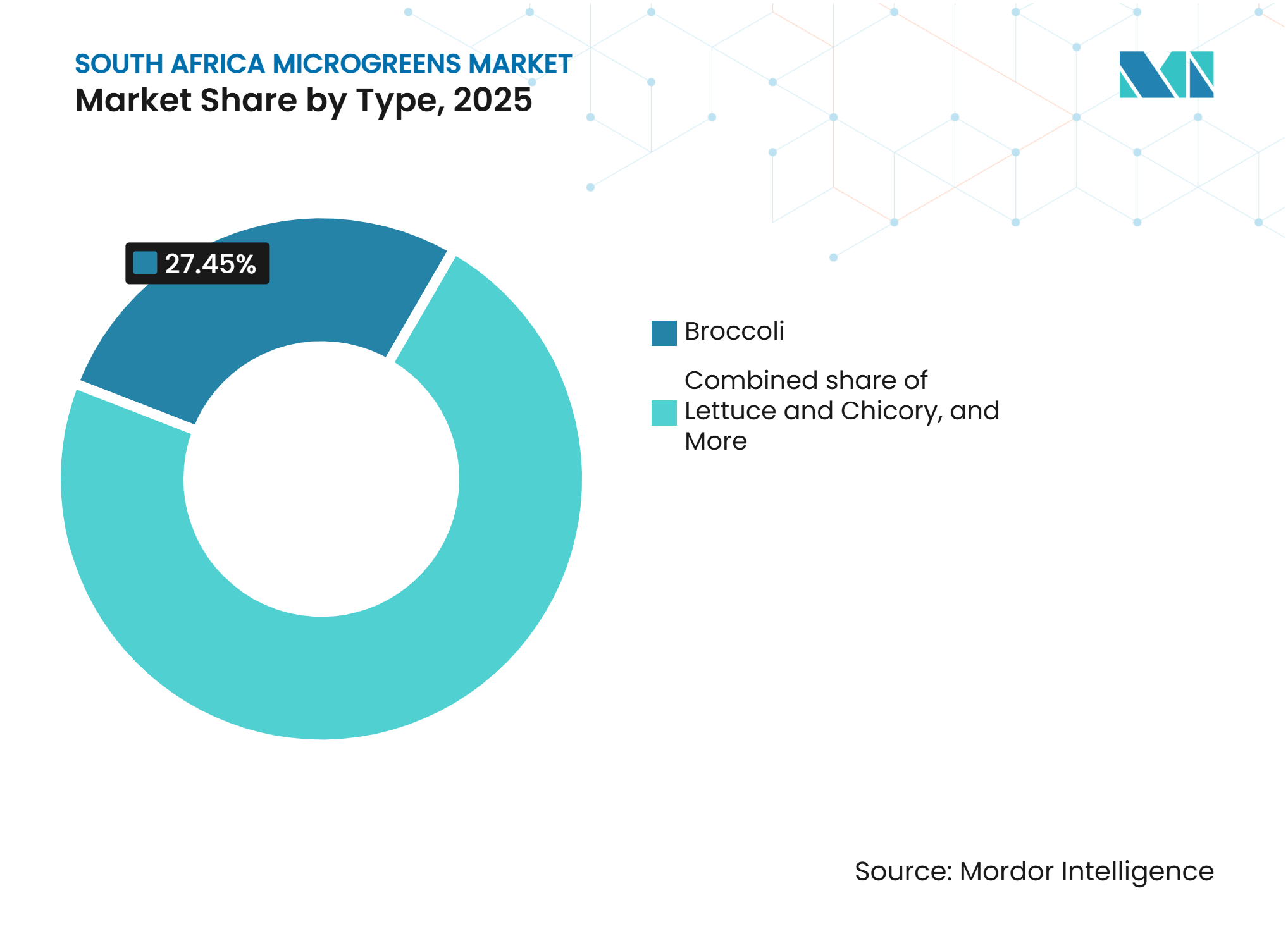
- By Type, Broccoli accounted for a 27.45% share of the South Africa microgreens market in 2025, while Basil is forecast to grow at a CAGR of 12.80% from 2026 to 2031.
- By Farming Method, Commercial Greenhouses accounted for a 44% share of the South Africa microgreens market in 2025, while Vertical Farming is forecast to grow at a CAGR of 13.70% from 2026 to 2031.
- By Growth Medium, Coconut Coir accounted for a 36% share of the market in 2025 and is forecast to be the fastest-growing segment, with a CAGR of 14.20% from 2026 to 2031.
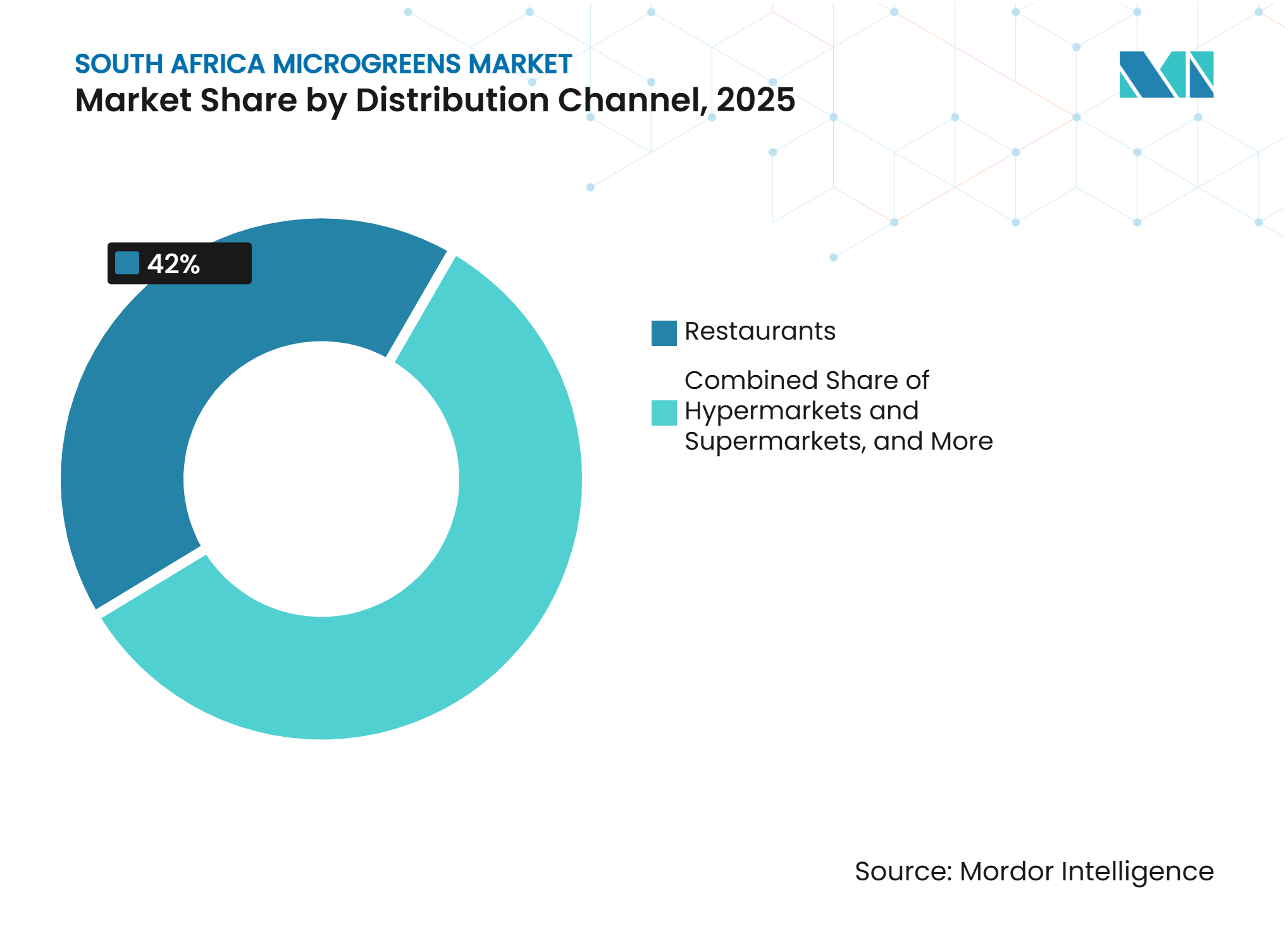
- By Distribution Channel, Restaurants accounted for a 42% share of the market in 2025 and are forecast to grow at a CAGR of 12.80% from 2026 to 2031.
Note: Market size and forecast figures in this report are generated using Mordor Intelligence’s proprietary estimation framework, updated with the latest available data and insights as of January 2026.
Market Trends and Insights
Drivers Impact Analysis of South Africa Microgreens Market*
| Driver | (~) % Impact on CAGR Forecast | Geographic Relevance | Impact Timeline |
|---|---|---|---|
| Rising health-conscious consumption | +2.0% | Gauteng, Western Cape, KwaZulu-Natal | Medium term (2-4 years) |
| Restaurant and chef adoption | +1.8% | Western Cape, Gauteng | Short term (≤ 2 years) |
| Expansion of indoor and vertical farming | +1.9% | Gauteng, Western Cape, KwaZulu-Natal | Medium term (2-4 years) |
| Retail and direct-to-consumer availability | +1.4% | Gauteng, Western Cape | Short term (≤ 2 years) |
| Load-shedding resilience through distributed production | +0.9% | All provinces, especially Gauteng and Western Cape | Medium term (2-4 years) |
| Water-efficient production in water-stressed provinces | +0.8% | Western Cape, Eastern Cape, Limpopo, KwaZulu-Natal | Long term (≥ 4 years) |
| Source: Mordor Intelligence | |||
Rising Health-Conscious Consumption
Urban consumers in Gauteng, the Western Cape, and KwaZulu-Natal are directing more grocery spending toward nutrient-dense and minimally processed foods. Microgreens align with this preference, as selected vitamins, minerals, and phytonutrients can be more concentrated in microgreens than in mature vegetables. This nutritional positioning supports product education through retail displays and direct ordering channels. Tiny Harvest in Johannesburg and MicroRoots in Centurion use grow-to-order and subscription formats that cater to this preference. Regular deliveries can reduce uncertainty for growers and help customers receive produce soon after harvest. However, premium pricing will remain difficult to sustain if claims are broad or unsupported, making clear product information and dependable quality essential for producers.
Restaurant and Chef Adoption
Restaurants are increasingly using microgreens as ingredients rather than solely as decorative garnishes. This demand is most visible in Cape Town and Johannesburg, where premium restaurants show strong interest in local and distinctive produce. FYN Restaurant in Cape Town was ranked 82nd on the World's 50 Best Restaurants list for 2025, reflecting the city's international profile in fine dining. Arable Grow documents partnerships with chefs at Western Cape wine estates, where its products are used in tasting-menu dishes.[1] Chef relationships can generate recurring orders and provide growers with direct feedback on variety, taste, and delivery requirements. Broader consumer interest may follow as restaurant menus introduce customers to unfamiliar microgreen varieties.
Expansion of Indoor and Vertical Farming
Controlled-environment production allows growers to operate outside conventional seasonal cycles. Microgreens generally have short crop cycles, making them suitable for frequent harvesting when lighting, temperature, and water conditions are stable. MicroThumbs operates 42 indoor farms across South Africa, demonstrating that a distributed production approach is already in use within the country. Water Research Commission work in Gauteng found that active recovery hydroponic systems can support vegetable production while lowering irrigation demand relative to less controlled methods.[2]Smaller production sites can shorten delivery routes and reduce the impact of disruption at a single facility. The South Africa microgreens market stands to benefit where growers combine this model with dependable energy and distribution planning.
Retail and Direct-to-Consumer Availability
Formal retailers are expanding premium fresh-produce offerings, creating a route to larger customer groups. Arable Grow supplies SPAR stores in the Western Cape through the retailer’s Supplier Development Programme and has received guidance toward Good Agricultural Practice certification. This model links product quality, documented processes, and predictable supply. Direct-to-consumer ordering remains useful for smaller producers, as it allows them to manage harvesting and delivery around customer demand. Subscription packs and messaging-based ordering can also keep delivery distances short. Retail and direct sales serve different customer needs and can therefore support the South Africa microgreens market simultaneously.
Restraints Impact Analysis of South Africa Microgreens Market*
| Restraint | (~) % Impact on CAGR Forecast | Geographic Relevance | Impact Timeline |
|---|---|---|---|
| Short shelf life and freshness-sensitive logistics | -1.4% | Gauteng, Western Cape, KwaZulu-Natal | Short term (≤ 2 years) |
| High controlled-environment production costs | -1.2% | All provinces with unreliable power or high logistics costs | Medium term (2-4 years) |
| Electricity reliability and backup-power expense | -0.9% | All provinces | Short term (≤ 2 years) |
| Limited standardization of small-farm food-safety claims | -0.7% | All provinces, strongest relevance for formal retail and hospitality | Medium term (2-4 years) |
| Source: Mordor Intelligence | |||
Short Shelf Life and Freshness-Sensitive Logistics
Microgreens require prompt handling after harvest, as their quality deteriorates quickly without adequate cooling. Soil-grown products typically have a short selling window, placing pressure on growers, delivery partners, and retail buyers. Power interruptions can worsen losses by disrupting cold storage and transport. Operating within a 30-kilometer delivery radius allows local operators to fulfill same-day or next-day orders. Controlled indoor production and careful packaging can extend the usable selling period for some products. However, growers without nearby customers or reliable refrigeration have limited capacity to serve distant areas of the South Africa microgreens market.
High Controlled-Environment Production Costs
Indoor production requires expenditure on lighting, temperature control, growing media, labor, packaging, and backup power, keeping microgreens more expensive than conventional salad greens. Urban Plantation indicated that its Farm in a Crate system required ZAR 50,000 (USD 2,703) to set up in 2025, with a 2.5-year recovery period per unit. Stable retail contracts make these investments more viable, while irregular spot sales increase financial risk. Energy costs add further pressure, as climate-controlled systems depend on a consistent electricity supply. Operators that have not invested in energy efficiency or onsite power generation may face a widening cost gap.
*Our forecasts treat driver/restraint impacts as directional, not additive. The impact forecasts reflect baseline growth, mix effects, and variable interactions.
South Africa Microgreens Market Segment Analysis
By Type:
Broccoli Leads the Market, While Basil Shows Strong GrowthBroccoli accounted for a 27.45% share of the South Africa microgreens market in 2025, making it the largest type. Its leading position reflects its nutritional profile and broad acceptance among restaurants and health-focused consumers. Broccoli contains glucosinolates, vitamins, and antioxidants, supporting its appeal in health-oriented food applications. Arable Grow lists broccoli among its microgreen products. Lettuce and chicory, arugula, peas, radish, basil, fennel, carrots, and sunflowers serve distinct flavor and presentation requirements. Arugula is valued for its peppery flavor, while pea shoots have gained use in home-delivery packs. Radish offers fast germination and visual color, and basil is valued for both aroma and flavor. MicroThumbs cultivates 32 varieties, indicating that broader product portfolios are already commercially relevant.
Basil is forecast to grow at a CAGR of 12.80% from 2026 to 2031, supported by demand from foodservice customers seeking aromatic ingredients with visual appeal. Tiny Harvest and Sprout About offer mixed packs that include herb varieties. The availability of diversified product offerings can broaden demand beyond established varieties such as broccoli and radish. Basil production can require closer control of growing conditions, which may favor growers with experience in controlled-environment cultivation. Consistent quality can also support premium positioning among foodservice and retail customers. Overall, product diversification provides opportunities for market growth, provided growers align their offerings with demand from restaurants, retailers, and direct-delivery customers.



By Farming Method:
Greenhouse Production Retains Scale While Vertical Farming GrowsCommercial Greenhouses accounted for a 44% share of the South Africa microgreens market in 2025, making them the largest farming method. Their leading position reflects their ability to use natural light alongside climate control and supply larger volumes. Vertical Farming is forecast to grow at a CAGR of 13.70% from 2026 to 2031, supported by multi-tier racks, LED lighting, and controlled production in limited urban spaces. Indoor Farming provides another controlled production approach, including single-level growing rooms and container farms, while vertical farming uses stacked growing systems to maximize production per unit of space.
Arable Grow’s container model illustrates how indoor sites can operate close to retail outlets in the Western Cape. Short delivery routes and reliable year-round availability support the adoption of indoor production. Open-field and tunnel production remains relevant in areas with favorable conditions and lower climate-control costs, though these methods have a smaller role where year-round consistency is important. The Water Research Commission recorded consistent production results from active recovery hydroponic systems across 4 years in Gauteng. Solar integration can improve the operating case for modular facilities. The most suitable farming method depends on customer volume, local climate, power conditions, and delivery distance.
By Growth Medium:
Coconut Coir Leads the Market and Grows FastestCoconut Coir accounted for a 36% share of the South Africa microgreens market in 2025, making it the largest growth medium, and is forecast to be the fastest-growing segment, with a CAGR of 14.20% from 2026 to 2031. Its ability to retain moisture while providing a clean, soil-free growing environment supports its use among commercial growers. As a byproduct of coconut processing, coconut coir can also appeal to growers seeking alternatives that support material reuse and waste reduction. Soil remains accessible for entry-level and smallholder producers because it requires less initial spending and fewer specialized nutrient-management skills. However, professional growers are increasingly considering soilless alternatives to improve production consistency and hygiene control.
Peat Moss supports germination but faces sustainability concerns as supply chains place greater attention on peat conservation. Tissue Paper can be used for delicate, short-cycle crops where a clean growing surface is required. Soilless systems can support year-round output with greater control over growing conditions, although their adoption depends on reliable water, nutrient, and energy supplies and trained operators. DALRRD requirements on food business registration and traceability reinforce the value of documented growing practices. Vertifarm in Cape Town and MicroRoots in Centurion operate soil-free indoor systems. Material selection depends on crop type, cost, hygiene requirements, and buyer preferences.
By Distribution Channel:
Restaurants Lead the Market and Grow FastestRestaurants accounted for a 42% share of the South Africa microgreens market in 2025, making them the largest distribution channel. Their leading position reflects recurring demand from foodservice operators, particularly restaurants seeking specialty varieties for flavor, presentation, and menu differentiation. Restaurants remain important in major urban markets such as Cape Town and Johannesburg, where regular deliveries can support fresh microgreens supply. Pico-Gro® operates a 7-hectare site in Midrand and employs 110 people, demonstrating the scale of production required to serve larger foodservice accounts.[3] Hypermarkets and supermarkets provide producers with access to a broader consumer base and can support market expansion beyond direct local deliveries. Arable Grow’s supply arrangement with SPAR in the Western Cape illustrates how an indoor producer can access formal retail shelves.
Retail distribution requires dependable product quality, suitable pack formats, delivery schedules, and compliance with buyer requirements. Direct deliveries and other channels can provide growers with closer customer relationships and greater control over product freshness. However, expanding into formal retail can increase handling, packaging, and logistics requirements. Restaurant supply may offer attractive margins but requires responsive ordering and consistent availability of preferred varieties. The choice of distribution channel depends on customer volume, delivery distance, packaging requirements, and the producer’s ability to maintain freshness across the supply chain.

Geography Analysis
Western Cape and Gauteng represented the largest share of the South Africa microgreens market in 2025. Both provinces have concentrations of premium restaurants, health-focused retailers, and urban households able to purchase specialty produce. Cape Town’s fine-dining base supports demand for fresh, locally produced varieties. FYN Restaurant’s 2025 global recognition illustrates this foodservice profile. Producers in the Western Cape include Vertifarm, Cape Microgreens, The Backyard Farmer, and Arable Grow. Johannesburg and the wider Gauteng area provide larger wholesale and retail volumes. Pico-Gro®, Tiny Harvest, Sprout About, and MicroThumbs are among the businesses serving this cluster.
Cape Town is particularly suited to proximity-based production because water scarcity, urban density, and limited agricultural land can constrain conventional supply. University of Cape Town-linked research in 2026 found that hydroponic approaches were relevant to these urban conditions. Johannesburg supports a broader mix of wholesale, retail, and direct delivery demand. KwaZulu-Natal is the third-largest provincial market, supported by Durban's restaurants and health-food retail. Local indoor production can help address the province's humidity-related cold-chain challenges. Islamic Relief South Africa and Green New World installed hydroponic greenhouse tunnels at Nxumalo Agricultural High School in Ulundi in July 2026. The project adds training capacity for controlled-environment production in the province.
Eastern Cape, Mpumalanga, Northern Cape, and parts of Limpopo remain less developed locations for premium perishable produce. Their urban foodservice base and distribution density are thinner than those of Gauteng and the Western Cape. The South Africa microgreens market size can still gain support from climate-adaptive farming projects as local infrastructure improves. The Limpopo Department of Agriculture and Rural Development supported an aquaponics and hydroponics facility in Bochum under Molemole Local Municipality. Water Research Commission projects in Giyani also examined hydroponic systems as a response to water scarcity and food security. These projects can build production capability before demand fully develops in secondary cities. Growth will depend on local buyers, refrigerated transport, and commercially viable operating costs.
Competitive Landscape
Market Concentration
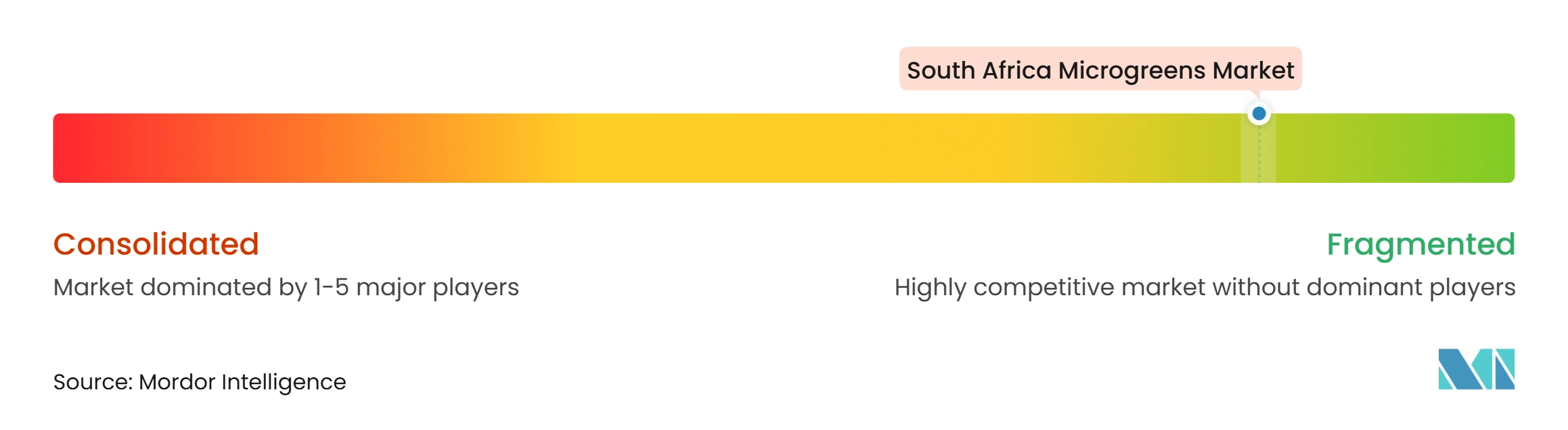
The South Africa microgreens market is fragmented, with several local producers competing across major urban markets. Arable Grow, Pico-Gro®, The Local Farmer, Metro Greens ZA, Tiny Harvest, MicroThumbs, and MicroRoots are among the companies active in the market. No company has disclosed audited South Africa-specific microgreens revenue. Short product life and proximity-based production limit direct competition across distant cities. This structure allows producers in Cape Town, Johannesburg, and Durban to focus on their local catchments, while also leaving each city open to new entrants that can meet local customer expectations.
Arable Grow has pursued a retail relationship with SPAR and has received support toward Good Agricultural Practice compliance. Pico-Gro® and MicroThumbs have built broad product portfolios, with MicroThumbs cultivating 32 varieties through its national farm network. MicroRoots and Tiny Harvest use subscriptions and grow-to-order sales to maintain proximity to household customers. These strategies respond to the practical requirements of freshness, product choice, and predictable demand. Retail readiness can become a meaningful distinction between businesses that can supply formal chains and those that remain local or informal. Documentation, traceability, and consistent supply will matter as much as product variety.
Global indoor farming developments highlight the risks of high fixed costs, even for established technology businesses. AeroFarms expanded its Micro Broccoli offering in 2026, illustrating continued product development in controlled-environment greens. International examples do not alter the local competitive structure, which remains shaped by South African power, water, and delivery conditions. Locally capitalized growers can use proven production methods without building large centralized facilities. The South Africa microgreens market favors operational discipline over rapid expansion without firm demand. Businesses that maintain local relationships and control operating costs are better positioned to remain competitive.
South Africa Microgreens Industry Leaders
-
Arable Grow
-
Pico-Gro
-
The Local Farmer
-
Metro Greens ZA
-
Tiny Harvest
- *Disclaimer: Major Players sorted in no particular order
South Africa Microgreens Market Companies Covered in this Report
- Arable Grow
- Pico-Gro
- The Local Farmer
- Tiny Harvest
- MicroRoots
- The Backyard Farmer
- Metro Greens ZA
- Nature’s Green Miracles
- Fresh Origins
- AeroFarms LLC (Dream Holdings, Inc.)
- GoodLeaf Farms (TruLeaf)
- The Chef’s Garden
- 80 Acres Farms
- Teshuva Agricultural Projects
- Farmbox Greens (Charlie’s Produce)
Recent Industry Developments in South Africa Microgreens Market
- August 2026: Arable Grow’s container farms achieved SPAR retail listing in the Western Cape, with SPAR’s Supplier Development Programme providing guidance toward GAP certification and formal-grocery compliance. The partnership establishes a model for small-scale indoor producers to access mass-retail channels while maintaining proximity-production freshness advantages.
- July 2026: Islamic Relief SA and Green New World installed hydroponic greenhouse tunnels at Nxumalo Agricultural High School in Ulundi, KwaZulu-Natal, expanding controlled-environment food production into a secondary province and providing training infrastructure for future commercial growers.
- March 2025: AB Farms won first prize at the Global Cleantech Innovation Programme South Africa Awards for a hydroponic system achieving up to 90% water savings, 50% electricity reduction, and 40% fertilizer reduction relative to conventional farming, gaining national recognition for grid-independent agricultural production.
South Africa Microgreens Market Report Scope
Microgreens are young, edible vegetable and herb seedlings harvested between the cotyledon and first true-leaf stages. They are cultivated in controlled and conventional growing systems and are primarily used as fresh ingredients for their flavor, visual appeal, and nutritional value.
The South Africa Microgreens Market Report is Segmented by Type (Broccoli, Lettuce and Chicory, Arugula, Basil, Fennel, Carrots, Sunflower, Radish, Peas, and Other Types), by Farming Method (Indoor Farming, Vertical Farming, Commercial Greenhouses, and Other Farming Methods), by Growth Medium (Peat Moss, Soil, Coconut Coir, Tissue Paper, and Other Growth Media), by Distribution Channel (Hypermarkets and Supermarkets, Restaurants, and Other Channels). The Market Forecasts are Provided in Terms of Value (USD).
Segmentation Overview
| Broccoli |
| Lettuce and Chicory |
| Arugula |
| Basil |
| Fennel |
| Carrots |
| Sunflower |
| Radish |
| Peas |
| Other Types |
| Indoor Farming |
| Vertical Farming |
| Commercial Greenhouses |
| Other Farming Methods |
| Peat Moss |
| Soil |
| Coconut Coir |
| Tissue Paper |
| Other Growth Media |
| Hypermarkets and Supermarkets |
| Restaurants |
| Other Channels |
| By Type | Broccoli |
| Lettuce and Chicory | |
| Arugula | |
| Basil | |
| Fennel | |
| Carrots | |
| Sunflower | |
| Radish | |
| Peas | |
| Other Types | |
| By Farming Method | Indoor Farming |
| Vertical Farming | |
| Commercial Greenhouses | |
| Other Farming Methods | |
| By Growth Medium | Peat Moss |
| Soil | |
| Coconut Coir | |
| Tissue Paper | |
| Other Growth Media | |
| By Distribution Channel | Hypermarkets and Supermarkets |
| Restaurants | |
| Other Channels |
Key Questions Answered in the Report
What is the current size of the South Africa microgreens market?
The South Africa microgreens market was valued at USD 86.0 million in 2025 and is estimated at USD 93.0 million in 2026. The market is forecast to reach USD 151.8 million by 2031, growing at a CAGR of 10.30% from 2026 to 2031.
Which farming method leads microgreens production in South Africa?
Commercial greenhouses held 44% share in 2025. Vertical Farming is forecast to grow at a CAGR of 13.70% from 2026 to 2031.
What is driving demand for microgreens in South Africa?
Urban health-focused purchasing, restaurant demand, retail availability, indoor farming, water efficiency, and supply resilience during power interruptions are the main factors.
Which provinces have the strongest demand for microgreens?
Western Cape and Gauteng are the largest provincial areas in the source draft. KwaZulu-Natal is the third-largest area and has growing controlled-environment activity.
Why is hydroponic production relevant to microgreens growers?
Hydroponic systems can support year-round output and conserve water. They are especially relevant to water-constrained urban areas and growers that need predictable production.